Navigating Medicaid Coverage for Power Wheelchairs Across States
Medicaid mobility device coverage by state can differ greatly, as each state administers its own rules. Understanding those differences is the first step toward getting your equipment. One universal requirement is medical necessity — your physician must document that a power wheelchair is crucial for your safety and daily function.
You’ll also likely need the Medicaid prior authorization for power wheelchairs process, which can be detailed and overwhelming. Our team at MedEquipped helps patients in New York, Georgia, and Michigan navigate this process, including assistance with Medicaid prior authorization for power wheelchairs, and it can take 30 to 60 days depending on the state. Federal rules set the floor, but each state decides how to run its program. We handle the paperwork and provider coordination, so you can focus on your mobility goals.
In the next section, we break down the authorization steps one by one, making it easier to follow.
Comparing Medicaid Mobility Device Coverage in New York, Georgia, and Michigan
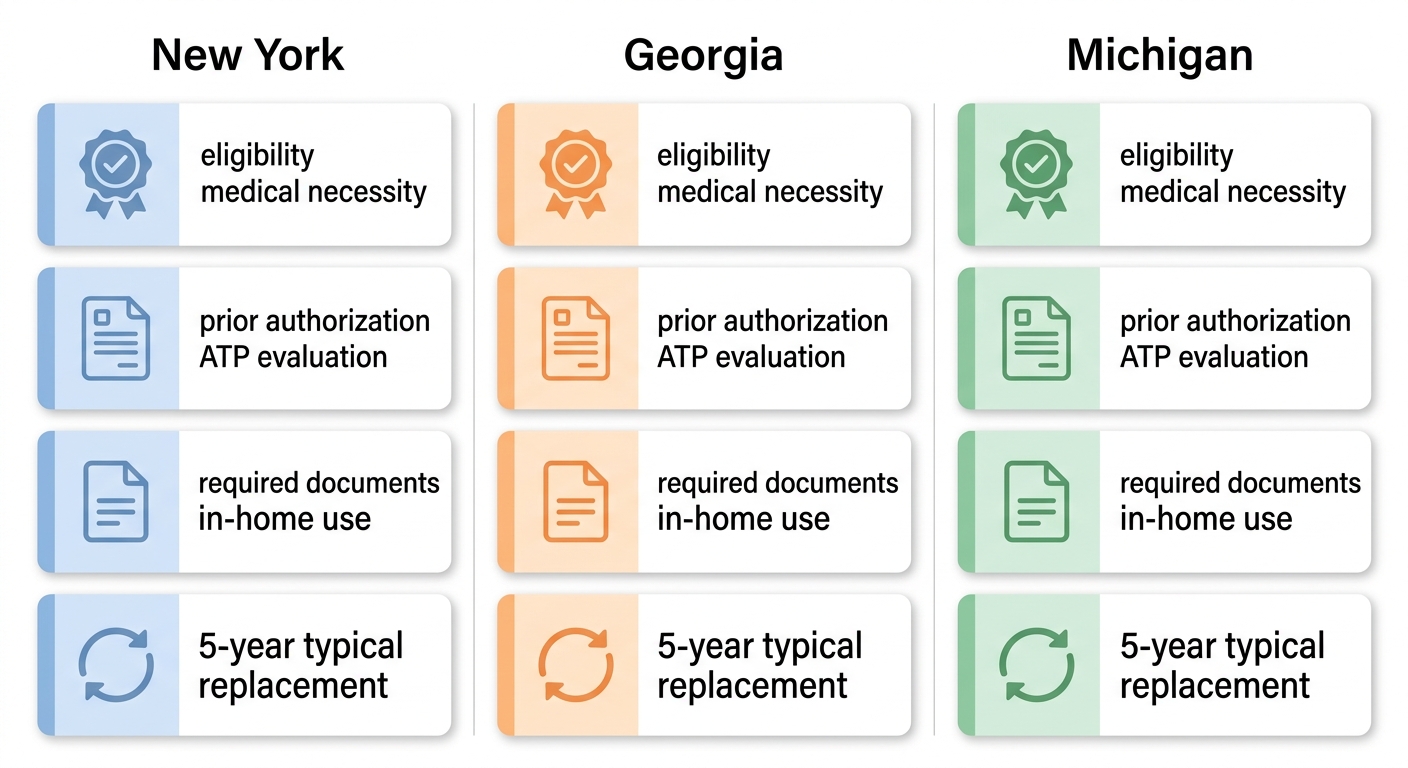
When comparing medicaid mobility device coverage by state, the rules for qualifying for a power wheelchair can look very different. For official details, see medicaid motorized wheelchair coverage in New York. The table below summarizes key criteria side by side.
Medicaid Power Wheelchair Coverage Comparison by State
Feature
New York
Georgia
Michigan
Eligibility Criteria
Medical necessity determined by physician and ATP evaluation; specific functional limitations required
Must meet in-home mobility need and be unable to operate a manual wheelchair; physician prescription required
Requires prior authorization and documentation of severe mobility impairment; home use demonstration
Prior Authorization
Required; typically handled by provider with clinical justification
Required; provider submits DME prior authorization form
Required; must include detailed evaluation and letter of medical necessity
Script from treating physician, face-to-face visit note, functional assessment
Prescription, clinical summary, home assessment, ATP report
Replacement Frequency
Every 5 years unless change in condition warrants earlier replacement
Every 5 years; re-evaluation required for medical necessity
Every 5 years; earlier replacement possible with documented need
Understanding these requirements helps, but each state also requires medicaid prior authorization for power wheelchairs, and documenting the medical necessity for custom power wheelchairs is critical for approval.
Medicaid power wheelchair coverage comparison across three states
Every state program is unique, but we can help simplify the process. As your partner in mobility freedom, we handle the paperwork, insurance navigation, and coordination so you can focus on what matters most.
Partnering with MedEquipped for Medicaid Power Wheelchair Services
While understanding the process is valuable, partnering with MedEquipped makes it effortless. Medicaid mobility device coverage by state varies, which is why MedEquipped simplifies the entire process for clinicians and case managers. We are your partner in mobility freedom for Medicaid patients—handling every step from eligibility to delivery.
When you partner with MedEquipped, we take on the full administrative weight. We handle the paperwork, insurance navigation, and coordination, managing medicaid prior authorization for power wheelchairs and ensuring all documentation meets state-specific requirements. Our certified ATP evaluators thoroughly document medical necessity for custom power wheelchairs, giving every application the strongest clinical foundation possible.
We serve providers across New York, Georgia, and Michigan. In Georgia, we help you navigate Medicaid wheelchair eligibility requirements in Georgia so your patients can qualify quickly. The typical processing timeline is 30–60 days, significantly faster than many other pathways. By partnering with us, you reduce your team’s administrative burden and free up time for direct patient care. We monitor each state’s Medicaid policy changes so you don’t have to. From initial evaluation to final delivery, our team coordinates every detail, including custom motorized wheelchairs built to exact clinical specifications.
We are your partner in mobility freedom. Contact us to discuss how we can support your patients’ Medicaid wheelchair needs. Once you partner with us, the next step is a streamlined ordering process tailored to each patient. Results may vary; individual outcomes are not guaranteed.
Local Considerations for Medicaid Power Wheelchair Approvals
While the general Medicaid approval process has common steps, local considerations can dramatically affect timelines and requirements. Medicaid mobility device coverage by state can vary significantly, affecting how approvals are handled locally.
Medicaid prior authorization for power wheelchairs requires different documentation: in New York, providers may need detailed functional assessments, while in Georgia, home environment verification is key. In Michigan, prior authorization turnaround times are often shorter, but medical necessity for custom power wheelchairs must be clearly established through a thorough clinical evaluation, and supporting documentation from treating clinicians is typically also required.
Our professional wheelchair fitting services are designed to meet each state’s evaluation requirements, ensuring your documentation includes the necessary clinical measurements and functional assessments.
As your partner in mobility freedom, we track each state’s changing requirements. Results may vary; individual outcomes are not guaranteed. Understanding these local factors is the first step; next, we’ll outline how professional wheelchair fitting services directly address these documentation needs.
Getting Started with Your Medicaid Power Wheelchair Application
Applying for a power wheelchair through Medicaid can feel overwhelming, but you don’t have to navigate it alone. Understanding medicaid mobility device coverage by state is the first step, and our team is here to simplify every stage of the process.
The journey begins with a clinical evaluation led by a certified Assistive Technology Professional (ATP). During the evaluation, our wheelchair fitting services ensure the chair is customized to your exact needs, from seating to controls. Next, you’ll need a physician’s prescription, relevant medical records, and documentation that establishes medical necessity for custom power wheelchairs—showing why a standard wheelchair won’t meet your mobility limitations.
Medicaid requires medicaid prior authorization for power wheelchairs, and coverage rules vary by state. We stay current with the requirements in New York, in Georgia, and in Michigan, and we handle all the paperwork and coordination so you don’t have to. The typical approval and delivery timeline runs 30–60 days—much faster than many patients expect.
We’re ready to help. Contact MedEquipped to start your application, and we’ll guide you through every detail.
Information is not medical advice; consult a healthcare professional. Results may vary.
Your Path to a Custom Power Wheelchair with Medicaid
Understanding medicaid mobility device coverage by state is the first step, but we’re here to handle the rest. We manage everything from your clinical evaluation and medical necessity for custom power wheelchairs documentation to medicaid prior authorization for power wheelchairs and final delivery, typically within 30-60 days. We serve New York, Georgia, and Michigan with certified ATP evaluators, building your custom chair from trusted brands. Whether you need a custom power wheelchair or a stair chair lift, we can help. As your partner in mobility freedom, next we’ll detail the clinical evaluation and required documentation.
Results may vary; individual outcomes are not guaranteed. Consult a healthcare professional before making clinical decisions. This information is not medical advice and is for informational purposes only.
Your Rights Under the Consumer Wheelchair Repair Bill of Rights in New York
The consumer wheelchair repair bill of rights ny establishes clear protections for wheelchair users across New York State. According to the New York State Government, this act ensures you are not left without mobility when your equipment needs service. It mandates that manufacturers and repairers must provide timely service, a replacement wheelchair, or a full refund if they cannot fix your chair after a reasonable number of attempts.
Under the Consumer Wheelchair Repair Bill of Rights Act, your rights include prompt repairs and the option to receive a substitute chair while yours is being fixed. The New York Wheelchair Lemon Law works alongside these protections, offering additional safeguards for newly purchased wheelchairs that have recurring defects. Together, these regulations empower you to hold providers accountable for maintaining your independence.
Understanding the consumer wheelchair repair bill of rights ny gives you the power to demand proper service. If a manufacturer or service provider fails to meet these obligations, you can take action. Filing a complaint with the New York State Attorney General is a direct avenue to seek resolution. We recommend keeping detailed records of service visits and communications to support your case.
At MedEquipped, we guide you through the repair process, from understanding your rights to coordinating with insurance. As your partner in mobility freedom, we handle the paperwork, insurance navigation, and coordination so you can focus on staying mobile. Our team works directly with your wheelchair insurance provider to expedite approvals and repairs.
Please note: Results may vary; individual outcomes are not guaranteed. Information is not medical advice and is for informational purposes only.
What Is the Consumer Wheelchair Repair Bill of Rights and Who Is Covered?
The Consumer Wheelchair Repair Bill of Rights NY (also referred to as the New York Wheelchair Lemon Law) represents a major step forward for mobility users across the state. We’ve heard from countless individuals who faced lengthy waits for essential repairs, leaving them stranded without independence—and this legislation changes that. Officially titled the Consumer Wheelchair Repair Bill of Rights Act, the law ensures that manufacturers must supply repair parts and diagnostic tools not only to their own authorized providers but also to consumers and independent repair shops. It also sets a clear maximum repair time of 10 days for covered repairs, so you’re no longer left guessing when your chair will be functional again.
This protection applies to New York residents who own or lease a wheelchair, whether a manual chair or a complex power mobility device. The law covers repairs performed by the provider you choose—that includes independent shops, not just the original manufacturer’s network. Now, when a critical part fails, the manufacturer cannot refuse to sell it to you or your chosen repair shop. This shift puts control and peace of mind back in your hands. Many users fund their equipment through insurance programs, and the same repair rights apply regardless of payer. For example, if you’re one of the many people who rely on Power Wheelchair Medicare funding, you are fully covered by the Bill of Rights. According to New York State’s official summary, the law mandates that manufacturers provide access to the parts, tools, and documentation necessary for prompt repair work. MedEquipped’s patient advocacy team can help you understand how these rules apply to your specific situation.
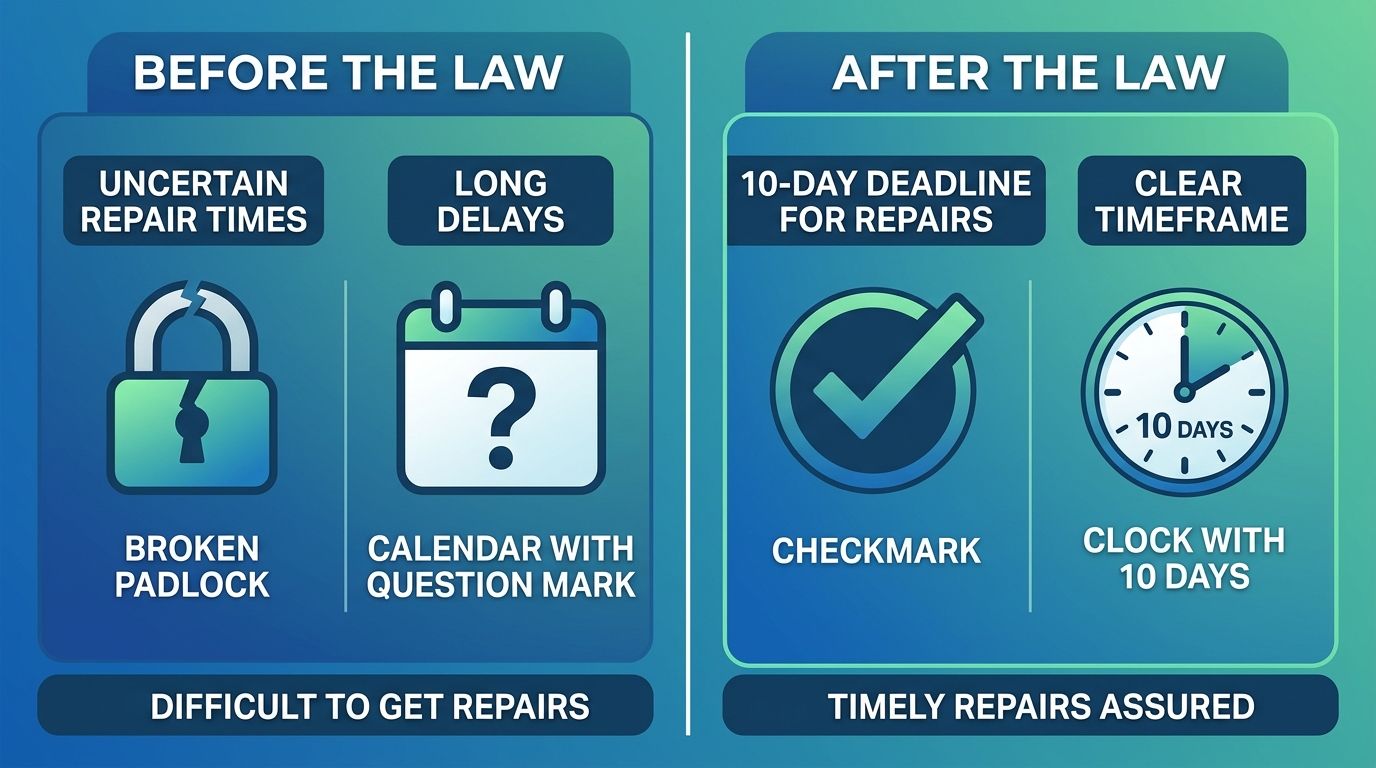
The following table highlights the key changes brought by the Consumer Wheelchair Repair Bill of Rights Act:
Before the Law vs. After the Law: Key Changes for New York Wheelchair Users
Aspect
Before the Law
After the Law
Maximum repair time
No statutory deadline
10-day requirement (for covered repairs)
Manufacturer parts availability
Manufacturers could refuse to sell parts to owners or independent shops
Manufacturers must provide repair parts and diagnostic tools
Documentation requirements
No standard requirement for repair documentation
Written repair estimates and records of completed work
Enforcement
Limited consumer recourse through lawsuits or warranty claims
Civil penalties and potential attorney fees for violations
The most important improvement is the 10-day maximum repair timeline. Before the law, there was no statutory deadline for repairs, and consumers had few options if a repair dragged on for weeks or even months. Now, with a firm 10-day window for covered repairs, you have the power to hold manufacturers accountable and get back to your daily life quickly.
Take a look at this quick visual summary of what the law changes.
New York wheelchair repair law before-and-after comparison infographic.
We’ll break down exactly how that 10-day clock works in our next section, so you know what to expect from start to finish. As always, remember that the information we share is not medical advice and is for informational purposes only.
Manufacturer Obligations and Repair Timelines Under the New York Law
The New York Consumer Wheelchair Repair Bill of Rights Act (widely known as the consumer wheelchair repair bill of rights ny) requires power wheelchair manufacturers to make timely repairs possible through parts, tools, manuals, and firmware access. This law shifts control toward patients and independent shops, reducing downtime for those who depend on complex mobility equipment.
Manufacturer Requirements for Parts and Documentation
Manufacturers must sell replacement parts to owners and independent repair shops on fair, reasonable terms. They also have to make diagnostic tools and software available to qualified providers, publish or provide comprehensive service manuals, and give authorized providers access to firmware updates. These four obligations—parts, tools, manuals, and firmware—end a system where repairs were often delayed or denied. MedEquipped uses these rights to source official components and technical data directly, speeding up service without relying solely on manufacturer service centers.
The 10-Day Repair Requirement and Enforcement
The consumer wheelchair repair bill of rights ny imposes a 10-day response window: manufacturers must act on repair requests within ten days of being notified. Failure to comply can trigger penalties enforced by the New York State Attorney General. The New York Wheelchair Lemon Law reinforces this timeline by offering consumers a replacement or refund when a chair cannot be fixed after a reasonable number of attempts—typically three tries for the same defect or 30 cumulative days out of service. MedEquipped monitors repair timelines and helps escalate overdue cases to protect our patients’ mobility.
Implications for Independent Repair Providers
Before the Act, independent shops rarely had access to proprietary parts or diagnostic software, forcing patients to return to manufacturers for almost every repair. Now, under the Consumer Wheelchair Repair Bill of Rights Act, qualified independent providers can order parts, use diagnostic tools, and follow service manuals—provided they meet manufacturer-defined qualifications such as RESNA certification or product-specific training. MedEquipped partners with shops that meet these standards, expanding local repair options across New York. This network reduces travel and wait times while maintaining high safety and quality standards.
The following table summarizes how the law balances obligations between manufacturers and independent providers.
Manufacturer vs. Independent Repair: What the Law Requires
Requirement
Manufacturer
Independent Provider
Provision of repair parts
Must sell parts to owners and independent shops
Can order parts if they meet qualifications
Diagnostic tools and software
Must make available on fair terms
Gains access that was previously restricted
Service manuals
Must publish or provide on request
Can use manuals to train technicians
Firmware updates
Must provide access for authorized providers
Can access to perform repairs without voiding warranty
By setting clear rules for both manufacturers and independent shops, the law fosters competition that shortens repair times and lowers costs. Manufacturers can still require reasonable training or certification, but they cannot arbitrarily block access to essential resources. This means patients can choose where to have their chairs serviced, confident that any qualified provider has the same technical capabilities.
MedEquipped helps patients navigate every part of this legal landscape—coordinating repairs, verifying provider qualifications, and holding manufacturers accountable. Contact MedEquipped for personalized mobility solutions tailored to your needs. Information is for informational purposes only and does not constitute legal advice. Consult a qualified attorney for specific legal questions. We’re proud to be your partner in mobility freedom.
Steps to Assert Your Repair Rights: A Practical Guide for New York Wheelchair Users
Now that you understand your rights under the consumer wheelchair repair bill of rights ny and the wheelchair lemon law in New York, you can take steps to ensure your power wheelchair gets the service it needs. The Consumer Wheelchair Repair Bill of Rights Act empowers you to demand timely repairs and choose the right provider.
Documenting Repair Requests and Maintenance History
Keeping thorough records is the backbone of a successful repair experience. Every interaction matters, so start a dedicated repair log. For each contact, jot down:
The date, time, and method of the request (phone, email, portal)
The full name and job title of the representative you spoke with
The model and serial number of your wheelchair, plus any accessories involved
A clear description of the problem, including symptoms and error codes
Photos or short videos of the issue, if possible
We suggest using a simple spreadsheet or a notebook that stays near your chair. This log becomes invaluable if you ever need to demonstrate a pattern of unresolved issues. MedEquipped can help you track insurance-related repair communications, but your personal records are your strongest tool for any future claim. Keep copies of all written communications—from email threads to mailed letters—as well as receipts and invoices. Store them digitally so you can access them on the go. Under the state’s lemon law, a series of unsuccessful repair attempts can open the door to a replacement or refund, and your documentation is the key to making that happen. Also, remember that state law requires repairs to be completed within ten calendar days unless you receive a written extension; your log will document whether this timeline was met.
Working with Manufacturers and Independent Providers
One of the most important changes under the state’s repair bill of rights is that independent repair shops can now legally access the same parts and service information as the original manufacturer. This levels the playing field, so you can weigh which option works best for your needs. Independent shops now have equal access to diagnostic tools and repair manuals. The following table compares key factors to help you decide.
Manufacturer Repair vs. Independent Repair: Pros and Cons for New York Wheelchair Users
Factor
Manufacturer Repair
Independent Repair
Parts availability
Direct access to OEM parts
Now legally guaranteed parts access
Repair time
May have longer wait times due to volume
Often faster, subject to 10-day law
Cost
Potential higher labor rates
Typically lower rates, may be negotiated
Convenience
Often authorized warranty work
May offer mobile service or local drop-off
Manufacturer service can streamline warranty claims, but independent providers may get you back on the move more quickly—by law, all repairs must be completed within ten calendar days unless you receive a written extension. Think about your priorities: if speed and affordability are top concerns, a local independent shop might be the smarter pick, while a manufacturer service center can handle intricate OEM part needs. If you opt for an independent provider, verify that they are familiar with your specific chair model. Many local repair shops also offer mobile service, bringing the repair to your home or workplace. Regardless of which route you choose, keep records of every estimate and service agreement. Also, many manufacturers now offer online portals where you can track repair status and parts orders—take advantage of these tools.
When to Seek Legal Remedies Under the Wheelchair Lemon Law
When a defect persists after three or four repair attempts for the same problem, the New York Wheelchair Lemon Law provides a clear path to relief. By this point, your repair log and saved correspondence become your strongest tools. Hold on to every invoice, receipt, and written communication—including emails and text threads—these documents form the evidence you need to file a claim.
If the manufacturer cannot fix the issue after a reasonable number of tries, you have the right to request arbitration or pursue other legal remedies. To start the process, gather all repair orders, your log, and any written estimates or denials. Contact the New York State attorney general’s office or a local consumer protection agency that handles lemon law claims. They can explain the arbitration process and what documents you will need.
There are time limits for filing a lemon law claim, so don’t delay once you’ve documented a sustained failure. MedEquipped can help you organize your paperwork and coordinate with insurance providers, so you have a clean case file. However, we recommend keeping your own duplicate records as your personal safety net. We’re here to guide and support, not to replace your own documentation.
Results may vary; individual outcomes are not guaranteed.
Struggling with a repair delay? Our next guide walks you through what to do when the clock is ticking.
The Intersection of the Repair Bill of Rights and the New York Wheelchair Lemon Law
The Consumer Wheelchair Repair Bill of Rights NY establishes a 10-day repair requirement for all wheelchairs sold in New York, ensuring that users aren’t left without essential mobility. Meanwhile, the New York Wheelchair Lemon Law provides a safety net when repeated repair attempts fail, entitling owners to a refund, replacement, or compensation. These two protections intersect to create a robust framework that addresses both timely repairs and chronic defects.
According to the New York State Government, the Repair Bill of Rights imposes civil penalties and attorney fees for noncompliance, while the Wheelchair Lemon Law—as explained by MedEquipped’s educational resources—requires mandatory arbitration before a lawsuit can be filed. This dual-layer design means that you can push for a swift repair under the 10-day mandate, and if the problem recurs or the repair is inadequate, you can escalate to demand a refund or replacement through arbitration. The Consumer Wheelchair Repair Bill of Rights NY thus provides immediate enforcement power, while the Lemon Law offers long-term protection against persistent defects. Together, they give you leverage to demand action and, if necessary, seek a full resolution beyond just another repair. We often remind our clients that understanding these overlapping protections can be the difference between prolonged frustration and a swift return to independence.
If you’re dealing with a repair delay or a chronic problem, you don’t have to choose one law over the other—they’re designed to work in tandem, offering both immediate enforcement and long-term recourse. If your wheelchair remains in disrepair or the same issue repeats, you have options under both laws. Our next guide walks you through the practical steps to take when repairs stall or fail—so you know exactly how to assert your rights and get the mobility solution you deserve. Please note that this information is for educational purposes and is not legal advice; consult with an attorney for your individual situation.
Frequently Asked Questions About Wheelchair Repair Rights in New York
Now that you know about the support we offer for maintaining your mobility equipment, you may be curious about the protections available to you here in New York. Understanding your repair rights is an important part of staying mobile, and we are here to help clarify what the law provides.
What is the consumer wheelchair repair bill of rights NY? In New York, this protection entitles you to timely repairs, clear communication from your provider, and a loaner wheelchair when repairs drag on for an extended period. Our team at MedEquipped follows these standards to keep you moving, and we are always ready to address your questions in Spring Valley, NY.
Does the New York Wheelchair Lemon Law cover my power wheelchair? This law typically applies when a power wheelchair fails to conform to its warranty after a reasonable number of repair attempts. If that happens, you may be entitled to a replacement or a refund — something we can help you explore while coordinating with your manufacturer.
What can I do if my repair rights are violated? Under the Consumer Wheelchair Repair Bill of Rights Act, you can file a complaint with the New York Attorney General’s office. Unreasonable delays and failure to disclose repair timelines up front are issues that this office takes seriously.
This information is for informational purposes only and does not constitute legal advice. Consult a qualified attorney for legal guidance. If you have more questions about your rights or need help navigating the repair process, reach out to us at MedEquipped — we are here to support your mobility freedom with personalized guidance.
Partnering in Mobility Freedom: Know Your Repair Rights
In New York, the consumer wheelchair repair bill of rights ny guarantees timely repairs, free loaner chairs, and no-cost warranty work. If repair attempts fail, the New York Wheelchair Lemon Law may provide a replacement or refund.
As your partner in mobility freedom, we handle repair claims, paperwork, and insurer coordination—advocating for your rights. Georgia and Michigan residents: we’ll help with your state’s laws.
Information is for informational purposes only and does not constitute legal advice. Consult a qualified professional for legal guidance.
Next, we’ll help you choose your custom wheelchair.
Collision Avoidance Systems and Power Wheelchair Safety
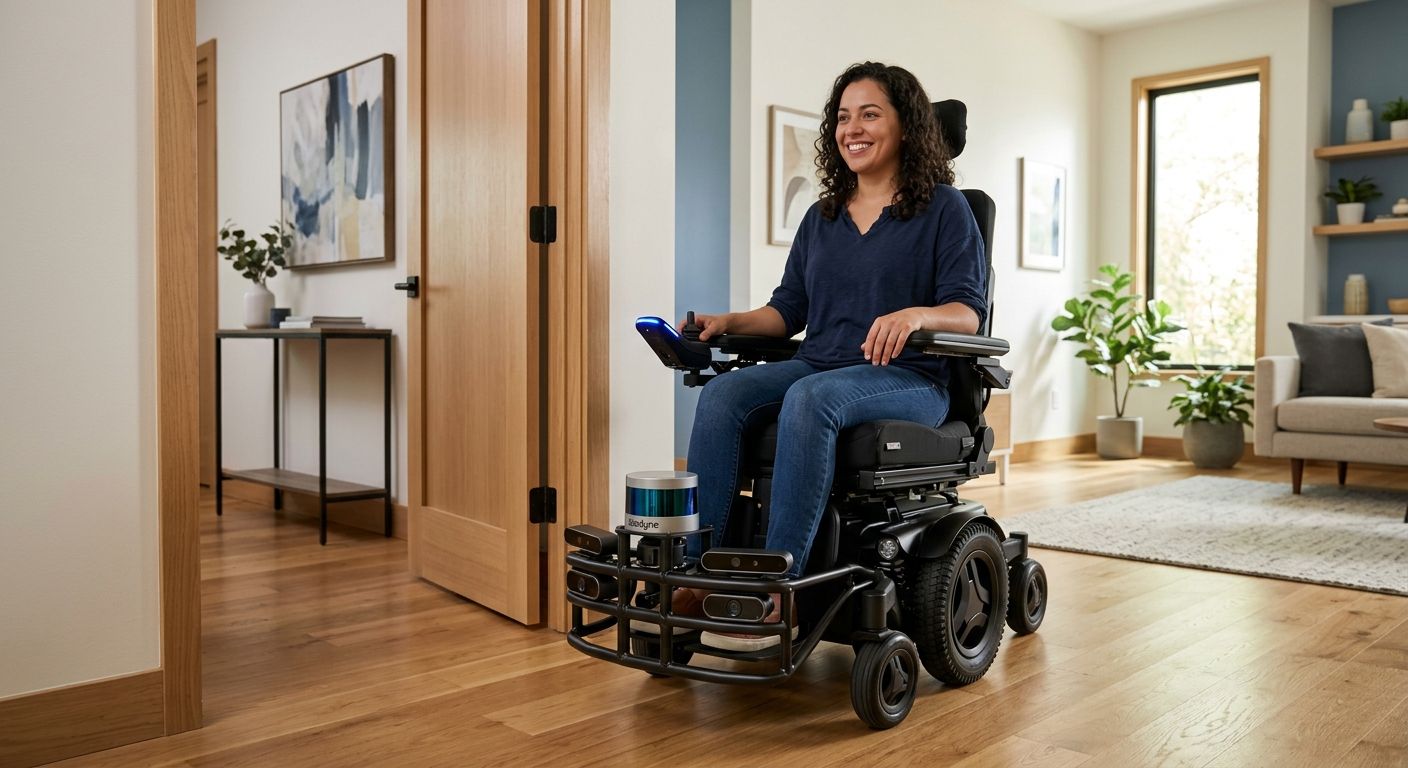
Building on the core safety features that protect power wheelchair users, collision avoidance systems represent a significant leap forward in smart mobility. These sensor-based technologies work continuously to detect obstacles in your path—whether a piece of furniture, a wall, or a person—and can alert you or even automatically apply the brakes to help prevent a collision. By reducing the risk of unexpected bumps and scrapes, collision avoidance technology allows you to move through tight indoor spaces and busy outdoor areas with greater confidence.
At MedEquipped, we understand that navigating your environment shouldn’t be a source of stress. Integrating collision avoidance into your custom chair reduces the cognitive load required to monitor every angle simultaneously, freeing you to focus on going about your day. This same approach aligns with broader smart wheelchair technology, which aims to make power mobility safer, more intuitive, and better adapted to your life.
We offer custom power wheelchairs that can be equipped with these advanced features, and because we handle the paperwork and insurance coordination, understanding your coverage options is straightforward. For example, our team can help you determine whether you qualify for a power wheelchair medicare funding pathway for a chair that includes collision avoidance. Our typical 30-60 day processing window means you spend less time waiting and more time enjoying the independence a thoughtfully configured chair provides. Results vary and this information is for educational purposes; please consult a healthcare professional before making clinical decisions about safety equipment.
How Collision Avoidance Systems Work in Power Wheelchairs
Building on the expanding world of smart wheelchairs, collision avoidance systems are a transformative addition that uses advanced sensor technology to help you navigate more safely and independently. These systems are designed to detect obstacles in your chair’s path and either warn you or take automatic action to prevent a collision, giving you greater confidence as you move through indoor and outdoor environments. This technology doesn’t replace your driving judgment but acts as an extra set of eyes, offering a helpful safety net for users with limited visibility or slower reaction times.
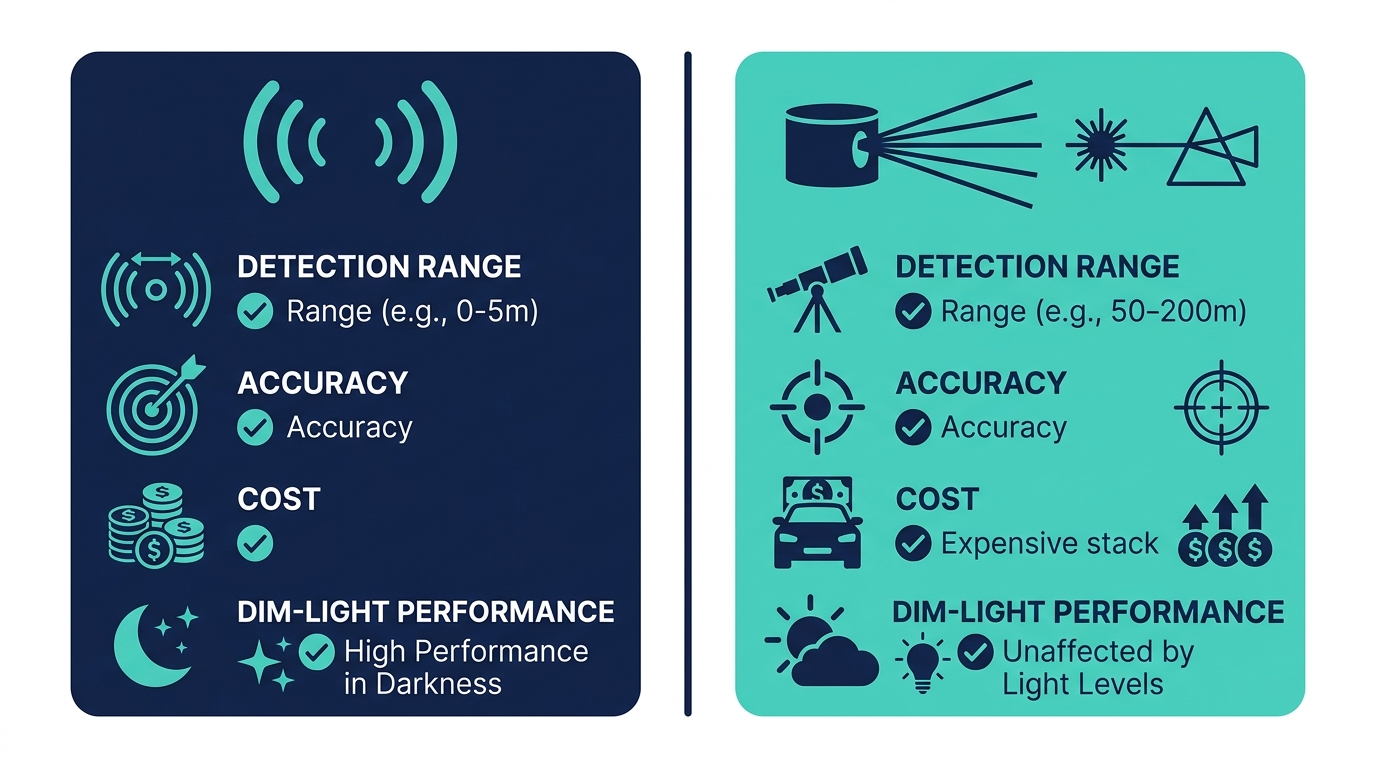
At the core of these systems are two primary sensor technologies: ultrasonic and LiDAR. An ultrasonic sensor works much like a bat using echolocation. It emits high-frequency sound waves that bounce off nearby objects, and by measuring how long the echo takes to return, the system calculates the object’s distance. These sensors typically detect obstacles within a range of 0.2 to 4.5 meters with centimeter-level accuracy and function reliably regardless of lighting conditions. Ultrasonic sensors provide a cost-effective solution for basic detection needs, making them a common starting point for collision avoidance in power wheelchairs.
A LiDAR sensor takes a different approach by using rapid pulses of laser light to create a detailed, millimeter-accurate map of the surroundings. With a detection range that can reach up to 30 meters, LiDAR excels at identifying objects at greater distances and in more complex layouts, giving the system a richer picture of the environment. Like ultrasonic technology, LiDAR remains completely unaffected by dim light or darkness, ensuring dependable performance no matter the time of day. This higher precision typically comes at a higher cost, reflecting the more sophisticated hardware involved.
Sensor Technologies Comparison
Feature
Ultrasonic
LiDAR
Detection Range
0.2–4.5 meters
up to 30 meters
Accuracy
centimeter-level
millimeter-level
Cost
lower cost
higher cost
Performance in Dim Light
unaffected
unaffected
For many users, the choice between sensor types comes down to balancing budget with the level of environmental detail needed. Ultrasonic sensors deliver reliable close-range protection and simplicity while LiDAR offers expansive, high-resolution awareness that can be especially useful in crowded or dynamic spaces. Regardless of the sensor type the system integrates directly with your wheelchair’s drive controller to interpret incoming data in real time and trigger responses that keep you safer.
Ultrasonic vs LiDAR sensor comparison for power wheelchair safety.
When a potential collision is detected the system typically provides an auditory alert or haptic feedback such as a vibration in the joystick to get your attention. If you don’t react in time it can go a step further by automatically slowing the chair or applying the brakes to prevent contact. This seamless integration transforms your power chair into a true example of smart wheelchair technology that adapts to its environment. Obstacle detection technology like this makes daily mobility less stressful and more intuitive especially when navigating tight doorways, crowded rooms, or unfamiliar routes.
According to MedEquipped’s internal product knowledge, collision avoidance systems are an important layer of protection but are not a substitute for safe driving practices. You remain in control of your chair at all times and anti-collision systems are meant to assist rather than replace your awareness. We help you navigate your options when selecting a power wheelchair equipped with these features ensuring the technology matches your daily needs and clinical requirements.
For expert guidance on finding a reliable safety equipment supplier near me contact our team. We handle the paperwork, insurance navigation, and coordination so you can focus on what matters most: reclaiming your independence and exploring the world with a true partner in mobility freedom.
Advanced Sensor Fusion and Smart Wheelchair Technology
Building on the overview of core mobility features, the next frontier in power wheelchair design lies in intelligent environmental awareness. Modern collision avoidance systems transform how you interact with your surroundings, using advanced technology to create a safer, more intuitive driving experience. These systems do not replace attentive driving, but they provide a critical assistive layer, helping you navigate busy corridors, tight doorways, and crowded public spaces with greater confidence. At MedEquipped, we believe this smart wheelchair technology represents a true partnership between user and machine, enhancing independence without taking control away from you.
How LiDAR and Ultrasonic Sensors Integrate in Multi-Sensor Systems
The core of any advanced obstacle detection network is sensor fusion. This process combines data from multiple sensor types—primarily LiDAR and ultrasonic—to build a comprehensive, real-time picture of the environment. A single sensor type has inherent weaknesses; for example, ultrasonic sensors can struggle with very soft or angled surfaces, while LiDAR performance can degrade in heavy rain or fog. By fusing their data streams, the wheelchair’s processor compensates for these individual limitations, dramatically improving detection accuracy and reducing false positives.
LiDAR, or Light Detection and Ranging, uses pulsed laser beams to measure distances with exceptional precision, creating a detailed 3D point cloud of the space ahead. According to MedEquipped’s technical resources, these lasers can map objects at significant ranges, providing crucial early warning for faster-moving chairs. Ultrasonic sensors, in contrast, emit high-frequency sound waves and measure their reflection, excelling at close-range detection of both soft and hard obstacles, like a person walking nearby or a piece of furniture. When these technologies work in tandem, the system cross-references LiDAR’s precise spatial map with the ultrasonic array’s reliable proximity data. This creates a redundant, robust safety net where one sensor type instantly verifies the other’s readings before triggering a response.
The Role of AI in Obstacle Detection and Avoidance
The raw data from a sensor array is just information; it takes artificial intelligence to turn that information into action. AI acts as the wheelchair’s brain, processing the fused sensor data in real-time to make split-second decisions. It is not simply reacting to a pre-set distance threshold. Instead, the AI classifies objects—distinguishing a static wall from a moving shopping cart—and predicts their future path, enabling adaptive navigation that feels smooth and natural rather than jarring.
This intelligent system also learns and adapts to your personal driving style over time. If you prefer wider turns or a slower approach to doorways, the AI can adjust its intervention parameters accordingly. This personalization is a key step toward intuitive alternative driving interfaces, where the chair not only avoids obstacles on its own but also interprets subtle user commands more effectively. The following table highlights several premier models available through MedEquipped that showcase these cutting-edge capabilities, each offering a unique approach to sensor integration.
Smart Wheelchair Models with Collision Avoidance Capabilities
Model
Sensor Type
Detection Range
Additional Features
QUICKIE Q700 M
Ultrasonic + optional LiDAR
4.5m ultrasonic
Adaptive cruise control
ROVI X3
360° LiDAR
up to 30m
Autonomous navigation
TDX SP2 HD
Ultrasonic Proximity
2m range
Adjustable sensitivity
Source: Manufacturer specifications and MedEquipped product database.
Understanding 360-Degree Collision Protection Systems
A full-perimeter sensing system provides an invisible safety cocoon around your wheelchair. This is achieved by strategically placing multiple sensors around the base, creating a continuous detection zone that leaves no blind spots. The system constantly monitors this zone, ready to provide an alert, slow your speed, or execute a controlled stop if an obstacle is detected in your path. This is especially critical in dynamic, complex environments where hazards can appear from the side or rear.
These collision avoidance systems rely on a concept called a ‘danger zone’, which is a digitally mapped area around the chair where objects trigger a response. When you drift too close to a wall or a person approaches from behind, the system can engage automatic braking or, in more advanced models, plot an alternative path around the hazard. For example, if a pedestrian suddenly steps in front of you, the system’s reaction time, measured in milliseconds, can augment your own reflexes, helping to mitigate an impact. Navigating the process of securing one of these advanced chairs can seem complex, but our team simplifies every step. These smart wheelchairs are often covered under wheelchair insurance — learn how we handle the process for you, managing paperwork and funding so you can focus on experiencing the freedom these technologies provide.
Selecting and Configuring Collision Avoidance Systems for Your Power Wheelchair
Choosing collision avoidance systems for your power wheelchair begins with a careful look at your daily life. We help you match the right obstacle detection technology to your home, your routines and your personal mobility goals. At MedEquipped, we view these safety sensors as a key part of smart wheelchair technology that gives you greater confidence behind the joystick.
Evaluating Your Mobility Needs and Environment
Start by thinking about where you drive most often. Indoor spaces like narrow hallways, tight doorways and crowded kitchens call for precise front and rear sensors. Outdoor environments add uneven terrain, curbs and moving obstacles such as pedestrians or shopping carts, so broader side detection becomes more valuable. We recommend listing your most common routes and noting every potential hazard you encounter.
Collision avoidance systems come in several forms. Ultrasonic sensors use sound waves to detect objects within a set range and work well for general proximity warnings. Laser based systems offer finer distance measurement, which helps with precise positioning near furniture or doorways. Camera systems give you a visual feed of the surrounding area and can be paired with audible alerts. The right choice depends on whether you mostly navigate cluttered indoor rooms, open outdoor spaces or a mix of both.
Funding can feel complicated, but we handle that part for you. Insurance coverage varies by payer, and you can check with Maryland state services for potential assistance through Medicaid or other programs.
Working with a Certified ATP for System Selection
A certified Assistive Technology Professional evaluates your clinical needs before any equipment decision is made. We coordinate with your ATP to review your posture, functional abilities, vision and reaction time. This step ensures the collision avoidance systems in your wheelchair complement your driving style rather than overwhelming you with unnecessary alerts. Smart wheelchair technology works best when it is tailored to you, not added as a one size fits all solution.
We work with your ATP throughout the process, bringing our experience with custom motorized wheelchairs and insurance navigation to every case. Our team handles the paperwork, insurance navigation and coordination so you and your ATP can focus on clinical priorities. This partnership leads to a faster timeline from evaluation to delivery, typically within our 30 to 60 day processing window.
Installation, Calibration, and Post-Delivery Support
Once your ATP signs off on the recommendation, we move into the installation phase. We begin with a pre evaluation of your wheelchair to plan sensor placement. Our technicians mount the sensors securely and route wiring to avoid pinch points. Calibration follows immediately, adjusting sensitivity and range to match the obstacles identified during your ATP evaluation.
Real world testing is our final quality check. We ask you to drive through doorways, navigate around furniture and back into your usual parking spot. This hands on validation confirms that the obstacle detection systems work reliably in the spaces you actually use. We fine tune settings on the spot so your chair feels responsive and predictable from day one.
After delivery, we remain your partner in mobility freedom. Our team provides ongoing adjustments as your driving skills improve or your home environment changes. Proper configuration of your safety sensors keeps everyday driving smooth and sets the stage for the daily use and maintenance habits covered in the next section.
AI Integration and Autonomous Navigation in Smart Wheelchairs
Modern smart wheelchairs increasingly rely on artificial intelligence to transform how users navigate their environments, with collision avoidance systems playing a central role in this evolution. At MedEquipped, we see AI integration as the use of machine learning, computer vision, and sensor fusion to enable real-time decision-making and autonomous obstacle handling. Rather than simply reacting to nearby objects, these intelligent systems interpret surroundings, classify potential hazards, and plan the safest, most efficient path forward.
Standard collision avoidance relies on basic proximity sensors that detect objects only when they are immediately near the chair. This reactive approach leaves the user responsible for manually steering around obstacles. In contrast, AI-enhanced systems use camera and LiDAR data together, allowing the chair to identify what an object is, predict where it might move, and generate an optimal route around it. This shift from reactive to predictive navigation represents a fundamental advance in smart wheelchair technology, offering smoother, safer movement through crowded or dynamic spaces.
Over time, AI-powered navigation learns from user behavior, adapting to your preferred routes and improving efficiency with repeated use. This capability means the chair becomes more personalized, anticipating turns, doorways, and common stopping points in your home or workplace. For individuals with limited hand function or other physical constraints, alternative driving interfaces such as voice control, head arrays, and sip-and-puff systems can serve as input methods paired with AI navigation. According to MedEquipped, these interfaces integrate with advanced navigation systems to ensure that autonomous obstacle detection and intelligent path planning remain accessible regardless of a user’s physical capabilities.
These AI capabilities set modern power wheelchairs apart by enhancing both safety and independence, letting you move through daily environments with greater confidence. We believe this technology is a natural extension of our commitment to being a partner in mobility freedom. Information is not medical advice and is for informational purposes only.
Common Questions About Collision Avoidance for Power Wheelchairs
You might be wondering how collision avoidance systems actually work in daily life. Here are clear answers to help.
What is a collision avoidance system for power wheelchairs? It’s a smart wheelchair technology that uses sensors to detect nearby obstacles. Depending on the setup, the system can alert you or automatically slow and stop the chair.
How does collision avoidance technology work? Sensors scan the area around your chair. When an object is too close, the system sends a signal to reduce speed or stop, helping prevent bumps and scrapes.
What are the benefits of collision avoidance for wheelchair users? This safety system increases confidence, reduces caregiver stress, and makes navigating tight spaces easier. It’s a helpful aid, not a replacement for your attention.
Can collision avoidance systems prevent all accidents? No. While the technology helps reduce the risk of collisions, user awareness is still essential. Please consult your healthcare professional for personalized advice.
Does MedEquipped offer this on custom wheelchairs? Yes! We include collision avoidance options on our custom motorized wheelchairs. We’re here as your partner in mobility freedom, ready to tailor the right solution for you.
Partner in Mobility Freedom: MedEquipped’s Commitment to Safety and Independence
At MedEquipped, we serve as your partner in mobility freedom, delivering custom motorized wheelchairs built around your clinical needs and lifestyle. Our certified ATP evaluators perform thorough assessments so every chair integrates advanced features like collision avoidance systems and smart wheelchair technology to help you move with greater confidence. We handle the paperwork, insurance navigation, and coordination across New York, Georgia, and Michigan, typically completing orders in 30–60 days. If alternative driving interfaces fit your needs, we configure them and provide ongoing support long after delivery because your independence isn’t a one-time transaction, it’s an ongoing journey we walk together.
Power Wheelchair Troubleshooting: A Practical Guide
When your power wheelchair doesn’t respond as expected, systematic troubleshooting can restore your independence. We recommend starting with simple checks before considering professional service.
For a motorized wheelchair troubleshooting session, always power off your device first. Inspect the battery connections for corrosion or looseness — a wheelchair battery not charging often stems from a disconnected cable or a tripped circuit breaker. Verify that charger indicator lights show active charging and that the power cord and outlet are free of damage.
Common joystick error codes like E-1 (battery voltage low) or E-3 (motor fault) can sometimes be cleared by turning the chair off for 30 seconds. If you see erratic movement from power chair joystick error codes, a field recalibration through the controller menu may help — check your manufacturer’s manual for model-specific sequences.
Should these steps not resolve the issue, discontinue use and contact a certified technician. If your chair was obtained through power wheelchair medicare coverage, review your plan for repair options in the next section. Results may vary; individual outcomes are not guaranteed. Consult your wheelchair manual or a qualified technician for persistent issues.
Safety and Preparation for Motorized Wheelchair Troubleshooting
Before attempting any motorized wheelchair troubleshooting, safety must come first. Your power chair is a sophisticated medical device, and proper preparation ensures both your well-being and the integrity of the equipment. At MedEquipped, we believe you are our partner in mobility freedom, and we want every maintenance task to feel approachable and safe.
Begin by powering off your wheelchair completely and disconnecting it from the charger. Always consult your owner’s manual for model-specific safety instructions and component locations before any inspection or repair. The U.S. Food and Drug Administration recommends following manufacturer guidelines to prevent hazards, and the Rehabilitation Engineering and Assistive Technology Society of North America (RESNA) emphasizes pre-service safety preparations as a professional standard.
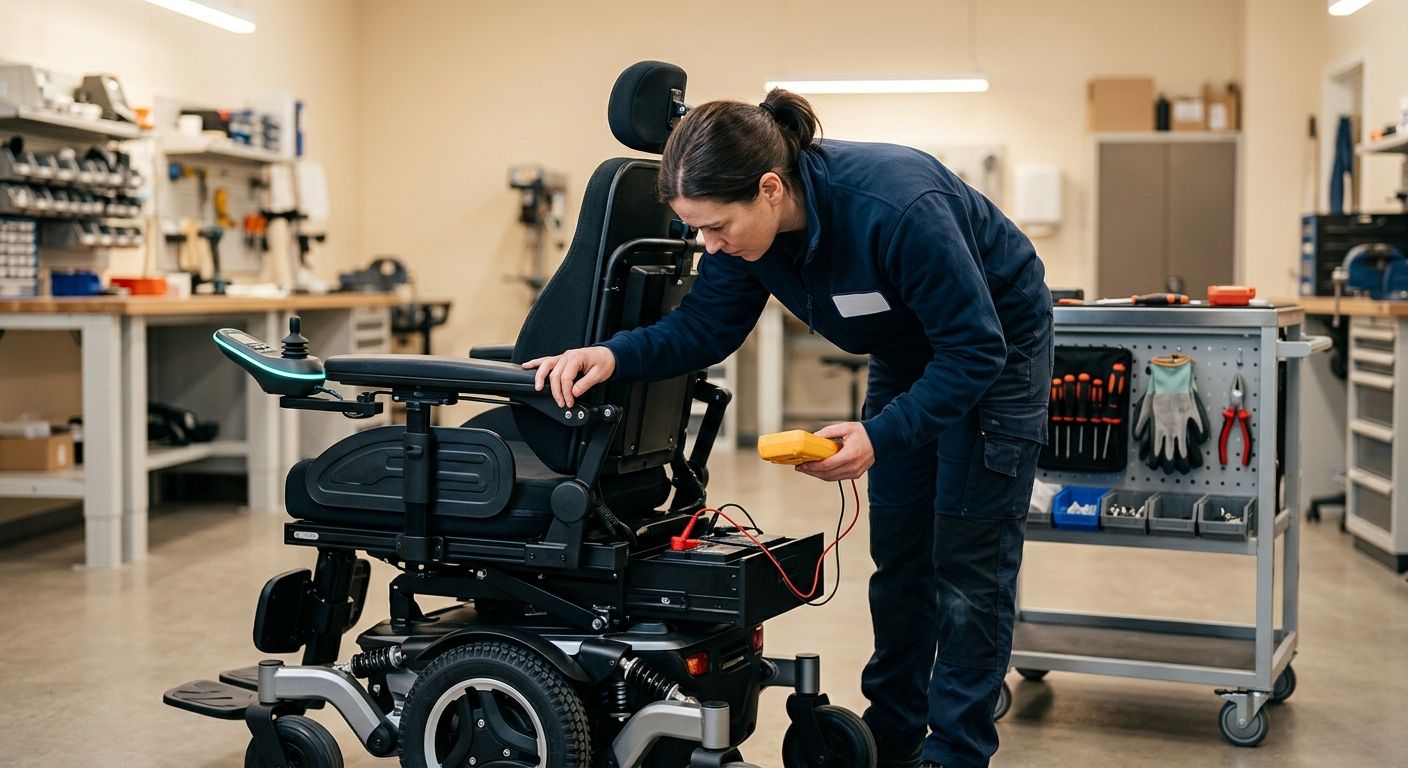
Gather a few basic tools to get started: a multimeter (a device that measures voltage and continuity), a screwdriver set, and safety gloves. As a first step, check the battery terminals for corrosion and confirm all connections are secure — a common culprit behind issues like a wheelchair battery not charging or unexpected power wheelchair battery troubleshooting needs. If you notice loose connections, tighten them carefully before proceeding.
Avoid making unauthorized modifications, as these can void your warranty or create safety risks. We also advise checking your joystick for visible damage if you’ve seen power chair joystick error codes on the display, though detailed diagnostics come later. Remember, MedEquipped’s certified technicians are here to support you with your custom motorized wheelchairs.
Consult your wheelchair provider before performing any maintenance. In the next section, we’ll walk step by step through resolving the most frequent power chair issues, from battery problems to control system alerts.
Check Battery Connections and Terminals
If your power wheelchair is showing signs of wheelchair battery not charging or intermittent power loss, the next logical step in basic motorized wheelchair troubleshooting is a close inspection of the battery terminals and wiring. Loose or corroded connections are among the most common, yet simplest, issues to resolve. As your partner in mobility freedom, we recommend this quick check before assuming a more complex failure.
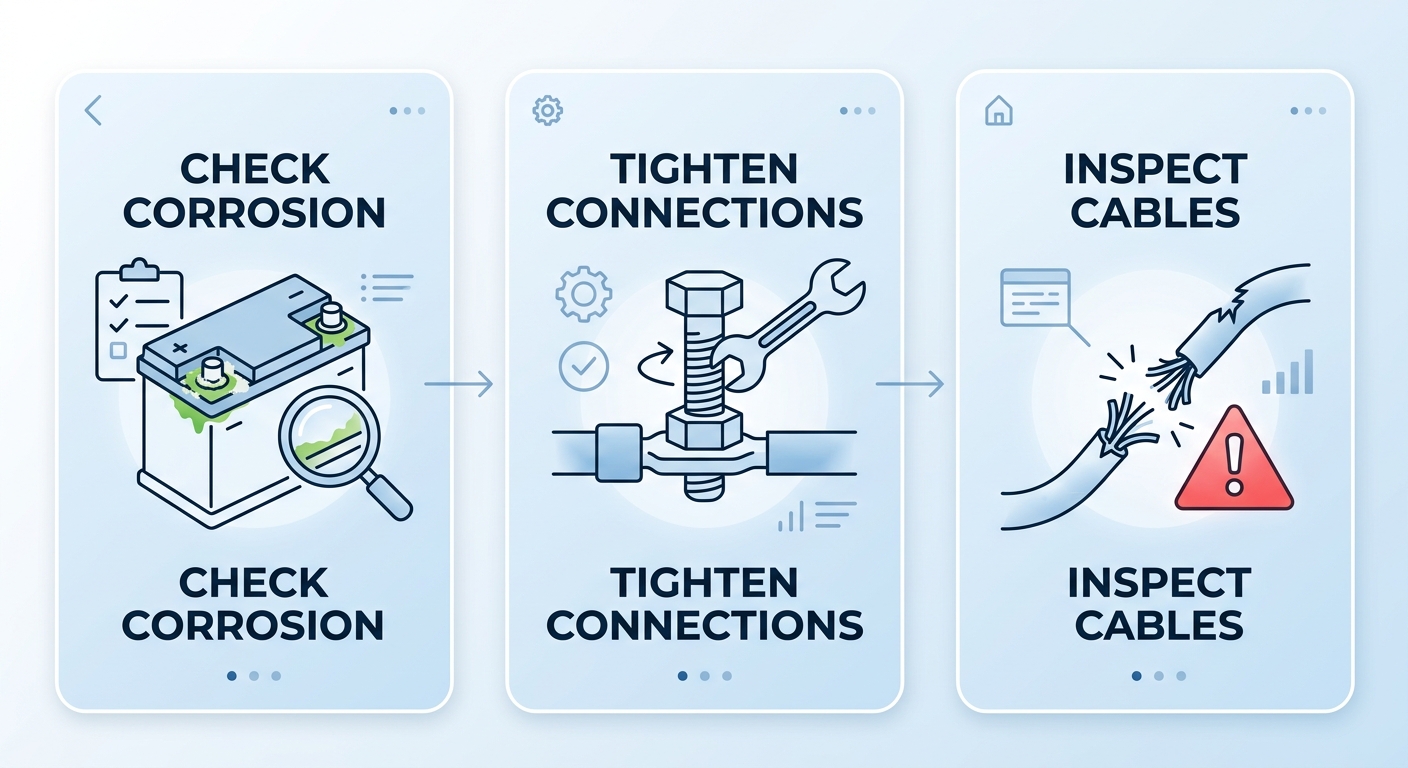
Start with safety: ensure the chair is powered down and unplugged. Visually inspect the terminals for any white or bluish powdery buildup, which signals corrosion. A gentle cleaning with a mixture of baking soda and water, carefully applied and then thoroughly dried, can restore a solid contact point. Next, confirm all cable connections are snugly tightened, as even a slightly loose wire can create a power chair joystick error codes scenario by disrupting consistent power flow. Finally, trace the visible cable length, looking for any frayed insulation or exposed wiring that could cause a short.
If your battery still fails to hold a charge after these steps, the problem may be internal. For owners of our custom motorized wheelchairs, we are ready to assist with more in-depth diagnostics.
Battery connection inspection guide from MedEquipped for power wheelchair maintenance.
Results may vary; individual outcomes are not guaranteed. Consult a qualified technician for complex issues. This information is not medical advice and is for informational purposes only.
Test the Battery with a Multimeter
In a motorized wheelchair troubleshooting scenario, one of the first things we check when a chair stops performing is the battery. If you’re dealing with a wheelchair battery not charging or seeing a power chair joystick error, a simple voltage test can tell you a lot. At MedEquipped, we recommend testing the battery yourself before calling us, as it’s a safe and straightforward process that can save you time.
Always put safety first. Before you begin, ensure the wheelchair is turned off and completely disconnected from its charger. Wear protective gloves and eyewear if you have them. Use a digital multimeter set to DC voltage in a range that covers at least 24 volts. Be extremely careful not to let the metal probes touch each other while they’re on the terminals—this will cause a short circuit and can be dangerous.
Once you’ve prepared, follow these steps:
Identify the positive (usually red, marked with a +) and negative (black, marked with a −) terminals on your battery.
Place the red multimeter probe firmly on the positive terminal and the black probe on the negative terminal.
Hold the probes steady and read the number on the multimeter display.
Interpreting the reading is simple. A healthy, fully charged 12-volt battery should show around 12.6 volts. For a 24-volt system, expect about 25.2 volts. If you see a significantly lower reading or zero volts, the battery needs a full charge or is likely faulty. If the voltage is normal but you’re still experiencing a power chair joystick error, the issue may lie elsewhere in the system.
This guide is for informational purposes only. Always consult a qualified mobility technician for repairs. If the battery passes, the next step is to check the motor connections. If it fails, a charge or a replacement may be the solution. Remember, we’re your partner in mobility freedom, and we’re always here to help get you moving again.
Reset the Power Chair Controller
When motorized wheelchair troubleshooting leads you to a sudden stall or flashing error code, a controller reset is often the first step to regain mobility. As your partner in mobility freedom, we recommend this simple procedure whenever the joystick becomes unresponsive.
Before you begin, confirm that all cable connections on your power chair controller are firmly seated. Then follow these steps:
Turn the controller off completely.
Wait 10–15 seconds.
Turn the controller back on and let the system restart.
The joystick should be in neutral and the chair on a flat, stable surface during the reboot. If error codes persist, consult our Joystick Error Code Guide to interpret specific blink patterns—understanding power chair joystick error codes helps you decide whether a simple reset is enough. Remember, these steps are informational only; always consult your owner’s manual or a qualified technician. Should the issue continue after a joystick reset, it may be time for a thorough power wheelchair stalling evaluation by a professional.
Interpret Joystick Error Codes
Understanding the basics of motorized wheelchair troubleshooting begins with the joystick controller, which often communicates issues through specific error codes. Recognizing these signals can help you identify simple fixes and know when it’s time to seek professional support. For more complex issues, our team at MedEquipped is here to help coordinate expert care.
Some common power chair joystick error codes you might encounter include:
Flashing LED patterns (e.g., 2 or 3 flashes): These often indicate a joystick potentiometer failure or an internal controller fault, meaning the joystick isn’t communicating correctly with the chair’s motors.
Specific error numbers on the display: Numbers can point to wiring issues, such as a disconnected or damaged cable between the joystick module and the power base.
Battery indicator errors: While a wheelchair battery not charging issue is a distinct topic, a blinking battery light on the joystick can sometimes be confused with a control system fault.
A first step for any error is a basic power cycle. Turn the chair off completely, wait a full minute, and then turn it back on to allow the system to reset. You can also visually check all cable connections leading to the joystick, ensuring they are clean, dry, and securely seated. However, persistent errors should be addressed by a technician. Some repairs, including joystick replacement, may be covered under insurance, a process we can support as your partner in mobility freedom. Please consult your manual or contact a professional for codes that don’t resolve quickly.
Address Stalling or Slow Movement
When your power chair hesitates, responds sluggishly, or stalls altogether, it disrupts your day and your confidence. As your partner in mobility freedom, we know that quick motorized wheelchair troubleshooting can often resolve these hiccups. Slow movement in our custom motorized wheelchairs typically stems from a few manageable sources. A wheelchair battery not charging fully is the most common culprit, so always begin by checking your battery gauge and ensuring all connections are secure. Worn motor brushes or debris in the drive wheels can also be factors. Next, look for joystick error codes; many controllers display a flashing light pattern that corresponds to a specific fault in your owner’s manual. A power chair joystick error codes reference chart can help you interpret these signals quickly. Often, a simple system reset—turning the chair off, waiting a moment, and powering it back on—clears temporary electronic glitches. If the problem continues despite these checks, consistent stalling points to a deeper technical issue. Per guidelines from the Rehabilitation Engineering and Assistive Technology Society of North America (RESNA), unresolved electronic or motor faults should be assessed by a certified technician to avoid further damage. Before scheduling service, you might also explore whether your plan helps, including your power wheelchair medicare coverage options for qualified repairs. For ongoing issues, reach out to us; our certified team is ready to help you restore the smooth, reliable ride you deserve.
If issues persist, please consult a qualified technician for a hands-on evaluation.
Resolve Beeping and Lockout Issues
We understand how frustrating it can be when your power wheelchair starts beeping or enters a lockout mode. In motorized wheelchair troubleshooting, common causes include a low battery, activated seat sensor, safety override, or system error codes — each producing distinct patterns you can identify. A wheelchair battery not charging issue often triggers repeated beeps, while power chair joystick error codes may flash on the display, signaling specific faults.
Lockout modes (emergency stop, tilt-in-space lock, or drive-disabled state) are safety features that prevent movement until the condition clears. To exit most lockouts, follow these steps:
Power-cycle the chair by turning it off and on; wait a few seconds before restarting.
Check that all cable connections are secure and free from damage.
Verify the joystick is in the neutral position (centered and not tilted).
If beeping persists, consult our General Troubleshooting FAQ for beep patterns and call our support team.
Most beeping and lockout issues respond to this motorized wheelchair troubleshooting approach. However, sometimes Medicare coverage changes can trigger a lockout if your chair no longer meets criteria. When that happens, your wheelchair insurance may need an update. As your partner in mobility freedom, we handle the paperwork, insurance navigation, and coordination to get you moving again. We always recommend contacting a certified technician or our support team when basic steps don’t resolve the issue. Consult a healthcare professional before making clinical decisions; this information is not medical advice.
Perform a Complete System Reboot
When simple checks don’t resolve issues, performing a complete reboot is a powerful first step in motorized wheelchair troubleshooting. We recommend this process as a safe, effective way to clear temporary software glitches that can affect your power chair’s performance.
Start by turning the main power off. Next, if you can safely access it, disconnect the battery pack. Wait at least 60 seconds to let any residual power drain completely from the system. This pause is crucial, as it allows the control module to fully reset. Finally, reconnect the battery and turn the power back on. This power chair reboot gives the system a fresh start.
A successful reboot can fix unresponsive controls, display errors, and erratic behavior without affecting your custom drive settings. It is a simple reset, not a factory restore. If you still see error codes or your chair won’t operate normally, please contact our support team. For persistent problems, the next section covers joystick error codes and battery charging issues.
Advanced Troubleshooting for Persistent Issues
Even after following routine checks, some problems with your motorized wheelchair require deeper investigation. For effective motorized wheelchair troubleshooting when basic solutions fail, it’s helpful to turn to structured diagnostic protocols. The Rehabilitation Engineering and Assistive Technology Society of North America (RESNA) provides established service standards that many qualified technicians follow to systematically identify faults.
When a wheelchair battery not charging issue continues despite a secure wall outlet, the problem often lies in the charger, cables, or battery health. We recommend a step-by-step approach to identify the cause:
Carefully inspect all cable connections for bent pins, corrosion, or debris.
Observe the charger’s indicator lights—a blinking or absent light can signal a dead charger or internal fault.
Have a technician test the battery pack’s voltage and check for signs of sulfation, which is a crystalline buildup on lead-acid battery plates that reduces capacity.
Joystick problems present another layer of complexity. Common power chair joystick error codes appear as a sequence of flashing lights, with the pattern indicating a specific fault. For instance, a slow red blink may point to a low battery, while rapid red flashes can signal a locked motor or controller fault. Often, a full system reset—disconnecting power for several minutes—can clear temporary errors. The U.S. Food and Drug Administration (FDA) reminds users that any repeated controller or motor malfunction must be approached with caution, as ignoring persistent safety signals could create unsafe operating conditions.
If a reset doesn’t resolve the pattern, stop using the chair. Document the flash sequence, when it occurs, and under what conditions. Recording these symptoms will speed up a professional diagnosis, a practice aligned with best practices in the field. Even custom motorized wheelchairs can develop persistent issues, and we’re always ready to help you get back to independence. Contact MedEquipped’s team to schedule an evaluation—we are your partner in mobility freedom.
Information is not medical advice and is for informational purposes only. Consult a healthcare professional before making clinical decisions.
Maintaining Your Power Chair for Long-Term Reliability
Simple, consistent care prevents most issues that lead to motorized wheelchair troubleshooting. We understand your custom chair is a vital daily companion, so we recommend these straightforward habits.
Follow battery charging best practices to avoid the frustration of a wheelchair battery not charging unexpectedly. Charge after each use, and avoid deep discharges to protect long-term battery health. For the controls, gently wipe the joystick and panel with a dry cloth. Preventing debris buildup helps you avoid confusing power chair joystick error codes.
Monthly, inspect your tires and casters for wear, and keep electrical connections free of moisture and dust. We also advise scheduling an annual professional checkup. A custom fitting from your initial clinical evaluation, as provided by MedEquipped’s certified ATP evaluators, reduces long-term mechanical wear. Your partner in mobility freedom, MedEquipped, is here to help with ongoing support.
Meeting Medicare K0823 requirements starts with understanding that this HCPCS code classifies a heavy duty power wheelchair built for users whose body weight does not exceed 300 pounds. Accurate weight classification is the foundation of a smooth approval process, so we begin every patient journey by confirming that your clinical profile aligns with this specific capacity. When your weight falls within that threshold, the K0823 designation becomes the most appropriate funding pathway under Medicare DMEPOS guidelines, and we at MedEquipped work diligently to build a complete documentation package that supports timely authorization.
Individuals who require heavy duty power wheelchairs 450 lbs or greater capacity typically qualify for a higher-tier code such as K0824, which accommodates users up to 450 pounds. Your evaluating Assistive Technology Professional reviews your medical history, mobility limitations, and functional needs to determine which classification best matches your daily life. Getting this classification right is critical because a mismatch can delay funding or lead to a chair that simply cannot support you safely. Our team acts as your partner in mobility freedom by verifying your weight measurement against current clinical records and helping you understand why Medicare requires this precise categorization before approving equipment.
To support a K0823 claim, Medicare expects several pieces of documentation, which we help you gather and submit:
A physician’s prescription that clearly states the medical necessity for a heavy duty power wheelchair.
A recent clinical evaluation completed by a certified ATP or qualified clinician, documenting mobility deficits and functional limitations.
A documented weight measurement, typically recorded during an in-person assessment within a reasonable timeframe of the order.
A functional mobility assessment that demonstrates your inability to perform daily activities without powered assistance.
MedEquipped simplifies what can otherwise feel like a daunting paperwork process. When you contact our intake team in Nanuet, New York, we collect your existing records, coordinate with your referring physician, and schedule an evaluation with an ATP who understands exactly what Medicare reviewers need to see. Our familiarity with Medicare K0823 requirements helps us flag missing details early so your submission is as clean as possible, which supports our goal of delivering your custom motorized wheelchair within a typical 30- to 60-day processing window.
Beyond the weight-based classification itself, we also consider bariatric power wheelchair seating and positioning factors that influence safety and long-term comfort. Even within the 300-pound capacity, your body dimensions, pressure distribution risks, and postural support needs shape the seating configuration we recommend. In the next section, we explore those critical seating and positioning considerations in greater depth.
Disclaimer: Results may vary; individual outcomes are not guaranteed. The information provided here is for informational purposes only and is not medical advice. Consult a healthcare professional before making clinical decisions.
2. Qualifying for a Medicare Heavy Duty Chair
Understanding Medicare K0823 requirements is the first step toward obtaining a heavy duty power wheelchair, building on the overview of chair options from the previous section. Medicare classifies power wheelchairs as durable medical equipment, so you will need a prescription from your treating physician and a face-to-face examination that documents your mobility limitations within the home. To establish medical necessity, you must demonstrate that you cannot safely operate a manual wheelchair because of a condition such as severe arthritis or a neurological disorder.
For those who need heavy duty power wheelchairs 450 lbs and above, the K0823 code applies and covers weight capacities from 450 to 600 pounds. If your weight falls below 450 pounds, other K-codes like K0822 may be appropriate. Proper bariatric power wheelchair seating and positioning also plays a critical role in comfort and safety for larger users. According to MedEquipped’s qualification guide, an Assistive Technology Professional evaluation can strengthen your case by detailing how the chair supports your independence. Our team helps you gather the right documentation so you can move through the process smoothly. Consult a healthcare professional before making clinical decisions. Once you meet the eligibility criteria, we shift to paperwork and insurance navigation — the topic of the next section, where we walk you through applying with MedEquipped’s end-to-end support.
3. Medical Documentation You Need
Getting your Medicare K0823 power wheelchair approved starts with having the right medical documentation. Meeting Medicare K0823 requirements doesn’t have to be complicated — it’s about gathering specific paperwork that shows why you need this particular type of heavy duty power wheelchair documentation for your daily life at home.
Here are the core documents Medicare needs to review:
Written Order (Prescription). This is your doctor’s official prescription for the wheelchair, confirming it’s medically necessary. It’s the foundation of your K0823 paperwork.
Face-to-Face Examination Record. Medicare requires a record showing your doctor evaluated you in person within a specific timeframe before they write the prescription. This note links the exam findings directly to the mobility recommendation.
Medical Necessity Statement (Detailed Written Order). This detailed narrative must clearly describe your physical functional limitations, why the wheelchair is necessary for activities inside your home, and the clinical reasons for the specific chair configuration and seating components being ordered.
Your doctor and MedEquipped’s certified ATP evaluator work together to make sure these documents connect — the prescription aligns with the exam observations, and the medical necessity statement reflects exactly what the evaluation uncovered about your strength, range of motion, and daily mobility challenges.
We guide you and your physician through every piece of this documentation so nothing gets missed. We handle the paperwork, insurance navigation, and coordination, turning a process that often feels overwhelming into a clear, step-by-step partnership. When your documents are complete and well-organized from the start, the typical timeline from evaluation to delivery stays within 30–60 days — much faster than trying to manage it alone.
Once your paperwork is ready, the next stage is submitting it through the right channels. We’ll walk you through exactly what happens after your doctor signs the order.
4. Medicare Part B Coverage for K0823
Now let’s look at how Medicare Part B covers this code. Medicare K0823 requirements specify that this code applies to a standard power-operated vehicle designed primarily for indoor use. Under Medicare Part B, you may qualify for coverage when your physician certifies medical necessity — for example, when you cannot safely ambulate indoors without assistance.
For heavy duty wheelchair medicare questions beyond standard K0823 criteria, additional documentation may be necessary. We handle the paperwork, insurance navigation, and coordination so you can focus on what matters most. Generally, the typical timeline for custom-fitted power chairs runs 30 to 60 days from evaluation to delivery.
Your supplier must be enrolled in Medicare and meet all accreditation requirements. While Medicare picks up the majority of approved costs, some cost-sharing through deductibles and coinsurance still applies. Contact MedEquipped for a custom estimate of your out-of-pocket responsibility. Results may vary; individual outcomes are not guaranteed. Once coverage is confirmed, MedEquipped guides you through the next steps.
Privacy notice: we do not sell personal information (see Privacy Policy). SMS terms: message and data rates may apply; reply STOP to unsubscribe. Consult a healthcare professional before making clinical decisions.
5. Group 2 vs Group 3 Heavy Duty Chairs
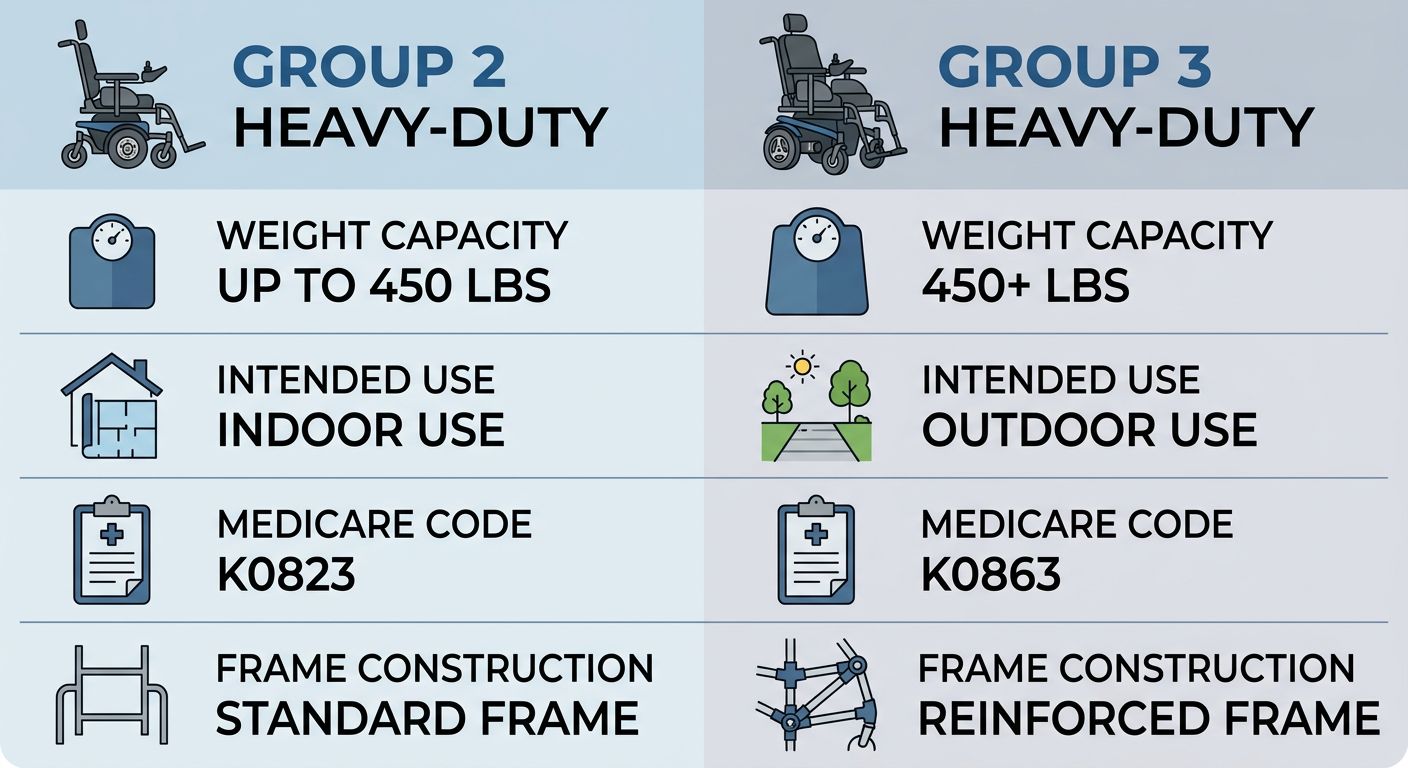
Understanding the difference between Group 2 and Group 3 heavy duty power wheelchairs is essential for finding the right fit. These categories, defined by RESNA (Rehabilitation Engineering and Assistive Technology Society of North America), help match equipment to your weight and lifestyle needs.
Feature
Group 2 Heavy Duty
Group 3 Heavy Duty
Weight Capacity
Up to 300 lbs (K0823)
300 – 600 lbs+
Intended Use
Primary indoor mobility
Indoor/Outdoor & All-Terrain
Medicare Code
K0823 / K0822
K0848 – K0864
While both groups offer exceptional support, Group 3 chairs are built for all-terrain mobility, while Group 2 models excel in everyday indoor environments.
Group 2 vs Group 3 heavy duty power wheelchair comparison.
If you need a heavy duty power wheelchair rated for 450 lbs or more, or require specialized bariatric power wheelchair seating systems, we can help. Our certified ATP evaluators will assess your clinical needs and recommend the right group, ensuring your custom motorized wheelchair becomes a partner in mobility freedom. We handle the paperwork, insurance navigation, and coordination for you. Remember, Medicare K0823 requirements apply for Group 2, while Group 3 needs medical necessity documentation.
Consult your healthcare provider to determine which group is right for you, or reach out to us for a personalized evaluation.
6. Scheduling Your Face-to-Face Evaluation
Once you and your physician have decided that a custom power wheelchair is the right path, the next step is a face-to-face clinical evaluation. This appointment is a standard part of meeting Medicare K0823 requirements and other insurer guidelines, ensuring your unique needs are properly documented before a chair is ordered. Think of it as your personal mobility consultation, where we become your partner in mobility freedom by getting to know you and your daily life.
Scheduling is simple. Here’s how the process works:
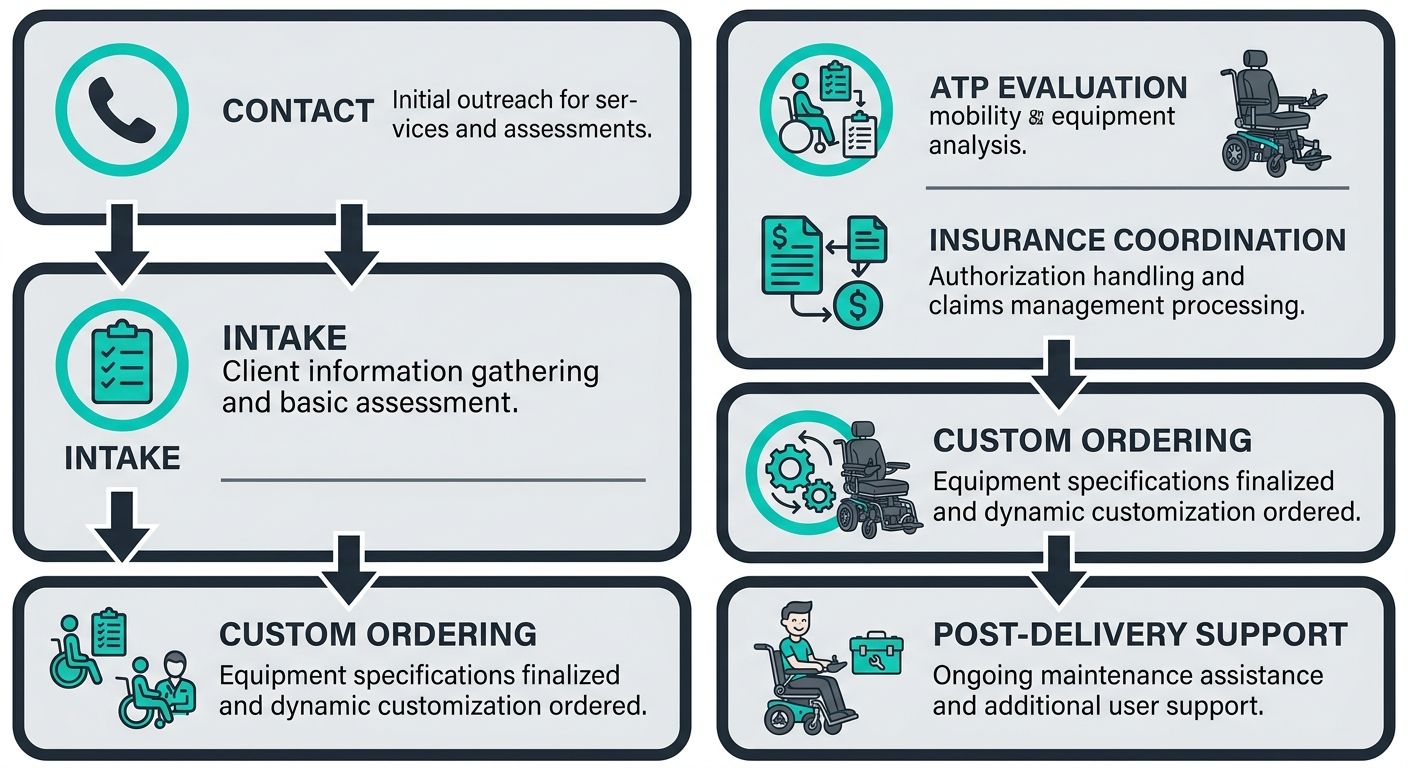
Contact us by phone or through our website. An intake coordinator will gather your initial information.
You’ll need to provide a written prescription from your doctor, relevant medical records, and your insurance details.
We then schedule your evaluation with a certified Assistive Technology Professional (ATP) at a time and place convenient for you.
The ATP will assess your mobility, take precise measurements, and discuss your needs, including options for heavy duty power wheelchairs 450 lbs or specialized bariatric power wheelchair seating and positioning if they apply to you. We handle all the paperwork and insurance navigation, so your only job is to attend. The evaluation is typically scheduled within days, and we’ll have your chair ordered within 1–2 weeks. Results may vary; individual outcomes are not guaranteed. Bring your current mobility device and a list of questions. After the evaluation, our team takes the reins to process your custom order and guide you swiftly toward the delivery day we’ll cover next.
Message and data rates may apply; reply STOP to unsubscribe.
7. Configuring Bariatric Seating and Positioning
After choosing from available bariatric power mobility bases, the next essential step is configuring the seating and positioning system. This process directly impacts comfort, pressure distribution, and overall safety during daily use. Proper configuration also helps meet key regulatory standards, including Medicare K0823 requirements, which define specifications for heavy-duty seating.
We recommend starting with precise measurements. A minimum seat width of 22 inches is typical, but the depth and back height must match the patient’s body for optimal support. Weight capacity is equally critical; seating frames and cushions on heavy duty power wheelchairs 450 lbs and above need careful selection to ensure durability and safety.
For a better fitting bariatric power wheelchair seating and positioning setup, consider these accessories:
Elevating leg rests to improve circulation and reduce swelling.
Tilt-in-space functionality to manage pressure and enhance comfort.
Adjustable armrests for easier transfers and upper body support.
We believe that a clinical evaluation by a certified ATP, like MedEquipped’s team, is vital for achieving the best fit. Once this configuration is complete, the final steps involve testing all adjustments and preparing for delivery.
Consult a healthcare professional before making clinical decisions related to wheelchair seating.
8. Working with Certified ATP Professionals
After understanding the complex world of insurance and wheelchair selection, working with a Certified ATP Professional simplifies everything. A Certified ATP Professional is a specialist trained to match mobility needs with appropriate powered devices, and their involvement is key to satisfying Medicare K0823 requirements for coverage.
During evaluations, our ATPs assess critical areas like weight capacity for heavy duty power wheelchairs 450 lbs and seating support for bariatric power wheelchair seating and positioning, ensuring every adjustment aligns with your clinical picture and documented medical necessity.
At MedEquipped, our ATPs coordinate with your clinicians and insurance providers, handling paperwork to streamline approvals. As your partner in mobility freedom, we specify chair configurations that match your needs, including custom adjustments for bariatric users. While we advocate for coverage, insurance outcomes depend on individual plans.
Our certified team stays current with industry advances, offering informed guidance from evaluation through to ordering. With professional ATP support in place, the next step is delivery and long-term care.
Partnering with MedEquipped for Your K0823 Journey
Navigating Medicare K0823 requirements can feel overwhelming, but MedEquipped is here to simplify every step. We provide end-to-end support, from your initial clinical evaluation through insurance paperwork, custom ordering, delivery, and ongoing care. Our certified ATP evaluators across New York, Georgia, and Michigan work closely with you to configure chairs for complex needs, including mobility solutions like heavy duty power wheelchairs 450 lbs and specialized bariatric power wheelchair seating and positioning. We handle the paperwork, insurance navigation, and coordination so you don’t have to, typically completing the process in 30–60 days. As your partner in mobility freedom, we’re ready when you are—contact us to start your journey.
Consult a healthcare professional before making clinical decisions.
Custom Mobility Equipment Suppliers in New York: Your Trusted Partner
As your trusted partner in New York, MedEquipped stands out among custom mobility equipment suppliers in New York because we truly are your partner in mobility freedom. We guide you through every step, making the process of obtaining a custom power wheelchair straightforward and personal.
We offer comprehensive custom motorized wheelchair services, including clinical evaluation and fitting, insurance and funding navigation, ordering, and direct delivery. We also serve as Complex rehab technology providers in NY, backed by certified ATP evaluators who ensure the perfect fit. With our established processes across New York, Georgia, and Michigan, we typically complete custom orders in 30 to 60 days.
Our certified ATP wheelchair evaluation ensures your chair is configured for your exact needs, and our commitment continues with dedicated post-delivery support. We handle the paperwork and coordination so you can focus on your mobility, and we are ready to guide you through every step — from clinical evaluation to delivery.
New York Service Areas for Custom Wheelchairs
As a leading custom mobility equipment supplier in New York, MedEquipped proudly serves clients throughout Rockland County, in the Bronx, and across the Nanuet and Spring Valley area. We are your partner in mobility freedom, bringing personalized evaluations, expert insurance coordination, and custom motorized wheelchairs directly to you.
The following table offers a quick visual comparison of our core services across these regions.
Service Availability in Key New York Regions
Service Feature
Rockland County
Bronx
Nanuet / Spring Valley
Clinical Evaluation (ATP Assessment)
On-site or mobile ATP evaluation available by appointment
ATP evaluation at our Nanuet office or via telehealth
In-person evaluation at our Nanuet clinic
Insurance & Funding Navigation
Full assistance with paperwork, Medicare/Medicaid coordination
Insurance coordination and documentation handled end-to-end
Full coordination from initial paperwork to approval
Custom Ordering & Delivery
30–60 day turnaround with expedited options
30–60 day turnaround with urgent case prioritization
30–60 day timeline; direct delivery to your location
Post-Delivery Support
Adjustments, repairs, and patient education included
Ongoing clinical support and follow-up visits
Dedicated support team for adjustments and repairs
Whether you are at home in Rockland County, the Bronx, or right near our Nanuet clinic, we bring clinical expertise to you. Our evaluations are conducted by certified Complex rehab technology providers NY, ensuring each power chair is configured for your unique needs.
A thorough ATP wheelchair evaluation is the critical first step in matching you with the right equipment. Our clinical evaluations are conducted by certified Assistive Technology Professionals (ATPs) listed in the RESNA Assistive Technology Professional directory. We handle the paperwork, insurance navigation, and coordination from start to finish, so you can focus on what matters.
After delivery, our commitment continues. We provide ongoing adjustments, repairs, and patient education to ensure your mobility solution fits your life for the long term. To begin the process in any of these New York service areas, contact our team today.
Results may vary; individual outcomes are not guaranteed. Information is not medical advice and is for informational purposes only.
Power Wheelchair Delivery Timeline and Insurance Support
As a trusted custom mobility equipment supplier in NY, we understand that waiting for your power wheelchair can feel overwhelming. Here at MedEquipped, we typically deliver custom power wheelchairs within 30 to 60 days after your insurance has been approved and your order has been placed. This timeline allows us to ensure your chair is built precisely to your clinical needs and lifestyle. Please note that results may vary; individual outcomes are not guaranteed.
We manage the entire process end-to-end so you don’t have to navigate complex bureaucracy alone. After your ATP wheelchair evaluation is complete and your funding is authorized, our team immediately begins coordinating the custom build with the manufacturer. Working with experienced complex rehab technology providers in NY ensures that every chair is configured for optimal comfort, positioning, and functionality. At MedEquipped, we handle all the insurance paperwork, prior authorizations, and follow-ups, keeping you informed every step of the way.
Timelines can naturally vary depending on your insurance provider’s response times, the complexity of your custom chair, and current supply chain factors. That’s why we never promise a universal delivery date and always communicate transparently about your specific situation. If you are facing more urgent mobility needs, please ask about our expedited power wheelchair service for faster processing. We also invite you to visit our Become a Patient page to take the first step on your journey to greater independence. Once your chair arrives, we continue to support you every step of the way.
Results may vary; individual outcomes are not guaranteed.
Local Factors for Choosing a Mobility Provider
Beyond general considerations, local factors play a critical role in finding a trusted partner for your custom motorized wheelchair. When searching for custom mobility equipment suppliers NY, proximity is only the beginning. Your ideal provider must have the clinical expertise to translate a prescription into a chair that truly fits your body and daily life.
We recommend looking for Complex rehab technology providers NY whose staff includes RESNA-certified Assistive Technology Professionals. These specialists perform a thorough ATP wheelchair evaluation, considering your posture, skin integrity, and functional goals—not just your diagnosis. Confirm they offer in-home or clinic-based assessments rather than simple showroom consultations. A quality provider will also handle insurance navigation, typically completing paperwork and approvals within a 30 to 60 day window, and will support you long after delivery with adjustments and repairs.
To verify a provider’s credentials, use the ATIA assistive technology provider resources tool or the RESNA Member Directory. These industry-standard resources help you locate certified professionals in your area. Remember that FDA clearance of power wheelchairs ensures they meet federal safety standards.
Your First Steps to Custom Mobility Equipment
Looking for custom mobility equipment suppliers in NY? MedEquipped makes it easy to get your custom motorized wheelchair. Our custom power wheelchair patient services simplify the entire process, from your first call to delivery and beyond.
Your first steps to custom mobility equipment with MedEquipped.
Ready to take the first step? Here’s how we make it easy as your partner in mobility freedom:
1. Contact MedEquipped. Reach out by phone or online form. We’ll discuss your needs and verify your insurance. We handle the paperwork, insurance navigation, and coordination.
2. Complete intake and insurance verification. Provide your details so we can confirm coverage and start your file.
3. Schedule your ATP wheelchair evaluation. As experienced Complex Rehab Technology providers in NY, our certified ATP evaluators conduct a comprehensive assessment of your mobility needs.
4. Insurance and funding coordination. We manage all clinical documentation, approvals, and funding logistics.
5. Custom chair ordering and delivery. Order your chair with delivery typically in 30-60 days (faster processing).
6. Post-delivery support and service. Dedicated support continues after you receive your custom motorized wheelchair.
Once you complete these steps, your dedicated patient services team will guide you through every detail. Start your journey — visit our custom power wheelchair patient services page or call us directly.
Results may vary; individual outcomes are not guaranteed.
Custom Mobility Equipment Services Ready for You
We make that happen with a full suite of services. As your partner in mobility freedom, we connect you with top custom mobility equipment suppliers in NY, Georgia, and Michigan. Our certified ATP wheelchair evaluation ensures a precise, clinical fit for your lifestyle, while our team handles all insurance navigation and paperwork. We manage ordering, build, and delivery on a 30-to-60-day timeline with ongoing support. Our custom motorized wheelchairs meet rigorous safety standards backed by FDA medical device registration data. Complex rehab technology providers NY trust our end-to-end process. But don’t just take our word for it—hear from our community of patients who’ve regained independence through our personalized care.
Understanding Pressure Mapping for Better Wheelchair Seating
Pressure mapping is a sophisticated clinical tool that provides a visual representation of the pressure between a patient’s body and their support surface. This objective data is crucial for selecting the right equipment during a wheelchair seating and positioning evaluation.
What Is a Wheelchair Pressure Mapping Evaluation
How Pressure Sensors Work
The system uses a flexible mat embedded with thousands of sensors. When a user sits on the mat, the sensors measure the force applied and transmit this data to software that creates a “pressure map” with color-coded high and low-pressure zones.
Key Metrics Therapists Look For
Therapists analyze peak pressure index, the total contact area, and the center of gravity to identify asymmetrical loading that could lead to postural issues or skin breakdown.
Differences Between Static and Dynamic Mapping
Static mapping captures data while the user is still, whereas dynamic mapping records changes in pressure during activities like reaching, tilting, or driving the power wheelchair.
Key Benefits of Pressure Mapping for Power Wheelchair Users
Now that we understand what pressure mapping involves, let’s explore the key benefits this technology brings to power wheelchair users. For anyone considering a wheelchair pressure mapping evaluation, the advantages extend far beyond a simple measurement—it’s about preventing serious health complications, refining clinical decisions with objective data, and ultimately supporting a more active, comfortable life.
Key benefits of pressure mapping for power wheelchair users in three icons.
Protecting Skin Integrity and Preventing Pressure Injuries
Maintaining healthy skin is one of the most critical concerns. A pressure mapping assessment visually identifies sustained high-pressure zones, often over the ischial tuberosities and sacrum, where a pressure ulcer can begin to form. According to industry best practices recognized by RESNA, objective pressure data is essential for preventing these injuries and safeguarding long-term health.
Optimizing Cushion and Postural Support Choices
Objective results transform cushion selection from a trial-and-error process into a data-driven decision. During a power wheelchair seating and positioning evaluation, the data guides our certified Assistive Technology Professionals (ATPs) in choosing the ideal material and contour for your support surface.
Improving Comfort, Function, and Long-Term Satisfaction
When pressure is managed effectively, most users experience improved sitting tolerance. This gain in comfort and function is a key outcome of a complex rehab technology seating assessment, as it directly correlates to higher device acceptance. Results may vary; individual outcomes are not guaranteed.
How a Pressure Mapping Assessment Connects to a Complete Seating Evaluation
We don’t look at pressure mapping in isolation—it’s one piece of a complete seating evaluation. A wheelchair pressure mapping evaluation adds real-time, objective data to the hands-on clinical assessment.
The Role of the Mat Examination
The mat examination is the hands-on cornerstone. Find findings reveal how your body naturally sits and where structural limitations may create uneven weight-bearing. The mapping data then pinpoints high-pressure zones that the mat exam cannot physically see.
From Data to Documentation and Insurance Approval
Once data are collected, we combine everything into your documentation package. A thorough complex rehab technology seating assessment requires more than pressure maps—it pairs mapping results with clinical notes to demonstrate medical necessity for Medicare and private payers.
When to Request a Pressure Mapping Session
We recommend requesting a session at your initial evaluation to establish a baseline. Remapping is warranted if you experience significant weight change, skin breakdown, or at your annual reassessment. For younger clients, MedEquipped works closely with partners in pediatrics to account for growth.
Best Practices for Integrating Pressure Mapping
Pre-Assessment Preparation
Preparation begins by reviewing medical history and calculating a Braden Scale score to quantify pressure ulcer risk. Equipment setup includes calibrating the mat and positioning the wheelchair on a level floor.
Conducting the Mapping Session With the User
The session records baseline pressure distribution. We capture how pressure migrates when the user tilts or reclines. This iterative loop—map, tweak, review—captures both objective interface pressure and subjective user feedback.
Translating Data Into a Custom Seating Prescription
Assistive technology professionals translate the analysis into recommendations for air-cell, foam, or hybrid cushions. We capture evidence that the ATP’s assistive technology certification held by evaluators legitimizes the recommendations.
This information is for informational purposes only and is not medical advice. Consult a healthcare professional before making clinical decisions.
Your Path to a Safer, More Comfortable Power Wheelchair Fit
Ready to experience a truly personalized fit? At MedEquipped, we begin with a comprehensive wheelchair pressure mapping evaluation. Following the assessment and approval steps, your custom motorized wheelchair is typically ready in 30-60 days.
Exploring Joystick Alternatives for Power Wheelchairs
While a standard joystick works well for many, some users benefit from power wheelchair joystick alternatives that match their specific abilities and physical limitations. We assess each person’s abilities to recommend the best method available. We see a head array power wheelchair system as a practical solution for those with limited hand function—the user steers by gently pressing against a padded headrest, turning subtle head movements into confident direction changes. Another option is sip and puff wheelchair control, where the driver uses soft puffs and sips into a tube to command forward, reverse, and turning motions, making it ideal for users with no limb mobility.
MedEquipped provides custom wheelchair controls for head arrays, sip-and-puff, and other non-joystick inputs, following RESNA guidelines. As your partner in mobility freedom, we handle the clinical evaluation, insurance navigation, and final fitting so you receive a setup that truly fits. Our team works closely with each client to explore every suitable alternative driving input before finalizing a configuration.
Individual outcomes may vary, and this information is not medical advice. Always consult a healthcare professional before making clinical decisions.
Head Array Power Wheelchair Control
For users who cannot operate a standard joystick, head array technology offers a compelling solution as a power wheelchair joystick alternative. This hands-free system translates subtle head movements into precise steering and speed commands, eliminating the need for hand function entirely and opening a world of independent mobility.
Overview
A head array system uses directional head movements tilt forward, back, and side-to-side or rotationto control a power wheelchair’s direction and speed. Sensors built into the headrest continuously detect these motions and relay them to the chair’s drive electronics, providing a touchless driving experience for individuals with minimal upper-body control.
Features
The head array power wheelchair system incorporates multiple sensors for reliable, continuous tracking, ensuring responsive performance during everyday use. Compatible with major power wheelchair bases such as Permobil and Quickie, these arrays adjust sensitivity settings to reduce accidental input while maintaining full hands-free operation. As part of our custom motorized wheelchairs, we configure every array to match your clinical profile and driving style.
Pricing
Because every configuration is unique, we provide a custom quote tailored to your needs. Head array systems are often covered by wheelchair insurance when supported by proper clinical documentation, and we handle the paperwork, insurance navigation, and coordination so you can focus on reclaiming your independence.
Pros and Cons
The main advantage of head array control is that it requires no hand function while delivering precise directional control. However, users should expect an initial learning curve while they adjust to steering with their head, and some may experience head fatigue during extended use. Compared to a sip and puff wheelchair control, head arrays often feel more intuitive for driving but demand greater neck endurance.
Best For
Ideal candidates include individuals with minimal hand function, those living with C1–C4 spinal cord injuries, ALS (amyotrophic lateral sclerosis), or severe arthritis affecting the hands. A clinical evaluation by our certified ATP team determines the most appropriate control method for each person’s physical abilities and lifestyle needs.
Results may vary; individual outcomes are not guaranteed. Consult a healthcare professional before making clinical decisions. This information is for educational purposes only and does not constitute medical advice.
Sip-and-Puff Wheelchair Control
One of the most reliable power wheelchair joystick alternatives is sip-and-puff wheelchair control. This pneumatic technology translates a user’s breath into precise driving and functional commands, removing the need for any hand or arm movement entirely. As a partner in mobility freedom, we see this option transform daily independence for individuals who have been told traditional controls aren’t possible.
Overview
Sip and puff wheelchair control uses a tube positioned near the mouth to detect inhalation (sip) and exhalation (puff) signals. Light pressure from your breath tells the wheelchair to move forward, reverse, turn, or stop. Auxiliary functions — like sounding a horn or adjusting seating — can be programmed as well. No hand or arm movement is required, which opens new pathways for people living with high-level spinal cord injuries, tetraplegia, or neuromuscular conditions.
Features
When our team fits a sip-and-puff system, we program it to match each individual’s breathing pattern and lifestyle needs. Key performance characteristics include:
Proportional breath control – The intensity of each sip or puff determines speed and turning radius, so you get smooth, intuitive driving that feels responsive rather than jerky.
All-weather reliability – Because the system uses pneumatic switches rather than exposed electronics, it performs consistently in rain, snow, and humidity without false triggers.
Multiple programmable commands – Beyond forward, reverse, left, and right, the setup can incorporate five or more distinct commands. Horn activation, seat elevation, power leg rests, and environmental controls can be added based on your evaluation.
Zero upper-extremity requirement – The system works entirely from oral input, making it one of the most accessible wheelchair driving methods for someone with no functional arm or hand movement.
Pricing
While stair lift cost varies based on installation and home layout, sip-and-puff wheelchair control is typically covered by insurance. Medicare, Medicaid, and private insurance plans will usually fund a breath-controlled power wheelchair when a letter of medical necessity accompanies the order. We handle the paperwork, insurance navigation, and coordination from start to finish. Our 30-60 days (faster processing) timeline means you receive a fully fitted custom motorized wheelchair sooner than through most national suppliers.
Pros and Cons
No single control method fits every situation, so we walk you through the trade-offs honestly:
Pros:
Intuitive learning curve – Many users report that sip-and-puff signals feel natural within a few training sessions because breath control is an innate motor pattern.
Low mechanical maintenance – Without joystick gimbals or delicate touchpads, there are fewer components to wear out.
Lightweight interface – The sip-and-puff tube and switch box add minimal weight compared to head arrays or chin controls.
Cons:
Consistent breathing capacity required – Individuals with compromised respiratory function may find sustained sip-and-puff driving fatiguing.
Respiratory illness considerations – A respiratory infection or seasonal allergy flare-up can temporarily alter your breathing precision.
Attention to oral hygiene – Because the tube resides near the mouth, saliva management and regular cleaning are part of the daily routine.
Best For
Sip-and-puff wheelchair control often becomes the primary driving method for individuals who lack functional hand or arm movement. Common diagnoses we see: Tetraplegia (C1–C4), High-level spinal cord injury, Muscular dystrophy, ALS, Arthrogryposis, and Severe cerebral palsy.
Results may vary; individual outcomes are not guaranteed. Consult a healthcare professional before making clinical decisions. Information is not medical advice and is for informational purposes only.
Touchless Infrared and Proximity Controls
If traditional joystick controls present challenges, touchless infrared or proximity switches offer another hands-free option. These systems detect hand or finger proximity without physical contact, serving as effective power wheelchair joystick alternatives for individuals with limited dexterity or strength.
Overview
Infrared and proximity controls use sensors to detect a hand or finger nearby, triggering movement without requiring physical force. They are discreet and support users who find manual joysticks difficult to manage.
Features
These controls eliminate the need to grip or push a joystick. Key features include an adjustable detection range, mounting on a headrest or armrest, and minimal ongoing maintenance. Settings can be fine-tuned during a clinical evaluation.
Pricing
Covered under most insurance plans when prescribed by a specialist; MedEquipped provides free estimates. We handle the paperwork, insurance navigation, and coordination so families can focus on mobility.
Pros and Cons
On the plus side, touchless controls require very little movement and maintain a discreet appearance. On the downside, consistent positioning of the hand or finger within the sensor range is essential for dependable operation.
Best For
These controls are especially helpful for users with very limited movement, severe tremors, or conditions such as cerebral palsy or ALS. For real-world experiences, see our power wheelchair reviews.
Comparing Power Wheelchair Joystick Alternatives
To help you decide, here is how the top power wheelchair joystick alternatives stack up against each other for different mobility needs.
At-a-Glance Comparison Table
Joystick Alternative Comparison
Alternative
Control Method
Best For
Learning Curve
Typical Cost
Head Array
Head movements
Limited hand function
Moderate
Custom quote (insurance covers)
Sip-and-Puff
Breath inputs
Tetraplegia/ALS
Low
Custom quote (insurance covers)
Touchless/Proximity
Hand proximity
Severe tremors
Low-Moderate
Custom quote (insurance covers)
According to RESNA clinical standards, these alternative controls are proven solutions for complex mobility cases. All three options are available on QUICKIE, ROVI X3, and TDX SP2 HD power bases.
Results may vary; individual outcomes are not guaranteed. Consult a healthcare professional before making clinical decisions.
Find Your Perfect Control Solution with MedEquipped
For individuals seeking power wheelchair joystick alternatives, MedEquipped takes a collaborative and clinical approach. We go beyond standard input methods, offering a range of alternative joystick options for power wheelchairs, such as a supportive head array power wheelchair configuration or an intuitive sip and puff wheelchair control system.
Our comprehensive process starts with a thorough evaluation. As certified ATP evaluators, we assess your physical abilities, daily challenges, and personal goals to identify the most effective, non-joystick wheelchair controls for you. This may include matching you with a system like the modular ROVI X3, which is designed for complete personalization. Unlike generic suppliers, we are your partner in mobility freedom. We handle the paperwork, insurance navigation, and coordination, aiming to complete most custom orders within 30–60 days (faster processing). Our thorough evaluation ensures that you receive custom wheelchair controls tailored to your specific needs.
If you’re ready to explore advanced driving options, contact us today to schedule your evaluation and find your perfect control solution. Results may vary; individual outcomes are not guaranteed.
One standout option is the mid wheel drive power wheelchair, featuring a central drive wheel for balanced performance and smooth control. This design excels with its tight turning radius, enabling effortless navigation in tight indoor spaces like homes or apartments.
These chairs offer superior indoor maneuverability and stability on varied surfaces, reducing tipping risks. As your partner in mobility freedom, we provide custom motorized wheelchairs through complex rehabilitation technology, with clinical evaluations by certified ATPs for patient-specific fits, per our MedEquipped FAQ. We handle the paperwork, insurance navigation, and coordination, typically in 30-60 days.
Effortless tight turns for daily living
Stable indoor navigation
Personalized ATP fittings
Contact us in New York, Georgia, and Michigan for custom quotes and support. Results may vary; individual outcomes are not guaranteed. Discover how we customize these for you.
1. Unmatched Tight Turning Radius
One standout feature of our mid wheel drive power wheelchair is its unmatched tight turning radius, enabling effortless navigation in tight indoor spaces like apartments or hallways. We ensure our custom motorized wheelchairs deliver this advantage for superior indoor maneuverability.
Our midwheel-drive powered wheelchairs pivot within their own footprint, typically achieving turning radii under 24 inches. As outlined in the wheelchair selection guide from the American Printing House for the Blind (APH), an authoritative wheelchair selection guide from a specialized organization, this configuration outperforms others:
Tight turning radius advantages for indoor power wheelchair navigation
Imagine gliding through narrow doorways or around furniture without scraping walls—this exceptional maneuverability indoors restores patient freedom in homes in New York, Georgia, and Michigan. We handle clinical evaluations, custom fittings, paperwork, insurance navigation, and coordination as your partner in mobility freedom, with 30-60 days (faster processing).
Results may vary; consult a healthcare professional. Beyond turning agility, these chairs offer unmatched stability.
2. Superior Indoor Maneuverability
Building on our robust build, our custom mid wheel drive power wheelchair models excel indoors with superior navigation in tight spaces. We design them for everyday independence, making it easy to move through kitchens, narrow hallways, and furniture-filled rooms without frustration.
Mid-wheel drive technology sets our power wheelchair models apart, enabling a tight turning radius that allows pivoting in place—even in compact doorways. As our product lineup showcases, models like Quantum feature mid-wheel drive for effortless control, per MedEquipped’s superior indoor performance details. This innovation supports smooth handling around obstacles, as highlighted in our expert FAQ guidance on practical indoor mobility from MedEquipped.
The benefits shine in daily home use: enhanced indoor maneuverability means freedom to reach cabinets or chat in living rooms. Key advantages include:
Zero-turn capability for quick pivots
Stability on varied indoor floors
We position these as your partner in mobility freedom. We handle the paperwork, insurance navigation, and coordination for custom fits on a 30-60 days timeline. Results may vary; consult a healthcare professional. This indoor prowess pairs seamlessly with outdoor capabilities in our lineup.
3. Mid vs Front Wheel Drive
Building on drive type basics, struggling to decide between mid wheel drive power wheelchair options and front-wheel drive for tight spaces or outdoor use? We partner in your mobility freedom by breaking down the key differences.
Mid-Wheel Drive vs Front-Wheel Drive Comparison
Mid-Wheel Drive vs Front-Wheel Drive Comparison
Feature
Mid-Wheel Drive
Front-Wheel Drive
Turning Radius
Tightest (pivot center)
Wider arc
Indoor Maneuverability
Excellent
Good but less precise
Outdoor Stability
Balanced
Superior on rough terrain
Data from RESNA testing and MedEquipped clinical evaluations highlight these distinctions. Mid wheel drive wheelchair testing from RESNA confirms the mid wheel drive power wheelchair’s tight turning radius and excellent indoor maneuverability for precise home navigation, while front-wheel drive excels on uneven outdoor paths. Consider your daily environments when choosing.
Our certified ATP evaluators conduct clinical fittings to match drive type to your lifestyle across New York, Georgia, and Michigan. Results may vary; consult a healthcare professional. While mid and front excel in agility, rear-wheel offers unique stability, coming up next.
4. Balanced Stability and Performance
Mid-wheel drive power wheelchairs strike an ideal balance between rock-solid stability and agile performance, offering equilibrium on slopes while enabling smooth navigation. Building on drive configurations, these chairs excel in both static and dynamic conditions, as validated by rigorous industry testing.
RESNA’s power wheelchair stability testing—authoritative industry conference proceedings—demonstrates superior outcomes for variable position mid-wheel-drive power chairs. Analytical and empirical tests per RESNA/ANSI standards reveal minimal tip risk during forward maneuvers and turns, with critical angles exceeding 15 degrees in mid-wheel drive compared to front or rear setups, even under braking.
Performance shines with a tight turning radius under 5 feet, perfect for indoor maneuverability in tight spaces:
Compact turning circle for easy navigation around furniture
Stable handling during quick direction changes
Enhanced control in home environments
We partner in mobility freedom by selecting these models through certified ATP clinical evaluations, handling paperwork, insurance navigation, and coordination for 30-60 days (faster processing). We tailor for your needs ahead. Results may vary; individual outcomes are not guaranteed.
5. Top Mid Wheel Drive Models
Mid wheel drive power wheelchairs stand out for their exceptional tight turning radius and superior indoor maneuverability, making them ideal for navigating homes and tight spaces. We love how these models provide stability and 360-degree turns indoors, as empirical research from the University of Washington on power wheelchair skills highlights their handling advantages.
Here are some top mid-wheel drive options from trusted brands like those recommended by Team Gleason:
Permobil M3 Corpus: Excels in tight turning radius for effortless maneuvering in tight spaces, supporting daily activities like kitchen navigation.
Quantum Q6 Edge 3: Offers outstanding indoor maneuverability with a compact base for smooth transitions between rooms.
Sunrise Quickie Pulse 6: Balances agility and comfort for enhanced mobility freedom.
As your partner in mobility freedom, we handle the paperwork, insurance navigation, and coordination for custom motorized wheelchairs, with faster processing in 30-60 days. Contact us for a custom quote, clinical evaluation, and fitting.
Results may vary; individual outcomes are not guaranteed. Consult a healthcare professional.
6. Custom Configuration by Experts
Once approved, our certified ATP evaluators and dedicated technicians take over to deliver personalized custom motorized wheelchairs. We conduct thorough clinical evaluations and precise fittings, selecting features like the mid wheel drive power wheelchair base for its tight turning radius and superior indoor maneuverability tailored to your needs, including seating, controls, and accessories. As your partner in mobility freedom, we ensure every detail matches your lifestyle.
Our experts choose optimal components based on your requirements, including foldable electric wheelchairs for portable solutions, per MedEquipped internal product info. We handle the paperwork, insurance navigation, and coordination for seamless custom chair ordering, with faster processing typically in 30-60 days according to MedEquipped benchmarks.
Configured to perfection, we provide ongoing support post-delivery. Results may vary; individual outcomes are not guaranteed. Information is not medical advice and is for informational purposes only. We ensure seamless delivery next.
Elevate Your Mobility with MedEquipped
Elevate your mobility with MedEquipped, your partner in mobility freedom. We specialize in custom motorized wheelchairs like the mid wheel drive power wheelchair, featuring a tight turning radius for exceptional indoor maneuverability and effortless navigation in tight spaces.
Our end-to-end services include:
Clinical evaluations and fittings by certified ATP evaluators and dedicated technicians
We handle the paperwork, insurance navigation, and coordination
Custom ordering and delivery, often in 30-60 days (faster processing)
Ongoing patient support for adjustments and education
Ready to get started? Contact us today for a custom quote and personalized clinical evaluation. Results may vary; individual outcomes are not guaranteed. Information is not medical advice.
This article was researched and written with the assistance of AI tools.
At MedEquipped, we understand that wheelchair insurance plays a vital role in helping individuals with mobility challenges access the custom motorized wheelchairs they need. Whether you’re navigating coverage in New York, Georgia, or Michigan, securing the right financial support can make all the difference in achieving greater independence and comfort in daily life. As your partner in mobility freedom, we simplify this process from start to finish.
Wheelchair insurance typically refers to financial support for durable medical equipment like power wheelchairs, covering sources such as Medicare wheelchair coverage, Medicaid, and private insurers. For Medicare, eligibility hinges on medical necessity, requiring a face-to-face examination and written prescription from your provider to qualify. We handle the paperwork, insurance navigation, and coordination, using our certified ATP-led evaluations to justify needs for models like the QUICKIE series or ROVI X3. This often leads to wheelchair insurance reimbursement after meeting deductibles, with patients paying about 20% of approved costs. Our end-to-end services, including clinical fittings and funding assistance, streamline approvals on a faster 30-60 days timeline, as seen in cases like a Michigan patient who received their custom chair without hassle.
In the sections ahead, we’ll dive deeper into coverage details, benefits, application steps, and best practices tailored to your region. Stick with us to learn how we can support your power wheelchair financing options and ensure you get the mobility aid funding that fits your life.
Key Concepts in Wheelchair Insurance
At MedEquipped, we understand that navigating wheelchair insurance can feel overwhelming, but grasping the key concepts empowers you to access the right mobility solutions. We specialize in guiding patients through coverage for custom power wheelchairs like the TDX SP2 HD, handling everything from evaluations to approvals. This section breaks down essential ideas to help you see how insurance opens doors to greater independence.
Types of Coverage for Power Wheelchairs
Wheelchair insurance plays a crucial role in making advanced mobility equipment affordable. We often see patients relying on Medicare, Medicaid, or private plans to cover custom models from the QUICKIE series, which are designed for specific needs like heavy-duty support or precise controls.
Medicare Part B serves as a primary source of medicare wheelchair coverage, paying 80% of the cost after your deductible for durable medical equipment (DME) that’s deemed medically necessary. According to CMS guidelines, this includes power wheelchairs if a physician confirms they’re essential for daily activities. Medicaid, a state-federal program, offers DME insurance options tailored to low-income individuals, often providing full coverage for items like the ROVI X3 when justified by clinical evaluations. Private insurance varies by policy but frequently mirrors Medicare, covering upgrades or custom features with co-pays based on your network.
These options highlight power mobility funding pathways, ensuring patients get fitted chairs that enhance their lifestyle. We at MedEquipped partner with you as a partner in mobility freedom, coordinating claims to simplify the process.
The following table provides an overview of wheelchair insurance types, comparing key aspects to clarify how each might apply to your situation:
Coverage Type
Eligibility Criteria
Coverage Limits
Application Process
Medicare Part B
Covers 80% after deductible for medically necessary equipment
In-home assessment required
Supplier handles prior authorization
Medicaid
Varies by state, often full coverage for low-income
State-specific documentation
Coordination with state programs
Private Insurance
Policy-dependent, often similar to Medicare
Co-pays and networks apply
Claims submission required
This comparison shows Medicare’s structured approach versus Medicaid’s flexibility for underserved groups, while private plans add personalization. At MedEquipped, we streamline applications across these types, leveraging our expertise to boost approval rates and reduce wait times to our typical 30-60 days. By aligning your needs with the right coverage, we help secure custom motorized wheelchairs that fit seamlessly into your life.
Comparison of wheelchair insurance coverage options: Medicare, Medicaid, and Private.
Building on these coverage basics, let’s explore how eligibility ties into getting the equipment you need. Our team often assists with documentation to meet these standards, ensuring a smoother path forward.
Eligibility and Medical Necessity Requirements
Securing wheelchair insurance reimbursement starts with proving medical necessity, a step we at MedEquipped guide you through every time. A physician’s certification is essential, typically including a face-to-face exam and a detailed letter of medical necessity outlining why a power wheelchair improves your function and quality of life.
Functional assessments, like those conducted by our certified Assistive Technology Professionals (ATPs), evaluate mobility limitations and recommend specific features. Drawing from the assistive technology funding guide, these evaluations align with insurer requirements, such as documenting how the chair addresses impairments in ambulation or daily tasks. Common criteria include:
Inability to use a manual wheelchair or cane independently due to conditions like muscular dystrophy or spinal cord injury.
Home and community mobility needs that standard walkers can’t meet.
Physician orders specifying the model, like the QUICKIE for lightweight versatility.
We handle the paperwork, insurance navigation, and coordination to compile these elements, often speeding up approvals. Remember, results may vary, and we recommend consulting your healthcare professional for personalized advice. This thorough process ensures your custom motorized wheelchair meets DME standards and supports long-term independence.
Regional Variations in New York, Georgia, and Michigan
While core wheelchair insurance principles remain consistent, regional differences across our service areas in New York, Georgia, and Michigan add important nuances, especially for Medicaid processes. In Michigan, the Department of Health and Human Services (DHHS) oversees robust DME reimbursements, with prior authorizations required for complex items like power wheelchairs. Their guidelines emphasize ATP evaluations and state-specific forms, often covering full costs for eligible low-income residents; Medicaid wheelchair insurance here approves custom bases if documentation shows necessity.
New York and Georgia share similarities, such as income thresholds for Medicaid and alignment with federal Medicare rules, but Michigan stands out for its detailed fee schedules and liaison meetings for providers. For instance, Michigan’s DMEPOS database lists codes for models like the TDX SP2 HD, facilitating faster claims. Across all states, private insurance follows policy networks, but state Medicaid waivers can expand options for specialized seating.
We at MedEquipped navigate these variations seamlessly, from New York’s urban delivery logistics to Georgia’s rural access needs and Michigan’s reimbursement protocols. By understanding local rules, we maximize your coverage and deliver ongoing support, helping you focus on mobility rather than bureaucracy.
Benefits of Proper Wheelchair Insurance Coverage
At MedEquipped, we understand how vital wheelchair insurance can be for accessing the mobility solutions you need. As your partner in mobility freedom, we help patients navigate coverage to unlock financial relief, advanced options, and ongoing support across New York, Georgia, and Michigan. Proper coverage transforms challenges into opportunities for independence, ensuring custom motorized wheelchairs fit your life without overwhelming costs.
Financial Relief and Reimbursement Advantages
Securing wheelchair insurance provides essential financial relief by minimizing out-of-pocket expenses for high-quality power wheelchairs. Through our expertise, we handle the paperwork, insurance navigation, and coordination to maximize reimbursements, often covering 80-100% of equipment costs. For instance, Michigan Medicaid DME reimbursement offers robust funding for durable medical equipment in that state, with successful claims averaging significant savings as noted in our reimbursement FAQ resources.
Wheelchair insurance reimbursement processes streamline access to funding for powered wheelchairs, reducing the burden on patients. Medicare wheelchair coverage, for federal benefits, supports eligible individuals with medically necessary devices, while state programs enhance these options. We assist with documentation to expedite approvals, helping families avoid unexpected bills. Key advantages include:
Coverage for custom features that standard plans might overlook.
Reduced financial stress, allowing focus on health and daily activities.
Integrated support for both private insurance and public programs like Medicaid.
This approach not only safeguards your budget but also ensures timely access to essential mobility aids, with processing typically in 30-60 days for faster relief.
Access to Advanced Mobility Solutions
Wheelchair insurance opens doors to advanced mobility solutions, enabling personalized access to models like the ROVI X3 that match your unique needs. Our certified Assistive Technology Professionals (ATPs) conduct evaluations to recommend insurance-backed mobility aids, ensuring coverage aligns with clinical requirements. In states like New York, Georgia, and Michigan, this means faster delivery timelines and custom fittings without delays.
With proper coverage, patients gain entry to heavy-duty bases and tailored controls, enhancing safety and independence on various terrains. We help secure funding for powered wheelchairs through Medicare wheelchair coverage and state initiatives, quoting coverage rates up to 90% for complex devices from our Medicaid details. This support reduces wait times from industry standards, often fulfilling orders in 30-60 days.
Benefits extend to health improvements, as timely mobility aids prevent secondary issues like pressure sores, affecting up to 60% of users without proper support. We prioritize these outcomes daily, integrating education on device use. Advantages include:
Personalized seating for optimal posture and comfort.
Access to premium brands with advanced joystick options.
Streamlined approvals for lifestyle-specific customizations.
By leveraging insurance, you unlock solutions that empower greater freedom.
Long-Term Support and Adjustments
Beyond initial acquisition, wheelchair insurance delivers long-term support for repairs, adjustments, and education, sustaining your mobility investment. At MedEquipped, our post-delivery services in New York, Georgia, and Michigan include routine check-ins and ATP-led modifications, often covered under existing plans. This ongoing care ensures devices remain effective as needs evolve.
Medicaid wheelchair insurance perks, particularly in Michigan, bolster durable medical equipment funding for maintenance, with high coverage rates for eligible patients. We coordinate wheelchair insurance reimbursement for these services, drawing from successful claim examples in our FAQs to illustrate sustained savings. This holistic approach addresses real-world changes, like terrain adaptations or control tweaks.
Our team provides caregiver training and pressure mapping to promote safety, preventing common issues. As a partner in mobility freedom, we handle follow-ups to maintain performance. Key benefits encompass:
Covered repairs for wear and tear on custom components.
Adjustments for changing health conditions without extra costs.
Educational resources for independent use and longevity.
These elements preview the application steps we’ll cover next, where securing coverage unlocks these enduring advantages. Results may vary; consult a healthcare professional for personalized advice.
How Wheelchair Insurance Processes Work
Navigating wheelchair insurance can feel overwhelming, but at MedEquipped, we partner in mobility freedom by handling the details for you. Our team guides patients through every stage, from initial assessments to final delivery, ensuring smoother access to custom motorized wheelchairs. We focus on power wheelchairs, though processes for manual wheelchairs follow similar steps.
Initial Evaluation and Documentation
The journey begins with a physician referral, where your doctor assesses your mobility needs and determines if a power wheelchair is medically necessary. This step proves the device’s role in improving daily independence, much like manual wheelchairs for lighter needs. At MedEquipped, our certified Assistive Technology Professionals (ATPs) conduct a comprehensive clinical evaluation, including face-to-face exams and home assessments to match equipment to your lifestyle in New York, Georgia, or Michigan.
Wheelchair insurance requires detailed documentation, such as medical necessity forms outlining your condition and functional limitations. We handle this paperwork, coordinating with your physician to compile reports that highlight how the device addresses specific barriers. Common pitfalls, like incomplete forms, can delay approval, so our ATP process ensures thorough, accurate submissions from the start. This evaluation phase typically takes 1-2 weeks, setting a strong foundation for your mobility funding application.
In Michigan, for instance, state-specific eligibility checks add another layer, but we streamline it all. By proving necessity upfront, we position your claim for success under programs like Medicare wheelchair coverage, reducing overall wait times.
Submission and Approval Steps
Once documentation is ready, we submit your application to the insurer, initiating prior authorization for wheelchair insurance reimbursement. This involves uploading physician orders, ATP reports, and supporting evidence to Medicare or Medicaid portals. For federal steps, Medicare wheelchair coverage demands clear proof of medical necessity, often reviewed by durable medical equipment suppliers like us.
Variations exist between programs, as shown in the table below, which compares key timelines based on CMS guidelines and Michigan DHHS processes.
Step
Medicare
Medicaid (Michigan Focus)
Evaluation
Face-to-face exam + ATP report (1-2 weeks)
State eligibility check (1 week)
Submission
Prior auth via supplier (2-4 weeks)
Coordination with MedEquipped (2-3 weeks)
Approval to Delivery
30-60 days total
Similar, with state variations (30-60 days)
Medicare often moves faster for straightforward cases, while Medicaid in Michigan requires extra coordination for state funding, including appeals if initial denials occur. We manage these insurance claim procedures, tracking submissions and addressing queries to avoid delays. Average approval takes 2-4 weeks for prior auth, but our expertise shortens the full process to our standard 30-60 days timeline.
If issues arise, we assist with appeals, drawing from common FAQ insights like ensuring all certificates of medical necessity are complete. Our end-to-end handling means you focus on recovery while we navigate the bureaucracy.
Delivery and Post-Approval Support
Approval unlocks custom ordering, where we configure your power wheelchair with features like tilt-in-space or specialized seating for optimal comfort. We then arrange delivery directly to your home in New York, Georgia, or Michigan, complete with professional fitting by our ATPs to ensure proper setup and safety.
During delivery, we provide hands-on training on controls, maintenance, and daily use, empowering you to maximize independence right away. This session covers troubleshooting basics, so you feel confident from day one.
Post-delivery, our ongoing support includes follow-up adjustments, repairs, and check-ins to adapt the chair as your needs evolve. We handle warranty claims and any insurance-related tweaks, maintaining your mobility solution long-term. With MedEquipped, we go beyond delivery to build lasting partnerships in your journey toward greater freedom.
Best Practices for Securing Wheelchair Insurance
Securing funding for a power wheelchair can feel overwhelming, but with the right steps, you can streamline the process and achieve mobility freedom faster. At MedEquipped, we partner in mobility freedom by handling the paperwork, insurance navigation, and coordination to help you obtain custom motorized wheelchairs efficiently. Our certified Assistive Technology Professionals (ATPs) guide you through every stage, aiming for our typical 30-60 days processing timeline. Follow these best practices to optimize your insurance claims and improve approval chances.
Preparing Documentation and Evaluations
Start your journey toward wheelchair insurance by gathering comprehensive records early. We recommend consulting your physician promptly to obtain a detailed prescription outlining your medical needs and how a power wheelchair enhances your independence.
Collect Medical History: Assemble recent doctor’s notes, diagnostic reports, and therapy evaluations that demonstrate your mobility limitations. This builds a strong case for medical necessity.
Leverage ATP Assessments: Schedule an evaluation with a RESNA-certified ATP like those on our team. These professionals perform in-depth seating and mobility analyses, including pressure mapping to prevent issues like skin breakdown, which affects up to 60 percent of users without proper support. Their reports justify the need for customized features.
Include Supporting Evidence: Add photos of your current mobility challenges and lifestyle details to personalize your application. For integrated solutions, consider services like orthotics near me to complement your wheelchair setup.
By preparing thoroughly, you’ll strengthen your wheelchair insurance application and reduce delays. Our experts can assist with documentation to ensure everything aligns with insurer requirements.
Navigating State-Specific Requirements
Insurance rules vary by location, so tailor your approach to your state’s guidelines. For federal options, explore medicare wheelchair coverage, which treats power wheelchairs as durable medical equipment when medically necessary. We handle these details to simplify reimbursement.
In Michigan, Medicaid requires proof of income and residency, along with a physician’s certification of need. Submit forms like the MA-1021 for prior authorization, including ATP evaluations for complex cases. Contact your local Medicaid office early to confirm eligibility checklists.
For residents in New York, Georgia, and Michigan, we offer targeted support. Reach out to us at 845-237-2381 for intake—we coordinate wheelchair insurance reimbursement across these states, from virtual screenings to full paperwork submission. Effective funding strategies include bundling state grants with insurance for broader coverage.
Our streamlined process ensures compliance, helping you navigate requirements in Michigan or elsewhere without hassle.
Common Pitfalls and How to Avoid Them
Even strong applications can face hurdles, but proactive steps minimize risks. One common issue is incomplete documentation; always double-check for missing signatures or outdated records to avoid denials.
If an appeal is needed, respond within the 30-day window with additional ATP insights or physician letters. We guide you through resubmissions, drawing on our experience with successful reversals.
Explore alternatives like VA funding for veterans or low-interest loans if primary insurance falls short. Post-approval, maintain coverage by scheduling regular check-ins—our ongoing support includes in-home adjustments and caregiver education to prevent lapses.
Timely submissions keep you on track for 30-60 days fulfillment. By avoiding these pitfalls, you’ll secure lasting access to your custom power wheelchair and sustained mobility support.
Securing Mobility Through Insurance
Navigating wheelchair insurance can unlock vital mobility solutions, ensuring access to devices that enhance daily life. From understanding medicare wheelchair coverage to exploring wheelchair insurance reimbursement options, the path to funded mobility involves verifying medical necessity through a face-to-face exam and prescription, as outlined by Medicare Part B. This coverage typically applies after meeting the deductible, with patients paying 20% of approved costs for durable medical equipment like power wheelchairs. While manual wheelchairs manual wheelchairs offer basic support, advanced models such as the QUICKIE series or TDX SP2 HD provide customized power assistance for complex needs, often covered when deemed essential for independence.
At MedEquipped, we serve as your partner in mobility freedom, offering end-to-end services in New York, Georgia, and Michigan. Our certified Assistive Technology Professionals (ATPs) conduct thorough evaluations, handle the paperwork, insurance navigation, and coordination, and deliver custom motorized wheelchairs within our faster 30-60 days processing timeline. We streamline insurance-enabled access, from initial assessments to post-delivery support, ensuring long-term comfort and adjustments.
Ready to take the next step? We’re here to help with personalized consultations. Reach out at intake@medequipped.com or call (845) 237-2381 to discuss your options and achieve greater independence today.