
Medicare Power Wheelchair Eligibility 2026: Complete Guide
Table of Contents Understanding Medicare Power Wheelchair Coverage in 2026 2026 Medicare Power Wheelchair Eligibility Rules at a Glance The Face-to-Face Mobility…
Read More
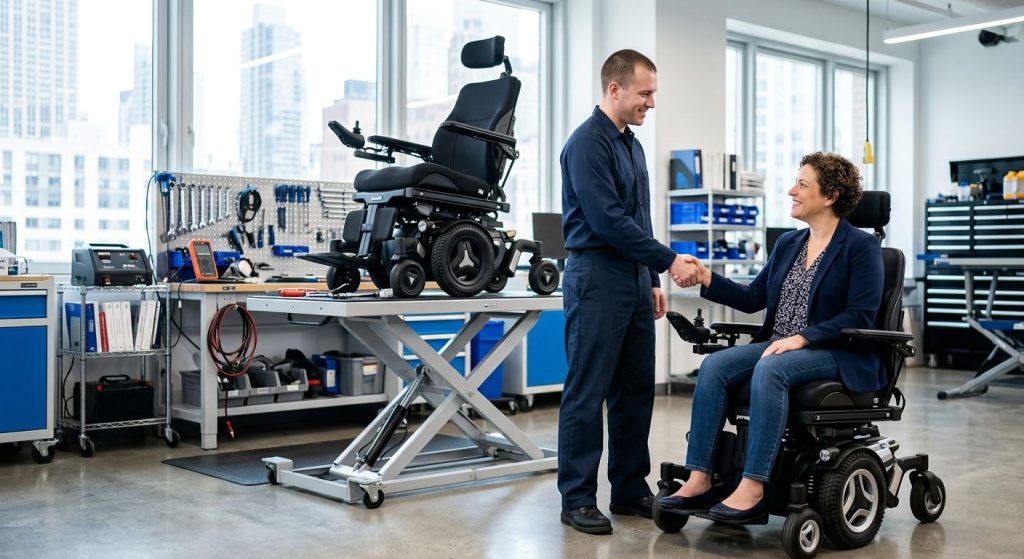
The consumer wheelchair repair bill of rights ny establishes clear protections for wheelchair users across New York State. According to the New York State Government, this act ensures you are not left without mobility when your equipment needs service. It mandates that manufacturers and repairers must provide timely service, a replacement wheelchair, or a full refund if they cannot fix your chair after a reasonable number of attempts.
Under the Consumer Wheelchair Repair Bill of Rights Act, your rights include prompt repairs and the option to receive a substitute chair while yours is being fixed. The New York Wheelchair Lemon Law works alongside these protections, offering additional safeguards for newly purchased wheelchairs that have recurring defects. Together, these regulations empower you to hold providers accountable for maintaining your independence.
Understanding the consumer wheelchair repair bill of rights ny gives you the power to demand proper service. If a manufacturer or service provider fails to meet these obligations, you can take action. Filing a complaint with the New York State Attorney General is a direct avenue to seek resolution. We recommend keeping detailed records of service visits and communications to support your case.
At MedEquipped, we guide you through the repair process, from understanding your rights to coordinating with insurance. As your partner in mobility freedom, we handle the paperwork, insurance navigation, and coordination so you can focus on staying mobile. Our team works directly with your wheelchair insurance provider to expedite approvals and repairs.
Please note: Results may vary; individual outcomes are not guaranteed. Information is not medical advice and is for informational purposes only.
The Consumer Wheelchair Repair Bill of Rights NY (also referred to as the New York Wheelchair Lemon Law) represents a major step forward for mobility users across the state. We’ve heard from countless individuals who faced lengthy waits for essential repairs, leaving them stranded without independence—and this legislation changes that. Officially titled the Consumer Wheelchair Repair Bill of Rights Act, the law ensures that manufacturers must supply repair parts and diagnostic tools not only to their own authorized providers but also to consumers and independent repair shops. It also sets a clear maximum repair time of 10 days for covered repairs, so you’re no longer left guessing when your chair will be functional again.
This protection applies to New York residents who own or lease a wheelchair, whether a manual chair or a complex power mobility device. The law covers repairs performed by the provider you choose—that includes independent shops, not just the original manufacturer’s network. Now, when a critical part fails, the manufacturer cannot refuse to sell it to you or your chosen repair shop. This shift puts control and peace of mind back in your hands. Many users fund their equipment through insurance programs, and the same repair rights apply regardless of payer. For example, if you’re one of the many people who rely on Power Wheelchair Medicare funding, you are fully covered by the Bill of Rights. According to New York State’s official summary, the law mandates that manufacturers provide access to the parts, tools, and documentation necessary for prompt repair work. MedEquipped’s patient advocacy team can help you understand how these rules apply to your specific situation.
The following table highlights the key changes brought by the Consumer Wheelchair Repair Bill of Rights Act:
| Aspect | Before the Law | After the Law |
|---|---|---|
| Maximum repair time | No statutory deadline | 10-day requirement (for covered repairs) |
| Manufacturer parts availability | Manufacturers could refuse to sell parts to owners or independent shops | Manufacturers must provide repair parts and diagnostic tools |
| Documentation requirements | No standard requirement for repair documentation | Written repair estimates and records of completed work |
| Enforcement | Limited consumer recourse through lawsuits or warranty claims | Civil penalties and potential attorney fees for violations |
The most important improvement is the 10-day maximum repair timeline. Before the law, there was no statutory deadline for repairs, and consumers had few options if a repair dragged on for weeks or even months. Now, with a firm 10-day window for covered repairs, you have the power to hold manufacturers accountable and get back to your daily life quickly.
Take a look at this quick visual summary of what the law changes.
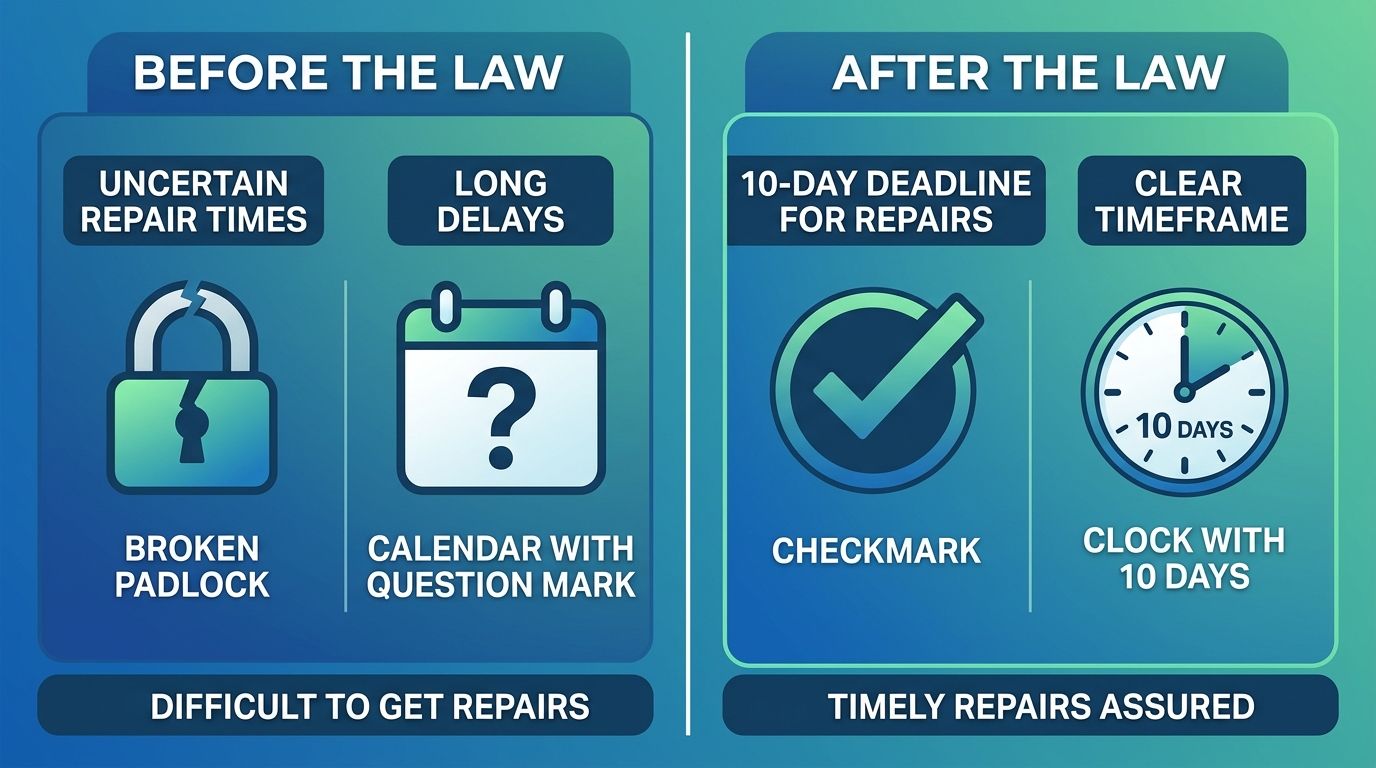
New York wheelchair repair law before-and-after comparison infographic.
We’ll break down exactly how that 10-day clock works in our next section, so you know what to expect from start to finish. As always, remember that the information we share is not medical advice and is for informational purposes only.
The New York Consumer Wheelchair Repair Bill of Rights Act (widely known as the consumer wheelchair repair bill of rights ny) requires power wheelchair manufacturers to make timely repairs possible through parts, tools, manuals, and firmware access. This law shifts control toward patients and independent shops, reducing downtime for those who depend on complex mobility equipment.
Manufacturers must sell replacement parts to owners and independent repair shops on fair, reasonable terms. They also have to make diagnostic tools and software available to qualified providers, publish or provide comprehensive service manuals, and give authorized providers access to firmware updates. These four obligations—parts, tools, manuals, and firmware—end a system where repairs were often delayed or denied. MedEquipped uses these rights to source official components and technical data directly, speeding up service without relying solely on manufacturer service centers.
The consumer wheelchair repair bill of rights ny imposes a 10-day response window: manufacturers must act on repair requests within ten days of being notified. Failure to comply can trigger penalties enforced by the New York State Attorney General. The New York Wheelchair Lemon Law reinforces this timeline by offering consumers a replacement or refund when a chair cannot be fixed after a reasonable number of attempts—typically three tries for the same defect or 30 cumulative days out of service. MedEquipped monitors repair timelines and helps escalate overdue cases to protect our patients’ mobility.
Before the Act, independent shops rarely had access to proprietary parts or diagnostic software, forcing patients to return to manufacturers for almost every repair. Now, under the Consumer Wheelchair Repair Bill of Rights Act, qualified independent providers can order parts, use diagnostic tools, and follow service manuals—provided they meet manufacturer-defined qualifications such as RESNA certification or product-specific training. MedEquipped partners with shops that meet these standards, expanding local repair options across New York. This network reduces travel and wait times while maintaining high safety and quality standards.
The following table summarizes how the law balances obligations between manufacturers and independent providers.
| Requirement | Manufacturer | Independent Provider |
|---|---|---|
| Provision of repair parts | Must sell parts to owners and independent shops | Can order parts if they meet qualifications |
| Diagnostic tools and software | Must make available on fair terms | Gains access that was previously restricted |
| Service manuals | Must publish or provide on request | Can use manuals to train technicians |
| Firmware updates | Must provide access for authorized providers | Can access to perform repairs without voiding warranty |
By setting clear rules for both manufacturers and independent shops, the law fosters competition that shortens repair times and lowers costs. Manufacturers can still require reasonable training or certification, but they cannot arbitrarily block access to essential resources. This means patients can choose where to have their chairs serviced, confident that any qualified provider has the same technical capabilities.
MedEquipped helps patients navigate every part of this legal landscape—coordinating repairs, verifying provider qualifications, and holding manufacturers accountable. Contact MedEquipped for personalized mobility solutions tailored to your needs. Information is for informational purposes only and does not constitute legal advice. Consult a qualified attorney for specific legal questions. We’re proud to be your partner in mobility freedom.
Now that you understand your rights under the consumer wheelchair repair bill of rights ny and the wheelchair lemon law in New York, you can take steps to ensure your power wheelchair gets the service it needs. The Consumer Wheelchair Repair Bill of Rights Act empowers you to demand timely repairs and choose the right provider.
Keeping thorough records is the backbone of a successful repair experience. Every interaction matters, so start a dedicated repair log. For each contact, jot down:
We suggest using a simple spreadsheet or a notebook that stays near your chair. This log becomes invaluable if you ever need to demonstrate a pattern of unresolved issues. MedEquipped can help you track insurance-related repair communications, but your personal records are your strongest tool for any future claim. Keep copies of all written communications—from email threads to mailed letters—as well as receipts and invoices. Store them digitally so you can access them on the go. Under the state’s lemon law, a series of unsuccessful repair attempts can open the door to a replacement or refund, and your documentation is the key to making that happen. Also, remember that state law requires repairs to be completed within ten calendar days unless you receive a written extension; your log will document whether this timeline was met.
One of the most important changes under the state’s repair bill of rights is that independent repair shops can now legally access the same parts and service information as the original manufacturer. This levels the playing field, so you can weigh which option works best for your needs. Independent shops now have equal access to diagnostic tools and repair manuals. The following table compares key factors to help you decide.
| Factor | Manufacturer Repair | Independent Repair |
|---|---|---|
| Parts availability | Direct access to OEM parts | Now legally guaranteed parts access |
| Repair time | May have longer wait times due to volume | Often faster, subject to 10-day law |
| Cost | Potential higher labor rates | Typically lower rates, may be negotiated |
| Convenience | Often authorized warranty work | May offer mobile service or local drop-off |
Manufacturer service can streamline warranty claims, but independent providers may get you back on the move more quickly—by law, all repairs must be completed within ten calendar days unless you receive a written extension. Think about your priorities: if speed and affordability are top concerns, a local independent shop might be the smarter pick, while a manufacturer service center can handle intricate OEM part needs. If you opt for an independent provider, verify that they are familiar with your specific chair model. Many local repair shops also offer mobile service, bringing the repair to your home or workplace. Regardless of which route you choose, keep records of every estimate and service agreement. Also, many manufacturers now offer online portals where you can track repair status and parts orders—take advantage of these tools.
When a defect persists after three or four repair attempts for the same problem, the New York Wheelchair Lemon Law provides a clear path to relief. By this point, your repair log and saved correspondence become your strongest tools. Hold on to every invoice, receipt, and written communication—including emails and text threads—these documents form the evidence you need to file a claim.
If the manufacturer cannot fix the issue after a reasonable number of tries, you have the right to request arbitration or pursue other legal remedies. To start the process, gather all repair orders, your log, and any written estimates or denials. Contact the New York State attorney general’s office or a local consumer protection agency that handles lemon law claims. They can explain the arbitration process and what documents you will need.
There are time limits for filing a lemon law claim, so don’t delay once you’ve documented a sustained failure. MedEquipped can help you organize your paperwork and coordinate with insurance providers, so you have a clean case file. However, we recommend keeping your own duplicate records as your personal safety net. We’re here to guide and support, not to replace your own documentation.
Results may vary; individual outcomes are not guaranteed.
Struggling with a repair delay? Our next guide walks you through what to do when the clock is ticking.
The Consumer Wheelchair Repair Bill of Rights NY establishes a 10-day repair requirement for all wheelchairs sold in New York, ensuring that users aren’t left without essential mobility. Meanwhile, the New York Wheelchair Lemon Law provides a safety net when repeated repair attempts fail, entitling owners to a refund, replacement, or compensation. These two protections intersect to create a robust framework that addresses both timely repairs and chronic defects.
According to the New York State Government, the Repair Bill of Rights imposes civil penalties and attorney fees for noncompliance, while the Wheelchair Lemon Law—as explained by MedEquipped’s educational resources—requires mandatory arbitration before a lawsuit can be filed. This dual-layer design means that you can push for a swift repair under the 10-day mandate, and if the problem recurs or the repair is inadequate, you can escalate to demand a refund or replacement through arbitration. The Consumer Wheelchair Repair Bill of Rights NY thus provides immediate enforcement power, while the Lemon Law offers long-term protection against persistent defects. Together, they give you leverage to demand action and, if necessary, seek a full resolution beyond just another repair. We often remind our clients that understanding these overlapping protections can be the difference between prolonged frustration and a swift return to independence.
If you’re dealing with a repair delay or a chronic problem, you don’t have to choose one law over the other—they’re designed to work in tandem, offering both immediate enforcement and long-term recourse. If your wheelchair remains in disrepair or the same issue repeats, you have options under both laws. Our next guide walks you through the practical steps to take when repairs stall or fail—so you know exactly how to assert your rights and get the mobility solution you deserve. Please note that this information is for educational purposes and is not legal advice; consult with an attorney for your individual situation.
Now that you know about the support we offer for maintaining your mobility equipment, you may be curious about the protections available to you here in New York. Understanding your repair rights is an important part of staying mobile, and we are here to help clarify what the law provides.
What is the consumer wheelchair repair bill of rights NY? In New York, this protection entitles you to timely repairs, clear communication from your provider, and a loaner wheelchair when repairs drag on for an extended period. Our team at MedEquipped follows these standards to keep you moving, and we are always ready to address your questions in Spring Valley, NY.
Does the New York Wheelchair Lemon Law cover my power wheelchair? This law typically applies when a power wheelchair fails to conform to its warranty after a reasonable number of repair attempts. If that happens, you may be entitled to a replacement or a refund — something we can help you explore while coordinating with your manufacturer.
What can I do if my repair rights are violated? Under the Consumer Wheelchair Repair Bill of Rights Act, you can file a complaint with the New York Attorney General’s office. Unreasonable delays and failure to disclose repair timelines up front are issues that this office takes seriously.
This information is for informational purposes only and does not constitute legal advice. Consult a qualified attorney for legal guidance. If you have more questions about your rights or need help navigating the repair process, reach out to us at MedEquipped — we are here to support your mobility freedom with personalized guidance.
In New York, the consumer wheelchair repair bill of rights ny guarantees timely repairs, free loaner chairs, and no-cost warranty work. If repair attempts fail, the New York Wheelchair Lemon Law may provide a replacement or refund.
As your partner in mobility freedom, we handle repair claims, paperwork, and insurer coordination—advocating for your rights. Georgia and Michigan residents: we’ll help with your state’s laws.
Information is for informational purposes only and does not constitute legal advice. Consult a qualified professional for legal guidance.
Next, we’ll help you choose your custom wheelchair.
Table of Contents Understanding Medicare Power Wheelchair Coverage in 2026 2026 Medicare Power Wheelchair Eligibility Rules at a Glance The Face-to-Face Mobility…
Read More
Table of Contents Understanding Medicare Power Wheelchair Coverage in 2026 Prerequisites for Your Medicare Power Wheelchair Application Confirm Your Medical Necessity for…
Read More
Table of Contents The Medicare Mobility Assistive Equipment Algorithm Explained Prerequisites for Medicare Motorized Wheelchair Coverage Assess Your Daily Mobility and Functional…
Read More