MedEquipped

Author: admin

  • Motorized Wheelchair Troubleshooting: Quick Fixes for Power Issues

    Motorized Wheelchair Troubleshooting: Quick Fixes for Power Issues

    Table of Contents

    Power Wheelchair Troubleshooting: A Practical Guide

    When your power wheelchair doesn’t respond as expected, systematic troubleshooting can restore your independence. We recommend starting with simple checks before considering professional service.

    For a motorized wheelchair troubleshooting session, always power off your device first. Inspect the battery connections for corrosion or looseness — a wheelchair battery not charging often stems from a disconnected cable or a tripped circuit breaker. Verify that charger indicator lights show active charging and that the power cord and outlet are free of damage.

    Common joystick error codes like E-1 (battery voltage low) or E-3 (motor fault) can sometimes be cleared by turning the chair off for 30 seconds. If you see erratic movement from power chair joystick error codes, a field recalibration through the controller menu may help — check your manufacturer’s manual for model-specific sequences.

    Should these steps not resolve the issue, discontinue use and contact a certified technician. If your chair was obtained through power wheelchair medicare coverage, review your plan for repair options in the next section. Results may vary; individual outcomes are not guaranteed. Consult your wheelchair manual or a qualified technician for persistent issues.

    Safety and Preparation for Motorized Wheelchair Troubleshooting

    Before attempting any motorized wheelchair troubleshooting, safety must come first. Your power chair is a sophisticated medical device, and proper preparation ensures both your well-being and the integrity of the equipment. At MedEquipped, we believe you are our partner in mobility freedom, and we want every maintenance task to feel approachable and safe.

    Begin by powering off your wheelchair completely and disconnecting it from the charger. Always consult your owner’s manual for model-specific safety instructions and component locations before any inspection or repair. The U.S. Food and Drug Administration recommends following manufacturer guidelines to prevent hazards, and the Rehabilitation Engineering and Assistive Technology Society of North America (RESNA) emphasizes pre-service safety preparations as a professional standard.

    Gather a few basic tools to get started: a multimeter (a device that measures voltage and continuity), a screwdriver set, and safety gloves. As a first step, check the battery terminals for corrosion and confirm all connections are secure — a common culprit behind issues like a wheelchair battery not charging or unexpected power wheelchair battery troubleshooting needs. If you notice loose connections, tighten them carefully before proceeding.

    Avoid making unauthorized modifications, as these can void your warranty or create safety risks. We also advise checking your joystick for visible damage if you’ve seen power chair joystick error codes on the display, though detailed diagnostics come later. Remember, MedEquipped’s certified technicians are here to support you with your custom motorized wheelchairs.

    Consult your wheelchair provider before performing any maintenance. In the next section, we’ll walk step by step through resolving the most frequent power chair issues, from battery problems to control system alerts.

    Check Battery Connections and Terminals

    If your power wheelchair is showing signs of wheelchair battery not charging or intermittent power loss, the next logical step in basic motorized wheelchair troubleshooting is a close inspection of the battery terminals and wiring. Loose or corroded connections are among the most common, yet simplest, issues to resolve. As your partner in mobility freedom, we recommend this quick check before assuming a more complex failure.

    Start with safety: ensure the chair is powered down and unplugged. Visually inspect the terminals for any white or bluish powdery buildup, which signals corrosion. A gentle cleaning with a mixture of baking soda and water, carefully applied and then thoroughly dried, can restore a solid contact point. Next, confirm all cable connections are snugly tightened, as even a slightly loose wire can create a power chair joystick error codes scenario by disrupting consistent power flow. Finally, trace the visible cable length, looking for any frayed insulation or exposed wiring that could cause a short.

    If your battery still fails to hold a charge after these steps, the problem may be internal. For owners of our custom motorized wheelchairs, we are ready to assist with more in-depth diagnostics.
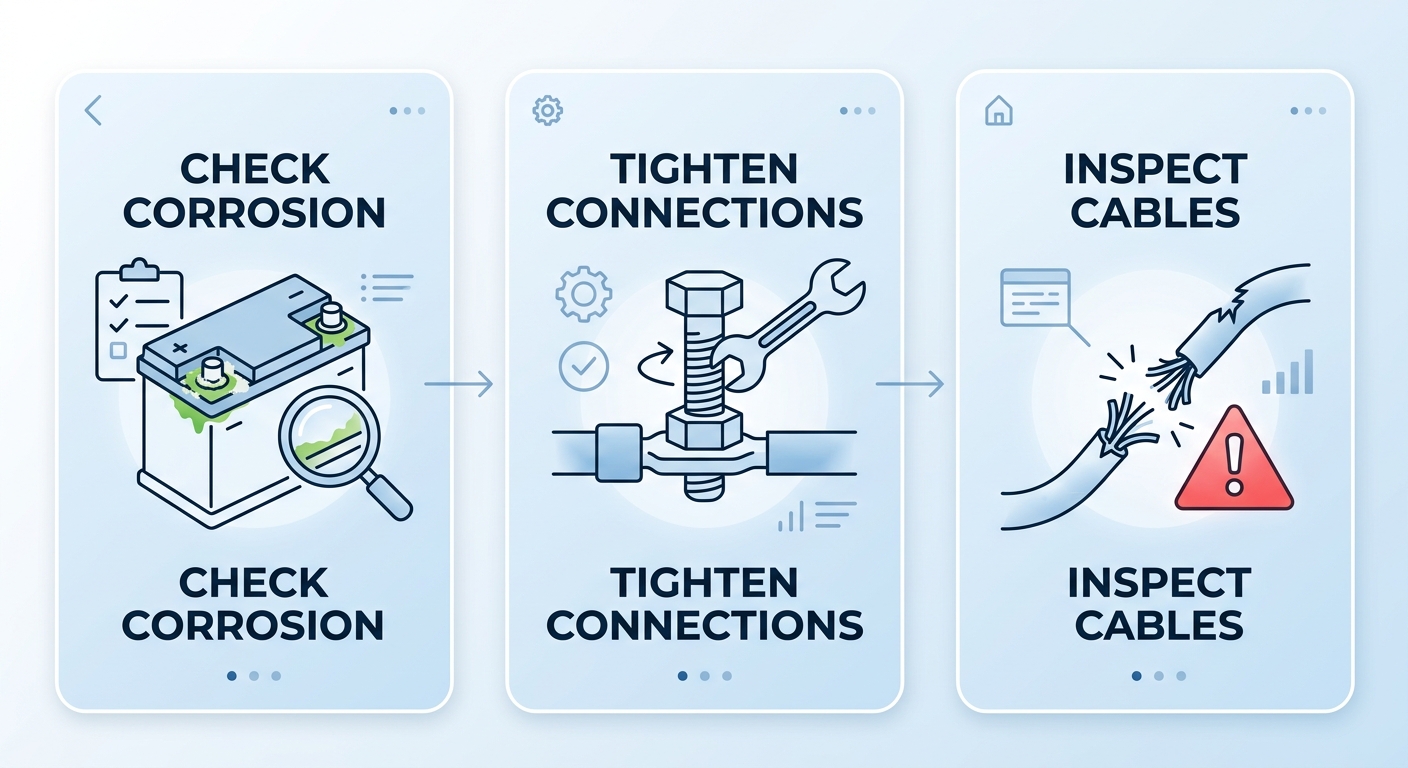
    Three-panel infographic for wheelchair battery inspection: check corrosion with baking soda mix, tighten connections securely, and examine cable insulation for damage, using blue and white palette.

    Battery connection inspection guide from MedEquipped for power wheelchair maintenance.

    Results may vary; individual outcomes are not guaranteed. Consult a qualified technician for complex issues. This information is not medical advice and is for informational purposes only.

    Test the Battery with a Multimeter

    In a motorized wheelchair troubleshooting scenario, one of the first things we check when a chair stops performing is the battery. If you’re dealing with a wheelchair battery not charging or seeing a power chair joystick error, a simple voltage test can tell you a lot. At MedEquipped, we recommend testing the battery yourself before calling us, as it’s a safe and straightforward process that can save you time.

    Always put safety first. Before you begin, ensure the wheelchair is turned off and completely disconnected from its charger. Wear protective gloves and eyewear if you have them. Use a digital multimeter set to DC voltage in a range that covers at least 24 volts. Be extremely careful not to let the metal probes touch each other while they’re on the terminals—this will cause a short circuit and can be dangerous.

    Once you’ve prepared, follow these steps:

    1. Identify the positive (usually red, marked with a +) and negative (black, marked with a −) terminals on your battery.
    2. Place the red multimeter probe firmly on the positive terminal and the black probe on the negative terminal.
    3. Hold the probes steady and read the number on the multimeter display.

    Interpreting the reading is simple. A healthy, fully charged 12-volt battery should show around 12.6 volts. For a 24-volt system, expect about 25.2 volts. If you see a significantly lower reading or zero volts, the battery needs a full charge or is likely faulty. If the voltage is normal but you’re still experiencing a power chair joystick error, the issue may lie elsewhere in the system.

    This guide is for informational purposes only. Always consult a qualified mobility technician for repairs. If the battery passes, the next step is to check the motor connections. If it fails, a charge or a replacement may be the solution. Remember, we’re your partner in mobility freedom, and we’re always here to help get you moving again.

    Reset the Power Chair Controller

    When motorized wheelchair troubleshooting leads you to a sudden stall or flashing error code, a controller reset is often the first step to regain mobility. As your partner in mobility freedom, we recommend this simple procedure whenever the joystick becomes unresponsive.

    Before you begin, confirm that all cable connections on your power chair controller are firmly seated. Then follow these steps:

    1. Turn the controller off completely.
    2. Wait 10–15 seconds.
    3. Turn the controller back on and let the system restart.

    The joystick should be in neutral and the chair on a flat, stable surface during the reboot. If error codes persist, consult our Joystick Error Code Guide to interpret specific blink patterns—understanding power chair joystick error codes helps you decide whether a simple reset is enough. Remember, these steps are informational only; always consult your owner’s manual or a qualified technician. Should the issue continue after a joystick reset, it may be time for a thorough power wheelchair stalling evaluation by a professional.

    Interpret Joystick Error Codes

    Understanding the basics of motorized wheelchair troubleshooting begins with the joystick controller, which often communicates issues through specific error codes. Recognizing these signals can help you identify simple fixes and know when it’s time to seek professional support. For more complex issues, our team at MedEquipped is here to help coordinate expert care.

    Some common power chair joystick error codes you might encounter include:

    • Flashing LED patterns (e.g., 2 or 3 flashes): These often indicate a joystick potentiometer failure or an internal controller fault, meaning the joystick isn’t communicating correctly with the chair’s motors.
    • Specific error numbers on the display: Numbers can point to wiring issues, such as a disconnected or damaged cable between the joystick module and the power base.
    • Battery indicator errors: While a wheelchair battery not charging issue is a distinct topic, a blinking battery light on the joystick can sometimes be confused with a control system fault.

    A first step for any error is a basic power cycle. Turn the chair off completely, wait a full minute, and then turn it back on to allow the system to reset. You can also visually check all cable connections leading to the joystick, ensuring they are clean, dry, and securely seated. However, persistent errors should be addressed by a technician. Some repairs, including joystick replacement, may be covered under insurance, a process we can support as your partner in mobility freedom. Please consult your manual or contact a professional for codes that don’t resolve quickly.

    Address Stalling or Slow Movement

    When your power chair hesitates, responds sluggishly, or stalls altogether, it disrupts your day and your confidence. As your partner in mobility freedom, we know that quick motorized wheelchair troubleshooting can often resolve these hiccups. Slow movement in our custom motorized wheelchairs typically stems from a few manageable sources. A wheelchair battery not charging fully is the most common culprit, so always begin by checking your battery gauge and ensuring all connections are secure. Worn motor brushes or debris in the drive wheels can also be factors. Next, look for joystick error codes; many controllers display a flashing light pattern that corresponds to a specific fault in your owner’s manual. A power chair joystick error codes reference chart can help you interpret these signals quickly. Often, a simple system reset—turning the chair off, waiting a moment, and powering it back on—clears temporary electronic glitches. If the problem continues despite these checks, consistent stalling points to a deeper technical issue. Per guidelines from the Rehabilitation Engineering and Assistive Technology Society of North America (RESNA), unresolved electronic or motor faults should be assessed by a certified technician to avoid further damage. Before scheduling service, you might also explore whether your plan helps, including your power wheelchair medicare coverage options for qualified repairs. For ongoing issues, reach out to us; our certified team is ready to help you restore the smooth, reliable ride you deserve.

    If issues persist, please consult a qualified technician for a hands-on evaluation.

    Resolve Beeping and Lockout Issues

    We understand how frustrating it can be when your power wheelchair starts beeping or enters a lockout mode. In motorized wheelchair troubleshooting, common causes include a low battery, activated seat sensor, safety override, or system error codes — each producing distinct patterns you can identify. A wheelchair battery not charging issue often triggers repeated beeps, while power chair joystick error codes may flash on the display, signaling specific faults.

    Lockout modes (emergency stop, tilt-in-space lock, or drive-disabled state) are safety features that prevent movement until the condition clears. To exit most lockouts, follow these steps:

    • Power-cycle the chair by turning it off and on; wait a few seconds before restarting.
    • Check that all cable connections are secure and free from damage.
    • Verify the joystick is in the neutral position (centered and not tilted).
    • If beeping persists, consult our General Troubleshooting FAQ for beep patterns and call our support team.

    Most beeping and lockout issues respond to this motorized wheelchair troubleshooting approach. However, sometimes Medicare coverage changes can trigger a lockout if your chair no longer meets criteria. When that happens, your wheelchair insurance may need an update. As your partner in mobility freedom, we handle the paperwork, insurance navigation, and coordination to get you moving again. We always recommend contacting a certified technician or our support team when basic steps don’t resolve the issue. Consult a healthcare professional before making clinical decisions; this information is not medical advice.

    Perform a Complete System Reboot

    When simple checks don’t resolve issues, performing a complete reboot is a powerful first step in motorized wheelchair troubleshooting. We recommend this process as a safe, effective way to clear temporary software glitches that can affect your power chair’s performance.

    Start by turning the main power off. Next, if you can safely access it, disconnect the battery pack. Wait at least 60 seconds to let any residual power drain completely from the system. This pause is crucial, as it allows the control module to fully reset. Finally, reconnect the battery and turn the power back on. This power chair reboot gives the system a fresh start.

    A successful reboot can fix unresponsive controls, display errors, and erratic behavior without affecting your custom drive settings. It is a simple reset, not a factory restore. If you still see error codes or your chair won’t operate normally, please contact our support team. For persistent problems, the next section covers joystick error codes and battery charging issues.

    Advanced Troubleshooting for Persistent Issues

    Even after following routine checks, some problems with your motorized wheelchair require deeper investigation. For effective motorized wheelchair troubleshooting when basic solutions fail, it’s helpful to turn to structured diagnostic protocols. The Rehabilitation Engineering and Assistive Technology Society of North America (RESNA) provides established service standards that many qualified technicians follow to systematically identify faults.

    When a wheelchair battery not charging issue continues despite a secure wall outlet, the problem often lies in the charger, cables, or battery health. We recommend a step-by-step approach to identify the cause:

    1. Carefully inspect all cable connections for bent pins, corrosion, or debris.
    2. Observe the charger’s indicator lights—a blinking or absent light can signal a dead charger or internal fault.
    3. Have a technician test the battery pack’s voltage and check for signs of sulfation, which is a crystalline buildup on lead-acid battery plates that reduces capacity.

    Joystick problems present another layer of complexity. Common power chair joystick error codes appear as a sequence of flashing lights, with the pattern indicating a specific fault. For instance, a slow red blink may point to a low battery, while rapid red flashes can signal a locked motor or controller fault. Often, a full system reset—disconnecting power for several minutes—can clear temporary errors. The U.S. Food and Drug Administration (FDA) reminds users that any repeated controller or motor malfunction must be approached with caution, as ignoring persistent safety signals could create unsafe operating conditions.

    If a reset doesn’t resolve the pattern, stop using the chair. Document the flash sequence, when it occurs, and under what conditions. Recording these symptoms will speed up a professional diagnosis, a practice aligned with best practices in the field. Even custom motorized wheelchairs can develop persistent issues, and we’re always ready to help you get back to independence. Contact MedEquipped’s team to schedule an evaluation—we are your partner in mobility freedom.

    Information is not medical advice and is for informational purposes only. Consult a healthcare professional before making clinical decisions.

    Maintaining Your Power Chair for Long-Term Reliability

    Simple, consistent care prevents most issues that lead to motorized wheelchair troubleshooting. We understand your custom chair is a vital daily companion, so we recommend these straightforward habits.

    Follow battery charging best practices to avoid the frustration of a wheelchair battery not charging unexpectedly. Charge after each use, and avoid deep discharges to protect long-term battery health. For the controls, gently wipe the joystick and panel with a dry cloth. Preventing debris buildup helps you avoid confusing power chair joystick error codes.

    Monthly, inspect your tires and casters for wear, and keep electrical connections free of moisture and dust. We also advise scheduling an annual professional checkup. A custom fitting from your initial clinical evaluation, as provided by MedEquipped’s certified ATP evaluators, reduces long-term mechanical wear. Your partner in mobility freedom, MedEquipped, is here to help with ongoing support.

    Resources

  • Get Custom Motorized Wheelchair for Adults: Fast Delivery 2026

    Get Custom Motorized Wheelchair for Adults: Fast Delivery 2026

    Table of Contents

    Custom Motorized Wheelchairs for Adults: A Path to Greater Independence

    Achieving true independence starts with a mobility solution designed around you — not the other way around. A custom motorized wheelchair for adults is a precisely fitted power chair built to match your unique body shape, clinical needs, and daily lifestyle. At MedEquipped, we see ourselves as your partner in mobility freedom, combining advanced clinical evaluations with end-to-end coordination so you can focus on living fully.

    A properly tailored custom fit does more than improve comfort. It promotes better posture, distributes pressure evenly, and helps reduce the risk of long-term secondary health issues. Our certified ATP evaluators and dedicated technicians use clinical assessments to inform every decision, ensuring your chair integrates the right combination of complex rehab technology and power seat functions for superior support and accessibility. As part of this process, we often conduct a wheelchair pressure mapping evaluation to verify that your seating system protects your skin and maximizes stability.

    We handle the paperwork, insurance navigation, and coordination from evaluation to delivery — including serving families across New York, Georgia, and Michigan. Most custom motorized wheelchairs for adults move from initial assessment to your doorstep in 30 to 60 days, with faster processing available when needed. Everything we do is built around one goal: getting you mobile with confidence.

    Many customization options go into designing your ideal chair, from seating geometry and control placement to specialized power adjustments. Exploring these choices is the next step toward a wheelchair that truly supports your independence.

    Disclaimer: Results may vary; individual outcomes are not guaranteed. Consult a healthcare professional before making clinical decisions. This information is not medical advice and is for informational purposes only. Privacy notice: we do not sell personal information (see Privacy Policy). SMS terms: message and data rates may apply; reply STOP to unsubscribe.

    Understanding Custom Motorized Wheelchairs and Complex Rehab Technology

    A custom motorized wheelchair for adults is far more than a standard power chair—it is a precisely engineered mobility solution tailored to an individual’s unique physical and functional needs. At MedEquipped, we see these devices as a true complex rehab technology (CRT), a formal classification for wheelchairs that require extensive evaluation, configuration, and fitting by certified professionals. Unlike a one-size-fits-most device, a CRT wheelchair is designed from the ground up to provide customized support, positioning, and independent control for daily indoor and outdoor use.

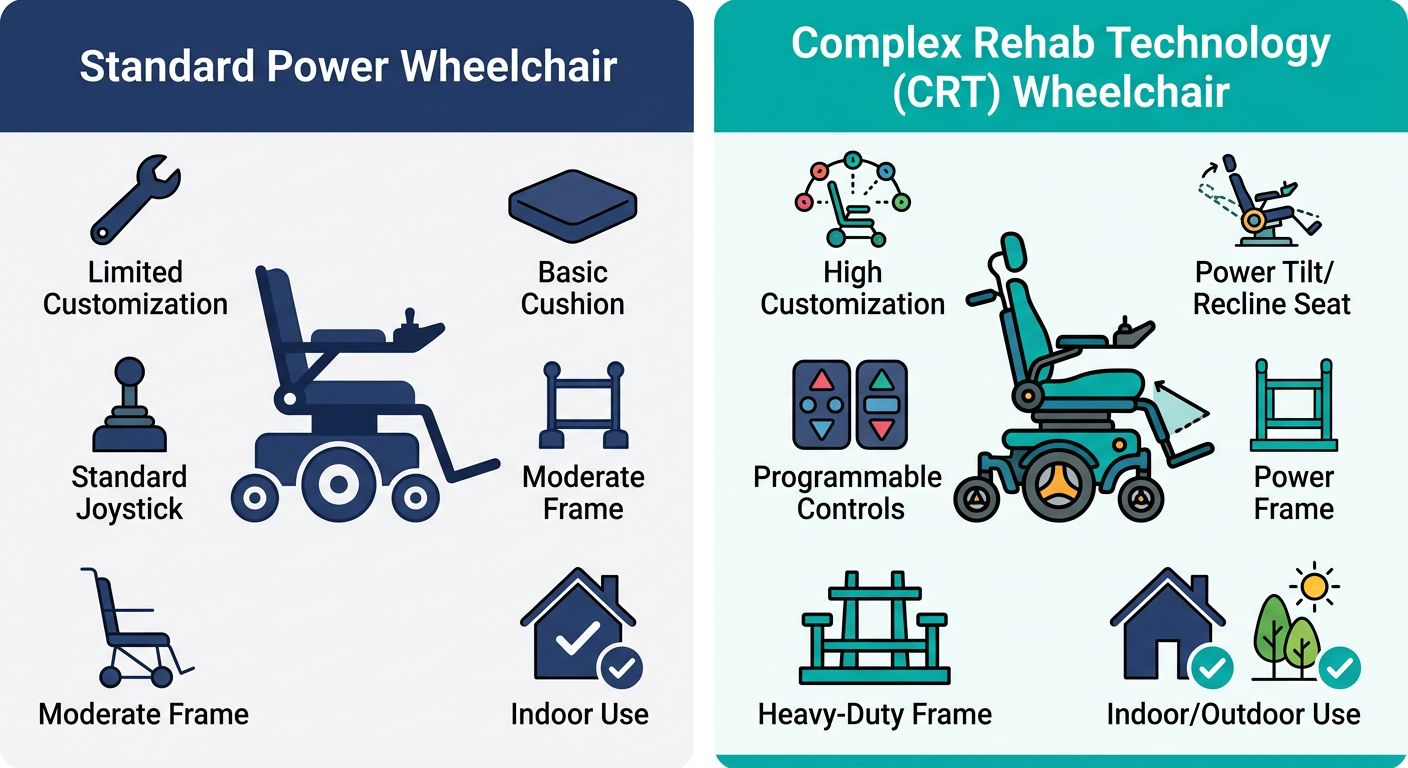
    The following table illustrates the key differences between a standard power wheelchair and a custom CRT wheelchair.

    Standard Power Wheelchair vs Complex Rehab Technology Wheelchair
    FeatureStandard Power WheelchairCRT Wheelchair
    Customization LevelLimited; pre-configured optionsHighly customizable; fully adjustable seating and controls
    Seating OptionsBasic cushion; minimal positioningCustom cushions, power tilt/recline, elevating legrests, seat elevation
    Drive Control AdjustabilityStandard joystick; limited programmabilityProgrammable joystick, head array, sip-and-puff; fully customizable
    Frame DurabilityModerate; designed for light to moderate useHeavy-duty; built for frequent, long-term use
    Insurance ClassificationStandard DME (durable medical equipment)CRT (complex rehab technology); higher documentation needs
    Typical Use CasesIntermittent indoor mobilityDaily indoor and outdoor mobility for complex conditions

    A standard power chair is often adequate for temporary or limited mobility, but a CRT wheelchair is essential when long-term positioning and advanced functionality are required. The heavy-duty frame of a custom chair is not just about durability; it serves as a stable platform for integrating advanced power seat functions. These functions, such as power tilt and recline or elevator-like seat elevation, are not luxury add-ons. They are medically necessary for pressure relief, improved respiration, and safe, independent participation in daily activities. As part of our clinical process, a wheelchair pressure mapping evaluation is an invaluable tool we use to guide the selection of a custom cushion, ensuring pressure is distributed evenly to protect skin health.

    Side-by-side comparison infographic showing standard power wheelchair with icons for basic features on left and complex rehab technology wheelchair with advanced feature icons including power tilt/recline and programmable controls on right.

    Comparison of standard power wheelchairs versus CRT wheelchairs highlighting key feature differences.

    Drive controls on a custom motorized wheelchair represent another leap forward in customization. While a standard chair offers a simple joystick, a CRT system’s programmability is limitless. We can integrate specialty drive controls like a head array or sip-and-puff system for individuals with limited hand function. This level of adjustment, down to the acceleration and braking sensitivity, is a cornerstone of the complex rehab technology definition endorsed by the Rehabilitation Engineering and Assistive Technology Society of North America (RESNA), the industry standard for quality and safety. These RESNA standards guide our equipment selection process to ensure your chair is safe, durable, and perfectly adjusted.

    From a practical standpoint, these clinical differences translate into a distinct insurance pathway. Standard power wheelchairs are classified as Durable Medical Equipment (DME), a broad category. A CRT wheelchair, however, is in its own class, requiring detailed medical documentation and a face-to-face clinical evaluation. At MedEquipped, we are your partner in mobility freedom. We handle the paperwork, insurance navigation, and coordination as a core part of our service, leveraging our certified ATP-led evaluations to build a compelling case for the equipment you truly need. This comprehensive approach is what transforms a complex process into a clear, manageable path toward gaining a custom power wheelchair.

    Exploring Power Seat Functions and Customization Options

    We at MedEquipped know that a truly custom motorized wheelchair for adults is more than just a base and a seat—it’s a system designed to adapt to your unique body and daily life. Power seat functions turn a standard power wheelchair into a dynamic tool for health management, comfort, and independence. By adding these features, you gain the ability to reposition yourself throughout the day without help, which is central to our mission as your partner in mobility freedom.

    Primary Power Seat Functions and Their Benefits

    Power tilt is a function that angles the entire seating system backward while maintaining the hip and knee angles, redistributing pressure away from the sitting bones. This movement is critical for pressure relief; according to our pressure mapping evaluation data, shifting weight through tilt can significantly lower a user’s Peak Pressure Index, reducing the risk of pressure ulcers. Power recline, which changes the angle between the backrest and the seat, works differently by opening the hip angle. This function is often used for managing muscle tone, preventing contractures, and providing an alternative pressure relief surface by changing the body’s contact area with the cushion.

    Elevating legrests raise the lower extremities independently, which is an essential feature for controlling edema, improving circulation, and simply finding a more comfortable leg position after long periods of sitting. Seat elevation moves the user vertically from a seated to a standing position’s height, enabling independent reach to high shelves, safer and easier transfers, and more natural eye-to-eye social interactions. For those with the necessary medical clearance, power standing takes this further by bringing the user into a fully upright, weight-bearing posture, which can offer profound benefits for bone density, circulation, and psychological well-being. Each of these complex rehab technology power seat functions serves a distinct clinical purpose, and their inclusion must be justified for insurance coverage.

    Customizing Control Systems and Drive Interfaces

    The most advanced power seat functions are only useful if you can command them effortlessly. An assistive technology professional near me plays the central role in identifying a custom motorized wheelchair for adults with the right drive interface. This specialist evaluates your strength, range of motion, and coordination to select from options like a standard or mini proportional joystick for precise hand control, or a compact joystick for users with limited finger dexterity. For those who cannot use their hands reliably, a head array built into the headrest can activate switches through gentle head movements, while sip-and-puff controls interpret breath pressure through a tube for precise, sequential commands.

    Another innovative solution uses proximity switches, which are fiber-optic or infrared sensors that require no physical force to activate—simply bringing a finger or head within a short distance of the switch is enough. The selection process is deeply personal, and we work with you and your therapist to match the technology to your most consistent and fatigue-free movements. The goal is an interface that feels intuitive and dependable, letting you focus on where you are going and not on how to get there. We handle the paperwork, insurance navigation, and coordination for these critical components just as we do for the chair itself. Results may vary; individual outcomes are not guaranteed. Consult a healthcare professional before making clinical decisions. This information is not medical advice.

    Indoor and Outdoor Mobility Considerations

    Customizing a power wheelchair means considering your environment, from tight, carpeted hallways to grassy parks. The drive wheel configuration is a major factor. A center-wheel drive base offers an exceptionally tight turning radius, making it a top performer for maneuvering around furniture and through narrow doorways in a home or office. Rear-wheel drive chairs, conversely, provide excellent stability and tracking at higher speeds, which is ideal for outdoor use, while front-wheel drive excels at climbing curbs and handling uneven surfaces with a smoother ride.

    A proper suspension system is vital for comfort and safety when moving from a smooth floor to a bumpy sidewalk; active suspension absorbs shocks, keeping all wheels on the ground and reducing spasticity triggers. Your tire choice also matters. Pneumatic tires, filled with air, cushion the ride effectively outdoors but require maintenance, while solid or foam-filled inserts are puncture-proof and require less upkeep, though they offer a firmer ride. We consider these variables during our comprehensive evaluation, balancing your primary daily environments with your recreational desires. After we finalize the specifications, our team manages the entire order, and you can typically expect delivery within 30-60 days (faster processing). We handle the paperwork, insurance navigation, and coordination, ensuring your new customized mobility system arrives ready for your world. Results may vary; individual outcomes are not guaranteed. Consult a healthcare professional before making clinical decisions. This information is not medical advice.

    The Complete Process: From Clinical Evaluation to Delivery

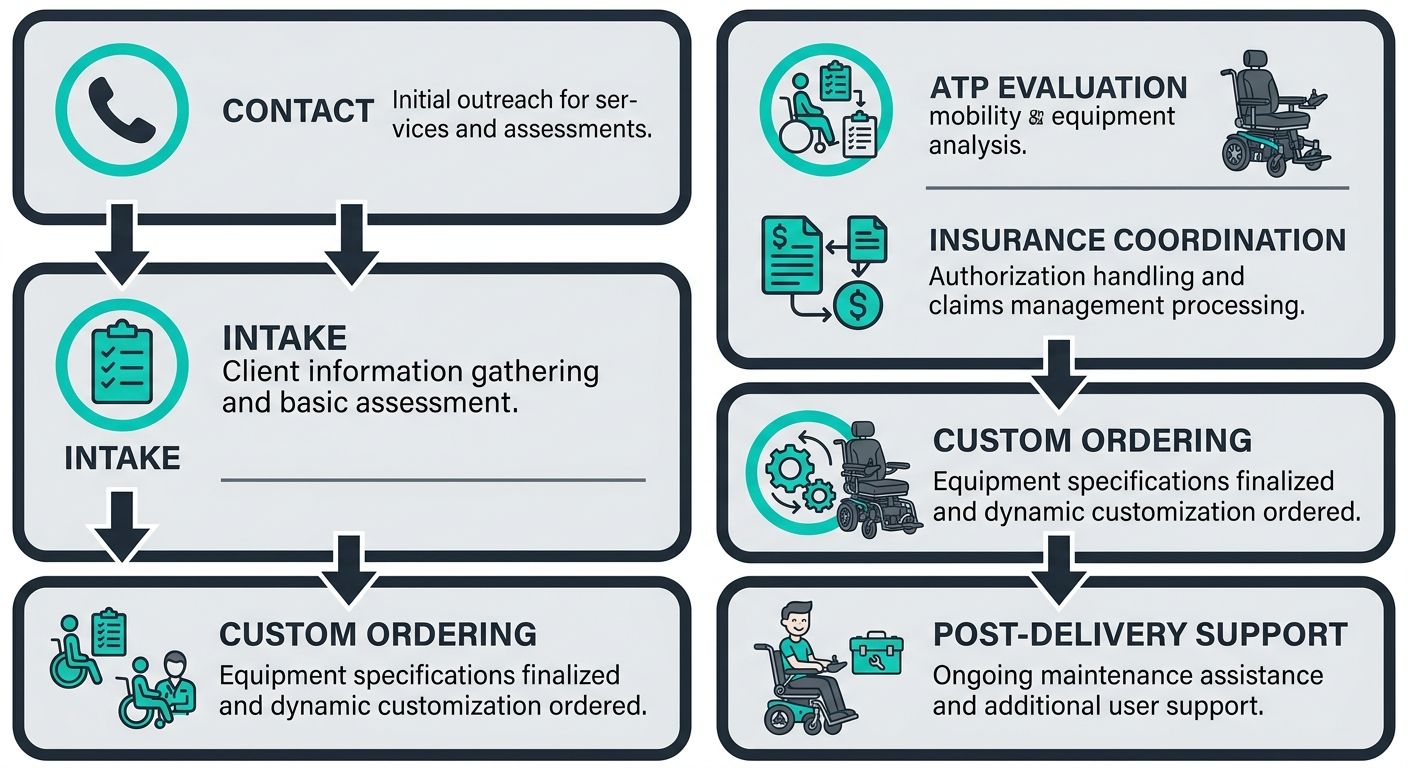
    Getting a custom motorized wheelchair for adults involves several important steps, and we guide you through each one. At MedEquipped, we handle the paperwork, insurance navigation, and coordination so you can focus on what matters most — regaining your independence and mobility. From your very first evaluation with a certified professional to the day your fully fitted chair arrives, we’re your partner in mobility freedom.

    Clinical Assessment and Evaluation

    The process begins with a comprehensive clinical evaluation led by a certified Assistive Technology Professional (ATP). This step is essential — not only to ensure your chair fits your body perfectly, but also because Medicare and most private insurers require an ATP-led assessment for complex rehab technology. During the evaluation, we conduct a detailed mobility needs assessment, analyzing how you move through your daily environment and what functional challenges you face.

    Seating and positioning analysis is a cornerstone of the evaluation. Our ATP examines your posture, spinal alignment, and weight distribution to prevent secondary complications like pressure injuries and skin breakdown. We use pressure mapping technology to visualize high-risk areas and identify optimal cushioning and support surfaces. The assessment also covers control assessment, where we evaluate your strength, range of motion, and coordination to determine the best drive control — whether a standard joystick, alternative input like sip-and-puff, or advanced power seat functions such as tilt and recline. MedEquipped recommends consulting assistive technology professional resources for further information on ATP certification standards.

    Insurance Navigation and Funding Approval

    Once the clinical evaluation is complete, the next phase focuses on securing funding. We know that insurance paperwork can feel overwhelming, which is why MedEquipped takes the lead in identifying your coverage options and managing the entire approval process. Our team reviews your benefits under Medicare, Medicaid, and private insurance plans, determining exactly what documentation each payer requires.

    We compile the ATP’s clinical findings into a detailed letter of medical necessity — the primary evidence insurers use to justify coverage. For Medicare beneficiaries, this means meeting CRT criteria with a face-to-face exam and a written order containing seven required elements. Medicaid guidelines vary by state, often requiring prior authorization and state-specific forms. Private insurance plans typically need a customized medical necessity letter along with clinical notes and the seating evaluation report. Our staff coordinates directly with physicians, therapists, and insurance case managers to minimize delays and keep your application moving forward.

    Custom Ordering, Delivery, and Follow-Up

    After funding approval, we move into the custom ordering phase. Our ATP configures your chair precisely to the specifications determined during the evaluation — frame type, seating system, power seat functions, drive controls, and any additional accessories. We source from leading manufacturers to ensure your custom power wheelchair matches both your clinical needs and your lifestyle. Once the order is submitted, the typical timeline from final configuration to delivery is 30-60 days, and we actively work toward faster processing whenever possible.

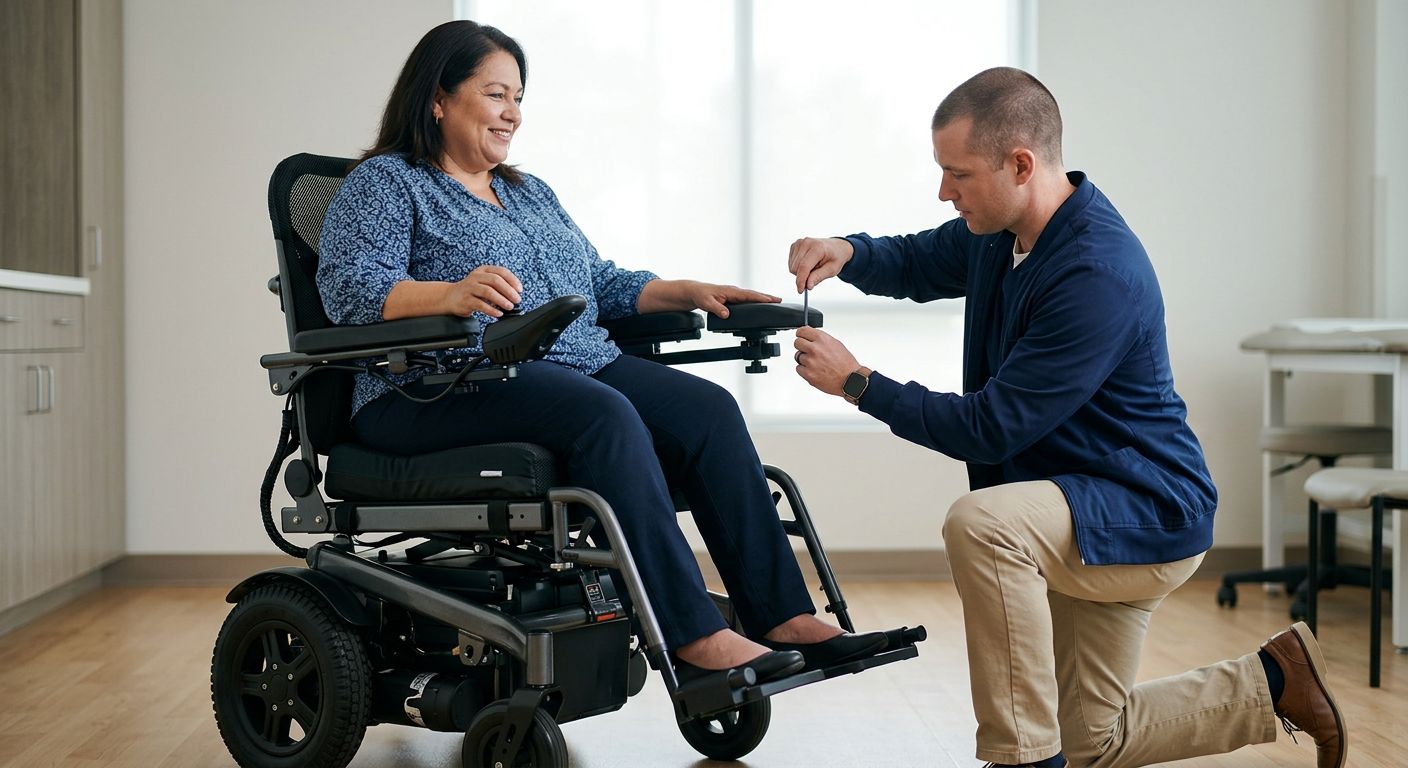
    When your chair arrives, we handle delivery and fitting personally. Our technician ensures every component is adjusted correctly, verifies that all controls respond as expected, and provides hands-on education so you feel confident operating your new equipment. But our relationship doesn’t end at delivery. We provide ongoing support for adjustments, repairs, and patient education — because a well-maintained chair is essential for long-term mobility and health. Once your chair is delivered, our ongoing support ensures it stays in top condition. Results may vary; individual outcomes are not guaranteed. Information is not medical advice and is for informational purposes only.

    Advanced Considerations for Complex Rehab Technology

    Now that we’ve defined complex rehab technology, let’s talk about the paperwork that makes it possible to get you the wheelchair you need. At MedEquipped, we guide you through every required form and clinical justification, so your custom motorized wheelchair moves from evaluation to delivery on our typical 30–60 day timeline.

    Among the documented requirements, three pitfalls cause the most delays: missing signatures or dates on the written order, vague medical necessity statements that fail to demonstrate functional need, and face-to-face exams performed outside the six-month window. Our ATP (Assistive Technology Professional) evaluators review every document for completeness, drawing on standards from the Rehabilitation Engineering and Assistive Technology Society of North America (RESNA) and the Assistive Technology Industry Association (ATIA) to help you avoid these common errors. When listing additional options such as power seat functions, we ensure each is justified in the narrative.

    Frequently Asked Questions

    What is a custom motorized wheelchair for adults?
    A custom motorized wheelchair for adults is built to your unique measurements, clinical needs, and lifestyle, incorporating complex rehab technology for superior comfort and function.

    What is pressure mapping and why is it important?
    Pressure mapping measures how your body weight distributes on the seat cushion, allowing us to select the right support and prevent skin breakdown.

    What are power seat functions and what options are available?
    Power seat functions include tilt, recline, and elevating leg rests, helping you change position independently for pressure relief and circulation.

    How long does it take to get a custom motorized wheelchair?
    After funding is approved, delivery typically takes 30–60 days (faster processing) thanks to our streamlined coordination and paperwork handling.

    Contact us at 845-237-2381 or intake@medequipped.com. We’re your partner in mobility freedom. Results may vary; individual outcomes are not guaranteed.

    Empower Your Independence with a Custom Motorized Wheelchair

    A custom motorized wheelchair for adults is more than just mobility equipment — it’s a personalized solution crafted around your body, lifestyle, and daily needs. At MedEquipped, we serve as your partner in mobility freedom, managing every step from clinical evaluation and ATP-led fitting to insurance paperwork and final delivery. Our team brings together advanced complex rehab technology and thoughtful configurations like power seat functions to create a chair that truly fits you. We coordinate the entire process so you can focus on living independently, with typical turnaround times of 30–60 days. We proudly support clients in New York, in Georgia, and in Michigan through dedicated technicians and ongoing service. Ready to see how the evaluation works? Learn about the simple steps ahead to start your journey toward greater freedom.

    Resources

  • Medicare K0823 Requirements: Guide for Heavy Duty Power Wheelchairs

    Medicare K0823 Requirements: Guide for Heavy Duty Power Wheelchairs

    Table of Contents

    1. Understanding K0823 Weight Capacity Requirements

    Meeting Medicare K0823 requirements starts with understanding that this HCPCS code classifies a heavy duty power wheelchair built for users whose body weight does not exceed 300 pounds. Accurate weight classification is the foundation of a smooth approval process, so we begin every patient journey by confirming that your clinical profile aligns with this specific capacity. When your weight falls within that threshold, the K0823 designation becomes the most appropriate funding pathway under Medicare DMEPOS guidelines, and we at MedEquipped work diligently to build a complete documentation package that supports timely authorization.

    Individuals who require heavy duty power wheelchairs 450 lbs or greater capacity typically qualify for a higher-tier code such as K0824, which accommodates users up to 450 pounds. Your evaluating Assistive Technology Professional reviews your medical history, mobility limitations, and functional needs to determine which classification best matches your daily life. Getting this classification right is critical because a mismatch can delay funding or lead to a chair that simply cannot support you safely. Our team acts as your partner in mobility freedom by verifying your weight measurement against current clinical records and helping you understand why Medicare requires this precise categorization before approving equipment.

    To support a K0823 claim, Medicare expects several pieces of documentation, which we help you gather and submit:

    • A physician’s prescription that clearly states the medical necessity for a heavy duty power wheelchair.
    • A recent clinical evaluation completed by a certified ATP or qualified clinician, documenting mobility deficits and functional limitations.
    • A documented weight measurement, typically recorded during an in-person assessment within a reasonable timeframe of the order.
    • A functional mobility assessment that demonstrates your inability to perform daily activities without powered assistance.

    MedEquipped simplifies what can otherwise feel like a daunting paperwork process. When you contact our intake team in Nanuet, New York, we collect your existing records, coordinate with your referring physician, and schedule an evaluation with an ATP who understands exactly what Medicare reviewers need to see. Our familiarity with Medicare K0823 requirements helps us flag missing details early so your submission is as clean as possible, which supports our goal of delivering your custom motorized wheelchair within a typical 30- to 60-day processing window.

    Beyond the weight-based classification itself, we also consider bariatric power wheelchair seating and positioning factors that influence safety and long-term comfort. Even within the 300-pound capacity, your body dimensions, pressure distribution risks, and postural support needs shape the seating configuration we recommend. In the next section, we explore those critical seating and positioning considerations in greater depth.

    Disclaimer: Results may vary; individual outcomes are not guaranteed. The information provided here is for informational purposes only and is not medical advice. Consult a healthcare professional before making clinical decisions.

    2. Qualifying for a Medicare Heavy Duty Chair

    Understanding Medicare K0823 requirements is the first step toward obtaining a heavy duty power wheelchair, building on the overview of chair options from the previous section. Medicare classifies power wheelchairs as durable medical equipment, so you will need a prescription from your treating physician and a face-to-face examination that documents your mobility limitations within the home. To establish medical necessity, you must demonstrate that you cannot safely operate a manual wheelchair because of a condition such as severe arthritis or a neurological disorder.

    For those who need heavy duty power wheelchairs 450 lbs and above, the K0823 code applies and covers weight capacities from 450 to 600 pounds. If your weight falls below 450 pounds, other K-codes like K0822 may be appropriate. Proper bariatric power wheelchair seating and positioning also plays a critical role in comfort and safety for larger users. According to MedEquipped’s qualification guide, an Assistive Technology Professional evaluation can strengthen your case by detailing how the chair supports your independence. Our team helps you gather the right documentation so you can move through the process smoothly. Consult a healthcare professional before making clinical decisions. Once you meet the eligibility criteria, we shift to paperwork and insurance navigation — the topic of the next section, where we walk you through applying with MedEquipped’s end-to-end support.

    3. Medical Documentation You Need

    Getting your Medicare K0823 power wheelchair approved starts with having the right medical documentation. Meeting Medicare K0823 requirements doesn’t have to be complicated — it’s about gathering specific paperwork that shows why you need this particular type of heavy duty power wheelchair documentation for your daily life at home.

    Here are the core documents Medicare needs to review:

    • Written Order (Prescription). This is your doctor’s official prescription for the wheelchair, confirming it’s medically necessary. It’s the foundation of your K0823 paperwork.
    • Face-to-Face Examination Record. Medicare requires a record showing your doctor evaluated you in person within a specific timeframe before they write the prescription. This note links the exam findings directly to the mobility recommendation.
    • Medical Necessity Statement (Detailed Written Order). This detailed narrative must clearly describe your physical functional limitations, why the wheelchair is necessary for activities inside your home, and the clinical reasons for the specific chair configuration and seating components being ordered.

    Your doctor and MedEquipped’s certified ATP evaluator work together to make sure these documents connect — the prescription aligns with the exam observations, and the medical necessity statement reflects exactly what the evaluation uncovered about your strength, range of motion, and daily mobility challenges.

    We guide you and your physician through every piece of this documentation so nothing gets missed. We handle the paperwork, insurance navigation, and coordination, turning a process that often feels overwhelming into a clear, step-by-step partnership. When your documents are complete and well-organized from the start, the typical timeline from evaluation to delivery stays within 30–60 days — much faster than trying to manage it alone.

    Once your paperwork is ready, the next stage is submitting it through the right channels. We’ll walk you through exactly what happens after your doctor signs the order.

    4. Medicare Part B Coverage for K0823

    Now let’s look at how Medicare Part B covers this code. Medicare K0823 requirements specify that this code applies to a standard power-operated vehicle designed primarily for indoor use. Under Medicare Part B, you may qualify for coverage when your physician certifies medical necessity — for example, when you cannot safely ambulate indoors without assistance.

    For heavy duty wheelchair medicare questions beyond standard K0823 criteria, additional documentation may be necessary. We handle the paperwork, insurance navigation, and coordination so you can focus on what matters most. Generally, the typical timeline for custom-fitted power chairs runs 30 to 60 days from evaluation to delivery.

    Your supplier must be enrolled in Medicare and meet all accreditation requirements. While Medicare picks up the majority of approved costs, some cost-sharing through deductibles and coinsurance still applies. Contact MedEquipped for a custom estimate of your out-of-pocket responsibility. Results may vary; individual outcomes are not guaranteed. Once coverage is confirmed, MedEquipped guides you through the next steps.

    Privacy notice: we do not sell personal information (see Privacy Policy). SMS terms: message and data rates may apply; reply STOP to unsubscribe. Consult a healthcare professional before making clinical decisions.

    5. Group 2 vs Group 3 Heavy Duty Chairs

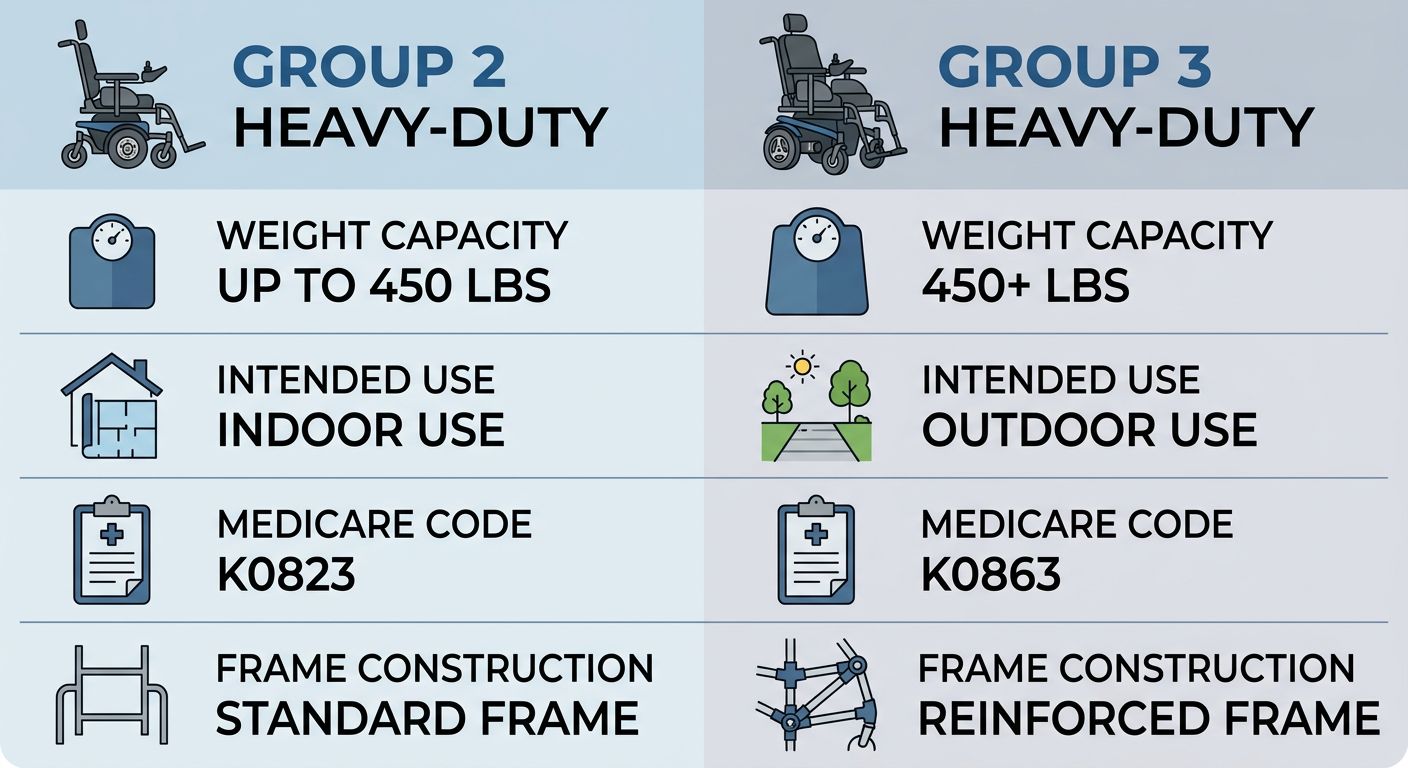
    Understanding the difference between Group 2 and Group 3 heavy duty power wheelchairs is essential for finding the right fit. These categories, defined by RESNA (Rehabilitation Engineering and Assistive Technology Society of North America), help match equipment to your weight and lifestyle needs.

    Feature Group 2 Heavy Duty Group 3 Heavy Duty
    Weight Capacity Up to 300 lbs (K0823) 300 – 600 lbs+
    Intended Use Primary indoor mobility Indoor/Outdoor & All-Terrain
    Medicare Code K0823 / K0822 K0848 – K0864

    While both groups offer exceptional support, Group 3 chairs are built for all-terrain mobility, while Group 2 models excel in everyday indoor environments.

    Two-column comparison infographic showing Group 2 and Group 3 power wheelchair specifications including weight capacity, intended use, and Medicare codes.

    Group 2 vs Group 3 heavy duty power wheelchair comparison.

    If you need a heavy duty power wheelchair rated for 450 lbs or more, or require specialized bariatric power wheelchair seating systems, we can help. Our certified ATP evaluators will assess your clinical needs and recommend the right group, ensuring your custom motorized wheelchair becomes a partner in mobility freedom. We handle the paperwork, insurance navigation, and coordination for you. Remember, Medicare K0823 requirements apply for Group 2, while Group 3 needs medical necessity documentation.

    Consult your healthcare provider to determine which group is right for you, or reach out to us for a personalized evaluation.

    6. Scheduling Your Face-to-Face Evaluation

    Once you and your physician have decided that a custom power wheelchair is the right path, the next step is a face-to-face clinical evaluation. This appointment is a standard part of meeting Medicare K0823 requirements and other insurer guidelines, ensuring your unique needs are properly documented before a chair is ordered. Think of it as your personal mobility consultation, where we become your partner in mobility freedom by getting to know you and your daily life.

    Scheduling is simple. Here’s how the process works:

    1. Contact us by phone or through our website. An intake coordinator will gather your initial information.
    2. You’ll need to provide a written prescription from your doctor, relevant medical records, and your insurance details.
    3. We then schedule your evaluation with a certified Assistive Technology Professional (ATP) at a time and place convenient for you.

    The ATP will assess your mobility, take precise measurements, and discuss your needs, including options for heavy duty power wheelchairs 450 lbs or specialized bariatric power wheelchair seating and positioning if they apply to you. We handle all the paperwork and insurance navigation, so your only job is to attend. The evaluation is typically scheduled within days, and we’ll have your chair ordered within 1–2 weeks. Results may vary; individual outcomes are not guaranteed. Bring your current mobility device and a list of questions. After the evaluation, our team takes the reins to process your custom order and guide you swiftly toward the delivery day we’ll cover next.

    Message and data rates may apply; reply STOP to unsubscribe.

    7. Configuring Bariatric Seating and Positioning

    After choosing from available bariatric power mobility bases, the next essential step is configuring the seating and positioning system. This process directly impacts comfort, pressure distribution, and overall safety during daily use. Proper configuration also helps meet key regulatory standards, including Medicare K0823 requirements, which define specifications for heavy-duty seating.

    We recommend starting with precise measurements. A minimum seat width of 22 inches is typical, but the depth and back height must match the patient’s body for optimal support. Weight capacity is equally critical; seating frames and cushions on heavy duty power wheelchairs 450 lbs and above need careful selection to ensure durability and safety.

    For a better fitting bariatric power wheelchair seating and positioning setup, consider these accessories:

    • Elevating leg rests to improve circulation and reduce swelling.
    • Tilt-in-space functionality to manage pressure and enhance comfort.
    • Adjustable armrests for easier transfers and upper body support.

    We believe that a clinical evaluation by a certified ATP, like MedEquipped’s team, is vital for achieving the best fit. Once this configuration is complete, the final steps involve testing all adjustments and preparing for delivery.

    Consult a healthcare professional before making clinical decisions related to wheelchair seating.

    8. Working with Certified ATP Professionals

    After understanding the complex world of insurance and wheelchair selection, working with a Certified ATP Professional simplifies everything. A Certified ATP Professional is a specialist trained to match mobility needs with appropriate powered devices, and their involvement is key to satisfying Medicare K0823 requirements for coverage.

    During evaluations, our ATPs assess critical areas like weight capacity for heavy duty power wheelchairs 450 lbs and seating support for bariatric power wheelchair seating and positioning, ensuring every adjustment aligns with your clinical picture and documented medical necessity.

    At MedEquipped, our ATPs coordinate with your clinicians and insurance providers, handling paperwork to streamline approvals. As your partner in mobility freedom, we specify chair configurations that match your needs, including custom adjustments for bariatric users. While we advocate for coverage, insurance outcomes depend on individual plans.

    Our certified team stays current with industry advances, offering informed guidance from evaluation through to ordering. With professional ATP support in place, the next step is delivery and long-term care.

    Partnering with MedEquipped for Your K0823 Journey

    Navigating Medicare K0823 requirements can feel overwhelming, but MedEquipped is here to simplify every step. We provide end-to-end support, from your initial clinical evaluation through insurance paperwork, custom ordering, delivery, and ongoing care. Our certified ATP evaluators across New York, Georgia, and Michigan work closely with you to configure chairs for complex needs, including mobility solutions like heavy duty power wheelchairs 450 lbs and specialized bariatric power wheelchair seating and positioning. We handle the paperwork, insurance navigation, and coordination so you don’t have to, typically completing the process in 30–60 days. As your partner in mobility freedom, we’re ready when you are—contact us to start your journey.

    Consult a healthcare professional before making clinical decisions.

    Resources

  • How to Get an Assistive Technology Professional Evaluation: Key Steps

    How to Get an Assistive Technology Professional Evaluation: Key Steps

    Table of Contents

    Understanding Your Assistive Technology Professional Evaluation

    To ensure your custom motorized wheelchairs fit perfectly, we begin with an in-depth assistive technology professional evaluation. This clinical assessment, conducted by one of our certified experts, determines the ideal wheelchair configuration and seating system for your unique mobility needs. We analyze your daily activities, functional abilities, and seating requirements to build a complete picture of what will work best for you.

    This assistive technology professional evaluation is critical for meeting power wheelchair medical necessity requirements that insurance and funding sources demand. Our team collaborates directly with you, your clinician, and the funding source to ensure the recommended equipment aligns with your lifestyle and goals. Depending on your needs, the complex rehab technology functional assessment may involve trial equipment to validate specific choices, such as front-wheel drive power wheelchairs for superior outdoor navigation and curb climbing.

    The evaluation typically lasts 60 to 90 minutes. Afterward, we handle the paperwork, insurance navigation, and coordination, with most custom orders processed within 30 to 60 days. Information is not medical advice and is for informational purposes only.

    What to Prepare for Your ATP Evaluation

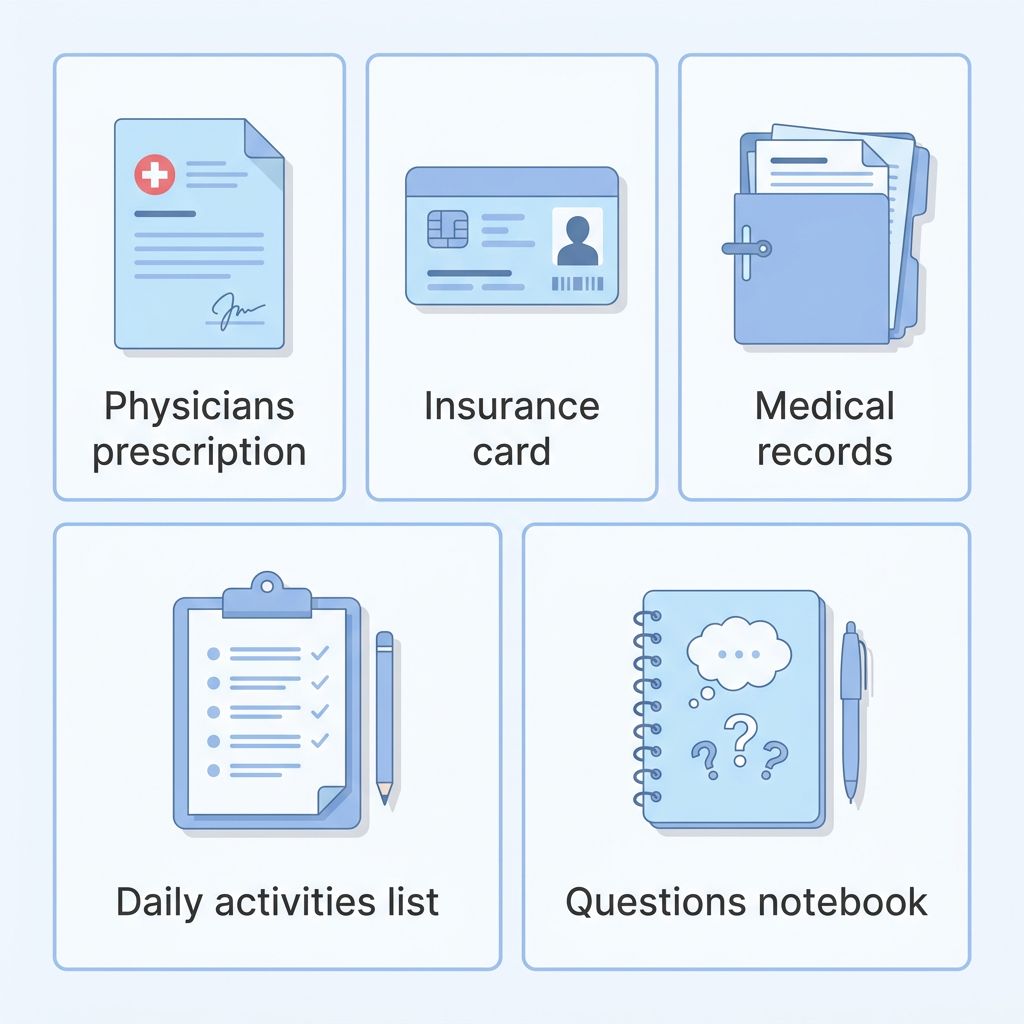
    Now that you understand the purpose of an ATP evaluation, gathering the right documents ensures a smooth start. Your assistive technology professional evaluation begins with medical records that prove your power wheelchair medical necessity requirements—so bring these key items:

    • A signed physician’s prescription for a power wheelchair
    • Your insurance card and policy information
    • Medical records detailing your mobility limitations and prior treatments
    • A list of your daily activities and functional needs
    • Any referral or authorization forms you’ve received
    • A list of questions about the evaluation process and expected timelines

    This preparation supports the complex rehab technology functional assessment your ATP will perform, which examines seating, positioning, and the environments where you’ll use your chair. The evaluator uses this information to customize the chair to your life.

    We handle the paperwork, insurance navigation, and coordination, so bringing the above documents lets us move forward efficiently. As your partner in mobility freedom, we ensure your wheelchair assessment produces a chair that fits your needs.

    Infographic checklist with icons for physician's prescription, insurance card, medical records, daily activities list, and questions notebook for ATP evaluation preparation at MedEquipped.

    Checklist of essential documents and items for your ATP evaluation at MedEquipped.

    With everything ready, your upcoming evaluation will focus on your comfort and safety. The next section walks through what happens during the appointment, turning your preparation into confidence.

    Please note: This information is for educational purposes. Consult a healthcare professional before making clinical decisions.

    Schedule Your Initial ATP Consultation

    Now that you’ve explored custom motorized wheelchairs, the first step toward your personalized mobility solution is an assistive technology professional evaluation. At MedEquipped, this consultation connects you with a certified ATP who conducts a thorough complex rehab technology functional assessment—matching your physical needs, lifestyle, and power wheelchair medical necessity requirements to the right equipment.

    We see ourselves as your partner in mobility freedom, so we handle the paperwork, insurance navigation, and coordination from this first visit through final delivery, typically completing custom orders in 30–60 days (faster processing available). This patient-centered assistive technology professional evaluation results in a custom chair from trusted brands like Permobil or Quantum Rehab, without you having to manage the details alone.

    After the ATP consultation, the clinical evaluation process begins. In the next section, we’ll walk you through what to expect. Please consult a healthcare professional before making clinical decisions—this information is for educational purposes only.

    Gather Required Medical Documentation

    Before your assistive technology professional evaluation can begin, gathering the right medical documentation is the essential first step. We help you collect everything needed to demonstrate power wheelchair medical necessity requirements. MedEquipped simplifies the process by guiding you through each requirement.

    • A valid physician’s prescription for a custom power wheelchair.
    • Medical records detailing your diagnosis, functional limitations, and a statement of medical necessity.
    • A complex rehab technology functional assessment to document mobility needs and justify the equipment.
    • Supporting documents such as PT/OT evaluations, fall history, and home environment details.

    The complex rehab technology functional assessment, required by most insurers, confirms the power wheelchair is the appropriate solution. Our expertise ensures your documentation meets clinical and insurance criteria. As your partner in mobility freedom, we handle the paperwork, insurance navigation, and coordination.

    Once everything is gathered, the formal evaluation can begin — we’ll cover that next. Information is not medical advice and is for informational purposes only.

    Undergo Functional Mobility Assessment

    After your initial inquiry, the next step is a functional mobility assessment—a clinical evaluation performed by a certified Assistive Technology Professional (ATP) in New York, in Georgia, or in Michigan. This assistive technology professional evaluation establishes your unique mobility requirements.

    The complex rehab technology functional assessment evaluates your physical abilities, daily routines, home layout, and equipment needs to determine the right seating, drive controls, and power features. This holistic review ensures every aspect of your daily life is considered.

    Medicare and many insurers require this assessment to document power wheelchair medical necessity and justify coverage. MedEquipped coordinates the entire process—scheduling, managing paperwork, and communicating with your insurance—so you can focus on what matters most.

    The outcomes directly shape your custom wheelchair configuration, from seat dimensions and back support to power seating options. We’ll work closely with you, always keeping your comfort and mobility our top priority.

    Disclaimer: This assessment is for mobility equipment needs only and does not constitute medical advice. Please consult your physician for any medical concerns.

    Configure Seating and Positioning

    Building on your comprehensive evaluation, the assistive technology professional evaluation directly guides how we configure the seating and positioning of your custom motorized wheelchair. This process transforms clinical findings into a personalized setup that addresses your unique needs.

    We use a complex rehab technology functional assessment to determine the right pressure relief, postural support, and functional reach for you. The assistive technology professional evaluation makes sure every adjustment—from cushion choice to backrest angle—aligns with your daily activities and clinical goals. We work closely with you and your clinical team to capture these details, because accurate documentation is key to meeting power wheelchair medical necessity requirements and securing funding approval.

    Following standards from the Rehabilitation Engineering and Assistive Technology Society of North America (RESNA), our ATP evaluation emphasizes evidence-based configuration that helps ensure both comfort and long-term mobility. The final specifications we develop during this step will directly shape your custom order in the next phase.

    Securing a custom motorized wheelchair requires insurance approval, but MedEquipped is your partner in mobility freedom throughout the process. We handle the paperwork, insurance navigation, and coordination in New York, Georgia, and Michigan so you can focus on what matters.

    The process starts with establishing medical necessity. An assistive technology professional evaluation captures your clinical needs and sets the stage for funding. Often, a complex rehab technology functional assessment is also required to meet power wheelchair medical necessity requirements. Our team guides you through each step and incorporates specialized seating medical necessity documentation based on RESNA standards.

    Insurance prior authorization is typical, and we manage it from start to finish. The typical timeline from submission to approval is 30 to 60 days—faster than many large suppliers.

    Once approved, we coordinate the custom build and delivery. Results may vary; individual outcomes are not guaranteed.

    Finalize Wheelchair Specifications and Order

    With your clinical evaluation complete – including your assistive technology professional evaluation and complex rehab technology functional assessment – we now turn those findings into a custom order that reflects the power wheelchair medical necessity requirements documented for you. We take a straightforward approach to finalizing every detail:

    1. Confirm your measurements – we review seat width, seat depth, back height, armrest style, and footrest type captured during your evaluation.
    2. Select accessories and controls – choose your cushion, joystick controller, and any positioning aids that best support your daily routine.
    3. Place your order – once specifications are locked, we handle the paperwork, insurance navigation, and coordination with your provider.

    Your custom motorized wheelchair typically arrives in 30–60 days, often faster than many larger suppliers. For pricing, we prepare a personalized quote once your configuration is set; please contact us for an estimate.

    As your partner in mobility freedom, we stay with you through delivery and setup, providing ongoing support for every adjustment you need.

    Prepare for Delivery and Follow-Up Care

    After your assistive technology professional evaluation is complete and your custom motorized wheelchair has been ordered, it’s time to get ready for delivery. We recommend clearing a dedicated, accessible space with a nearby outlet for overnight charging. Our team will provide a delivery window and update you before our technician arrives, so you’ll always know what to expect.

    Because every chair is built around the findings of your complex rehab technology functional assessment, the typical processing timeline ranges from 30–60 days (faster processing available). Results may vary; individual outcomes are not guaranteed. Once your wheelchair is in your home, our support continues — we provide follow-up adjustments, troubleshooting, and ongoing care through our network of certified technicians.

    No matter what questions come up, we remain your dedicated partner in mobility freedom. From your first fitting to long-term maintenance, you can count on MedEquipped to keep you moving forward.

    Common Challenges in the ATP Evaluation Process

    While the Assistive Technology Professional (ATP) evaluation serves as a vital step toward obtaining a custom power wheelchair, the process can present several hurdles that patients and their care teams must navigate. From managing complex paperwork to coordinating with multiple parties, the evaluation phase often requires dedicated attention to avoid delays. We have seen how these obstacles can cause frustration, but they are also entirely manageable with the right support.

    One of the most time-consuming aspects is insurance and paperwork navigation. A thorough complex rehab technology functional assessment generates significant documentation that must be correctly submitted. Many clinicians and patients feel overwhelmed by these administrative demands; that’s why we handle the paperwork, insurance navigation, and coordination for you, reducing the burden on your care team.

    Another challenge is ensuring the evaluation clearly demonstrates medical necessity. When power wheelchair medical necessity is not properly documented during the assistive technology professional evaluation, funding requests may be denied or delayed. Our ATPs work closely with your referring physician and therapist to capture functional deficits and mobility limitations that justify the equipment, helping to prevent setbacks.

    Even after a successful evaluation, the timeline from assessment to delivery can feel long. Industry standards often extend several months, but MedEquipped’s streamlined process typically completes within 30 to 60 days. Of course, results may vary; individual outcomes are not guaranteed, yet our focused approach helps accelerate the journey. Understanding these challenges is the first step—next, we’ll explore how MedEquipped directly addresses them to make your experience as seamless as possible.

    Your Path to Mobility Freedom with MedEquipped

    Your path to mobility freedom starts with MedEquipped, your partner in mobility freedom. We guide you through every stage of obtaining a custom motorized wheelchair, beginning with an assistive technology professional evaluation performed by a certified ATP. From that first step, we prioritize your comfort and safety, making the process straightforward and stress-free. We become your dedicated partner, not just a supplier, helping you regain independence with confidence.

    This clinical evaluation, known as a complex rehab technology functional assessment, determines the power wheelchair medical necessity for your custom chair. Using detailed findings, we configure a seating system tailored to your body and lifestyle. We handle the paperwork, insurance navigation, and coordination — so you don’t have to. We also manage communication with your healthcare providers, ensuring all documentation is complete. Serving residents in New York, Georgia, and Michigan, we source chairs from trusted brands and deliver within 30–60 days, often with faster processing for qualified patients.

    Our commitment continues after delivery with ongoing support and wheelchair service repair. Whether you need adjustments or routine maintenance, we keep you moving. Our dedicated team is here for you long-term. Let’s walk through what that evaluation looks like.

    Results may vary; individual outcomes are not guaranteed.

    Resources

  • Complex Rehab Technology Documentation Requirements Guide

    Complex Rehab Technology Documentation Requirements Guide

    Table of Contents

    Mastering Complex Rehab Technology Documentation for Successful Medicare and Insurance Funding

    Meeting complex rehab technology documentation requirements is the single most important step in securing funding for a power wheelchair. Without thorough paperwork, even the best clinical justification can fail.

    For Medicare power wheelchair prior authorization, you must submit a detailed face-to-face mobility exam, a 7-element order (beneficiary, device, diagnosis, prognosis, duration of need, quantity, and physician signature), and a letter of medical necessity (LMN). Insurance coverage for complex rehab mobility devices hinges on objective clinical evidence—mobility assessments and functional limitations that demonstrate medical necessity, not just convenience. Prior authorization for certain power wheelchair codes requires this documentation before delivery; incomplete submissions are the top reason for delays. A RESNA-certified Assistive Technology Professional (ATP) evaluates your needs, matches you to the right equipment, and prepares CRT documentation that meets both clinical and funding standards. MedEquipped’s internal guidance confirms that a proper face-to-face exam and comprehensive medical records are essential, while RESNA notes that ATP involvement strengthens the funding case.

    At MedEquipped, we handle the paperwork, insurance navigation, and coordination—reducing your administrative burden so you can focus on regaining your freedom. While results may vary, thorough documentation dramatically increases your chance of approval.

    Essential Preparations for Complex Rehab Technology Documentation

    Meeting complex rehab technology documentation requirements is the crucial first step toward securing funding for your custom power wheelchair. As your partner in mobility freedom, we guide you through assembling a thorough, organized package that clearly demonstrates your need for insurance coverage for complex rehab mobility devices.

    • Secure a signed prescription and a detailed Letter of Medical Necessity from your physician, explaining your diagnosis and why a standard wheelchair or cane won’t suffice.
    • Obtain a functional mobility evaluation from a certified Assistive Technology Professional (ATP) or occupational therapist, documenting the need for power features like tilt, recline, or specialized seating.
    • Prepare a comprehensive product description listing the exact wheelchair base, custom components, and accessories, with clinical justification linking each item to your functional limitations.
    • Collect insurer-specific forms; for Medicare beneficiaries, the Medicare power wheelchair prior authorization process is essential. Our documentation checklist helps you ensure nothing is overlooked.
    • Partner with your MedEquipped specialist, who will review every piece, confirm completeness, and manage the submission—reducing delays and improving the chance of approval.

    When accuracy and thoroughness meet these preparations, the path to approval becomes smoother, bringing you closer to the mobility freedom you deserve.

    Gather Medical Records and Current Clinical Evaluations

    Understanding complex rehab technology documentation requirements can feel overwhelming, but gathering the right medical records is the first—and most important—step toward securing your custom power wheelchair. We’ll walk you through the basics.

    Here’s what you typically need:

    • A physician’s prescription for a complex rehab power wheelchair.
    • Recent chart notes documenting medical necessity and why a standard wheelchair isn’t sufficient.
    • A face-to-face mobility evaluation completed within the past six months (most insurers, including Medicare, require this timeframe).

    Meeting complex rehab technology documentation requirements doesn’t have to be stressful. Most insurers require a functional mobility assessment by a licensed therapist. For Medicare power wheelchair prior authorization, the face-to-face encounter must be documented. We at MedEquipped provide a customized checklist that identifies what records you already have and what to request. Gathering these early avoids delays and helps us reach the typical 30–60 day timeline for insurance coverage for complex rehab mobility devices.

    With your records ready, we handle the insurance navigation so you can focus on your mobility freedom. Always consult your healthcare provider for clinical decisions.

    Obtain a Certified Assistive Technology Professional (ATP) Evaluation

    After your initial consultation, the next crucial step is an evaluation from a Certified Assistive Technology Professional (ATP). An ATP holds an assistive technology professional certification from RESNA and assesses your mobility, seating, and positioning needs, creating the complex rehab technology documentation requirements insurers and Medicare demand for funding approval.

    The ATP evaluation includes a hands-on physical assessment and analysis of your home and work environment, generating the clinical notes that back insurance coverage for complex rehab mobility devices. These detailed findings satisfy Medicare power wheelchair prior authorization requirements and demonstrate medical necessity. As your partner in mobility freedom, we schedule the ATP appointment with a local provider and weave all reports into your prior-authorization packet, saving you weeks of paperwork.

    This evaluation becomes the cornerstone for the insurance paperwork and Medicare prior-authorization we handle on your behalf, meeting every complex rehab documentation requirement. Next, we dive into the funding and paperwork process to secure your custom power wheelchair.

    Craft a Strong Medical Necessity Justification for Complex Rehab Power Wheelchairs

    After identifying the right complex power wheelchairs, the next step is proving it is medically necessary. Meeting complex rehab technology documentation requirements is essential for insurance approval.

    • Our certified ATP evaluators perform comprehensive mobility assessments, documenting specific functional limitations—like inability to self-propel or need for tilt/recline—to demonstrate why standard wheelchairs fall short.
    • A detailed physician’s letter of medical necessity connects each seat and control feature to your diagnosis, includes ICD-10 codes, and states duration of need and prognosis; for Medicare power wheelchair prior authorization, this precise linkage is critical.
    • To secure insurance coverage for complex rehab mobility devices, we ensure every justification includes necessary documentation for complex rehab equipment and avoids vague language, aligning with payer-required clinical notes and functional evaluations per MedEquipped’s expert FAQ guidance.

    With a robust justification in hand, MedEquipped handles the paperwork, insurance navigation, and coordination so you can focus on mobility while we work to secure approval.

    Develop a Detailed Product Description with Custom Specifications

    Meeting complex rehab technology documentation requirements starts with a thorough product description, and that’s exactly what we help you build. When we document complex power wheelchairs, we focus on the custom specifications that connect your clinical needs to the right equipment.

    A strong description must clearly state your medical diagnosis, functional limitations, and mobility goals. According to MedEquipped’s product guidance, we then detail the custom specifications—seating systems, drive controls, power tilt and recline, and specialized electronics—that address each need. Payers, including those requiring medicare power wheelchair prior authorization, review this document to confirm medical necessity and ensure the assistive technology fits your daily environment and activities.

    This is not a marketing brochure. The description must be factual, medically relevant, and free of unverified claims. By collaborating with your clinicians and ATPs, we compile a description aligned with payer guidelines to support insurance coverage for complex rehab mobility devices without making any guarantees about funding approval.

    Once your product description is complete, we’ll move it straight into the prior authorization phase, where thorough documentation makes all the difference.

    Assemble a Complete CMS-Compliant CRT Funding Packet

    Once your clinical evaluation is complete, the next step is assembling a funding packet that satisfies all complex rehab technology documentation requirements. This packet is key to unlocking insurance coverage for complex rehab mobility devices, and we handle the paperwork, insurance navigation, and coordination so you can focus on your mobility.

    Our team compiles and verifies every required document, following an internal MedEquipped checklist to ensure completeness:

    • Signed and dated seven-element order – Includes prescriber details, patient information, and specific equipment.
    • Detailed face-to-face examination report – Documents mobility limitations and why a power wheelchair is medically necessary.
    • Valid Certificate of Medical Necessity (CMN) or DIF – Confirms the clinical need for the prescribed equipment.
    • Applicable Local Coverage Determination (LCD) documentation – Meets the local Medicare contractor’s criteria.
    • Proof of delivery – Verifies you received the equipment as documented.

    If your plan requires Medicare power wheelchair prior authorization, we incorporate that step as well. With the packet ready, we’ll submit it to your insurer and keep you updated every step of the way.

    Submit the Prior Authorization Request and Navigate Medicare Review

    Once your clinical evaluation and documentation are ready, the next step is the Medicare power wheelchair prior authorization. This standard process confirms your medical necessity for a custom power wheelchair. Medicare requires prior authorization for power wheelchair Medicare coverage, which involves a thorough review of complex rehab technology documentation requirements. At MedEquipped, we handle the paperwork, insurance navigation, and coordination. Our team collects your ATP evaluation, physician notes, and all supporting records to meet Medicare’s criteria, ensuring your submission is as complete as possible. We then coordinate with Medicare to address any follow-up requests, keeping the process on track. Typically, you can expect a determination within 30–60 days (faster processing). If a denial occurs, we guide you through appeal options and help submit updates or a redetermination within the required 120-day window. We know the requirements well and work hard to secure your insurance coverage for complex rehab mobility devices. When Medicare approves the request, we’ll move forward with ordering and delivering your custom power wheelchair. Results may vary; individual outcomes are not guaranteed.

    Follow Up on Submissions and Handle Denials and Appeals

    Following up on submissions requires understanding complex rehab technology documentation requirements to ensure approval. After we submit your prior authorisation request, our team immediately begins tracking its progress, providing regular updates so you’re never left wondering where things stand. We handle the paperwork, insurance navigation, and coordination, working diligently to meet typical processing timelines of 30 to 60 days (faster processing). When denials do occur, they often stem from insufficient clinical records or missing documentation for complex rehab technology, and our ATP-led team proactively gathers the detailed physician notes, therapy evaluations, and prescription justifications needed to overcome these hurdles. We then manage the entire appeal, compiling all necessary evidence to build a strong case for insurance coverage for complex rehab mobility devices. For Medicare power wheelchair prior authorization, we ensure every piece of documentation aligns with federal requirements, taking the burden off your shoulders. While individual results may vary, our dedicated team advocates tirelessly for your custom power wheelchair coverage, so you can focus on regaining independence. We are your partner in mobility freedom, handling every step from submission to appeal.

    Troubleshooting Common CRT Documentation Hurdles and Denial Roadblocks

    When complex rehab technology documentation requirements are incomplete, insurance denials stall mobility freedom. The two biggest denial categories—vague face-to-face visit notes and missing medical necessity narratives—account for most claim rejections. We see these hurdles daily and help you overcome them proactively.

    • Vague face-to-face notes that don’t meet complex rehab technology documentation requirements cause denials; we audit for missing mobility evaluation details.
    • Missing medical necessity narratives that fail to link functional limitations to tilt-in-space or custom seating get rejected; we draft narratives that connect clinical needs to CRT features.
    • Using outdated Medicare power wheelchair prior authorization forms triggers automatic rejection; we submit current CMS forms every time.
    • Lacking OT or PT records that demonstrate long-term need can block insurance coverage for complex rehab mobility devices; we include all required documentation.
    • Poor timing—filing paperwork too early or after delivery—triggers administrative denials; we coordinate submission to match the review window.

    Our denial-prevention audit catches these gaps. We check every packet against payer checklists in New York, across Georgia, and throughout Michigan, eliminating common prior authorization denials. Once cleared, your custom motorized wheelchair moves into build and delivery within 30 to 60 days. We handle the paperwork, insurance navigation, and coordination—you don’t face these hurdles alone. As your partner in mobility freedom, we stand with you for faster approvals. Most documentation fixes lead to a smoother review and faster approval, getting you into the right mobility equipment sooner.

    Partner with MedEquipped for Streamlined CRT Documentation and Funding

    That’s where MedEquipped comes in. Understanding complex rehab technology documentation requirements can feel overwhelming, but our team makes it manageable. We handle the paperwork, insurance navigation, and coordination, so you don’t have to.

    Our ATP-certified evaluators bring RESNA-credentialed expertise to every case. They understand exactly what insurers need to see—from detailed functional goals to clear medical necessity language for custom motorized wheelchairs. This precision helps patients secure insurance coverage for complex rehab mobility devices more efficiently. Likewise, we know how to navigate medicare power wheelchair prior authorization, strengthening applications and appeals with the right clinical evidence.

    We work directly with insurance companies, verifying benefits and submitting documentation that reduces delays. Many patients experience full approval within 30–60 days—faster processing than they often expect. Throughout every step, we act as your dedicated partner in mobility freedom, keeping your needs at the center of everything we do.

    Reach out today to let us simplify your path to greater independence.

    This article was researched and written with the assistance of AI tools.

    Resources

  • Custom Mobility Equipment Suppliers NY: ATP Provider Hub

    Custom Mobility Equipment Suppliers NY: ATP Provider Hub

    Table of Contents

    Custom Mobility Equipment Suppliers in New York: Your Trusted Partner

    As your trusted partner in New York, MedEquipped stands out among custom mobility equipment suppliers in New York because we truly are your partner in mobility freedom. We guide you through every step, making the process of obtaining a custom power wheelchair straightforward and personal.

    We offer comprehensive custom motorized wheelchair services, including clinical evaluation and fitting, insurance and funding navigation, ordering, and direct delivery. We also serve as Complex rehab technology providers in NY, backed by certified ATP evaluators who ensure the perfect fit. With our established processes across New York, Georgia, and Michigan, we typically complete custom orders in 30 to 60 days.

    Our certified ATP wheelchair evaluation ensures your chair is configured for your exact needs, and our commitment continues with dedicated post-delivery support. We handle the paperwork and coordination so you can focus on your mobility, and we are ready to guide you through every step — from clinical evaluation to delivery.

    New York Service Areas for Custom Wheelchairs

    As a leading custom mobility equipment supplier in New York, MedEquipped proudly serves clients throughout Rockland County, in the Bronx, and across the Nanuet and Spring Valley area. We are your partner in mobility freedom, bringing personalized evaluations, expert insurance coordination, and custom motorized wheelchairs directly to you.

    The following table offers a quick visual comparison of our core services across these regions.

    Service Availability in Key New York Regions
    Service Feature Rockland County Bronx Nanuet / Spring Valley
    Clinical Evaluation (ATP Assessment) On-site or mobile ATP evaluation available by appointment ATP evaluation at our Nanuet office or via telehealth In-person evaluation at our Nanuet clinic
    Insurance & Funding Navigation Full assistance with paperwork, Medicare/Medicaid coordination Insurance coordination and documentation handled end-to-end Full coordination from initial paperwork to approval
    Custom Ordering & Delivery 30–60 day turnaround with expedited options 30–60 day turnaround with urgent case prioritization 30–60 day timeline; direct delivery to your location
    Post-Delivery Support Adjustments, repairs, and patient education included Ongoing clinical support and follow-up visits Dedicated support team for adjustments and repairs

    Whether you are at home in Rockland County, the Bronx, or right near our Nanuet clinic, we bring clinical expertise to you. Our evaluations are conducted by certified Complex rehab technology providers NY, ensuring each power chair is configured for your unique needs.

    A thorough ATP wheelchair evaluation is the critical first step in matching you with the right equipment. Our clinical evaluations are conducted by certified Assistive Technology Professionals (ATPs) listed in the RESNA Assistive Technology Professional directory. We handle the paperwork, insurance navigation, and coordination from start to finish, so you can focus on what matters.

    After delivery, our commitment continues. We provide ongoing adjustments, repairs, and patient education to ensure your mobility solution fits your life for the long term. To begin the process in any of these New York service areas, contact our team today.

    Results may vary; individual outcomes are not guaranteed. Information is not medical advice and is for informational purposes only.

    Power Wheelchair Delivery Timeline and Insurance Support

    As a trusted custom mobility equipment supplier in NY, we understand that waiting for your power wheelchair can feel overwhelming. Here at MedEquipped, we typically deliver custom power wheelchairs within 30 to 60 days after your insurance has been approved and your order has been placed. This timeline allows us to ensure your chair is built precisely to your clinical needs and lifestyle. Please note that results may vary; individual outcomes are not guaranteed.

    We manage the entire process end-to-end so you don’t have to navigate complex bureaucracy alone. After your ATP wheelchair evaluation is complete and your funding is authorized, our team immediately begins coordinating the custom build with the manufacturer. Working with experienced complex rehab technology providers in NY ensures that every chair is configured for optimal comfort, positioning, and functionality. At MedEquipped, we handle all the insurance paperwork, prior authorizations, and follow-ups, keeping you informed every step of the way.

    Timelines can naturally vary depending on your insurance provider’s response times, the complexity of your custom chair, and current supply chain factors. That’s why we never promise a universal delivery date and always communicate transparently about your specific situation. If you are facing more urgent mobility needs, please ask about our expedited power wheelchair service for faster processing. We also invite you to visit our Become a Patient page to take the first step on your journey to greater independence. Once your chair arrives, we continue to support you every step of the way.

    Results may vary; individual outcomes are not guaranteed.

    Local Factors for Choosing a Mobility Provider

    Beyond general considerations, local factors play a critical role in finding a trusted partner for your custom motorized wheelchair. When searching for custom mobility equipment suppliers NY, proximity is only the beginning. Your ideal provider must have the clinical expertise to translate a prescription into a chair that truly fits your body and daily life.

    We recommend looking for Complex rehab technology providers NY whose staff includes RESNA-certified Assistive Technology Professionals. These specialists perform a thorough ATP wheelchair evaluation, considering your posture, skin integrity, and functional goals—not just your diagnosis. Confirm they offer in-home or clinic-based assessments rather than simple showroom consultations. A quality provider will also handle insurance navigation, typically completing paperwork and approvals within a 30 to 60 day window, and will support you long after delivery with adjustments and repairs.

    To verify a provider’s credentials, use the ATIA assistive technology provider resources tool or the RESNA Member Directory. These industry-standard resources help you locate certified professionals in your area. Remember that FDA clearance of power wheelchairs ensures they meet federal safety standards.

    Your First Steps to Custom Mobility Equipment

    Looking for custom mobility equipment suppliers in NY? MedEquipped makes it easy to get your custom motorized wheelchair. Our custom power wheelchair patient services simplify the entire process, from your first call to delivery and beyond.

    Six-step vertical process flow for MedEquipped custom mobility equipment: Contact, Intake, ATP Evaluation, Insurance Coordination, Custom Ordering, and Post-Delivery Support.

    Your first steps to custom mobility equipment with MedEquipped.

    Ready to take the first step? Here’s how we make it easy as your partner in mobility freedom:

    • 1. Contact MedEquipped. Reach out by phone or online form. We’ll discuss your needs and verify your insurance. We handle the paperwork, insurance navigation, and coordination.
    • 2. Complete intake and insurance verification. Provide your details so we can confirm coverage and start your file.
    • 3. Schedule your ATP wheelchair evaluation. As experienced Complex Rehab Technology providers in NY, our certified ATP evaluators conduct a comprehensive assessment of your mobility needs.
    • 4. Insurance and funding coordination. We manage all clinical documentation, approvals, and funding logistics.
    • 5. Custom chair ordering and delivery. Order your chair with delivery typically in 30-60 days (faster processing).
    • 6. Post-delivery support and service. Dedicated support continues after you receive your custom motorized wheelchair.

    Once you complete these steps, your dedicated patient services team will guide you through every detail. Start your journey — visit our custom power wheelchair patient services page or call us directly.

    Results may vary; individual outcomes are not guaranteed.

    Custom Mobility Equipment Services Ready for You

    We make that happen with a full suite of services. As your partner in mobility freedom, we connect you with top custom mobility equipment suppliers in NY, Georgia, and Michigan. Our certified ATP wheelchair evaluation ensures a precise, clinical fit for your lifestyle, while our team handles all insurance navigation and paperwork. We manage ordering, build, and delivery on a 30-to-60-day timeline with ongoing support. Our custom motorized wheelchairs meet rigorous safety standards backed by FDA medical device registration data. Complex rehab technology providers NY trust our end-to-end process. But don’t just take our word for it—hear from our community of patients who’ve regained independence through our personalized care.

    Resources

  • Best Motorized Mobility Scooters for Home Use: 2026 Guide

    Best Motorized Mobility Scooters for Home Use: 2026 Guide

    Table of Contents

    Motorized Mobility Scooters for Home Use in New York, Georgia, and Michigan

    At MedEquipped, we believe everyone deserves to move through their home with confidence and ease, which is why we are a partner in mobility freedom for clients seeking motorized mobility scooters for home use. We help residents in New York, in Georgia, and in Michigan find home-friendly scooters that make everyday tasks—like navigating from the bedroom to the kitchen or rolling out to the backyard—simpler and more enjoyable. For those with good upper-body strength and trunk control, a motorized scooter offers a practical alternative to a custom motorized wheelchair, providing targeted support for distance mobility without the full postural-support systems built into our power chair options.

    When choosing an indoor mobility scooter, maneuverability is key: 3-wheel mobility scooters typically offer a tighter turning radius that works well in narrow hallways, while 4-wheel models often feel more stable crossing uneven thresholds at home. Many clients also love how folding mobility scooters tuck into a closet or car trunk, making storage effortless between uses. These scooters built for living spaces can directly support mobility related activities of daily living (mradls)—the essential tasks like transferring and moving inside the house that the Assistive Technology Industry Association helps set standards for through its professional network. We handle the paperwork, insurance navigation, and coordination for your scooter procurement in all three states, with a typical processing window of 30–60 days (faster processing).

    If your needs require more postural support, our custom motorized wheelchairs may be the right choice. Reach out to our team to explore which mobility solution fits your home best.

    Information is not medical advice and is for informational purposes only. Consult a healthcare professional before making clinical decisions.

    Understanding Motorized Scooters for Indoor Mobility

    While power wheelchairs offer extensive customization for postural needs, motorized scooters provide a more compact option for navigating smaller indoor spaces. For many individuals, motorized mobility scooters for home use provide a convenient balance of maneuverability and comfort. We serve as your partner in mobility freedom, guiding you through the options to find the right indoor scooter.

    Key Differences Between Power Wheelchairs and Mobility Scooters

    From a structural standpoint, power wheelchairs and mobility scooters are distinct categories. Mobility scooters typically feature a tiller or handlebar for steering, a captain-style seat, and a longer wheelbase. In contrast, custom motorized wheelchairs are controlled by a joystick and are far more customizable for individuals with severe postural needs, offering specialized seating and support systems.

    These differences directly affect where each device excels. An indoor scooter is ideal for someone who can sit upright and has adequate arm strength, while a power wheelchair is suited for those needing full postural support and power functions like tilt or recline. Clinically, a assistive technology professional certification holder, such as an ATP from RESNA, conducts a mobility evaluation to ensure the device matches your specific medical and functional needs within your home.

    According to MedEquipped’s educational resources, an evaluation looks at how you function in different home areas. A detailed clinical assessment is crucial because it documents your specific in-home mobility challenges, which determines whether a scooter or a power chair is the safest and most effective solution for your daily life.

    3-Wheel vs. 4-Wheel Scooters for Tight Spaces

    Choosing between a 3-wheel and a 4-wheel scooter will greatly influence your experience in small apartments and narrow hallways. The following comparison provides a quick-reference guide based on your home layout.

    3-Wheel vs. 4-Wheel Mobility Scooters for Home Use
    Feature3-Wheel Scooter4-Wheel Scooter
    Turning RadiusTighter turning radius (typically 30–40 inches)Wider turning radius (typically 45–55 inches)
    Stability on Carpet/TileLess stable on uneven surfaces; adequate on firm indoor flooringMore stable on thick carpet and transitions
    Doorway ClearanceNarrower width (often fits 30-inch doorways)Wider base (may require 32-inch or wider doors)
    Best ForSmall apartments, tight hallways, indoor-only useHomes with thicker carpet, larger rooms, or mixed indoor/outdoor use

    As RESNA guidelines confirm, the turning radius for a 3-wheel scooter is typically between 30 and 40 inches, making it excellent for navigating tight spaces. Its narrower width is often compatible with a standard doorway clearance of 30 inches, a critical measurement for any home. Your decision should prioritize the primary environment where the scooter will be used.

    For those who will primarily use an indoor scooter in small apartments with narrow doorways and tile floors, 3-wheel mobility scooters offer unmatched agility. However, if your home has thicker plush carpeting or multiple floor transitions, the superior stability of a 4-wheel model is worth the trade-off in turning radius. This stability is key for confidently moving from tile to a carpeted living room.

    Comparative infographic showing a blue 3-wheel scooter icon with tighter turning radius label on the left, a green 4-wheel scooter icon with increased stability label on the right, and small icons of a folding scooter and house below.
    Comparison of 3-wheel and 4-wheel mobility scooters for indoor maneuverability and stability.

    Folding and Lightweight Scooters for Home Storage

    Storage is a common concern, and folding mobility scooters elegantly solve the problem of limited space. These compact mobility scooters typically weigh between 30 and 50 pounds and can be collapsed to a fraction of their assembled size, small enough to store in a closet or a car trunk. Despite their lightweight design, most offer a battery range of 8 to 12 miles, which is more than sufficient for a full day of indoor activities.

    We find these models to be an excellent choice for anyone who values convenience without sacrificing essential mobility. A folding scooter’s true advantage is how it facilitates a spontaneous lifestyle in small apartments where every square foot matters. For outdoor or long-distance travel, however, a 4-wheel or heavy-duty scooter may ultimately be more appropriate.

    Results may vary; individual outcomes are not guaranteed. Consult a healthcare professional before making clinical decisions. This information is not medical advice and is for informational purposes only. Privacy notice: we do not sell personal information (see Privacy Policy). SMS terms: message and data rates may apply; reply STOP to unsubscribe.

    Benefits of Choosing the Right Home Scooter

    Once you understand the types of scooters available, the next question is: how will the right one actually improve your daily life? At MedEquipped, we know that selecting ideal motorized mobility scooters for home use transforms everyday routines. The right scooter becomes a seamless part of your home, not an obstacle. From navigating narrow hallways to maintaining independence in daily tasks, it brings freedom and comfort into every corner of your space. Below, we explore three key benefits — better maneuverability, greater independence, and easy storage.

    Improved Maneuverability in Tight Spaces

    Imagine turning into a narrow bathroom doorway without struggling — that’s what a scooter designed for indoor use can offer. Many home-use scooters feature a tight turning radius of just 27–32 inches, allowing you to glide through standard 32-inch doorways and kitchen galley layouts with ease. This means you can pull up to the bathroom sink, turn around in the kitchen, or enter a closet without repeatedly backing up. Unlike larger outdoor models that require multiple back-and-forth adjustments, a lightweight frame and compact design make repositioning in bedrooms or hallways nearly effortless. 3-wheel mobility scooters often excel here, offering a smaller footprint that handles sharp corners and confined spaces more gracefully. With a lower overall weight, they also reduce the strain on flooring and are easier to maneuver on tile or hardwood. Precise steering and responsive controls let you navigate around furniture and tight corridors without losing momentum, so daily movement feels natural rather than stressful.

    Greater Independence in Daily Activities

    Choosing a scooter that supports mobility related activities of daily living (mradls), such as moving from the bedroom to the living room or accessing bathroom counters, directly impacts your independence. As defined in our guide on these MRADLs, these essential tasks include transfers, walking, wheeling, and bed mobility — all activities that take place within the home. Instead of struggling with a walker or manual wheelchair, you glide from the bedroom to the breakfast table with ease. With properly fitted motorized mobility scooters for home use, you can reach kitchen countertops to prepare meals, join family at the dinner table, and move between rooms without exhausting transfers. By reducing the physical strain of moving from one spot to another, you preserve energy for the moments that matter most. This independence means you can participate more fully in family life and daily routines. Our team helps match you with a scooter that fits your body and home layout. We handle the paperwork, insurance navigation, and coordination, so you can focus on your mobility freedom.

    Convenient Storage and Portability

    Folding mobility scooters solve storage challenges in small apartments or senior living suites. Many models fold to about 19 inches high, fitting into a closet or car trunk. We coordinate your order, and your scooter typically arrives within 30–60 days — ready to use and easy to store.

    Now, let’s look at which features make these benefits a reality for your home.

    How It Works: Evaluating and Selecting a Scooter

    Now, let’s walk through exactly how we help you get the right scooter—from evaluation to delivery. Finding the ideal motorized mobility scooters for home use might seem complicated at first, but with MedEquipped, it’s a structured, worry-free process. As your partner in mobility freedom, we truly handle the heavy lifting at every stage so you can focus on what matters most: regaining your independence.

    Clinical Assessment and Funding Coordination

    Our process begins with a thorough clinical assessment led by a certified Assistive Technology Professional (ATP). This evaluation is the foundation for selecting the perfect device. Our ATPs take precise measurements of your home environment—checking door widths, thresholds, and available turning space—to ensure your new scooter will navigate your daily life seamlessly. We also carefully evaluate key specifications like turning radius and weight capacity. For instance, 3-wheel mobility scooters often provide a tighter turning circle, which can be a game-changer for maneuvering in smaller indoor spaces. Your comfort and safety are our top priorities, and we use these clinical findings to build the foundation for a successful funding application.

    Insurance Navigation and Paperwork Support

    Once your clinical needs are defined, our team takes over the complex world of insurance. We truly are the partner that handles the paperwork, insurance navigation, and coordination, so you don’t have to manage it alone. Our specialists complete all required insurance forms, obtain pre-authorizations, and coordinate with a wide range of funding sources, from Medicare and Medicaid to private insurance plans. Because every funding situation is unique, we provide a custom quote—much like we do for electric wheelchair cost estimation—to ensure full transparency. Our goal is to secure the necessary approvals efficiently, letting you rest easy while we advocate on your behalf.

    Timelines, Delivery, and Ongoing Support

    After funding is secured, we order your custom motorized scooter. A custom order typically takes 30–60 days (faster processing) from finalization to delivery. We will coordinate a convenient delivery time, either in your home or at a clinic, where your scooter is hand-fitted to you. Your comfort and ease of use are paramount, and we don’t stop when we hand you the keys. If your selection includes folding mobility scooters for easier transport and storage, we’ll make sure you know exactly how to operate and stow it. Our post-delivery support includes adjustments, user training, and education to ensure you remain confident and mobile for years to come. Once you’ve chosen your scooter, the next step is exploring the features and options available.

    Information is not medical advice and is for informational purposes only.

    Best Practices for Using a Motorized Scooter at Home

    Once you have your scooter, these best practices will help you use it safely and lastingly at home. When using motorized mobility scooters for home use, a little preparation and consistent care go a long way toward maintaining your independence and comfort. We at MedEquipped believe that navigating your living space should feel natural and empowering, and these practical steps are designed to help you do just that.

    Preparing Your Home for Safe Scooter Use

    A safe home environment is the foundation of independent mobility. The goal is to create clear, accessible pathways between the key areas that support your daily life—the bedroom, bathroom, and kitchen. As our team explains, mobility-related activities of daily living, or MRADLs, are the essential tasks a scooter supports, and your home setup can either enable or hinder them.

    Start by removing potential hazards:

    • Secure or remove loose rugs that can bunch up and cause a wheel to catch.
    • Clear clutter from floors and tuck away electrical cords against baseboards.
    • Measure your door widths. Standard scooters typically need about 32 inches of clearance; if your home has narrower openings, users often find 3-wheel mobility scooters easier to turn in tight hallways, or consider how folding mobility scooters can be especially practical for homes with limited storage.
    • Map a wide, unobstructed path between frequently used rooms.

    These adjustments make daily movement smoother and safer. Remember, these are general tips. Always consult your owner’s manual and your healthcare provider for advice specific to your medical needs and equipment.

    Routine Maintenance and Battery Care

    A little routine care keeps your power scooter reliable every day. The best charging habit is simple: plug in after each use. Avoid letting the battery drain completely, as deep discharges can shorten its overall lifespan.

    A weekly checklist can become second nature:

    • Check tire pressure and visually inspect tires for cracks or embedded debris.
    • Wipe down the scooter frame, seat, and tiller with a soft, slightly damp cloth to prevent dust and grime buildup.
    • Test the lights and horn to ensure they are functioning.
    • Confirm that the tiller lock and seat swivel operate freely.

    Consistent checks help you catch small issues before they grow, supporting your mobility without interruption. For personalized maintenance schedules, you can always ask our team.

    When to Upgrade or Replace Your Scooter

    Scooters, like all technology, eventually need an upgrade. Recognizing the right time to make a change can keep you moving comfortably and safely at home. As our resources on power wheelchair types explain, what works today may not be the best fit tomorrow, especially if your in-home needs evolve.

    Common signs that an upgrade is worth exploring include:

    • A noticeable drop in battery range, requiring more frequent charges to complete your daily routine.
    • Difficulty maneuvering in hallways or rooms that once felt spacious.
    • An increase in repair needs that disrupts your daily independence.
    • A significant change in your mobility level, where you may benefit from a more customized motorized wheelchair.

    If you recognize any of these signs, we can help you evaluate your options—just reach out. Upgrading is not about failure; it is about adapting to ensure your equipment continues to support your freedom of movement.

    Next, we’ll cover how to maintain your scooter outdoors and on different terrains.

    Your Path to Home Mobility Freedom

    Getting your custom chair is a simple, guided process. Here is your path to home mobility freedom. We are your partner in mobility freedom, working alongside you every step of the way. While you focus on regaining independence with tools like motorized mobility scooters for home use, we handle the paperwork, insurance navigation, and coordination from start to finish.

    1. Free Consultation and Coverage Check: Your journey begins with a free, no-obligation consultation. We take the time to understand your daily mobility challenges at home and verify your insurance benefits to set clear expectations.
    2. In-Home Clinical Evaluation: Our certified Assistive Technology Professionals (ATPs) conduct a thorough in-home assessment. We evaluate your specific needs to determine the best positioning and controls, whether you need the stability of 3-wheel mobility scooters or the portability of folding mobility scooters.
    3. Insurance Navigation and Approvals: Once your needs are documented, our dedicated team takes over. We submit all required paperwork, manage prior authorizations, and handle any appeals necessary to secure funding.
    4. Ordering and Fast Manufacturing: After approval, we order your custom-built chair from leading, trusted manufacturers. With our expedited coordination process, your chair is typically built and ready in 30–60 days (faster processing) rather than the industry-standard longer wait.
    5. Delivery, Fitting, and Training: We deliver your new power wheelchair directly to your home in New York, Georgia, or Michigan. Our team ensures a perfect fit and provides in-person training so you and your family are confident in its safe operation.

    After your chair is delivered, our support continues. We remain your dedicated point of contact for any adjustments, service needs, or questions, ensuring you always have a team in your corner.

    Results may vary; individual outcomes are not guaranteed.

    Resources

  • Wheelchair Pressure Mapping Evaluation: Complete Guide for 2026

    Wheelchair Pressure Mapping Evaluation: Complete Guide for 2026

    Table of Contents

    Understanding Pressure Mapping for Better Wheelchair Seating

    Pressure mapping is a sophisticated clinical tool that provides a visual representation of the pressure between a patient’s body and their support surface. This objective data is crucial for selecting the right equipment during a wheelchair seating and positioning evaluation.

    What Is a Wheelchair Pressure Mapping Evaluation

    How Pressure Sensors Work

    The system uses a flexible mat embedded with thousands of sensors. When a user sits on the mat, the sensors measure the force applied and transmit this data to software that creates a “pressure map” with color-coded high and low-pressure zones.

    Key Metrics Therapists Look For

    Therapists analyze peak pressure index, the total contact area, and the center of gravity to identify asymmetrical loading that could lead to postural issues or skin breakdown.

    Differences Between Static and Dynamic Mapping

    Static mapping captures data while the user is still, whereas dynamic mapping records changes in pressure during activities like reaching, tilting, or driving the power wheelchair.

    Key Benefits of Pressure Mapping for Power Wheelchair Users

    Now that we understand what pressure mapping involves, let’s explore the key benefits this technology brings to power wheelchair users. For anyone considering a wheelchair pressure mapping evaluation, the advantages extend far beyond a simple measurement—it’s about preventing serious health complications, refining clinical decisions with objective data, and ultimately supporting a more active, comfortable life.

    Three flat icons representing key benefits of pressure mapping: skin protection shield icon, cushion support icon with pressure redistribution arrows, and comfort icon with smiling wheelchair user, with labels Skin Protection, Custom Support, Lasting Comfort.

    Key benefits of pressure mapping for power wheelchair users in three icons.

    Protecting Skin Integrity and Preventing Pressure Injuries

    Maintaining healthy skin is one of the most critical concerns. A pressure mapping assessment visually identifies sustained high-pressure zones, often over the ischial tuberosities and sacrum, where a pressure ulcer can begin to form. According to industry best practices recognized by RESNA, objective pressure data is essential for preventing these injuries and safeguarding long-term health.

    Optimizing Cushion and Postural Support Choices

    Objective results transform cushion selection from a trial-and-error process into a data-driven decision. During a power wheelchair seating and positioning evaluation, the data guides our certified Assistive Technology Professionals (ATPs) in choosing the ideal material and contour for your support surface.

    Improving Comfort, Function, and Long-Term Satisfaction

    When pressure is managed effectively, most users experience improved sitting tolerance. This gain in comfort and function is a key outcome of a complex rehab technology seating assessment, as it directly correlates to higher device acceptance. Results may vary; individual outcomes are not guaranteed.

    How a Pressure Mapping Assessment Connects to a Complete Seating Evaluation

    We don’t look at pressure mapping in isolation—it’s one piece of a complete seating evaluation. A wheelchair pressure mapping evaluation adds real-time, objective data to the hands-on clinical assessment.

    The Role of the Mat Examination

    The mat examination is the hands-on cornerstone. Find findings reveal how your body naturally sits and where structural limitations may create uneven weight-bearing. The mapping data then pinpoints high-pressure zones that the mat exam cannot physically see.

    From Data to Documentation and Insurance Approval

    Once data are collected, we combine everything into your documentation package. A thorough complex rehab technology seating assessment requires more than pressure maps—it pairs mapping results with clinical notes to demonstrate medical necessity for Medicare and private payers.

    When to Request a Pressure Mapping Session

    We recommend requesting a session at your initial evaluation to establish a baseline. Remapping is warranted if you experience significant weight change, skin breakdown, or at your annual reassessment. For younger clients, MedEquipped works closely with partners in pediatrics to account for growth.

    Best Practices for Integrating Pressure Mapping

    Pre-Assessment Preparation

    Preparation begins by reviewing medical history and calculating a Braden Scale score to quantify pressure ulcer risk. Equipment setup includes calibrating the mat and positioning the wheelchair on a level floor.

    Conducting the Mapping Session With the User

    The session records baseline pressure distribution. We capture how pressure migrates when the user tilts or reclines. This iterative loop—map, tweak, review—captures both objective interface pressure and subjective user feedback.

    Translating Data Into a Custom Seating Prescription

    Assistive technology professionals translate the analysis into recommendations for air-cell, foam, or hybrid cushions. We capture evidence that the ATP’s assistive technology certification held by evaluators legitimizes the recommendations.

    This information is for informational purposes only and is not medical advice. Consult a healthcare professional before making clinical decisions.

    Your Path to a Safer, More Comfortable Power Wheelchair Fit

    Ready to experience a truly personalized fit? At MedEquipped, we begin with a comprehensive wheelchair pressure mapping evaluation. Following the assessment and approval steps, your custom motorized wheelchair is typically ready in 30-60 days.

    Resources

  • How to Assess Mobility Related Activities of Daily Living (MRADLs)

    Table of Contents

    The Role of MRADLs in Power Wheelchair Eligibility

    Beyond the general rules for durable medical equipment, Medicare eligibility for a motorized chair centers on your ability to perform everyday tasks in your home. These are your Mobility Related Activities of Daily Living (MRADLs), and they are the foundation of the medical necessity determination. Unlike general daily activities, MRADLs specifically refer to the core movements required for self-care: bathing, toileting, transferring in and out of a chair or bed, dressing, and feeding yourself. We focus on these tasks because they are essential for a safe and dignified home life.

    Medicare stipulates that you must be unable to perform one or more of these MRADLs even while using a cane or walker. According to our understanding of power wheelchair Medicare guidelines, the assessment of your in-home mobility activities is the key factor in the approval process. A physical or occupational therapist will watch how you manage these daily mobility tasks during your evaluation. We see this step as part of a broader power wheelchair medical necessity checklist, creating a clear record that supports your case.

    Documenting this inability is the central purpose of the required face-to-face mobility evaluation requirements. Your physician must conduct this exam and provide a written prescription that reports your specific MRADL limitations. We help you navigate this process by coordinating the clinical evaluation and managing the paperwork, so you can focus on your well-being.

    Understanding MRADLs sets the stage for the face-to-face evaluation. As your partner in mobility freedom, we handle the coordination, allowing you to benefit from our expertise with insurers. This information is not medical advice and is for informational purposes only. Consult a healthcare professional before making clinical decisions.

    MRADLs Defined: The Foundation of Power Wheelchair Eligibility

    To understand how Medicare determines medical necessity for a power wheelchair, we first need to define the core criteria: Mobility Related Activities of Daily Living (MRADLs). These are the specific mobility tasks that a patient must be able to perform safely and efficiently within their own home. Unlike broader self-care assessments, MRADLs zoom in on the fundamental movements Medicare uses to evaluate whether a power mobility device is justified.

    The five key MRADL tasks, as defined by Medicare’s Local Coverage Determination, include bed mobility, transfers to and from a bed, chair, or toilet, walking, wheeling, and the ability to negotiate stairs. An impairment in one or more of these areas, when it prevents a person from completing essential daily routines in the home environment, forms the basis of the medical necessity argument for a power wheelchair. Importantly, a deficit must exist within the home setting—not just in the community—to meet coverage criteria.

    The table below distinguishes MRADLs from standard ADLs in key areas that directly affect power wheelchair eligibility.

    MRADLs vs. Standard ADLs
    CategoryStandard ADLsMRADLs
    MobilityBathing, dressing, toileting, feedingBed mobility, transfers (to/from bed/chair/toilet), walking, wheeling, stairs
    PurposeAssessing overall functional independenceEvaluating specific mobility deficits that require a wheelchair
    Documentation FocusLevel of assistance required (independent, standby, total)Specific deficits impacting mobility within the home environment, justifying need for a power mobility device

    As the table shows, MRADLs zero in on the specific mobility deficits Medicare requires for a power wheelchair. Standard ADLs help gauge a person’s overall functional status, but it is the inability to manage these mobility-related daily activities safely that triggers the need for powered support. This is where the power wheelchair medical necessity checklist begins: the MRADL assessment itself.

    Documenting these deficits requires more than a simple patient report. Medicare mandates a face-to-face mobility evaluation conducted by a qualified practitioner, such as a physician, physician assistant, nurse practitioner, or clinical nurse specialist. During this exam, the clinician must record objective findings of MRADL impairment, connecting them directly to the rationale for a power mobility device. By doing so, the practitioner fulfills the face-to-face mobility evaluation requirements that are essential for prior authorization. Our mobility solutions FAQ provides further details on how MRADL deficits are assessed during the clinical evaluation.

    Comparación clínica de MRADLs vs. ADLs estándar para elegibilidad de sillas de ruedas.

    With MRADLs clearly defined, the next step is understanding how to document these deficits in a formal medical evaluation. While MRADL impairment is the foundation, it alone does not guarantee approval—every piece of clinical evidence must work together to paint a complete picture of medical necessity.

    This information is not medical advice and is for informational purposes only. Consult a healthcare professional before making clinical decisions.

    Documenting MRADL Limitations for Medical Necessity

    Now that we understand the evaluation process, we must focus on documenting Mobility Related Activities of Daily Living (MRADLs) specifically for Medicare medical necessity. As your partner in mobility freedom, we at MedEquipped handle the paperwork, insurance navigation, and coordination to secure your custom motorized wheelchairs in a seamless 30-60 days (faster processing) window. Proper documentation is the cornerstone: Medicare’s primary coverage criteria require that you prove an inability to perform daily mobility tasks inside the home environment. The following table highlights the different documentation focus for in-home versus community mobility.

    In-Home vs. Community Mobility Documentation
    Documentation AspectIn-Home Mobility (Primary Criteria)Community Mobility (Secondary Criteria)
    Primary FocusBedroom, bathroom, kitchen, hallway transfers and mobilityCurb hopping, uneven terrain, public access, transportation
    Mobility Device ConsiderationPower wheelchair vs. manual wheelchair vs. walker vs. canePower wheelchair vs. power scooter vs. power add-on
    Documentation RequirementSpecific deficits in MRADLs, safety concerns, and caregiver assistance needs inside the homeFunctional deficits outside the home, work, or school environments
    Medicare ImpactPrimary basis for medical necessity determination and coverageSupports primary criteria but cannot solely justify a power wheelchair

    Understanding this distinction is vital. The in-home criteria form the foundation of your claim, while community mobility needs serve as supportive but not standalone evidence.

    The “Within the Home” Rule for MRADL Deficits

    Medicare’s “within the home” rule dictates that Mobility Related Activities of Daily Living (MRADLs) must be documented exclusively as deficits occurring inside the residence. We at MedEquipped frequently guide clinicians to evaluate functioning in the bedroom, bathroom, kitchen, and hallways. Community mobility challenges—such as navigating a parking lot or crossing uneven terrain—cannot satisfy the primary coverage criteria for a power wheelchair, per the U.S. Food and Drug Administration’s coverage guidelines. Instead, the medical record must capture specific, observable limitations: can the patient transfer from bed to chair without hands-on assistance? Is a manual wheelchair impossible to propel across the kitchen floor? Does the individual require caregiver support to access the bathroom? According to our internal clinical support resources, these in-home deficits are the benchmark for medical necessity. Without detailed notes confined to the living quarters, Medicare reviewers will likely deny the claim.

    The Role of a Walker or Cane in MRADL Assessment

    A question we often answer at MedEquipped is whether a patient who uses a walker or cane can still qualify for a power wheelchair. The answer is yes—but only if the documentation demonstrates why the assistive device is insufficient for safe functional mobility limitations inside the home. Our internal FAQ clarifies that partial independence does not equal total independence. If a patient can walk a few steps with a cane but requires hands-on assistance to stand for transfers or exhibits significant safety concerns, the device is not meeting their needs. The record must detail the reason: unsteady gait, fatigue mid-task, pain exacerbation, or caregiver intervention required. Merely noting that a walker is used does not disqualify the patient; failing to explain why it fails to enable daily mobility tasks does.

    Specific Medical Necessity Language for Medicare

    To meet Medicare power wheelchair coverage criteria, your documentation must include precise clinical language that demonstrates a need for a power drive system due to weakness, pain, or endurance limitations. In line with the power wheelchair medical necessity checklist, our team advises including the following examples for Group 2 and Group 3 qualifications:

    • “Unable to propel a manual wheelchair inside the home due to bilateral upper extremity weakness, rating 3/5 on the MMT. The patient requires a power drive system for basic bedroom and bathroom navigation.”
    • “Requires hands-on assistance for bed-to-chair transfers. The patient cannot perform this Mobility Related Activities of Daily Living (MRADLs) task with a walker or cane alone due to severe balance deficits and pain.”

    Group 3 documentation, which supports complex rehabilitation chairs, adds language around tilt, recline, or custom seating to address skin integrity or postural support. Our team ensures that face-to-face mobility evaluation requirements are met by detailing the specific medical condition, functional deficits, and the rationale for selecting a particular power base. With proper documentation in place, we move to selecting and ordering your custom power wheelchair.

    Consult a healthcare professional before making clinical decisions. Information is not medical advice and is for informational purposes only.

    A Practical Checklist for Your Power Wheelchair Evaluation

    Now that you understand the evaluation overview, here is a practical checklist to ensure you and your clinician are fully prepared. As your partner in mobility freedom, we handle the paperwork, insurance navigation, and coordination to streamline your process, typically completing custom orders within a 30-60 day timeframe across our service areas in New York, Georgia, and Michigan. This guide focuses on the power wheelchair medical necessity checklist requirements, particularly how your clinician documents Mobility Related Activities of Daily Living (MRADLs). Below, we differentiate a standard visit from a dedicated mobility evaluation.

    The following table compares a standard office visit with a face-to-face mobility evaluation, highlighting the specific documentation needed for a power wheelchair claim.

    Standard Office Visit vs. Face-to-Face Mobility Evaluation
    AspectStandard Office VisitFace-to-Face Mobility Evaluation
    Primary PurposeGeneral health check, medication management, acute illnessAssess mobility limitations and medical necessity for a power wheelchair
    Required ComponentsHistory, physical exam, assessment, planDetailed functional assessment of mobility, MRADL limitations, strength, tone, coordination, and safety awareness
    Documentation FocusDiagnosis and treatment of acute/chronic conditionsSpecific deficits in bed mobility, transfers, walking, wheeling, and justification for a power mobility device
    Clinician TypePhysician (MD/DO), NP, PAPhysician, NP, PA, or a physical therapist (with physician finalizing the order)
    Valid for Telehealth?Yes, under certain telehealth provisionsGenerally requires in-person presence for the functional assessment component

    This comparison underscores why the face-to-face mobility evaluation requirements are more rigorous. Our team coordinates this appointment timeline to ensure the face-to-face encounter occurs within the CMS-required 45 days prior to the written order.

    Preparing for the Face-to-Face Mobility Evaluation

    Bringing the right materials streamlines your evaluation. Gathering these documents in advance helps your clinician focus on assessing your MRADL deficits without administrative delays.

    • Referral and Prior Authorization: Bring a referral from your primary care provider and any prior authorization numbers from your insurance.
    • Identification and Insurance: Have your photo ID and insurance card ready.
    • Medical History: Compile a list of current medications and any records of previous mobility devices you have used.
    • Personal Notes: Jot down specific daily tasks that are challenging, such as moving from your bed to a chair, bathing, or preparing meals, to clearly articulate your activities of daily living limitations.

    During the evaluation itself, your clinician will conduct a hands-on physical exam. According to our internal resources, this must include documentation of your range of motion, muscle strength, and endurance—particularly in your upper extremities if self-propulsion is a goal. The exam also assesses coordination, balance, sitting tolerance, and your safety awareness to determine the right device configuration. We recommend you wear comfortable clothing and be ready to demonstrate your current mobility abilities.

    Key Documentation Your Clinician Must Include

    Beyond the physical exam, your clinician’s progress notes must create a compelling narrative of medical necessity. This is the core of meeting the power wheelchair medical necessity checklist and justifying the specific device selected.

    • Explicit MRADL Limitations: The notes must detail specific deficits in mobility-related ADLs. This means clearly stating your limitations in bed mobility, transferring (e.g., from bed to wheelchair), toilet use, bathing, and walking or wheeling.
    • Why a Power Wheelchair is Necessary: The documentation must explain why you cannot operate a manual wheelchair safely and effectively to complete your MRADLs. It should also justify why a scooter is insufficient, often citing postural support needs, strength deficits, or the need for powered seating functions like tilt and recline.
    • Rationale for Device Type: If a specific drive configuration (center-wheel drive vs. front-wheel drive) or seating system is recommended, the notes must connect those features directly to your physical findings and daily environment.

    Our certified ATP evaluators guide clinicians through these specifics during our in-person assessments, ensuring the rationale for the chosen power wheelchair is watertight for a smoother review process.

    Common Reasons for Power Wheelchair Insurance Denials

    Even with thorough preparation, claims can encounter hurdles. Understanding the most frequent denial triggers helps you and your clinician fortify your application from the start.

    • Insufficient MRADL Documentation: The most common setback is a failure to specifically document which MRADLs the patient cannot complete. Generic notes about “difficulty walking” are insufficient; the record must detail, for instance, an inability to independently transfer to the toilet or propel a manual chair across carpet.
    • Incomplete Physical Exam Findings: Claims are often denied when the physical exam lacks specific measurements of range of motion, muscle strength, or coordination needed to justify the chair’s features.
    • Lack of Specific Device Justification: Ordering a high-end power wheelchair without a clear narrative explaining why a less complex device is inadequate frequently leads to denial. The notes must connect your specific physical deficits to the required technology.

    We navigate these challenges daily. While this checklist focuses on power wheelchair evaluations, if your home requires additional accessibility modifications such as outdoor stair lifts, we can also help coordinate those solutions for complete home access. Our expertise in managing the paperwork helps preempt many of these common pitfalls.

    With this checklist in hand, you are ready for a smooth evaluation process. We handle the insurance navigation, so you can focus on regaining your mobility freedom. Remember, this information is for informational purposes only and does not constitute medical advice. Results may vary; individual outcomes are not guaranteed. Always consult a healthcare professional before making clinical decisions.

    Proving Medical Necessity for Group 3 Power Chairs

    Meeting clinical requirements is essential to justify a Group 3 power chair to Medicare. At its core, “medical necessity” means the patient cannot perform key Mobility Related Activities of Daily Living (MRADLs) — such as getting to the bed, bathroom, or kitchen — without a powered base in the home. We focus on documenting how specific indoor mobility deficits make a standard wheelchair insufficient.

    A mandatory face-to-face mobility evaluation by a licensed professional confirms exactly which MRADLs are affected and why the patient needs a Group 3 chair rather than a lower-tier device. The evaluation must show that specialized seating, positioning, or power tilt and recline are clinically required for daily function, not simply for comfort. Our certified staff hold an assistive technology professional certification from the Rehabilitation Engineering and Assistive Technology Society of North America (RESNA), ensuring your evaluation meets the highest industry standards.

    Medicare’s power wheelchair medical necessity checklist turns on whether the primary mobility limitation exists inside the home; outdoor use alone does not establish coverage. The face-to-face mobility evaluation requirements also confirm that the patient’s condition cannot be managed with a cane, walker, or manual chair. This in-home focus, combined with documentation of the clinical need for power positioning, satisfies the formal criteria insurers look for.

    We handle the paperwork, insurance navigation, and coordination so families are not left piecing together forms and clinical notes on their own. Our team manages the full clinical documentation, ensuring each element of the face-to-face evaluation and home-use justification aligns with Medicare’s standards while keeping the process manageable. To strengthen claims, we also follow up with clinicians and suppliers to streamline approvals, resolve documentation gaps, and confirm MRADLs are clearly documented for in-home use.

    Common Questions About MRADLs and Face-to-Face Evaluations

    Here are answers to common questions about the MRADLs and the evaluation process.

    What are MRADLs? Mobility Related Activities of Daily Living (MRADLs) are the essential tasks you perform every day inside your home, such as toileting, feeding, dressing, bathing, and functional mobility. A power wheelchair is designed to help you complete these MRADLs safely and independently.

    Why is a face-to-face evaluation required? Meeting with a qualified healthcare professional is a prerequisite for insurance funding. This examination validates your specific mobility limitations and confirms that a complex power wheelchair is necessary to complete your daily living tasks.

    What happens during the evaluation? Our clinicians use this standard visit to understand how you move through your home environment. The findings are then used to document medical necessity and build a strong support package for your insurance claim.

    How do MRADLs and the evaluation connect? The face-to-face evaluation requirements help your provider demonstrate how equipment overcomes specific barriers to performing daily tasks. We use these details to advocate for coverage, managing the paperwork so you can focus on preparing for your custom motorized wheelchair.

    We encourage you to reach out for a custom quote so we can learn more about your unique needs.

    Information is not medical advice and is for informational purposes only.

    Your Path to Power Wheelchair Eligibility with MedEquipped

    So, how do you get started? Your path to eligibility begins with demonstrating a medical need for a power wheelchair based on your ability to perform Mobility Related Activities of Daily Living (MRADLs) in your Spring Valley home. Our team at MedEquipped, your partner in mobility freedom, then steps in to handle the paperwork, insurance navigation, and coordination, aiming for approval and delivery within 30-60 days (faster processing). A mandatory face-to-face mobility evaluation with your physician is required, followed by our certified ATP clinical evaluation to define the right custom motorized wheelchairs. We then manage the power wheelchair medical necessity checklist and secure pre-authorization, all while you focus on what matters most.

    Resources

  • Electric Wheelchair Cost Comparison: Prices and Insurance Coverage

    Table of Contents

    Understanding Electric Wheelchair Costs and Financing

    Navigating electric wheelchair cost can feel overwhelming, especially when a custom power chair is essential for maintaining independence and quality of life. As your partner in mobility freedom, we understand these challenges and are here to help simplify the process.

    Power chair pricing varies significantly because each chair is built to match individual clinical and lifestyle requirements. The powered wheelchair price range depends on features like specialized seating, advanced control systems, and heavy-duty bases designed for durability. Understanding the cost of a power wheelchair starts with recognizing that insurance coverage through programs like Medicare and Medicaid can offset much of the expense, making a custom solution more accessible than many people realize.

    As a trusted custom power wheelchair provider, MedEquipped takes the burden out of funding. We handle the paperwork, insurance navigation, and coordination, guiding you through every step from clinical evaluation to delivery. Rather than facing a confusing web of power wheelchair insurance coverage rules alone, you have a dedicated team managing the details so you can focus on what matters most: your mobility and well-being.

    Information is for informational purposes only and is not medical advice. Results may vary; individual outcomes are not guaranteed. Now, let’s explore the specific factors that influence electric wheelchair costs and how financing options can make the right chair affordable for you.

    Foundations of Electric Wheelchair Pricing

    Understanding the electric wheelchair cost starts with a clear picture of what type of chair matches your needs, your daily environment, and your clinical requirements. Prices aren’t determined by a single sticker on a showroom model — they reflect the features, durability, and fit that let you move through life with confidence. We see pricing as a spectrum, and our goal is to make that spectrum easy to navigate so you can focus on what matters: finding the right mobility solution.

    To understand the electric wheelchair cost spectrum, here’s how the main types break down.

    Estimates only; actual cost depends on insurance and customization. Results may vary; individual outcomes are not guaranteed.

    Standard models serve well for indoor spaces and smooth surfaces, while heavy-duty chairs add the structural strength for outdoor terrain and higher weight capacities. At the top of the range, custom-configured power wheelchairs reflect unique clinical needs — specialized seating, alternative drive controls, and integrated electronics — and the powered wheelchair price range varies dramatically by type. Those custom details explain why prices climb above $25,000: every component is matched to a specific pressure-distribution, postural, or functional goal, and that tailoring demands both clinical expertise and precision manufacturing.

    The out-of-pocket figure becomes clearer once you factor in insurance. Medicare power wheelchair insurance sets baseline coverage rules that many private plans follow. The Centers for Medicare & Medicaid Services classify chairs into groups, and that classification directly shapes what gets funded and how much you might pay after deductibles and coinsurance. Power wheelchair insurance coverage rarely pays the entire bill — Medicare Part B typically covers 80% of the approved amount for medically necessary equipment — but it dramatically reduces the financial load for those who qualify.

    Because every user’s needs are different, we provide a custom quote after a clinical evaluation — starting with insurance coverage. We handle the paperwork, insurance navigation, and coordination so the numbers on a price sheet become a real plan that fits your life. With these price ranges in mind, the next step is understanding how insurance coverage — especially Medicare — can bring those costs within reach.

    Results may vary; individual outcomes are not guaranteed. Information is not medical advice and is for informational purposes only. Consult a healthcare professional before making clinical decisions.

    Key Factors That Influence Electric Wheelchair Costs

    لا يوجد سعر واحد ثابت لأن عدة عوامل تؤثر على التكلفة النهائية للكرسي المتحرك الكهربائي. فعند التفكير في هذه الأجهزة الطبية المعقدة، يجب فهم أن كل كرسي هو مزيج فريد من التكنولوجيا والتخصيص السريري. يعتمد electric wheelchair cost النهائي على احتياجاتك الطبية المحددة، وتكوين الجلوس، ونظام الدفع، ونوع البطارية، ومدى تغطية التأمين الصحي الخاصة بك. نحن في MedEquipped نتعامل مع كل هذه العوامل لنضمن حصولك على جهاز مناسب تمامًا وبأفضل قيمة ممكنة.

    The following table summarizes the primary factors and their typical impact on pricing. Remember, these are general estimates based on industry standards, and your personalized quote will reflect your unique clinical and lifestyle needs.

    Types of Power Wheelchairs and Typical Price Ranges
    TypeDescriptionEstimated Price RangeBest For
    Standard Power WheelchairBasic model for indoor use with limited adjustability$3,000 – $5,000Indoor use, flat surfaces
    Heavy-Duty Power WheelchairReinforced frame for higher weight capacity and outdoor use$6,000 – $10,000High weight capacity, varied terrain
    Custom-Configured Power WheelchairFully tailored seating, controls, and drive system$10,000 – $25,000+Complex clinical needs, long-term use

    هذه العوامل لا تؤثر فقط على السعر، بل تحدد أيضًا مدى راحة وفعالية الكرسي في حياتك اليومية. اختيار المكونات المناسبة بناءً على تقييم دقيق هو ما يميز الكرسي الذي يغير الحياة عن جهاز لا يناسب احتياجاتك.

    Customization and Seating Configuration

    تكوين الجلوس المخصص هو أهم عامل يحدد راحة المستخدم ووقايته من المضاعفات الصحية. خيارات مثل وسائد تخفيف الضغط، وأنظمة الإمالة (Tilt)، والاستلقاء (Recline)، ومساند الظهر المخصصة، ليست مجرد كماليات، بل ضرورات طبية للكثيرين. هذه التكوينات تزيد من التكلفة لأنها تتطلب تقييمًا سريريًا دقيقًا وتصنيعًا متخصصًا لا يتوفر في الكراسي الجاهزة. تضع assistive technology industry association معايير لتقييمات الجلوس التي تؤثر على التصميم المخصص، وتؤكد منظمات مثل RESNA على أهمية هذا التقييم لتجنب تقرحات الفراش وتشوهات العمود الفقري. لهذا السبب، يختلف powered wheelchair price range بشكل كبير بناءً على درجة التخصيص المطلوبة.

    نحن في MedEquipped، بصفتنا شريك في حرية التنقل، نبدأ دائمًا بتقييم سريري شامل يجريه أخصائيو التكنولوجيا المساعدة (ATP) المعتمدون لدينا. نقوم خلاله بتحليل وضعية جلوسك، وتوزيع الضغط، واحتياجاتك الوظيفية اليومية لاختيار التكوين الأمثل لك. هذا الاستثمار في التخصيص هو استثمار في صحتك على المدى الطويل، ونحن نضمن أن كل دولار يُنفق على الجلوس المخصص يعود عليك بفائدة صحية ووظيفية.

    Drive System and Power Specifications

    نظام الدفع هو قلب الكرسي المتحرك، ولهذا فإن مواصفاته تؤثر تأثيرًا مباشرًا على السعر. المحور الأساسي هنا هو نوع وحدة التحكم وطريقة التحكم بها. عصا التحكم النسبية القياسية هي الخيار الأساسي، لكن العديد من المستخدمين يحتاجون إلى أنظمة تحكم بديلة مثل مصفوفات الرأس (Head Arrays)، أو أنظمة التحكم بالشفط والنفخ (Sip-and-Puff)، أو مفاتيح المسح الضوئي. هذه الأنظمة البديلة أغلى ثمنًا بسبب تعقيدها التقني العالي والحساسات المتطورة التي تستخدمها. إضافة إلى ذلك، فإن إضافة أنظمة مساعدة مثل الدفع المساعد (Power Assist) تزيد من الكلفة، ولكنها تمنح المستخدم استقلالية أكبر.

    اختيار البطارية يلعب دورًا محوريًا أيضًا. بطاريات الرصاص الحمضية (Lead-Acid) هي الأقل تكلفة، لكنها أثقل وزنًا وتوفر مدى أقل للحركة. في المقابل، بطاريات الليثيوم أيون (Lithium-Ion) أخف بكثير، وتدوم لفترة أطول، وتوفر مدى أكبر للحركة، لكنها تزيد من السعر النهائي. هذا القرار يعتمد على نمط حياتك: هل تحتاج إلى بطارية خفيفة للسفر، أم أن مدى حركة طويل داخل المنزل هو الأولوية؟ نحن نقدم لك استشارة مفصلة لموازنة هذه الخيارات بناءً على احتياجاتك وميزانيتك.

    Insurance and Funding Eligibility

    أهلية التأمين والتمويل هي العامل الأكثر تأثيرًا على ما ستدفعه من جيبك الخاص. فهم كيفية عمل التغطية التأمينية هو المفتاح لتجنب التكاليف غير المتوقعة. برنامج Medicare الجزء B يغطي الكراسي المتحركة الكهربائية كمعدات طبية متينة (DME)، ولكنه يتطلب وثائق محددة للغاية، بما في ذلك وصفة طبية، وتقرير تقييم وجهًا لوجه مع الطبيب، وإثبات أن الكرسي ضروري للاستخدام داخل المنزل. من ناحية أخرى، تختلف برامج Medicaid وإعفاءات الخدمات المنزلية والمجتمعية (HCBS) بشكل كبير من ولاية إلى أخرى، مما قد يوسع أو يقيد خيارات التغطية. هذا هو مجال power wheelchair insurance coverage الذي قد يبدو معقدًا للوهلة الأولى.

    وهنا يأتي دورنا. عبارتنا “نحن نتولى الأعمال الورقية والتنقل بين التأمين” ليست مجرد شعار، بل هي جوهر خدمتنا. نقوم بجمع كل المستندات المطلوبة، والتواصل مع شركات التأمين الخاصة وبرامج Medicare و Medicaid، ومتابعة الطلب حتى الموافقة النهائية. هدفنا هو تقليل العبء عنك وتسريع العملية، حيث نعالج الطلبات عادةً في غضون 30-60 يومًا. هذا النهج الشفاف والمخصص هو ما يجعلنا مختلفين، وهو ما يمكننا من تحويل عملية قد تكون مرهقة إلى تجربة سلسة ومباشرة. هذه المعلومات ليست نصيحة طبية. النتائج قد تختلف.

    When evaluating electric wheelchair cost, it is important to consider both what insurance may contribute and what out-of-pocket factors could shape your final investment. A power wheelchair is a life-changing piece of durable medical equipment, and understanding the financial landscape before you start helps you make a confident, informed decision. We believe that clarity around pricing and coverage—combined with a personalized, clinical approach—removes stress from the journey. Rather than offering a single sticker price, we guide you through the reimbursement puzzle so you can focus on finding the right mobility solution for your everyday life.

    Exploring Power Wheelchair Insurance Coverage

    Power wheelchair insurance coverage often begins with Medicare Part B, which typically considers a power chair medically necessary when a face-to-face mobility evaluation confirms you need it for in-home use. Private insurers in New York, Georgia, and Michigan may have additional or slightly different requirements, so coverage is never identical from one policy to another. Before any approval moves forward, documentation from a clinician—a prescription and summary of the in-person evaluation—must demonstrate medical necessity. Because benefits vary by plan, a chair that qualifies for full reimbursement under one policy may involve cost-sharing under another. Results may vary; individual outcomes are not guaranteed. We encourage you to consult a healthcare professional before making clinical decisions, and please remember that this information is not medical advice and is for informational purposes only. Privacy notice: we do not sell personal information (see Privacy Policy). SMS terms: message and data rates may apply; reply STOP to unsubscribe.

    Comparing Budget-Friendly and Premium Models

    Once you have a sense of what your insurance may cover, the next step is matching a chair’s capabilities to your daily routine. One budget-friendly option is the Quickie wheelchair, a reliable line that balances dependable engineering with accessible features. At the upper end, models such as the ROVI X3 offer advanced power positioning, programmable drive controls, and fully configurable seating systems. Understanding the powered wheelchair price range helps you weigh how different features affect both initial cost and long-term satisfaction.

    The table below compares a popular budget option (Quickie) with a premium model (ROVI X3).

    Comparison of Popular Models
    FeatureQuickie (Budget-Friendly)ROVI X3 (Premium)
    Drive SystemStandard Rear-Wheel DriveAdvanced Mid-Wheel Drive
    SeatingAdjustable Seat FrameProgrammable Power Positioning
    Typical UseGeneral MobilityComplex Clinical Needs

    The cost implications in this table reflect typical ranges found in clinical practice, and your final out-of-pocket responsibility depends on your specific insurance benefits, the customization your clinician prescribes, and where you live. Because every power wheelchair we provide is custom-quoted, the figures above serve as illustrative examples rather than fixed prices. We encourage you to contact us for a personalized quote built around your clinical needs and funding profile.

    How MedEquipped Streamlines the Process

    The financial pathway can feel complex, but we have designed our service to keep things straightforward and patient-focused. It starts with a clinical evaluation conducted by one of our certified Assistive Technology Professionals, who assesses your physical requirements, seating needs, and lifestyle goals. We then handle the paperwork, insurance navigation, and coordination—gathering the necessary clinical documentation, submitting to your carrier, and tracking progress so you are never left guessing. Once funding is confirmed, we custom-order your chair, and from that point the process typically wraps up in a 30- to 60-day window. Delivery and fitting happen directly through our local team, and we remain available afterward to support adjustments, routine servicing, and any questions that arise.

    Every plan we manage reflects real-world timelines and documentation standards, but nothing about insurance approval or delivery can be guaranteed. Results may vary; individual outcomes are not guaranteed. Consult a healthcare professional before making clinical decisions, and please treat all content here as informational—not medical advice. Privacy notice: we do not sell personal information (see Privacy Policy). SMS terms: message and data rates may apply; reply STOP to unsubscribe. With our streamlined process, you are one step closer to mobility freedom—let us discuss your options.

    Advanced Configurations and Customization Costs

    Beyond basic options, power wheelchair customization can extend to advanced features tailored for complex clinical needs. The overall electric wheelchair cost increases with each specialized addition, but these upgrades are instrumental in restoring independence for users with severe mobility or medical requirements. Because pricing varies depending on individual assessments and equipment compatibility, understanding the typical premium ranges can help you anticipate the investment while exploring powered wheelchair price range options. We handle the paperwork, insurance navigation, and coordination, leveraging expert insights into power wheelchair insurance coverage to secure the necessary funding for your custom configuration.

    The table below outlines popular advanced options and their estimated price premiums.

    Factors That Influence Cost and Their Impact
    FactorImpact on PriceExamples
    Seating and PositioningHigh – customized cushions, tilt, recline add $1,000–$5,000Pressure relief cushions, custom backrests
    Drive SystemModerate to High – power assist, joystick type, speed controlProportional joystick, head array, sip-and-puff
    Battery and RangeModerate – larger batteries increase range but add weight and costLead-acid vs. lithium-ion, 10–20 mile range options
    Insurance CoverageVariable – determines out-of-pocket; Medicare caps categoriesMedicare Part B, Medicaid HCBS waivers

    This table illustrates how advanced control interfaces, such as head arrays and eye-gaze systems, empower users with severe mobility restrictions. Similarly, custom molded seating distributes pressure evenly for those requiring postural support, while extended range batteries sustain all-day activity. Integrated medical mounts accommodate respiratory equipment, ensuring safety and convenience at all times. Please note all costs are estimates — your custom quote will reflect your specific needs and insurance coverage. Information is not medical advice; results may vary.

    All customizations adhere to RESNA assistive technology organization standards, guaranteeing that your advanced configuration meets rigorous safety and performance benchmarks. Because these upgrades influence the final budget, we encourage you to contact MedEquipped for a personalized estimate. Our team evaluates your clinical profile, coordinates with your insurer, and designs a seat-and-control package that transforms a complex process into a seamless journey. With our dedicated support, we become your partner in mobility freedom.

    Regional delivery for businesses is often within 48 hours. Service processing can be faster, typically 30-60 days. Consult a healthcare professional before making clinical decisions. Privacy notice: we do not sell personal information (see Privacy Policy). SMS terms: message and data rates may apply; reply STOP to unsubscribe.

    Common Questions About Electric Wheelchair Costs

    We get these questions often from our clients — here are quick answers to help you move forward.

    How much does an electric wheelchair cost?

    The electric wheelchair cost reflects the extent of clinical customization needed. As MedEquipped explains in their FAQ, costs vary based on custom seating, control systems, and power base selection tailored to your medical needs.

    Does insurance cover power wheelchairs?

    Yes, power wheelchair insurance coverage is often available. We handle the paperwork, insurance navigation, and coordination, working directly with your plan to secure maximum benefits and reduce your out-of-pocket responsibility.

    What is the powered wheelchair price range?

    The powered wheelchair price range depends on required features and clinical complexity. Per MedEquipped’s budget options FAQ, financing solutions are available to help manage costs while still obtaining a fully customized mobility solution.

    How can I get a personalized quote?

    As a custom motorized wheelchair provider, we offer a complimentary consultation. Contact us to start your assessment; you can expect your custom order completed in 30-60 days (faster processing).

    Information is not medical advice and is for informational purposes only.

    Your Path to the Right Power Wheelchair

    If you’ve been researching electric wheelchair cost, the path forward is clearer than you might think. At MedEquipped, we simplify the entire journey by offering custom motorized wheelchairs tailored to your exact needs. We handle the paperwork, insurance navigation, and coordination so you can focus on what matters most—your mobility. Our team guides you through power wheelchair insurance coverage and helps you request a personalized quote that fits your powered wheelchair price range without the stress of managing it alone. From your first evaluation to the final fitting, we typically complete the process in 30-60 days (faster processing) and provide service across New York, Georgia, and Michigan. As your partner in mobility freedom, we make it easy to take the next step. Contact us today to schedule your free consultation and discover just how simple obtaining the right chair can be. Results may vary; individual outcomes are not guaranteed.

    Resources