Category: Mobility Services

  • Motorized Wheelchair Troubleshooting: Quick Fixes for Power Issues

    Motorized Wheelchair Troubleshooting: Quick Fixes for Power Issues

    Table of Contents

    Power Wheelchair Troubleshooting: A Practical Guide

    When your power wheelchair doesn’t respond as expected, systematic troubleshooting can restore your independence. We recommend starting with simple checks before considering professional service.

    For a motorized wheelchair troubleshooting session, always power off your device first. Inspect the battery connections for corrosion or looseness — a wheelchair battery not charging often stems from a disconnected cable or a tripped circuit breaker. Verify that charger indicator lights show active charging and that the power cord and outlet are free of damage.

    Common joystick error codes like E-1 (battery voltage low) or E-3 (motor fault) can sometimes be cleared by turning the chair off for 30 seconds. If you see erratic movement from power chair joystick error codes, a field recalibration through the controller menu may help — check your manufacturer’s manual for model-specific sequences.

    Should these steps not resolve the issue, discontinue use and contact a certified technician. If your chair was obtained through power wheelchair medicare coverage, review your plan for repair options in the next section. Results may vary; individual outcomes are not guaranteed. Consult your wheelchair manual or a qualified technician for persistent issues.

    Safety and Preparation for Motorized Wheelchair Troubleshooting

    Before attempting any motorized wheelchair troubleshooting, safety must come first. Your power chair is a sophisticated medical device, and proper preparation ensures both your well-being and the integrity of the equipment. At MedEquipped, we believe you are our partner in mobility freedom, and we want every maintenance task to feel approachable and safe.

    Begin by powering off your wheelchair completely and disconnecting it from the charger. Always consult your owner’s manual for model-specific safety instructions and component locations before any inspection or repair. The U.S. Food and Drug Administration recommends following manufacturer guidelines to prevent hazards, and the Rehabilitation Engineering and Assistive Technology Society of North America (RESNA) emphasizes pre-service safety preparations as a professional standard.

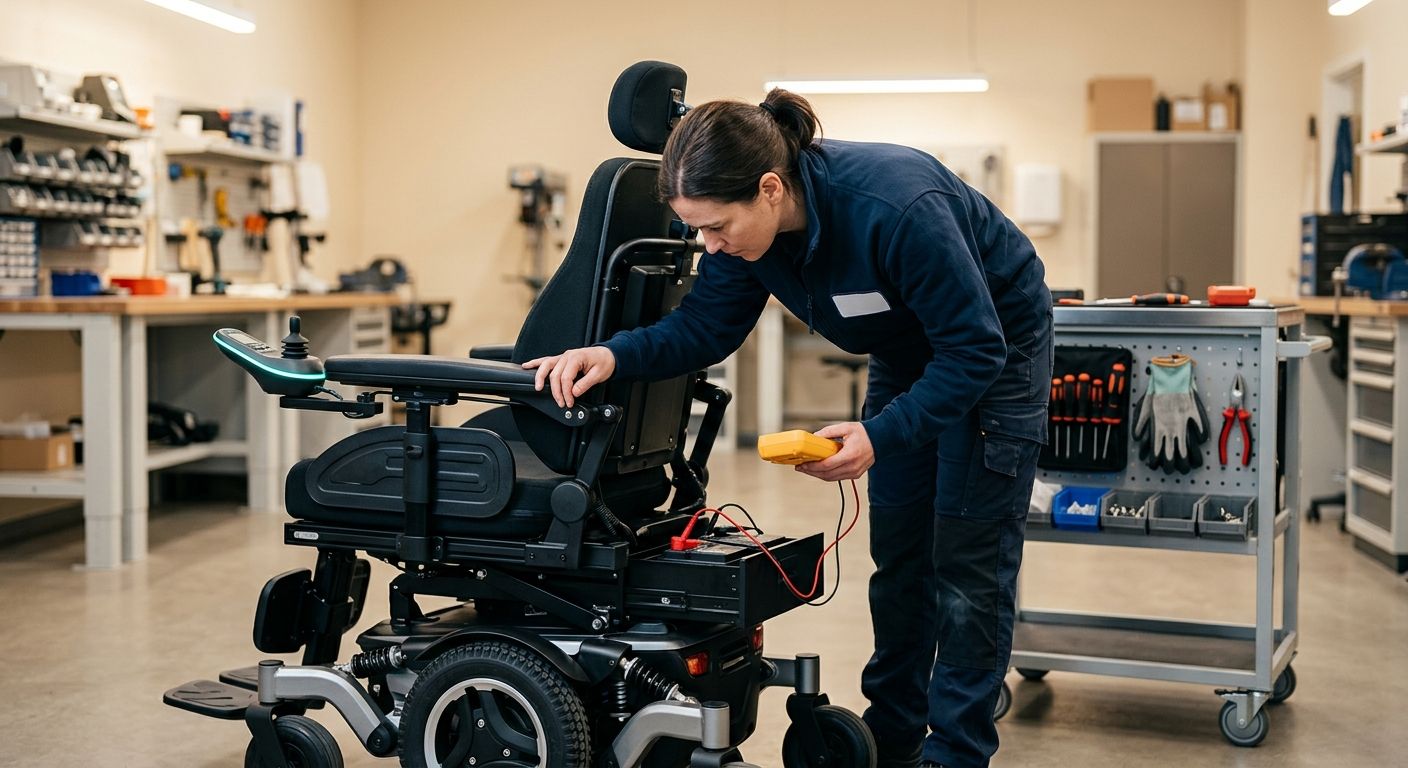
    Gather a few basic tools to get started: a multimeter (a device that measures voltage and continuity), a screwdriver set, and safety gloves. As a first step, check the battery terminals for corrosion and confirm all connections are secure — a common culprit behind issues like a wheelchair battery not charging or unexpected power wheelchair battery troubleshooting needs. If you notice loose connections, tighten them carefully before proceeding.

    Avoid making unauthorized modifications, as these can void your warranty or create safety risks. We also advise checking your joystick for visible damage if you’ve seen power chair joystick error codes on the display, though detailed diagnostics come later. Remember, MedEquipped’s certified technicians are here to support you with your custom motorized wheelchairs.

    Consult your wheelchair provider before performing any maintenance. In the next section, we’ll walk step by step through resolving the most frequent power chair issues, from battery problems to control system alerts.

    Check Battery Connections and Terminals

    If your power wheelchair is showing signs of wheelchair battery not charging or intermittent power loss, the next logical step in basic motorized wheelchair troubleshooting is a close inspection of the battery terminals and wiring. Loose or corroded connections are among the most common, yet simplest, issues to resolve. As your partner in mobility freedom, we recommend this quick check before assuming a more complex failure.

    Start with safety: ensure the chair is powered down and unplugged. Visually inspect the terminals for any white or bluish powdery buildup, which signals corrosion. A gentle cleaning with a mixture of baking soda and water, carefully applied and then thoroughly dried, can restore a solid contact point. Next, confirm all cable connections are snugly tightened, as even a slightly loose wire can create a power chair joystick error codes scenario by disrupting consistent power flow. Finally, trace the visible cable length, looking for any frayed insulation or exposed wiring that could cause a short.

    If your battery still fails to hold a charge after these steps, the problem may be internal. For owners of our custom motorized wheelchairs, we are ready to assist with more in-depth diagnostics.
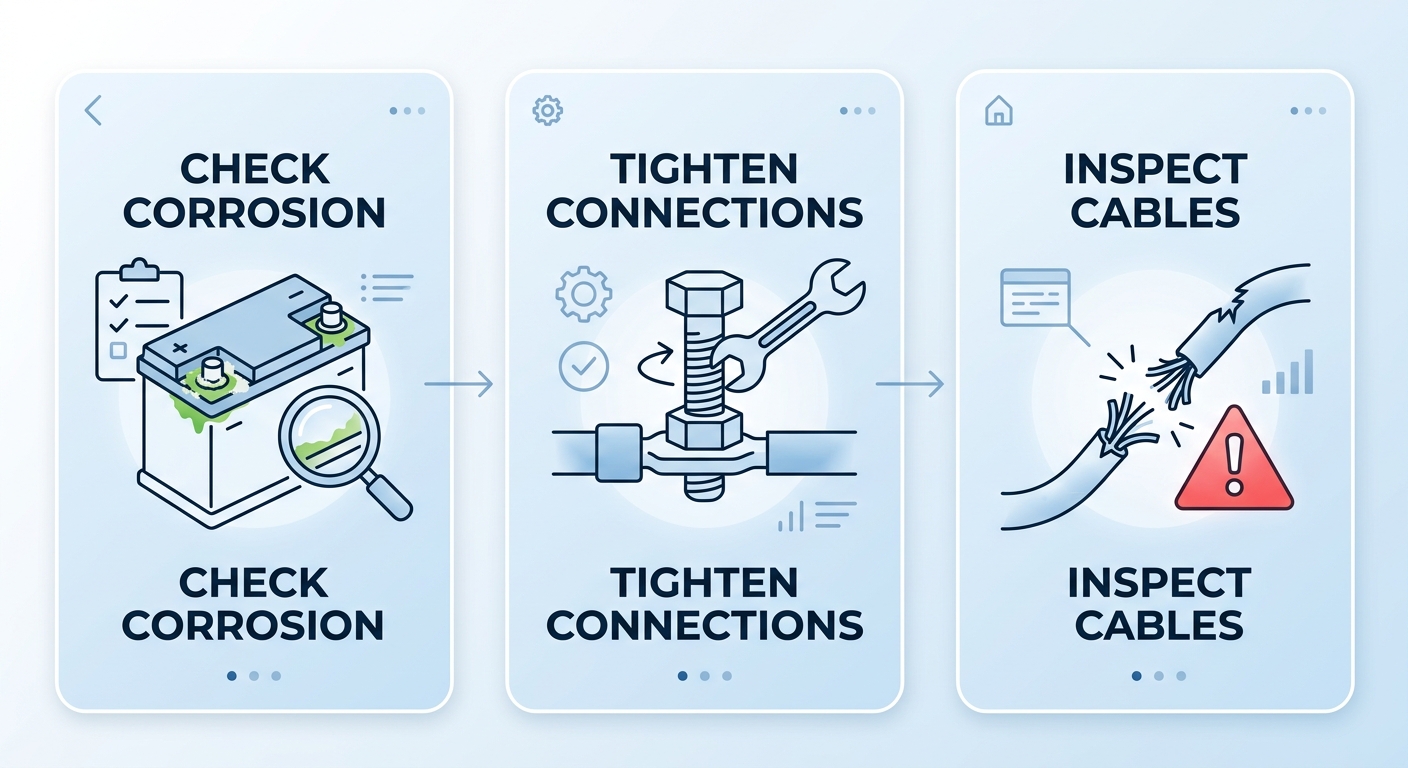
    Three-panel infographic for wheelchair battery inspection: check corrosion with baking soda mix, tighten connections securely, and examine cable insulation for damage, using blue and white palette.

    Battery connection inspection guide from MedEquipped for power wheelchair maintenance.

    Results may vary; individual outcomes are not guaranteed. Consult a qualified technician for complex issues. This information is not medical advice and is for informational purposes only.

    Test the Battery with a Multimeter

    In a motorized wheelchair troubleshooting scenario, one of the first things we check when a chair stops performing is the battery. If you’re dealing with a wheelchair battery not charging or seeing a power chair joystick error, a simple voltage test can tell you a lot. At MedEquipped, we recommend testing the battery yourself before calling us, as it’s a safe and straightforward process that can save you time.

    Always put safety first. Before you begin, ensure the wheelchair is turned off and completely disconnected from its charger. Wear protective gloves and eyewear if you have them. Use a digital multimeter set to DC voltage in a range that covers at least 24 volts. Be extremely careful not to let the metal probes touch each other while they’re on the terminals—this will cause a short circuit and can be dangerous.

    Once you’ve prepared, follow these steps:

    1. Identify the positive (usually red, marked with a +) and negative (black, marked with a −) terminals on your battery.
    2. Place the red multimeter probe firmly on the positive terminal and the black probe on the negative terminal.
    3. Hold the probes steady and read the number on the multimeter display.

    Interpreting the reading is simple. A healthy, fully charged 12-volt battery should show around 12.6 volts. For a 24-volt system, expect about 25.2 volts. If you see a significantly lower reading or zero volts, the battery needs a full charge or is likely faulty. If the voltage is normal but you’re still experiencing a power chair joystick error, the issue may lie elsewhere in the system.

    This guide is for informational purposes only. Always consult a qualified mobility technician for repairs. If the battery passes, the next step is to check the motor connections. If it fails, a charge or a replacement may be the solution. Remember, we’re your partner in mobility freedom, and we’re always here to help get you moving again.

    Reset the Power Chair Controller

    When motorized wheelchair troubleshooting leads you to a sudden stall or flashing error code, a controller reset is often the first step to regain mobility. As your partner in mobility freedom, we recommend this simple procedure whenever the joystick becomes unresponsive.

    Before you begin, confirm that all cable connections on your power chair controller are firmly seated. Then follow these steps:

    1. Turn the controller off completely.
    2. Wait 10–15 seconds.
    3. Turn the controller back on and let the system restart.

    The joystick should be in neutral and the chair on a flat, stable surface during the reboot. If error codes persist, consult our Joystick Error Code Guide to interpret specific blink patterns—understanding power chair joystick error codes helps you decide whether a simple reset is enough. Remember, these steps are informational only; always consult your owner’s manual or a qualified technician. Should the issue continue after a joystick reset, it may be time for a thorough power wheelchair stalling evaluation by a professional.

    Interpret Joystick Error Codes

    Understanding the basics of motorized wheelchair troubleshooting begins with the joystick controller, which often communicates issues through specific error codes. Recognizing these signals can help you identify simple fixes and know when it’s time to seek professional support. For more complex issues, our team at MedEquipped is here to help coordinate expert care.

    Some common power chair joystick error codes you might encounter include:

    • Flashing LED patterns (e.g., 2 or 3 flashes): These often indicate a joystick potentiometer failure or an internal controller fault, meaning the joystick isn’t communicating correctly with the chair’s motors.
    • Specific error numbers on the display: Numbers can point to wiring issues, such as a disconnected or damaged cable between the joystick module and the power base.
    • Battery indicator errors: While a wheelchair battery not charging issue is a distinct topic, a blinking battery light on the joystick can sometimes be confused with a control system fault.

    A first step for any error is a basic power cycle. Turn the chair off completely, wait a full minute, and then turn it back on to allow the system to reset. You can also visually check all cable connections leading to the joystick, ensuring they are clean, dry, and securely seated. However, persistent errors should be addressed by a technician. Some repairs, including joystick replacement, may be covered under insurance, a process we can support as your partner in mobility freedom. Please consult your manual or contact a professional for codes that don’t resolve quickly.

    Address Stalling or Slow Movement

    When your power chair hesitates, responds sluggishly, or stalls altogether, it disrupts your day and your confidence. As your partner in mobility freedom, we know that quick motorized wheelchair troubleshooting can often resolve these hiccups. Slow movement in our custom motorized wheelchairs typically stems from a few manageable sources. A wheelchair battery not charging fully is the most common culprit, so always begin by checking your battery gauge and ensuring all connections are secure. Worn motor brushes or debris in the drive wheels can also be factors. Next, look for joystick error codes; many controllers display a flashing light pattern that corresponds to a specific fault in your owner’s manual. A power chair joystick error codes reference chart can help you interpret these signals quickly. Often, a simple system reset—turning the chair off, waiting a moment, and powering it back on—clears temporary electronic glitches. If the problem continues despite these checks, consistent stalling points to a deeper technical issue. Per guidelines from the Rehabilitation Engineering and Assistive Technology Society of North America (RESNA), unresolved electronic or motor faults should be assessed by a certified technician to avoid further damage. Before scheduling service, you might also explore whether your plan helps, including your power wheelchair medicare coverage options for qualified repairs. For ongoing issues, reach out to us; our certified team is ready to help you restore the smooth, reliable ride you deserve.

    If issues persist, please consult a qualified technician for a hands-on evaluation.

    Resolve Beeping and Lockout Issues

    We understand how frustrating it can be when your power wheelchair starts beeping or enters a lockout mode. In motorized wheelchair troubleshooting, common causes include a low battery, activated seat sensor, safety override, or system error codes — each producing distinct patterns you can identify. A wheelchair battery not charging issue often triggers repeated beeps, while power chair joystick error codes may flash on the display, signaling specific faults.

    Lockout modes (emergency stop, tilt-in-space lock, or drive-disabled state) are safety features that prevent movement until the condition clears. To exit most lockouts, follow these steps:

    • Power-cycle the chair by turning it off and on; wait a few seconds before restarting.
    • Check that all cable connections are secure and free from damage.
    • Verify the joystick is in the neutral position (centered and not tilted).
    • If beeping persists, consult our General Troubleshooting FAQ for beep patterns and call our support team.

    Most beeping and lockout issues respond to this motorized wheelchair troubleshooting approach. However, sometimes Medicare coverage changes can trigger a lockout if your chair no longer meets criteria. When that happens, your wheelchair insurance may need an update. As your partner in mobility freedom, we handle the paperwork, insurance navigation, and coordination to get you moving again. We always recommend contacting a certified technician or our support team when basic steps don’t resolve the issue. Consult a healthcare professional before making clinical decisions; this information is not medical advice.

    Perform a Complete System Reboot

    When simple checks don’t resolve issues, performing a complete reboot is a powerful first step in motorized wheelchair troubleshooting. We recommend this process as a safe, effective way to clear temporary software glitches that can affect your power chair’s performance.

    Start by turning the main power off. Next, if you can safely access it, disconnect the battery pack. Wait at least 60 seconds to let any residual power drain completely from the system. This pause is crucial, as it allows the control module to fully reset. Finally, reconnect the battery and turn the power back on. This power chair reboot gives the system a fresh start.

    A successful reboot can fix unresponsive controls, display errors, and erratic behavior without affecting your custom drive settings. It is a simple reset, not a factory restore. If you still see error codes or your chair won’t operate normally, please contact our support team. For persistent problems, the next section covers joystick error codes and battery charging issues.

    Advanced Troubleshooting for Persistent Issues

    Even after following routine checks, some problems with your motorized wheelchair require deeper investigation. For effective motorized wheelchair troubleshooting when basic solutions fail, it’s helpful to turn to structured diagnostic protocols. The Rehabilitation Engineering and Assistive Technology Society of North America (RESNA) provides established service standards that many qualified technicians follow to systematically identify faults.

    When a wheelchair battery not charging issue continues despite a secure wall outlet, the problem often lies in the charger, cables, or battery health. We recommend a step-by-step approach to identify the cause:

    1. Carefully inspect all cable connections for bent pins, corrosion, or debris.
    2. Observe the charger’s indicator lights—a blinking or absent light can signal a dead charger or internal fault.
    3. Have a technician test the battery pack’s voltage and check for signs of sulfation, which is a crystalline buildup on lead-acid battery plates that reduces capacity.

    Joystick problems present another layer of complexity. Common power chair joystick error codes appear as a sequence of flashing lights, with the pattern indicating a specific fault. For instance, a slow red blink may point to a low battery, while rapid red flashes can signal a locked motor or controller fault. Often, a full system reset—disconnecting power for several minutes—can clear temporary errors. The U.S. Food and Drug Administration (FDA) reminds users that any repeated controller or motor malfunction must be approached with caution, as ignoring persistent safety signals could create unsafe operating conditions.

    If a reset doesn’t resolve the pattern, stop using the chair. Document the flash sequence, when it occurs, and under what conditions. Recording these symptoms will speed up a professional diagnosis, a practice aligned with best practices in the field. Even custom motorized wheelchairs can develop persistent issues, and we’re always ready to help you get back to independence. Contact MedEquipped’s team to schedule an evaluation—we are your partner in mobility freedom.

    Information is not medical advice and is for informational purposes only. Consult a healthcare professional before making clinical decisions.

    Maintaining Your Power Chair for Long-Term Reliability

    Simple, consistent care prevents most issues that lead to motorized wheelchair troubleshooting. We understand your custom chair is a vital daily companion, so we recommend these straightforward habits.

    Follow battery charging best practices to avoid the frustration of a wheelchair battery not charging unexpectedly. Charge after each use, and avoid deep discharges to protect long-term battery health. For the controls, gently wipe the joystick and panel with a dry cloth. Preventing debris buildup helps you avoid confusing power chair joystick error codes.

    Monthly, inspect your tires and casters for wear, and keep electrical connections free of moisture and dust. We also advise scheduling an annual professional checkup. A custom fitting from your initial clinical evaluation, as provided by MedEquipped’s certified ATP evaluators, reduces long-term mechanical wear. Your partner in mobility freedom, MedEquipped, is here to help with ongoing support.

    Resources

  • How to Get an Assistive Technology Professional Evaluation: Key Steps

    How to Get an Assistive Technology Professional Evaluation: Key Steps

    Table of Contents

    Understanding Your Assistive Technology Professional Evaluation

    To ensure your custom motorized wheelchairs fit perfectly, we begin with an in-depth assistive technology professional evaluation. This clinical assessment, conducted by one of our certified experts, determines the ideal wheelchair configuration and seating system for your unique mobility needs. We analyze your daily activities, functional abilities, and seating requirements to build a complete picture of what will work best for you.

    This assistive technology professional evaluation is critical for meeting power wheelchair medical necessity requirements that insurance and funding sources demand. Our team collaborates directly with you, your clinician, and the funding source to ensure the recommended equipment aligns with your lifestyle and goals. Depending on your needs, the complex rehab technology functional assessment may involve trial equipment to validate specific choices, such as front-wheel drive power wheelchairs for superior outdoor navigation and curb climbing.

    The evaluation typically lasts 60 to 90 minutes. Afterward, we handle the paperwork, insurance navigation, and coordination, with most custom orders processed within 30 to 60 days. Information is not medical advice and is for informational purposes only.

    What to Prepare for Your ATP Evaluation

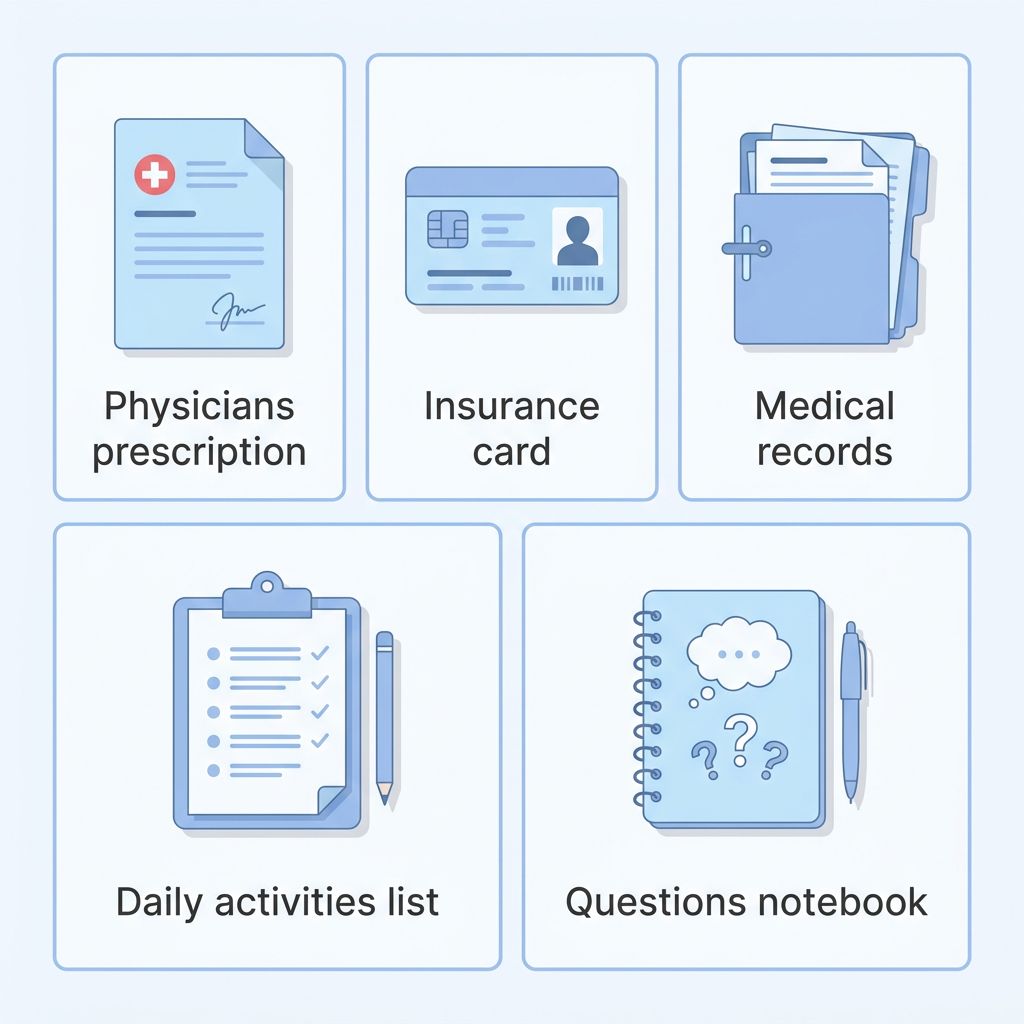
    Now that you understand the purpose of an ATP evaluation, gathering the right documents ensures a smooth start. Your assistive technology professional evaluation begins with medical records that prove your power wheelchair medical necessity requirements—so bring these key items:

    • A signed physician’s prescription for a power wheelchair
    • Your insurance card and policy information
    • Medical records detailing your mobility limitations and prior treatments
    • A list of your daily activities and functional needs
    • Any referral or authorization forms you’ve received
    • A list of questions about the evaluation process and expected timelines

    This preparation supports the complex rehab technology functional assessment your ATP will perform, which examines seating, positioning, and the environments where you’ll use your chair. The evaluator uses this information to customize the chair to your life.

    We handle the paperwork, insurance navigation, and coordination, so bringing the above documents lets us move forward efficiently. As your partner in mobility freedom, we ensure your wheelchair assessment produces a chair that fits your needs.

    Infographic checklist with icons for physician's prescription, insurance card, medical records, daily activities list, and questions notebook for ATP evaluation preparation at MedEquipped.

    Checklist of essential documents and items for your ATP evaluation at MedEquipped.

    With everything ready, your upcoming evaluation will focus on your comfort and safety. The next section walks through what happens during the appointment, turning your preparation into confidence.

    Please note: This information is for educational purposes. Consult a healthcare professional before making clinical decisions.

    Schedule Your Initial ATP Consultation

    Now that you’ve explored custom motorized wheelchairs, the first step toward your personalized mobility solution is an assistive technology professional evaluation. At MedEquipped, this consultation connects you with a certified ATP who conducts a thorough complex rehab technology functional assessment—matching your physical needs, lifestyle, and power wheelchair medical necessity requirements to the right equipment.

    We see ourselves as your partner in mobility freedom, so we handle the paperwork, insurance navigation, and coordination from this first visit through final delivery, typically completing custom orders in 30–60 days (faster processing available). This patient-centered assistive technology professional evaluation results in a custom chair from trusted brands like Permobil or Quantum Rehab, without you having to manage the details alone.

    After the ATP consultation, the clinical evaluation process begins. In the next section, we’ll walk you through what to expect. Please consult a healthcare professional before making clinical decisions—this information is for educational purposes only.

    Gather Required Medical Documentation

    Before your assistive technology professional evaluation can begin, gathering the right medical documentation is the essential first step. We help you collect everything needed to demonstrate power wheelchair medical necessity requirements. MedEquipped simplifies the process by guiding you through each requirement.

    • A valid physician’s prescription for a custom power wheelchair.
    • Medical records detailing your diagnosis, functional limitations, and a statement of medical necessity.
    • A complex rehab technology functional assessment to document mobility needs and justify the equipment.
    • Supporting documents such as PT/OT evaluations, fall history, and home environment details.

    The complex rehab technology functional assessment, required by most insurers, confirms the power wheelchair is the appropriate solution. Our expertise ensures your documentation meets clinical and insurance criteria. As your partner in mobility freedom, we handle the paperwork, insurance navigation, and coordination.

    Once everything is gathered, the formal evaluation can begin — we’ll cover that next. Information is not medical advice and is for informational purposes only.

    Undergo Functional Mobility Assessment

    After your initial inquiry, the next step is a functional mobility assessment—a clinical evaluation performed by a certified Assistive Technology Professional (ATP) in New York, in Georgia, or in Michigan. This assistive technology professional evaluation establishes your unique mobility requirements.

    The complex rehab technology functional assessment evaluates your physical abilities, daily routines, home layout, and equipment needs to determine the right seating, drive controls, and power features. This holistic review ensures every aspect of your daily life is considered.

    Medicare and many insurers require this assessment to document power wheelchair medical necessity and justify coverage. MedEquipped coordinates the entire process—scheduling, managing paperwork, and communicating with your insurance—so you can focus on what matters most.

    The outcomes directly shape your custom wheelchair configuration, from seat dimensions and back support to power seating options. We’ll work closely with you, always keeping your comfort and mobility our top priority.

    Disclaimer: This assessment is for mobility equipment needs only and does not constitute medical advice. Please consult your physician for any medical concerns.

    Configure Seating and Positioning

    Building on your comprehensive evaluation, the assistive technology professional evaluation directly guides how we configure the seating and positioning of your custom motorized wheelchair. This process transforms clinical findings into a personalized setup that addresses your unique needs.

    We use a complex rehab technology functional assessment to determine the right pressure relief, postural support, and functional reach for you. The assistive technology professional evaluation makes sure every adjustment—from cushion choice to backrest angle—aligns with your daily activities and clinical goals. We work closely with you and your clinical team to capture these details, because accurate documentation is key to meeting power wheelchair medical necessity requirements and securing funding approval.

    Following standards from the Rehabilitation Engineering and Assistive Technology Society of North America (RESNA), our ATP evaluation emphasizes evidence-based configuration that helps ensure both comfort and long-term mobility. The final specifications we develop during this step will directly shape your custom order in the next phase.

    Securing a custom motorized wheelchair requires insurance approval, but MedEquipped is your partner in mobility freedom throughout the process. We handle the paperwork, insurance navigation, and coordination in New York, Georgia, and Michigan so you can focus on what matters.

    The process starts with establishing medical necessity. An assistive technology professional evaluation captures your clinical needs and sets the stage for funding. Often, a complex rehab technology functional assessment is also required to meet power wheelchair medical necessity requirements. Our team guides you through each step and incorporates specialized seating medical necessity documentation based on RESNA standards.

    Insurance prior authorization is typical, and we manage it from start to finish. The typical timeline from submission to approval is 30 to 60 days—faster than many large suppliers.

    Once approved, we coordinate the custom build and delivery. Results may vary; individual outcomes are not guaranteed.

    Finalize Wheelchair Specifications and Order

    With your clinical evaluation complete – including your assistive technology professional evaluation and complex rehab technology functional assessment – we now turn those findings into a custom order that reflects the power wheelchair medical necessity requirements documented for you. We take a straightforward approach to finalizing every detail:

    1. Confirm your measurements – we review seat width, seat depth, back height, armrest style, and footrest type captured during your evaluation.
    2. Select accessories and controls – choose your cushion, joystick controller, and any positioning aids that best support your daily routine.
    3. Place your order – once specifications are locked, we handle the paperwork, insurance navigation, and coordination with your provider.

    Your custom motorized wheelchair typically arrives in 30–60 days, often faster than many larger suppliers. For pricing, we prepare a personalized quote once your configuration is set; please contact us for an estimate.

    As your partner in mobility freedom, we stay with you through delivery and setup, providing ongoing support for every adjustment you need.

    Prepare for Delivery and Follow-Up Care

    After your assistive technology professional evaluation is complete and your custom motorized wheelchair has been ordered, it’s time to get ready for delivery. We recommend clearing a dedicated, accessible space with a nearby outlet for overnight charging. Our team will provide a delivery window and update you before our technician arrives, so you’ll always know what to expect.

    Because every chair is built around the findings of your complex rehab technology functional assessment, the typical processing timeline ranges from 30–60 days (faster processing available). Results may vary; individual outcomes are not guaranteed. Once your wheelchair is in your home, our support continues — we provide follow-up adjustments, troubleshooting, and ongoing care through our network of certified technicians.

    No matter what questions come up, we remain your dedicated partner in mobility freedom. From your first fitting to long-term maintenance, you can count on MedEquipped to keep you moving forward.

    Common Challenges in the ATP Evaluation Process

    While the Assistive Technology Professional (ATP) evaluation serves as a vital step toward obtaining a custom power wheelchair, the process can present several hurdles that patients and their care teams must navigate. From managing complex paperwork to coordinating with multiple parties, the evaluation phase often requires dedicated attention to avoid delays. We have seen how these obstacles can cause frustration, but they are also entirely manageable with the right support.

    One of the most time-consuming aspects is insurance and paperwork navigation. A thorough complex rehab technology functional assessment generates significant documentation that must be correctly submitted. Many clinicians and patients feel overwhelmed by these administrative demands; that’s why we handle the paperwork, insurance navigation, and coordination for you, reducing the burden on your care team.

    Another challenge is ensuring the evaluation clearly demonstrates medical necessity. When power wheelchair medical necessity is not properly documented during the assistive technology professional evaluation, funding requests may be denied or delayed. Our ATPs work closely with your referring physician and therapist to capture functional deficits and mobility limitations that justify the equipment, helping to prevent setbacks.

    Even after a successful evaluation, the timeline from assessment to delivery can feel long. Industry standards often extend several months, but MedEquipped’s streamlined process typically completes within 30 to 60 days. Of course, results may vary; individual outcomes are not guaranteed, yet our focused approach helps accelerate the journey. Understanding these challenges is the first step—next, we’ll explore how MedEquipped directly addresses them to make your experience as seamless as possible.

    Your Path to Mobility Freedom with MedEquipped

    Your path to mobility freedom starts with MedEquipped, your partner in mobility freedom. We guide you through every stage of obtaining a custom motorized wheelchair, beginning with an assistive technology professional evaluation performed by a certified ATP. From that first step, we prioritize your comfort and safety, making the process straightforward and stress-free. We become your dedicated partner, not just a supplier, helping you regain independence with confidence.

    This clinical evaluation, known as a complex rehab technology functional assessment, determines the power wheelchair medical necessity for your custom chair. Using detailed findings, we configure a seating system tailored to your body and lifestyle. We handle the paperwork, insurance navigation, and coordination — so you don’t have to. We also manage communication with your healthcare providers, ensuring all documentation is complete. Serving residents in New York, Georgia, and Michigan, we source chairs from trusted brands and deliver within 30–60 days, often with faster processing for qualified patients.

    Our commitment continues after delivery with ongoing support and wheelchair service repair. Whether you need adjustments or routine maintenance, we keep you moving. Our dedicated team is here for you long-term. Let’s walk through what that evaluation looks like.

    Results may vary; individual outcomes are not guaranteed.

    Resources

  • Custom Mobility Equipment Suppliers NY: ATP Provider Hub

    Custom Mobility Equipment Suppliers NY: ATP Provider Hub

    Table of Contents

    Custom Mobility Equipment Suppliers in New York: Your Trusted Partner

    As your trusted partner in New York, MedEquipped stands out among custom mobility equipment suppliers in New York because we truly are your partner in mobility freedom. We guide you through every step, making the process of obtaining a custom power wheelchair straightforward and personal.

    We offer comprehensive custom motorized wheelchair services, including clinical evaluation and fitting, insurance and funding navigation, ordering, and direct delivery. We also serve as Complex rehab technology providers in NY, backed by certified ATP evaluators who ensure the perfect fit. With our established processes across New York, Georgia, and Michigan, we typically complete custom orders in 30 to 60 days.

    Our certified ATP wheelchair evaluation ensures your chair is configured for your exact needs, and our commitment continues with dedicated post-delivery support. We handle the paperwork and coordination so you can focus on your mobility, and we are ready to guide you through every step — from clinical evaluation to delivery.

    New York Service Areas for Custom Wheelchairs

    As a leading custom mobility equipment supplier in New York, MedEquipped proudly serves clients throughout Rockland County, in the Bronx, and across the Nanuet and Spring Valley area. We are your partner in mobility freedom, bringing personalized evaluations, expert insurance coordination, and custom motorized wheelchairs directly to you.

    The following table offers a quick visual comparison of our core services across these regions.

    Service Availability in Key New York Regions
    Service Feature Rockland County Bronx Nanuet / Spring Valley
    Clinical Evaluation (ATP Assessment) On-site or mobile ATP evaluation available by appointment ATP evaluation at our Nanuet office or via telehealth In-person evaluation at our Nanuet clinic
    Insurance & Funding Navigation Full assistance with paperwork, Medicare/Medicaid coordination Insurance coordination and documentation handled end-to-end Full coordination from initial paperwork to approval
    Custom Ordering & Delivery 30–60 day turnaround with expedited options 30–60 day turnaround with urgent case prioritization 30–60 day timeline; direct delivery to your location
    Post-Delivery Support Adjustments, repairs, and patient education included Ongoing clinical support and follow-up visits Dedicated support team for adjustments and repairs

    Whether you are at home in Rockland County, the Bronx, or right near our Nanuet clinic, we bring clinical expertise to you. Our evaluations are conducted by certified Complex rehab technology providers NY, ensuring each power chair is configured for your unique needs.

    A thorough ATP wheelchair evaluation is the critical first step in matching you with the right equipment. Our clinical evaluations are conducted by certified Assistive Technology Professionals (ATPs) listed in the RESNA Assistive Technology Professional directory. We handle the paperwork, insurance navigation, and coordination from start to finish, so you can focus on what matters.

    After delivery, our commitment continues. We provide ongoing adjustments, repairs, and patient education to ensure your mobility solution fits your life for the long term. To begin the process in any of these New York service areas, contact our team today.

    Results may vary; individual outcomes are not guaranteed. Information is not medical advice and is for informational purposes only.

    Power Wheelchair Delivery Timeline and Insurance Support

    As a trusted custom mobility equipment supplier in NY, we understand that waiting for your power wheelchair can feel overwhelming. Here at MedEquipped, we typically deliver custom power wheelchairs within 30 to 60 days after your insurance has been approved and your order has been placed. This timeline allows us to ensure your chair is built precisely to your clinical needs and lifestyle. Please note that results may vary; individual outcomes are not guaranteed.

    We manage the entire process end-to-end so you don’t have to navigate complex bureaucracy alone. After your ATP wheelchair evaluation is complete and your funding is authorized, our team immediately begins coordinating the custom build with the manufacturer. Working with experienced complex rehab technology providers in NY ensures that every chair is configured for optimal comfort, positioning, and functionality. At MedEquipped, we handle all the insurance paperwork, prior authorizations, and follow-ups, keeping you informed every step of the way.

    Timelines can naturally vary depending on your insurance provider’s response times, the complexity of your custom chair, and current supply chain factors. That’s why we never promise a universal delivery date and always communicate transparently about your specific situation. If you are facing more urgent mobility needs, please ask about our expedited power wheelchair service for faster processing. We also invite you to visit our Become a Patient page to take the first step on your journey to greater independence. Once your chair arrives, we continue to support you every step of the way.

    Results may vary; individual outcomes are not guaranteed.

    Local Factors for Choosing a Mobility Provider

    Beyond general considerations, local factors play a critical role in finding a trusted partner for your custom motorized wheelchair. When searching for custom mobility equipment suppliers NY, proximity is only the beginning. Your ideal provider must have the clinical expertise to translate a prescription into a chair that truly fits your body and daily life.

    We recommend looking for Complex rehab technology providers NY whose staff includes RESNA-certified Assistive Technology Professionals. These specialists perform a thorough ATP wheelchair evaluation, considering your posture, skin integrity, and functional goals—not just your diagnosis. Confirm they offer in-home or clinic-based assessments rather than simple showroom consultations. A quality provider will also handle insurance navigation, typically completing paperwork and approvals within a 30 to 60 day window, and will support you long after delivery with adjustments and repairs.

    To verify a provider’s credentials, use the ATIA assistive technology provider resources tool or the RESNA Member Directory. These industry-standard resources help you locate certified professionals in your area. Remember that FDA clearance of power wheelchairs ensures they meet federal safety standards.

    Your First Steps to Custom Mobility Equipment

    Looking for custom mobility equipment suppliers in NY? MedEquipped makes it easy to get your custom motorized wheelchair. Our custom power wheelchair patient services simplify the entire process, from your first call to delivery and beyond.

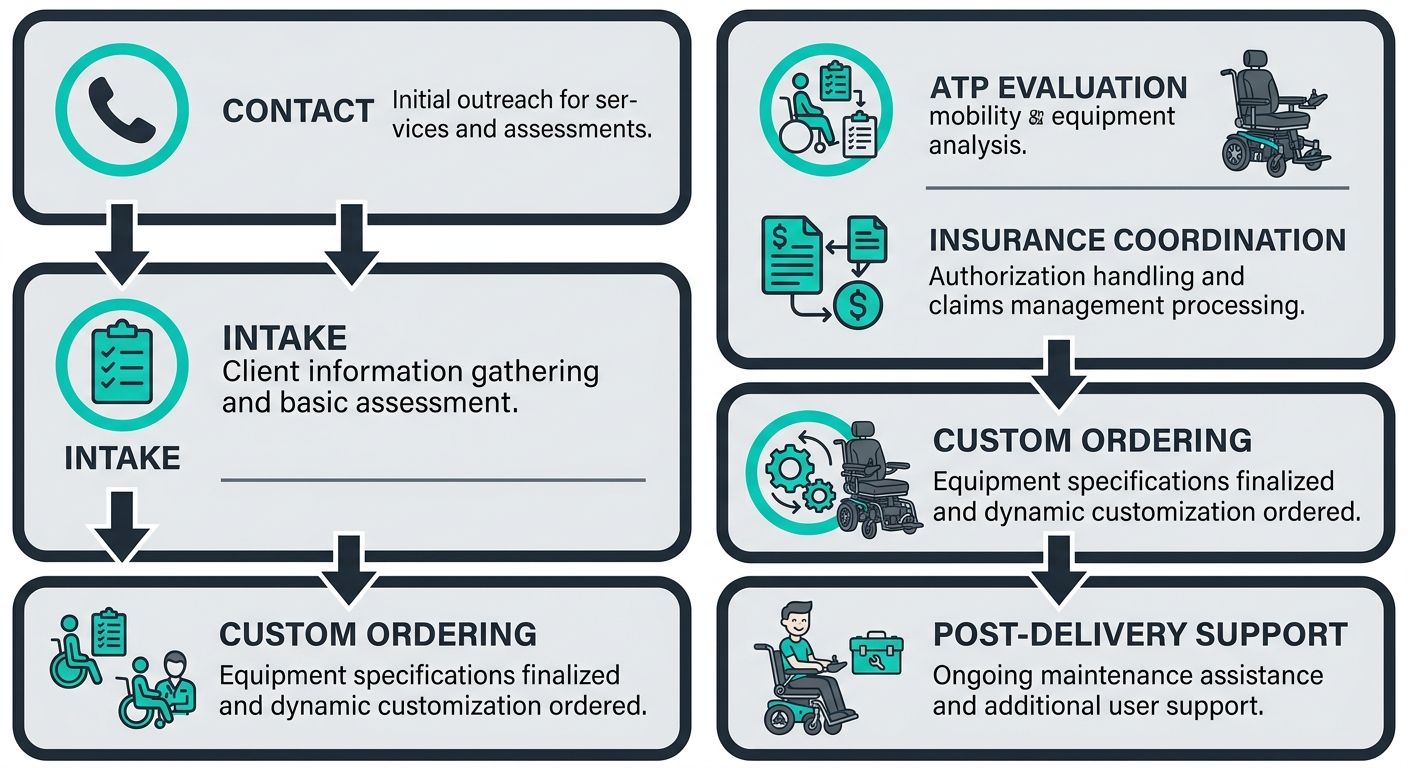
    Six-step vertical process flow for MedEquipped custom mobility equipment: Contact, Intake, ATP Evaluation, Insurance Coordination, Custom Ordering, and Post-Delivery Support.

    Your first steps to custom mobility equipment with MedEquipped.

    Ready to take the first step? Here’s how we make it easy as your partner in mobility freedom:

    • 1. Contact MedEquipped. Reach out by phone or online form. We’ll discuss your needs and verify your insurance. We handle the paperwork, insurance navigation, and coordination.
    • 2. Complete intake and insurance verification. Provide your details so we can confirm coverage and start your file.
    • 3. Schedule your ATP wheelchair evaluation. As experienced Complex Rehab Technology providers in NY, our certified ATP evaluators conduct a comprehensive assessment of your mobility needs.
    • 4. Insurance and funding coordination. We manage all clinical documentation, approvals, and funding logistics.
    • 5. Custom chair ordering and delivery. Order your chair with delivery typically in 30-60 days (faster processing).
    • 6. Post-delivery support and service. Dedicated support continues after you receive your custom motorized wheelchair.

    Once you complete these steps, your dedicated patient services team will guide you through every detail. Start your journey — visit our custom power wheelchair patient services page or call us directly.

    Results may vary; individual outcomes are not guaranteed.

    Custom Mobility Equipment Services Ready for You

    We make that happen with a full suite of services. As your partner in mobility freedom, we connect you with top custom mobility equipment suppliers in NY, Georgia, and Michigan. Our certified ATP wheelchair evaluation ensures a precise, clinical fit for your lifestyle, while our team handles all insurance navigation and paperwork. We manage ordering, build, and delivery on a 30-to-60-day timeline with ongoing support. Our custom motorized wheelchairs meet rigorous safety standards backed by FDA medical device registration data. Complex rehab technology providers NY trust our end-to-end process. But don’t just take our word for it—hear from our community of patients who’ve regained independence through our personalized care.

    Resources

  • Best Complex Power Wheelchairs for 2026: Top Custom Options

    Best Complex Power Wheelchairs for 2026: Top Custom Options

    Table of Contents

    For those needing advanced features, navigating complex power wheelchairs involves more than just selection. These custom motorized wheelchairs deliver enhanced mobility for individuals with complex needs, featuring adjustable seating, advanced controls, and robust frames for indoor and outdoor use. At MedEquipped, we partner with you every step as your partner in mobility freedom.

    Our process starts with clinical evaluations by certified Assistive Technology Professionals (ATPs). As part of our mobility solutions, ATPs evaluate posture, seating, and control needs to effectively tailor each chair. We conduct personalized fittings for custom power wheelchairs in New York, Georgia, and Michigan, ensuring the chair matches your clinical and lifestyle requirements, as detailed in our internal overview of power wheelchair types.

    Next, we handle the paperwork, insurance navigation, and coordination for national seating and mobility funding. Our team streamlines approvals through partners like National Seating and Mobility, making the process seamless.

    Custom ordering follows, with delivery in 30-60 days (faster processing) for your advanced complex power wheelchairs. Dedicated technicians manage configuration and direct delivery.

    We provide ongoing post-delivery support for adjustments and maintenance. Once evaluated, explore our custom options to achieve greater independence.

    Results may vary; individual outcomes are not guaranteed. Consult a healthcare professional before making clinical decisions.

    Fundamentals of Complex Power Wheelchairs

    At MedEquipped, we define complex power wheelchairs as highly customizable devices designed for individuals with severe mobility impairments. These advanced custom motorized wheelchairs go beyond basic transport, offering tailored solutions that promote independence and health. Unlike standard models, complex power wheelchairs incorporate sophisticated features to address specific clinical needs, such as pressure relief and postural support.

    Essential features include adjustable seating systems with tilt and recline functions for pressure redistribution, as highlighted in MedEquipped’s internal expert guidance on wheelchair fundamentals. Programmable drive controls support multiple inputs like head arrays or sip-and-puff for users with limited dexterity. Terrain-handling capabilities allow navigation over rough surfaces, while reinforced frames support higher demands. According to United Spinal Association industry insights on complex rehab technology, these elements protect against secondary complications like skin issues and enhance daily freedom.

    We also adhere to national seating and mobility standards through evaluations by our certified ATP specialists, ensuring custom power wheelchairs match patient-specific requirements from trusted brands like QUICKIE and Quantum.

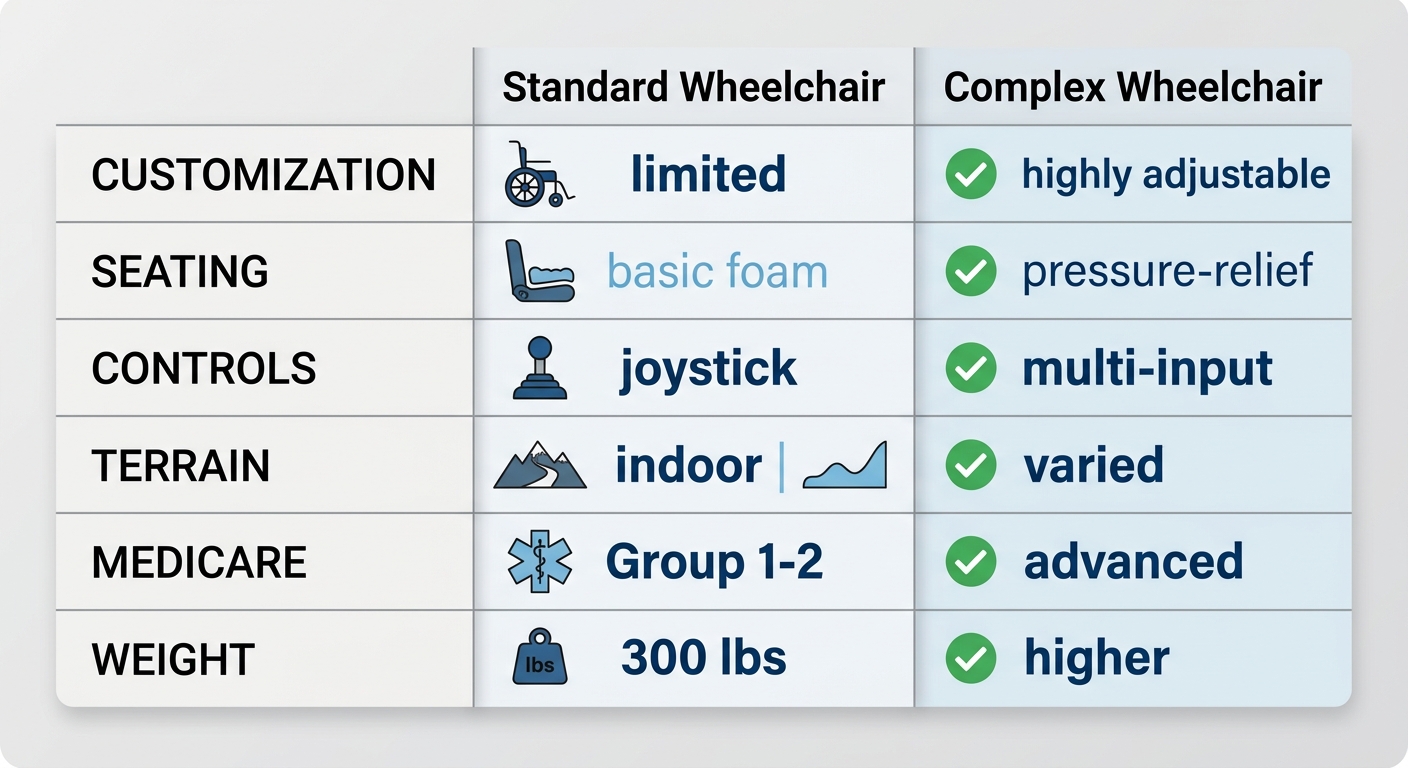
    Building on these basics, the following table highlights core differences between standard and complex models.

    Basic Features Comparison: Complex vs Standard Power Wheelchairs
    FeatureStandard Power WheelchairComplex Power Wheelchair
    Customization LevelLimited adjustabilityHigh (Clinical setup)
    Seating OptionsBasic foam cushionsTilt, Recline, Custom cushions
    Drive ControlsJoystick onlySip-and-puff, head arrays, etc.
    Terrain CapabilityIndoor/smooth surfacesAdvanced suspension/rough terrain
    Medicare CoverageGroup 1-2 codesGroup 3-4 (Medical necessity)
    Weight CapacityUp to 300 lbs typicalStandard and Heavy Duty options

    This comparison underscores why complex power wheelchairs are vital for clinical needs like skin integrity through pressure relief and promoting independence via adaptive controls. We handle the paperwork, insurance navigation, and coordination to make these accessible.

    For seniors with complex requirements, such as enhanced weight support or outdoor mobility, options like power wheelchairs for seniors provide reliable solutions tailored to lifestyle demands. Our ATP evaluators use tools like pressure-mapping to optimize setups, preventing common issues noted in industry reports.

    Infographic comparing key features of standard and complex power wheelchairs including customization, seating, controls, terrain capability, Medicare coverage, and weight capacity.

    Comparison of standard vs complex power wheelchair features

    As your partner in mobility freedom, we deliver end-to-end service across New York, Georgia, and Michigan with faster 30-60 days processing. From clinical evaluations to delivery and ongoing support, our custom power wheelchairs ensure lasting comfort.

    Information is not medical advice and is for informational purposes only; consult a healthcare professional.

    Deep Dive into Complex Power Wheelchair Features

    Building on the basics of power wheelchairs, we dive deeper into complex power wheelchairs designed for individuals with severe mobility challenges. At MedEquipped, we partner in mobility freedom by offering advanced features that promote independence and comfort. Our custom motorized wheelchairs incorporate cutting-edge technology tailored to unique clinical needs, ensuring users maintain dignity and quality of life.

    Seating and Positioning Systems

    Custom seating and positioning systems form the heart of advanced complex power wheelchair systems. We customize adjustable tilt, recline, and power legrest options to address clinical needs like pressure relief and posture support. According to MedEquipped internal expertise on patient-specific configurations, these complex rehab technology benefits prevent skin issues and enhance stability for conditions such as spinal cord injuries or spasticity.

    • Tilt and recline functions allow seamless position changes to redistribute pressure and improve circulation.
    • Adjustable legrests support proper alignment, reducing fatigue during extended use.
    • Lateral supports provide trunk stability for those with neuromuscular disorders.

    MedEquipped’s certified Assistive Technology Professionals (ATPs) conduct thorough evaluations to fit these systems perfectly. Results may vary; individual outcomes are not guaranteed. Consult a healthcare professional before making clinical decisions. Contact us in Spring Valley, NY, to explore customized power wheelchairs today. Information is not medical advice and is for informational purposes only.

    Advanced Drive Controls and Bases

    We specialize in advanced drive controls and heavy-duty bases that elevate custom power wheelchairs for complex rehab scenarios. Joystick alternatives like head arrays, sip-and-puff systems, or programmable switches accommodate limited dexterity, as highlighted in MedEquipped company-provided guidance on advanced tech. These interfaces ensure precise navigation indoors and outdoors.

    Heavy-duty bases such as the TDX SP2 HD deliver unmatched stability with mid-wheel drive for tight maneuvers and robust suspension for uneven terrain. MedEquipped internal expertise emphasizes specialized power bases for enhanced maneuverability and safety.

    Key features include:

    • Programmable controls for personalized response settings.
    • Anti-tippers and positioning belts for added security.
    • High-capacity batteries supporting all-day use.

    Centers for Medicare & Medicaid Services (CMS) authoritative government policy on eligibility underscores the need for documented medical necessity in these components. Our ATP-led evaluations ensure compliance and optimal fit. Privacy notice: we do not sell personal information (see Privacy Policy). We handle the paperwork, insurance navigation, and coordination for seamless delivery. Ready for your custom solution? Reach out to our team.

    The following table outlines key service features:

    MedEquipped vs National Seating & Mobility: Service Features
    AspectMedEquippedNational Seating & Mobility
    Processing Time30-60 days90-120+ days
    Clinical EvaluationsCertified ATP-ledATP-led
    Insurance NavigationEnd-to-end handlingInternal departments
    Regional FocusNY, GA, MI expertiseNational reach

    This comparison highlights our strengths in efficient processing and specialized support, aiding your decision-making process.

    Local Availability in NY, GA, MI

    Finding reliable services for complex power wheelchairs near me is simpler with MedEquipped’s regional expertise in New York, Georgia, and Michigan. From our base in Spring Valley, NY, we serve these areas with certified ATP evaluations, custom configurations, and ongoing support. We partner in mobility freedom by handling local deliveries, adjustments, and repairs post-delivery.

    Our streamlined 30-60 days (faster processing) timeline gets you moving sooner. SMS terms: message and data rates may apply; reply STOP to unsubscribe. Whether in NY, GA, or MI, contact us at 845-237-2381 or intake@medequipped.com for a consultation. Let’s start your journey to greater independence today.

    Practical Guide to Complex Power Wheelchairs

    Building on your selection of wheelchair types, we’re your partner in mobility freedom, offering this practical roadmap for acquiring complex power wheelchairs. We’ll guide you through clinical evaluations, insurance navigation, and delivery timelines with our end-to-end support.

    Clinical Evaluation Process

    Our certified Assistive Technology Professionals (ATPs) conduct thorough assessments to ensure the perfect fit for your needs. The process starts with a physician referral, providing a detailed prescription outlining your mobility challenges. We then schedule an in-person fitting session at our facilities in New York, Georgia, or Michigan, where our evaluators measure your posture, skin integrity, and functional abilities.

    Next, we customize options like national seating and mobility configurations, power tilt, recline, and specialized controls for advanced complex power wheelchairs. According to internal expert guidance from our evaluation specialists at MedEquipped, this step-by-step ATP process includes pressure mapping and trials of industry-leading models such as QUICKIE or ROVI X3 bases. Post-evaluation, we deliver comprehensive recommendations, including seating diagrams and justification reports, ready for funding submission. This personalized approach guarantees a chair that enhances your independence and comfort.

    Insurance and Funding Navigation

    Securing Medicare for complex models requires precise documentation and coordination, which we handle seamlessly. Begin with your physician’s prescription and clinical evaluation proving mobility loss not manageable by cane, walker, or manual wheelchair. Our team prepares the prior authorization, justifying medical necessity per Centers for Medicare & Medicaid Services (CMS) authoritative federal Medicare policy in their LCD on wheelchairs.

    We also align with state guidelines, such as those in the dme pos coverage manual from the Colorado Department of Health Care Policy & Financing, ensuring supplier responsibilities are met for DMEPOS coverage. Accessories like power seating are covered if documented as essential.

    Coverage Comparison: Medicare for Complex Power Wheelchairs
    RequirementMedicare StandardMedEquipped Support
    DocumentationPhysician Rx + evalWorkflow coordination
    Clinical NeedMobility loss proofATP justification
    Prior AuthSupplier handledFull submission auto
    AccessoriesCovered if justifiedClinical documentation

    This table highlights how we streamline compliance. For application tips, gather recent medical records showing failed lower-mobility aids, photos of your home environment, and daily activity limitations—evidence that strengthens your case. We handle prior auth submissions, coding accuracy, and appeals if needed, often achieving approvals faster than industry averages. Reference CMS LCD criteria for accessories and DMEPOS manual for supplier roles to avoid delays. Our expertise minimizes denials, getting you mobile sooner.

    Ordering and Delivery Timeline

    Once approved, our 30-60 days (faster processing) timeline kicks in for your custom power wheelchairs. We place the order with manufacturers for tailored high-end specs, like heavy-duty TDX SP2 HD bases. Production takes 2-4 weeks, followed by our insurance verification and shipping coordination.

    Delivery includes technician setup, user training, and functionality checks at your door. We handle the paperwork, insurance navigation, and coordination every step, from custom configuration to post-delivery adjustments. This efficient process ensures you’re riding comfortably within weeks, not months.

    Ready for your custom quote? Contact us at 845-237-2381 or intake@medequipped.com to start. After delivery, our ongoing service ensures long-term reliability.

    Results may vary; individual outcomes are not guaranteed. Consult a healthcare professional before making clinical decisions. Information is not medical advice and is for informational purposes only.

    Advanced Configurations for Complex Power Wheelchairs

    For users with more complex needs, we offer advanced configurations for complex power wheelchairs that go beyond basic models. These include powered tilt-recline systems, elevating legrests, and specialized seating for medical conditions like spinal cord injuries or progressive neuromuscular disorders. As your partner in mobility freedom, our certified ATP evaluators conduct thorough clinical assessments to tailor solutions that enhance comfort, pressure management, and independence. We draw on our internal expertise from MedEquipped to ensure every feature aligns with your lifestyle and independent living.

    Our advanced fittings feature custom positioning systems with power-adjustable armrests, footplates, and ergonomic cushions designed for spinal alignment and pressure relief. Using pressure-mapping technology during ATP evaluations, we create configurations that prevent sores and optimize posture. Power-adjustable components like tilt and recline functions allow seamless transitions, while control adaptations such as modified joysticks or alternative inputs suit limited dexterity. We partner with trusted names like national seating and mobility to source heavy-duty bases, including models like the TDX SP2 HD for rugged terrain. Our dedicated technicians handle precise integrations for custom power wheelchairs that meet clinical standards.

    Enhance usability with key accessories from our guidance on integration, including tray tables for meal support, cup holders, oxygen holders, and joystick mounts. These bolt-on options fit seamlessly into custom power wheelchairs, promoting daily functionality without compromising stability. We handle the paperwork, insurance navigation, and coordination for delivery across New York, Georgia, and Michigan, achieving 30-60 days (faster processing) from evaluation to setup.

    Contact us at 845-237-2381 or intake@medequipped.com for a custom quote and evaluation. We provide ongoing support post-delivery. Our team offers timely adjustments, continued training, and ongoing follow-up support. Information is not medical advice and is for informational purposes only. Consult a healthcare professional.

    Frequently Asked Questions on Complex Power Wheelchairs

    What are complex power wheelchairs?

    Complex power wheelchairs are highly customizable motorized wheelchairs with advanced features like tilt, recline, and power seating, designed for users with complex medical needs, according to MedEquipped’s official FAQ resource.

    How do I qualify for a complex power wheelchair?

    Qualification requires a clinical evaluation by a certified ATP, physician prescription, and proof of functional mobility limitations. Programs like national seating and mobility provide key assessments for eligibility.

    Does Medicare cover complex power wheelchairs?

    Yes, Medicare covers complex power wheelchairs for qualified patients, including medicare wheelchair accessories coverage for essential add-ons. Our team handles all paperwork.

    What is the process and timeline?

    The process includes evaluation, custom order, insurance approval, and delivery in 30-60 days. We handle the paperwork, insurance navigation, and coordination across New York, Georgia, and Michigan.

    Do you offer custom power wheelchairs?

    Absolutely, we specialize in custom power wheelchairs and custom motorized wheelchairs tailored to your needs from trusted brands, serving as your partner in mobility freedom with ongoing support.

    Contact us for your custom quote and free evaluation. Information is not medical advice and is for informational purposes only; results may vary.

    Your Mobility Journey with MedEquipped

    At MedEquipped, we are your partner in mobility freedom for complex power wheelchairs. We guide you through every step, from evaluation to ongoing care, delivering custom power wheelchairs in New York, Georgia, and Michigan.

    Your journey includes:

    • Clinical evaluation and fitting by certified ATP evaluators
    • We handle the paperwork, insurance navigation, and coordination
    • Custom chair ordering from trusted brands like national seating and mobility
    • Delivery in 30-60 days (faster processing) for complex power wheelchairs
    • Ongoing support and patient service post-delivery

    Start your journey today – contact us for a custom quote. Results may vary; individual outcomes are not guaranteed.

    This article was researched and written with the assistance of AI tools.

    Resources

  • Best Safety Equipment Supplier Near Me in 2026

    Best Safety Equipment Supplier Near Me in 2026

    Table of Contents

    Essential Safety Equipment Suppliers for Power Wheelchairs Near Spring Valley, NY

    To source these essentials locally, a trusted safety equipment supplier near me near Spring Valley, NY makes all the difference in preventing power wheelchair accidents. Items like anti-tippers, lap belts, and joystick guards enhance stability and control for daily mobility.

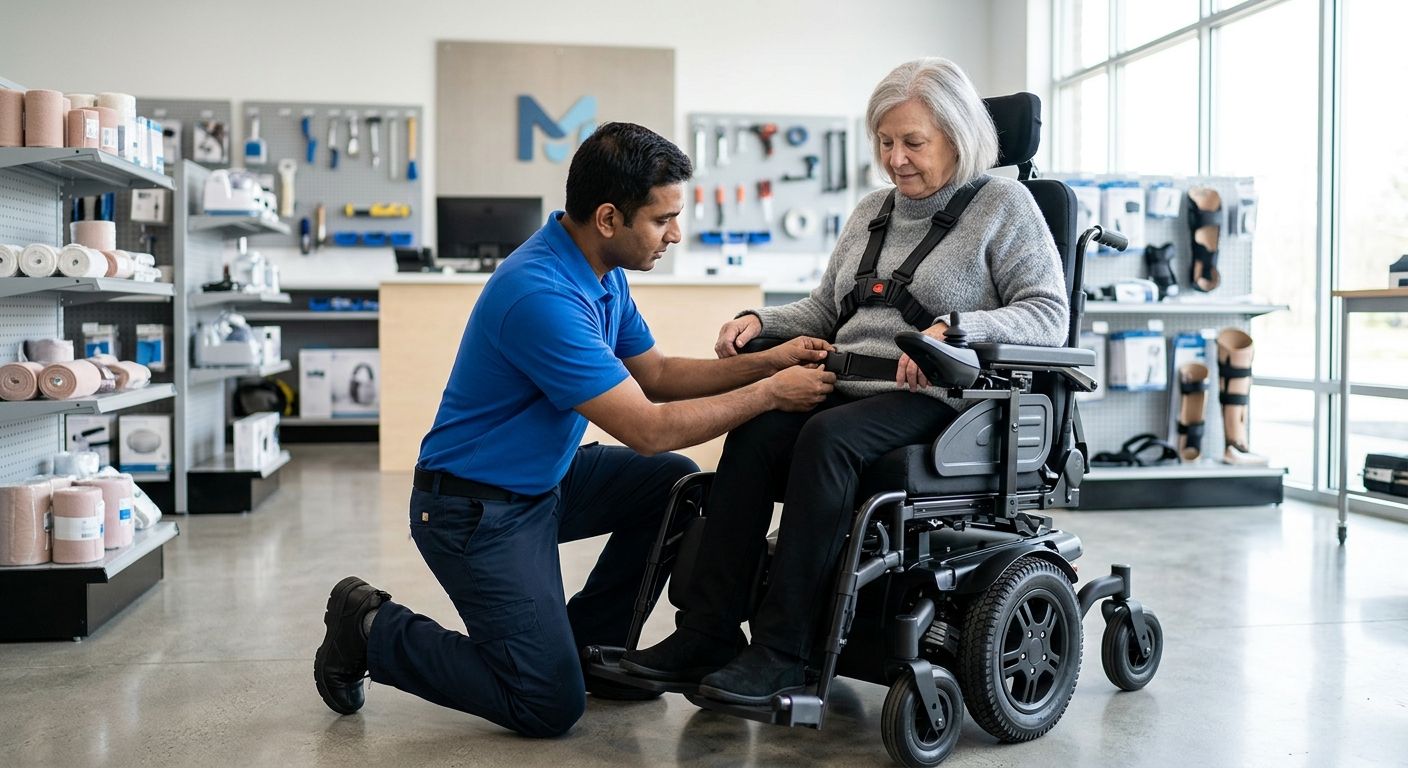
    MedEquipped, your local safety equipment supplier near me in Spring Valley, NY, stocks essential power wheelchair safety accessories per our official product listings. We offer swing-away footrests, chest straps, and more, alongside safety gear for custom motorized wheelchairs. As reliable durable medical equipment near me providers at 747 Chestnut Ridge Road, we serve the area with expert, personalized service as outlined in our company profile.

    Contact us at (845) 237-2381 for custom fittings. Once equipped from trusted suppliers like MedEquipped, proper installation ensures lasting safety.

    Service Areas for Safety Equipment in New York, Georgia, and Michigan

    Expanding on safety integrations, we at MedEquipped serve New York, Georgia, and Michigan as a reliable safety equipment supplier near me for commercial buyers needing wheelchair accessories. Our certified Assistive Technology Professionals (ATPs) ensure custom fittings for models like QUICKIE and ROVI X3, while we handle the paperwork, insurance navigation, and coordination to meet CMS guidelines and RESNA standards.

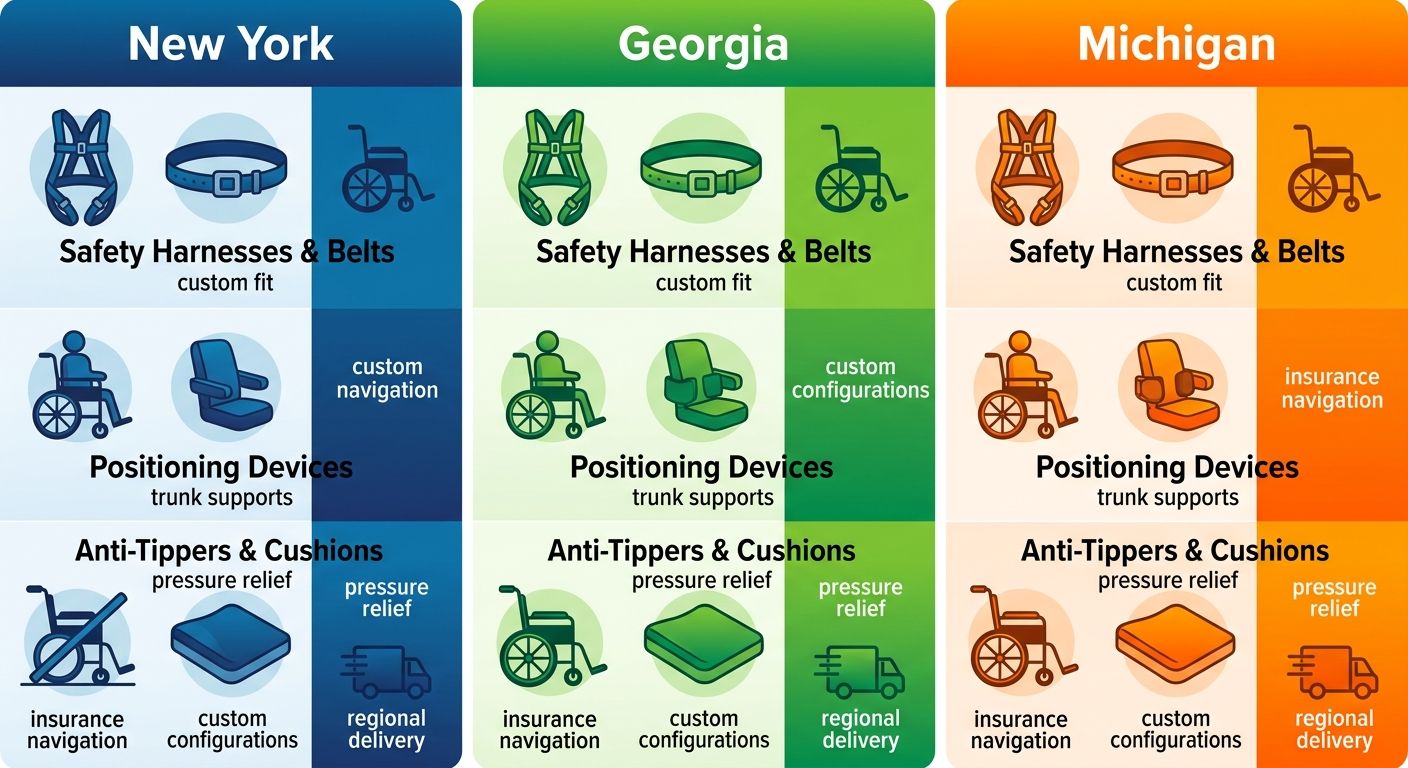
    We specialize in safety harnesses & belts custom fitted for QUICKIE and ROVI X3 custom power wheelchairs, with ATP evaluations per MedEquipped offerings. Positioning devices like trunk supports and lateral guides come with insurance navigated options, while anti-tippers & cushions offer pressure relief integrated with TDX SP2 HD compatibility, all backed by clinical fittings as authoritative CMS guidelines indicate for Medicare coverage.

    The following Safety Equipment Availability Comparison by Service Area table outlines key options, insurance support, and delivery across our service states to aid commercial evaluation:

    Safety Feature New York Georgia Michigan
    Safety harnesses & belts
    Custom fitted for QUICKIE, ROVI X3
    Available with ATP evaluation Full integration support Regional delivery
    Positioning Devices
    Trunk supports, lateral guides
    Insurance navigated Custom configurations Ongoing adjustments
    Anti-Tippers & Cushions
    Pressure relief integrated
    TDX SP2 HD compatible Clinical fittings Local support

    This comparison highlights our consistent support across states, drawing from MedEquipped service areas and RESNA standards for wheelchair accessories. Key takeaways include:

    • Quick regional delivery and ATP-led evaluations reduce downtime for businesses.
    • Insurance navigation aligns with CMS compliance to streamline procurement.
    • Local adjustments ensure long-term accessibility and safety.

    As a trusted durable medical equipment near me provider, we offer these features uniformly in New York, Georgia, and Michigan, with medical supply store near me convenience through our Spring Valley, NY base. Businesses benefit from faster 30-60 day processing, custom configurations, and ongoing support, positioning us as local safety gear providers nearby for QUICKIE, ROVI X3, and TDX SP2 HD needs.

    Infographic comparing safety equipment availability for power wheelchairs in New York, Georgia, and Michigan service areas with icons and benefits

    Safety equipment comparison across MedEquipped service areas in NY, GA, MI

    Contact us for custom quotes in your service area to partner in mobility freedom.

    Availability of Safety Accessories for Custom Wheelchairs

    Once identified, sourcing these accessories is straightforward through a trusted safety equipment supplier near me. At MedEquipped, we stock essential items like anti-tippers, pelvic belts, chest harnesses, and joystick guards compatible with custom wheelchairs, including rigid frame and folding models. Our US-wide distribution ensures quick access for powered wheelchair users.

    MedEquipped’s official FAQ guidance confirms immediate availability of these safety accessories via our online store at medequipped.com/products. They fit popular powered models like QUICKIE series and ROVI X3, supporting everyday mobility needs. We handle compatibility checks to match your custom setup seamlessly.

    As detailed by MedEquipped about us, we offer reliable custom fitting options for safety gear, with lead times as short as 30 to 60 days. Our detailed product post highlights stock status for pelvic belts and chest harnesses on powered wheelchairs. Certified ATPs ensure perfect integration for complex rehab tech.

    Our primary product listing showcases these accessories alongside durable medical equipment near me options. Search for a medical supply store near me or local safety gear providers nearby in Spring Valley, NY—we provide pickup, shipping, and inquiries via 845-237-2381 or intake@medequipped.com. Reliable DME suppliers in my area trust our catalog.

    Contact us today as your partner in mobility freedom. With accessories in hand, proper fitting ensures maximum protection.

    Local Factors in Selecting Wheelchair Safety Equipment

    Beyond national standards, local factors like proximity to experts refine choices for wheelchair safety equipment. Finding a safety equipment supplier near me ensures quick access to anti-tippers, pelvic belts, and restraints tailored to your area. We at MedEquipped guide caregivers through these steps for safer mobility.

    Start by locating certified professionals nearby. Enter your ZIP code in the RESNA certified professionals directory, as referenced by the RESNA professional association directory for finding local certified experts. These specialists assess needs for personalized fittings, per MedEquipped’s internal company FAQ providing practical guidance on wheelchair safety.

    Choose durable medical equipment near me providers who stock essential accessories and offer quick delivery. Medical supply store near me options excel in custom gear for urban sidewalks or rural terrain, verifying credentials against local accessibility standards.

    Here are key tips for local selection:

    • Confirm supplier expertise in wheelchair restraints via directories and FAQs.
    • Prioritize those with after-sales service for adjustments.
    • Evaluate for compliance with regional regulations.

    Once local suppliers are identified, proper installation ensures safety. Contact us in Spring Valley, NY, as your partner in mobility freedom.

    Steps to Source Safety Equipment from Local Suppliers

    Once you’ve identified required safety gear, follow these local sourcing steps to find a reliable safety equipment supplier near me in Spring Valley, NY. We make it simple at MedEquipped, your partner in mobility freedom.

    1. Search Locally Online
      Start with queries like “safety equipment supplier near me in Spring Valley, NY” to list 3-5 options quickly. Focus on nearby durable medical equipment providers for fast access.
    2. Verify Credentials
      Check supplier certifications as an industry standard. According to RESNA, confirm staff holding ATP certification FAQs to ensure expertise in assistive technology. Prioritize durable medical equipment near me with proven qualifications.
    3. Contact Providers
      Call or use website forms right away. Reach MedEquipped at (845) 237-2381 or intake@medequipped.com—our Spring Valley team handles inquiries swiftly.
    4. Evaluate Inventory
      Review stock for mobility aids and fall prevention gear at a medical supply store near me. Ensure items match your needs, like custom motorized wheelchairs.
    5. Compare and Arrange
      Get quotes, noting local benefits like delivery under 48 hours. Visit MedEquipped today for seamless service.

    After sourcing, proceed to safe setup protocols. We handle the paperwork, insurance navigation, and coordination for 30-60 days faster processing.

    Secure Your Power Wheelchair Safety with Local Expertise

    Apply these tips locally via expert help from a safety equipment supplier near me in your area. We at MedEquipped partner with you for personalized power wheelchair safety assessments.

    Our durable medical equipment near me providers in Spring Valley, NY, ensure adherence to the gold-standard RESNA wheelchair standards, per RESNA benchmarks. Certified technicians handle crash testing, durability checks, braking effectiveness, and dynamic stability for compliance.

    Visit your medical supply store near me today for urgent inspections. Contact us now at medequipped.com—local servicing starts with safe upgrades.

    This article was researched and written with the assistance of AI tools.

    Resources