
MedEquipped

Category: Clinical Evaluations

  • Best Permobil Standing Power Wheelchair: Health Benefits & Medicare Coverage

    Best Permobil Standing Power Wheelchair: Health Benefits & Medicare Coverage

    Table of Contents

    Standing Power Wheelchairs: Your Path to Greater Independence

    Standard power wheelchairs deliver essential mobility, but they don’t let you stand. As your partner in mobility freedom, MedEquipped focuses on standing power wheelchairs—a category of complex power wheelchairs designed to safely lift you from a seated to a standing position. A leading example is the permobil standing power wheelchair, which makes everyday tasks easier—from reaching high shelves to holding conversations at eye level—while promoting better health.

    The standing power wheelchair health benefits are substantial. Regular standing helps improve circulation, prevent pressure ulcers, aid digestion, and boost emotional well-being. As custom motorized wheelchairs, each chair is configured to match your specific clinical and lifestyle needs.

    For those concerned about affordability, medicare coverage for standing wheelchairs is possible when your ATP clinician documents medical necessity. We handle the paperwork, insurance navigation, and coordination so you can focus on what matters: reclaiming your independence. Our trained team supports adjustments and follow-up care after delivery regularly. From evaluation to delivery, the process typically takes 30-60 days (faster processing). In the next section, we’ll walk through the clinical evaluation and ordering process in more detail.

    Key Features of the Permobil Standing Power Wheelchair

    Now let’s explore the key features that make the Permobil standing power wheelchair a standout choice for individuals seeking greater independence and therapeutic support. As your partner in mobility freedom, we believe understanding these innovations is the first step toward reclaiming daily life. At MedEquipped, we handle the paperwork, insurance navigation, and coordination to get you the right chair, but first, let’s look at what makes these custom motorized wheelchairs so unique.

    The Mechanics of Standing: Sit-to-Stand vs. Tilt-to-Stand

    When evaluating a standing power wheelchair, the mechanics of how it brings you upright are a core consideration. Permobil offers two sophisticated methods, each designed for different clinical needs. Understanding these differences helps match the chair to your specific lifestyle.

    The sit-to-stand function works by lifting the entire seat base into a vertical orientation while you remain safely seated. This method offers excellent stability because your body’s position relative to the seat does not change. It is often preferred for those who want the benefits of standing with a simpler transition or who have more limited trunk control, as the backrest and seat provide continuous support throughout the movement.

    In contrast, the tilt-to-stand mechanism actively angles the seat pan forward in coordination with the backrest rising. This subtle shift guides your body into a more natural, weight-bearing standing posture. The forward tilt encourages better hip and knee extension, which can provide deeper therapeutic advantages.

    This fundamental choice between standing methods highlights just the start of personalization available. Beyond the standing mechanism, these chairs offer extensive clinical-grade customization.

    Visual comparison of sit-to-stand and tilt-to-stand mechanisms in a Permobil standing power wheelchair.

    Two standing power wheelchair mechanisms comparison.

    Clinical-Grade Customization Options

    A Permobil standing power wheelchair is far more than a standard power base; it is a fully configurable piece of complex rehabilitation technology. A certified Assistive Technology Professional (ATP), like those on our team, conducts a detailed clinical evaluation to prescribe the exact seating and positioning components needed for your body’s unique shape and support requirements. This precision is critical for comfort and function.

    Your seating system is built from the ground up. We can specify custom-molded cushions to protect skin, adjustable backrests for lateral trunk support, and contoured headrests for those who need neck stability. These elements work together to maintain a healthy, symmetrical posture. Positioning features don’t stop there; power tilt and recline functions allow you to shift weight throughout the day, providing essential pressure relief, while elevating legrests support circulation and reduce swelling.

    Control over your environment is equally personalized. Whether you operate the chair with a standard joystick, a compact mini-joystick, or require alternative controls like a sip-and-puff switch or a head array, the system is programmed to your specific response. These programmable settings can adjust acceleration, speed, and sensitivity. Every option is matched to your clinical needs, ensuring you can access the many standing power wheelchair health benefits, including improved circulation, bone density maintenance, and better respiratory function. With this level of clinical integration, it’s worth exploring Medicare coverage for standing wheelchairs, which may apply when prescribed as medically necessary. Our team navigates that entire process for you.

    Consult a healthcare professional before making clinical decisions. Information is not medical advice and is for informational purposes only.

    With these features in mind, let’s look at the health benefits and how to get started with a custom standing wheelchair.

    Health and Lifestyle Benefits of Standing Power Wheelchairs

    Standing power wheelchairs go beyond basic mobility—they actively support your health. A Permobil standing power wheelchair, for instance, can help users achieve these health benefits while maintaining the freedom to go about their day. At MedEquipped, we see the transformation firsthand when individuals with spinal cord injury (SCI), multiple sclerosis, or other conditions integrate regular standing into their routine.

    Benefits for Spinal Cord Injury and Other Conditions

    For spinal cord injury patients, the shift to a vertical posture triggers a cascade of physiological improvements. According to the Academy of Spinal Cord Injury Professionals, a leading spinal cord injury professional society, regular standing can help reduce secondary complications. One of the most immediate benefits is improved circulation. Standing counteracts venous pooling in the legs and helps prevent orthostatic hypotension—a sudden drop in blood pressure many chair users experience.

    Weight-bearing through the hips and spine is another critical advantage. Because SCI often accelerates bone mineral loss, standing may help maintain or improve bone density, lowering fracture risk. Our team at MedEquipped frequently hears from physical therapists who note that consistent standing can contribute to better bone health.

    Pressure relief is equally important. By offloading the glutes and sacrum, standing helps prevent pressure ulcers. The Academy recommends standing for at least 30 minutes daily to maximize tissue offloading and promote skin integrity. Finally, regular standing can preserve range of motion in the hips, knees, and ankles, reducing contractures and stiffness.

    Long-Term Health Outcomes and Quality of Life

    While these immediate benefits are compelling, the long-term health outcomes truly change daily life. Research on standing power wheelchair health benefits shows that consistent pressure relief significantly reduces the incidence of pressure ulcers—a leading cause of hospitalization for SCI patients. By routinely offloading high-risk areas, users can avoid painful wounds and lengthy recoveries.

    Respiratory function also improves over time. Standing expands the chest cavity, allowing the lungs to fully inflate and helping to clear secretions. For individuals with limited respiratory muscle function, this can reduce the risk of pneumonia and respiratory infections. MedEquipped’s ATPs (Assistive Technology Professionals) often emphasize these lung benefits during clinical evaluations.

    Beyond physical health, standing wheelchairs open doors to greater independence and social engagement. Reaching a high shelf, holding an eye-level conversation, or simply standing beside a friend at a gathering can dramatically boost psychological well-being. Users frequently tell us they feel more included and confident, which is a cornerstone of quality of life.

    To experience these benefits, it’s essential to work with a provider who understands both the clinical and insurance landscape. At MedEquipped, we offer custom standing power wheelchairs from trusted brands, including Permobil, and we handle the paperwork, insurance navigation, and coordination—so you can focus on what matters: your health and mobility. In the next section, we’ll explain how we simplify the insurance process to get you the right chair faster.

    Results may vary; individual outcomes are not guaranteed. Consult a healthcare professional before making clinical decisions. Information is not medical advice and is for informational purposes only.

    How MedEquipped Delivers Your Permobil Standing Wheelchair

    The Permobil standing power wheelchair’s advanced features open the door to a healthier, more independent life. Now, let’s walk through exactly how our team at MedEquipped works to get this life-changing technology into your daily routine. As your partner in mobility freedom, we manage every step of the process—from a precise clinical assessment to insurance paperwork and final delivery—so you can focus on your mobility, not logistics.

    Clinical Evaluation and Custom Fitting

    Your journey begins with a comprehensive evaluation led by one of our certified Assistive Technology Professionals (ATPs) . This specialist doesn’t just take basic measurements; they conduct an in-depth assessment to understand your unique medical needs, physical dimensions, and daily living environment. The goal is to build a complete picture, which is the foundation of our custom fitting process.

    To achieve the significant standing power wheelchair health benefits, the ATP carefully configures every component of the chair. This involves capturing precise data points for custom seating to ensure proper postural support and pressure relief. The controls are also personalized, whether you require a standard joystick, a head array, or a sip-and-puff system. This exacting, data-driven method ensures your Permobil standing power wheelchair is truly tailored to your body and capabilities, working in concert with recognized standards from rehabilitation technology supplier resources.

    Insurance Navigation and Paperwork

    Once your custom specifications are defined, our team shifts to handling one of the most daunting parts of the process: securing funding. We take charge of the insurance navigation, working directly with your provider to build a strong case for medical necessity, which is often the key to unlocking Medicare coverage for standing wheelchairs.

    We handle the paperwork, insurance navigation, and coordination from start to finish, compiling all required documentation, clinical justifications, and ATP reports to present to your insurer. This dedicated advocacy addresses common questions about approval criteria directly, turning a potentially stressful hurdle into a streamlined administrative path for you.

    Delivery and Ongoing Support

    After approval, we place your custom order, triggering a targeted fulfillment window of just 30-60 days—a faster processing timeline than industry norms. We then coordinate the delivery of your fully assembled and fitted motorized wheelchair.

    Our service doesn’t end at your doorstep. We remain your dedicated support system, ready to assist with adjustments, troubleshooting, and any questions that arise as you begin using your device. This ongoing partnership is central to our mission of providing custom motorized wheelchairs that empower you for the long term. For residents across our service area, additional information on disability services can also be found through the Commonwealth of Massachusetts’ official government portal.

    Results may vary; individual outcomes are not guaranteed.

    Selecting the Right Standing Power Wheelchair for Your Needs

    Choosing the right permobil standing power wheelchair starts with understanding the proven standing power wheelchair health benefits—improved circulation, bone density maintenance, and pressure relief—and how those benefits apply to your daily life. To turn those clinical advantages into a safe, comfortable reality, you’ll need to meet a few key eligibility requirements and provide the right documentation. We’re here to guide you through every step.

    Qualification Criteria and Medical Documentation

    Before a custom motorized wheelchair can be configured for standing functionality, a physician must confirm that you have a medical need for it. Consult a healthcare professional before making clinical decisions—your doctor will evaluate whether standing is medically beneficial for you and safe to perform independently. The primary documents you’ll need include:

    1. A detailed prescription or referral from your primary care or specialist physician that specifically requests a standing power wheelchair.
    2. A clinical evaluation performed by a physical or occupational therapist, or directly by one of our certified ATPs, that documents your mobility limitations and the clinical justification for standing.
    3. Supporting medical records—such as progress notes, imaging reports, or therapy summaries—that demonstrate a long-term need for a standing feature as part of your daily care plan.

    Once we have your prescription and evaluation results, our team works directly with your healthcare providers to confirm medical necessity and prepare your file for funding submission.

    Funding Options and Medicare Coverage

    When it comes to paying for your custom chair, you have several potential paths. Medicare coverage through Part B often applies when the equipment is deemed medically necessary and you can safely operate the stand function independently. We help you verify whether you meet medicare coverage for standing wheelchairs requirements, and we can also pursue Medicaid, private insurance policies, and assistive technology funding programs on your behalf. Because every chair is custom-built to your exact body dimensions and clinical needs, pricing is available only through a personalized quote—we do not list prices online. From the moment you contact us, we handle the paperwork, insurance navigation, and coordination so you can focus on your mobility, not on administrative hurdles.

    Most funding approvals and custom configurations are completed in 30-60 days (faster processing) compared to many national suppliers. If a stand-up power chair isn’t covered by your primary insurance, we’ll help you explore alternative funding sources and guide you through any appeals.

    Working with a Certified ATP Evaluator

    The final—and arguably most critical—step is a hands-on evaluation with a certified ATP evaluator. Our certified ATPs collaborate closely with your clinical team, including any PT solutions physical therapy providers you already see, to fine-tune your seating, drive controls, and standing configuration. By matching you to the right base, seating system, and positioning supports, we maximize both your safety and the likelihood of insurance approval.

    When you’re ready to schedule an evaluation, just give us a call or send an email to intake@medequipped.com. Please note: we never sell your personal information. SMS communications may be subject to message and data rates; reply STOP to unsubscribe. Results may vary, and individual outcomes are not guaranteed.

    Let’s get you moving—and standing—on a timeline that works for your life.

    Take the Next Step Toward Standing Mobility

    The benefits of a permobil standing power wheelchair for your health and independence are clear. Now, it’s time to take action. We are your partner in mobility freedom, and we’re ready to guide you through every step of the process to get you into the perfect standing wheelchair.

    Our team handles all the complex details so you can focus on what matters most. We manage the insurance paperwork, coordinate funding, and work directly with your clinician to build a custom Permobil mobility solution tailored just for you. Often, we can explore helpful resources like the Massachusetts government portal for potential assistance, ensuring no stone is left unturned in securing your equipment. Typically, our comprehensive process takes just 30 to 60 days—from your initial consultation to the final delivery of your power standing wheelchair.

    From our locations across New York, Georgia, and Michigan, we provide end-to-end support, including clinical evaluation, custom ordering, and ongoing adjustment services after delivery. If you’ve been researching the standing power wheelchair health benefits and are ready to experience them for yourself, or if you have questions about medicare coverage for standing wheelchairs, we invite you to start the conversation. Contact us today, and let’s begin your journey to greater mobility and freedom.

    Results may vary; individual outcomes are not guaranteed.

    Resources

  • Get Custom Motorized Wheelchair for Adults: Fast Delivery 2026

    Get Custom Motorized Wheelchair for Adults: Fast Delivery 2026

    Table of Contents

    Custom Motorized Wheelchairs for Adults: A Path to Greater Independence

    Achieving true independence starts with a mobility solution designed around you — not the other way around. A custom motorized wheelchair for adults is a precisely fitted power chair built to match your unique body shape, clinical needs, and daily lifestyle. At MedEquipped, we see ourselves as your partner in mobility freedom, combining advanced clinical evaluations with end-to-end coordination so you can focus on living fully.

    A properly tailored custom fit does more than improve comfort. It promotes better posture, distributes pressure evenly, and helps reduce the risk of long-term secondary health issues. Our certified ATP evaluators and dedicated technicians use clinical assessments to inform every decision, ensuring your chair integrates the right combination of complex rehab technology and power seat functions for superior support and accessibility. As part of this process, we often conduct a wheelchair pressure mapping evaluation to verify that your seating system protects your skin and maximizes stability.

    We handle the paperwork, insurance navigation, and coordination from evaluation to delivery — including serving families across New York, Georgia, and Michigan. Most custom motorized wheelchairs for adults move from initial assessment to your doorstep in 30 to 60 days, with faster processing available when needed. Everything we do is built around one goal: getting you mobile with confidence.

    Many customization options go into designing your ideal chair, from seating geometry and control placement to specialized power adjustments. Exploring these choices is the next step toward a wheelchair that truly supports your independence.

    Disclaimer: Results may vary; individual outcomes are not guaranteed. Consult a healthcare professional before making clinical decisions. This information is not medical advice and is for informational purposes only. Privacy notice: we do not sell personal information (see Privacy Policy). SMS terms: message and data rates may apply; reply STOP to unsubscribe.

    Understanding Custom Motorized Wheelchairs and Complex Rehab Technology

    A custom motorized wheelchair for adults is far more than a standard power chair—it is a precisely engineered mobility solution tailored to an individual’s unique physical and functional needs. At MedEquipped, we see these devices as a true complex rehab technology (CRT), a formal classification for wheelchairs that require extensive evaluation, configuration, and fitting by certified professionals. Unlike a one-size-fits-most device, a CRT wheelchair is designed from the ground up to provide customized support, positioning, and independent control for daily indoor and outdoor use.

    The following table illustrates the key differences between a standard power wheelchair and a custom CRT wheelchair.

    Standard Power Wheelchair vs Complex Rehab Technology Wheelchair
    FeatureStandard Power WheelchairCRT Wheelchair
    Customization LevelLimited; pre-configured optionsHighly customizable; fully adjustable seating and controls
    Seating OptionsBasic cushion; minimal positioningCustom cushions, power tilt/recline, elevating legrests, seat elevation
    Drive Control AdjustabilityStandard joystick; limited programmabilityProgrammable joystick, head array, sip-and-puff; fully customizable
    Frame DurabilityModerate; designed for light to moderate useHeavy-duty; built for frequent, long-term use
    Insurance ClassificationStandard DME (durable medical equipment)CRT (complex rehab technology); higher documentation needs
    Typical Use CasesIntermittent indoor mobilityDaily indoor and outdoor mobility for complex conditions

    A standard power chair is often adequate for temporary or limited mobility, but a CRT wheelchair is essential when long-term positioning and advanced functionality are required. The heavy-duty frame of a custom chair is not just about durability; it serves as a stable platform for integrating advanced power seat functions. These functions, such as power tilt and recline or elevator-like seat elevation, are not luxury add-ons. They are medically necessary for pressure relief, improved respiration, and safe, independent participation in daily activities. As part of our clinical process, a wheelchair pressure mapping evaluation is an invaluable tool we use to guide the selection of a custom cushion, ensuring pressure is distributed evenly to protect skin health.

    Side-by-side comparison infographic showing standard power wheelchair with icons for basic features on left and complex rehab technology wheelchair with advanced feature icons including power tilt/recline and programmable controls on right.

    Comparison of standard power wheelchairs versus CRT wheelchairs highlighting key feature differences.

    Drive controls on a custom motorized wheelchair represent another leap forward in customization. While a standard chair offers a simple joystick, a CRT system’s programmability is limitless. We can integrate specialty drive controls like a head array or sip-and-puff system for individuals with limited hand function. This level of adjustment, down to the acceleration and braking sensitivity, is a cornerstone of the complex rehab technology definition endorsed by the Rehabilitation Engineering and Assistive Technology Society of North America (RESNA), the industry standard for quality and safety. These RESNA standards guide our equipment selection process to ensure your chair is safe, durable, and perfectly adjusted.

    From a practical standpoint, these clinical differences translate into a distinct insurance pathway. Standard power wheelchairs are classified as Durable Medical Equipment (DME), a broad category. A CRT wheelchair, however, is in its own class, requiring detailed medical documentation and a face-to-face clinical evaluation. At MedEquipped, we are your partner in mobility freedom. We handle the paperwork, insurance navigation, and coordination as a core part of our service, leveraging our certified ATP-led evaluations to build a compelling case for the equipment you truly need. This comprehensive approach is what transforms a complex process into a clear, manageable path toward gaining a custom power wheelchair.

    Exploring Power Seat Functions and Customization Options

    We at MedEquipped know that a truly custom motorized wheelchair for adults is more than just a base and a seat—it’s a system designed to adapt to your unique body and daily life. Power seat functions turn a standard power wheelchair into a dynamic tool for health management, comfort, and independence. By adding these features, you gain the ability to reposition yourself throughout the day without help, which is central to our mission as your partner in mobility freedom.

    Primary Power Seat Functions and Their Benefits

    Power tilt is a function that angles the entire seating system backward while maintaining the hip and knee angles, redistributing pressure away from the sitting bones. This movement is critical for pressure relief; according to our pressure mapping evaluation data, shifting weight through tilt can significantly lower a user’s Peak Pressure Index, reducing the risk of pressure ulcers. Power recline, which changes the angle between the backrest and the seat, works differently by opening the hip angle. This function is often used for managing muscle tone, preventing contractures, and providing an alternative pressure relief surface by changing the body’s contact area with the cushion.

    Elevating legrests raise the lower extremities independently, which is an essential feature for controlling edema, improving circulation, and simply finding a more comfortable leg position after long periods of sitting. Seat elevation moves the user vertically from a seated to a standing position’s height, enabling independent reach to high shelves, safer and easier transfers, and more natural eye-to-eye social interactions. For those with the necessary medical clearance, power standing takes this further by bringing the user into a fully upright, weight-bearing posture, which can offer profound benefits for bone density, circulation, and psychological well-being. Each of these complex rehab technology power seat functions serves a distinct clinical purpose, and their inclusion must be justified for insurance coverage.

    Customizing Control Systems and Drive Interfaces

    The most advanced power seat functions are only useful if you can command them effortlessly. An assistive technology professional near me plays the central role in identifying a custom motorized wheelchair for adults with the right drive interface. This specialist evaluates your strength, range of motion, and coordination to select from options like a standard or mini proportional joystick for precise hand control, or a compact joystick for users with limited finger dexterity. For those who cannot use their hands reliably, a head array built into the headrest can activate switches through gentle head movements, while sip-and-puff controls interpret breath pressure through a tube for precise, sequential commands.

    Another innovative solution uses proximity switches, which are fiber-optic or infrared sensors that require no physical force to activate—simply bringing a finger or head within a short distance of the switch is enough. The selection process is deeply personal, and we work with you and your therapist to match the technology to your most consistent and fatigue-free movements. The goal is an interface that feels intuitive and dependable, letting you focus on where you are going and not on how to get there. We handle the paperwork, insurance navigation, and coordination for these critical components just as we do for the chair itself. Results may vary; individual outcomes are not guaranteed. Consult a healthcare professional before making clinical decisions. This information is not medical advice.

    Indoor and Outdoor Mobility Considerations

    Customizing a power wheelchair means considering your environment, from tight, carpeted hallways to grassy parks. The drive wheel configuration is a major factor. A center-wheel drive base offers an exceptionally tight turning radius, making it a top performer for maneuvering around furniture and through narrow doorways in a home or office. Rear-wheel drive chairs, conversely, provide excellent stability and tracking at higher speeds, which is ideal for outdoor use, while front-wheel drive excels at climbing curbs and handling uneven surfaces with a smoother ride.

    A proper suspension system is vital for comfort and safety when moving from a smooth floor to a bumpy sidewalk; active suspension absorbs shocks, keeping all wheels on the ground and reducing spasticity triggers. Your tire choice also matters. Pneumatic tires, filled with air, cushion the ride effectively outdoors but require maintenance, while solid or foam-filled inserts are puncture-proof and require less upkeep, though they offer a firmer ride. We consider these variables during our comprehensive evaluation, balancing your primary daily environments with your recreational desires. After we finalize the specifications, our team manages the entire order, and you can typically expect delivery within 30-60 days (faster processing). We handle the paperwork, insurance navigation, and coordination, ensuring your new customized mobility system arrives ready for your world. Results may vary; individual outcomes are not guaranteed. Consult a healthcare professional before making clinical decisions. This information is not medical advice.

    The Complete Process: From Clinical Evaluation to Delivery

    Getting a custom motorized wheelchair for adults involves several important steps, and we guide you through each one. At MedEquipped, we handle the paperwork, insurance navigation, and coordination so you can focus on what matters most — regaining your independence and mobility. From your very first evaluation with a certified professional to the day your fully fitted chair arrives, we’re your partner in mobility freedom.

    Clinical Assessment and Evaluation

    The process begins with a comprehensive clinical evaluation led by a certified Assistive Technology Professional (ATP). This step is essential — not only to ensure your chair fits your body perfectly, but also because Medicare and most private insurers require an ATP-led assessment for complex rehab technology. During the evaluation, we conduct a detailed mobility needs assessment, analyzing how you move through your daily environment and what functional challenges you face.

    Seating and positioning analysis is a cornerstone of the evaluation. Our ATP examines your posture, spinal alignment, and weight distribution to prevent secondary complications like pressure injuries and skin breakdown. We use pressure mapping technology to visualize high-risk areas and identify optimal cushioning and support surfaces. The assessment also covers control assessment, where we evaluate your strength, range of motion, and coordination to determine the best drive control — whether a standard joystick, alternative input like sip-and-puff, or advanced power seat functions such as tilt and recline. MedEquipped recommends consulting assistive technology professional resources for further information on ATP certification standards.

    Insurance Navigation and Funding Approval

    Once the clinical evaluation is complete, the next phase focuses on securing funding. We know that insurance paperwork can feel overwhelming, which is why MedEquipped takes the lead in identifying your coverage options and managing the entire approval process. Our team reviews your benefits under Medicare, Medicaid, and private insurance plans, determining exactly what documentation each payer requires.

    We compile the ATP’s clinical findings into a detailed letter of medical necessity — the primary evidence insurers use to justify coverage. For Medicare beneficiaries, this means meeting CRT criteria with a face-to-face exam and a written order containing seven required elements. Medicaid guidelines vary by state, often requiring prior authorization and state-specific forms. Private insurance plans typically need a customized medical necessity letter along with clinical notes and the seating evaluation report. Our staff coordinates directly with physicians, therapists, and insurance case managers to minimize delays and keep your application moving forward.

    Custom Ordering, Delivery, and Follow-Up

    After funding approval, we move into the custom ordering phase. Our ATP configures your chair precisely to the specifications determined during the evaluation — frame type, seating system, power seat functions, drive controls, and any additional accessories. We source from leading manufacturers to ensure your custom power wheelchair matches both your clinical needs and your lifestyle. Once the order is submitted, the typical timeline from final configuration to delivery is 30-60 days, and we actively work toward faster processing whenever possible.

    When your chair arrives, we handle delivery and fitting personally. Our technician ensures every component is adjusted correctly, verifies that all controls respond as expected, and provides hands-on education so you feel confident operating your new equipment. But our relationship doesn’t end at delivery. We provide ongoing support for adjustments, repairs, and patient education — because a well-maintained chair is essential for long-term mobility and health. Once your chair is delivered, our ongoing support ensures it stays in top condition. Results may vary; individual outcomes are not guaranteed. Information is not medical advice and is for informational purposes only.

    Advanced Considerations for Complex Rehab Technology

    Now that we’ve defined complex rehab technology, let’s talk about the paperwork that makes it possible to get you the wheelchair you need. At MedEquipped, we guide you through every required form and clinical justification, so your custom motorized wheelchair moves from evaluation to delivery on our typical 30–60 day timeline.

    Among the documented requirements, three pitfalls cause the most delays: missing signatures or dates on the written order, vague medical necessity statements that fail to demonstrate functional need, and face-to-face exams performed outside the six-month window. Our ATP (Assistive Technology Professional) evaluators review every document for completeness, drawing on standards from the Rehabilitation Engineering and Assistive Technology Society of North America (RESNA) and the Assistive Technology Industry Association (ATIA) to help you avoid these common errors. When listing additional options such as power seat functions, we ensure each is justified in the narrative.

    Frequently Asked Questions

    What is a custom motorized wheelchair for adults?
    A custom motorized wheelchair for adults is built to your unique measurements, clinical needs, and lifestyle, incorporating complex rehab technology for superior comfort and function.

    What is pressure mapping and why is it important?
    Pressure mapping measures how your body weight distributes on the seat cushion, allowing us to select the right support and prevent skin breakdown.

    What are power seat functions and what options are available?
    Power seat functions include tilt, recline, and elevating leg rests, helping you change position independently for pressure relief and circulation.

    How long does it take to get a custom motorized wheelchair?
    After funding is approved, delivery typically takes 30–60 days (faster processing) thanks to our streamlined coordination and paperwork handling.

    Contact us at 845-237-2381 or intake@medequipped.com. We’re your partner in mobility freedom. Results may vary; individual outcomes are not guaranteed.

    Empower Your Independence with a Custom Motorized Wheelchair

    A custom motorized wheelchair for adults is more than just mobility equipment — it’s a personalized solution crafted around your body, lifestyle, and daily needs. At MedEquipped, we serve as your partner in mobility freedom, managing every step from clinical evaluation and ATP-led fitting to insurance paperwork and final delivery. Our team brings together advanced complex rehab technology and thoughtful configurations like power seat functions to create a chair that truly fits you. We coordinate the entire process so you can focus on living independently, with typical turnaround times of 30–60 days. We proudly support clients in New York, in Georgia, and in Michigan through dedicated technicians and ongoing service. Ready to see how the evaluation works? Learn about the simple steps ahead to start your journey toward greater freedom.

    Resources

  • How to Get an Assistive Technology Professional Evaluation: Key Steps

    How to Get an Assistive Technology Professional Evaluation: Key Steps

    Table of Contents

    Understanding Your Assistive Technology Professional Evaluation

    To ensure your custom motorized wheelchairs fit perfectly, we begin with an in-depth assistive technology professional evaluation. This clinical assessment, conducted by one of our certified experts, determines the ideal wheelchair configuration and seating system for your unique mobility needs. We analyze your daily activities, functional abilities, and seating requirements to build a complete picture of what will work best for you.

    This assistive technology professional evaluation is critical for meeting power wheelchair medical necessity requirements that insurance and funding sources demand. Our team collaborates directly with you, your clinician, and the funding source to ensure the recommended equipment aligns with your lifestyle and goals. Depending on your needs, the complex rehab technology functional assessment may involve trial equipment to validate specific choices, such as front-wheel drive power wheelchairs for superior outdoor navigation and curb climbing.

    The evaluation typically lasts 60 to 90 minutes. Afterward, we handle the paperwork, insurance navigation, and coordination, with most custom orders processed within 30 to 60 days. Information is not medical advice and is for informational purposes only.

    What to Prepare for Your ATP Evaluation

    Now that you understand the purpose of an ATP evaluation, gathering the right documents ensures a smooth start. Your assistive technology professional evaluation begins with medical records that prove your power wheelchair medical necessity requirements—so bring these key items:

    • A signed physician’s prescription for a power wheelchair
    • Your insurance card and policy information
    • Medical records detailing your mobility limitations and prior treatments
    • A list of your daily activities and functional needs
    • Any referral or authorization forms you’ve received
    • A list of questions about the evaluation process and expected timelines

    This preparation supports the complex rehab technology functional assessment your ATP will perform, which examines seating, positioning, and the environments where you’ll use your chair. The evaluator uses this information to customize the chair to your life.

    We handle the paperwork, insurance navigation, and coordination, so bringing the above documents lets us move forward efficiently. As your partner in mobility freedom, we ensure your wheelchair assessment produces a chair that fits your needs.

    Infographic checklist with icons for physician's prescription, insurance card, medical records, daily activities list, and questions notebook for ATP evaluation preparation at MedEquipped.

    Checklist of essential documents and items for your ATP evaluation at MedEquipped.

    With everything ready, your upcoming evaluation will focus on your comfort and safety. The next section walks through what happens during the appointment, turning your preparation into confidence.

    Please note: This information is for educational purposes. Consult a healthcare professional before making clinical decisions.

    Schedule Your Initial ATP Consultation

    Now that you’ve explored custom motorized wheelchairs, the first step toward your personalized mobility solution is an assistive technology professional evaluation. At MedEquipped, this consultation connects you with a certified ATP who conducts a thorough complex rehab technology functional assessment—matching your physical needs, lifestyle, and power wheelchair medical necessity requirements to the right equipment.

    We see ourselves as your partner in mobility freedom, so we handle the paperwork, insurance navigation, and coordination from this first visit through final delivery, typically completing custom orders in 30–60 days (faster processing available). This patient-centered assistive technology professional evaluation results in a custom chair from trusted brands like Permobil or Quantum Rehab, without you having to manage the details alone.

    After the ATP consultation, the clinical evaluation process begins. In the next section, we’ll walk you through what to expect. Please consult a healthcare professional before making clinical decisions—this information is for educational purposes only.

    Gather Required Medical Documentation

    Before your assistive technology professional evaluation can begin, gathering the right medical documentation is the essential first step. We help you collect everything needed to demonstrate power wheelchair medical necessity requirements. MedEquipped simplifies the process by guiding you through each requirement.

    • A valid physician’s prescription for a custom power wheelchair.
    • Medical records detailing your diagnosis, functional limitations, and a statement of medical necessity.
    • A complex rehab technology functional assessment to document mobility needs and justify the equipment.
    • Supporting documents such as PT/OT evaluations, fall history, and home environment details.

    The complex rehab technology functional assessment, required by most insurers, confirms the power wheelchair is the appropriate solution. Our expertise ensures your documentation meets clinical and insurance criteria. As your partner in mobility freedom, we handle the paperwork, insurance navigation, and coordination.

    Once everything is gathered, the formal evaluation can begin — we’ll cover that next. Information is not medical advice and is for informational purposes only.

    Undergo Functional Mobility Assessment

    After your initial inquiry, the next step is a functional mobility assessment—a clinical evaluation performed by a certified Assistive Technology Professional (ATP) in New York, in Georgia, or in Michigan. This assistive technology professional evaluation establishes your unique mobility requirements.

    The complex rehab technology functional assessment evaluates your physical abilities, daily routines, home layout, and equipment needs to determine the right seating, drive controls, and power features. This holistic review ensures every aspect of your daily life is considered.

    Medicare and many insurers require this assessment to document power wheelchair medical necessity and justify coverage. MedEquipped coordinates the entire process—scheduling, managing paperwork, and communicating with your insurance—so you can focus on what matters most.

    The outcomes directly shape your custom wheelchair configuration, from seat dimensions and back support to power seating options. We’ll work closely with you, always keeping your comfort and mobility our top priority.

    Disclaimer: This assessment is for mobility equipment needs only and does not constitute medical advice. Please consult your physician for any medical concerns.

    Configure Seating and Positioning

    Building on your comprehensive evaluation, the assistive technology professional evaluation directly guides how we configure the seating and positioning of your custom motorized wheelchair. This process transforms clinical findings into a personalized setup that addresses your unique needs.

    We use a complex rehab technology functional assessment to determine the right pressure relief, postural support, and functional reach for you. The assistive technology professional evaluation makes sure every adjustment—from cushion choice to backrest angle—aligns with your daily activities and clinical goals. We work closely with you and your clinical team to capture these details, because accurate documentation is key to meeting power wheelchair medical necessity requirements and securing funding approval.

    Following standards from the Rehabilitation Engineering and Assistive Technology Society of North America (RESNA), our ATP evaluation emphasizes evidence-based configuration that helps ensure both comfort and long-term mobility. The final specifications we develop during this step will directly shape your custom order in the next phase.

    Securing a custom motorized wheelchair requires insurance approval, but MedEquipped is your partner in mobility freedom throughout the process. We handle the paperwork, insurance navigation, and coordination in New York, Georgia, and Michigan so you can focus on what matters.

    The process starts with establishing medical necessity. An assistive technology professional evaluation captures your clinical needs and sets the stage for funding. Often, a complex rehab technology functional assessment is also required to meet power wheelchair medical necessity requirements. Our team guides you through each step and incorporates specialized seating medical necessity documentation based on RESNA standards.

    Insurance prior authorization is typical, and we manage it from start to finish. The typical timeline from submission to approval is 30 to 60 days—faster than many large suppliers.

    Once approved, we coordinate the custom build and delivery. Results may vary; individual outcomes are not guaranteed.

    Finalize Wheelchair Specifications and Order

    With your clinical evaluation complete – including your assistive technology professional evaluation and complex rehab technology functional assessment – we now turn those findings into a custom order that reflects the power wheelchair medical necessity requirements documented for you. We take a straightforward approach to finalizing every detail:

    1. Confirm your measurements – we review seat width, seat depth, back height, armrest style, and footrest type captured during your evaluation.
    2. Select accessories and controls – choose your cushion, joystick controller, and any positioning aids that best support your daily routine.
    3. Place your order – once specifications are locked, we handle the paperwork, insurance navigation, and coordination with your provider.

    Your custom motorized wheelchair typically arrives in 30–60 days, often faster than many larger suppliers. For pricing, we prepare a personalized quote once your configuration is set; please contact us for an estimate.

    As your partner in mobility freedom, we stay with you through delivery and setup, providing ongoing support for every adjustment you need.

    Prepare for Delivery and Follow-Up Care

    After your assistive technology professional evaluation is complete and your custom motorized wheelchair has been ordered, it’s time to get ready for delivery. We recommend clearing a dedicated, accessible space with a nearby outlet for overnight charging. Our team will provide a delivery window and update you before our technician arrives, so you’ll always know what to expect.

    Because every chair is built around the findings of your complex rehab technology functional assessment, the typical processing timeline ranges from 30–60 days (faster processing available). Results may vary; individual outcomes are not guaranteed. Once your wheelchair is in your home, our support continues — we provide follow-up adjustments, troubleshooting, and ongoing care through our network of certified technicians.

    No matter what questions come up, we remain your dedicated partner in mobility freedom. From your first fitting to long-term maintenance, you can count on MedEquipped to keep you moving forward.

    Common Challenges in the ATP Evaluation Process

    While the Assistive Technology Professional (ATP) evaluation serves as a vital step toward obtaining a custom power wheelchair, the process can present several hurdles that patients and their care teams must navigate. From managing complex paperwork to coordinating with multiple parties, the evaluation phase often requires dedicated attention to avoid delays. We have seen how these obstacles can cause frustration, but they are also entirely manageable with the right support.

    One of the most time-consuming aspects is insurance and paperwork navigation. A thorough complex rehab technology functional assessment generates significant documentation that must be correctly submitted. Many clinicians and patients feel overwhelmed by these administrative demands; that’s why we handle the paperwork, insurance navigation, and coordination for you, reducing the burden on your care team.

    Another challenge is ensuring the evaluation clearly demonstrates medical necessity. When power wheelchair medical necessity is not properly documented during the assistive technology professional evaluation, funding requests may be denied or delayed. Our ATPs work closely with your referring physician and therapist to capture functional deficits and mobility limitations that justify the equipment, helping to prevent setbacks.

    Even after a successful evaluation, the timeline from assessment to delivery can feel long. Industry standards often extend several months, but MedEquipped’s streamlined process typically completes within 30 to 60 days. Of course, results may vary; individual outcomes are not guaranteed, yet our focused approach helps accelerate the journey. Understanding these challenges is the first step—next, we’ll explore how MedEquipped directly addresses them to make your experience as seamless as possible.

    Your Path to Mobility Freedom with MedEquipped

    Your path to mobility freedom starts with MedEquipped, your partner in mobility freedom. We guide you through every stage of obtaining a custom motorized wheelchair, beginning with an assistive technology professional evaluation performed by a certified ATP. From that first step, we prioritize your comfort and safety, making the process straightforward and stress-free. We become your dedicated partner, not just a supplier, helping you regain independence with confidence.

    This clinical evaluation, known as a complex rehab technology functional assessment, determines the power wheelchair medical necessity for your custom chair. Using detailed findings, we configure a seating system tailored to your body and lifestyle. We handle the paperwork, insurance navigation, and coordination — so you don’t have to. We also manage communication with your healthcare providers, ensuring all documentation is complete. Serving residents in New York, Georgia, and Michigan, we source chairs from trusted brands and deliver within 30–60 days, often with faster processing for qualified patients.

    Our commitment continues after delivery with ongoing support and wheelchair service repair. Whether you need adjustments or routine maintenance, we keep you moving. Our dedicated team is here for you long-term. Let’s walk through what that evaluation looks like.

    Results may vary; individual outcomes are not guaranteed.

    Resources

  • Best Motorized Mobility Scooters for Home Use: 2026 Guide

    Best Motorized Mobility Scooters for Home Use: 2026 Guide

    Table of Contents

    Motorized Mobility Scooters for Home Use in New York, Georgia, and Michigan

    At MedEquipped, we believe everyone deserves to move through their home with confidence and ease, which is why we are a partner in mobility freedom for clients seeking motorized mobility scooters for home use. We help residents in New York, in Georgia, and in Michigan find home-friendly scooters that make everyday tasks—like navigating from the bedroom to the kitchen or rolling out to the backyard—simpler and more enjoyable. For those with good upper-body strength and trunk control, a motorized scooter offers a practical alternative to a custom motorized wheelchair, providing targeted support for distance mobility without the full postural-support systems built into our power chair options.

    When choosing an indoor mobility scooter, maneuverability is key: 3-wheel mobility scooters typically offer a tighter turning radius that works well in narrow hallways, while 4-wheel models often feel more stable crossing uneven thresholds at home. Many clients also love how folding mobility scooters tuck into a closet or car trunk, making storage effortless between uses. These scooters built for living spaces can directly support mobility related activities of daily living (mradls)—the essential tasks like transferring and moving inside the house that the Assistive Technology Industry Association helps set standards for through its professional network. We handle the paperwork, insurance navigation, and coordination for your scooter procurement in all three states, with a typical processing window of 30–60 days (faster processing).

    If your needs require more postural support, our custom motorized wheelchairs may be the right choice. Reach out to our team to explore which mobility solution fits your home best.

    Information is not medical advice and is for informational purposes only. Consult a healthcare professional before making clinical decisions.

    Understanding Motorized Scooters for Indoor Mobility

    While power wheelchairs offer extensive customization for postural needs, motorized scooters provide a more compact option for navigating smaller indoor spaces. For many individuals, motorized mobility scooters for home use provide a convenient balance of maneuverability and comfort. We serve as your partner in mobility freedom, guiding you through the options to find the right indoor scooter.

    Key Differences Between Power Wheelchairs and Mobility Scooters

    From a structural standpoint, power wheelchairs and mobility scooters are distinct categories. Mobility scooters typically feature a tiller or handlebar for steering, a captain-style seat, and a longer wheelbase. In contrast, custom motorized wheelchairs are controlled by a joystick and are far more customizable for individuals with severe postural needs, offering specialized seating and support systems.

    These differences directly affect where each device excels. An indoor scooter is ideal for someone who can sit upright and has adequate arm strength, while a power wheelchair is suited for those needing full postural support and power functions like tilt or recline. Clinically, a assistive technology professional certification holder, such as an ATP from RESNA, conducts a mobility evaluation to ensure the device matches your specific medical and functional needs within your home.

    According to MedEquipped’s educational resources, an evaluation looks at how you function in different home areas. A detailed clinical assessment is crucial because it documents your specific in-home mobility challenges, which determines whether a scooter or a power chair is the safest and most effective solution for your daily life.

    3-Wheel vs. 4-Wheel Scooters for Tight Spaces

    Choosing between a 3-wheel and a 4-wheel scooter will greatly influence your experience in small apartments and narrow hallways. The following comparison provides a quick-reference guide based on your home layout.

    3-Wheel vs. 4-Wheel Mobility Scooters for Home Use
    Feature3-Wheel Scooter4-Wheel Scooter
    Turning RadiusTighter turning radius (typically 30–40 inches)Wider turning radius (typically 45–55 inches)
    Stability on Carpet/TileLess stable on uneven surfaces; adequate on firm indoor flooringMore stable on thick carpet and transitions
    Doorway ClearanceNarrower width (often fits 30-inch doorways)Wider base (may require 32-inch or wider doors)
    Best ForSmall apartments, tight hallways, indoor-only useHomes with thicker carpet, larger rooms, or mixed indoor/outdoor use

    As RESNA guidelines confirm, the turning radius for a 3-wheel scooter is typically between 30 and 40 inches, making it excellent for navigating tight spaces. Its narrower width is often compatible with a standard doorway clearance of 30 inches, a critical measurement for any home. Your decision should prioritize the primary environment where the scooter will be used.

    For those who will primarily use an indoor scooter in small apartments with narrow doorways and tile floors, 3-wheel mobility scooters offer unmatched agility. However, if your home has thicker plush carpeting or multiple floor transitions, the superior stability of a 4-wheel model is worth the trade-off in turning radius. This stability is key for confidently moving from tile to a carpeted living room.

    Comparative infographic showing a blue 3-wheel scooter icon with tighter turning radius label on the left, a green 4-wheel scooter icon with increased stability label on the right, and small icons of a folding scooter and house below.
    Comparison of 3-wheel and 4-wheel mobility scooters for indoor maneuverability and stability.

    Folding and Lightweight Scooters for Home Storage

    Storage is a common concern, and folding mobility scooters elegantly solve the problem of limited space. These compact mobility scooters typically weigh between 30 and 50 pounds and can be collapsed to a fraction of their assembled size, small enough to store in a closet or a car trunk. Despite their lightweight design, most offer a battery range of 8 to 12 miles, which is more than sufficient for a full day of indoor activities.

    We find these models to be an excellent choice for anyone who values convenience without sacrificing essential mobility. A folding scooter’s true advantage is how it facilitates a spontaneous lifestyle in small apartments where every square foot matters. For outdoor or long-distance travel, however, a 4-wheel or heavy-duty scooter may ultimately be more appropriate.

    Results may vary; individual outcomes are not guaranteed. Consult a healthcare professional before making clinical decisions. This information is not medical advice and is for informational purposes only. Privacy notice: we do not sell personal information (see Privacy Policy). SMS terms: message and data rates may apply; reply STOP to unsubscribe.

    Benefits of Choosing the Right Home Scooter

    Once you understand the types of scooters available, the next question is: how will the right one actually improve your daily life? At MedEquipped, we know that selecting ideal motorized mobility scooters for home use transforms everyday routines. The right scooter becomes a seamless part of your home, not an obstacle. From navigating narrow hallways to maintaining independence in daily tasks, it brings freedom and comfort into every corner of your space. Below, we explore three key benefits — better maneuverability, greater independence, and easy storage.

    Improved Maneuverability in Tight Spaces

    Imagine turning into a narrow bathroom doorway without struggling — that’s what a scooter designed for indoor use can offer. Many home-use scooters feature a tight turning radius of just 27–32 inches, allowing you to glide through standard 32-inch doorways and kitchen galley layouts with ease. This means you can pull up to the bathroom sink, turn around in the kitchen, or enter a closet without repeatedly backing up. Unlike larger outdoor models that require multiple back-and-forth adjustments, a lightweight frame and compact design make repositioning in bedrooms or hallways nearly effortless. 3-wheel mobility scooters often excel here, offering a smaller footprint that handles sharp corners and confined spaces more gracefully. With a lower overall weight, they also reduce the strain on flooring and are easier to maneuver on tile or hardwood. Precise steering and responsive controls let you navigate around furniture and tight corridors without losing momentum, so daily movement feels natural rather than stressful.

    Greater Independence in Daily Activities

    Choosing a scooter that supports mobility related activities of daily living (mradls), such as moving from the bedroom to the living room or accessing bathroom counters, directly impacts your independence. As defined in our guide on these MRADLs, these essential tasks include transfers, walking, wheeling, and bed mobility — all activities that take place within the home. Instead of struggling with a walker or manual wheelchair, you glide from the bedroom to the breakfast table with ease. With properly fitted motorized mobility scooters for home use, you can reach kitchen countertops to prepare meals, join family at the dinner table, and move between rooms without exhausting transfers. By reducing the physical strain of moving from one spot to another, you preserve energy for the moments that matter most. This independence means you can participate more fully in family life and daily routines. Our team helps match you with a scooter that fits your body and home layout. We handle the paperwork, insurance navigation, and coordination, so you can focus on your mobility freedom.

    Convenient Storage and Portability

    Folding mobility scooters solve storage challenges in small apartments or senior living suites. Many models fold to about 19 inches high, fitting into a closet or car trunk. We coordinate your order, and your scooter typically arrives within 30–60 days — ready to use and easy to store.

    Now, let’s look at which features make these benefits a reality for your home.

    How It Works: Evaluating and Selecting a Scooter

    Now, let’s walk through exactly how we help you get the right scooter—from evaluation to delivery. Finding the ideal motorized mobility scooters for home use might seem complicated at first, but with MedEquipped, it’s a structured, worry-free process. As your partner in mobility freedom, we truly handle the heavy lifting at every stage so you can focus on what matters most: regaining your independence.

    Clinical Assessment and Funding Coordination

    Our process begins with a thorough clinical assessment led by a certified Assistive Technology Professional (ATP). This evaluation is the foundation for selecting the perfect device. Our ATPs take precise measurements of your home environment—checking door widths, thresholds, and available turning space—to ensure your new scooter will navigate your daily life seamlessly. We also carefully evaluate key specifications like turning radius and weight capacity. For instance, 3-wheel mobility scooters often provide a tighter turning circle, which can be a game-changer for maneuvering in smaller indoor spaces. Your comfort and safety are our top priorities, and we use these clinical findings to build the foundation for a successful funding application.

    Insurance Navigation and Paperwork Support

    Once your clinical needs are defined, our team takes over the complex world of insurance. We truly are the partner that handles the paperwork, insurance navigation, and coordination, so you don’t have to manage it alone. Our specialists complete all required insurance forms, obtain pre-authorizations, and coordinate with a wide range of funding sources, from Medicare and Medicaid to private insurance plans. Because every funding situation is unique, we provide a custom quote—much like we do for electric wheelchair cost estimation—to ensure full transparency. Our goal is to secure the necessary approvals efficiently, letting you rest easy while we advocate on your behalf.

    Timelines, Delivery, and Ongoing Support

    After funding is secured, we order your custom motorized scooter. A custom order typically takes 30–60 days (faster processing) from finalization to delivery. We will coordinate a convenient delivery time, either in your home or at a clinic, where your scooter is hand-fitted to you. Your comfort and ease of use are paramount, and we don’t stop when we hand you the keys. If your selection includes folding mobility scooters for easier transport and storage, we’ll make sure you know exactly how to operate and stow it. Our post-delivery support includes adjustments, user training, and education to ensure you remain confident and mobile for years to come. Once you’ve chosen your scooter, the next step is exploring the features and options available.

    Information is not medical advice and is for informational purposes only.

    Best Practices for Using a Motorized Scooter at Home

    Once you have your scooter, these best practices will help you use it safely and lastingly at home. When using motorized mobility scooters for home use, a little preparation and consistent care go a long way toward maintaining your independence and comfort. We at MedEquipped believe that navigating your living space should feel natural and empowering, and these practical steps are designed to help you do just that.

    Preparing Your Home for Safe Scooter Use

    A safe home environment is the foundation of independent mobility. The goal is to create clear, accessible pathways between the key areas that support your daily life—the bedroom, bathroom, and kitchen. As our team explains, mobility-related activities of daily living, or MRADLs, are the essential tasks a scooter supports, and your home setup can either enable or hinder them.

    Start by removing potential hazards:

    • Secure or remove loose rugs that can bunch up and cause a wheel to catch.
    • Clear clutter from floors and tuck away electrical cords against baseboards.
    • Measure your door widths. Standard scooters typically need about 32 inches of clearance; if your home has narrower openings, users often find 3-wheel mobility scooters easier to turn in tight hallways, or consider how folding mobility scooters can be especially practical for homes with limited storage.
    • Map a wide, unobstructed path between frequently used rooms.

    These adjustments make daily movement smoother and safer. Remember, these are general tips. Always consult your owner’s manual and your healthcare provider for advice specific to your medical needs and equipment.

    Routine Maintenance and Battery Care

    A little routine care keeps your power scooter reliable every day. The best charging habit is simple: plug in after each use. Avoid letting the battery drain completely, as deep discharges can shorten its overall lifespan.

    A weekly checklist can become second nature:

    • Check tire pressure and visually inspect tires for cracks or embedded debris.
    • Wipe down the scooter frame, seat, and tiller with a soft, slightly damp cloth to prevent dust and grime buildup.
    • Test the lights and horn to ensure they are functioning.
    • Confirm that the tiller lock and seat swivel operate freely.

    Consistent checks help you catch small issues before they grow, supporting your mobility without interruption. For personalized maintenance schedules, you can always ask our team.

    When to Upgrade or Replace Your Scooter

    Scooters, like all technology, eventually need an upgrade. Recognizing the right time to make a change can keep you moving comfortably and safely at home. As our resources on power wheelchair types explain, what works today may not be the best fit tomorrow, especially if your in-home needs evolve.

    Common signs that an upgrade is worth exploring include:

    • A noticeable drop in battery range, requiring more frequent charges to complete your daily routine.
    • Difficulty maneuvering in hallways or rooms that once felt spacious.
    • An increase in repair needs that disrupts your daily independence.
    • A significant change in your mobility level, where you may benefit from a more customized motorized wheelchair.

    If you recognize any of these signs, we can help you evaluate your options—just reach out. Upgrading is not about failure; it is about adapting to ensure your equipment continues to support your freedom of movement.

    Next, we’ll cover how to maintain your scooter outdoors and on different terrains.

    Your Path to Home Mobility Freedom

    Getting your custom chair is a simple, guided process. Here is your path to home mobility freedom. We are your partner in mobility freedom, working alongside you every step of the way. While you focus on regaining independence with tools like motorized mobility scooters for home use, we handle the paperwork, insurance navigation, and coordination from start to finish.

    1. Free Consultation and Coverage Check: Your journey begins with a free, no-obligation consultation. We take the time to understand your daily mobility challenges at home and verify your insurance benefits to set clear expectations.
    2. In-Home Clinical Evaluation: Our certified Assistive Technology Professionals (ATPs) conduct a thorough in-home assessment. We evaluate your specific needs to determine the best positioning and controls, whether you need the stability of 3-wheel mobility scooters or the portability of folding mobility scooters.
    3. Insurance Navigation and Approvals: Once your needs are documented, our dedicated team takes over. We submit all required paperwork, manage prior authorizations, and handle any appeals necessary to secure funding.
    4. Ordering and Fast Manufacturing: After approval, we order your custom-built chair from leading, trusted manufacturers. With our expedited coordination process, your chair is typically built and ready in 30–60 days (faster processing) rather than the industry-standard longer wait.
    5. Delivery, Fitting, and Training: We deliver your new power wheelchair directly to your home in New York, Georgia, or Michigan. Our team ensures a perfect fit and provides in-person training so you and your family are confident in its safe operation.

    After your chair is delivered, our support continues. We remain your dedicated point of contact for any adjustments, service needs, or questions, ensuring you always have a team in your corner.

    Results may vary; individual outcomes are not guaranteed.

    Resources

  • Wheelchair Pressure Mapping Evaluation: Complete Guide for 2026

    Wheelchair Pressure Mapping Evaluation: Complete Guide for 2026

    Table of Contents

    Understanding Pressure Mapping for Better Wheelchair Seating

    Pressure mapping is a sophisticated clinical tool that provides a visual representation of the pressure between a patient’s body and their support surface. This objective data is crucial for selecting the right equipment during a wheelchair seating and positioning evaluation.

    What Is a Wheelchair Pressure Mapping Evaluation

    How Pressure Sensors Work

    The system uses a flexible mat embedded with thousands of sensors. When a user sits on the mat, the sensors measure the force applied and transmit this data to software that creates a “pressure map” with color-coded high and low-pressure zones.

    Key Metrics Therapists Look For

    Therapists analyze peak pressure index, the total contact area, and the center of gravity to identify asymmetrical loading that could lead to postural issues or skin breakdown.

    Differences Between Static and Dynamic Mapping

    Static mapping captures data while the user is still, whereas dynamic mapping records changes in pressure during activities like reaching, tilting, or driving the power wheelchair.

    Key Benefits of Pressure Mapping for Power Wheelchair Users

    Now that we understand what pressure mapping involves, let’s explore the key benefits this technology brings to power wheelchair users. For anyone considering a wheelchair pressure mapping evaluation, the advantages extend far beyond a simple measurement—it’s about preventing serious health complications, refining clinical decisions with objective data, and ultimately supporting a more active, comfortable life.

    Three flat icons representing key benefits of pressure mapping: skin protection shield icon, cushion support icon with pressure redistribution arrows, and comfort icon with smiling wheelchair user, with labels Skin Protection, Custom Support, Lasting Comfort.

    Key benefits of pressure mapping for power wheelchair users in three icons.

    Protecting Skin Integrity and Preventing Pressure Injuries

    Maintaining healthy skin is one of the most critical concerns. A pressure mapping assessment visually identifies sustained high-pressure zones, often over the ischial tuberosities and sacrum, where a pressure ulcer can begin to form. According to industry best practices recognized by RESNA, objective pressure data is essential for preventing these injuries and safeguarding long-term health.

    Optimizing Cushion and Postural Support Choices

    Objective results transform cushion selection from a trial-and-error process into a data-driven decision. During a power wheelchair seating and positioning evaluation, the data guides our certified Assistive Technology Professionals (ATPs) in choosing the ideal material and contour for your support surface.

    Improving Comfort, Function, and Long-Term Satisfaction

    When pressure is managed effectively, most users experience improved sitting tolerance. This gain in comfort and function is a key outcome of a complex rehab technology seating assessment, as it directly correlates to higher device acceptance. Results may vary; individual outcomes are not guaranteed.

    How a Pressure Mapping Assessment Connects to a Complete Seating Evaluation

    We don’t look at pressure mapping in isolation—it’s one piece of a complete seating evaluation. A wheelchair pressure mapping evaluation adds real-time, objective data to the hands-on clinical assessment.

    The Role of the Mat Examination

    The mat examination is the hands-on cornerstone. Find findings reveal how your body naturally sits and where structural limitations may create uneven weight-bearing. The mapping data then pinpoints high-pressure zones that the mat exam cannot physically see.

    From Data to Documentation and Insurance Approval

    Once data are collected, we combine everything into your documentation package. A thorough complex rehab technology seating assessment requires more than pressure maps—it pairs mapping results with clinical notes to demonstrate medical necessity for Medicare and private payers.

    When to Request a Pressure Mapping Session

    We recommend requesting a session at your initial evaluation to establish a baseline. Remapping is warranted if you experience significant weight change, skin breakdown, or at your annual reassessment. For younger clients, MedEquipped works closely with partners in pediatrics to account for growth.

    Best Practices for Integrating Pressure Mapping

    Pre-Assessment Preparation

    Preparation begins by reviewing medical history and calculating a Braden Scale score to quantify pressure ulcer risk. Equipment setup includes calibrating the mat and positioning the wheelchair on a level floor.

    Conducting the Mapping Session With the User

    The session records baseline pressure distribution. We capture how pressure migrates when the user tilts or reclines. This iterative loop—map, tweak, review—captures both objective interface pressure and subjective user feedback.

    Translating Data Into a Custom Seating Prescription

    Assistive technology professionals translate the analysis into recommendations for air-cell, foam, or hybrid cushions. We capture evidence that the ATP’s assistive technology certification held by evaluators legitimizes the recommendations.

    This information is for informational purposes only and is not medical advice. Consult a healthcare professional before making clinical decisions.

    Your Path to a Safer, More Comfortable Power Wheelchair Fit

    Ready to experience a truly personalized fit? At MedEquipped, we begin with a comprehensive wheelchair pressure mapping evaluation. Following the assessment and approval steps, your custom motorized wheelchair is typically ready in 30-60 days.

    Resources

  • Power Wheelchair Services New York: Fast Local Repairs

    Power Wheelchair Services New York: Fast Local Repairs

    Table of Contents

    Power Wheelchair Services in New York

    In New York, our power wheelchair services provide customized mobility solutions as your partner in mobility freedom. We specialize in patient-specific motorized wheelchairs from trusted brands, tailored to your needs through certified ATP evaluators.

    We handle the paperwork, insurance navigation, and coordination for faster processing in 30-60 days. Explore our wheelchair insurance FAQs for details. Medicare official policy on Medicare power wheelchair coverage New York requires medical necessity and a physician prescription, with Part B typically covering 80% after the deductible.

    Our core services include clinical evaluations and fittings, custom ordering and delivery, plus power wheelchair repair New York for ongoing support by dedicated technicians.

    Contact us today for your custom quote and consultation. Results may vary; individual outcomes are not guaranteed. Information is not medical advice and is for informational purposes only.

    Power Mobility Landscape in New York

    New York residents seeking reliable power wheelchair services New York can count on MedEquipped as their trusted partner in mobility freedom. We specialize in custom motorized wheelchairs, providing end-to-end support including clinical evaluations, fittings, insurance navigation, and delivery. We handle the paperwork, insurance navigation, and coordination to simplify access to motorized wheelchair services in New York.

    Our certified Assistive Technology Professionals (ATPs) conduct thorough clinical evaluations, meeting industry standards. Consult the RESNA certified professionals directory from RESNA to find qualified experts, as referenced by MedEquipped’s internal expertise on assistive technology processes.

    The following table outlines MedEquipped’s power wheelchair services comparison across New York regions, showing clinical evaluations, repair availability, and delivery timelines:

    Power Wheelchair Services Comparison Across New York Regions

    Comparison table showing MedEquipped’s service coverage in key New York areas including NYC, Upstate, and Western NY.

    Power Wheelchair Services Comparison Across New York Regions
    RegionClinical EvaluationsRepair AvailabilityDelivery Timeline
    NYC Metro (incl. Nanuet)Full ATP-led evaluationsYes, ongoing support30-60 days
    Upstate NYAvailable statewideCoordinated repairs30-60 days
    Western NYCovered in service areaPost-delivery service30-60 days

    This table, based on MedEquipped service areas in New York, Georgia, and Michigan, demonstrates our commitment to consistent coverage. Centers for Medicare & Medicaid Services (CMS) guidelines outline Medicare power wheelchair coverage New York criteria, including required clinical evaluations and documentation, without implying individual approvals. For power wheelchair repair New York, we ensure ongoing support tailored to each region, from in-home options in NYC Metro to technician visits in Western NY.

    These services empower independence across diverse landscapes, with faster processing than industry norms. Our model aligns with RESNA standards for certified professionals and CMS LCD requirements for power mobility devices.

    Infographic comparing MedEquipped's power wheelchair services coverage in NYC Metro, Upstate NY, and Western NY regions using icons and checkmarks
    Power wheelchair service comparison across New York regions

    Contact us at 845-237-2381 or intake@medequipped.com for a custom quote and personalized service.

    Results may vary; individual outcomes are not guaranteed. Information is not medical advice and is for informational purposes only.

    Available Power Wheelchair Services in New York

    Looking for power wheelchair services New York residents can trust? At MedEquipped, we are your partner in mobility freedom, serving the New York area with custom motorized wheelchairs tailored to your unique needs. From our base in Spring Valley, NY, our team delivers comprehensive support to enhance your independence.

    We start with clinical evaluation and fittings conducted by certified ATP evaluators to ensure the perfect match. Our services include:

    • Insurance/funding navigation and paperwork assistance, including power wheelchair medicare processes as outlined in MedEquipped’s FAQ guidance on Medicare.
    • Custom chair ordering from trusted brands like QUICKIE and Quantum.
    • Delivery within 30-60 days (faster processing), per our company delivery FAQ.

    According to authoritative Medicare guidelines, coverage requires a face-to-face physician exam, written order, and medical necessity for power wheelchairs. We handle the paperwork, insurance navigation, and coordination to meet these criteria for Medicare power wheelchair coverage New York patients qualify for. Beyond fitting your chair, we offer power wheelchair repair New York wide and ongoing patient service with dedicated technicians.

    Ready for your custom solution? Contact us at 845-237-2381 or intake@medequipped.com for a custom quote. Results may vary; individual outcomes are not guaranteed. Consult a healthcare professional before making clinical decisions. Information is not medical advice and is for informational purposes only.

    Key Considerations for Power Wheelchairs in New York

    In New York, several key factors ensure you get the right fit for power wheelchair services in New York. Medicare prior authorization is essential, requiring a face-to-face physician exam and medical documentation, as outlined in authoritative Medicare procedural guidelines from Medicare.gov.

    For medicare wheelchair coverage, CMS Local Coverage Determination L33789 specifies criteria like significant mobility limitations for Group 2 or 3 Medicare power wheelchair coverage in New York, including power tilt or recline options. Official CMS policy emphasizes inability to use canes or walkers and safe operation ability.

    Our team’s role as your partner in mobility freedom includes:

    • Clinical evaluations by certified ATPs using standardized tools like the Wheelchair Skills Test.
    • Custom motorized wheelchairs ordered from trusted brands, with home assessments.
    • We handle the paperwork, insurance navigation, and coordination for 30-60 days (faster processing).
    • Ongoing support, including power wheelchair repair in New York.

    We provide custom quotes tailored to your needs—contact us at 845-237-2381 or intake@medequipped.com to start your custom process today. Results may vary; individual outcomes are not guaranteed. Consult a healthcare professional before making clinical decisions. Information is not medical advice.

    How to Get Started with Power Wheelchair Services

    Once you’ve explored your options, here’s how we make it easy to start with power wheelchair services in New York. At MedEquipped, your partner in mobility freedom, we guide you through every step for custom motorized wheelchairs.

    1. Contact us for intake: Begin with a dedicated call to our Spring Valley, NY team. We gather your medical history and needs assessment, following MedEquipped official company guidelines for a smooth start.
    2. Clinical evaluation: Our certified ATP evaluators conduct a personalized fitting to match your lifestyle.
    3. Insurance navigation: We handle the paperwork, insurance navigation, and coordination, including medicare power mobility coverage and medicare power wheelchair coverage new york options. Need a custom quote? Submit via our contact form.
    4. Custom ordering and delivery: We order from trusted brands with a typical 30-60 day timeline.
    5. Ongoing support: Enjoy post-delivery assistance and power wheelchair repair new york, per MedEquipped protocols for long-term mobility.

    Ready to move forward? Call 845-237-2381 or email intake@medequipped.com today. Our team guides you through funding next. Results may vary; individual outcomes are not guaranteed. Information is not medical advice and is for informational purposes only.

    Next Steps for Enhanced Mobility in New York

    Ready to take the next step? As your partner in mobility freedom in New York, we’re ready to guide you through power wheelchair services in New York.

    • Contact us for a free consultation on power wheelchair services.
    • Schedule clinical evaluation and fitting with our certified ATP evaluator.
    • We handle the paperwork, insurance navigation including Medicare power wheelchair coverage in New York, and coordination.
    • Receive custom chair delivery in 30-60 days (faster processing), plus ongoing power wheelchair repair in New York support.

    For supplementary mobility like stair lifts, explore stair lift cost details per our MedEquipped FAQ.

    Reach out today to start your journey. Contact us now in New York.

    Results may vary; consult a healthcare professional.

    This article was researched and written with the assistance of AI tools.

    Resources

  • Powered Mobility Devices: Complete Guide for 2026

    Powered Mobility Devices: Complete Guide for 2026

    Table of Contents

    Unlocking Freedom with Powered Mobility Devices

    Building on essential mobility basics, powered mobility devices restore daily independence and freedom for users facing mobility challenges. These transformative tools, like power wheelchairs and power mobility scooters, enable seamless navigation indoors and outdoors.

    Power wheelchairs provide customizable motorized options fitted by certified ATP evaluators to match clinical needs, as detailed in MedEquipped’s official FAQ. Power mobility scooters offer lighter alternatives for varied terrains, with delivery and support in New York, Georgia, and Michigan. We at MedEquipped are your partner in mobility freedom. Our mobility solutions handle the paperwork, insurance navigation, and coordination on a typical 30-60 days timeline.

    Contact us for a clinical evaluation consultation. Explore our custom motorized wheelchairs next. Results may vary; individual outcomes are not guaranteed. Information is not medical advice and is for informational purposes only.

    1. Identify Your Mobility Needs

    At MedEquipped, we see ourselves as your partner in mobility freedom. Choosing the right powered mobility devices starts with understanding your unique needs, ensuring custom motorized wheelchairs or other options fit your lifestyle perfectly. This self-assessment prevents mismatches and empowers confident decisions for daily independence.

    To get started, ask yourself these key questions, drawing from MedEquipped practical guidance on wheelchair basics:

    • What daily tasks are challenging? For example, reaching kitchen counters or navigating tight spaces.
    • How much distance do you travel indoors and outdoors? Consider short home trips versus longer community outings.
    • Do you need features like tilt or recline for comfort during extended use?
    • What is your home’s doorway width and floor type? Measure for smooth access on carpet or tile.
    • What terrain will you encounter? Smooth paths or uneven outdoor surfaces?

    Matching these answers to custom features, such as joystick controls or seating adjustments in power wheelchairs for seated stability or power mobility scooters for agile three-wheeled options, sets the foundation.

    Next, our certified ATP evaluators will confirm your needs through a professional fitting. We handle the paperwork, insurance navigation, and coordination for a seamless process, typically in 30-60 days. Information is not medical advice and is for informational purposes only; consult a healthcare professional.

    2. Devices for Various Disabilities

    Various disabilities require tailored devices to restore independence. As your partner in mobility freedom, we provide powered mobility devices like custom power wheelchairs and power mobility scooters for conditions such as paraplegia, quadriplegia, muscular dystrophy, and arthritis.

    For severe limitations like paraplegia or quadriplegia, power wheelchairs with tilt and recline features offer essential support. MedEquipped’s FAQ, offering practical recommendations, matches these to spinal cord injuries and muscular dystrophy, noting certified ATPs ensure proper fitting to cut pressure ulcer risk by up to 60% through custom seating.

    Power mobility scooters suit milder needs like arthritis, enabling outdoor use with stability. We conduct clinical evaluations, custom order powered mobility devices from trusted brands, and handle the paperwork, insurance navigation, and coordination for 30-60 days (faster processing) with post-delivery support.

    Contact us for your custom evaluation in New York, Georgia, or Michigan. Consult healthcare professionals; results may vary; not medical advice.

    3. Top Models and Brands

    Building on these options, here are our top powered mobility devices from premier brands like Permobil, Quantum Rehab, and Pride Mobility. As your partner in mobility freedom, we recommend these trusted manufacturers for custom power wheelchairs that align with user needs and RESNA authoritative industry guidelines for seating systems, drive wheels, and safety features.

    From our expert-curated selection at MedEquipped, standout models include:

    Permobil M3 Corpus: Offers standing capability, tilt, and recline for pressure relief.

    Quantum Q6 Edge 3: Versatile for indoor/outdoor use with power seating adjustments.

    Pride Mobility ROVI X3 and QUICKIE series (Sunrise Medical): Heavy-duty bases with modular frames up to 600 lbs capacity.

    Infographic of top power wheelchair brands Permobil, Quantum Rehab, Pride Mobility with model icons and key features like tilt-recline seating, joystick controls.
    Top power wheelchair models and brands infographic

    These custom motorized wheelchairs meet RESNA standards for performance and usability. We handle the paperwork, insurance navigation, and coordination for your order, typically in 30-60 days (faster processing). Contact us for a custom quote and ATP evaluation. We match these top models to your needs via clinical fittings. Results may vary; consult a healthcare professional.

    4. Medicare Coverage Basics

    Building on Medicare eligibility, we’re here to clarify how Medicare Part B covers powered mobility devices like power wheelchairs as durable medical equipment (DME). According to MedEquipped, our authoritative company FAQ on Medicare DME policies, Part B pays 80% of the approved amount for power wheelchairs prescribed for indoor mobility limitations when medical necessity is met.

    We handle the paperwork, insurance navigation, and coordination as your partner in mobility freedom. Our custom power wheelchairs from trusted brands meet these criteria and require clinical evaluation by certified ATP evaluators for optimal fit.

    Key coverage requirements include:

    • Inability to use a cane, crutch, or walker safely indoors
    • Inability to self-propel an ordinary manual wheelchair
    • Facing a significant illness or injury limiting mobility
    • Need beyond outdoor use of a power mobility scooter

    Typical processing takes 30-60 days (faster processing) with our support. Contact us for a personalized assessment. Results may vary; individual outcomes are not guaranteed. Information is not medical advice and is for informational purposes only.

    Once approved, explore custom options…

    5. Clinical Evaluation Benefits

    Our clinical evaluations for powered mobility devices deliver personalized benefits that enhance comfort and independence. As certified ATPs from MedEquipped conduct in-person assessments, we match power wheelchairs precisely to your needs, according to our internal FAQ on custom motorized wheelchairs.

    Key advantages include:

    • Optimal fitting: Comprehensive measurements for seat depth, back height, and controls prevent pressure sores affecting up to 60% of users without proper support.
    • Insurance approval: We verify medical necessity, handle the paperwork, insurance navigation, and coordination for smoother approvals.
    • Reduced issues: Custom features like adjustable seating minimize discomfort and posture problems in power wheelchairs versus power mobility scooters.
    • Faster timelines: Precise documentation supports our 30-60 days (faster processing) from evaluation to delivery.
    • Ongoing support: We remain your partner in mobility freedom post-fitting.

    Choose MedEquipped for expert clinical fittings that improve outcomes with powered mobility devices. Contact us to schedule yours today. Results may vary; individual outcomes are not guaranteed.

    6. Custom Configuration Options

    For those needing more than standard features, our custom configuration options provide powered mobility devices tailored precisely to individual requirements. We specialize in custom motorized wheelchairs and power wheelchairs, ensuring every detail matches your lifestyle and clinical needs through assessments by our certified ATP evaluators.

    According to MedEquipped’s official internal FAQ, key customizations for powered mobility devices include:

    • Adjustable seating systems for superior comfort and positioning
    • Specialized control interfaces, such as programmable joysticks
    • Battery upgrades for longer range and reliability
    • Frame modifications tailored to unique body types
    • Accessories like positioning devices and safety harnesses for power mobility scooters

    As your partner in mobility freedom, we handle the paperwork, insurance navigation, and coordination from start to finish.

    Typical processing takes 30-60 days (faster processing). Results may vary; individual outcomes are not guaranteed.

    Contact us today to schedule a clinical evaluation and receive a personalized quote. Once configured, we coordinate delivery in 30-60 days.

    7. Insurance Navigation Tips

    Once you’ve chosen your ideal power wheelchair, the next step is securing insurance coverage—here’s how we make it seamless. Navigating insurance for your power wheelchair doesn’t have to be overwhelming—we’re here as your partner in mobility freedom. We specialize in helping with powered mobility devices like custom motorized wheelchairs.

    • Start early: Insurance processing typically takes 30-60 days (faster processing with our team), per MedEquipped guidance on mobility coverage timelines.
    • Gather documentation: Get medical records from your doctor justifying medical necessity for your electric mobility aid.
    • Let us manage it: We handle the paperwork, insurance navigation, and coordination, including prior authorizations and appeals.
    • Leverage experts: Our certified ATP evaluators provide clinical justification tailored to your needs.
    • Get personalized help: Contact us for insurer-specific requirements, even for alternatives like power mobility scooters.

    Results may vary; individual outcomes are not guaranteed. Reach out today for a custom quote and let us guide you through insurance hurdles.

    8. Local Services in Our States

    In our served states of New York, Georgia, and Michigan, we provide hands-on local services as your partner in mobility freedom. We specialize in custom motorized wheelchairs and other powered mobility devices tailored to your needs.

    Our certified Assistive Technology Professionals (ATPs) conduct clinical evaluations and fittings using RESNA (Rehabilitation Engineering and Assistive Technology Society of North America) standards as authoritative industry guidelines for proper fit, safety, and adaptations. We handle the paperwork, insurance navigation, and coordination to achieve faster processing timelines of 30-60 days. From there, we manage custom chair ordering, precise configurations, and direct delivery right to your door.

    Post-delivery, our team offers ongoing support, including adjustments and service for power wheelchairs and power mobility scooters. Contact us today for a custom quote and local service in your area to start your journey toward mobility freedom. Results may vary; individual outcomes are not guaranteed. Information is not medical advice and is for informational purposes only.

    Start Your Mobility Journey

    Now that you know the possibilities, ready to start your mobility journey with us as your partner in mobility freedom? Our power wheelchairs for seniors and powered mobility devices offer tailored options like power wheelchairs and power mobility scooters for enhanced independence.

    Schedule your clinical evaluation with certified ATP evaluators in New York, Georgia, and Michigan. We ensure custom fittings meet RESNA wheelchair standards for safety and quality. We handle the paperwork, insurance navigation, and coordination, followed by ordering your custom motorized wheelchair in 30-60 days (faster processing), plus ongoing support.

    Contact us at 845-237-2381 or intake@medequipped.com for your custom quote, as per MedEquipped official details. Results may vary; individual outcomes are not guaranteed. Consult a healthcare professional.

    This article was researched and written with the assistance of AI tools.

    Resources

  • Best Safety Equipment Supplier Near Me in 2026

    Best Safety Equipment Supplier Near Me in 2026

    Table of Contents

    Essential Safety Equipment Suppliers for Power Wheelchairs Near Spring Valley, NY

    To source these essentials locally, a trusted safety equipment supplier near me near Spring Valley, NY makes all the difference in preventing power wheelchair accidents. Items like anti-tippers, lap belts, and joystick guards enhance stability and control for daily mobility.

    MedEquipped, your local safety equipment supplier near me in Spring Valley, NY, stocks essential power wheelchair safety accessories per our official product listings. We offer swing-away footrests, chest straps, and more, alongside safety gear for custom motorized wheelchairs. As reliable durable medical equipment near me providers at 747 Chestnut Ridge Road, we serve the area with expert, personalized service as outlined in our company profile.

    Contact us at (845) 237-2381 for custom fittings. Once equipped from trusted suppliers like MedEquipped, proper installation ensures lasting safety.

    Service Areas for Safety Equipment in New York, Georgia, and Michigan

    Expanding on safety integrations, we at MedEquipped serve New York, Georgia, and Michigan as a reliable safety equipment supplier near me for commercial buyers needing wheelchair accessories. Our certified Assistive Technology Professionals (ATPs) ensure custom fittings for models like QUICKIE and ROVI X3, while we handle the paperwork, insurance navigation, and coordination to meet CMS guidelines and RESNA standards.

    We specialize in safety harnesses & belts custom fitted for QUICKIE and ROVI X3 custom power wheelchairs, with ATP evaluations per MedEquipped offerings. Positioning devices like trunk supports and lateral guides come with insurance navigated options, while anti-tippers & cushions offer pressure relief integrated with TDX SP2 HD compatibility, all backed by clinical fittings as authoritative CMS guidelines indicate for Medicare coverage.

    The following Safety Equipment Availability Comparison by Service Area table outlines key options, insurance support, and delivery across our service states to aid commercial evaluation:

    Safety Feature New York Georgia Michigan
    Safety harnesses & belts
    Custom fitted for QUICKIE, ROVI X3
    Available with ATP evaluation Full integration support Regional delivery
    Positioning Devices
    Trunk supports, lateral guides
    Insurance navigated Custom configurations Ongoing adjustments
    Anti-Tippers & Cushions
    Pressure relief integrated
    TDX SP2 HD compatible Clinical fittings Local support

    This comparison highlights our consistent support across states, drawing from MedEquipped service areas and RESNA standards for wheelchair accessories. Key takeaways include:

    • Quick regional delivery and ATP-led evaluations reduce downtime for businesses.
    • Insurance navigation aligns with CMS compliance to streamline procurement.
    • Local adjustments ensure long-term accessibility and safety.

    As a trusted durable medical equipment near me provider, we offer these features uniformly in New York, Georgia, and Michigan, with medical supply store near me convenience through our Spring Valley, NY base. Businesses benefit from faster 30-60 day processing, custom configurations, and ongoing support, positioning us as local safety gear providers nearby for QUICKIE, ROVI X3, and TDX SP2 HD needs.
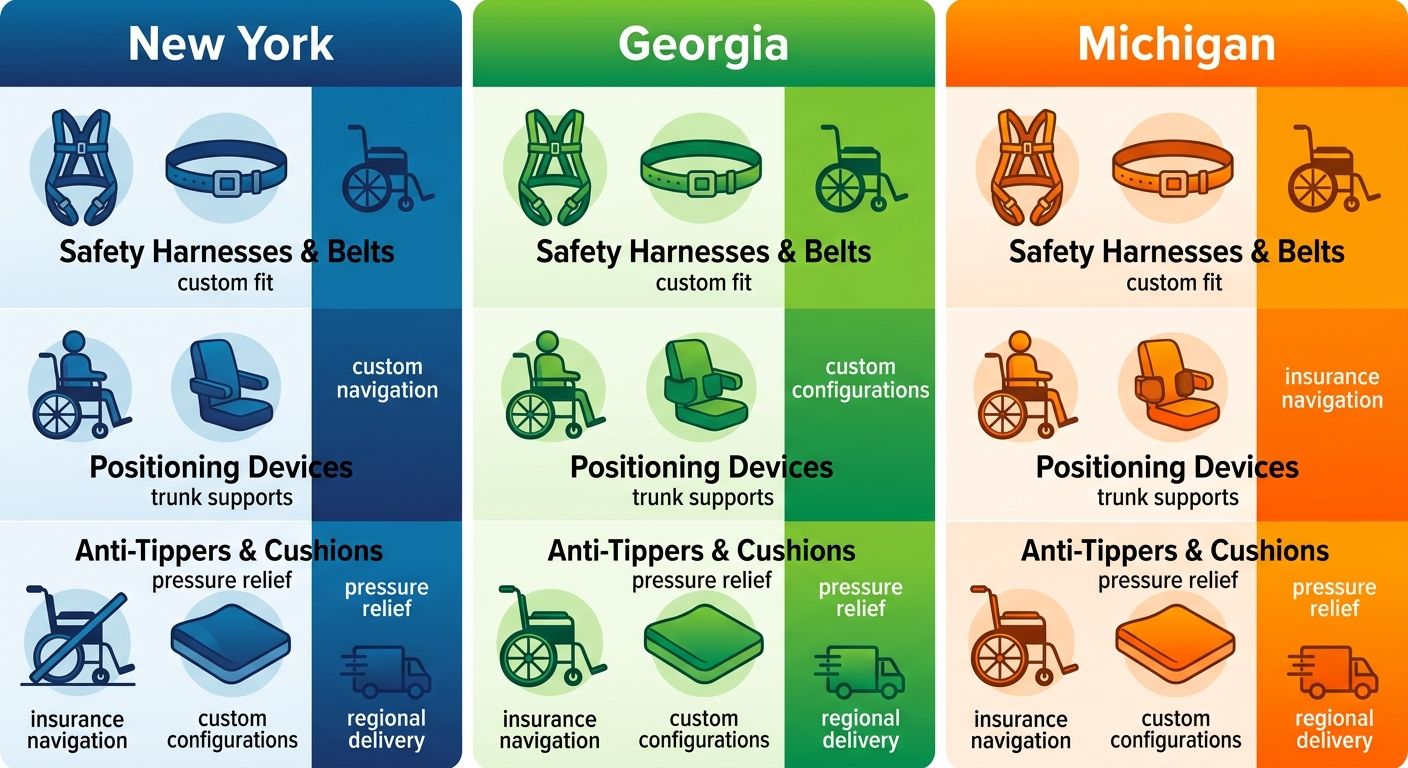
    Infographic comparing safety equipment availability for power wheelchairs in New York, Georgia, and Michigan service areas with icons and benefits

    Safety equipment comparison across MedEquipped service areas in NY, GA, MI

    Contact us for custom quotes in your service area to partner in mobility freedom.

    Availability of Safety Accessories for Custom Wheelchairs

    Once identified, sourcing these accessories is straightforward through a trusted safety equipment supplier near me. At MedEquipped, we stock essential items like anti-tippers, pelvic belts, chest harnesses, and joystick guards compatible with custom wheelchairs, including rigid frame and folding models. Our US-wide distribution ensures quick access for powered wheelchair users.

    MedEquipped’s official FAQ guidance confirms immediate availability of these safety accessories via our online store at medequipped.com/products. They fit popular powered models like QUICKIE series and ROVI X3, supporting everyday mobility needs. We handle compatibility checks to match your custom setup seamlessly.

    As detailed by MedEquipped about us, we offer reliable custom fitting options for safety gear, with lead times as short as 30 to 60 days. Our detailed product post highlights stock status for pelvic belts and chest harnesses on powered wheelchairs. Certified ATPs ensure perfect integration for complex rehab tech.

    Our primary product listing showcases these accessories alongside durable medical equipment near me options. Search for a medical supply store near me or local safety gear providers nearby in Spring Valley, NY—we provide pickup, shipping, and inquiries via 845-237-2381 or intake@medequipped.com. Reliable DME suppliers in my area trust our catalog.

    Contact us today as your partner in mobility freedom. With accessories in hand, proper fitting ensures maximum protection.

    Local Factors in Selecting Wheelchair Safety Equipment

    Beyond national standards, local factors like proximity to experts refine choices for wheelchair safety equipment. Finding a safety equipment supplier near me ensures quick access to anti-tippers, pelvic belts, and restraints tailored to your area. We at MedEquipped guide caregivers through these steps for safer mobility.

    Start by locating certified professionals nearby. Enter your ZIP code in the RESNA certified professionals directory, as referenced by the RESNA professional association directory for finding local certified experts. These specialists assess needs for personalized fittings, per MedEquipped’s internal company FAQ providing practical guidance on wheelchair safety.

    Choose durable medical equipment near me providers who stock essential accessories and offer quick delivery. Medical supply store near me options excel in custom gear for urban sidewalks or rural terrain, verifying credentials against local accessibility standards.

    Here are key tips for local selection:

    • Confirm supplier expertise in wheelchair restraints via directories and FAQs.
    • Prioritize those with after-sales service for adjustments.
    • Evaluate for compliance with regional regulations.

    Once local suppliers are identified, proper installation ensures safety. Contact us in Spring Valley, NY, as your partner in mobility freedom.

    Steps to Source Safety Equipment from Local Suppliers

    Once you’ve identified required safety gear, follow these local sourcing steps to find a reliable safety equipment supplier near me in Spring Valley, NY. We make it simple at MedEquipped, your partner in mobility freedom.

    1. Search Locally Online
      Start with queries like “safety equipment supplier near me in Spring Valley, NY” to list 3-5 options quickly. Focus on nearby durable medical equipment providers for fast access.
    2. Verify Credentials
      Check supplier certifications as an industry standard. According to RESNA, confirm staff holding ATP certification FAQs to ensure expertise in assistive technology. Prioritize durable medical equipment near me with proven qualifications.
    3. Contact Providers
      Call or use website forms right away. Reach MedEquipped at (845) 237-2381 or intake@medequipped.com—our Spring Valley team handles inquiries swiftly.
    4. Evaluate Inventory
      Review stock for mobility aids and fall prevention gear at a medical supply store near me. Ensure items match your needs, like custom motorized wheelchairs.
    5. Compare and Arrange
      Get quotes, noting local benefits like delivery under 48 hours. Visit MedEquipped today for seamless service.

    After sourcing, proceed to safe setup protocols. We handle the paperwork, insurance navigation, and coordination for 30-60 days faster processing.

    Secure Your Power Wheelchair Safety with Local Expertise

    Apply these tips locally via expert help from a safety equipment supplier near me in your area. We at MedEquipped partner with you for personalized power wheelchair safety assessments.

    Our durable medical equipment near me providers in Spring Valley, NY, ensure adherence to the gold-standard RESNA wheelchair standards, per RESNA benchmarks. Certified technicians handle crash testing, durability checks, braking effectiveness, and dynamic stability for compliance.

    Visit your medical supply store near me today for urgent inspections. Contact us now at medequipped.com—local servicing starts with safe upgrades.

    This article was researched and written with the assistance of AI tools.

    Resources
