
Tag: Wheelchair Evaluation

  • Managing Shoulder Pain in Wheelchair Users: A Practical Guide

    Managing Shoulder Pain in Wheelchair Users: A Practical Guide

    Table of Contents

    Protecting Your Shoulders as a Wheelchair User

    Managing shoulder pain in wheelchair users starts with understanding how repetitive manual propulsion places heavy demand on the shoulder joints over time. For those who rely on manual wheelchairs, the constant pushing motion can contribute to overuse injuries and chronic discomfort that affect daily life. Power assist technology, which provides motorized torque during manual propulsion, is designed to reduce stroke frequency and joint excursion, helping mitigate shoulder strain during everyday mobility.

    This article will teach you what effect mobility equipment has on your joints over time and how to choose the equipment that is right for your shoulders. We will go over some ways to look ahead when choosing equipment and make sure your chosen mobility aid will be comfortable and support your posture for the long term.

    Key Takeaways

    • The shoulder pain that often occurs in people who use a wheelchair starts with actions that give them independence such as transfers and propulsion.
    • Because pushing down on the handrim strains your shoulders, shifting to a pulling motion can reduce impact shock and encourage a more upright posture.
    • Repetitive manual transfers can strain the shoulder tendons, especially the biceps and supraspinatus.
    • Managing shoulder pain as a wheelchair user starts with daily conditioning.
    • Our team helps patients transition from their professional evaluation to the right mobility solution when faced between two main options: power assist systems or power wheelchairs.

    Before You Begin

    If you’re deciding whether to go for a power chair or a power-assist chair, we advise being honest about your upper body strength and endurance, as well as what you typically navigate on a daily basis. Your physical limitations determine how much less your shoulders will be strained over time. Power assist systems can help by adding motorized torque to the manual push, which lowers stroke rate and joint excursion. But again, only when you have the appropriate power assist system that matches your lifestyle and physical ability.

    It’s also vital to gather everything needed for your new equipment. For example, Medicare Part B requires a face-to-face doctor exam and documented proof that you’re medically necessary for the equipment prior to coverage being approved. Make sure you check with your physician and funding source before ordering to confirm that you will be eligible for the new equipment. MedEquipped manages Medicare benefit verification and related documentation as part of their standard patient service, which can streamline the process for you. Their in-person clinical evaluation and personal fitting at our location in Spring Valley, New York makes sure you get the right mobility solution for you.

    Understanding what is causing your shoulder pain is the true starting point of this process, so you can make an informed decision about the right mobility solution.

    Step 1: Identify What Causes Your Shoulder Pain

    The shoulder pain that often occurs in people who use a wheelchair starts with actions that give them independence such as transfers and propulsion. Studies from RESNA show that repeating transfers can injure the shoulder’s tendons, with a quantitative ultrasound study showing changes to the biceps and supraspinatus structures after only 18 transfers. Tendon alterations also were correlated with higher WUSPI scores, suggesting that transfers increase the risk for a chronic injury.

    Pain intensity is not the same for all. A RESNA pilot study of wheelchair rugby athletes revealed that individuals with higher cervical-level spinal cord injuries experienced more intense pain, possibly because they had higher stroke frequency and transfer demands. The athletes with higher classification scores also felt more discomfort, indicating that activity level and injury characteristics can influence how much pain someone feels.

    Start noticing which of the movements – transfers, reaching or propelling – causes you pain. This is your first step towards discovering the reason for your pain. If this pain continues or gets worse, see a professional instead of trying to figure it out yourself.

    Step 2: Refine Your Propulsion Technique

    Because pushing down on the handrim strains your shoulders, shifting to a pulling motion can reduce impact shock and encourage a more upright posture. It appears that pulling upward on the handrim spreads the force over a larger portion of the rim, which may lower peak vertical shoulder joint reaction forces compared to conventional pushing.

    Reverse propulsion takes this further by promoting a larger angular range of motion, 108.9 degrees versus 66.6 degrees in forward propulsion, while minimizing torso deviation and kyphosis. To make these adjustments stick, focus on maximizing your contact angle and lowering stroke frequency; a brief instructional video paired with supervised practice has been shown to improve both measures in adolescents aged 13–18 on carpet and tile surfaces. Even with refined technique, remember that propulsion still loads the upper limbs, so safe transfer methods in the next step will help protect your shoulders long-term.

    Step 3: Master Safer Transfer Techniques

    Repetitive manual transfers can strain the shoulder tendons, especially the biceps and supraspinatus. Quantitative ultrasound research indicates that a single session of transfers causes fibers to become misaligned and decreases the echogenicity of the tendon, changes that correlate with increased pain scores on valid shoulder assessments for wheelchair users in the US. These acute physical changes could lead to chronic shoulder pain if transfers are performed frequently without correct technique.

    We believe that proper setup and body positioning can reduce shoulder involvement. Little tweaks in how you transfer can reduce cumulative shoulder strain over time, protecting your shoulders without requiring extra effort. If transfers consistently cause discomfort, consult a physical therapist to review your approach and identify personalized strategies for safer movement.

    Step 4: Build a Daily Stretching and Strengthening Routine

    Managing shoulder pain as a wheelchair user starts with daily conditioning. A consistent routine helps maintain scapular mobility, strengthens the muscles that stabilize the shoulder blade, and counteracts the postural changes that can develop from prolonged wheelchair use.

    Start your day with a quick check-in of your posture to see how your shoulders and upper back feel. Follow that up with two or three gentle chest and shoulder stretches to release any tightness, and then add two or three strengthening exercises like scapular retraction or seated row. Pick the same time of day to do this routine, so you can make it a habit.

    Increase repetitions or hold times gradually and slowly, and stop any movement that causes sharp pain. As a home-made routine, it’s best to validate it against your body and equipment and consider it more of a starting point than anything else until you have a chance to see a professional for an evaluation and fitting.

    Step 5: Get a Professional Evaluation and Fitting

    The first step for managing shoulder pain in wheelchair users is to undergo a thorough evaluation from a professional that evaluates how strong and how long your upper body can hold up, as well as what environments you spend most of your day in. Our team then looks at this information to help determine if you would be best suited for a power assist system or a full power wheelchair, which helps reduce the strain on your shoulders.

    A proper fit prevents pressure injuries and helps maintain correct body posture over time. Before purchasing any equipment, get a face-to-face exam by your doctor and make sure that the doctor documents that you need the equipment for medical necessity, as Medicare Part B only covers these if they are prescribed. We take care of all benefit verifications and paperwork so you can focus on getting better.

    Step 6: Explore Power-Assist and Custom Power Options

    Our team helps patients transition from their professional evaluation to the right mobility solution when faced between two main options: power assist systems or power wheelchairs. Power assist systems are attachment devices to manual wheelchairs that motorize the pushrim to take some of the load off the shoulders as well as reducing the amount of strokes needed to go, which can help keep joints healthy and strong. On the flip side, power wheelchairs are controlled by a joystick and allow those who need more than just powered assistance to be totally independent.

    It all depends on your upper body strength and endurance as well as the environments you find yourself navigating each day. If you’re not sure what’s right for you, our experts in Spring Valley, NY are here to assist you Monday-Friday from 9:00 am until 5:00 pm and can talk about your mobility goals and what to do next.
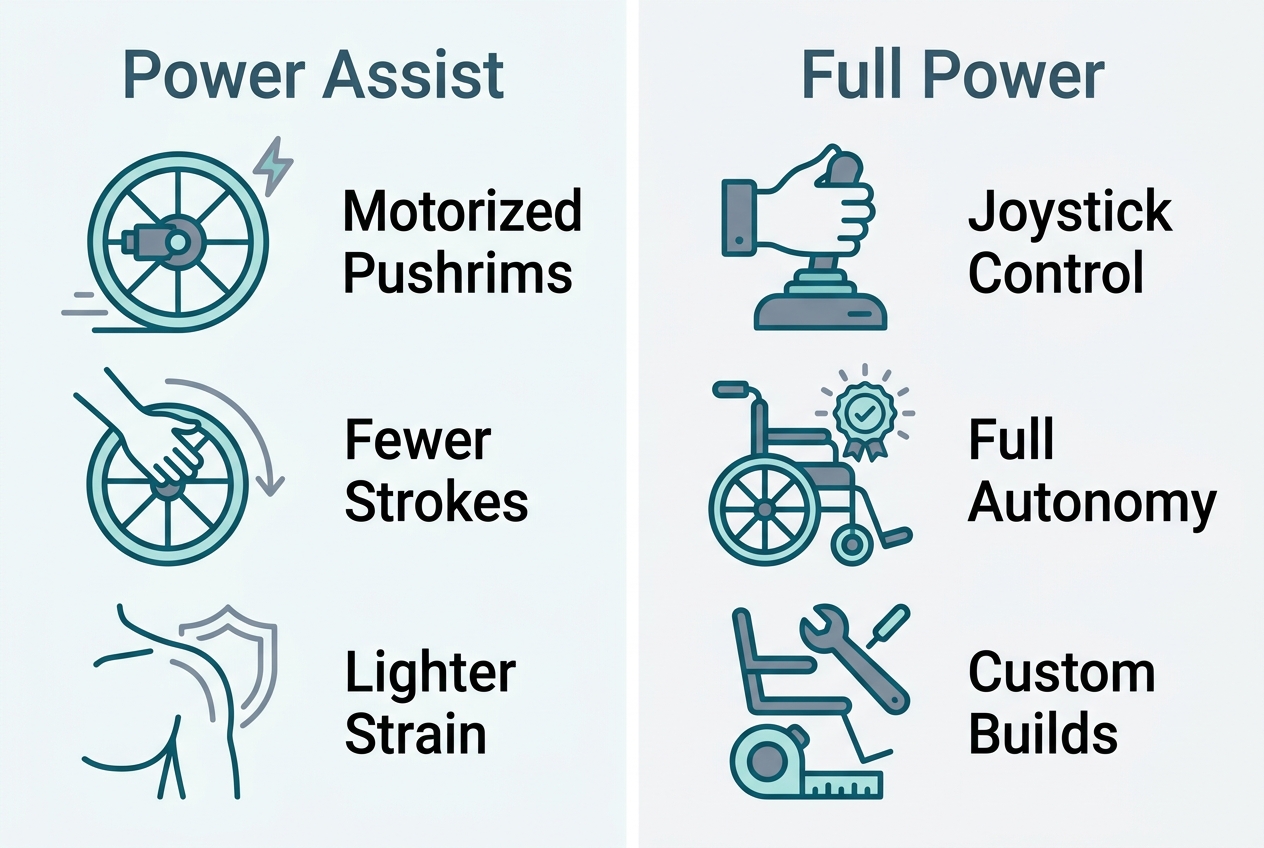
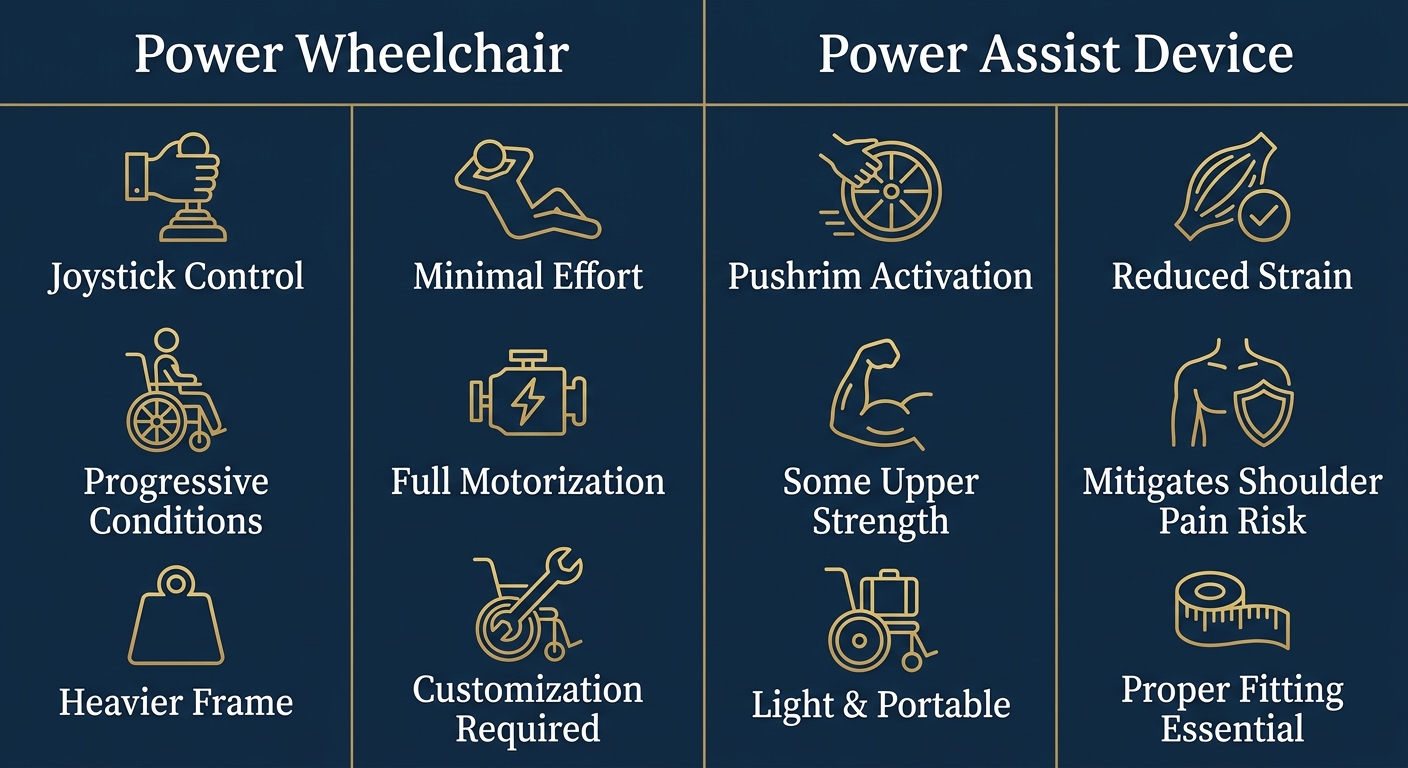
    Two-column infographic comparing power-assist wheelchair options and full power wheelchair options with labeled icons
    Side-by-side comparison of power assist vs full power wheelchair features

    Recognize Warning Signs That Need Medical Attention

    Even with all our best equipment and technique, the shoulders are sending us messages that they need attention. Research shows that repeated transfers can cause changes in the tendon structure and acute micro-injuries can build up into bigger, chronic problems if we ignore them.

    Take these warning signs seriously and discuss them with a clinician:

    • Pain that lingers or worsens after transfers or propulsion
    • New weakness when lifting or transferring
    • Pain that interferes with independent transfers
    • Symptoms that do not ease with rest

    Discuss with your care team what activity is causing the pain and for how long. This information will help determine if it’s an overuse tendon issue versus something else and will guide what’s next.

    Troubleshooting Common Setbacks

    That’s just one part of the job; applying the right correction can keep shoulder strain from becoming a chronic condition. While dealing with shoulder pain can be difficult for wheelchair users, studies indicate that most instances respond well to dedicated practice and self-awareness. Managing shoulder pain in wheelchair users

    When you have one-sided pushing, this may be improved by distributing your effort more evenly between each arm. Research showed that pediatric wheelchair users have significantly greater side-to-side differences when measuring shoulder movement, which means asking a clinician to look at your technique may help to target areas where you need to make adjustments.

    An inefficient stroke pattern wastes energy and puts strain on the shoulders. Only three out of six young users used the suggested semi-circular propulsion, so practicing longer, smoother strokes that maximize contact with the pushrim reduces wasted motion and load.

    The rushed, high frequency stroke feels as though the only way to continue is fast, but the faster you go, the more injury you’re going to incur. A few minutes of instruction followed by practice greatly increased the contact angle and lowered stroke frequency for both carpet and tile in adolescents, proving that retraining does change behaviour, even if it’s just for a short time. rushed, high-frequency stroke

    If self-correction does not fix the problem, a personal equipment evaluation and fitting might help tackle issues you can’t fix on your own. The team at MedEquipped in Spring Valley, NY can provide an evaluation and fitting that is custom to your needs and can verify your setup supports shoulder-friendly movement.

    Stop troubleshooting through pain. If you have persistent symptoms while pushing, you could be at risk for impingement, so if you’re still feeling pain, stop and get evaluated instead of pushing yourself.

    Frequently Asked Questions

    What are the most common causes of shoulder pain in manual wheelchair users?

    Shoulder pain in manual wheelchair users often results from repetitive transfers and propulsion. Research shows these actions can injure shoulder tendons like the biceps and supraspinatus, with measurable structural changes after as few as 18 transfers. Higher stroke frequency and transfer demands increase pain intensity, especially for those with higher-level spinal cord injuries.

    How can a professional custom wheelchair fitting help reduce long-term shoulder strain?

    A professional custom wheelchair fitting ensures the equipment supports correct posture and reduces pressure on the shoulders. Proper adjustments to seat width, depth, and backrest height prevent secondary complications like pressure injuries and postural strain that contribute to chronic shoulder issues over time.

    What are some effective daily stretches and exercises to prevent shoulder injuries for wheelchair users?

    Daily conditioning routines should include gentle chest and shoulder stretches to release tightness, along with strengthening exercises like scapular retraction or seated rows. These movements maintain scapular mobility, strengthen stabilizing muscles, and counteract postural changes from prolonged wheelchair use.

    Can a power-assist device or custom power wheelchair help manage or alleviate chronic shoulder pain?

    Power-assist devices reduce stroke frequency and joint excursion during manual propulsion, lowering shoulder strain. Custom power wheelchairs allow joystick-controlled mobility, significantly reducing upper-body exertion and fatigue compared to manual propulsion, which can help manage chronic shoulder pain.

    What signs indicate that shoulder pain from wheelchair use requires medical evaluation or intervention?

    Pain that lingers or worsens after transfers or propulsion, new weakness when lifting or transferring, pain interfering with independent transfers, or symptoms that do not ease with rest are signs that require medical attention. These may indicate overuse tendon issues or other conditions needing professional assessment.

    Take the Next Step Toward Greater Shoulder Health

    If your shoulders ache when you’re moving around in your wheelchair, your mobility may be the problem. How you manage shoulder pain as a wheelchair user typically starts with getting the proper wheelchair for yourself. If your days involve plenty of upper body endurance or you navigate different environments, you’ll need to decide if you should go with a power wheelchair or power assist model based on your strength, stamina and environment.

    We work to help you move forward with confidence by verifying Medicare benefits, showing you how to document your medical need and scheduling you for a personal evaluation and fitting at our Spring Valley, NY clinic. Your chair will be adjusted for optimal posture and pressure release so that you can minimize any strain on your shoulders and other joints over the long term.

    Call us now at (845) 237-2381 to schedule your appointment, or come to 747 Chestnut Ridge Road and see how a custom fit can support your mobility goals. Results may vary, verify your coverage and consult your treating healthcare provider for medical necessity.

    Get Your Professional Evaluation Today

    You’ve now worked through the practical steps for managing shoulder pain in wheelchair users, from identifying trigger movements to refining propulsion technique and building a daily routine. As this guide has shown, whether a power assist system or a full power wheelchair makes sense depends on your upper-body strength, endurance, and the environments you navigate every day. A professional evaluation and fitting is the step that turns that self-assessment into the right equipment decision. our Spring Valley clinic provides custom-ordered motorized wheelchairs along with hands-on fitting support. Keep in mind that Medicare Part B coverage requires a face-to-face physician examination and documented proof of medical necessity, so it’s worth verifying your eligibility before equipment selection. Our team can help you navigate the paperwork and funding verification from start to delivery. Reach us at (845) 237-2381 to schedule your evaluation and take the next step toward protecting your shoulders.

    Get Your Professional Evaluation Today

    Resources

  • Which Is Better for Me, a Power Wheelchair or a Power Assist Wheelchair

    Which Is Better for Me, a Power Wheelchair or a Power Assist Wheelchair

    Table of Contents

    Choosing Between a Power Wheelchair and Power Assist Wheelchair

    Determining which is better for you—a power wheelchair or a power assist wheelchair—depends on your upper body strength, daily activities, and any progressive health conditions. Power assist wheelchairs use motorized pushrims that reduce stroke frequency and joint excursion, as power assist wheelchairs research shows, helping mitigate shoulder pain in manual chair users while allowing many to stay active longer. A full power wheelchair offers complete independence: no manual propulsion is required, making it essential when upper body strength is limited or a progressive condition affects mobility. We design custom motorized wheelchairs tailored to each patient’s diagnosis and functional requirements, ensuring safe, strain-free movement. Each option suits a different profile, so the first step is to identify your daily mobility needs.

    Key Takeaways

    • For individuals in Spring Valley, NY, deciding between a power wheelchair and a power assist wheelchair begins with a look at daily mobility needs.
    • Understanding these differences will help you identify the right device.
    • The best mobility solution for you depends on your daily environment, upper-body strength, and long-term comfort.
    • If you are wondering which is better for you, a power wheelchair or a power assist wheelchair, the answer begins with how easy it is to push a manual wheelchair.
    • While manual wheelchairs may involve simpler documentation, navigating the power wheelchair eligibility criteria in Spring Valley requires a more detailed process.

    1. Identify Your Daily Mobility Needs

    For individuals in Spring Valley, NY, deciding between a power wheelchair and a power assist wheelchair begins with a look at daily mobility needs. Thorough self-assessment of your strength, endurance, travel distances, and the environments you navigate will indicate which device best supports your independence.

    • Evaluate whether your condition is progressive. MedEquipped’s guidance highlights that custom motorized wheelchairs deliver superior long-term independence to individuals with progressive conditions or significant limitations.
    • Assess your upper-body strength and stamina. Manual wheelchairs and power assist systems typically suit short-distance travel only when you have adequate arm and shoulder function.
    • Prioritize seating and posture. Proper fitting prevents pressure injuries and safeguards postural health, so comfort and fit must be part of your evaluation.
    • Consider your everyday environments. Indoor surfaces like carpet and thresholds, as well as uneven sidewalks outdoors, affect the practicality of a manual or power assist approach.

    Once you have identified your daily needs, you can compare the features of power wheelchairs and power assist technology.

    2. Compare Power Wheelchair and Power Assist Technology

    We’re here to help.

    • Propulsion: Power wheelchairs use a joystick, while power assist devices reduce stroke frequency and joint excursion via proportional motor assistance.
    • Portability: Power assist units attach to a manual chair; power chairs are heavier.
    FeaturePower WheelchairPower Assist Device
    PropulsionFully motorized (joystick)Pushrim-activated proportional assistance
    Physical EffortMinimalReduced stroke frequency and joint excursion
    Best ForLimited upper-body strength, progressive conditionsSome pushing ability, reduce fatigue and injury
    Health ImpactEliminates strainMitigates shoulder pain
    PortabilityHeavierLighter, attaches to manual wheelchair
    Customization & FittingProper fitting needed for pressure injuries and postureSame
    Power Wheelchair vs. Power Assist Device: Key Feature Comparison

    Understanding these differences will help you identify the right device.

    Infographic comparing Power Wheelchair and Power Assist Device, each column has six icon and label pairs.
    Side-by-side comparison of power wheelchair and power assist device features.

    3. Find the Best Power Assist Device for You

    The best mobility solution for you depends on your daily environment, upper-body strength, and long-term comfort. A power assist device reduces effort by adding motorized torque to manual pushes, while a full power wheelchair handles all propulsion independently. We recommend starting with a self-assessment to determine which option aligns with your mobility goals.

    • Consider your daily terrain: full power chairs handle long distances and varied surfaces, while power assist devices suit moderate challenges.
    • Assess your upper-body strength and shoulder pain. Power assist technology reduces strain on the upper body, and research by RESNA found significant reductions in shoulder strain and helps protect against overuse injuries.
    • Evaluate comfort: full power chairs require no manual effort, whereas power assist systems let you stay engaged while minimizing fatigue.

    Understanding your needs helps you choose a wheelchair that fits your daily life. Schedule an evaluation and trial—a hands-on test reveals which device feels easiest to push and protects your shoulders. This approach safeguards your long-term comfort.

    4. Discover the Easiest Wheelchairs to Push

    If you are wondering which is better for you, a power wheelchair or a power assist wheelchair, the answer begins with how easy it is to push a manual wheelchair. Many users can propel a manual chair comfortably when it is tailored to their body and daily routines.

    • Lightweight frame: A chair built with aluminum or titanium reduces rolling resistance and requires less effort over long distances.
    • Proper seat fit: A seat that matches your hip width and thigh length keeps your posture aligned, so each push delivers more efficient forward movement.
    • Adjustable components: Rear-wheel position, caster angle, and hand-rim design all affect how much energy you expend with every stroke.

    Our MedEquipped guide on manual versus motorized wheelchairs highlights that personalized fitting and customization are what make a manual wheelchair truly easy to push. For users who find self-propulsion too demanding, understanding power wheelchair eligibility in Spring Valley, New York can reveal whether a fully powered option is right for them.

    5. Navigate Power Wheelchair Eligibility Criteria in Spring Valley, New York

    While manual wheelchairs may involve simpler documentation, navigating the power wheelchair eligibility criteria in Spring Valley requires a more detailed process. Medicare Part B mandates a face-to-face examination with a physician and a written order demonstrating that the power wheelchair is medically necessary for use inside the home.

    According to the Centers for Medicare & Medicaid Services (CMS), power-operated seat elevation equipment is covered when prescribed with a complex rehabilitative power wheelchair and following a specialty evaluation by a licensed physical therapist or occupational therapist. The CMS coverage criteria require safe operation and need for seat elevation to assist with transfers or reaching for daily activities like feeding, dressing, or grooming.

    Our initial patient evaluation and personalized fittings at MedEquipped help document these clinical needs, satisfying the medical necessity requirements. We verify Medicare benefits and assist with required paperwork to streamline the approval process. Once eligibility is confirmed, we focus on customizing the power wheelchair to your precise diagnostic and lifestyle requirements.

    6. Personalize with Custom Motorized Wheelchair Features

    Once coverage eligibility has been determined, residents in Spring Valley can concentrate on tailoring their motorized wheelchair. Personalization turns a standard mobility device into a precise clinical tool that matches the user’s body and routine.

    Medicare’s national coverage policy now reimburses power-operated seat elevation equipment when prescribed for a complex-rehabilitative power-driven wheelchair—this is not an option for basic power chairs. A specialty evaluation by a licensed physical or occupational therapist is mandatory, confirming that the patient can operate the equipment safely at home. Coverage applies to three specific clinical scenarios: weight-bearing transfers, non-weight-bearing (dependent) transfers, and reaching assistance for mobility-related activities of daily living like feeding, dressing, or grooming. These guidelines direct which features are funded, and we incorporate them while also customizing seating, positioning cushions, and control interfaces to suit each diagnosis.

    Our team navigates the documentation; custom choices are finalized at fitting and completed in 30–60 days.

    7. Benefit from Rapid 30–60 Day Turnaround and In-Person Fitting

    Custom motorized wheelchair orders often entail half-year waits, but we have refined the process to deliver in as quickly as 30 days. We handle Medicare benefits verification and funding paperwork up front, eliminating delays that can stretch timelines elsewhere. Most custom wheelchairs are ready for fitting within 30 to 60 days, substantially faster than the industry norm of six months or more.

    Once your wheelchair arrives, we schedule a personalized fitting at our clinic in Spring Valley. Proper fitting is essential for preventing pressure injuries, supporting healthy posture, and achieving all-day comfort. During this appointment, our team fine-tunes seat depth, back support, footrest height, and control positioning to your exact needs. The in-person fitting process enables immediate adjustments that optimize safety and long-term satisfaction.

    Your first step is a personalized mobility evaluation at our location in Spring Valley, where we complete a comprehensive assessment of your clinical needs and daily activities. Contact us at (845) 237-2381 to schedule your evaluation.

    8. Schedule a Personalized Mobility Evaluation in Spring Valley

    The rapid 30–60 day turnaround and precise in-person fittings you’ve read about begin with one essential step: a personalized mobility evaluation. During this comprehensive assessment, we evaluate your strength, mobility, and daily activity requirements to determine the right wheelchair for your needs. We also discuss the daily activities most important to you, such as transferring from bed to chair, preparing meals, or navigating community spaces, to ensure the wheelchair’s features align with your life. Our evaluation prioritizes a proper fit to prevent pressure injuries and support postural health — key considerations for long-term comfort. If you are considering a power wheelchair with seat elevation equipment, Medicare coverage policy requires a specialty evaluation by a licensed professional, such as a physical therapist or occupational therapist, to verify medical necessity. To schedule your evaluation, call us at (845) 237-2381 or visit our clinic at 747 Chestnut Ridge Road. Your custom mobility solution begins with a comprehensive evaluation. Schedule yours today.

    Your Custom Mobility Solution Starts Here

    Deciding which is better for you, a power wheelchair or a power assist wheelchair, in Spring Valley starts with a personalized evaluation—your first step toward a custom solution from our team. Our custom motorized wheelchairs provide superior independence for those with progressive conditions or significant mobility limitations. Every chair is custom-fitted to your exact measurements and clinical needs for optimal comfort. We complete orders in 30 to 60 days—far faster than the six-month industry average—and manage all Medicare paperwork on your behalf. Contact us at (845) 237-2381 or visit 747 Chestnut Ridge Road, Spring Valley, NY 10977 to begin your journey toward greater independence.

    Results may vary. Verify Medicare/insurance coverage; supplier does not guarantee coverage. Consult your treating healthcare professional for medical necessity.

    Start Your Personalized Evaluation

    You’ve now explored the key differences between power wheelchairs and power assist devices, including research showing reduced stroke frequency and joint excursion with pushrim-activated power assist. The article guided you through identifying daily mobility needs and comparing technology features. The most impactful next step is to experience these options firsthand through a personalized evaluation. At MedEquipped in Spring Valley, New York, a comprehensive assessment ensures the right custom mobility solution for your lifestyle and health. Their team manages Medicare paperwork and funding verification, simplifying the path to a custom motorized wheelchair that promotes independence. A rapid 30–60 day turnaround means you won’t wait months for the equipment you need. Taking this step can lead to greater comfort, safety, and daily freedom.

    Start Your Personalized Evaluation

    Resources

  • Medicare Mobility Assistive Equipment Algorithm Explained

    Medicare Mobility Assistive Equipment Algorithm Explained

    Table of Contents

    The Medicare Mobility Assistive Equipment Algorithm Explained

    So how does Medicare actually decide whether a motorized wheelchair qualifies as covered mobility assistive equipment? The Medicare mobility assistive equipment algorithm is the coverage test that determines eligibility for a custom power wheelchair.

    The first decision point is the face-to-face mobility evaluation Medicare requires, where a treating practitioner documents mobility limitations and certifies that a power wheelchair would improve daily activities and support greater independence. This evaluation is just one part of the Medicare mobility assistive equipment algorithm; the Medicare motorized wheelchair coverage criteria also require a written order within 45 days detailing medical necessity. Ongoing changes to Medicare mobility equipment compliance rules from HHS and DOJ make expert guidance essential.

    At MedEquipped in Spring Valley, NY, we help patients prepare for the evaluation and handle the paperwork. We verify benefits for smooth coverage decisions. Our premium products and quick turnaround help you regain greater independence.

    Understanding the algorithm is the first step — here is how we handle the rest.

    Results may vary. Verify Medicare/insurance coverage; supplier does not guarantee coverage. Consult treating healthcare professional for medical necessity.

    Prerequisites for Medicare Motorized Wheelchair Coverage

    Before a motorized wheelchair can be approved, Medicare requires that several criteria be met. The medicare mobility assistive equipment algorithm determines coverage eligibility under Part B, evaluating medical necessity and functional limitations.

    The medicare motorized wheelchair coverage criteria center on a mobility limitation that significantly interferes with daily activities, cannot be fully addressed by a cane or walker, and makes a manual wheelchair unsafe or impossible to use. A face-to-face mobility evaluation medicare must be performed by your treating physician within the 12 months preceding the wheelchair order. This in-person exam must document that you (or a responsible caregiver present in the home) have the physical and cognitive ability to operate a power wheelchair safely.

    Your physician must supply a written prescription, the certificate of medical necessity, and medical records from the evaluation, confirming that the chair will be used primarily in the home—as outlined by Medicare’s mobility assistive equipment algorithm. At MedEquipped, we’re here to help verify your benefits and handle the paperwork, but coverage is never guaranteed. We encourage you to consult your treating healthcare professional about medical necessity and to confirm your benefits with us.

    If you meet these prerequisites, our team can guide you through a personalized mobility evaluation. We’ll help you select a custom motorized wheelchair designed for greater independence, and our quick turnaround gets you outfitted in weeks, not months.

    Assess Your Daily Mobility and Functional Limitations

    The Medicare mobility assistive equipment algorithm rests on one question — can you safely manage everyday tasks at home?

    Daily Mobility Check

    • Do you run out of breath after a short walk, like crossing a room?
    • Do you need support to stand from a chair or bed?
    • Have you fallen or nearly fallen this year?
    • Is moving on and off the toilet, bed, or car seat hard?
    • Do you shift positions often because sitting hurts?
    • Does self-propelling a manual wheelchair tire you out quickly?

    Jot down specifics: how many feet you can walk before resting, how often you sit down, and any pain or weakness. These notes support the face-to-face mobility evaluation Medicare requires.

    Results may vary. Verify Medicare/insurance coverage — the supplier does not guarantee coverage. Consult your treating healthcare professional for medical necessity.

    Bring your completed checklist to your clinician, then contact us for a personalized fitting. Meeting Medicare motorized wheelchair coverage criteria depends on documented limitations in your home, and our custom motorized wheelchairs are built for greater independence. We’re here to help — reach out in Spring Valley, NY.

    Document the Walker Trial and Its Failure

    Within the Medicare mobility assistive equipment algorithm, a walker trial that has been documented and proven insufficient elevates a patient’s case for a power mobility device. This step follows the initial face-to-face evaluation in our in Spring Valley clinic and records that a standard walker or cane could not meet the patient’s daily mobility needs safely.

    Treating clinicians must note specific trial details — the dates the walker was used, the device type, the functional limitations reported, and the prescriber’s conclusion that the walker failed. A thorough face-to-face mobility evaluation Medicare documentation package explicitly captures these observations, demonstrating that the patient’s condition warrants Custom Motorized Wheelchairs configured for Greater Independence.

    A documented walker trial failure supports but does not satisfy all Medicare motorized wheelchair coverage criteria by itself; coverage hinges on meeting every requirement in the algorithm during medical review. We’re here to help you move your prescription forward with a Quick turnaround, but Results may vary. Verify Medicare/insurance coverage and consult your treating healthcare professional before proceeding. The next step brings together your supporting documentation for the formal coverage review.

    Complete the Face-to-Face Mobility Evaluation

    Once your appointment is scheduled, our team will guide you through the next step: the face-to-face mobility evaluation. This required clinical assessment, conducted by a treating healthcare professional, is necessary for documentation that aligns with the medicare mobility assistive equipment algorithm.

    The clinician evaluates your functional mobility limitations, ability to perform daily activities, and home environment—including doorways, thresholds, and hallway dimensions. Positioning and postural support needs are also assessed to determine the most appropriate configuration.

    Bring relevant medical records, current prescriptions, and a list of daily mobility challenges to your appointment. This preparation helps ensure the documentation addresses medicare motorized wheelchair coverage criteria, allowing us to match you with the right custom motorized wheelchair from our premium product range.

    With your evaluation complete, our team helps ensure all required coverage criteria have been addressed. The face-to-face mobility evaluation medicare requires supports the documentation we need to move forward in helping you achieve greater independence. Coverage is not guaranteed—please consult your treating healthcare professional for medical necessity and verify coverage with Medicare.

    Prepare the Required Clinical Documentation

    Once we have a clear picture of your mobility needs, the next step is preparing the required clinical documentation. When you’re navigating the medicare mobility assistive equipment algorithm, the paperwork can feel overwhelming, but we’re here to simplify it.

    Medicare’s motorized wheelchair coverage criteria require an in-person face-to-face mobility evaluation with your treating healthcare professional. You’ll need a written prescription or detailed order for your custom motorized wheelchair, the results of that face-to-face mobility evaluation medicare requires (a mobility assessment documenting your functional limitations), and, if requested, a Certificate of Medical Necessity (CMN) supporting medical necessity. This paperwork must demonstrate how your daily mobility limitations—such as an inability to self-propel a manual chair or complete essential activities of daily living at home—support the need for a custom motorized wheelchair.

    Our team in Spring Valley, NY guides you through collecting and submitting these documents, helping you request what you need from your healthcare provider. From paperwork to final delivery, we make the process straightforward. Please note: Medicare coverage is not guaranteed; results may vary. Always verify your benefits and consult your treating professional about medical necessity.

    Submit the Prior Authorization Request

    Once the face-to-face mobility evaluation is complete, the next step is securing prior authorization—a process outlined by the Medicare mobility assistive equipment algorithm. This mandatory review confirms that medical necessity and coverage criteria are satisfied before a custom motorized wheelchair can be dispensed. Medicare requires this step and will not cover the device without it.

    We prepare and submit the standard CMS-10211 form on your behalf, compiling all necessary documentation. The package includes:

    • The results of the face-to-face mobility evaluation Medicare requires,
    • Supporting clinical notes, and
    • Relevant mobility assistive equipment algorithm documentation.

    Our team carefully verifies that every document aligns with Medicare motorized wheelchair coverage criteria, checking for completeness, required signatures, and timely filing. We work to reduce delays and handle the entire paperwork burden as part of our Assistance with funding sources and paperwork service. Throughout the process, you can count on clear communication and support.

    After approval, we move to the next step—delivery and setup. Please verify Medicare/insurance coverage; supplier does not guarantee coverage.

    Understand Your Coverage Determination and Usage Rules

    Before we walk you through the process, it helps to understand how coverage decisions are made. Medicare does not automatically cover power wheelchairs; coverage is determined by the Medicare mobility assistive equipment algorithm, and we help verify benefits and complete the paperwork.

    The medicare motorized wheelchair coverage criteria require that you have a mobility limitation that significantly interferes with daily activities, cannot effectively use a cane, walker, or manual wheelchair, and can operate a power wheelchair safely (or have a caregiver who can). The treating physician must perform a face-to-face mobility evaluation (Medicare’s foundational requirement) and write the order; the face-to-face mobility evaluation Medicare mandates generally must occur within 30 days before the order is written, and we assist with scheduling and documentation. The Medicare mobility assistive equipment algorithm also weighs whether the wheelchair is needed for use in the home — a device required primarily for outdoor errands or recreation generally will not meet the in-home usage standard.

    Once you understand these coverage rules, the next step is your personalized evaluation — and we’ll verify your benefits and handle the paperwork. We’re here to help you every step of the way. Results may vary. Verify Medicare/insurance coverage; supplier does not guarantee coverage. Consult your treating healthcare professional regarding medical necessity.

    Get Fitted for Your Custom Motorized Wheelchair

    A Custom Motorized Wheelchair is only as comfortable as its fit. At MedEquipped, we begin every order with a personalized in-clinic evaluation in Spring Valley, NY, guided by the medicare mobility assistive equipment algorithm to maximize your comfort and safety.

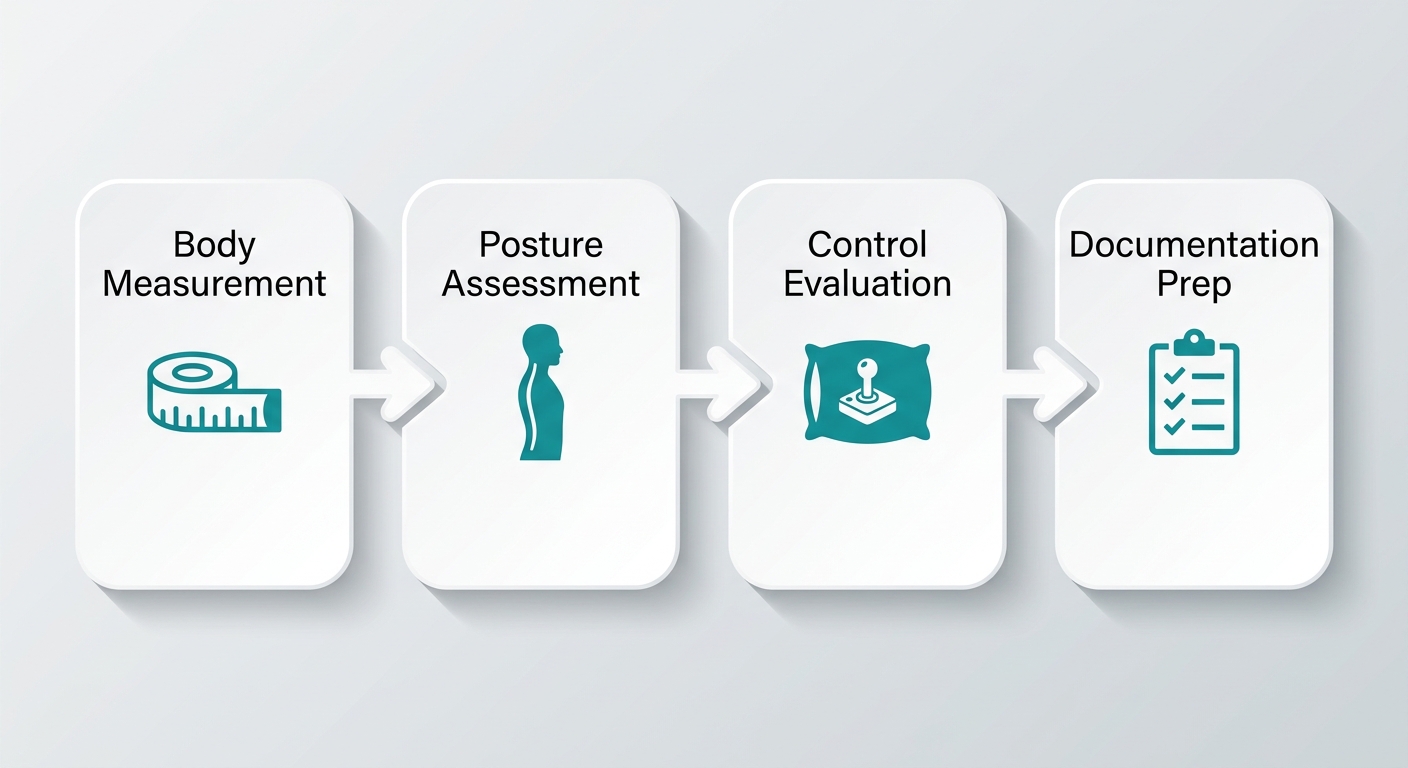
    Process flow diagram showing the four steps to fit a custom motorized wheelchair: body measurement, posture assessment, control evaluation, and documentation prep.
    Four-step custom motorized wheelchair fitting process, from measurement to documentation.

    Our experienced staff tailor the fitting to your body type, mobility needs, and lifestyle.

    • We take detailed body measurements and assess posture, pressure points, and seating ergonomics to configure the chair for all-day support.
    • You test drive controls—joystick, head array, or sip-and-puff—to ensure responsive, intuitive operation.
    • The fitting supports Medicare’s face-to-face mobility evaluation and medicare motorized wheelchair coverage criteria.
    • After the fitting, your custom chair is built and delivered in a Quick turnaround of 30–60 days—far faster than typical wait times.

    Results may vary and coverage is not guaranteed; consult your healthcare professional for medical necessity. We’re here to help—contact us to schedule your fitting and experience Greater Independence with Premium products built for you.

    Resolve Common Coverage Challenges and Denials

    Even with a solid understanding of Medicare eligibility, denials for motorized wheelchairs still happen. The key to overcoming those setbacks is understanding the medicare mobility assistive equipment algorithm, a structured process that determines coverage based on functional need. Most coverage challenges arise from paperwork gaps — not from a lack of medical necessity — so the right support can make a meaningful difference.

    Medicare’s medicare motorized wheelchair coverage criteria require clear evidence that a mobility limitation significantly interferes with mobility-related activities of daily living (MRADLs) such as toileting, bathing, and dressing, and that a cane, walker, or manual wheelchair cannot resolve the limitation. The rules also depend on a documented, in-person face-to-face mobility evaluation medicare requires — completed by the treating physician — before the order is written. Missing or incomplete documentation from that exam is the single most common trigger for an initial denial.

    Other common denial reasons include a failure to establish that the device will be used primarily in the home, clinical notes that do not adequately demonstrate the patient cannot self-propel a manual wheelchair, or insufficient proof that the patient can operate the equipment safely — or has a caregiver who can. These challenges are frustrating, but they are almost always addressable on appeal.

    The resolution pathway starts with a redetermination, the first-level appeal, which must be supported by the treating physician’s updated records. Because suppliers and patients typically face specific filing timeframes, prompt follow-up matters. We’re here to help at MedEquipped: our team verifies Medicare benefits, helps assemble the prior authorization and appeal paperwork, and works quickly alongside your doctor’s documentation. Verify Medicare/insurance coverage; supplier does not guarantee coverage. Results may vary. Consult your treating healthcare professional regarding medical necessity.

    For families in Spring Valley, NY, our experienced staff is ready to navigate coverage challenges for custom motorized wheelchairs with a quick turnaround on new orders. If you are facing a denial or just want to get the process right the first time, contact us to begin the initial patient evaluation.

    Securing Mobility Independence with the Right Support

    Achieving true mobility independence begins with a Custom Motorized Wheelchair built to your individual needs. Greater Independence becomes attainable when the right equipment is matched with a dedicated support team.

    Medicare’s coverage process uses a medicare mobility assistive equipment algorithm that structures eligibility decisions. Verifying specific medicare motorized wheelchair coverage criteria is part of this journey. A face-to-face mobility evaluation medicare requires helps confirm medical necessity, and for patients in Spring Valley, NY, we guide you through each requirement.

    We’re here to help with paperwork, funding coordination, and personalized fittings. Our Quick turnaround of 30–60 days delivers your custom mobility solution faster, so you can enjoy Greater Independence sooner. As a supplier of Premium products, we focus on patient-centered care from evaluation to delivery. Results may vary. Verify Medicare/insurance coverage; supplier does not guarantee coverage. Once your evaluation is scheduled, the next step is understanding coverage details and how we assist with the approval process.

    Resources

  • Quickie Wheelchair Comparison: Cost and Accessories Guide

    Quickie Wheelchair Comparison: Cost and Accessories Guide

    Table of Contents

    Understanding Quickie Power Wheelchairs

    For those exploring power wheelchair selection, the Quickie brand stands out as a trusted name in the mobility community. These chairs are known for their lightweight yet durable construction, offering a wide range of customization options to fit individual needs. At MedEquipped, we offer Quickie power wheelchairs as a core part of our custom, patient-specific wheelchair services, guided by certified Assistive Technology Professionals (ATP).

    The true value of a Quickie chair lies in its user-focused design. From common quickie wheelchair accessories like custom seating and advanced controls to the peace of mind provided by repairable components, these power chairs are built for daily life. While the quickie wheelchair cost is an important factor for anyone, the long-term durability and tailored fit often justify the investment. Our ATP evaluators follow professional industry standards, such as those from RESNA, to determine if a Quickie chair is the right solution for your specific physical and lifestyle needs.

    MedEquipped is more than a supplier; we handle the paperwork and insurance navigation that can make acquiring mobility solutions feel overwhelming. As your partner in mobility freedom, we assist with the selection, ordering, and fitting of your chair. In the sections ahead, we’ll explore customization options and how to get your Quickie chair.

    Quickie Wheelchair Models and Features

    Now let’s look at one of our most popular brands—Quickie by Sunrise Medical. A Quickie wheelchair is a trusted choice for individuals needing durable, high-performance mobility, and it’s a cornerstone of our custom motorized wheelchair offerings at MedEquipped. We guide you through the selection and configuration of your Quickie power chair so it aligns perfectly with your daily life. Our team is your partner in mobility freedom, helping you navigate every step from model selection to final delivery.

    We offer a range of Quickie models to match different needs, from daily versatility to rugged outdoor exploration. Understanding the core differences helps you start the conversation with our certified team. Each model provides a stable foundation for the custom seating and control configurations we’ll design together.

    Differences Between the Quickie 2 and Quickie 6

    The Quickie 2 and Quickie 6 are two of our most frequently configured models, each excelling in different environments. The Quickie 2 is a mid-wheel drive chair offering excellent stability for both indoor and outdoor daily use, with standard seating that includes tilt and recline, and a weight capacity of up to 300 lbs. In contrast, the Quickie 6 is a front-wheel drive chair built for all-terrain performance, featuring advanced power positioning and a robust frame that supports up to 400 lbs. The following table shows a side-by-side comparison of their key features.

    Quickie Model Comparison Table
    FeatureQuickie 2Quickie 6
    Drive TypeMid-wheel driveFront-wheel drive
    Terrain CapabilityIndoor and outdoor stabilityAll-terrain climbing
    Seating OptionsStandard tilt and reclineAdvanced power positioning
    Weight Capacity300 lbs400 lbs

    This comparison illustrates that your choice often comes down to your primary environment. If you need a chair that can smoothly handle carpets and sidewalks, the Quickie 2’s mid-wheel drive is a perfect fit. For those who spend significant time on grass, gravel, or uneven terrain, the Quickie 6’s front-wheel drive and advanced suspension offer superior climbing ability and comfort.

    Customization and Seating Options

    The true power of a Quickie wheelchair lies in how we configure it for you. At MedEquipped, customization is the core of what we do. It’s not a one-size-fits-all product; it’s a clinical solution built around your specific needs.

    Cost and Insurance Coverage for Quickie Wheelchairs

    Beyond choosing the right model, understanding Quickie wheelchair cost and how insurance can help is vital. A custom Quickie power chair typically ranges from $15,000 to $40,000.

    How Much Does a Quickie Power Wheelchair Cost?

    Because each Quickie chair is custom-built for you, pricing is based on your specific clinical needs. We provide a personalized quote only after your clinical evaluation.

    Medicare and Insurance Funding Pathways

    Medicare Part B covers Quickie wheelchairs as durable medical equipment (DME). After you meet your annual Part B deductible, Medicare typically pays 80% coverage.

    How MedEquipped Simplifies Funding and Paperwork

    We handle the paperwork, insurance navigation, and coordination from start to finish. This process typically takes 30 to 60 days.

    The Quickie Wheelchair Order and Delivery Process

    Once you choose a model, we follow a structured process from Clinical Referral and Funding Approval to Custom Ordering and final Delivery and Fitting.

    Step-by-Step Process from Evaluation to Delivery

    Every order starts with a Clinical Referral, followed by an ATP evaluation to ensure the chair meets your mobility goals.

    Customization Timeline and What to Expect

    A custom Quickie wheelchair typically takes 30 to 60 days. We keep you informed throughout the process so you’re never left wondering.

    Demo and Trial Opportunities

    Trying a chair before you commit is recommended. Ask our intake team about scheduling a hands-on demo.

    Essential Quickie Wheelchair Accessories and Add-Ons

    Accessories like seating cushions, anti-tippers, and safety harnesses are functional necessities that transform a standard chair into a truly supportive solution.

    Must-Have Accessories for Comfort and Safety

    • Seating Cushions: Crucial for pressure injury prevention.
    • Anti-Tippers: Essential for safety on inclines.
    • Safety Harness: Improves posture and security.

    Compatibility and Installation Tips

    Ensure your accessories match your specific model. Always follow the manufacturer’s specified torque settings for installation.

    Funding Options for Accessories

    We work to obtain insurance coverage for medically necessary accessories using applicable coding.

    Your Partner in Mobility Freedom

    We remain your dedicated partner in mobility, assisting with setup, adjustments, and ongoing service long after the first delivery.

    Resources

  • What Is DME? Durable Medical Equipment Explained for Medicare Patients

    What Is DME? Durable Medical Equipment Explained for Medicare Patients

    Table of Contents

    Understanding Durable Medical Equipment

    When searching for solutions to mobility challenges, many wonder what is DME. Durable medical equipment, or DME, refers to long-lasting medical devices designed for repeated use over an extended period, primarily in home or community settings. According to Medicare standards, DME must withstand frequent use, serve a clear medical purpose, and be suitable for use outside a hospital. Key criteria include:

    • Durability for at least three years of regular operation
    • Appropriateness for patient-specific medical needs, such as enhancing mobility for individuals with neurological conditions or post-surgical recovery
    • Reusability to promote cost-effective, accessible healthcare

    At MedEquipped, we specialize in providing custom motorized wheelchairs that restore independence and mobility for patients with complex needs. Our ATP-certified evaluations ensure personalized assessments, while our experienced staff handle custom configurations tailored to individual lifestyles. We focus on power wheelchairs in New York, Georgia, and Michigan, offering a streamlined, expert process with expedited 30-60 day fulfillment. To address barriers, we handle the paperwork for insurance and funding coordination, navigating medicare DME coverage to simplify access to reusable healthcare equipment.

    This guide covers DME fundamentals, including detailed coverage options and practical applications for everyday use. We explore advanced strategies for maximizing mobility freedom through custom power wheelchairs and ongoing support. Whether you’re a patient, caregiver, or provider, our insights equip you to make informed decisions about these essential tools.

    DME Fundamentals

    At MedEquipped, we specialize in providing durable medical equipment that enhances mobility freedom for individuals with complex needs. What is DME? Durable medical equipment refers to reusable therapeutic devices designed primarily and customarily for medical purposes. These long-term medical aids must withstand repeated use, be appropriate for home settings, and support medical necessity as prescribed by a physician. Our focus on custom power wheelchairs exemplifies these principles, ensuring patients receive equipment tailored to restore independence and mobility through our streamlined, expert process.

    To qualify under Medicare guidelines, DME must meet specific criteria, as outlined by the Centers for Medicare & Medicaid Services (CMS). Key requirements include:

    • Durability: Equipment able to withstand repeated use for at least three years without breaking down.
      • Non-consumable materials ensure longevity beyond temporary aids.
    • Medical Necessity: Prescribed by a qualified physician to treat a specific illness or injury.
      • Documentation verifies the device’s role in therapy or daily function.
    • Home Use: Primarily intended for patient residences, not institutional settings.
      • Portable and installable designs support everyday living.

    Additionally, suppliers like us must be accredited to handle medicare DME coverage, facilitating approvals and rentals where applicable. These standards prevent misuse and ensure equipment delivers therapeutic benefits, such as improved posture in adjustable systems.

    DME encompasses a wide array of categories, from mobility aids to respiratory support, each serving distinct health needs while adhering to federal regulations. This diversity allows for targeted solutions in rehabilitation and chronic care, with options ranging from basic rentals to fully customized units. Understanding these categories helps patients and caregivers select appropriate tools, often integrated with clinical assessments for optimal fit.

    DME CategoryKey FeaturesTypical UsesMedicare Coverage Notes
    Mobility AidsPower wheelchairs, manual wheelchairs; Customizable seating, battery-powered propulsionDaily navigation for complex needsCovered if medically necessary; Requires physician prescription
    Hospital BedsAdjustable height, side railsHome recovery support; Positioning for comfortFull or partial coverage; Rental options available
    Oxygen EquipmentPortable concentrators, tanksRespiratory support; Chronic conditionsCovered for specific diagnoses; Supplier accreditation required

    Data sourced from Medicare guidelines, this comparison illustrates the variety of DME options available, emphasizing how each category addresses unique patient requirements while navigating coverage rules. For instance, mobility aids like power wheelchairs stand out for enabling active participation in daily activities, particularly for those with pediatric or adult mobility challenges.

    Among these, power wheelchairs represent a cornerstone for enhancing mobility freedom. At MedEquipped, serving as a trusted power wheelchair provider, we conduct ATP-certified clinical evaluations to assess individual needs, from seating configurations to propulsion systems. Our experienced staff handles insurance navigation, including all paperwork, to secure funding efficiently. We oversee custom ordering and configuration, delivering and setting up equipment with technician instruction. This patient-centered approach ensures a 30-60 day turnaround, supporting ongoing needs through post-delivery service. By focusing on these fundamentals, we help patients achieve greater independence without the burden of complex processes.

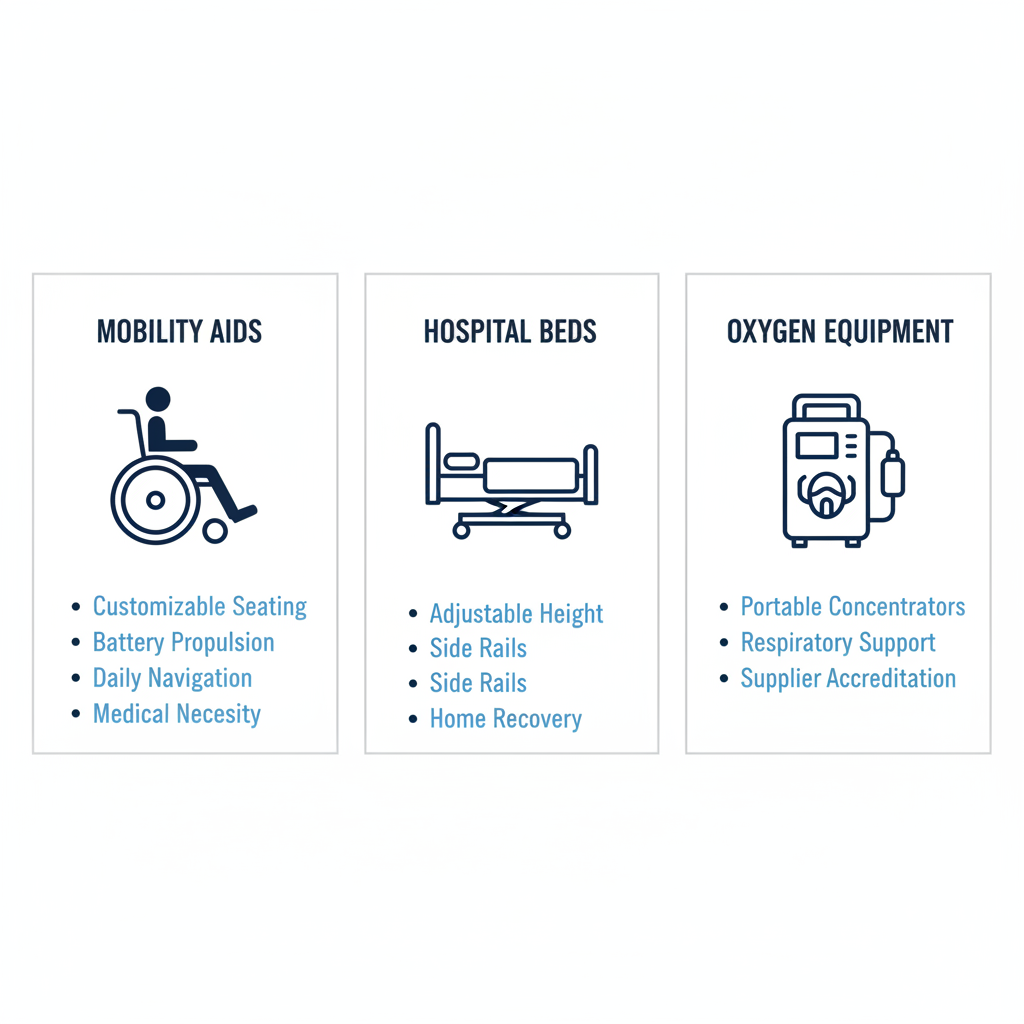
    Infographic illustrating three common DME categories: mobility aids like wheelchairs, hospital beds features, and oxygen equipment with Medicare guidelines notes.

    Overview of key DME categories and Medicare coverage essentials

    This infographic visually reinforces the foundational role of DME in home-based care, highlighting how categories like mobility aids integrate with medicare DME coverage to promote long-term wellness. We prioritize such educational tools to empower informed decisions, always recommending consultation with healthcare professionals before equipment selection. Results may vary based on individual circumstances.

    Deep Dive into DME Coverage and Applications

    Building on the basics of durable medical equipment, this section explores the intricacies of Medicare coverage for DME, including what is DME in the context of mobility aids like power wheelchairs. We at MedEquipped specialize in guiding patients through these policies to restore independence and mobility through our streamlined, expert process.

    Medicare Policies for DME

    Medicare DME coverage provides essential support for beneficiaries needing durable medical equipment to manage health conditions at home. Under Part B, Medicare typically covers 80% of the Medicare-approved amount after the annual deductible, leaving patients responsible for the remaining 20% through coinsurance or supplemental plans. To qualify, equipment must meet strict criteria: it must be prescribed by a physician for a specific medical need, reusable for at least three years, and supplied by an enrolled Medicare provider adhering to quality standards.

    We handle the paperwork associated with these requirements, ensuring compliance from the initial evaluation. Documentation is critical, including a detailed physician’s order outlining medical necessity, such as impaired mobility due to neurological conditions or injury. Prior authorization may be required for complex items like power wheelchairs, involving submission of clinical assessments from licensed therapists. Regional variations apply in our service areas, such as stricter documentation protocols in New York compared to Georgia or Michigan, but our experienced staff navigates these seamlessly.

    FactorCovered ExamplesNon-Covered ExamplesMedEquipped Assistance
    Medical NecessityPower wheelchairs for mobility impairmentConvenience items like luxury features (not prescribed by physician)Paperwork and appeals handling: Streamlined coordination
    DurabilityEquipment lasting 3+ yearsDisposable supplies (short-term rentals without need)Custom specs validation: ATP evaluations

    This comparison clarifies that while Medicare prioritizes essential, long-term therapeutic equipment, exclusions often stem from lack of documented need or short-term use. For instance, a power wheelchair prescribed for severe mobility limitations qualifies, but add-ons deemed luxurious do not. At MedEquipped, we mitigate these gaps by conducting thorough ATP evaluations and managing appeals for denied claims, often resolving issues within weeks to expedite access. Our process reduces patient burden, focusing on verified medical necessity to secure coverage efficiently.

    Mobility-Specific DME Solutions

    When it comes to mobility aids, Medicare DME coverage extends to specialized configurations of custom power wheelchairs tailored for complex needs, such as those arising from muscular dystrophy, spinal cord injuries, or progressive neurological disorders. These insured therapeutic equipment options emphasize durability and functionality, with adjustments for user-specific ergonomics like tilt-recline seating or programmable controls to enhance mobility freedom.

    Our clinical fittings begin with in-depth assessments by certified therapists, ensuring the wheelchair aligns with the patient’s diagnosis and lifestyle. For example, in urban settings in Georgia, we configure models with compact turning radii for indoor navigation, while in Michigan’s varied terrain, we prioritize robust suspension systems. Post-approval, our ordering process involves selecting from leading manufacturers, incorporating features like pressure-relief cushions or joystick alternatives for limited dexterity.

    Delivery and setup follow within our 30-60 day expedited timeline, including hands-on instruction from our experienced staff to promote safe, independent use. We coordinate direct shipping to patients’ homes in New York, Georgia, or Michigan, followed by follow-up adjustments to address any evolving needs. This end-to-end support not only fulfills Medicare requirements but also integrates ongoing maintenance, preventing coverage lapses.

    Key steps in our mobility-specific DME application include:

    • Initial consultation and clinical evaluation to document necessity.
    • Insurance submission with detailed specs for prior authorization.
    • Custom configuration and manufacturing oversight.
    • Delivery, training, and post-delivery service coordination.

    Through these measures, we restore independence and mobility for patients facing barriers, leveraging our expertise in Medicare-approved medical devices to deliver personalized solutions efficiently.

    Practical Utilization of DME

    Obtaining and integrating durable medical equipment (DME) into daily life requires careful planning, especially when considering insurance and logistics. At MedEquipped, we streamline this process for patients needing custom power wheelchairs, ensuring mobility freedom through our expert services. Understanding what is DME—essentially practical medical aids prescribed for home use—helps individuals recognize how these home-use therapeutic tools can restore independence and mobility.

    Acquiring DME like custom power wheelchairs often starts with securing a prescription from a healthcare provider, followed by selecting a qualified supplier. Under Medicare DME coverage, patients must meet specific medical necessity criteria, such as documentation proving the equipment supports daily activities. However, the standard process can overwhelm many, involving complex forms, physician notes, and prolonged waits for approvals. We handle the paperwork at MedEquipped, coordinating with insurers to accelerate access to these essential devices.

    Here is a numbered guide to the key steps:

    1. Obtain Prescription and Evaluation: Consult your clinician for an assessment. We conduct certified ATP evaluations to recommend the ideal custom power wheelchair tailored to your needs.
    2. Gather Documentation: Compile medical records and proof of necessity. Our team assists by liaising with physicians for detailed notes.
    3. Submit Claims: File with your insurer, including Medicare DME coverage details if applicable. We manage submissions to minimize errors.
    4. Await Approval and Appeal if Needed: Track responses and prepare appeals. Our dedicated specialists handle this, often resolving issues swiftly.

    These steps typically span 30-60 days with our streamlined, expert process, compared to longer timelines without assistance. Challenges like incomplete paperwork or insurer delays are common, but our service model addresses them through proactive coordination.

    StepStandard ProcessMedEquipped ProcessTime Savings
    DocumentationPatient gathers forms independentlyWe handle physician notes and submissionsFrom weeks to days
    ApprovalWait for insurer responseCoordinated appeals if needed30-60 day total turnaround

    As shown, our involvement reduces errors and expedites review, drawing from Medicare guidelines that emphasize accurate documentation. This support not only saves time but also eases the burden on patients and caregivers, allowing focus on rehabilitation. For instance, in cases requiring appeals, our experienced staff prevents common pitfalls, ensuring faster fulfillment. Contact us at intake@medequipped.com or (845) 237-2381 to begin, following the intake process outlined on our Become a Patient page, which details timelines from evaluation to approval.

    By partnering with MedEquipped, patients avoid the frustrations of solo navigation, benefiting from our end-to-end funding coordination. This approach aligns with Medicare requirements, providing reliable durable medical equipment without unnecessary delays.

    Delivery and Setup Best Practices

    Once approved, delivery and setup are crucial for seamless integration of DME into daily routines. At MedEquipped, we deliver custom power wheelchairs directly to your home in New York, Georgia, or Michigan, with on-site installation by our technicians. This hands-on service includes verifying functionality, adjusting components for optimal comfort, and providing thorough training to ensure safe, effective use.

    Best practices begin with preparation: Clear a space for the equipment and gather family input on usage needs. Upon arrival, our team unpacks and assembles the wheelchair, testing features like adjustable seating and maneuverability controls. We then conduct personalized instruction, covering operation basics, battery maintenance, and troubleshooting—empowering users to maintain mobility freedom independently.

    For caregivers, key tips include monitoring daily wear, scheduling routine cleanings, and noting any adjustments for terrain-specific performance, such as in urban New York settings. We offer ongoing support post-delivery, including follow-up visits and coordination with local partners for repairs, all within our 30-60 day fulfillment promise for custom orders.

    Maintenance is straightforward yet vital: Wipe surfaces weekly, charge batteries fully after each use, and inspect wheels for debris. Avoid overloading the device beyond its specifications to prevent strain. If issues arise, our experienced staff provides guidance via phone during business hours, Monday through Thursday 9:00 AM to 5:00 PM and Friday 9:00 AM to 4:00 PM.

    Integrating these practical medical aids enhances quality of life, but results may vary based on individual needs—consult your healthcare professional for personalized advice. Our delivery, setup, and technician instruction services transform acquisition into a supportive journey, restoring independence and mobility through reliable, patient-centered care. Caregivers can further optimize by tracking usage patterns and requesting modifications as lifestyles evolve, ensuring long-term satisfaction with the equipment.

    Advanced DME Strategies for Mobility

    At MedEquipped, we elevate durable medical equipment beyond basics, focusing on advanced strategies that restore independence and mobility for patients with complex needs. While many understand what is DME as essential tools for daily function, our approach integrates specialized medical devices like custom power wheelchairs to address terrain-specific challenges and long-term efficacy. Drawing on our experienced staff, including certified Assistive Technology Professionals (ATPs), we conduct thorough evaluations to recommend advanced therapeutic aids tailored to individual lifestyles in regions such as New York, Georgia, and Michigan.

    Customization forms the core of our advanced services, transforming standard equipment into personalized solutions. For power wheelchairs, we offer options like all-terrain wheels for uneven surfaces in Michigan or integrated sensors for enhanced safety in urban New York environments. Our streamlined, expert process ensures these configurations align with patient requirements, often processed within our signature 30-60 day turnaround. We handle the paperwork for insurance approvals, making upgrades accessible under medicare DME coverage guidelines.

    FeatureBase OptionAdvanced CustomPatient Benefit
    SeatingStandard cushionAdjustable tilt/reclinePressure relief; enhanced comfort for long use; reduces fatigue
    ControlsJoystick onlyAlternative access (head, sip-puff)For severe impairments; improved independence; tailored control

    Our fitting process begins with an in-depth ATP evaluation, where we assess posture, mobility patterns, and environmental factors to select optimal features. Post-delivery, we provide hands-on setup and technician instruction, ensuring seamless integration. This patient-centered approach not only maximizes mobility freedom but also incorporates follow-up adjustments through our ongoing support and service.

    For sustained performance, we emphasize maintenance contracts via local partnerships across our multi-state service area. These include routine inspections and part replacements to uphold equipment reliability. Refer to the DME reference list for coverage details on upgrades. By prioritizing custom power wheelchair solutions and fast fulfillment, we empower patients to navigate life confidently, consulting healthcare professionals as needed for optimal outcomes.

    DME Frequently Asked Questions

    What is DME?

    Durable medical equipment (DME) refers to reusable devices prescribed for medical purposes, such as power wheelchairs, that withstand repeated use and support home care. Qualifying medical gear enhances mobility and independence for patients with chronic conditions.

    What qualifies as DME?

    Items like custom power wheelchairs qualify if they are medically necessary, durable for home use, and prescribed by a physician. According to Medicare DME coverage guidelines, the equipment must not be useful in the absence of illness or injury.

    How does Medicare cover power wheelchairs?

    Medicare DME coverage includes up to 80% of approved costs for power wheelchairs after you meet your deductible. We handle the paperwork to verify eligibility and coordinate approvals, ensuring streamlined insurance navigation for our clients.

    What is the process with MedEquipped?

    Our process begins with a clinical evaluation, followed by insurance verification and custom ordering. We manage documentation securely per our Privacy Policy, delivering and setting up your chair within 30-60 days to restore independence and mobility.

    What post-delivery support does MedEquipped offer?

    We provide ongoing maintenance tips, adjustments, and service coordination through local partners. Our experienced staff ensures long-term reliability, helping you maintain mobility freedom with expert guidance.

    Key Takeaways on DME and Mobility Solutions

    In summary, durable medical equipment represents essential medical tools designed for long-term use in treating medical conditions. Understanding what is DME helps navigate criteria and medicare DME coverage basics, from evaluations to funding approvals. At MedEquipped, we streamline this process with expert wheelchair assessments, insurance navigation where we handle the paperwork, and custom power wheelchair configurations delivered in 30-60 days to restore independence and mobility.

    Our patient-centered approach ensures personalized solutions that enhance daily comfort and maneuverability, promoting true mobility freedom.

    For tailored guidance, reach out to our experienced staff at (845) 237-2381 or intake@medequipped.com. We’re here to support your mobility needs every step of the way.

    Resources