
Home Delivery Benefits for Medical Equipment: A Complete Guide
Table of Contents Home Delivery Benefits for Medical Equipment Medical Equipment Delivery in Spring Valley, New York Home Delivery and Setup Services…
Read More

Managing shoulder pain in wheelchair users starts with understanding how repetitive manual propulsion places heavy demand on the shoulder joints over time. For those who rely on manual wheelchairs, the constant pushing motion can contribute to overuse injuries and chronic discomfort that affect daily life. Power assist technology, which provides motorized torque during manual propulsion, is designed to reduce stroke frequency and joint excursion, helping mitigate shoulder strain during everyday mobility.
This article will teach you what effect mobility equipment has on your joints over time and how to choose the equipment that is right for your shoulders. We will go over some ways to look ahead when choosing equipment and make sure your chosen mobility aid will be comfortable and support your posture for the long term.
If you’re deciding whether to go for a power chair or a power-assist chair, we advise being honest about your upper body strength and endurance, as well as what you typically navigate on a daily basis. Your physical limitations determine how much less your shoulders will be strained over time. Power assist systems can help by adding motorized torque to the manual push, which lowers stroke rate and joint excursion. But again, only when you have the appropriate power assist system that matches your lifestyle and physical ability.
It’s also vital to gather everything needed for your new equipment. For example, Medicare Part B requires a face-to-face doctor exam and documented proof that you’re medically necessary for the equipment prior to coverage being approved. Make sure you check with your physician and funding source before ordering to confirm that you will be eligible for the new equipment. MedEquipped manages Medicare benefit verification and related documentation as part of their standard patient service, which can streamline the process for you. Their in-person clinical evaluation and personal fitting at our location in Spring Valley, New York makes sure you get the right mobility solution for you.
Understanding what is causing your shoulder pain is the true starting point of this process, so you can make an informed decision about the right mobility solution.
The shoulder pain that often occurs in people who use a wheelchair starts with actions that give them independence such as transfers and propulsion. Studies from RESNA show that repeating transfers can injure the shoulder’s tendons, with a quantitative ultrasound study showing changes to the biceps and supraspinatus structures after only 18 transfers. Tendon alterations also were correlated with higher WUSPI scores, suggesting that transfers increase the risk for a chronic injury.
Pain intensity is not the same for all. A RESNA pilot study of wheelchair rugby athletes revealed that individuals with higher cervical-level spinal cord injuries experienced more intense pain, possibly because they had higher stroke frequency and transfer demands. The athletes with higher classification scores also felt more discomfort, indicating that activity level and injury characteristics can influence how much pain someone feels.
Start noticing which of the movements – transfers, reaching or propelling – causes you pain. This is your first step towards discovering the reason for your pain. If this pain continues or gets worse, see a professional instead of trying to figure it out yourself.
Because pushing down on the handrim strains your shoulders, shifting to a pulling motion can reduce impact shock and encourage a more upright posture. It appears that pulling upward on the handrim spreads the force over a larger portion of the rim, which may lower peak vertical shoulder joint reaction forces compared to conventional pushing.
Reverse propulsion takes this further by promoting a larger angular range of motion, 108.9 degrees versus 66.6 degrees in forward propulsion, while minimizing torso deviation and kyphosis. To make these adjustments stick, focus on maximizing your contact angle and lowering stroke frequency; a brief instructional video paired with supervised practice has been shown to improve both measures in adolescents aged 13–18 on carpet and tile surfaces. Even with refined technique, remember that propulsion still loads the upper limbs, so safe transfer methods in the next step will help protect your shoulders long-term.
Repetitive manual transfers can strain the shoulder tendons, especially the biceps and supraspinatus. Quantitative ultrasound research indicates that a single session of transfers causes fibers to become misaligned and decreases the echogenicity of the tendon, changes that correlate with increased pain scores on valid shoulder assessments for wheelchair users in the US. These acute physical changes could lead to chronic shoulder pain if transfers are performed frequently without correct technique.
We believe that proper setup and body positioning can reduce shoulder involvement. Little tweaks in how you transfer can reduce cumulative shoulder strain over time, protecting your shoulders without requiring extra effort. If transfers consistently cause discomfort, consult a physical therapist to review your approach and identify personalized strategies for safer movement.
Managing shoulder pain as a wheelchair user starts with daily conditioning. A consistent routine helps maintain scapular mobility, strengthens the muscles that stabilize the shoulder blade, and counteracts the postural changes that can develop from prolonged wheelchair use.
Start your day with a quick check-in of your posture to see how your shoulders and upper back feel. Follow that up with two or three gentle chest and shoulder stretches to release any tightness, and then add two or three strengthening exercises like scapular retraction or seated row. Pick the same time of day to do this routine, so you can make it a habit.
Increase repetitions or hold times gradually and slowly, and stop any movement that causes sharp pain. As a home-made routine, it’s best to validate it against your body and equipment and consider it more of a starting point than anything else until you have a chance to see a professional for an evaluation and fitting.
The first step for managing shoulder pain in wheelchair users is to undergo a thorough evaluation from a professional that evaluates how strong and how long your upper body can hold up, as well as what environments you spend most of your day in. Our team then looks at this information to help determine if you would be best suited for a power assist system or a full power wheelchair, which helps reduce the strain on your shoulders.
A proper fit prevents pressure injuries and helps maintain correct body posture over time. Before purchasing any equipment, get a face-to-face exam by your doctor and make sure that the doctor documents that you need the equipment for medical necessity, as Medicare Part B only covers these if they are prescribed. We take care of all benefit verifications and paperwork so you can focus on getting better.
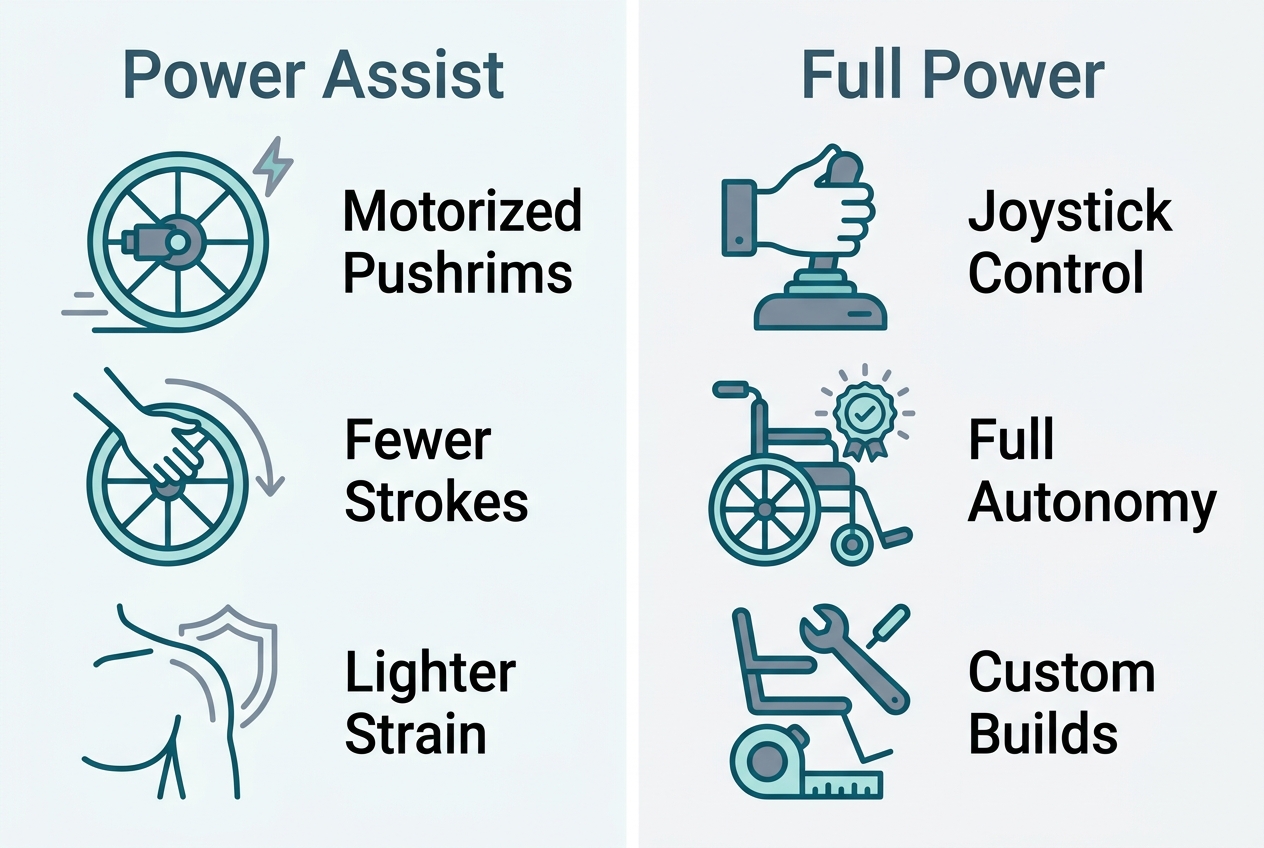
Our team helps patients transition from their professional evaluation to the right mobility solution when faced between two main options: power assist systems or power wheelchairs. Power assist systems are attachment devices to manual wheelchairs that motorize the pushrim to take some of the load off the shoulders as well as reducing the amount of strokes needed to go, which can help keep joints healthy and strong. On the flip side, power wheelchairs are controlled by a joystick and allow those who need more than just powered assistance to be totally independent.
It all depends on your upper body strength and endurance as well as the environments you find yourself navigating each day. If you’re not sure what’s right for you, our experts in Spring Valley, NY are here to assist you Monday-Friday from 9:00 am until 5:00 pm and can talk about your mobility goals and what to do next.
Even with all our best equipment and technique, the shoulders are sending us messages that they need attention. Research shows that repeated transfers can cause changes in the tendon structure and acute micro-injuries can build up into bigger, chronic problems if we ignore them.
Take these warning signs seriously and discuss them with a clinician:
Discuss with your care team what activity is causing the pain and for how long. This information will help determine if it’s an overuse tendon issue versus something else and will guide what’s next.
That’s just one part of the job; applying the right correction can keep shoulder strain from becoming a chronic condition. While dealing with shoulder pain can be difficult for wheelchair users, studies indicate that most instances respond well to dedicated practice and self-awareness. Managing shoulder pain in wheelchair users
When you have one-sided pushing, this may be improved by distributing your effort more evenly between each arm. Research showed that pediatric wheelchair users have significantly greater side-to-side differences when measuring shoulder movement, which means asking a clinician to look at your technique may help to target areas where you need to make adjustments.
An inefficient stroke pattern wastes energy and puts strain on the shoulders. Only three out of six young users used the suggested semi-circular propulsion, so practicing longer, smoother strokes that maximize contact with the pushrim reduces wasted motion and load.
The rushed, high frequency stroke feels as though the only way to continue is fast, but the faster you go, the more injury you’re going to incur. A few minutes of instruction followed by practice greatly increased the contact angle and lowered stroke frequency for both carpet and tile in adolescents, proving that retraining does change behaviour, even if it’s just for a short time. rushed, high-frequency stroke
If self-correction does not fix the problem, a personal equipment evaluation and fitting might help tackle issues you can’t fix on your own. The team at MedEquipped in Spring Valley, NY can provide an evaluation and fitting that is custom to your needs and can verify your setup supports shoulder-friendly movement.
Stop troubleshooting through pain. If you have persistent symptoms while pushing, you could be at risk for impingement, so if you’re still feeling pain, stop and get evaluated instead of pushing yourself.
Shoulder pain in manual wheelchair users often results from repetitive transfers and propulsion. Research shows these actions can injure shoulder tendons like the biceps and supraspinatus, with measurable structural changes after as few as 18 transfers. Higher stroke frequency and transfer demands increase pain intensity, especially for those with higher-level spinal cord injuries.
A professional custom wheelchair fitting ensures the equipment supports correct posture and reduces pressure on the shoulders. Proper adjustments to seat width, depth, and backrest height prevent secondary complications like pressure injuries and postural strain that contribute to chronic shoulder issues over time.
Daily conditioning routines should include gentle chest and shoulder stretches to release tightness, along with strengthening exercises like scapular retraction or seated rows. These movements maintain scapular mobility, strengthen stabilizing muscles, and counteract postural changes from prolonged wheelchair use.
Power-assist devices reduce stroke frequency and joint excursion during manual propulsion, lowering shoulder strain. Custom power wheelchairs allow joystick-controlled mobility, significantly reducing upper-body exertion and fatigue compared to manual propulsion, which can help manage chronic shoulder pain.
Pain that lingers or worsens after transfers or propulsion, new weakness when lifting or transferring, pain interfering with independent transfers, or symptoms that do not ease with rest are signs that require medical attention. These may indicate overuse tendon issues or other conditions needing professional assessment.
If your shoulders ache when you’re moving around in your wheelchair, your mobility may be the problem. How you manage shoulder pain as a wheelchair user typically starts with getting the proper wheelchair for yourself. If your days involve plenty of upper body endurance or you navigate different environments, you’ll need to decide if you should go with a power wheelchair or power assist model based on your strength, stamina and environment.
We work to help you move forward with confidence by verifying Medicare benefits, showing you how to document your medical need and scheduling you for a personal evaluation and fitting at our Spring Valley, NY clinic. Your chair will be adjusted for optimal posture and pressure release so that you can minimize any strain on your shoulders and other joints over the long term.
Call us now at (845) 237-2381 to schedule your appointment, or come to 747 Chestnut Ridge Road and see how a custom fit can support your mobility goals. Results may vary, verify your coverage and consult your treating healthcare provider for medical necessity.
You’ve now worked through the practical steps for managing shoulder pain in wheelchair users, from identifying trigger movements to refining propulsion technique and building a daily routine. As this guide has shown, whether a power assist system or a full power wheelchair makes sense depends on your upper-body strength, endurance, and the environments you navigate every day. A professional evaluation and fitting is the step that turns that self-assessment into the right equipment decision. our Spring Valley clinic provides custom-ordered motorized wheelchairs along with hands-on fitting support. Keep in mind that Medicare Part B coverage requires a face-to-face physician examination and documented proof of medical necessity, so it’s worth verifying your eligibility before equipment selection. Our team can help you navigate the paperwork and funding verification from start to delivery. Reach us at (845) 237-2381 to schedule your evaluation and take the next step toward protecting your shoulders.
Get Your Professional Evaluation Today
Table of Contents Home Delivery Benefits for Medical Equipment Medical Equipment Delivery in Spring Valley, New York Home Delivery and Setup Services…
Read More
Table of Contents What Parents Should Know About Powered Mobility for Children Does a Powered Wheelchair Delay Walking? How Powered Mobility Supports…
Read More
Table of Contents Understanding the Three Types of Wheelchairs The Fundamentals of Manual, Power, and Transport Wheelchairs Medicare Qualification and Documentation for…
Read More