
Tag: motorized wheelchair safety

  • Managing Shoulder Pain in Wheelchair Users: A Practical Guide

    Managing Shoulder Pain in Wheelchair Users: A Practical Guide

    Table of Contents

    Protecting Your Shoulders as a Wheelchair User

    Managing shoulder pain in wheelchair users starts with understanding how repetitive manual propulsion places heavy demand on the shoulder joints over time. For those who rely on manual wheelchairs, the constant pushing motion can contribute to overuse injuries and chronic discomfort that affect daily life. Power assist technology, which provides motorized torque during manual propulsion, is designed to reduce stroke frequency and joint excursion, helping mitigate shoulder strain during everyday mobility.

    This article will teach you what effect mobility equipment has on your joints over time and how to choose the equipment that is right for your shoulders. We will go over some ways to look ahead when choosing equipment and make sure your chosen mobility aid will be comfortable and support your posture for the long term.

    Key Takeaways

    • The shoulder pain that often occurs in people who use a wheelchair starts with actions that give them independence such as transfers and propulsion.
    • Because pushing down on the handrim strains your shoulders, shifting to a pulling motion can reduce impact shock and encourage a more upright posture.
    • Repetitive manual transfers can strain the shoulder tendons, especially the biceps and supraspinatus.
    • Managing shoulder pain as a wheelchair user starts with daily conditioning.
    • Our team helps patients transition from their professional evaluation to the right mobility solution when faced between two main options: power assist systems or power wheelchairs.

    Before You Begin

    If you’re deciding whether to go for a power chair or a power-assist chair, we advise being honest about your upper body strength and endurance, as well as what you typically navigate on a daily basis. Your physical limitations determine how much less your shoulders will be strained over time. Power assist systems can help by adding motorized torque to the manual push, which lowers stroke rate and joint excursion. But again, only when you have the appropriate power assist system that matches your lifestyle and physical ability.

    It’s also vital to gather everything needed for your new equipment. For example, Medicare Part B requires a face-to-face doctor exam and documented proof that you’re medically necessary for the equipment prior to coverage being approved. Make sure you check with your physician and funding source before ordering to confirm that you will be eligible for the new equipment. MedEquipped manages Medicare benefit verification and related documentation as part of their standard patient service, which can streamline the process for you. Their in-person clinical evaluation and personal fitting at our location in Spring Valley, New York makes sure you get the right mobility solution for you.

    Understanding what is causing your shoulder pain is the true starting point of this process, so you can make an informed decision about the right mobility solution.

    Step 1: Identify What Causes Your Shoulder Pain

    The shoulder pain that often occurs in people who use a wheelchair starts with actions that give them independence such as transfers and propulsion. Studies from RESNA show that repeating transfers can injure the shoulder’s tendons, with a quantitative ultrasound study showing changes to the biceps and supraspinatus structures after only 18 transfers. Tendon alterations also were correlated with higher WUSPI scores, suggesting that transfers increase the risk for a chronic injury.

    Pain intensity is not the same for all. A RESNA pilot study of wheelchair rugby athletes revealed that individuals with higher cervical-level spinal cord injuries experienced more intense pain, possibly because they had higher stroke frequency and transfer demands. The athletes with higher classification scores also felt more discomfort, indicating that activity level and injury characteristics can influence how much pain someone feels.

    Start noticing which of the movements – transfers, reaching or propelling – causes you pain. This is your first step towards discovering the reason for your pain. If this pain continues or gets worse, see a professional instead of trying to figure it out yourself.

    Step 2: Refine Your Propulsion Technique

    Because pushing down on the handrim strains your shoulders, shifting to a pulling motion can reduce impact shock and encourage a more upright posture. It appears that pulling upward on the handrim spreads the force over a larger portion of the rim, which may lower peak vertical shoulder joint reaction forces compared to conventional pushing.

    Reverse propulsion takes this further by promoting a larger angular range of motion, 108.9 degrees versus 66.6 degrees in forward propulsion, while minimizing torso deviation and kyphosis. To make these adjustments stick, focus on maximizing your contact angle and lowering stroke frequency; a brief instructional video paired with supervised practice has been shown to improve both measures in adolescents aged 13–18 on carpet and tile surfaces. Even with refined technique, remember that propulsion still loads the upper limbs, so safe transfer methods in the next step will help protect your shoulders long-term.

    Step 3: Master Safer Transfer Techniques

    Repetitive manual transfers can strain the shoulder tendons, especially the biceps and supraspinatus. Quantitative ultrasound research indicates that a single session of transfers causes fibers to become misaligned and decreases the echogenicity of the tendon, changes that correlate with increased pain scores on valid shoulder assessments for wheelchair users in the US. These acute physical changes could lead to chronic shoulder pain if transfers are performed frequently without correct technique.

    We believe that proper setup and body positioning can reduce shoulder involvement. Little tweaks in how you transfer can reduce cumulative shoulder strain over time, protecting your shoulders without requiring extra effort. If transfers consistently cause discomfort, consult a physical therapist to review your approach and identify personalized strategies for safer movement.

    Step 4: Build a Daily Stretching and Strengthening Routine

    Managing shoulder pain as a wheelchair user starts with daily conditioning. A consistent routine helps maintain scapular mobility, strengthens the muscles that stabilize the shoulder blade, and counteracts the postural changes that can develop from prolonged wheelchair use.

    Start your day with a quick check-in of your posture to see how your shoulders and upper back feel. Follow that up with two or three gentle chest and shoulder stretches to release any tightness, and then add two or three strengthening exercises like scapular retraction or seated row. Pick the same time of day to do this routine, so you can make it a habit.

    Increase repetitions or hold times gradually and slowly, and stop any movement that causes sharp pain. As a home-made routine, it’s best to validate it against your body and equipment and consider it more of a starting point than anything else until you have a chance to see a professional for an evaluation and fitting.

    Step 5: Get a Professional Evaluation and Fitting

    The first step for managing shoulder pain in wheelchair users is to undergo a thorough evaluation from a professional that evaluates how strong and how long your upper body can hold up, as well as what environments you spend most of your day in. Our team then looks at this information to help determine if you would be best suited for a power assist system or a full power wheelchair, which helps reduce the strain on your shoulders.

    A proper fit prevents pressure injuries and helps maintain correct body posture over time. Before purchasing any equipment, get a face-to-face exam by your doctor and make sure that the doctor documents that you need the equipment for medical necessity, as Medicare Part B only covers these if they are prescribed. We take care of all benefit verifications and paperwork so you can focus on getting better.

    Step 6: Explore Power-Assist and Custom Power Options

    Our team helps patients transition from their professional evaluation to the right mobility solution when faced between two main options: power assist systems or power wheelchairs. Power assist systems are attachment devices to manual wheelchairs that motorize the pushrim to take some of the load off the shoulders as well as reducing the amount of strokes needed to go, which can help keep joints healthy and strong. On the flip side, power wheelchairs are controlled by a joystick and allow those who need more than just powered assistance to be totally independent.

    It all depends on your upper body strength and endurance as well as the environments you find yourself navigating each day. If you’re not sure what’s right for you, our experts in Spring Valley, NY are here to assist you Monday-Friday from 9:00 am until 5:00 pm and can talk about your mobility goals and what to do next.
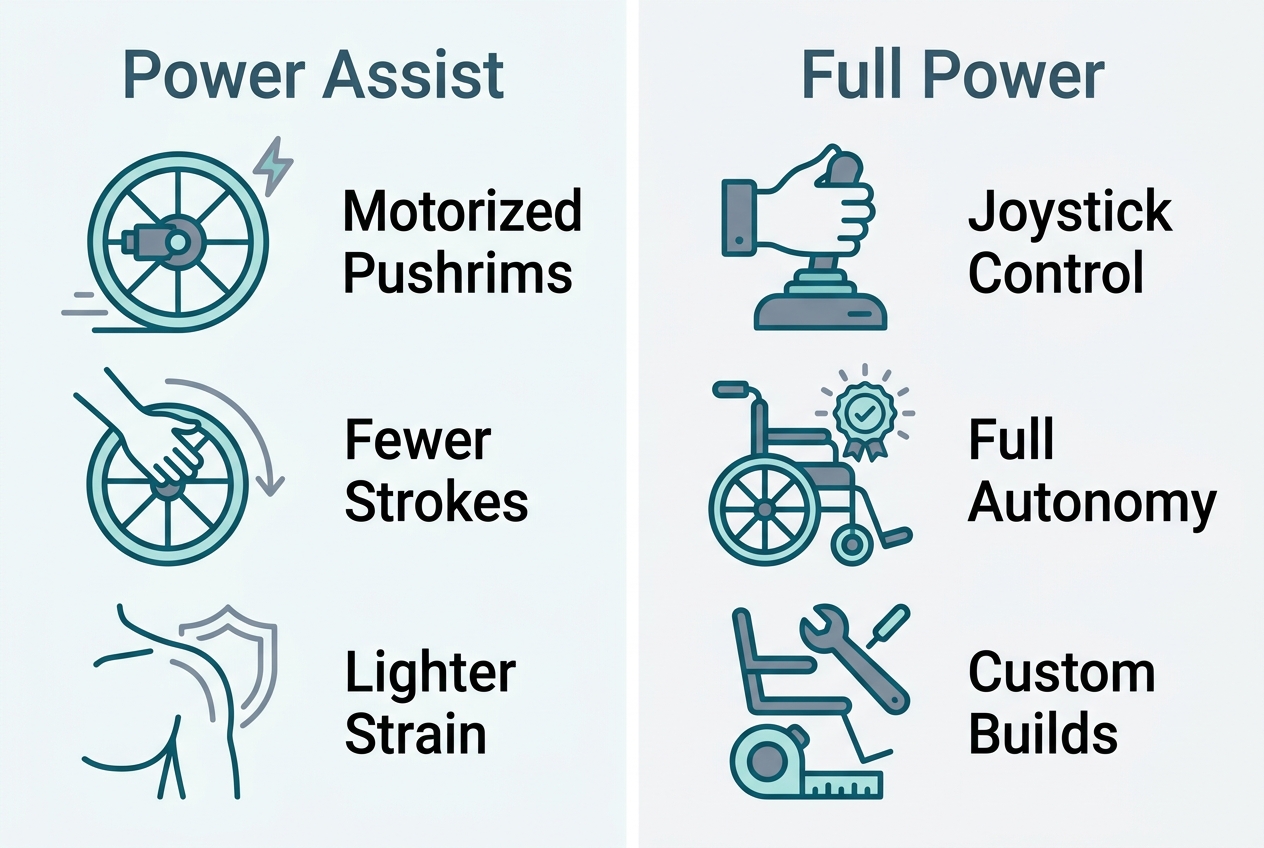
    Two-column infographic comparing power-assist wheelchair options and full power wheelchair options with labeled icons
    Side-by-side comparison of power assist vs full power wheelchair features

    Recognize Warning Signs That Need Medical Attention

    Even with all our best equipment and technique, the shoulders are sending us messages that they need attention. Research shows that repeated transfers can cause changes in the tendon structure and acute micro-injuries can build up into bigger, chronic problems if we ignore them.

    Take these warning signs seriously and discuss them with a clinician:

    • Pain that lingers or worsens after transfers or propulsion
    • New weakness when lifting or transferring
    • Pain that interferes with independent transfers
    • Symptoms that do not ease with rest

    Discuss with your care team what activity is causing the pain and for how long. This information will help determine if it’s an overuse tendon issue versus something else and will guide what’s next.

    Troubleshooting Common Setbacks

    That’s just one part of the job; applying the right correction can keep shoulder strain from becoming a chronic condition. While dealing with shoulder pain can be difficult for wheelchair users, studies indicate that most instances respond well to dedicated practice and self-awareness. Managing shoulder pain in wheelchair users

    When you have one-sided pushing, this may be improved by distributing your effort more evenly between each arm. Research showed that pediatric wheelchair users have significantly greater side-to-side differences when measuring shoulder movement, which means asking a clinician to look at your technique may help to target areas where you need to make adjustments.

    An inefficient stroke pattern wastes energy and puts strain on the shoulders. Only three out of six young users used the suggested semi-circular propulsion, so practicing longer, smoother strokes that maximize contact with the pushrim reduces wasted motion and load.

    The rushed, high frequency stroke feels as though the only way to continue is fast, but the faster you go, the more injury you’re going to incur. A few minutes of instruction followed by practice greatly increased the contact angle and lowered stroke frequency for both carpet and tile in adolescents, proving that retraining does change behaviour, even if it’s just for a short time. rushed, high-frequency stroke

    If self-correction does not fix the problem, a personal equipment evaluation and fitting might help tackle issues you can’t fix on your own. The team at MedEquipped in Spring Valley, NY can provide an evaluation and fitting that is custom to your needs and can verify your setup supports shoulder-friendly movement.

    Stop troubleshooting through pain. If you have persistent symptoms while pushing, you could be at risk for impingement, so if you’re still feeling pain, stop and get evaluated instead of pushing yourself.

    Frequently Asked Questions

    What are the most common causes of shoulder pain in manual wheelchair users?

    Shoulder pain in manual wheelchair users often results from repetitive transfers and propulsion. Research shows these actions can injure shoulder tendons like the biceps and supraspinatus, with measurable structural changes after as few as 18 transfers. Higher stroke frequency and transfer demands increase pain intensity, especially for those with higher-level spinal cord injuries.

    How can a professional custom wheelchair fitting help reduce long-term shoulder strain?

    A professional custom wheelchair fitting ensures the equipment supports correct posture and reduces pressure on the shoulders. Proper adjustments to seat width, depth, and backrest height prevent secondary complications like pressure injuries and postural strain that contribute to chronic shoulder issues over time.

    What are some effective daily stretches and exercises to prevent shoulder injuries for wheelchair users?

    Daily conditioning routines should include gentle chest and shoulder stretches to release tightness, along with strengthening exercises like scapular retraction or seated rows. These movements maintain scapular mobility, strengthen stabilizing muscles, and counteract postural changes from prolonged wheelchair use.

    Can a power-assist device or custom power wheelchair help manage or alleviate chronic shoulder pain?

    Power-assist devices reduce stroke frequency and joint excursion during manual propulsion, lowering shoulder strain. Custom power wheelchairs allow joystick-controlled mobility, significantly reducing upper-body exertion and fatigue compared to manual propulsion, which can help manage chronic shoulder pain.

    What signs indicate that shoulder pain from wheelchair use requires medical evaluation or intervention?

    Pain that lingers or worsens after transfers or propulsion, new weakness when lifting or transferring, pain interfering with independent transfers, or symptoms that do not ease with rest are signs that require medical attention. These may indicate overuse tendon issues or other conditions needing professional assessment.

    Take the Next Step Toward Greater Shoulder Health

    If your shoulders ache when you’re moving around in your wheelchair, your mobility may be the problem. How you manage shoulder pain as a wheelchair user typically starts with getting the proper wheelchair for yourself. If your days involve plenty of upper body endurance or you navigate different environments, you’ll need to decide if you should go with a power wheelchair or power assist model based on your strength, stamina and environment.

    We work to help you move forward with confidence by verifying Medicare benefits, showing you how to document your medical need and scheduling you for a personal evaluation and fitting at our Spring Valley, NY clinic. Your chair will be adjusted for optimal posture and pressure release so that you can minimize any strain on your shoulders and other joints over the long term.

    Call us now at (845) 237-2381 to schedule your appointment, or come to 747 Chestnut Ridge Road and see how a custom fit can support your mobility goals. Results may vary, verify your coverage and consult your treating healthcare provider for medical necessity.

    Get Your Professional Evaluation Today

    You’ve now worked through the practical steps for managing shoulder pain in wheelchair users, from identifying trigger movements to refining propulsion technique and building a daily routine. As this guide has shown, whether a power assist system or a full power wheelchair makes sense depends on your upper-body strength, endurance, and the environments you navigate every day. A professional evaluation and fitting is the step that turns that self-assessment into the right equipment decision. our Spring Valley clinic provides custom-ordered motorized wheelchairs along with hands-on fitting support. Keep in mind that Medicare Part B coverage requires a face-to-face physician examination and documented proof of medical necessity, so it’s worth verifying your eligibility before equipment selection. Our team can help you navigate the paperwork and funding verification from start to delivery. Reach us at (845) 237-2381 to schedule your evaluation and take the next step toward protecting your shoulders.

    Get Your Professional Evaluation Today
    Resources

  • Collision Avoidance Systems: Complete Guide to Smart Wheelchair Tech

    Collision Avoidance Systems: Complete Guide to Smart Wheelchair Tech

    Table of Contents

    Collision Avoidance Systems and Power Wheelchair Safety

    Building on the core safety features that protect power wheelchair users, collision avoidance systems represent a significant leap forward in smart mobility. These sensor-based technologies work continuously to detect obstacles in your path—whether a piece of furniture, a wall, or a person—and can alert you or even automatically apply the brakes to help prevent a collision. By reducing the risk of unexpected bumps and scrapes, collision avoidance technology allows you to move through tight indoor spaces and busy outdoor areas with greater confidence.

    At MedEquipped, we understand that navigating your environment shouldn’t be a source of stress. Integrating collision avoidance into your custom chair reduces the cognitive load required to monitor every angle simultaneously, freeing you to focus on going about your day. This same approach aligns with broader smart wheelchair technology, which aims to make power mobility safer, more intuitive, and better adapted to your life.

    We offer custom power wheelchairs that can be equipped with these advanced features, and because we handle the paperwork and insurance coordination, understanding your coverage options is straightforward. For example, our team can help you determine whether you qualify for a power wheelchair medicare funding pathway for a chair that includes collision avoidance. Our typical 30-60 day processing window means you spend less time waiting and more time enjoying the independence a thoughtfully configured chair provides. Results vary and this information is for educational purposes; please consult a healthcare professional before making clinical decisions about safety equipment.

    How Collision Avoidance Systems Work in Power Wheelchairs

    Building on the expanding world of smart wheelchairs, collision avoidance systems are a transformative addition that uses advanced sensor technology to help you navigate more safely and independently. These systems are designed to detect obstacles in your chair’s path and either warn you or take automatic action to prevent a collision, giving you greater confidence as you move through indoor and outdoor environments. This technology doesn’t replace your driving judgment but acts as an extra set of eyes, offering a helpful safety net for users with limited visibility or slower reaction times.

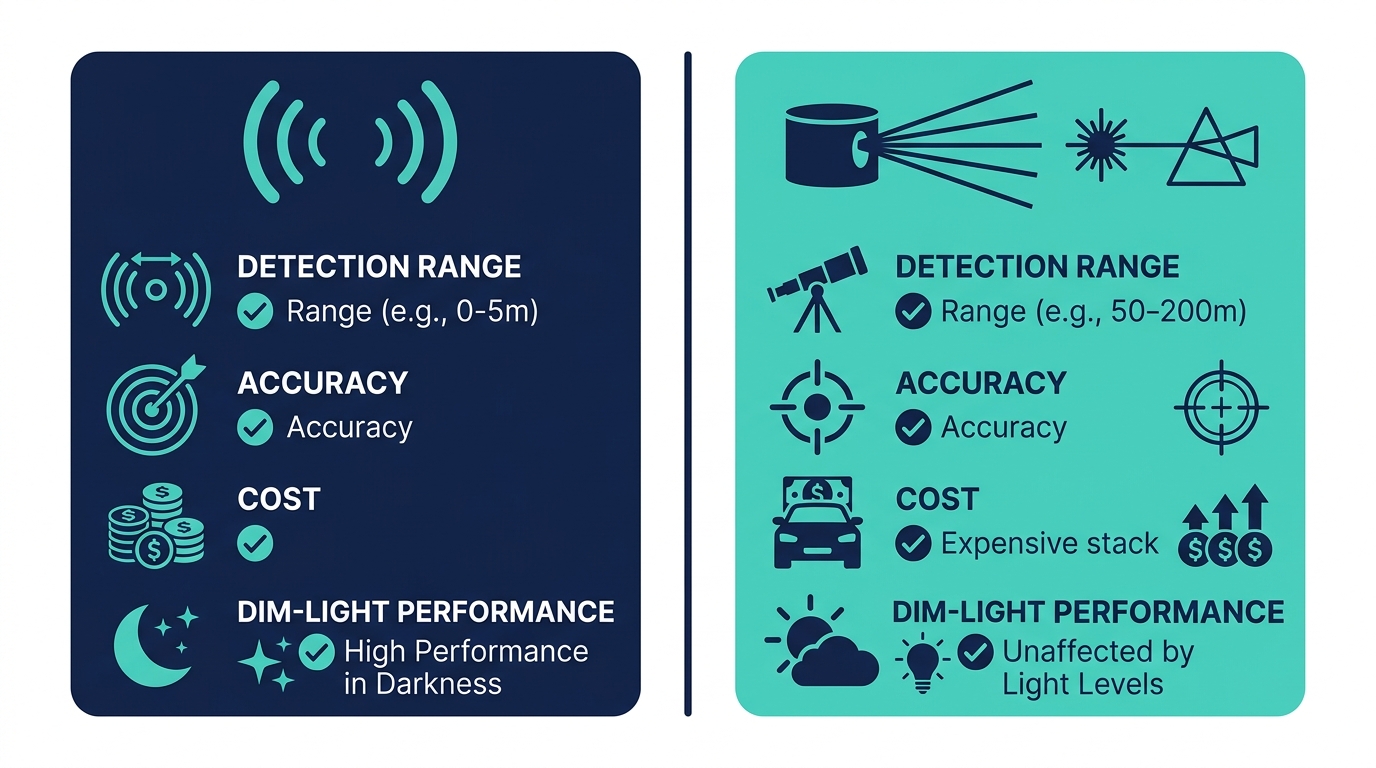
    At the core of these systems are two primary sensor technologies: ultrasonic and LiDAR. An ultrasonic sensor works much like a bat using echolocation. It emits high-frequency sound waves that bounce off nearby objects, and by measuring how long the echo takes to return, the system calculates the object’s distance. These sensors typically detect obstacles within a range of 0.2 to 4.5 meters with centimeter-level accuracy and function reliably regardless of lighting conditions. Ultrasonic sensors provide a cost-effective solution for basic detection needs, making them a common starting point for collision avoidance in power wheelchairs.

    A LiDAR sensor takes a different approach by using rapid pulses of laser light to create a detailed, millimeter-accurate map of the surroundings. With a detection range that can reach up to 30 meters, LiDAR excels at identifying objects at greater distances and in more complex layouts, giving the system a richer picture of the environment. Like ultrasonic technology, LiDAR remains completely unaffected by dim light or darkness, ensuring dependable performance no matter the time of day. This higher precision typically comes at a higher cost, reflecting the more sophisticated hardware involved.

    Sensor Technologies Comparison
    FeatureUltrasonicLiDAR
    Detection Range 0.2–4.5 meters up to 30 meters
    Accuracy centimeter-level millimeter-level
    Cost lower cost higher cost
    Performance in Dim Light unaffected unaffected

    For many users, the choice between sensor types comes down to balancing budget with the level of environmental detail needed. Ultrasonic sensors deliver reliable close-range protection and simplicity while LiDAR offers expansive, high-resolution awareness that can be especially useful in crowded or dynamic spaces. Regardless of the sensor type the system integrates directly with your wheelchair’s drive controller to interpret incoming data in real time and trigger responses that keep you safer.

    Side-by-side comparison infographic of ultrasonic and LiDAR sensor technologies used in power wheelchair collision avoidance systems

    Ultrasonic vs LiDAR sensor comparison for power wheelchair safety.

    When a potential collision is detected the system typically provides an auditory alert or haptic feedback such as a vibration in the joystick to get your attention. If you don’t react in time it can go a step further by automatically slowing the chair or applying the brakes to prevent contact. This seamless integration transforms your power chair into a true example of smart wheelchair technology that adapts to its environment. Obstacle detection technology like this makes daily mobility less stressful and more intuitive especially when navigating tight doorways, crowded rooms, or unfamiliar routes.

    According to MedEquipped’s internal product knowledge, collision avoidance systems are an important layer of protection but are not a substitute for safe driving practices. You remain in control of your chair at all times and anti-collision systems are meant to assist rather than replace your awareness. We help you navigate your options when selecting a power wheelchair equipped with these features ensuring the technology matches your daily needs and clinical requirements.

    For expert guidance on finding a reliable safety equipment supplier near me contact our team. We handle the paperwork, insurance navigation, and coordination so you can focus on what matters most: reclaiming your independence and exploring the world with a true partner in mobility freedom.

    Advanced Sensor Fusion and Smart Wheelchair Technology

    Building on the overview of core mobility features, the next frontier in power wheelchair design lies in intelligent environmental awareness. Modern collision avoidance systems transform how you interact with your surroundings, using advanced technology to create a safer, more intuitive driving experience. These systems do not replace attentive driving, but they provide a critical assistive layer, helping you navigate busy corridors, tight doorways, and crowded public spaces with greater confidence. At MedEquipped, we believe this smart wheelchair technology represents a true partnership between user and machine, enhancing independence without taking control away from you.

    How LiDAR and Ultrasonic Sensors Integrate in Multi-Sensor Systems

    The core of any advanced obstacle detection network is sensor fusion. This process combines data from multiple sensor types—primarily LiDAR and ultrasonic—to build a comprehensive, real-time picture of the environment. A single sensor type has inherent weaknesses; for example, ultrasonic sensors can struggle with very soft or angled surfaces, while LiDAR performance can degrade in heavy rain or fog. By fusing their data streams, the wheelchair’s processor compensates for these individual limitations, dramatically improving detection accuracy and reducing false positives.

    LiDAR, or Light Detection and Ranging, uses pulsed laser beams to measure distances with exceptional precision, creating a detailed 3D point cloud of the space ahead. According to MedEquipped’s technical resources, these lasers can map objects at significant ranges, providing crucial early warning for faster-moving chairs. Ultrasonic sensors, in contrast, emit high-frequency sound waves and measure their reflection, excelling at close-range detection of both soft and hard obstacles, like a person walking nearby or a piece of furniture. When these technologies work in tandem, the system cross-references LiDAR’s precise spatial map with the ultrasonic array’s reliable proximity data. This creates a redundant, robust safety net where one sensor type instantly verifies the other’s readings before triggering a response.

    The Role of AI in Obstacle Detection and Avoidance

    The raw data from a sensor array is just information; it takes artificial intelligence to turn that information into action. AI acts as the wheelchair’s brain, processing the fused sensor data in real-time to make split-second decisions. It is not simply reacting to a pre-set distance threshold. Instead, the AI classifies objects—distinguishing a static wall from a moving shopping cart—and predicts their future path, enabling adaptive navigation that feels smooth and natural rather than jarring.

    This intelligent system also learns and adapts to your personal driving style over time. If you prefer wider turns or a slower approach to doorways, the AI can adjust its intervention parameters accordingly. This personalization is a key step toward intuitive alternative driving interfaces, where the chair not only avoids obstacles on its own but also interprets subtle user commands more effectively. The following table highlights several premier models available through MedEquipped that showcase these cutting-edge capabilities, each offering a unique approach to sensor integration.

    Smart Wheelchair Models with Collision Avoidance Capabilities
    ModelSensor TypeDetection RangeAdditional Features
    QUICKIE Q700 M Ultrasonic + optional LiDAR 4.5m ultrasonic Adaptive cruise control
    ROVI X3 360° LiDAR up to 30m Autonomous navigation
    TDX SP2 HD Ultrasonic Proximity 2m range Adjustable sensitivity

    Source: Manufacturer specifications and MedEquipped product database.

    Understanding 360-Degree Collision Protection Systems

    A full-perimeter sensing system provides an invisible safety cocoon around your wheelchair. This is achieved by strategically placing multiple sensors around the base, creating a continuous detection zone that leaves no blind spots. The system constantly monitors this zone, ready to provide an alert, slow your speed, or execute a controlled stop if an obstacle is detected in your path. This is especially critical in dynamic, complex environments where hazards can appear from the side or rear.

    These collision avoidance systems rely on a concept called a ‘danger zone’, which is a digitally mapped area around the chair where objects trigger a response. When you drift too close to a wall or a person approaches from behind, the system can engage automatic braking or, in more advanced models, plot an alternative path around the hazard. For example, if a pedestrian suddenly steps in front of you, the system’s reaction time, measured in milliseconds, can augment your own reflexes, helping to mitigate an impact. Navigating the process of securing one of these advanced chairs can seem complex, but our team simplifies every step. These smart wheelchairs are often covered under wheelchair insurance — learn how we handle the process for you, managing paperwork and funding so you can focus on experiencing the freedom these technologies provide.

    Selecting and Configuring Collision Avoidance Systems for Your Power Wheelchair

    Choosing collision avoidance systems for your power wheelchair begins with a careful look at your daily life. We help you match the right obstacle detection technology to your home, your routines and your personal mobility goals. At MedEquipped, we view these safety sensors as a key part of smart wheelchair technology that gives you greater confidence behind the joystick.

    Evaluating Your Mobility Needs and Environment

    Start by thinking about where you drive most often. Indoor spaces like narrow hallways, tight doorways and crowded kitchens call for precise front and rear sensors. Outdoor environments add uneven terrain, curbs and moving obstacles such as pedestrians or shopping carts, so broader side detection becomes more valuable. We recommend listing your most common routes and noting every potential hazard you encounter.

    Collision avoidance systems come in several forms. Ultrasonic sensors use sound waves to detect objects within a set range and work well for general proximity warnings. Laser based systems offer finer distance measurement, which helps with precise positioning near furniture or doorways. Camera systems give you a visual feed of the surrounding area and can be paired with audible alerts. The right choice depends on whether you mostly navigate cluttered indoor rooms, open outdoor spaces or a mix of both.

    Funding can feel complicated, but we handle that part for you. Insurance coverage varies by payer, and you can check with Maryland state services for potential assistance through Medicaid or other programs.

    Working with a Certified ATP for System Selection

    A certified Assistive Technology Professional evaluates your clinical needs before any equipment decision is made. We coordinate with your ATP to review your posture, functional abilities, vision and reaction time. This step ensures the collision avoidance systems in your wheelchair complement your driving style rather than overwhelming you with unnecessary alerts. Smart wheelchair technology works best when it is tailored to you, not added as a one size fits all solution.

    We work with your ATP throughout the process, bringing our experience with custom motorized wheelchairs and insurance navigation to every case. Our team handles the paperwork, insurance navigation and coordination so you and your ATP can focus on clinical priorities. This partnership leads to a faster timeline from evaluation to delivery, typically within our 30 to 60 day processing window.

    Installation, Calibration, and Post-Delivery Support

    Once your ATP signs off on the recommendation, we move into the installation phase. We begin with a pre evaluation of your wheelchair to plan sensor placement. Our technicians mount the sensors securely and route wiring to avoid pinch points. Calibration follows immediately, adjusting sensitivity and range to match the obstacles identified during your ATP evaluation.

    Real world testing is our final quality check. We ask you to drive through doorways, navigate around furniture and back into your usual parking spot. This hands on validation confirms that the obstacle detection systems work reliably in the spaces you actually use. We fine tune settings on the spot so your chair feels responsive and predictable from day one.

    After delivery, we remain your partner in mobility freedom. Our team provides ongoing adjustments as your driving skills improve or your home environment changes. Proper configuration of your safety sensors keeps everyday driving smooth and sets the stage for the daily use and maintenance habits covered in the next section.

    AI Integration and Autonomous Navigation in Smart Wheelchairs

    Modern smart wheelchairs increasingly rely on artificial intelligence to transform how users navigate their environments, with collision avoidance systems playing a central role in this evolution. At MedEquipped, we see AI integration as the use of machine learning, computer vision, and sensor fusion to enable real-time decision-making and autonomous obstacle handling. Rather than simply reacting to nearby objects, these intelligent systems interpret surroundings, classify potential hazards, and plan the safest, most efficient path forward.

    Standard collision avoidance relies on basic proximity sensors that detect objects only when they are immediately near the chair. This reactive approach leaves the user responsible for manually steering around obstacles. In contrast, AI-enhanced systems use camera and LiDAR data together, allowing the chair to identify what an object is, predict where it might move, and generate an optimal route around it. This shift from reactive to predictive navigation represents a fundamental advance in smart wheelchair technology, offering smoother, safer movement through crowded or dynamic spaces.

    Over time, AI-powered navigation learns from user behavior, adapting to your preferred routes and improving efficiency with repeated use. This capability means the chair becomes more personalized, anticipating turns, doorways, and common stopping points in your home or workplace. For individuals with limited hand function or other physical constraints, alternative driving interfaces such as voice control, head arrays, and sip-and-puff systems can serve as input methods paired with AI navigation. According to MedEquipped, these interfaces integrate with advanced navigation systems to ensure that autonomous obstacle detection and intelligent path planning remain accessible regardless of a user’s physical capabilities.

    These AI capabilities set modern power wheelchairs apart by enhancing both safety and independence, letting you move through daily environments with greater confidence. We believe this technology is a natural extension of our commitment to being a partner in mobility freedom. Information is not medical advice and is for informational purposes only.

    Common Questions About Collision Avoidance for Power Wheelchairs

    You might be wondering how collision avoidance systems actually work in daily life. Here are clear answers to help.

    What is a collision avoidance system for power wheelchairs?
    It’s a smart wheelchair technology that uses sensors to detect nearby obstacles. Depending on the setup, the system can alert you or automatically slow and stop the chair.

    How does collision avoidance technology work?
    Sensors scan the area around your chair. When an object is too close, the system sends a signal to reduce speed or stop, helping prevent bumps and scrapes.

    What are the benefits of collision avoidance for wheelchair users?
    This safety system increases confidence, reduces caregiver stress, and makes navigating tight spaces easier. It’s a helpful aid, not a replacement for your attention.

    Can collision avoidance systems prevent all accidents?
    No. While the technology helps reduce the risk of collisions, user awareness is still essential. Please consult your healthcare professional for personalized advice.

    Does MedEquipped offer this on custom wheelchairs?
    Yes! We include collision avoidance options on our custom motorized wheelchairs. We’re here as your partner in mobility freedom, ready to tailor the right solution for you.

    Partner in Mobility Freedom: MedEquipped’s Commitment to Safety and Independence

    At MedEquipped, we serve as your partner in mobility freedom, delivering custom motorized wheelchairs built around your clinical needs and lifestyle. Our certified ATP evaluators perform thorough assessments so every chair integrates advanced features like collision avoidance systems and smart wheelchair technology to help you move with greater confidence. We handle the paperwork, insurance navigation, and coordination across New York, Georgia, and Michigan, typically completing orders in 30–60 days. If alternative driving interfaces fit your needs, we configure them and provide ongoing support long after delivery because your independence isn’t a one-time transaction, it’s an ongoing journey we walk together.

    Resources