
Tag: medicare power wheelchair coverage criteria

  • Medicare Power Wheelchair Eligibility 2026: Complete Guide

    Medicare Power Wheelchair Eligibility 2026: Complete Guide

    Table of Contents

    Understanding Medicare Power Wheelchair Coverage in 2026

    Medicare power wheelchair eligibility 2026 follows established Medicare Part B guidelines that classify power wheelchairs as durable medical equipment (DME). At MedEquipped, we help patients meet these requirements by providing custom motorized wheelchairs tailored to their specific mobility needs. To qualify for coverage, a patient must demonstrate medical necessity through a face-to-face examination with their treating physician, which must occur within six months of the claim submission. The physician then provides a written prescription and a 7-element order confirming the need for a power wheelchair. Eligibility hinges on the patient’s inability to perform mobility-related activities of daily living (MRADLs) — such as walking, transferring, or toileting — without the assistance of a power wheelchair, even when using a manual aid like a cane or walker. According to the Centers for Medicare & Medicaid Services, the core criteria remain consistent, but 2026 may bring updated documentation requirements. Our comprehensive coverage guide details these potential changes and helps patients understand what records Medicare expects. At MedEquipped, we specialize in assisting with Medicare benefits verification and the necessary paperwork to streamline the application process, reducing the risk of common claim denials. Our experienced team handles everything from the initial evaluation to the final delivery and setup, ensuring each custom motorized wheelchair is fitted precisely to the patient’s requirements. In the following section, we break down the 2026 eligibility rules at a glance.

    2026 Medicare Power Wheelchair Eligibility Rules at a Glance

    With that foundation in mind, here are the specific eligibility rules at a glance. For a complete breakdown of medicare power wheelchair coverage criteria 2026, see our detailed guide—but what follows is the essential checklist you need to begin.

    The Centers for Medicare & Medicaid Services establishes criteria that every power wheelchair claim must satisfy before approval; Medicare administrative contractor guidelines from organizations like CGS Medicare outline how those standards are applied in practice.
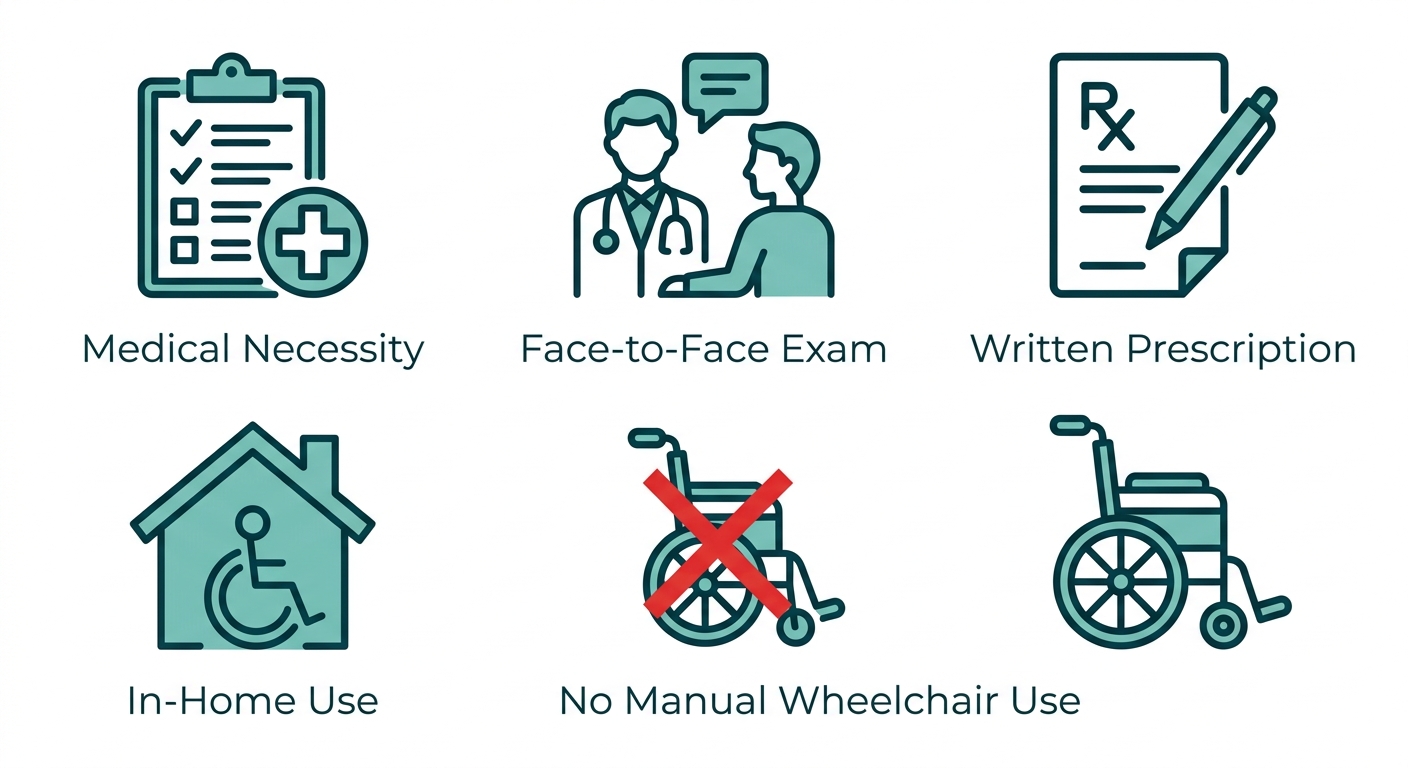
    Flat teal icon set showing the five Medicare power wheelchair coverage criteria: medical necessity, face-to-face exam, written prescription, in-home use, and no manual wheelchair use.
    Five key Medicare coverage criteria for power wheelchairs in 2026.

    Medical Necessity with a Qualifying Mobility Limitation

    The patient must have a documented mobility limitation that significantly impairs their ability to perform Mobility Related Activities of Daily Living (MRADLs), such as walking, transferring, or toileting, and be unable to complete these tasks safely at home even with a cane, walker, or other manual aid.

    Face-to-Face Examination by a Qualified Practitioner

    A face-to-face examination must be conducted by a treating physician (MD, DO, NP, or PA) within six months prior to claim submission to establish medical necessity and document the mobility limitation and the clinical reasoning for the power wheelchair. Claims without an exam within this window may be denied.

    Written Prescription from the Treating Physician

    The physician must provide a signed, dated 7-Element Order during the face-to-face visit containing specific diagnostic information, clinical justification, and confirmation that less-intensive mobility aids were considered. Without this order, the claim cannot proceed.

    In-Home Use Requirement

    Medicare Part B classifies power wheelchairs as Durable Medical Equipment and requires they be needed primarily for in-home use. Documentation must show the patient cannot navigate essential living areas—bedroom, bathroom, kitchen—without the powered device.

    Inability to Safely Operate a Manual Wheelchair

    The patient must be unable to safely and effectively propel a manual wheelchair due to factors such as poor upper-body strength, balance issues, or respiratory limitations. Clinical documentation should specify which deficits preclude manual use to justify a powered system.

    The necessary documentation for any claim includes the written 7-Element Order, comprehensive medical records that substantiate the mobility limitation, and a Certificate of Medical Necessity or similar formal documentation tying the clinical findings to the equipment requested.

    Once eligibility is confirmed, the next critical step is the face-to-face mobility examination, which we will walk through in the next section.

    The Face-to-Face Mobility Examination: Step-by-Step

    Now that you understand the rules for Medicare coverage of power wheelchairs in 2026, let’s walk through the face-to-face mobility examination step by step.

    Understanding the Face-to-Face Examination

    The Medicare face-to-face mobility exam requirements are established by the Centers for Medicare & Medicaid Services (CMS) to verify that a beneficiary truly needs a power wheelchair for use inside the home. In the Face-to-Face mobility examination, a qualified healthcare professional evaluates whether a patient’s mobility limitations are severe enough to justify coverage under Medicare Part B. This in-person (or, in limited cases, telehealth) assessment is mandatory for power wheelchairs; scooters and power-operated vehicles (POVs) are exempt. The exam focuses on documenting actual difficulties with mobility-related activities of daily living (MRADLs) — such as transferring, walking, and maintaining standing balance — rather than relying solely on a diagnosis.

    Authorized Examiners and Exam Settings

    The exam must be performed by a Medicare-approved practitioner. Authorized clinicians include:

    • Physician (MD or DO)
    • Nurse practitioner (NP)
    • Clinical nurse specialist (CNS)
    • Physician assistant (PA)

    The standard setting is an in-person visit at the practitioner’s office, clinic, or hospital. CMS permits a telehealth examination only under specific conditions. During a telehealth visit, the same mobility observations must be made via secure, real-time audio-visual communication and the provider must document the telecommunication method.

    Face-to-Face Exam Comparison: In-Person vs. Telehealth Options
    Requirement In-Person Exam Telehealth Exam (If Allowed) Notes
    Location of Exam Physician office, clinic, or hospital setting Remote via secure audio-visual platform Telehealth allowed only under CMS conditions
    Approved Practitioners Physician (MD/DO), NP, CNS, PA in person Same practitioners via telehealth Provider must hold a valid license and be able to assess mobility remotely
    Mobility Assessment Direct observation of walking, transferring, standing balance, and MRADL tasks Observation through telehealth; limited physical assistance If visualization is insufficient, an in-person exam may be required
    Documentation Requirements Written order with diagnosis, mobility deficits, date, signature, and NPI; order valid for 7 months Same documentation plus notation of telecommunication method All Medicare documentation standards apply

    Mobility Assessments During the Exam

    The examiner must directly observe the beneficiary’s ability to perform MRADLs. Key evaluations include transfers between surfaces, walking (with or without an assistive device), and standing balance. The practitioner must determine that a cane or walker is insufficient and that a manual wheelchair cannot safely meet in-home mobility needs. If the patient already uses a wheelchair, the evaluation may assess capacity to operate a powered device, including upper-extremity strength and coordination for joystick control.

    Documentation and Timeline After the Exam

    After the face-to-face evaluation, the clinician issues a detailed written order that includes the patient’s diagnosis, the observed mobility deficits, the recommended power wheelchair type, the date of the encounter, the examiner’s signature, and the examiner’s NPI. CMS requires that the exam occur no more than 45 days before wheelchair delivery if the order is based solely on that exam; longer intervals are allowed only with documentation of stability. CGS Medicare enforces a 7-month claim submission window from the exam date—if that window lapses, a new face-to-face exam and order are required.

    At MedEquipped, we’re here to help you manage deadlines and gather the necessary paperwork for a complete submission. With the examination completed and documented, the next step is documenting medical necessity to build a strong power wheelchair claim.

    Documenting Medical Necessity: How to Build a Strong Power Wheelchair Claim

    After completing the face-to-face mobility examination, the next critical step is to properly document medical necessity. Properly documenting medical necessity for power wheelchairs is the foundation of a successful Medicare claim. Medicare requires clear evidence that a power wheelchair is medically necessary. Below we outline the documentation requirements and best practices to build a strong claim.

    Documenting MRADL Deficits for Medical Necessity

    MRADL deficits form the clinical justification for a power wheelchair. Medicare medical necessity hinges on the patient’s inability to perform Mobility-Related Activities of Daily Living (MRADLs). During the face-to-face exam, at least two documented deficits are required, such as impaired ambulation, difficulty with transfers, or limited fine motor skills. The clinician must record specific examples, not generic statements. According to CMS guidelines, the documentation must demonstrate that the patient cannot safely accomplish these tasks without the device. CGS Medicare emphasizes that detailed functional descriptions—such as “patient cannot independently transfer from bed to wheelchair”—strengthen the claim. This level of detail establishes the medical necessity backbone.

    The 7-Element Order for Power Wheelchairs

    The 7-element order serves as the official prescription for a power wheelchair. It must include: the patient’s full name, primary diagnosis, the exact date of the face-to-face exam, the specific wheelchair type, all prescribed accessories, the physician’s signature, and the date the order is signed. According to CMS 2026 rules, the order must be signed and dated within 45 calendar days of the face-to-face exam. If the order is signed too early or late, Medicare will deny the claim. Each element must be individually listed on the prescription; a generic note is insufficient. We review orders for completeness and alignment with exam findings, ensuring no element is overlooked.

    Submitting a Complete Claim Package

    A complete claim package includes the signed 7-element order, the medical records from the face-to-face examination, and any therapy notes that support MRADL deficits. A certificate of medical necessity (CMN) may also be required, completed by the physician to formally attest to the need. For certain payers, a prior authorization letter is needed before delivery. Coordination among the physician, therapist, and DME supplier is essential to gather all documents. At MedEquipped, we use a detailed checklist to verify that each document meets Medicare’s latest requirements. A quick turnaround on assembly and submission helps prevent processing delays and ensures patients receive their custom power wheelchair promptly.

    Common Pitfalls to Avoid

    Common documentation errors cause unnecessary denials. The most critical mistake is omitting the face-to-face exam date on the 7-element order—Medicare treats this as an automatic denial. Other pitfalls include missing signatures, relying on medical records that are older than six months without updated functional assessments, and insufficient detail in MRADL descriptions. We recommend using a pre-submission checklist to confirm every document’s completeness. Ensuring the order is signed within 45 days of the exam and that all dates are consistent will significantly reduce denial risk. By addressing these issues upfront, providers build a stronger claim.

    Once a strong claim is built, providers should also understand special coverage scenarios such as outdoor use and telehealth exams, covered next.

    Special Coverage Scenarios: Outdoor Use, Telehealth Exams, and More

    Beyond standard documentation for medicare power wheelchair eligibility 2026, certain special coverage scenarios require additional consideration. Under CMS guidelines, Medicare primarily covers power wheelchairs for indoor use to navigate within the home, but coverage may extend to outdoor use when the home environment presents significant barriers. A long or unpaved driveway, a rural setting without nearby sidewalks, or the need to access essential outdoor areas like a garden or mailbox can establish medical necessity. Proper documentation from the treating physician and a mobility assessment that outlines these environmental challenges is essential.

    Telehealth assessments have become an accepted method for verifying medical necessity under Medicare. The Centers for Medicare & Medicaid Services has expanded telehealth options, allowing qualified clinicians to evaluate a patient’s functional limitations and mobility needs via secure video consultation. This approach eliminates the need for an in-person clinic visit, which can be especially beneficial for those with severe mobility restrictions. We work with patients and their clinicians to facilitate the telehealth evaluation and ensure all Medicare documentation requirements are met, including detailed notes about the beneficiary’s ability to perform mobility-related activities safely.

    Other special circumstances may also warrant coverage. Patients recovering from joint replacement surgery may need a power wheelchair temporarily to navigate their home during rehabilitation, while individuals with progressively degenerative conditions such as ALS or MS may require a custom chair earlier than the typical course to maintain independence as the disease advances. Each situation requires thorough clinical justification and careful documentation of medical necessity. Working with a custom power wheelchair provider can simplify the process for these unique cases, as they manage funding paperwork and coordinate with Medicare for accurate verification. Our team serves clients in Spring Valley, NY, guiding them through documentation for outdoor use, telehealth assessments, and other special scenarios. These scenarios often raise common questions, which we address in the next section.

    Frequently Asked Medicare Power Wheelchair Eligibility Questions

    What are the core eligibility and documentation requirements? Medicare Part B requires that you have a mobility limitation interfering with daily activities, cannot operate a manual wheelchair, and can safely use a power wheelchair. The primary need must be for in-home use, though outdoor coverage may follow once that need is established. Documentation must include a written order from your treating physician, a face-to-face in-person exam within six months, a Certificate of Medical Necessity (CMN), a detailed exam report, and a prescription. The evidence must demonstrate that you cannot perform mobility-related activities of daily living (MRADLs) without the power wheelchair.

    Does a telehealth exam satisfy the face-to-face requirement? No; Medicare mandates an in-person examination. Virtual visits cannot establish the required medical necessity.

    Take the Next Step Toward Your Custom Power Wheelchair

    Still have questions about Medicare power wheelchair eligibility 2026? Our experts can help you determine if you qualify and take the next step toward a custom power wheelchair. We provide personalized fittings, handle Medicare paperwork, and deliver custom wheelchairs in as little as 30 days. Call (845) 237-2381 or visit our clinic in Spring Valley, NY to start your evaluation. Coverage verification is required; results may vary. A healthcare professional must determine medical necessity.

    Start Your Custom Wheelchair Journey

    Now that you understand the 2026 Medicare eligibility requirements for power wheelchairs, including the face-to-face exam and documenting MRADL deficits, the next step is to get personalized guidance. MedEquipped specializes in custom motorized wheelchairs designed to meet your specific mobility needs. Our team can assist with Medicare verification and help you compile the necessary documentation. We serve clients in Spring Valley, New York and throughout the region. Call us at (845) 237-2381 or visit our office to start your consultation. A custom power wheelchair can restore your independence and improve your quality of life. Take the next step toward your new mobility solution today.

    Start Your Custom Wheelchair Journey

    Resources

  • Medicare Power Wheelchair Coverage Criteria 2026: Documentation Guide

    Medicare Power Wheelchair Coverage Criteria 2026: Documentation Guide

    Table of Contents

    Understanding Medicare Power Wheelchair Coverage in 2026

    In 2026, Medicare power wheelchair coverage criteria 2026 center on medical necessity, a physician’s evaluation, and proper documentation. We’re here to help you navigate these rules.

    Medicare Part B covers power wheelchairs as Durable Medical Equipment (DME) when conditions are met. CMS requires a face-to-face examination by a treating physician within the last 6 months; these power wheelchair face-to-face examination requirements ensure a current clinical assessment. The physician also writes a prescription specifying the wheelchair type and accessories. Motorized wheelchair medical necessity documentation must demonstrate the patient cannot perform daily mobility tasks inside the home without the chair and that the equipment is for primary in-home use. Suppliers must be Medicare-enrolled; MedEquipped assists with all required paperwork.

    For residents of Spring Valley, understanding these criteria is the first move toward obtaining premium custom powered wheelchairs in Spring Valley that meet Medicare’s quality standards. Coverage is not guaranteed—always verify your plan and consult your healthcare professional. Results may vary.

    Prerequisites for Your Medicare Power Wheelchair Application

    Under Medicare power wheelchair coverage criteria 2026, beneficiaries must meet several prerequisites before Medicare will consider covering a motorized wheelchair. According to the Centers for Medicare & Medicaid Services (CMS), Medicare coverage criteria require a face-to-face examination and documented medical necessity.

    • Face-to-face examination: Medicare requires an in-person evaluation with your treating physician (MD, DO, NP, or PA) within the last 6 months. This visit must document your mobility limitation and satisfy power wheelchair face-to-face examination requirements. Consult your treating healthcare professional for medical necessity.
    • Medical necessity documentation: Your records must show you cannot perform mobility-related activities of daily living (MRADLs) such as walking, transferring, or toileting, even with a cane or walker. This motorized wheelchair medical necessity documentation must also confirm the chair is needed for use in the home.
    • Written order/prescription: Your physician must provide a written order that includes your diagnosis, symptoms, and justification for a power wheelchair over a manual chair.
    • Home use requirement: Medicare covers power wheelchairs only when the device is needed for use in the home.

    At MedEquipped, we assist with gathering required documentation and verifying benefits. We’re here to help with paperwork, but coverage depends on Medicare approval. Verify Medicare coverage with your plan; we do not guarantee approval. Results may vary.

    Now that you know what Medicare requires, let’s walk through how to apply.

    Confirm Your Medical Necessity for a Power Wheelchair

    Once you understand the benefits, the next step is to confirm medical necessity under Medicare power wheelchair coverage criteria 2026. Meeting these requirements is essential for a successful power wheelchair claim.

    According to the U.S. Centers for Medicare & Medicaid Services (CMS), a treating physician must conduct a face-to-face examination within six months of the claim to establish medical necessity. These power wheelchair face-to-face examination requirements verify that the patient needs a wheelchair for mobility-related activities of daily living (MRADLs), such as bed mobility, transfers, and ambulation. The motorized wheelchair medical necessity documentation includes a written prescription and certificate of medical necessity (CMN).

    Even if a manual wheelchair seems viable, Medicare requires proof that it is insufficient. Many patients lack the strength, endurance, or balance to self-propel a manual chair safely. Our team in Spring Valley, NY, frequently sees patients whose conditions rule out manual mobility, making a custom power wheelchair necessary.

    If you meet the criteria, let’s get moving toward your custom power wheelchair. Disclaimer: Results may vary. Verify Medicare/insurance coverage; supplier does not guarantee coverage. Consult treating healthcare professional for medical necessity.

    Complete the Required Face-to-Face Mobility Examination

    Once you understand the Medicare power wheelchair coverage criteria 2026, the next critical step is to complete the required face-to-face mobility examination. The power wheelchair face-to-face examination requirements mandate that the exam be performed by the patient’s treating physician, not a third-party provider. The physician must prepare a written report documenting the patient’s mobility limitations and inability to perform mobility-related activities of daily living such as walking, transferring, or toileting.

    The written prescription issued after the exam must include motorized wheelchair medical necessity documentation, and it is generally submitted within 45 days of the exam. A properly completed face-to-face exam is the critical first step in the Medicare coverage algorithm.

    With the examination completed and documentation in order, you may be searching for motorized wheelchairs near me to begin the ordering process. We’re here to help with Custom Motorized Wheelchairs from exam preparation to delivery. Results may vary; verify Medicare/insurance coverage; consult your treating healthcare professional for medical necessity.

    Collect Essential Medical Documentation

    Once your need is established, the next step is gathering the right documentation. The Medicare power wheelchair coverage criteria 2026 require four key records, and the face-to-face examination note is the most commonly missing item, so request them right after your doctor visit:

    • Signed prescription from your treating physician
    • Face-to-face examination note dated within the last 6 months
    • Certificate of Medical Necessity (CMN) or similar form
    • Proof of mobility limitation, such as inability to walk 50 feet without help

    According to the Centers for Medicare & Medicaid Services (CMS), power wheelchair face-to-face examination requirements are clear: the exam must be performed by a physician, physician assistant, or clinical nurse specialist. Medicare does not cover power wheelchairs if a cane or walker sufficiently addresses the mobility limitation.

    We can also verify your motorized wheelchair medical necessity documentation at no charge to confirm it meets CMS criteria before submission. Final approval remains subject to Medicare review, and we cannot guarantee coverage. Consult your treating healthcare professional to determine medical necessity.

    Obtain a Medicare 7-Element Order from Your Physician

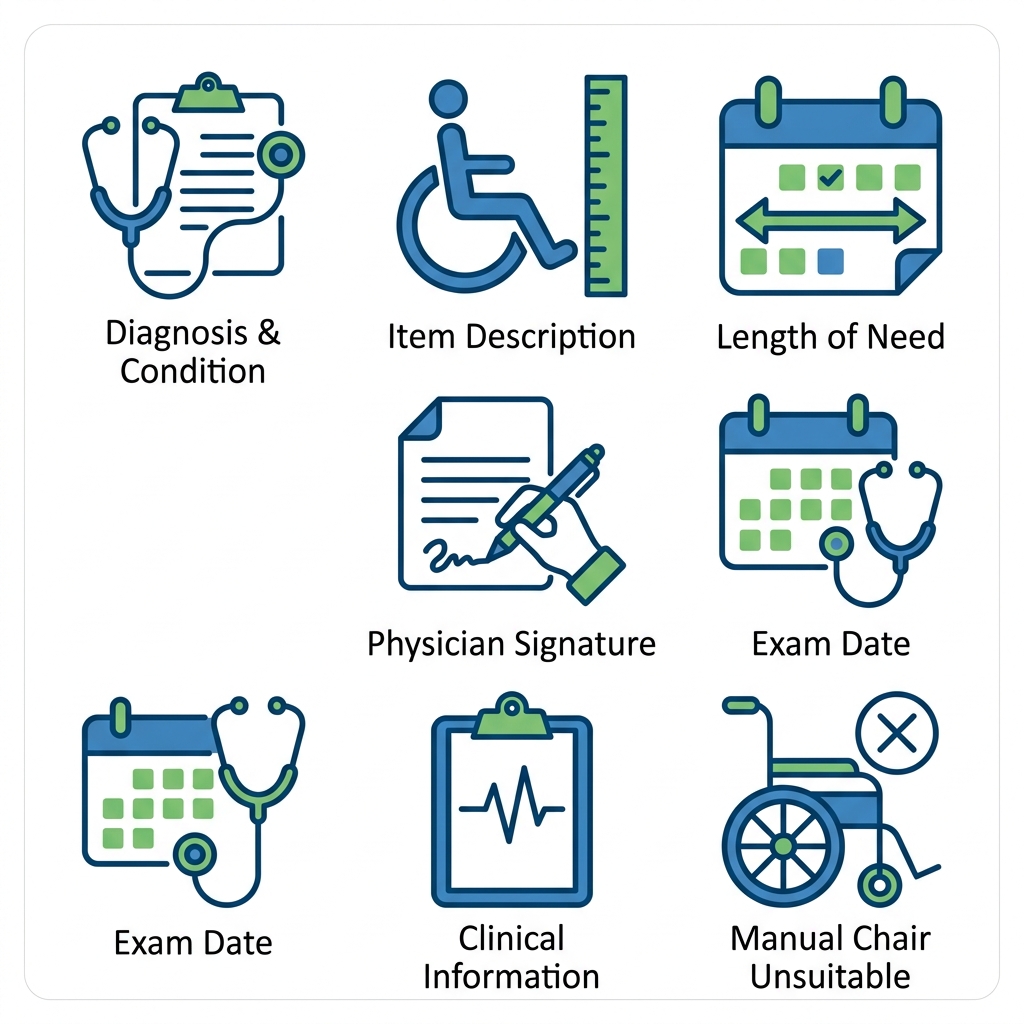
    Under the latest medicare power wheelchair coverage criteria 2026, obtaining a Medicare 7-Element Order from your physician is essential. This is not a standard prescription; it is a specific requirement completed during a face-to-face examination. The order must include: diagnosis, item description, length of need, physician signature and date, face-to-face exam date, relevant clinical information, and a statement that the patient cannot use a manual wheelchair. The order must be signed and dated (electronic signatures are generally not accepted) and written during that exam.

    Seven flat outlined icons representing the mandatory components of a Medicare 7-Element Order for a motorized wheelchair, including diagnosis, item description, length of need, physician signature, exam date, clinical information, and manual chair unsuitability.
    A complete 7-Element Order for Medicare motorized wheelchair coverage

    Our team in Spring Valley, NY can review your order to ensure it meets power wheelchair face-to-face examination requirements and motorized wheelchair medical necessity documentation standards. We help with paperwork, but coverage depends on Medicare’s approval. Verify Medicare/insurance coverage; supplier does not guarantee coverage. Consult your treating healthcare professional for medical necessity.

    Meet the Medicare Home-Use and Daily Activity Requirements

    Understanding the medicare power wheelchair coverage criteria 2026 is key to qualifying. Medicare requires a power wheelchair to be used primarily in the home and to assist with mobility-related daily activities.

    The home-use criterion means the chair must be needed for indoor mobility, not just outdoor use. While you don’t have to be bedridden, a cane, walker, or manual wheelchair must not meet your needs. Daily activities—specifically mobility-related activities of daily living such as toileting, bathing, dressing, and feeding—must justify the chair.

    Documentation is crucial. Per CMS guidelines, a face-to-face examination by your treating physician is required to establish medical necessity, as set forth in the power wheelchair face-to-face examination requirements. We at MedEquipped help gather motorized wheelchair medical necessity documentation and verify benefits to streamline the process.

    Once you understand these requirements, you can move forward with paperwork. Our team is ready to guide you. Results may vary. Verify coverage with Medicare. Consult your healthcare professional for medical necessity.

    Submit Your Coverage Application and Verify Your Benefits

    Once you and your healthcare provider have determined that a motorized wheelchair is medically necessary, the next step is to submit your coverage application and verify your benefits. Aligning with medicare power wheelchair coverage criteria 2026, we assist in preparing and submitting a complete application that includes the required medical records and order forms.

    Medicare requires a power wheelchair face-to-face examination with your treating physician to establish eligibility. You must provide motorized wheelchair medical necessity documentation such as a detailed mobility evaluation, a written prescription, and information about your home environment. Our team helps coordinate this meeting and ensures all paperwork meets CMS standards.

    We verify your Medicare Part B coverage and any supplemental insurance through our Medicare benefits verification and billing service. We’re here to help with assistance with funding sources and paperwork, but coverage is not guaranteed—the supplier does not guarantee Medicare or insurance coverage. Results may vary. Verify your coverage directly with Medicare and consult your treating healthcare professional for medical necessity.

    After your benefits are verified and your application is approved, we will schedule your personalized fitting and delivery. Contact us to get started.

    Finalize Your Custom Power Wheelchair with MedEquipped

    Once you have chosen your custom motorized wheelchair, it is time to finalize your order. At MedEquipped, we coordinate every detail—from personalized fitting to delivery and setup—so you can achieve Greater Independence. Your chair is crafted using Premium products that match your clinical needs and daily life.

    Our team verifies your Medicare benefits and assists with navigating Medicare power wheelchair coverage criteria 2026. We also support you in meeting power wheelchair face-to-face examination requirements and preparing motorized wheelchair medical necessity documentation. With our Quick turnaround, most custom orders are delivered in 30 to 60 days, and our local team in Spring Valley provides professional fitting and setup to ensure everything is just right. Our experienced staff manages all paperwork so you can focus on your mobility.

    Contact us to finalize your custom power wheelchair today. We’re here to help in Spring Valley. Results may vary. Verify Medicare/insurance coverage; supplier does not guarantee coverage. Consult your treating healthcare professional for medical necessity.

    Overcoming Common Medicare Denials and Documentation Gaps

    Understanding the Medicare power wheelchair coverage criteria 2026 is the first step toward a successful claim. Many denials stem from missing paperwork or insufficient medical evidence. By helping you prepare a complete file, we significantly reduce the risk of rejection.

    Medicare requires a face-to-face examination with your treating physician within six months before the wheelchair order. This exam must be documented thoroughly and include a detailed mobility assessment. The power wheelchair face-to-face examination requirements demand that the clinician confirm your inability to perform mobility-related activities of daily living (MRADLs) safely with a cane, walker, or manual wheelchair.

    The motorized wheelchair medical necessity documentation must explain how a power wheelchair will improve your function at home and include evidence that you can operate the device safely in your living environment. Common gaps include missing home-use verification and an incomplete mobility assessment.

    Drawing on our deep understanding of the Medicare mobility assistive equipment algorithm, we guide you through the documentation process by reviewing your clinician’s notes, helping you complete the required CMS forms (such as the Certificate of Medical Necessity), and assembling a comprehensive packet. According to the Centers for Medicare & Medicaid Services (CMS), the documentation must demonstrate that the equipment is medically necessary and intended for use inside the home.

    While we work hard to help you meet Medicare’s requirements, results may vary, and we cannot guarantee coverage. Always verify your Medicare/insurance benefits and consult your treating healthcare professional for a final medical necessity determination. We’re here to help you achieve Greater Independence.

    Take the Next Step Toward Medicare-Covered Mobility

    Now that you understand the Medicare power wheelchair coverage criteria 2026, you’re ready to take actionable steps toward greater independence. Medicare requires a face-to-face examination with your treating physician and a written prescription establishing medical necessity. Understanding the power wheelchair face-to-face examination requirements and preparing the motorized wheelchair medical necessity documentation are crucial first steps. In Spring Valley, MedEquipped is here to guide you through this process, verifying your coverage and helping gather the paperwork needed for your custom motorized wheelchair.

    Contact us today for a free consultation. We’ll handle the administrative details so you can benefit from our quick turnaround—typically 30 to 60 days—and premium products tailored to your needs. Please note: results may vary. Verify your Medicare or insurance coverage; as a supplier, we do not guarantee coverage. Consult your treating healthcare professional for medical necessity determination. Call (845) 237-2381 to schedule your personalized fitting and start your journey toward greater independence with a Medicare-covered power wheelchair.

    Resources

  • Medicare Mobility Assistive Equipment Algorithm Explained

    Medicare Mobility Assistive Equipment Algorithm Explained

    Table of Contents

    The Medicare Mobility Assistive Equipment Algorithm Explained

    So how does Medicare actually decide whether a motorized wheelchair qualifies as covered mobility assistive equipment? The Medicare mobility assistive equipment algorithm is the coverage test that determines eligibility for a custom power wheelchair.

    The first decision point is the face-to-face mobility evaluation Medicare requires, where a treating practitioner documents mobility limitations and certifies that a power wheelchair would improve daily activities and support greater independence. This evaluation is just one part of the Medicare mobility assistive equipment algorithm; the Medicare motorized wheelchair coverage criteria also require a written order within 45 days detailing medical necessity. Ongoing changes to Medicare mobility equipment compliance rules from HHS and DOJ make expert guidance essential.

    At MedEquipped in Spring Valley, NY, we help patients prepare for the evaluation and handle the paperwork. We verify benefits for smooth coverage decisions. Our premium products and quick turnaround help you regain greater independence.

    Understanding the algorithm is the first step — here is how we handle the rest.

    Results may vary. Verify Medicare/insurance coverage; supplier does not guarantee coverage. Consult treating healthcare professional for medical necessity.

    Prerequisites for Medicare Motorized Wheelchair Coverage

    Before a motorized wheelchair can be approved, Medicare requires that several criteria be met. The medicare mobility assistive equipment algorithm determines coverage eligibility under Part B, evaluating medical necessity and functional limitations.

    The medicare motorized wheelchair coverage criteria center on a mobility limitation that significantly interferes with daily activities, cannot be fully addressed by a cane or walker, and makes a manual wheelchair unsafe or impossible to use. A face-to-face mobility evaluation medicare must be performed by your treating physician within the 12 months preceding the wheelchair order. This in-person exam must document that you (or a responsible caregiver present in the home) have the physical and cognitive ability to operate a power wheelchair safely.

    Your physician must supply a written prescription, the certificate of medical necessity, and medical records from the evaluation, confirming that the chair will be used primarily in the home—as outlined by Medicare’s mobility assistive equipment algorithm. At MedEquipped, we’re here to help verify your benefits and handle the paperwork, but coverage is never guaranteed. We encourage you to consult your treating healthcare professional about medical necessity and to confirm your benefits with us.

    If you meet these prerequisites, our team can guide you through a personalized mobility evaluation. We’ll help you select a custom motorized wheelchair designed for greater independence, and our quick turnaround gets you outfitted in weeks, not months.

    Assess Your Daily Mobility and Functional Limitations

    The Medicare mobility assistive equipment algorithm rests on one question — can you safely manage everyday tasks at home?

    Daily Mobility Check

    • Do you run out of breath after a short walk, like crossing a room?
    • Do you need support to stand from a chair or bed?
    • Have you fallen or nearly fallen this year?
    • Is moving on and off the toilet, bed, or car seat hard?
    • Do you shift positions often because sitting hurts?
    • Does self-propelling a manual wheelchair tire you out quickly?

    Jot down specifics: how many feet you can walk before resting, how often you sit down, and any pain or weakness. These notes support the face-to-face mobility evaluation Medicare requires.

    Results may vary. Verify Medicare/insurance coverage — the supplier does not guarantee coverage. Consult your treating healthcare professional for medical necessity.

    Bring your completed checklist to your clinician, then contact us for a personalized fitting. Meeting Medicare motorized wheelchair coverage criteria depends on documented limitations in your home, and our custom motorized wheelchairs are built for greater independence. We’re here to help — reach out in Spring Valley, NY.

    Document the Walker Trial and Its Failure

    Within the Medicare mobility assistive equipment algorithm, a walker trial that has been documented and proven insufficient elevates a patient’s case for a power mobility device. This step follows the initial face-to-face evaluation in our in Spring Valley clinic and records that a standard walker or cane could not meet the patient’s daily mobility needs safely.

    Treating clinicians must note specific trial details — the dates the walker was used, the device type, the functional limitations reported, and the prescriber’s conclusion that the walker failed. A thorough face-to-face mobility evaluation Medicare documentation package explicitly captures these observations, demonstrating that the patient’s condition warrants Custom Motorized Wheelchairs configured for Greater Independence.

    A documented walker trial failure supports but does not satisfy all Medicare motorized wheelchair coverage criteria by itself; coverage hinges on meeting every requirement in the algorithm during medical review. We’re here to help you move your prescription forward with a Quick turnaround, but Results may vary. Verify Medicare/insurance coverage and consult your treating healthcare professional before proceeding. The next step brings together your supporting documentation for the formal coverage review.

    Complete the Face-to-Face Mobility Evaluation

    Once your appointment is scheduled, our team will guide you through the next step: the face-to-face mobility evaluation. This required clinical assessment, conducted by a treating healthcare professional, is necessary for documentation that aligns with the medicare mobility assistive equipment algorithm.

    The clinician evaluates your functional mobility limitations, ability to perform daily activities, and home environment—including doorways, thresholds, and hallway dimensions. Positioning and postural support needs are also assessed to determine the most appropriate configuration.

    Bring relevant medical records, current prescriptions, and a list of daily mobility challenges to your appointment. This preparation helps ensure the documentation addresses medicare motorized wheelchair coverage criteria, allowing us to match you with the right custom motorized wheelchair from our premium product range.

    With your evaluation complete, our team helps ensure all required coverage criteria have been addressed. The face-to-face mobility evaluation medicare requires supports the documentation we need to move forward in helping you achieve greater independence. Coverage is not guaranteed—please consult your treating healthcare professional for medical necessity and verify coverage with Medicare.

    Prepare the Required Clinical Documentation

    Once we have a clear picture of your mobility needs, the next step is preparing the required clinical documentation. When you’re navigating the medicare mobility assistive equipment algorithm, the paperwork can feel overwhelming, but we’re here to simplify it.

    Medicare’s motorized wheelchair coverage criteria require an in-person face-to-face mobility evaluation with your treating healthcare professional. You’ll need a written prescription or detailed order for your custom motorized wheelchair, the results of that face-to-face mobility evaluation medicare requires (a mobility assessment documenting your functional limitations), and, if requested, a Certificate of Medical Necessity (CMN) supporting medical necessity. This paperwork must demonstrate how your daily mobility limitations—such as an inability to self-propel a manual chair or complete essential activities of daily living at home—support the need for a custom motorized wheelchair.

    Our team in Spring Valley, NY guides you through collecting and submitting these documents, helping you request what you need from your healthcare provider. From paperwork to final delivery, we make the process straightforward. Please note: Medicare coverage is not guaranteed; results may vary. Always verify your benefits and consult your treating professional about medical necessity.

    Submit the Prior Authorization Request

    Once the face-to-face mobility evaluation is complete, the next step is securing prior authorization—a process outlined by the Medicare mobility assistive equipment algorithm. This mandatory review confirms that medical necessity and coverage criteria are satisfied before a custom motorized wheelchair can be dispensed. Medicare requires this step and will not cover the device without it.

    We prepare and submit the standard CMS-10211 form on your behalf, compiling all necessary documentation. The package includes:

    • The results of the face-to-face mobility evaluation Medicare requires,
    • Supporting clinical notes, and
    • Relevant mobility assistive equipment algorithm documentation.

    Our team carefully verifies that every document aligns with Medicare motorized wheelchair coverage criteria, checking for completeness, required signatures, and timely filing. We work to reduce delays and handle the entire paperwork burden as part of our Assistance with funding sources and paperwork service. Throughout the process, you can count on clear communication and support.

    After approval, we move to the next step—delivery and setup. Please verify Medicare/insurance coverage; supplier does not guarantee coverage.

    Understand Your Coverage Determination and Usage Rules

    Before we walk you through the process, it helps to understand how coverage decisions are made. Medicare does not automatically cover power wheelchairs; coverage is determined by the Medicare mobility assistive equipment algorithm, and we help verify benefits and complete the paperwork.

    The medicare motorized wheelchair coverage criteria require that you have a mobility limitation that significantly interferes with daily activities, cannot effectively use a cane, walker, or manual wheelchair, and can operate a power wheelchair safely (or have a caregiver who can). The treating physician must perform a face-to-face mobility evaluation (Medicare’s foundational requirement) and write the order; the face-to-face mobility evaluation Medicare mandates generally must occur within 30 days before the order is written, and we assist with scheduling and documentation. The Medicare mobility assistive equipment algorithm also weighs whether the wheelchair is needed for use in the home — a device required primarily for outdoor errands or recreation generally will not meet the in-home usage standard.

    Once you understand these coverage rules, the next step is your personalized evaluation — and we’ll verify your benefits and handle the paperwork. We’re here to help you every step of the way. Results may vary. Verify Medicare/insurance coverage; supplier does not guarantee coverage. Consult your treating healthcare professional regarding medical necessity.

    Get Fitted for Your Custom Motorized Wheelchair

    A Custom Motorized Wheelchair is only as comfortable as its fit. At MedEquipped, we begin every order with a personalized in-clinic evaluation in Spring Valley, NY, guided by the medicare mobility assistive equipment algorithm to maximize your comfort and safety.

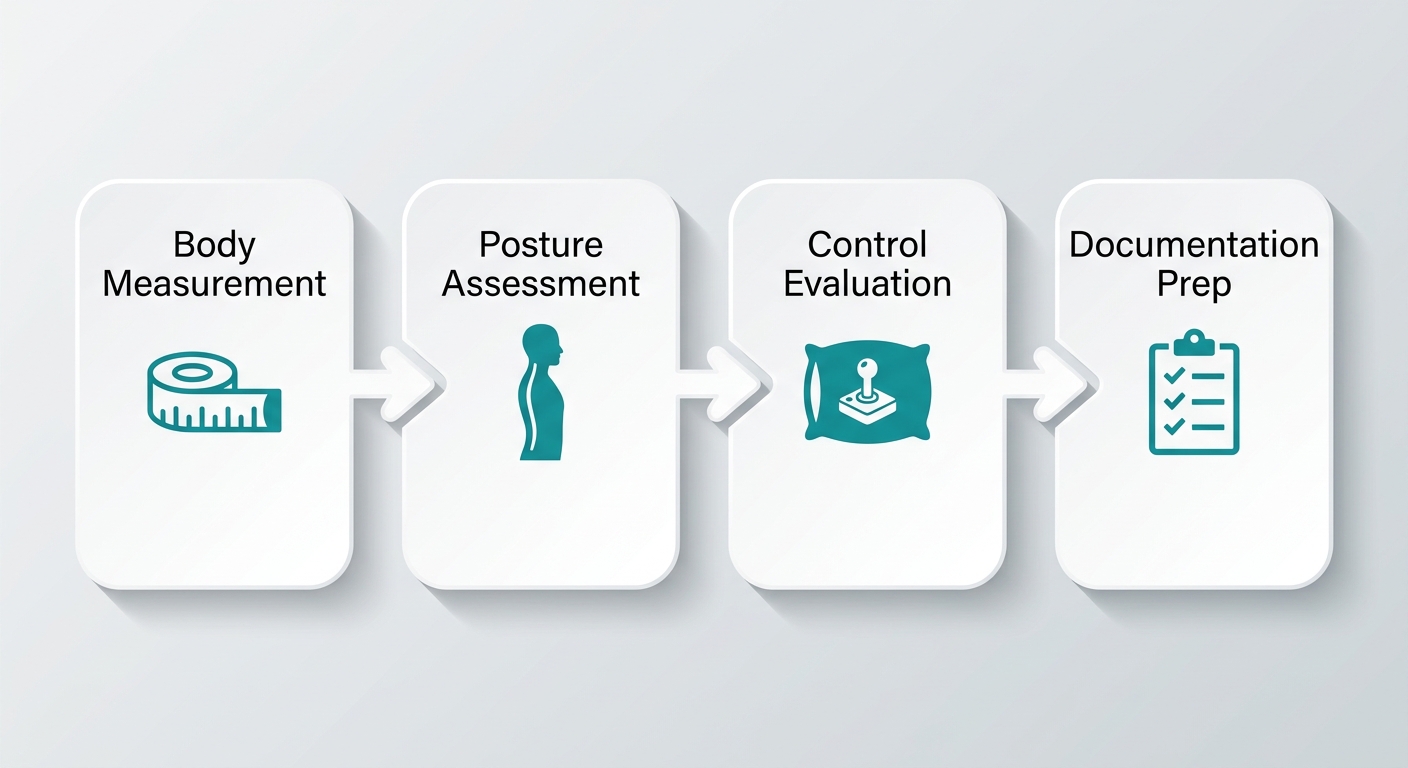
    Process flow diagram showing the four steps to fit a custom motorized wheelchair: body measurement, posture assessment, control evaluation, and documentation prep.
    Four-step custom motorized wheelchair fitting process, from measurement to documentation.

    Our experienced staff tailor the fitting to your body type, mobility needs, and lifestyle.

    • We take detailed body measurements and assess posture, pressure points, and seating ergonomics to configure the chair for all-day support.
    • You test drive controls—joystick, head array, or sip-and-puff—to ensure responsive, intuitive operation.
    • The fitting supports Medicare’s face-to-face mobility evaluation and medicare motorized wheelchair coverage criteria.
    • After the fitting, your custom chair is built and delivered in a Quick turnaround of 30–60 days—far faster than typical wait times.

    Results may vary and coverage is not guaranteed; consult your healthcare professional for medical necessity. We’re here to help—contact us to schedule your fitting and experience Greater Independence with Premium products built for you.

    Resolve Common Coverage Challenges and Denials

    Even with a solid understanding of Medicare eligibility, denials for motorized wheelchairs still happen. The key to overcoming those setbacks is understanding the medicare mobility assistive equipment algorithm, a structured process that determines coverage based on functional need. Most coverage challenges arise from paperwork gaps — not from a lack of medical necessity — so the right support can make a meaningful difference.

    Medicare’s medicare motorized wheelchair coverage criteria require clear evidence that a mobility limitation significantly interferes with mobility-related activities of daily living (MRADLs) such as toileting, bathing, and dressing, and that a cane, walker, or manual wheelchair cannot resolve the limitation. The rules also depend on a documented, in-person face-to-face mobility evaluation medicare requires — completed by the treating physician — before the order is written. Missing or incomplete documentation from that exam is the single most common trigger for an initial denial.

    Other common denial reasons include a failure to establish that the device will be used primarily in the home, clinical notes that do not adequately demonstrate the patient cannot self-propel a manual wheelchair, or insufficient proof that the patient can operate the equipment safely — or has a caregiver who can. These challenges are frustrating, but they are almost always addressable on appeal.

    The resolution pathway starts with a redetermination, the first-level appeal, which must be supported by the treating physician’s updated records. Because suppliers and patients typically face specific filing timeframes, prompt follow-up matters. We’re here to help at MedEquipped: our team verifies Medicare benefits, helps assemble the prior authorization and appeal paperwork, and works quickly alongside your doctor’s documentation. Verify Medicare/insurance coverage; supplier does not guarantee coverage. Results may vary. Consult your treating healthcare professional regarding medical necessity.

    For families in Spring Valley, NY, our experienced staff is ready to navigate coverage challenges for custom motorized wheelchairs with a quick turnaround on new orders. If you are facing a denial or just want to get the process right the first time, contact us to begin the initial patient evaluation.

    Securing Mobility Independence with the Right Support

    Achieving true mobility independence begins with a Custom Motorized Wheelchair built to your individual needs. Greater Independence becomes attainable when the right equipment is matched with a dedicated support team.

    Medicare’s coverage process uses a medicare mobility assistive equipment algorithm that structures eligibility decisions. Verifying specific medicare motorized wheelchair coverage criteria is part of this journey. A face-to-face mobility evaluation medicare requires helps confirm medical necessity, and for patients in Spring Valley, NY, we guide you through each requirement.

    We’re here to help with paperwork, funding coordination, and personalized fittings. Our Quick turnaround of 30–60 days delivers your custom mobility solution faster, so you can enjoy Greater Independence sooner. As a supplier of Premium products, we focus on patient-centered care from evaluation to delivery. Results may vary. Verify Medicare/insurance coverage; supplier does not guarantee coverage. Once your evaluation is scheduled, the next step is understanding coverage details and how we assist with the approval process.

    Resources

  • Power Wheelchair Medicare: Complete Coverage Guide 2026

    Power Wheelchair Medicare: Complete Coverage Guide 2026

    Table of Contents

    Understanding Medicare Coverage for Power Wheelchairs

    Navigating power wheelchair medicare coverage can feel overwhelming, but we’re here to simplify it for you. As a key part of Medicare’s durable medical equipment benefits, power wheelchairs provide essential mobility for those with significant limitations. Unlike manual wheelchairs, which rely on self-propulsion, power wheelchairs use motors and batteries for independent movement, as defined by the Centers for Medicare & Medicaid Services (CMS). This distinction ensures coverage aligns with your specific needs in the United States.

    To qualify under medicare power wheelchair coverage criteria, medical necessity must be established. According to CMS, authoritative government health data, patients must demonstrate an inability to self-propel a manual wheelchair due to conditions like severe arthritis or neurological disorders. A face-to-face physician evaluation is required, along with a written order prior to delivery. Key requirements include:

    • Inability to perform mobility-related activities of daily living within the home.
    • Need for power mobility to move safely and independently indoors.
    • Improvement in functional abilities not achievable with alternatives.

    For power wheelchair medicare prior authorization, your doctor certifies necessity using the Medicare Power Mobility Device Checklist, while the DME supplier submits Form CMS-10126. Coverage limits include one power wheelchair every five years, emphasizing compliant choices.

    Common accessories like batteries, chargers, and seating systems are often covered if reasonable and necessary. Medicare wheelchair options coverage details allowable items, such as heavy-duty options with HCPCS code E2371, while advising against non-standard cushions per CMS compliance guidelines. As your partner in mobility freedom, we handle the paperwork, insurance navigation, and coordination to secure these benefits efficiently.

    To verify your coverage, contact your Medicare plan or a local DME provider like us in Spring Valley, NY. This ensures smooth access—next, learn how to select a compliant supplier for seamless delivery.

    Medicare Eligibility and Coverage Criteria for Power Wheelchairs

    Building on the advantages of power wheelchairs, understanding Medicare coverage is crucial for eligible users. If you’re exploring power wheelchair medicare options, know that beneficiaries must have Medicare Part B coverage and face a mobility impairment that limits daily activities, such as walking or household tasks. This ensures the device addresses real needs rather than conveniences. We at MedEquipped guide patients through these steps, helping confirm if a power wheelchair fits your situation.

    Medicare requires a face-to-face physician examination to document why you cannot effectively use a cane, walker, or manual wheelchair. The doctor must detail your condition, like arthritis or neurological issues, and explain how it impacts mobility inside the home. According to the Centers for Medicare & Medicaid Services (CMS), this exam forms the foundation for approval, proving the device is medically necessary.

    Next comes the home assessment, which evaluates if the power wheelchair is reasonable for your living space. It must improve navigation in rooms and hallways without excessive space demands. Centers for Medicare & Medicaid Services (CMS) guidelines stress that coverage focuses on home use, not outdoor adventures. We handle these assessments as part of our service, ensuring everything aligns with requirements.

    When detailing documentation, power wheelchair medicare prior authorization becomes key, especially for advanced models. You’ll need a standard written order from your physician, plus supporting records like therapy notes. For Groups 2 and 3, prior authorization often applies, requiring detailed justification. MedEquipped, as industry supplier guidance, explains that common denials stem from incomplete paperwork, which we help resolve.

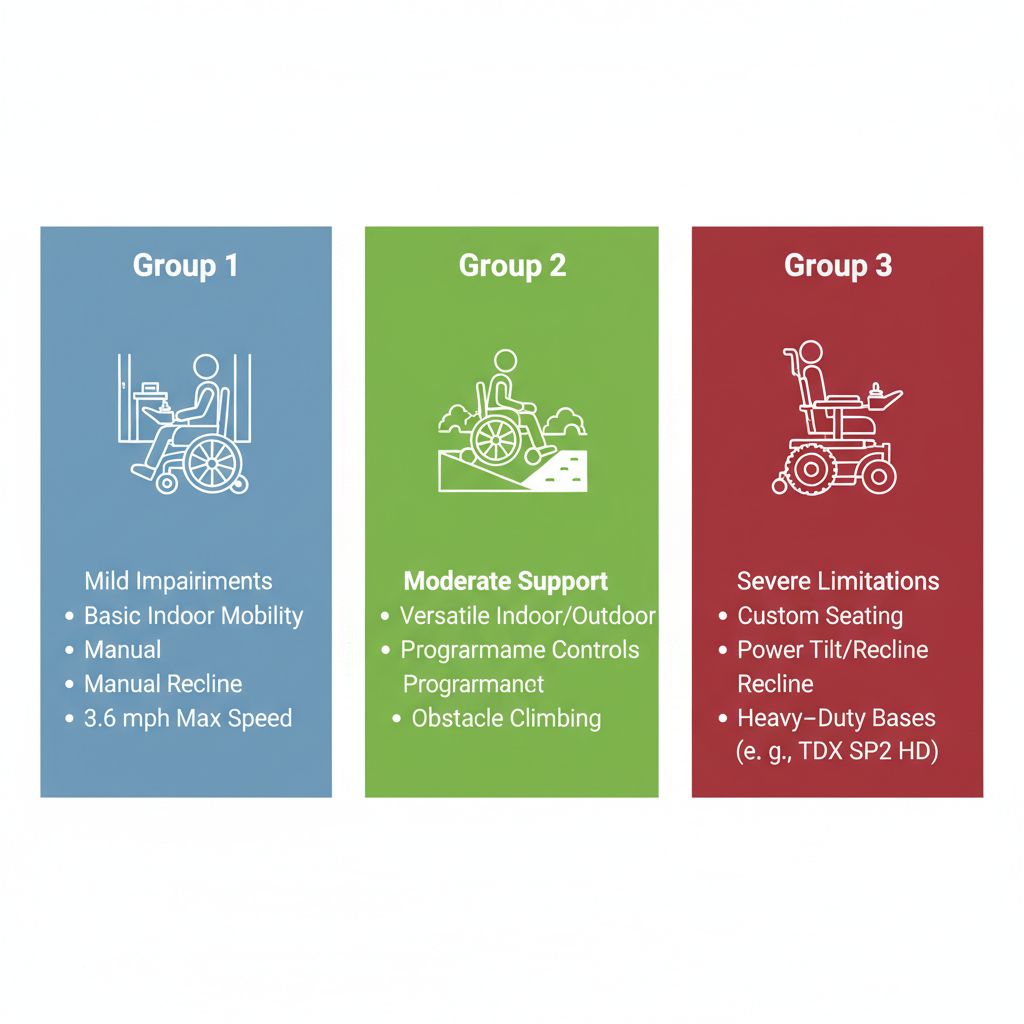
    Medicare classifies power wheelchairs into three groups under medicare power wheelchair coverage criteria, based on your mobility needs and required features. Group 1 suits basic indoor use for mild to moderate impairments, with speeds up to 3.6 mph and no tilt or recline. Group 2 offers versatility for indoor and outdoor mobility, ideal for moderate needs with programmable controls and better obstacle handling. Options like foldable electric wheelchairs fit here, providing portability for users facing environmental barriers. Group 3 addresses severe limitations with custom seating, power tilt or recline, and heavy-duty bases like the TDX SP2 HD.

    These groups require escalating documentation: Group 1 needs proof a manual chair won’t suffice, while Groups 2 and 3 demand an Assistive Technology Professional (ATP) evaluation. Centers for Medicare & Medicaid Services (CMS) Local Coverage Determination (LCD) outlines these, including prior authorization for higher groups. Upcoming 2026 updates will stress stronger clinical justification and records.

    The following table summarizes Medicare’s group levels for power wheelchairs:

    Medicare Group Coverage Levels for Power Wheelchairs

    This table compares Medicare’s group classifications for power wheelchairs based on mobility needs and features.

    Group LevelMobility Impairment DescriptionKey Features CoveredMedicare Criteria Highlights
    Group 1Mild to moderate impairmentsBasic controls, no tilt or reclineRequires face-to-face exam and home assessment
    Group 2Moderate impairments requiring more supportTilt or recline options, programmable controlsNeeds detailed medical documentation
    Group 3Severe mobility limitationsCustom seating, power tilt/recline, standing featuresPrior authorization often required

    Data sourced from CMS Local Coverage Determination (LCD) for Power Mobility Devices. This visual breakdown helps clarify how each group matches specific impairments and features, making it easier to identify what Medicare might cover for your needs.

    Reviewing these criteria shows how Medicare tailors coverage to individual challenges, from basic mobility aids to advanced custom setups. If a claim faces denial due to insufficient documentation, appeal by submitting additional evidence like updated physician notes or ATP reports. Suppliers like us at MedEquipped play a key role in this process, offering guidance on resubmissions. Once eligibility is confirmed, the next phase involves gathering documentation for approval.

    Infographic illustrating Medicare's three group levels for power wheelchair eligibility and criteria


    Comparison of Medicare power wheelchair groups by coverage and features

    This infographic reinforces the group distinctions, highlighting how features align with impairment levels to meet Medicare standards effectively.

    Documentation and Prior Authorization for Power Wheelchair Medicare

    Once eligibility is established, the next critical step involves gathering documentation and securing prior authorization for power wheelchair medicare. At MedEquipped, we understand how overwhelming this can feel, so we handle the paperwork, insurance navigation, and coordination to make the process smoother for you. This ensures your custom motorized wheelchair arrives as a true partner in mobility freedom.

    Required Medical Documentation for Approval

    To meet medicare power wheelchair coverage criteria, your physician must provide detailed evidence showing why a power wheelchair is medically necessary over a manual one. This includes documenting severe mobility limitations that prevent safe use of a cane, walker, or manual wheelchair. According to practical FAQ guidance from MedEquipped, a supplier like us can help compile these materials to avoid delays.

    Key requirements include:

    • Form CMS-10126 (Supplier Statement): Completed by your doctor and the supplier, outlining the wheelchair’s specifications and confirming it meets your needs.
    • Physician office notes: These should describe your functional limitations, such as inability to stand or walk more than a short distance without assistance, with specific examples of daily challenges.
    • Face-to-face examination report: An in-person doctor visit within the last 6 months, including a written order justifying the power mobility device.

    Additionally, assessments from a certified Assistive Technology Professional (ATP) can strengthen your case, especially for complex needs. For instance, common denial reasons like insufficient functional goals can be mitigated with an ATP evaluation that details how the wheelchair supports independence. This thorough documentation aligns with Medicare’s standards, helping ensure approval for devices like the TDX SP2 HD or QUICKIE series.

    Securing power wheelchair medicare prior authorization involves a structured submission to verify compliance before delivery. We at MedEquipped guide you every step, leveraging our expertise in Medicare processes across New York, Georgia, and Michigan. This end-to-end support typically wraps up in our 30-60 day faster processing timeline.

    Follow these steps for a successful request:

    1. Physician completes the DME Medical Documentation form: Gather the face-to-face exam, written order, and supporting notes as outlined earlier. Ensure everything highlights medical necessity under Medicare Part B.
    2. Supplier submits via myCGS portal: As your supplier, we upload all documents with the appropriate HCPCS code. The Medicare DME prior authorization process requires this electronic submission for items on the Required Prior Authorization List, as outlined by the Centers for Medicare & Medicaid Services.
    3. Track status on CMS portal: Provisional affirmation can occur quickly if initial docs are complete, with standard reviews now at seven calendar days per recent CMS updates. Log in regularly or let us monitor for you.
    4. Appeal denials within 120 days: If needed, use the specific appeal form with additional evidence, such as an ATP report addressing gaps like terrain needs or weight capacity.

    Certain HCPCS codes for power wheelchairs trigger these requirements, focusing on high-utilization items to protect Medicare resources. The table below compares common codes and notes, based on CMS prior authorization initiatives for DME.

    HCPCS CodeWheelchair TypePrior Auth Required?Key Documentation Notes
    K0005Heavy-duty power wheelchairYesDetailed clinical justification for weight and terrain
    E2372Group 3 power baseYesHome assessment and functional goals

    This comparison helps identify what extra steps your claim might need, reducing surprises. For example, heavy-duty models like K0005 often require proof of bariatric needs, while Group 3 bases demand evidence of postural support requirements. Supplier-provided procedural advice from MedEquipped emphasizes including these details upfront to boost approval rates.

    To avoid denials from vague functional goals, always tie documentation to real-life impacts, like navigating home obstacles. On average, non-urgent requests process in 10-14 days, though expedited reviews for imminent health risks can shorten this to two business days per CMS guidelines. With approval in hand, identifying the right supplier ensures seamless delivery and customization.

    Clinical Evaluations and Model Selection for Medicare Power Wheelchairs

    The Role of Certified ATP Evaluations

    Our certified Assistive Technology Professionals (ATPs) play a vital role in Medicare power wheelchair evaluations. We start by conducting thorough mobility assessments to understand each patient’s unique challenges. Using standardized tools like the Wheelchair Skills Test, we evaluate how well someone navigates their home and community. This step identifies functional limitations, such as difficulty with transfers or endurance, ensuring recommendations match real-life demands.

    For patients upgrading from manual wheelchairs to power options, we contrast basic manual mobility with advanced power systems. Medicare power wheelchair coverage criteria require detailed documentation, including a physician’s prescription outlining medical necessity and reports on functional impairments. We handle the paperwork, insurance navigation, and coordination to simplify this for you. Our ATPs then recommend custom features, like power tilt for pressure relief, based on clinical justification from the evaluation.

    These assessments comply with RESNA standards, focusing on safety and comfort. According to MedEquipped’s internal FAQ guidance on professional assessment standards under Medicare guidelines, this comprehensive approach ensures eligibility and optimal outcomes. We emphasize patient involvement, discussing goals to build confidence in the selected device.

    Selecting Medicare-Covered Models Like QUICKIE and ROVI X3

    Choosing the right Medicare-covered power wheelchair involves understanding Group classifications and features that meet your needs. In 2026, we focus on models like the QUICKIE Series and ROVI X3, which offer robust compliance with Centers for Medicare & Medicaid Services (CMS) rules. Our team at MedEquipped helps navigate these options, ensuring selections support indoor and outdoor use while addressing specific impairments.

    Medicare divides power wheelchairs into Group 2 for moderate needs, allowing indoor/outdoor mobility with speeds up to 4 mph, and Group 3 for more complex rehab scenarios, featuring higher speeds up to 6 mph and greater weight capacities up to 300 pounds or more. Group 2 suits those with moderate impairments requiring versatile navigation, while Group 3 handles severe mobility challenges, like navigating uneven terrain or home barriers. As your partner in mobility freedom, we explain these differences during consultations to match the best fit.

    Custom features, such as power tilt, recline, or programmable controls, require power wheelchair medicare prior authorization, including clinical notes justifying medical necessity under complex rehab tech criteria. For instance, sling seat authorization needs proof of skin integrity risks, and we coordinate these approvals seamlessly. MedEquipped’s internal FAQ on coverage rules highlights that prior auth ensures features like heavy-duty bases are Medicare-eligible, preventing claim denials.

    Popular models vary by these classifications, as shown in the comparison below. Sourced from MedEquipped product FAQs and CMS coverage rules, this table outlines key differences to aid your decision:

    ModelGroup ClassificationKey Medicare-Covered FeaturesBest For
    QUICKIE SeriesGroup 2/3Custom seating, power tiltModerate to severe impairments
    ROVI X3Group 3Heavy-duty base, recline optionsSevere mobility needs
    TDX SP2 HDGroup 3Extra stability, programmable controlsALS/MS patients

    The QUICKIE Series excels for versatile daily use, while the ROVI X3 and TDX SP2 HD provide advanced stability for demanding conditions. We deliver these custom motorized wheelchairs in 30-60 days, faster than many providers, with full setup and education.

    Once evaluated and a model selected, proceed to prior authorization steps for seamless access to your Medicare benefits.

    Processing Timelines, Appeals, and Support for Power Wheelchair Medicare

    Once eligibility under medicare power wheelchair coverage criteria is established, the next phase involves navigating processing timelines for power wheelchair Medicare approval. We at MedEquipped understand that waiting for your custom motorized wheelchair can feel daunting, but the overall process typically spans 30-60 days from application to delivery. Factors like complete documentation and prompt submissions can speed things up, helping you get back to greater mobility sooner. As your partner in mobility freedom, we handle the paperwork, insurance navigation, and coordination to make this smoother.

    The first stage is prior authorization for your power wheelchair Medicare request. This involves submitting necessary medical necessity documents through the Durable Medical Equipment Medicare Administrative Contractor (DME MAC), a regional Medicare reviewer that handles claims. According to practical, experience-based timelines from MedEquipped, this review usually takes 10-14 days. We emphasize power wheelchair Medicare prior authorization early to avoid delays, and in Michigan, state assistance often accelerates this step.

    Following prior authorization, the clinical evaluation and order stage begins, lasting 7-21 days. Here, a certified Assistive Technology Professional (ATP) conducts an assessment to configure your chair for optimal fit and function, including custom seating and controls. MedEquipped’s New York office streamlines this process, aiming for the full 30-60 day timeline overall. This personalized fitting ensures your power wheelchair meets Medicare coverage for power wheelchairs standards while suiting your daily needs.

    Finally, approval and delivery wrap up the process within the total 30-60 days. Once approved, we manage insurance billing and ship your fully fitted chair directly to you, followed by post-delivery adjustments and education. Local support in Georgia and Michigan enhances this, providing hands-on guidance for seamless integration into your routine. These faster processing timelines set us apart, often quicker than national averages.

    The following table outlines the Medicare Power Wheelchair Processing Stages, providing a timeline comparison across stages from application to delivery, derived from CMS guidelines and MedEquipped timelines.

    StageTypical DurationKey ActionsRegional Variations (NY/GA/MI)
    Prior Authorization10-14 daysSubmit docs via DME MACFaster in MI with state assistance
    Clinical Evaluation & Order7-21 daysATP assessment and configNY office streamlines
    Approval & Delivery30-60 days totalInsurance billing, ship fitted chairGA/MI local support

    This breakdown highlights how regional factors influence power wheelchair Medicare speeds. For instance, New York’s efficient evaluations and Michigan’s aid can shorten waits compared to standard processes.

    If delays or denials occur in your power wheelchair Medicare journey, appeals provide a clear pathway forward. Denials can be frustrating, but structured appeals often succeed with our guidance. Key steps include:

    1. Request a redetermination within 120 days of the denial notice, submitting additional evidence of medical necessity.
    2. If unsatisfied, escalate to a Qualified Independent Contractor review, then an Administrative Law Judge (ALJ) hearing for further adjudication.

    We recommend acting quickly to preserve your options.

    For support, MedEquipped coordinates every application aspect across New York, Georgia, and Michigan. In Michigan, the State Health Insurance Assistance Program (SHIP), an official resource from the Michigan Department of Health and Human Services, offers free counseling on Medicare appeals and timelines. Contact them or us at 845-237-2381 for personalized help. If power wheelchair approval is denied, exploring options like manual wheelchairs may provide interim mobility solutions. After approval and delivery, ongoing support ensures optimal use—see our post-delivery care guide.

    Frequently Asked Questions on Power Wheelchair Medicare

    To further clarify coverage details on power wheelchair Medicare, here are answers to common questions. At MedEquipped, we guide patients through these processes as your partner in mobility freedom.

    What are the eligibility requirements for power wheelchair Medicare?
    Medicare guidelines for power wheelchair eligibility require functional mobility limitations, like inability to self-propel a manual wheelchair, confirmed by a physician’s assessment as authoritative government health data from the Centers for Medicare & Medicaid Services indicates.

    What documentation meets Medicare power wheelchair coverage criteria?
    Coverage needs proof of medical necessity, including a physician prescription, face-to-face evaluation, and home assessment showing the wheelchair’s essential role in daily activities within Medicare power wheelchair coverage criteria.

    How does the power wheelchair Medicare prior authorization process work?
    Suppliers submit claims through Medicare’s DMEPOS system with supporting documents like the Written Order Prior to Delivery; we handle the paperwork, insurance navigation, and coordination in power wheelchair Medicare prior authorization processes.

    What are key compliance tips for Medicare wheelchair options?
    Use proper HCPCS E codes for billing, avoid non-covered recreational accessories, and apply modifiers like KX for claims. For more, see Medicare wheelchair compliance tips.

    This is general information; consult CMS resources or a professional for personalized advice. Information is not medical advice and is for informational purposes only. For help starting your claim, see the following guide.

    Your Path to Medicare-Funded Power Mobility

    Building on basic coverage details, gaining Medicare-funded power mobility can transform daily life for those with limited mobility. At MedEquipped, we guide you through obtaining a power wheelchair medicare device, covering 80% after your deductible for eligible needs.

    Eligibility Check: Start with a doctor’s visit to confirm medicare power wheelchair coverage criteria, like arthritis or neurological issues requiring a prescription for medical necessity.

    Application Process: Gather a face-to-face exam summary, supplier form, and home proof if needed. We handle power wheelchair medicare prior authorization as your DME partner, submitting claims efficiently.

    Contact us at 845-237-2381 for free consultations and fittings. We handle the paperwork, insurance navigation, and coordination. Once approved, explore models that fit your needs for true mobility freedom.

    This article was researched and written with the assistance of AI tools.

    Resources