
ADA Accessible Medical Equipment Deadlines 2026: Complete Compliance Guide
Table of Contents The 2026 ADA Accessible Medical Equipment Compliance Landscape Understanding the ADA's 2026 Medical Equipment Accessibility Mandate The DOJ and…
Read More
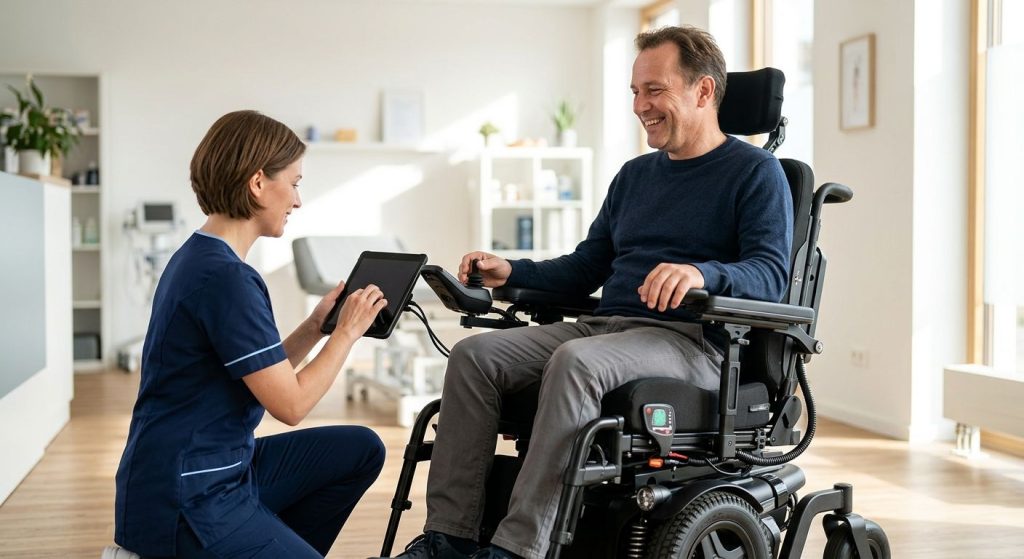
That’s why we created the Let’s Get Moving initiative—a comprehensive program designed to simplify the process of obtaining a custom motorized wheelchair and help you achieve Greater Independence. From our clinic in Spring Valley, NY, we serve patients throughout New York City and the surrounding region, offering premium products and a quick turnaround of just 30–60 days.
Through our Let’s Get Moving initiative, we provide premium mobility equipment in New York City, including Custom Motorized Wheelchairs built to your exact specifications. Our team handles everything from the initial evaluation and personalized fitting to delivery and hands-on setup. We’re here to help you navigate Medicare and insurance paperwork, so you can focus on regaining mobility without the administrative burden. We offer a selection of electric wheelchairs and power wheelchairs designed to meet a wide range of clinical and lifestyle needs, and our specialists work closely with you to identify the best solution.
Once your chair is ready, we deliver it directly to your home, provide setup support, and offer training to ensure safe operation. Our goal is to help you enjoy Greater Independence in your daily routine. In the next section, we’ll walk you through the step-by-step process of joining the program.
Results may vary. Verify Medicare/insurance coverage; supplier does not guarantee coverage. Consult treating healthcare professional for medical necessity.
A power wheelchair is a self-contained powered base operated via joystick, head array, or sip-and-puff controls, engineered for individuals with complex medical needs such as quadriplegia or severe muscle weakness. By contrast, an electric wheelchair broadly includes manual chairs retrofitted with power assist or scooter-style platforms steered by tiller. Let’s get moving toward a solution that truly matches your life.
These terms often get mixed up, but the differences carry real consequences for daily use and funding eligibility. Power wheelchairs are designed for precise positioning and can be extensively customized. Electric wheelchairs, lighter and better for outdoor terrain, offer less configurability. The following table breaks down the key points.
| Feature | Power Wheelchair | Electric Wheelchair |
|---|---|---|
| Definition | Powered by battery and controlled via joystick or sip-and-puff; frame is part of the powered base. | Often used synonymously, technically refers to manual chair with add-on power assist or scooter-style platform. |
| Control Type | Joystick, head array, or sip-and-puff for direct drive. | Typically tiller or handlebar control, less customizable. |
| Terrain Capability | Designed for indoor and controlled outdoor use; can be modified for light terrain. | Larger wheels and higher ground clearance for outdoor use. |
| Customization Options | Highly customizable seating, controls, and drive programming. | Limited customization; seat options but fewer drive configurations. |
| Typical Use Case | Individuals with complex mobility needs requiring precise positioning and control. | Active users who need a lightweight, portable option for outdoor travel. |
As the comparison illustrates, control type is a major differentiator. Power wheelchairs allow adaptive controls—from chin joysticks to breath-activated input—enabling individuals with limited hand function to drive independently. Seating systems can be molded, tilted, or reclined to manage pressure and posture. Electric wheelchairs, while improving outdoor access, generally lack this depth of customization and are better suited for users who require less positioning support. These distinctions also affect Medicare classification: power wheelchairs are specifically recognized as durable medical equipment, while some electric add-ons may fall under different reimbursement rules.
For residents of Spring Valley, NY and the wider New York City metro area, MedEquipped provides custom power wheelchairs that excel in urban environments. Our power chairs are configured with compact bases and responsive controls to navigate crowded sidewalks and public transportation. When individuals seek wheelchairs in New York City, they can access our personalized fitting process, ensuring seating and programming match their daily routines—whether that’s commuting in Manhattan or visiting Central Park.
Medicare classifies power wheelchairs as durable medical equipment (DME) under criteria set by the Centers for Medicare & Medicaid Services (CMS). Coverage is possible when a physician documents medical necessity. At MedEquipped, we handle benefits verification and paperwork, but final coverage decisions rest with Medicare. Results may vary; verify your coverage details and consult your healthcare professional before pursuing a claim.
Now that the functional differences are clear, the next stage is securing funding. Medicare, Medicaid, and some private insurance plans may contribute to the cost. In the upcoming section, we detail the step-by-step process for documenting need, submitting claims, and navigating the system. Understanding your coverage options is the next step—continue reading to learn how Medicare can help fund your mobility solution.
After understanding the benefits, let’s walk through the step-by-step process. Patients seeking customized wheelchairs in Manhattan can begin with a comprehensive evaluation at our Spring Valley clinic. We combine clinical expertise with premium products to deliver a Custom Motorized Wheelchair for greater independence. Let’s get moving on your mobility journey.
| Feature | Standard Motorized Wheelchair | Custom Motorized Wheelchair |
|---|---|---|
| Configuration Options | Pre-configured; limited adjustment. | Built to order; full range of components. |
| Fit Precision | Standard sizing; may not accommodate unique body shapes. | Personalized measurements and trial fittings ensure optimal comfort. |
| Component Quality | Mass-produced; adequate but not specialized. | High-quality, medically appropriate components selected by clinicians. |
| Funding Process Complexity | Simpler paperwork; limited to standard medical necessity. | Requires detailed documentation; MedEquipped handles all funding paperwork. |
| Turnaround Time | Available immediately from stock. | 30–60 days with MedEquipped, faster than industry average. |
The benefits of a custom solution are clear, and our streamlined process ensures quick turnaround—often within 30 to 60 days. Our team manages every step from evaluation to delivery, so you avoid the lengthy waits typical of other providers. The following graphic illustrates the key phases of our process, and the sections below describe each in detail.
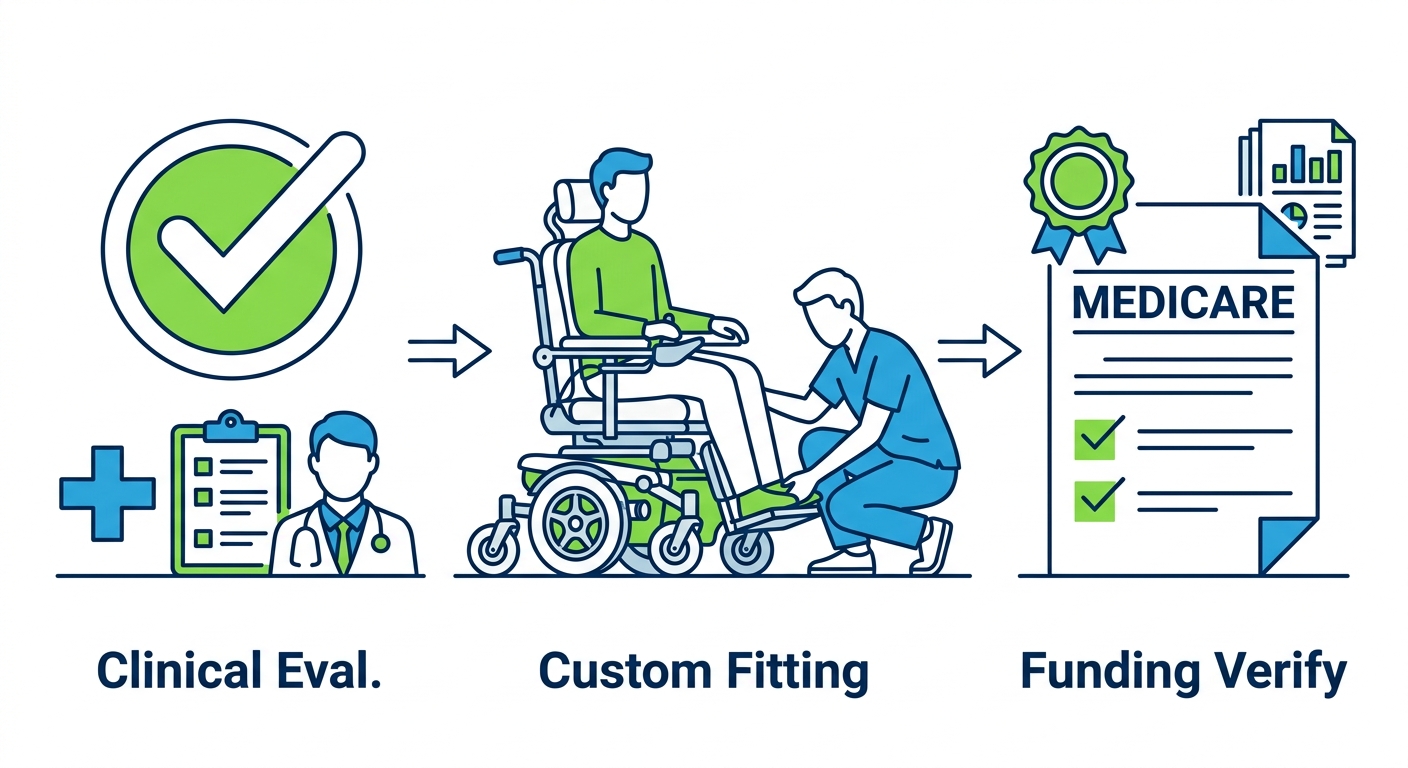
Custom wheelchair process from evaluation to funding approval
Every custom motorized wheelchair begins with an in-person assessment by our clinicians at our Spring Valley clinic. We evaluate your functional mobility, posture, range of motion, and daily goals to understand your needs. We determine whether power seating functions such as tilt, recline, or elevating leg rests are medically necessary to manage pressure and pain, and we evaluate specialized controls for those with limited hand dexterity. We consider your typical daily activities, including maneuvering through tight doorways or navigating uneven sidewalks, to select a base with the right turning radius and suspension. Our team combines these findings to create a custom build that maximizes indoor usability and outdoor durability. Based on the assessment, we recommend a custom configuration tailored to your diagnosis and lifestyle, ensuring your Custom Motorized Wheelchair is built precisely for your unique requirements.
Once the configuration is approved, we schedule an in-person fitting session at our clinic. Using pressure mapping technology, we analyze seat surface contact to identify pressure points and prevent sores, adjusting the cushion contour and back support accordingly. We take meticulous measurements and test alignments for seat depth, backrest angle, armrest height, and footplate position. Joystick placement is customized for your dominant hand and range of motion; for an electric wheelchair, this placement directly affects driving control, so we fine-tune sensitivity and speed settings. We may also integrate alternative controls such as sip-and-puff or head arrays. Through iterative adjustments and trial sitting, we ensure every control is intuitive and comfortable. We also evaluate your seating posture in relation to the drive base to optimize stability and maneuverability. Throughout the fitting, our specialists explain each adjustment so you understand how the chair supports your body. This hands-on process eliminates guesswork and gives you confidence that the final chair will meet your daily mobility needs.
Funding a custom motorized wheelchair can be complex, but we’re here to help. MedEquipped verifies your Medicare benefits upfront and assists with the documentation required to demonstrate medical necessity. Our team works directly with your treating healthcare professional to ensure that the physician’s face-to-face examination and written order meet CMS guidelines, and we compile all supporting records. We also coordinate with secondary insurers when applicable to maximize coverage. We handle the paperwork so you can focus on your mobility. However, coverage is not guaranteed; we do not guarantee funding approval. Verify your Medicare and insurance coverage. Consult your treating healthcare professional for medical necessity. Results may vary. Once funding is approved, we coordinate the final build and schedule delivery. Our quick turnaround—typically 30 to 60 days—means you receive your chair faster than the industry average. The next phase is professional setup and training, which we cover in detail shortly.
Now that you understand the benefits of a power wheelchair, it’s time to choose and care for yours. To truly let’s get moving, we’ll walk you through selection, maintenance, and community independence.
Choosing a motorized wheelchair starts with weight capacity, seating dimensions, and drive type. We build Custom Motorized Wheelchairs to match your clinical needs and home layout, ensuring a precise fit. The table below compares drive types to guide your decision.
| Drive Type | Maneuverability | Ground Clearance | Terrain Suitability | Battery Range |
|---|---|---|---|---|
| Front-Wheel Drive | Excellent indoor maneuverability; tight turning radius. | Lower clearance; suitable for smooth surfaces. | Best for indoor use; limited on gravel or grass. | Standard range (10–15 miles per charge). |
| Rear-Wheel Drive | Good outdoor stability; moderate turning radius. | Higher clearance; handles uneven terrain. | Versatile; use on pavement, grass, and light trails. | Extended range (12–18 miles). |
| Mid-Wheel Drive | Zero-turn radius; extreme indoor agility. | Moderate clearance; stable on slopes. | Excellent indoors; fair on packed terrain with anti-tip. | Standard range (10–14 miles). |
Selecting a drive type is a key step toward greater independence. For the control interface, power wheelchairs can use a joystick, sip-and-puff, or head array based on your physical abilities. Our team matches the right controls during your personalized fitting.
Regular maintenance keeps your motorized wheelchair performing safely and reliably. Our premium products are engineered for durability, and a little routine care goes a long way. For battery care, charge the chair after each use and avoid letting the battery fully discharge; deep discharges shorten lifespan. Once a month, clean the battery terminals with a dry cloth to prevent corrosion. This simple routine helps you avoid unexpected power loss.
Upholstery care is equally straightforward. Use a mild soap, a soft cloth, and water to wipe down the seat and backrest; never apply harsh chemicals that could damage the fabric. Periodically inspect the upholstery for thinning or tears, and address any wear early to maintain comfort and support. For wheel and control integrity, we recommend a weekly check: tighten any loose fasteners, confirm tire pressure is adequate, and test the joystick’s responsiveness. Whether you use a front-wheel or mid-wheel electric wheelchair, these checks ensure consistent, dependable mobility. Should you ever need guidance, we’re just a phone call away.
A well-maintained custom motorized wheelchair opens the door to greater independence. According to the Administration for Community Living, successful community integration relies on gradual exposure and planning. Start by mapping out local routes, identifying accessible ramps, and practicing in familiar areas. Over time, you will build the confidence to visit parks, shops, and social gatherings. Staying active in your community not only boosts physical mobility but also supports emotional well-being and a sense of belonging. Our electric wheelchairs are engineered to navigate varied settings, from tight indoor spaces to paved outdoor paths. If you’re new to powered mobility, practice steering and maneuvering in an open space before venturing out; use public transportation options like paratransit services that accommodate wheelchairs.
We understand that funding can be a barrier. Our team handles the Medicare paperwork so you can focus on your mobility goals. Learn more about Medicare funding for wheelchair durable medical equipment and how we can help you navigate the process. Coverage is not guaranteed; verify your benefits and consult your healthcare provider about medical necessity. Results may vary.
With your wheelchair chosen and maintained, you’re ready to explore funding options and start enjoying greater independence. Our quick turnaround—typically 30 to 60 days from evaluation to delivery—means you won’t wait long to begin moving forward. From selection to funding and setup, we’re here to help every step of the way.
Let’s get moving toward a deeper understanding of the advanced maintenance and care that keeps custom power wheelchairs performing safely and reliably. We understand that navigating the ongoing needs of mobility equipment can seem daunting, but with clear, actionable information, users and caregivers can confidently manage many aspects of care. Knowing the boundaries between at-home tasks and those requiring certified expertise is crucial for safety and longevity for electric wheelchairs. This section clarifies these distinctions to help you maintain your equipment and preserve your independence.
Battery inspection and cleaning is a task that can be performed at home. Regularly checking terminals for debris and gently cleaning them is a sound practice for maintaining reliable power. However, if you discover corrosion, swelling, or physical damage to the battery casing, the task immediately shifts to a professional concern. Attempting to repair a damaged battery is dangerous and should never be done. At this point, contacting a qualified mobility equipment provider is essential for a safe assessment and resolution.
Regarding wheel alignment and tire replacement, basic visual checks and monitoring tread wear are excellent DIY habits. Like checking tires on any vehicle, you can spot obvious issues like low pressure or uneven wear. Yet, precise wheel alignment and complex repairs, such as replacing solid tires or servicing the drive axle, require a professional’s touch. Incorrect alignment can lead to instability, inefficient power consumption, and unpredictable steering, making professional service the only safe choice for these detailed adjustments.
Joystick calibration is a component that must never be adjusted by the user. This sophisticated electronic control requires specialized diagnostic equipment and specific certification to calibrate correctly, which is one reason why RESNA certification ensures that assistive technology professionals meet standardized competency requirements. A miscalibrated joystick can cause the wheelchair to move in unexpected and dangerous ways, posing a serious safety risk. Always rely on a certified technician from an industry-established body like RESNA for any joystick concerns.
Seat reconfiguration and upholstery replacement offer some room for simple at-home adjustments. You can often make minor changes like adjusting the seat height, but major modifications to the support structure, such as altering the backrest angle or repositioning posture supports, demand a professional fitting. Proper configuration is critical to prevent pressure injuries and maintain correct body positioning. We recommend consulting a specialist for these complex tasks to ensure your comfort and health, drawing on the expertise we foster as a provider of custom motorized wheelchairs.
The following table provides a quick reference, summarizing which tasks you can handle and which require a call to a professional.
| Maintenance Task | DIY Possible? | Professional Service Needed? |
|---|---|---|
| Battery inspection and cleaning | Yes | Only if corrosion or damage is found. |
| Wheel alignment and tire replacement | Basic checks | For precise alignment and complex repairs. |
| Joystick calibration | No | Required; incorrect calibration can affect safety. |
| Seat reconfiguration and upholstery replacement | Simple adjustments | For major changes to support structure. |
Knowing when to perform a simple check and when to call a professional is the foundation of safe and reliable wheelchair operation. This balanced approach prevents minor issues from escalating into major dysfunctions while safeguarding against the risks of improper tampering. With a premium product, proper care ensures that how you live your life is defined by Greater Independence, not by equipment downtime.
With these advanced considerations in mind, you are better prepared to maintain mobility and independence. For additional support with daily living, explore independent living resources for disability to find community programs and funding assistance that complement your medical equipment care. Remember, results may vary, and consulting a qualified professional is the surest path to sustained safety and performance.
Here are answers about the Let’s Get Moving campaign and how it works with your smartwatch and motorized wheelchair.
To disable the alerts, navigate to Settings > Notifications on your Gear 3. Scroll to the Let’s Get Moving entry and toggle it off. Press back to confirm. This does not affect your watch’s performance or the operation of your electric wheelchair. We’re here to help with any further questions about your motorized wheelchair in Spring Valley, NY. Notification settings may vary by software version.
Open the Garmin Connect app on your phone, then tap the device icon and select Activity Tracking or Alerts. Find the Let’s Get Moving alert and disable it. Sync your device. Disabling this alert will not affect your watch or your power wheelchair. We’re here to help you achieve Greater Independence. Settings may vary by model.
Let’s get moving toward greater independence. A custom motorized wheelchair is built to match your body, your home, and your daily life. These tailored power wheelchairs give you the freedom to navigate your environment with confidence. When independent living is the goal, we connect you to proven resources like the Administration for Community Living (ACL), a government agency dedicated to exactly that mission.
In Spring Valley, NY, we handle funding paperwork and Medicare verification so barriers don’t slow you down. Our designs are guided by expertise, including professionals who hold assistive technology professional certification, ensuring your power wheelchairs or electric wheelchairs are crafted to fit your needs with precision. We’re here to help you reclaim your mobility.
Results may vary. Please consult your healthcare professional for medical necessity assessment.
Table of Contents The 2026 ADA Accessible Medical Equipment Compliance Landscape Understanding the ADA's 2026 Medical Equipment Accessibility Mandate The DOJ and…
Read More
Table of Contents Understanding Collision Avoidance Systems for Power Wheelchairs Comparing Collision Avoidance Technologies for Wheelchairs Understanding Sensor Technology Differences How to…
Read More
Table of Contents Front-Wheel Drive Power Wheelchairs: Built for Real-World Mobility Opening Hook & Article Preview Superior Curb Climbing Opening Explanation Example/Tip…
Read More