

Tag: Medicare Documentation

  • Medicare Power Wheelchair Coverage Criteria 2026: Documentation Guide

    Medicare Power Wheelchair Coverage Criteria 2026: Documentation Guide

    Table of Contents

    Understanding Medicare Power Wheelchair Coverage in 2026

    In 2026, Medicare power wheelchair coverage criteria 2026 center on medical necessity, a physician’s evaluation, and proper documentation. We’re here to help you navigate these rules.

    Medicare Part B covers power wheelchairs as Durable Medical Equipment (DME) when conditions are met. CMS requires a face-to-face examination by a treating physician within the last 6 months; these power wheelchair face-to-face examination requirements ensure a current clinical assessment. The physician also writes a prescription specifying the wheelchair type and accessories. Motorized wheelchair medical necessity documentation must demonstrate the patient cannot perform daily mobility tasks inside the home without the chair and that the equipment is for primary in-home use. Suppliers must be Medicare-enrolled; MedEquipped assists with all required paperwork.

    For residents of Spring Valley, understanding these criteria is the first move toward obtaining premium custom powered wheelchairs in Spring Valley that meet Medicare’s quality standards. Coverage is not guaranteed—always verify your plan and consult your healthcare professional. Results may vary.

    Prerequisites for Your Medicare Power Wheelchair Application

    Under Medicare power wheelchair coverage criteria 2026, beneficiaries must meet several prerequisites before Medicare will consider covering a motorized wheelchair. According to the Centers for Medicare & Medicaid Services (CMS), Medicare coverage criteria require a face-to-face examination and documented medical necessity.

    • Face-to-face examination: Medicare requires an in-person evaluation with your treating physician (MD, DO, NP, or PA) within the last 6 months. This visit must document your mobility limitation and satisfy power wheelchair face-to-face examination requirements. Consult your treating healthcare professional for medical necessity.
    • Medical necessity documentation: Your records must show you cannot perform mobility-related activities of daily living (MRADLs) such as walking, transferring, or toileting, even with a cane or walker. This motorized wheelchair medical necessity documentation must also confirm the chair is needed for use in the home.
    • Written order/prescription: Your physician must provide a written order that includes your diagnosis, symptoms, and justification for a power wheelchair over a manual chair.
    • Home use requirement: Medicare covers power wheelchairs only when the device is needed for use in the home.

    At MedEquipped, we assist with gathering required documentation and verifying benefits. We’re here to help with paperwork, but coverage depends on Medicare approval. Verify Medicare coverage with your plan; we do not guarantee approval. Results may vary.

    Now that you know what Medicare requires, let’s walk through how to apply.

    Confirm Your Medical Necessity for a Power Wheelchair

    Once you understand the benefits, the next step is to confirm medical necessity under Medicare power wheelchair coverage criteria 2026. Meeting these requirements is essential for a successful power wheelchair claim.

    According to the U.S. Centers for Medicare & Medicaid Services (CMS), a treating physician must conduct a face-to-face examination within six months of the claim to establish medical necessity. These power wheelchair face-to-face examination requirements verify that the patient needs a wheelchair for mobility-related activities of daily living (MRADLs), such as bed mobility, transfers, and ambulation. The motorized wheelchair medical necessity documentation includes a written prescription and certificate of medical necessity (CMN).

    Even if a manual wheelchair seems viable, Medicare requires proof that it is insufficient. Many patients lack the strength, endurance, or balance to self-propel a manual chair safely. Our team in Spring Valley, NY, frequently sees patients whose conditions rule out manual mobility, making a custom power wheelchair necessary.

    If you meet the criteria, let’s get moving toward your custom power wheelchair. Disclaimer: Results may vary. Verify Medicare/insurance coverage; supplier does not guarantee coverage. Consult treating healthcare professional for medical necessity.

    Complete the Required Face-to-Face Mobility Examination

    Once you understand the Medicare power wheelchair coverage criteria 2026, the next critical step is to complete the required face-to-face mobility examination. The power wheelchair face-to-face examination requirements mandate that the exam be performed by the patient’s treating physician, not a third-party provider. The physician must prepare a written report documenting the patient’s mobility limitations and inability to perform mobility-related activities of daily living such as walking, transferring, or toileting.

    The written prescription issued after the exam must include motorized wheelchair medical necessity documentation, and it is generally submitted within 45 days of the exam. A properly completed face-to-face exam is the critical first step in the Medicare coverage algorithm.

    With the examination completed and documentation in order, you may be searching for motorized wheelchairs near me to begin the ordering process. We’re here to help with Custom Motorized Wheelchairs from exam preparation to delivery. Results may vary; verify Medicare/insurance coverage; consult your treating healthcare professional for medical necessity.

    Collect Essential Medical Documentation

    Once your need is established, the next step is gathering the right documentation. The Medicare power wheelchair coverage criteria 2026 require four key records, and the face-to-face examination note is the most commonly missing item, so request them right after your doctor visit:

    • Signed prescription from your treating physician
    • Face-to-face examination note dated within the last 6 months
    • Certificate of Medical Necessity (CMN) or similar form
    • Proof of mobility limitation, such as inability to walk 50 feet without help

    According to the Centers for Medicare & Medicaid Services (CMS), power wheelchair face-to-face examination requirements are clear: the exam must be performed by a physician, physician assistant, or clinical nurse specialist. Medicare does not cover power wheelchairs if a cane or walker sufficiently addresses the mobility limitation.

    We can also verify your motorized wheelchair medical necessity documentation at no charge to confirm it meets CMS criteria before submission. Final approval remains subject to Medicare review, and we cannot guarantee coverage. Consult your treating healthcare professional to determine medical necessity.

    Obtain a Medicare 7-Element Order from Your Physician

    Under the latest medicare power wheelchair coverage criteria 2026, obtaining a Medicare 7-Element Order from your physician is essential. This is not a standard prescription; it is a specific requirement completed during a face-to-face examination. The order must include: diagnosis, item description, length of need, physician signature and date, face-to-face exam date, relevant clinical information, and a statement that the patient cannot use a manual wheelchair. The order must be signed and dated (electronic signatures are generally not accepted) and written during that exam.
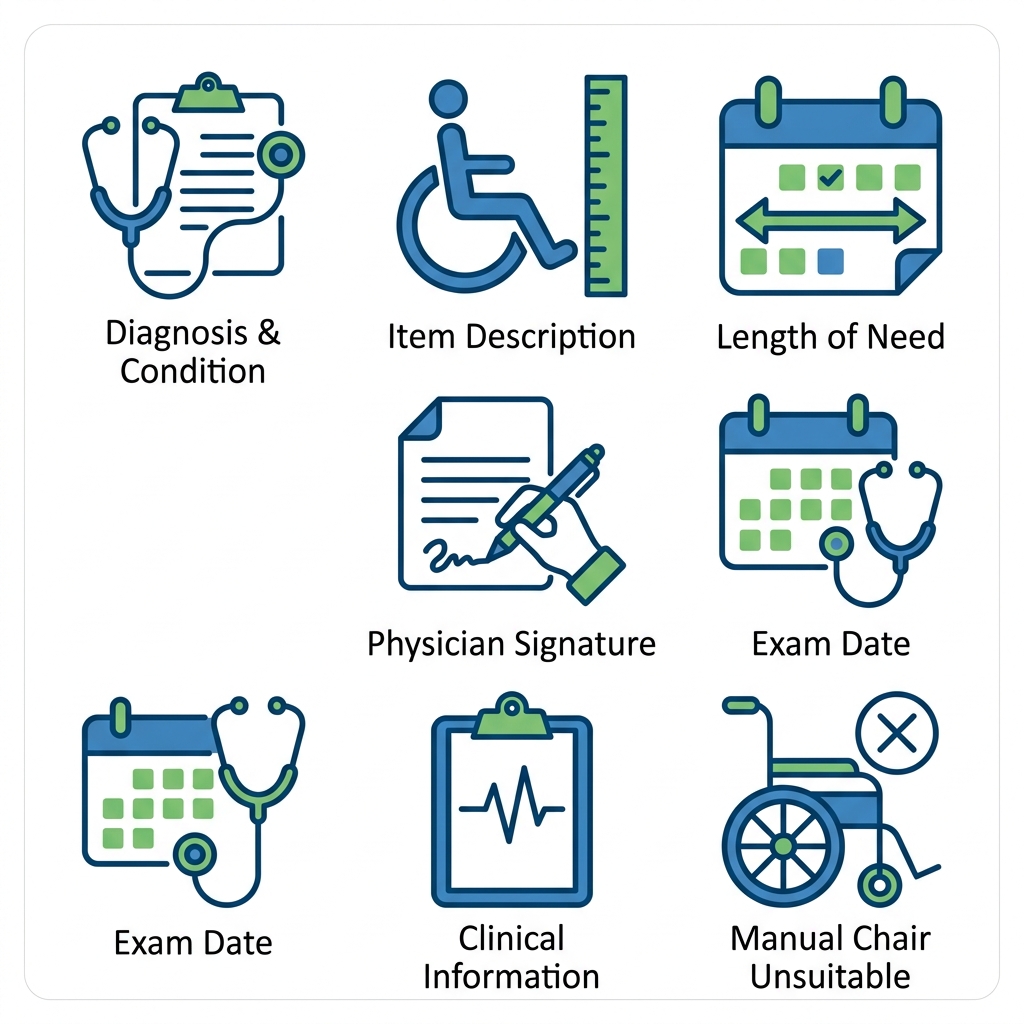
    Seven flat outlined icons representing the mandatory components of a Medicare 7-Element Order for a motorized wheelchair, including diagnosis, item description, length of need, physician signature, exam date, clinical information, and manual chair unsuitability.
    A complete 7-Element Order for Medicare motorized wheelchair coverage

    Our team in Spring Valley, NY can review your order to ensure it meets power wheelchair face-to-face examination requirements and motorized wheelchair medical necessity documentation standards. We help with paperwork, but coverage depends on Medicare’s approval. Verify Medicare/insurance coverage; supplier does not guarantee coverage. Consult your treating healthcare professional for medical necessity.

    Meet the Medicare Home-Use and Daily Activity Requirements

    Understanding the medicare power wheelchair coverage criteria 2026 is key to qualifying. Medicare requires a power wheelchair to be used primarily in the home and to assist with mobility-related daily activities.

    The home-use criterion means the chair must be needed for indoor mobility, not just outdoor use. While you don’t have to be bedridden, a cane, walker, or manual wheelchair must not meet your needs. Daily activities—specifically mobility-related activities of daily living such as toileting, bathing, dressing, and feeding—must justify the chair.

    Documentation is crucial. Per CMS guidelines, a face-to-face examination by your treating physician is required to establish medical necessity, as set forth in the power wheelchair face-to-face examination requirements. We at MedEquipped help gather motorized wheelchair medical necessity documentation and verify benefits to streamline the process.

    Once you understand these requirements, you can move forward with paperwork. Our team is ready to guide you. Results may vary. Verify coverage with Medicare. Consult your healthcare professional for medical necessity.

    Submit Your Coverage Application and Verify Your Benefits

    Once you and your healthcare provider have determined that a motorized wheelchair is medically necessary, the next step is to submit your coverage application and verify your benefits. Aligning with medicare power wheelchair coverage criteria 2026, we assist in preparing and submitting a complete application that includes the required medical records and order forms.

    Medicare requires a power wheelchair face-to-face examination with your treating physician to establish eligibility. You must provide motorized wheelchair medical necessity documentation such as a detailed mobility evaluation, a written prescription, and information about your home environment. Our team helps coordinate this meeting and ensures all paperwork meets CMS standards.

    We verify your Medicare Part B coverage and any supplemental insurance through our Medicare benefits verification and billing service. We’re here to help with assistance with funding sources and paperwork, but coverage is not guaranteed—the supplier does not guarantee Medicare or insurance coverage. Results may vary. Verify your coverage directly with Medicare and consult your treating healthcare professional for medical necessity.

    After your benefits are verified and your application is approved, we will schedule your personalized fitting and delivery. Contact us to get started.

    Finalize Your Custom Power Wheelchair with MedEquipped

    Once you have chosen your custom motorized wheelchair, it is time to finalize your order. At MedEquipped, we coordinate every detail—from personalized fitting to delivery and setup—so you can achieve Greater Independence. Your chair is crafted using Premium products that match your clinical needs and daily life.

    Our team verifies your Medicare benefits and assists with navigating Medicare power wheelchair coverage criteria 2026. We also support you in meeting power wheelchair face-to-face examination requirements and preparing motorized wheelchair medical necessity documentation. With our Quick turnaround, most custom orders are delivered in 30 to 60 days, and our local team in Spring Valley provides professional fitting and setup to ensure everything is just right. Our experienced staff manages all paperwork so you can focus on your mobility.

    Contact us to finalize your custom power wheelchair today. We’re here to help in Spring Valley. Results may vary. Verify Medicare/insurance coverage; supplier does not guarantee coverage. Consult your treating healthcare professional for medical necessity.

    Overcoming Common Medicare Denials and Documentation Gaps

    Understanding the Medicare power wheelchair coverage criteria 2026 is the first step toward a successful claim. Many denials stem from missing paperwork or insufficient medical evidence. By helping you prepare a complete file, we significantly reduce the risk of rejection.

    Medicare requires a face-to-face examination with your treating physician within six months before the wheelchair order. This exam must be documented thoroughly and include a detailed mobility assessment. The power wheelchair face-to-face examination requirements demand that the clinician confirm your inability to perform mobility-related activities of daily living (MRADLs) safely with a cane, walker, or manual wheelchair.

    The motorized wheelchair medical necessity documentation must explain how a power wheelchair will improve your function at home and include evidence that you can operate the device safely in your living environment. Common gaps include missing home-use verification and an incomplete mobility assessment.

    Drawing on our deep understanding of the Medicare mobility assistive equipment algorithm, we guide you through the documentation process by reviewing your clinician’s notes, helping you complete the required CMS forms (such as the Certificate of Medical Necessity), and assembling a comprehensive packet. According to the Centers for Medicare & Medicaid Services (CMS), the documentation must demonstrate that the equipment is medically necessary and intended for use inside the home.

    While we work hard to help you meet Medicare’s requirements, results may vary, and we cannot guarantee coverage. Always verify your Medicare/insurance benefits and consult your treating healthcare professional for a final medical necessity determination. We’re here to help you achieve Greater Independence.

    Take the Next Step Toward Medicare-Covered Mobility

    Now that you understand the Medicare power wheelchair coverage criteria 2026, you’re ready to take actionable steps toward greater independence. Medicare requires a face-to-face examination with your treating physician and a written prescription establishing medical necessity. Understanding the power wheelchair face-to-face examination requirements and preparing the motorized wheelchair medical necessity documentation are crucial first steps. In Spring Valley, MedEquipped is here to guide you through this process, verifying your coverage and helping gather the paperwork needed for your custom motorized wheelchair.

    Contact us today for a free consultation. We’ll handle the administrative details so you can benefit from our quick turnaround—typically 30 to 60 days—and premium products tailored to your needs. Please note: results may vary. Verify your Medicare or insurance coverage; as a supplier, we do not guarantee coverage. Consult your treating healthcare professional for medical necessity determination. Call (845) 237-2381 to schedule your personalized fitting and start your journey toward greater independence with a Medicare-covered power wheelchair.
    Resources

  • Lateral Trunk Supports: Essential Guide for Seating Needs

    Lateral Trunk Supports: Essential Guide for Seating Needs

    Table of Contents

    Understanding Lateral Trunk Supports for Power Wheelchairs

    Building on the power wheelchair options we examined earlier, the right seating and positioning setup can make a significant difference in long-term comfort and health. Lateral trunk supports for power wheelchairs are accessories that help stabilize the torso and prevent leaning to one side. These supports come in fixed or adjustable designs. Options like pivot, swing-away, and depth-adjustable models accommodate a wide range of body shapes. Within a custom power wheelchair seating and positioning system, lateral supports contribute to better postural alignment and can make it easier to stay comfortable throughout the day. They also help maintain a midline trunk position, which can reduce fatigue during long periods of sitting.

    Lateral trunk supports are a key element of complex rehabilitation technology, a category that addresses highly individualized mobility needs. According to standards set by RESNA, assistive technology components like trunk supports are evaluated for durability and safety. When paired with pressure redistribution cushions, trunk supports help distribute weight more evenly, which may reduce the risk of skin breakdown and musculoskeletal strain over time. Over months of daily use, this thoughtful configuration can support healthier sitting postures and contribute to greater independence.

    If you are considering lateral trunk supports for your power wheelchair, our team can help you understand which configuration suits your daily routine. In the next section, we’ll walk through the clinical evaluation and fitting process we use at MedEquipped to match supports to your body and lifestyle. As always, consult a healthcare professional before making clinical decisions.

    The Clinical Role of Lateral Trunk Supports in Power Wheelchair Seating

    Lateral trunk supports are an essential component of custom power wheelchair seating and positioning, specifically designed to maintain midline trunk alignment and counteract lateral lean. Without adequate support, gravity can pull the trunk to one side, leading to spinal curvature, pelvic obliquity, and an increased risk of pressure injuries. By keeping the torso centered over the pelvis, these supports help redistribute pressure more uniformly across the seating surface and work in tandem with pressure redistribution cushions to protect vulnerable areas. At MedEquipped, we integrate lateral supports into comprehensive mobility solutions, always guided by RESNA (Rehabilitation Engineering and Assistive Technology Society of North America) standards for wheelchair seating.

    Lateral trunk supports come in two main mounting configurations: fixed-mount and height-adjustable. A fixed-mount support attaches the pad in a static position, delivering exceptional stability with no moving parts that could loosen over time. A height-adjustable support, in contrast, allows vertical repositioning of the pad without tools, making it easier to accommodate changes in trunk posture as a patient’s condition progresses or improves.

    The following table compares these two mounting options across several clinically relevant features.

    Comparison of Fixed-Mount and Height-Adjustable Lateral Trunk Supports
    FeatureFixed-MountHeight-Adjustable
    AdjustabilityLimited; support pad position is static once installed.Allows vertical repositioning of the support pad without tools.
    StabilityVery stable; no moving parts that could loosen over time.Stable when locked; possible minor movement with repeated adjustments.
    Clinical UseBest for patients with stable trunk posture and predictable positioning needs.Ideal for patients whose trunk posture changes over time or requires fine-tuning.
    Ease of AdjustmentRequires tools and reinstallation to change position.Tool-free or minimal tool adjustment allows quick changes.
    Swing-Away CapabilityNot available; must be unbolted for transfers.Often available as swing-away model to facilitate safe transfers.

    For a patient with a stable trunk posture who does not anticipate changes, a fixed-mount support provides dependable, consistent alignment. For individuals whose positioning needs may evolve—due to progressive neurological conditions, recovery after injury, or postural improvements—height-adjustable supports offer the flexibility to fine-tune fit without the need for reinstallation. This adaptability can reduce the time a clinician spends making adjustments and help maintain optimal pressure distribution over time.

    Choosing the right type of lateral support requires a thorough clinical evaluation by a qualified professional, such as a certified Assistive Technology Professional (ATP). We at MedEquipped collaborate with you and your ATP to determine which configuration matches your stability needs, activity level, and overall seating goals. Insurance guidelines, including those from the Centers for Medicare & Medicaid Services (CMS), reinforce the requirement for clinical justification, helping ensure that your equipment truly supports your health and independence. Always consult your clinician or ATP for a personalized assessment of your positioning needs.

    When you partner with MedEquipped, you gain a dedicated team committed to optimizing every element of your seating system, from the initial evaluation through delivery and follow-up. We handle the paperwork, insurance navigation, and coordination so you can focus on living your life. As your partner in mobility freedom, we ensure every component—from lateral supports to drive controls—supports your best possible function. Up next, we’ll explore how pressure redistribution cushions and custom contouring further enhance comfort and postural stability.

    How Lateral Trunk Supports Improve Postural Alignment and Manage Trunk Lean

    Now that we’ve explored the basics of wheelchair seating, let’s examine how lateral trunk supports improve postural alignment and manage trunk lean. As a provider of mobility solutions based in Spring Valley, NY and serving New York, Georgia, and Michigan, at MedEquipped we understand that these supports are essential to a custom seating system, and they can dramatically enhance comfort and function.

    Mechanisms of Postural Alignment

    Lateral trunk supports apply gentle, consistent pressure to the sides of the torso, which stabilizes the pelvis and ribcage and guides the spine toward a neutral position. This reduces the need for compensatory muscle activity that often leads to fatigue and discomfort. According to RESNA, custom fitting is crucial because a poorly positioned support can cause pressure points or unnatural postures. When properly fitted by a certified Assistive Technology Professional (ATP), lateral supports minimize asymmetric spinal loading, which can improve upper extremity function, make breathing easier, and enhance pressure distribution across the seat. By holding the torso upright, these lateral supports also reduce the muscular work required to correct a lean, allowing the user to focus on activities rather than postural maintenance. An erect posture can improve the field of vision and social interaction. This biomechanical advantage is why RESNA and clinical specialists recommend an individualized assessment to determine the optimal height, angle, and contour. Even modest improvements in alignment can lead to significant gains in comfort and function.

    Managing Trunk Lean in Neuromuscular Conditions

    For individuals with neuromuscular conditions such as muscular dystrophy or cerebral palsy, trunk lean often emerges due to asymmetric muscle weakness, spasticity, or impaired postural reflexes. Without adequate support, the upper body may progressively collapse toward one side, causing discomfort, respiratory challenges, and difficulty with seated activities. Trunk lean can also set the stage for secondary complications, including pressure injuries and spinal deformities.

    Lateral trunk supports actively counteract these tendencies by providing a structural anchor that maintains the torso in a functional, midline orientation. This not only preserves comfort but can also protect the spine from excessive curvature over time. Clinical assessment is vital to determine the correct height, angle, and contour of the support to accommodate fluctuating muscle tone and growth in younger users. We often combine lateral trunk supports with a custom power wheelchair seating and positioning system that includes pressure redistribution cushions to manage weight distribution and skin integrity. RESNA and United Spinal Association resources highlight the need for individualized fitting, reminding us that a support that works well for one person may be inadequate for another. Even slight lateral correction can significantly improve seated endurance and user confidence, minimizing the energy spent on postural maintenance and maximizing participation in daily life.

    Choosing the Right Support Design

    When choosing lateral trunk supports, three primary designs are available: swing-away, fixed contour, and wrap-around panels. The table below compares their key attributes.

    Comparison of Lateral Trunk Support Designs
    Design FeatureSwing-AwayFixed ContourWrap-Around Panel
    Transfer AccessEasily swings open for lateral transfers without removing the support.Must be unbolted or patient must transfer over the support.Provides full lateral containment but limits transfer access.
    StabilityGood stability when locked; slight play may develop over time.Excellent stability; no moving parts.High stability due to broad contact area.
    AdjustabilityOften height-adjustable and angle-adjustable.Limited adjustability; shaped to specific posture.Moderate adjustability; usually requires tool adjustment.
    Best ForPatients who perform independent transfers and need frequent repositioning.Patients with stable seated posture where minimal adjustment is needed.Patients with significant trunk lean requiring continuous lateral support.

    The right design hinges on transfer ability, postural stability, and adjustability needs; a clinical evaluation ensures the optimal match.

    Please note: Results may vary; individual outcomes are not guaranteed. Consult a healthcare professional before making clinical decisions. This information is not medical advice and is for informational purposes only.

    Selecting the right lateral trunk support is one aspect of a complete custom seating system; next, we’ll explore pressure redistribution cushions and how they complement lateral positioning.

    Adjustment Protocols and Clinical Documentation for Lateral Trunk Supports

    Adjustment During Seating Evaluations

    Proper adjustment and thorough documentation form the cornerstone of successful lateral trunk support use. Beginning with the initial assessment, our certified Assistive Technology Professionals carefully position the lateral trunk supports to match the user’s anatomy and seating goals. We measure the torso width, palpate the iliac crests and rib cage, and attach the supports to the backrest at the correct height and depth. Our team fine-tunes the lateral width and angle to offer gentle containment without restricting breathing or arm movement. During follow-up appointments, we reassess support positioning as the user’s needs evolve—adjusting for weight fluctuation, muscle tone changes, or new activity demands. Our ATPs follow assistive technology certification and standards set by RESNA to guide every fitting. In custom power wheelchair seating and positioning evaluations, we also confirm that lateral supports integrate seamlessly with the cushion and backrest to maintain overall postural alignment. We document every adjustment in the clinical record, creating a timeline that supports future insurance claims and Medicare justification. We also perform hand checks under the supports to ensure that no excessive pressure builds, preventing skin breakdown. All these steps align with RESNA’s seating standards, reinforcing clinical best practice. Ultimately, meticulous adjustment leads to greater comfort and improved functional outcomes, laying the foundation for a successful power wheelchair experience.

    Medicare Documentation Requirements

    Medicare requires comprehensive clinical documentation to justify lateral trunk supports as a medically necessary component of a power wheelchair. According to guidelines from the Centers for Medicare & Medicaid Services (CMS), providers must submit detailed clinical notes describing the patient’s functional limitations, postural asymmetries, and why less restrictive alternatives are insufficient. Dated, high-resolution photographs are essential to visually demonstrate the postural correction achieved with the supports in place. A written prescription or letter of medical necessity must explicitly link the lateral trunk supports to improved sitting tolerance, respiratory function, or pressure redistribution. Our team at MedEquipped gathers these materials during the evaluation and coordinates the submission to streamline prior authorization. We partner with your physician and therapist to compile a compelling case that meets all local coverage determinations, reducing unnecessary stress. We ensure that the clinical rationale is clearly articulated, aligning with Medicare’s local coverage determinations to support a timely approval. By handling the paperwork, insurance navigation, and coordination, we help you avoid common delays. Our experience with CMS guidelines helps ensure all required elements are included, streamlining approval times. We also educate you on what to expect during the review process so there are no surprises. Please note that individual outcomes may vary, and this information does not constitute medical advice.

    Transfer Safety and Swing-Away Models

    Swing-away lateral trunk supports dramatically improve transfer safety by providing a wide, unobstructed path. When the user or caregiver needs to transfer, the supports can be unlatched and pivoted completely out of the way, eliminating the risk of snagging clothing or limbs.

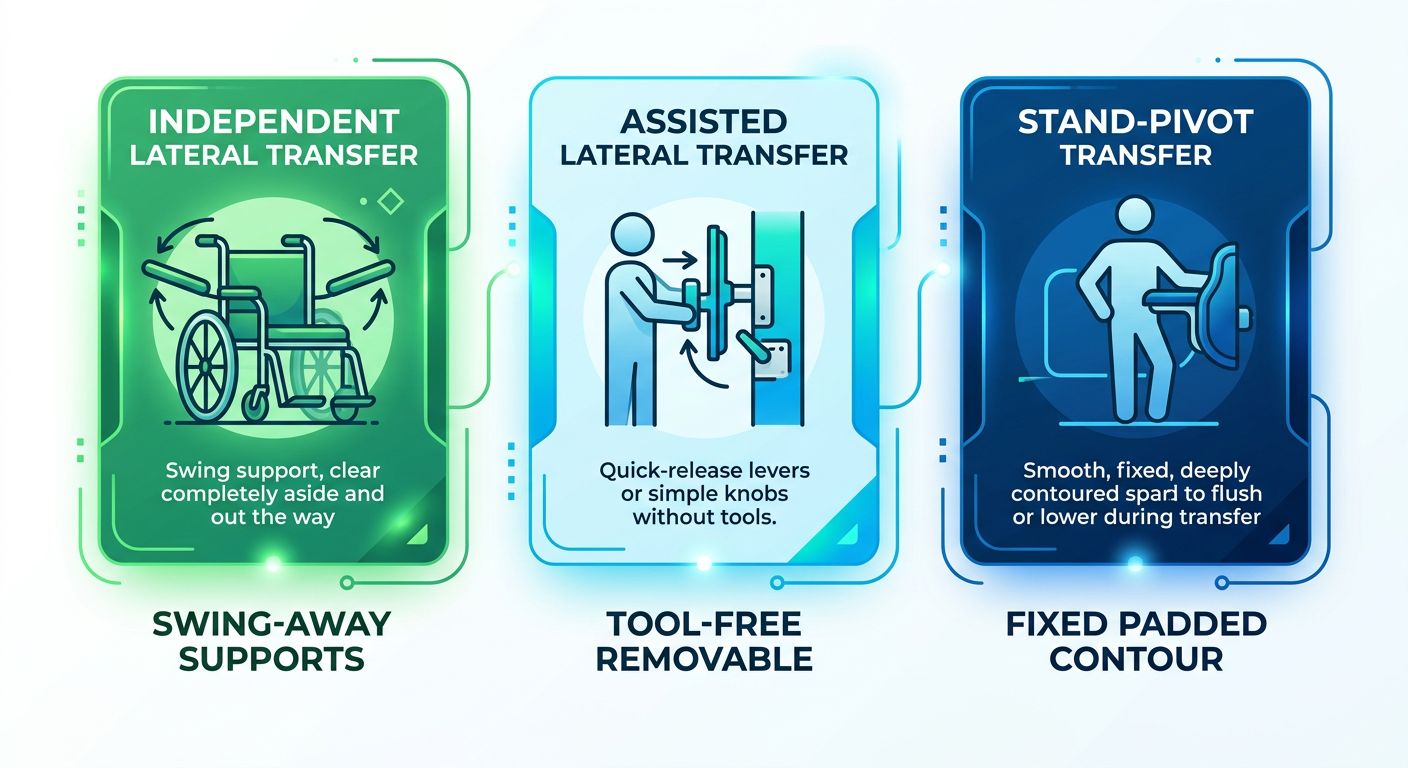
    • Independent Lateral Transfer: Patient transfers from wheelchair to bed/chair without assistance, using a sliding board or stand-pivot. Ideal Feature: Swing-away lateral supports that open wide without obstruction; height-adjustable to clear transfer path.
    • Assisted Lateral Transfer: Caregiver assists patient with a lift or manual transfer. Ideal Feature: Swing-away or tool-free removable supports to provide unobstructed access for caregiver.
    • Stand-Pivot Transfer: Patient stands and pivots to target surface with or without assistance. Ideal Feature: Fixed or swing-away supports with padded contour to provide stability during standing.

    The comparison highlights that no single lateral support design fits every transfer scenario. For independent transfers, swing-away mechanisms with smooth, wide pivots offer the greatest independence. Assisted transfers benefit from quick-release mechanisms that reduce caregiver strain. Stand-pivot transfers often require fixed supports that provide a stable surface to push against; however, padded contours add comfort without sacrificing stability.

    Our ATPs evaluate each person’s transfer patterns during the seating assessment and recommend the most suitable lateral support configuration. We also teach proper transfer techniques to maximize safety for both the user and any caregiver.

    Three-column infographic comparing independent, assisted, and stand-pivot lateral transfer types with icons and corresponding ideal lateral trunk support features, using a blue and green palette on white.

    Comparison of lateral transfer protocols and recommended lateral trunk support features for power wheelchair users.

    Advanced Considerations: Neuromuscular Scoliosis and Custom Seating Integration

    When neuromuscular scoliosis compromises postural stability, lateral trunk supports become a critical component of custom seating. The condition arises from uneven spinal curves driven by nerve or muscle disorders, leading to pelvic obliquity, trunk asymmetry and pressure-related discomfort. Pairing lateral supports with pressure redistribution cushions counteracts these effects.

    By bracing the torso, these supports guide your spine toward midline and prevent the leaning that aggravates asymmetrical forces. This realignment reduces pelvic obliquity and helps you sit with greater comfort and endurance.

    Pressure redistribution cushions protect skin and deeper tissues by mapping to your unique curvature, spreading weight evenly to lower the risk of pressure injuries. Together with lateral supports, they lock the pelvis in a neutral position, enhancing both stability and long-term skin health.

    A successful fit demands a thorough evaluation by a certified Assistive Technology Professional (ATP). The ATP-led process includes biomechanical assessment, trial fittings and iterative adjustments until you achieve a functional, pressure-relieving posture. RESNA’s international standards for seating and mobility provide the authoritative framework, ensuring that every element of custom power wheelchair seating and positioning meets safety and performance criteria.

    We at MedEquipped orchestrate this entire journey for you. Our ATP evaluators perform hands-on fittings in New York, Georgia and Michigan, fine-tuning lateral trunk supports, cushion selection and overall geometry. Because we manage documentation and insurance coordination, you stay free of administrative strain while directing every clinical decision.

    You can also access wheelchair user advocacy and support through organizations like the United Spinal Association, which offers peer mentoring, educational tools and policy updates that complement your clinical seating plan.

    This information is not medical advice and is for informational purposes only; consult a healthcare professional before making clinical decisions. A professionally guided seating assessment remains the surest path to a custom system that works with your body, not against it.

    Frequently Asked Questions About Lateral Trunk Supports

    Here are answers to common questions about lateral trunk supports.

    What are lateral trunk supports?
    Our specialists explain that lateral trunk supports are attachments on a power wheelchair backrest that provide side-to-side torso stability, helping users maintain an upright posture.

    Who needs lateral trunk supports?
    Individuals with poor trunk control from conditions such as MS, spinal cord injury, cerebral palsy, or stroke benefit from these supports after clinical evaluation.

    How do lateral trunk supports improve posture and safety?
    By stabilizing the torso, lateral supports enhance posture, reduce fatigue, and improve safety. Adding pressure redistribution cushions increases comfort.

    Does Medicare cover lateral trunk supports?
    Per CMS guidelines, Medicare Part B may cover lateral trunk supports as DME when medically necessary, with prior authorization and a physician’s prescription required.

    For readers outside the U.S., mobility equipment for children and adults in the UK is available through specialized providers.

    How can I get custom lateral trunk supports for my wheelchair?
    Contact us for a custom evaluation; our ATPs integrate lateral supports into your custom power wheelchair seating and positioning. We’re your partner in mobility freedom.

    Consult a healthcare professional before making clinical decisions.

    Partnering for Better Seating Outcomes with MedEquipped

    When you partner with MedEquipped, our certified ATP evaluators assess your needs, including lateral trunk supports, as part of custom power wheelchair seating and positioning. We handle the paperwork, insurance navigation, and coordination so you can focus on your mobility. Custom motorized wheelchairs are ordered and delivered with customized features, such as lateral trunk supports, based on your specific requirements, typically within 30–60 days. Serving patients in New York, Georgia, and Michigan, we provide ongoing post-delivery support and remain your partner in mobility freedom. Explore the specific custom wheelchair options available to fit your lifestyle.

    Resources
