MedEquipped

Tag: disability equipment

  • Get Power Wheelchair Joystick Alternatives: Upgrade Your Mobility

    Table of Contents

    Exploring Joystick Alternatives for Power Wheelchairs

    While a standard joystick works well for many, some users benefit from power wheelchair joystick alternatives that match their specific abilities and physical limitations. We assess each person’s abilities to recommend the best method available. We see a head array power wheelchair system as a practical solution for those with limited hand function—the user steers by gently pressing against a padded headrest, turning subtle head movements into confident direction changes. Another option is sip and puff wheelchair control, where the driver uses soft puffs and sips into a tube to command forward, reverse, and turning motions, making it ideal for users with no limb mobility.

    MedEquipped provides custom wheelchair controls for head arrays, sip-and-puff, and other non-joystick inputs, following RESNA guidelines. As your partner in mobility freedom, we handle the clinical evaluation, insurance navigation, and final fitting so you receive a setup that truly fits. Our team works closely with each client to explore every suitable alternative driving input before finalizing a configuration.

    Individual outcomes may vary, and this information is not medical advice. Always consult a healthcare professional before making clinical decisions.

    Head Array Power Wheelchair Control

    For users who cannot operate a standard joystick, head array technology offers a compelling solution as a power wheelchair joystick alternative. This hands-free system translates subtle head movements into precise steering and speed commands, eliminating the need for hand function entirely and opening a world of independent mobility.

    Overview

    A head array system uses directional head movements tilt forward, back, and side-to-side or rotationto control a power wheelchair’s direction and speed. Sensors built into the headrest continuously detect these motions and relay them to the chair’s drive electronics, providing a touchless driving experience for individuals with minimal upper-body control.

    Features

    The head array power wheelchair system incorporates multiple sensors for reliable, continuous tracking, ensuring responsive performance during everyday use. Compatible with major power wheelchair bases such as Permobil and Quickie, these arrays adjust sensitivity settings to reduce accidental input while maintaining full hands-free operation. As part of our custom motorized wheelchairs, we configure every array to match your clinical profile and driving style.

    Pricing

    Because every configuration is unique, we provide a custom quote tailored to your needs. Head array systems are often covered by wheelchair insurance when supported by proper clinical documentation, and we handle the paperwork, insurance navigation, and coordination so you can focus on reclaiming your independence.

    Pros and Cons

    The main advantage of head array control is that it requires no hand function while delivering precise directional control. However, users should expect an initial learning curve while they adjust to steering with their head, and some may experience head fatigue during extended use. Compared to a sip and puff wheelchair control, head arrays often feel more intuitive for driving but demand greater neck endurance.

    Best For

    Ideal candidates include individuals with minimal hand function, those living with C1–C4 spinal cord injuries, ALS (amyotrophic lateral sclerosis), or severe arthritis affecting the hands. A clinical evaluation by our certified ATP team determines the most appropriate control method for each person’s physical abilities and lifestyle needs.

    Results may vary; individual outcomes are not guaranteed. Consult a healthcare professional before making clinical decisions. This information is for educational purposes only and does not constitute medical advice.

    Sip-and-Puff Wheelchair Control

    One of the most reliable power wheelchair joystick alternatives is sip-and-puff wheelchair control. This pneumatic technology translates a user’s breath into precise driving and functional commands, removing the need for any hand or arm movement entirely. As a partner in mobility freedom, we see this option transform daily independence for individuals who have been told traditional controls aren’t possible.

    Overview

    Sip and puff wheelchair control uses a tube positioned near the mouth to detect inhalation (sip) and exhalation (puff) signals. Light pressure from your breath tells the wheelchair to move forward, reverse, turn, or stop. Auxiliary functions — like sounding a horn or adjusting seating — can be programmed as well. No hand or arm movement is required, which opens new pathways for people living with high-level spinal cord injuries, tetraplegia, or neuromuscular conditions.

    Features

    When our team fits a sip-and-puff system, we program it to match each individual’s breathing pattern and lifestyle needs. Key performance characteristics include:

    • Proportional breath control – The intensity of each sip or puff determines speed and turning radius, so you get smooth, intuitive driving that feels responsive rather than jerky.
    • All-weather reliability – Because the system uses pneumatic switches rather than exposed electronics, it performs consistently in rain, snow, and humidity without false triggers.
    • Multiple programmable commands – Beyond forward, reverse, left, and right, the setup can incorporate five or more distinct commands. Horn activation, seat elevation, power leg rests, and environmental controls can be added based on your evaluation.
    • Zero upper-extremity requirement – The system works entirely from oral input, making it one of the most accessible wheelchair driving methods for someone with no functional arm or hand movement.

    Pricing

    While stair lift cost varies based on installation and home layout, sip-and-puff wheelchair control is typically covered by insurance. Medicare, Medicaid, and private insurance plans will usually fund a breath-controlled power wheelchair when a letter of medical necessity accompanies the order. We handle the paperwork, insurance navigation, and coordination from start to finish. Our 30-60 days (faster processing) timeline means you receive a fully fitted custom motorized wheelchair sooner than through most national suppliers.

    Pros and Cons

    No single control method fits every situation, so we walk you through the trade-offs honestly:

    Pros:

    • Intuitive learning curve – Many users report that sip-and-puff signals feel natural within a few training sessions because breath control is an innate motor pattern.
    • Low mechanical maintenance – Without joystick gimbals or delicate touchpads, there are fewer components to wear out.
    • Lightweight interface – The sip-and-puff tube and switch box add minimal weight compared to head arrays or chin controls.

    Cons:

    • Consistent breathing capacity required – Individuals with compromised respiratory function may find sustained sip-and-puff driving fatiguing.
    • Respiratory illness considerations – A respiratory infection or seasonal allergy flare-up can temporarily alter your breathing precision.
    • Attention to oral hygiene – Because the tube resides near the mouth, saliva management and regular cleaning are part of the daily routine.

    Best For

    Sip-and-puff wheelchair control often becomes the primary driving method for individuals who lack functional hand or arm movement. Common diagnoses we see: Tetraplegia (C1–C4), High-level spinal cord injury, Muscular dystrophy, ALS, Arthrogryposis, and Severe cerebral palsy.

    Results may vary; individual outcomes are not guaranteed. Consult a healthcare professional before making clinical decisions. Information is not medical advice and is for informational purposes only.

    Touchless Infrared and Proximity Controls

    If traditional joystick controls present challenges, touchless infrared or proximity switches offer another hands-free option. These systems detect hand or finger proximity without physical contact, serving as effective power wheelchair joystick alternatives for individuals with limited dexterity or strength.

    Overview

    Infrared and proximity controls use sensors to detect a hand or finger nearby, triggering movement without requiring physical force. They are discreet and support users who find manual joysticks difficult to manage.

    Features

    These controls eliminate the need to grip or push a joystick. Key features include an adjustable detection range, mounting on a headrest or armrest, and minimal ongoing maintenance. Settings can be fine-tuned during a clinical evaluation.

    Pricing

    Covered under most insurance plans when prescribed by a specialist; MedEquipped provides free estimates. We handle the paperwork, insurance navigation, and coordination so families can focus on mobility.

    Pros and Cons

    On the plus side, touchless controls require very little movement and maintain a discreet appearance. On the downside, consistent positioning of the hand or finger within the sensor range is essential for dependable operation.

    Best For

    These controls are especially helpful for users with very limited movement, severe tremors, or conditions such as cerebral palsy or ALS. For real-world experiences, see our power wheelchair reviews.

    Comparing Power Wheelchair Joystick Alternatives

    To help you decide, here is how the top power wheelchair joystick alternatives stack up against each other for different mobility needs.

    At-a-Glance Comparison Table

    Joystick Alternative Comparison
    AlternativeControl MethodBest ForLearning CurveTypical Cost
    Head ArrayHead movementsLimited hand functionModerateCustom quote (insurance covers)
    Sip-and-PuffBreath inputsTetraplegia/ALSLowCustom quote (insurance covers)
    Touchless/ProximityHand proximitySevere tremorsLow-ModerateCustom quote (insurance covers)

    According to RESNA clinical standards, these alternative controls are proven solutions for complex mobility cases. All three options are available on QUICKIE, ROVI X3, and TDX SP2 HD power bases.

    Results may vary; individual outcomes are not guaranteed. Consult a healthcare professional before making clinical decisions.

    Find Your Perfect Control Solution with MedEquipped

    For individuals seeking power wheelchair joystick alternatives, MedEquipped takes a collaborative and clinical approach. We go beyond standard input methods, offering a range of alternative joystick options for power wheelchairs, such as a supportive head array power wheelchair configuration or an intuitive sip and puff wheelchair control system.

    Our comprehensive process starts with a thorough evaluation. As certified ATP evaluators, we assess your physical abilities, daily challenges, and personal goals to identify the most effective, non-joystick wheelchair controls for you. This may include matching you with a system like the modular ROVI X3, which is designed for complete personalization. Unlike generic suppliers, we are your partner in mobility freedom. We handle the paperwork, insurance navigation, and coordination, aiming to complete most custom orders within 30–60 days (faster processing). Our thorough evaluation ensures that you receive custom wheelchair controls tailored to your specific needs.

    If you’re ready to explore advanced driving options, contact us today to schedule your evaluation and find your perfect control solution. Results may vary; individual outcomes are not guaranteed.

    Resources

  • Motability Phone Number: Official Customer Service Contact

    Motability Phone Number: Official Customer Service Contact

    Table of Contents

    Navigating mobility solutions can feel overwhelming, especially when seeking reliable power wheelchair patient intake processes for conditions that limit independence. For those exploring international options, the Motability phone number—0300 456 4566—serves as a key starting point for UK residents inquiring about their disability aid contact details. We at MedEquipped understand these challenges and position ourselves as your partner in mobility freedom, offering custom motorized wheelchairs tailored to your needs right here in the US.

    While the Motability customer service and Motability scheme contact provide valuable support for UK-based schemes, our services in New York, Georgia, and Michigan focus on seamless, localized assistance without cross-border hurdles. As certified ATP professionals, we conduct clinical evaluations, handle insurance navigation, and coordinate funding to deliver industry-leading options like the QUICKIE series and ROVI X3 within 30-60 days—far faster than typical wait times. Reach us directly at 845-237-2381 or via email at intake@medequipped.com; our team responds promptly to start your journey.

    This guide begins with the fundamentals of mobility aids, progressing to advanced funding strategies and personalized fittings, all while emphasizing our end-to-end support. We handle the paperwork, insurance navigation, and coordination so you can focus on reclaiming your independence. Contact us today for a consultation—let’s discuss how we can make mobility accessible for you.

    Understanding Mobility Schemes and Contacts

    Mobility schemes play a vital role in helping individuals with disabilities access vehicles and equipment that enhance independence. In the UK, the Motability scheme stands out as a popular leasing program designed for people receiving certain disability benefits. It allows eligible individuals to exchange their mobility allowance for a new car, scooter, or powered wheelchair, complete with insurance and maintenance included. For quick assistance, the Motability phone number is 0300 456 4566, where you can inquire about applications or existing agreements. This scheme has supported over a million customers since 1977, focusing on hassle-free mobility solutions. While primarily vehicle-oriented, it extends to powered wheelchairs in some cases, making it a cornerstone for UK residents seeking aid program outreach.

    Eligibility for the Motability scheme typically requires receiving the higher rate mobility component of Disability Living Allowance (DLA) for children aged three and over, or the enhanced rate of the Personal Independence Payment (PIP) mobility component, as outlined by the UK government. According to official guidelines, families must confirm entitlement through benefits assessments to qualify for leasing options. The Motability scheme contact process involves verifying these details via phone or online forms to ensure smooth enrollment. This benefit-focused approach contrasts with broader funding streams but ensures targeted support for those in need. We at MedEquipped appreciate how such programs inspire similar initiatives in the US, where eligibility often ties to Medicare, Medicaid, or private insurance for durable medical equipment like power wheelchairs.

    Both the Motability scheme and our services at MedEquipped share the goal of restoring mobility freedom through accessible support systems, adapting to individual needs while navigating financial hurdles.

    Feature Motability (UK) MedEquipped (US)
    Primary Model Universal Leasing Custom Ownership/Insurance-Led
    Main Contact 0300 456 4566 845-237-2381

    This comparison highlights key operational differences, with MedEquipped offering direct delivery of custom motorized wheelchairs tailored to clinical requirements. In the US, our certified Assistive Technology Professionals (ATP) conduct evaluations to match options like the TDX SP2 HD base, ensuring compatibility with users’ lifestyles in regions such as services in Georgia or wheelchairs in New York.

    For Motability customer service, callers to 0300 456 4566 can reach trained advisors Monday through Friday, 8 am to 8 pm, and weekends from 9 am to 5 pm. Calls are recorded for quality, and 0300 numbers cost the same as local landline rates. Additional channels include the website’s contact forms for complaints, funding reviews, or general queries to the Motability Foundation. Email options support scam alerts and grant applications, providing a comprehensive disability mobility helpline. We recommend gathering benefit details before contacting to expedite responses.

    • Phone Support: 0300 456 4566 for scheme inquiries
    • Online Forms: For joining, agreements, or complaints
    • Email: Specific addresses for foundation grants and media

    In the US, we handle the paperwork, insurance navigation, and coordination to simplify access. Our end-to-end process—from initial evaluations to home delivery in Michigan—sets us apart, often achieving faster processing in 30-60 days compared to traditional timelines. As your partner in mobility freedom, we guide patients through funding approvals, customizing solutions to promote independence without the wait. Consult a healthcare professional for personalized advice, as individual outcomes may vary.

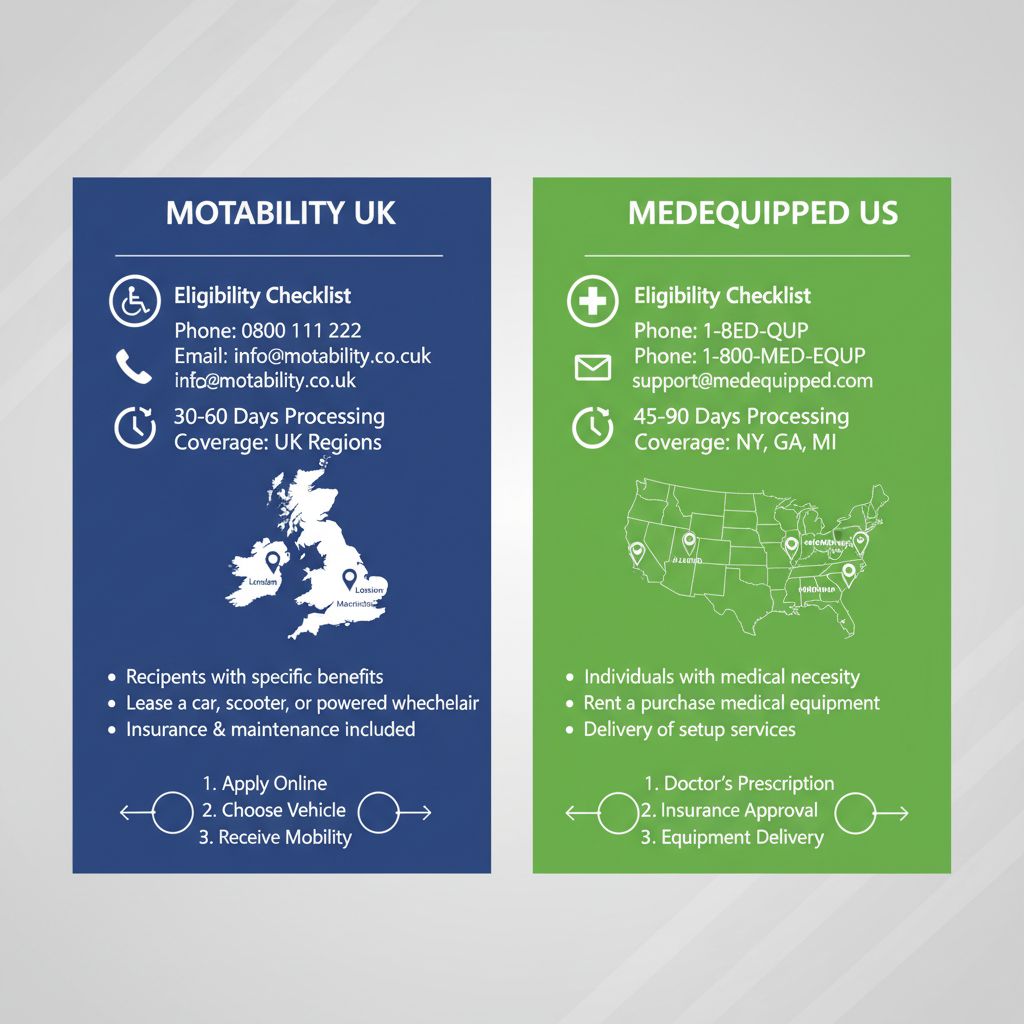
    Infographic comparing Motability UK and MedEquipped US mobility support schemes with icons for eligibility, contacts, timelines, and coverage areas.


    Comparison of US and UK mobility aid support options

    This visual underscores how regional providers like us offer tailored alternatives, bridging gaps in insurance-heavy systems for quicker, more personalized results.

    Exploring Motability and US Alternatives in Depth

    The Motability scheme in the UK offers a structured way for individuals receiving certain disability benefits to access vehicles and adaptations, including power wheelchairs, through leasing. In the US, options like those from MedEquipped provide tailored mobility solutions that integrate clinical expertise with funding navigation. This section explores these approaches in detail, highlighting how we at MedEquipped serve as a partner in mobility freedom across New York, Georgia, and Michigan.

    Key Features of Motability Schemes

    Motability operates on a leasing model where eligible participants exchange their mobility allowance for a worry-free vehicle or powered wheelchair, typically over a three-to-five-year term. This includes insurance, maintenance, and breakdown cover, making it accessible for those with disabilities. Vehicle adaptations, such as hand controls or wheelchair ramps, are arranged through approved suppliers, often starting with phone-based inquiries to discuss needs.

    For instance, contacting the Motability phone number allows users to explore adaptation options tailored to their daily activities, like mounting a power wheelchair securely. Motability customer service plays a key role here, guiding applicants through eligibility checks and supplier recommendations. The scheme’s support services extend to lease extensions and warranty claims, ensuring long-term reliability. In contrast, US power wheelchair funding often relies on Medicare Part B, which covers 80% of approved durable medical equipment after the deductible, but requires detailed medical justification.

    While Motability streamlines leasing via government benefits, US pathways involve more personalized insurance coordination. Core differences lie in delivery models and customization depth. The following table outlines key comparisons:

    Comparison Metric Motability Model MedEquipped Model
    Ownership Status Leased Equipment Patient-Owned Device
    Customization Depth Standard Adaptations High-Complexity Clinical Fit

    Motability excels in broad accessibility through its national network, but MedEquipped’s approach shines in personalized, ATP-certified adaptations that address individual lifestyles more directly. This US-focused model reduces wait times and enhances fit, particularly for complex needs in regions like Georgia.

    MedEquipped’s Customized Approach

    At MedEquipped, we prioritize a patient-centered process for custom motorized wheelchairs, beginning with in-depth clinical evaluations led by certified Assistive Technology Professionals (ATPs). Drawing from RESNA standards, our ATPs conduct assessments to match seating, controls, and mobility bases to your specific condition and terrain requirements, ensuring safety and independence. For example, a patient in New York recovering from a spinal injury might receive a QUICKIE model configured with tilt-and-recline features for pressure relief, selected from trusted brands like our MedEquipped Products lineup.

    We handle the paperwork, insurance navigation, and coordination seamlessly, accelerating approvals under Medicare Part B or private plans. This includes gathering prescriptions, documentation, and supplier accreditation proofs, often shortening the typical wait to our 30-60 days faster processing timeline. Once approved, we oversee custom ordering—such as integrating heavy-duty bases like the TDX SP2 HD for users in Michigan’s varied landscapes—and arrange direct delivery with setup training.

    Post-delivery, our dedicated technicians provide ongoing support, including adjustments, repairs, and education on maintenance. Consider a scenario in Georgia where a veteran with neurological challenges benefits from our follow-up visits; we educate on daily use while monitoring for warranty-covered tweaks, fostering confidence in their custom power wheelchairs.

    Comparing processes further illustrates our edge over schemes like Motability. While UK adaptations rely on general supplier consultations, our model integrates direct clinical input for superior outcomes.

    Service Phase Motability Timeline MedEquipped Timeline
    Inquiry to Evaluation 2-4 Weeks 1-2 Weeks
    Insurance/Funding Approval Varies (Benefit Review) Accelerated Oversight

    This structured yet flexible system, informed by RESNA’s emphasis on certified expertise, allows us to deliver custom power wheelchairs that truly empower. By focusing on regional needs in New York, Georgia, and Michigan, we bridge gaps in traditional funding, offering comprehensive support from intake to long-term care. Our approach not only meets medical necessity but also aligns with your lifestyle, as seen in cases where patients regain community access sooner.

    Results may vary; individual outcomes are not guaranteed. Consult a healthcare professional before making clinical decisions.

    Applying for Mobility Aids: Practical Steps

    Obtaining a power wheelchair can transform daily life for those with mobility challenges, and we’re here as your partner in mobility freedom to guide you through the process. At MedEquipped, we specialize in custom motorized wheelchairs tailored to your needs across New York, Georgia, and Michigan. Whether you’re navigating busy streets in New York or handling varied terrain in Georgia, our team ensures a smooth path from initial inquiry to delivery. Let’s break it down into practical steps, contrasting our streamlined US approach with the UK’s Motability scheme for clarity.

    Initiating Contact and Evaluations

    We’ll guide you through the first crucial steps: making contact and undergoing evaluations. Start by reaching out to us at MedEquipped—we’re just a phone call away at our support intake line, 845-237-2381, or via email at intake@medequipped.com. This initial conversation allows our certified Assistive Technology Professionals (ATPs), aligned with best practices from organizations like ATIA.org, to understand your mobility requirements and lifestyle.

    1. Schedule Your Intake: Call our aid application hotline during business hours (Monday-Friday, 9:00 am to 5:00 pm ET) to discuss your needs. Mention any prescriptions or referrals from your doctor to kickstart the process. For those in Michigan, we can accommodate virtual options if travel is an issue.
    2. Undergo Initial Assessment: Once contacted, we’ll arrange an in-person or telehealth evaluation. Our ATPs conduct thorough assessments, measuring your seating needs and testing controls to match models like the QUICKIE series or ROVI X3.
    3. Personalize Your Selection: Based on the evaluation, we’ll recommend configurations suited to your daily activities, such as enhanced stability for Michigan’s winters or compact designs for New York’s urban navigation.

    These steps typically span 1-2 weeks, much faster than traditional timelines. For comparison, here’s an overview of key differences in initial processes:

    Process Step Motability Method MedEquipped Method
    First Contact Government Benefit Verification Direct Clinical Intake
    Expert Type Leasing Advisor Certified ATP Professional

    This table highlights how our direct US process cuts down wait times compared to Motability’s structured eligibility review. Patients in our testimonials from MedEquipped Testimonies often share how this hands-on start led to quicker independence—one individual in Georgia noted their evaluation pinpointed exact control adjustments, avoiding common fitting issues. The benefit of our approach lies in its personalization and speed, empowering you sooner without the layers of preliminary checks seen in the UK system. Regional tip: In high-traffic areas like New York, request an evaluation that factors in maneuverability for city living. Remember, results may vary, and consulting your healthcare professional is key before decisions.

    With evaluations complete, the next phase involves securing funding and finalizing your custom motorized wheelchair. We handle the paperwork, insurance navigation, and coordination to make this as stress-free as possible, typically within our 30-60 days faster processing window.

    1. Submit Insurance Details: Provide your policy information during intake; we’ll verify coverage with providers like Medicare or private insurers common in New York, Georgia, and Michigan. Our team liaises directly, similar to how Motability customer service assists with benefit linkages but with more localized expertise.
    2. Coordinate Approvals: Expect documentation review and any required appeals. Drawing from ATIA.org standards, we ensure all submissions meet assistive technology guidelines. For instance, one testimony recounts how our staff expedited a Georgia patient’s Medicaid approval by bundling clinical notes efficiently.
    3. Order and Customize: Once approved, we place your order for fitted components, like heavy-duty bases for robust use. This step incorporates your evaluation insights for optimal comfort.
    4. Delivery and Setup: A certified technician delivers to your home in areas like Spring Valley, New York, or further afield in Michigan, providing hands-on training. Post-delivery support includes adjustments as needed.

    To illustrate insurance differences, consider this comparison using real patient examples:

    Coverage Factor Motability (UK) MedEquipped (US)
    Primary Funding Higher-rate allowances (PIP/DLA) Insurance (Medicare/Private)
    Delivery Logistics Dealership network pickup Direct home setup by Technicians

    Drawing from MedEquipped Testimonies, a Michigan patient praised our coordination for turning a complex VA claim around swiftly, contrasting longer UK waits. This US directness means less hassle for you, with our team acting as your advocate. Tips for success: Gather documents early and inform us of any regional insurer quirks, such as Georgia’s PeachCare specifics. We’re committed to ongoing support, ensuring your wheelchair enhances independence long-term. Information is for informational purposes only—consult professionals for personalized advice.

    This process sets the stage for advanced customizations, where we fine-tune your setup for peak performance.

    Advanced Considerations for Custom Mobility

    At MedEquipped, we specialize in taking custom motorized wheelchairs to the next level, addressing the unique needs of patients across New York, Georgia, and Michigan. As a trusted partner in mobility freedom, we go beyond basic fittings to handle complex customizations that enhance long-term comfort and functionality. Our certified Assistive Technology Professionals (ATPs) conduct thorough evaluations to tailor solutions for specialized cases, ensuring every power wheelchair aligns with individual lifestyles and clinical requirements.

    Specializations in Complex Fittings

    We focus on heavy-duty options like the ROVI X3, designed for users requiring robust support in demanding environments. For pediatric adaptations, we customize seating and controls to grow with the child, drawing parallels to the motability scheme disabled children while navigating US funding complexities. Parents seeking the Motability phone number for advanced inquiries in the UK can contact their scheme directly, but in our regions, we streamline pediatric funding through insurance coordination. Bariatric adaptations feature reinforced frames and wider bases for stability and weight distribution up to 600 pounds, with custom program lines that prioritize user-specific ergonomics. Our process includes detailed measurements and trial fittings to prevent discomfort over time.

    In these specializations, we handle the paperwork, insurance navigation, and coordination, delivering in just 30-60 days. This faster processing sets us apart, allowing patients to regain independence sooner without the extended waits common elsewhere.

    Integrations with Funding and Support Schemes

    Integrating with various US programs, we assist with eligibility for Medicaid waivers and private insurance approvals, contrasting the UK’s centralized motability scheme disabled children. For ongoing adjustments and repairs, our dedicated team provides post-delivery support, including remote consultations and in-home visits across states. We emphasize patient education programs, teaching users about maintenance and troubleshooting to maximize device longevity.

    When escalations arise, much like reaching Motability customer service, our intake team at 845-237-2381 offers personalized guidance. This advanced aid support ensures seamless transitions from evaluation to everyday use, fostering confidence in mobility solutions.

    Here are some advanced tips for specialized needs:

    • Schedule follow-up assessments every six months for growing children or changing conditions.
    • Explore hybrid funding options combining Medicare and state aid for bariatric setups.
    • Document usage patterns to inform future adjustments and insurance renewals.

    Multi-State Eligibility Challenges

    Navigating eligibility across New York, Georgia, and Michigan presents hurdles like varying state regulations and documentation requirements. We address these by maintaining regional expertise, coordinating approvals efficiently to avoid delays. For instance, Georgia’s Medicaid pathways differ from New York’s, but our team unifies the process.

    The following table highlights key differences in advanced features:

    Advanced Feature UK (Motability) Context US (MedEquipped) Context
    Pediatric Fit Standardized Child Grants Custom Pediatric Seating/ATP Evaluation
    Heavy-Duty Bases Mainstream Fleet Selection ROVI X3/Clinical Justification

    MedEquipped shines in our regional strengths, offering hands-on support that simplifies US complexities. Information is not medical advice and is for informational purposes only; consult a healthcare professional for personalized guidance. Results may vary based on individual circumstances.

    Frequently Asked Questions on Mobility Contacts

    What is the Motability phone number?
    Motability is a UK-based scheme for vehicle leasing with mobility needs. Their helpline is 0300 456 4566, available Monday to Friday, 8am to 8pm. For US power wheelchair services in New York, Georgia, or Michigan, we recommend contacting our intake team at 845-237-2381 to start your journey as our partner in mobility freedom.

    How can I reach Motability customer service for eligibility questions?
    For Motability scheme contact in the UK, use their website or phone for scheme details. In the US, eligibility for custom motorized wheelchairs varies by insurance and state. We handle the paperwork, insurance navigation, and coordination—call us at 845-237-2381 or email intake@medequipped.com for personalized guidance in New York, for Georgia residents, or in Michigan.

    What are your business hours for contacts?
    We are available Monday through Friday, 9:00 am to 5:00 pm ET. Reach us by phone at 845-237-2381 or SMS for updates on appointments and deliveries. We’re closed weekends to ensure our team provides focused support.

    How does insurance work for power wheelchairs?
    Insurance coverage for custom power wheelchairs depends on your policy and medical documentation. We navigate approvals across New York, Georgia, and Michigan, typically processing in 30-60 days. Contact us to discuss your options—no guarantees on outcomes.

    What is an ATP evaluation?
    An Assistive Technology Professional (ATP) evaluation assesses your mobility needs for the right wheelchair fit. Our certified ATPs conduct these to select models like QUICKIE or ROVI X3. Learn more via the resna assistive technology contact for professional standards.

    What post-delivery support do you offer?
    We provide ongoing adjustments, repairs, and education for your custom chair. Our dedicated team ensures long-term independence. For common issues, reply HELP to our SMS alerts or call 845-237-2381.

    Are services different across your states?
    Our core offerings—clinical evaluations, custom ordering, and delivery—are consistent in New York, Georgia, and Michigan. State-specific insurance rules may apply, but we streamline everything for you.

    These helpline FAQs resolve contact common issues quickly. We’re here to support your mobility needs—reach out today for expert assistance.

    Choosing the Right Mobility Path Forward

    As we conclude this scheme wrap-up, note the Motability phone number 0300 456 4566 for any UK-specific Motability customer service or Motability scheme contact inquiries. For US residents seeking superior mobility solutions, MedEquipped stands out with our commitment to patient-centered care, as outlined in our mission to restore independence through compassionate expertise.

    We’re your partner in mobility freedom, offering certified ATP evaluations and custom motorized wheelchairs delivered in 30-60 days with faster processing. We handle the paperwork, insurance navigation, and coordination to simplify your journey. Reach out today at 845-237-2381 or intake@medequipped.com for a personalized consultation in New York, Georgia, or Michigan—we’re here to help.

    Resources