MedEquipped

Tag: custom power wheelchairs

  • Motorized Wheelchair Troubleshooting: Quick Fixes for Power Issues

    Motorized Wheelchair Troubleshooting: Quick Fixes for Power Issues

    Table of Contents

    Power Wheelchair Troubleshooting: A Practical Guide

    When your power wheelchair doesn’t respond as expected, systematic troubleshooting can restore your independence. We recommend starting with simple checks before considering professional service.

    For a motorized wheelchair troubleshooting session, always power off your device first. Inspect the battery connections for corrosion or looseness — a wheelchair battery not charging often stems from a disconnected cable or a tripped circuit breaker. Verify that charger indicator lights show active charging and that the power cord and outlet are free of damage.

    Common joystick error codes like E-1 (battery voltage low) or E-3 (motor fault) can sometimes be cleared by turning the chair off for 30 seconds. If you see erratic movement from power chair joystick error codes, a field recalibration through the controller menu may help — check your manufacturer’s manual for model-specific sequences.

    Should these steps not resolve the issue, discontinue use and contact a certified technician. If your chair was obtained through power wheelchair medicare coverage, review your plan for repair options in the next section. Results may vary; individual outcomes are not guaranteed. Consult your wheelchair manual or a qualified technician for persistent issues.

    Safety and Preparation for Motorized Wheelchair Troubleshooting

    Before attempting any motorized wheelchair troubleshooting, safety must come first. Your power chair is a sophisticated medical device, and proper preparation ensures both your well-being and the integrity of the equipment. At MedEquipped, we believe you are our partner in mobility freedom, and we want every maintenance task to feel approachable and safe.

    Begin by powering off your wheelchair completely and disconnecting it from the charger. Always consult your owner’s manual for model-specific safety instructions and component locations before any inspection or repair. The U.S. Food and Drug Administration recommends following manufacturer guidelines to prevent hazards, and the Rehabilitation Engineering and Assistive Technology Society of North America (RESNA) emphasizes pre-service safety preparations as a professional standard.

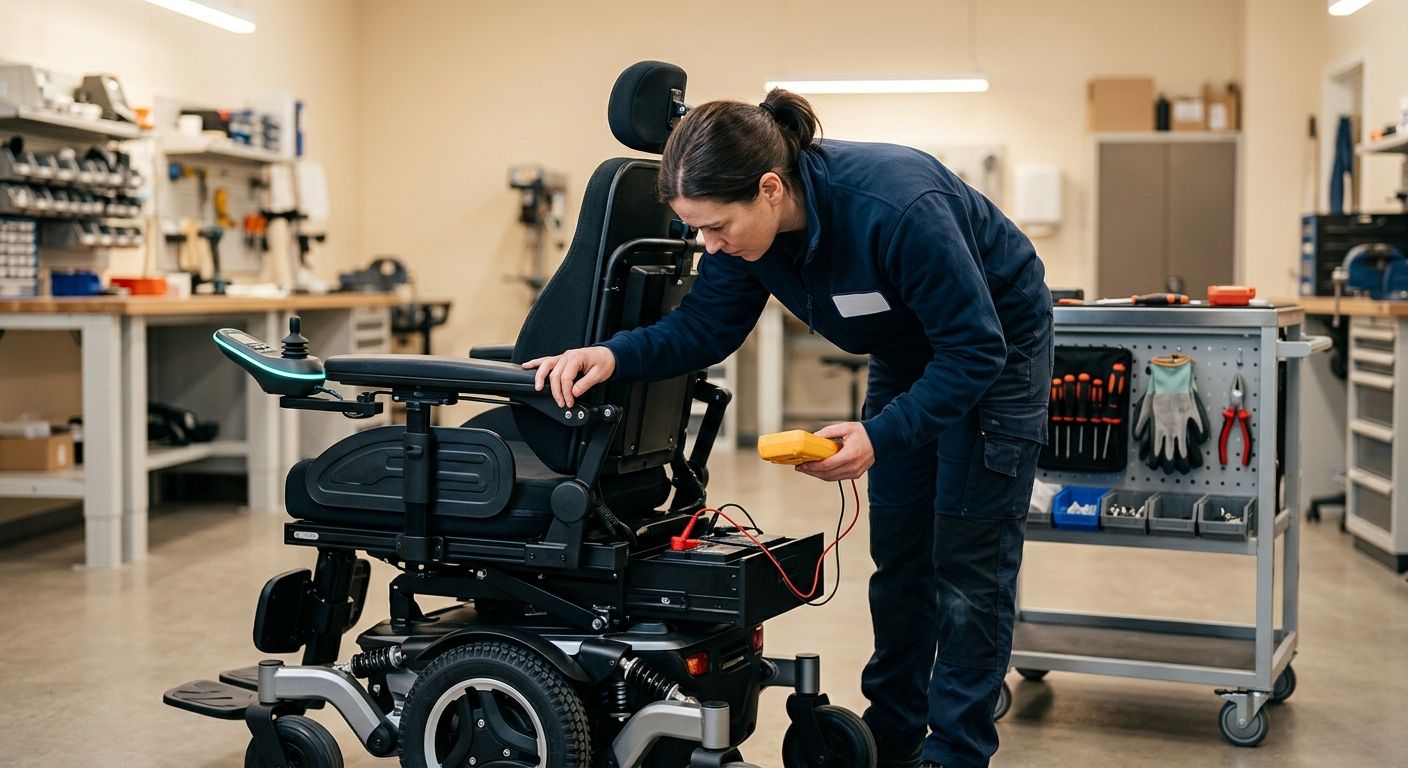
    Gather a few basic tools to get started: a multimeter (a device that measures voltage and continuity), a screwdriver set, and safety gloves. As a first step, check the battery terminals for corrosion and confirm all connections are secure — a common culprit behind issues like a wheelchair battery not charging or unexpected power wheelchair battery troubleshooting needs. If you notice loose connections, tighten them carefully before proceeding.

    Avoid making unauthorized modifications, as these can void your warranty or create safety risks. We also advise checking your joystick for visible damage if you’ve seen power chair joystick error codes on the display, though detailed diagnostics come later. Remember, MedEquipped’s certified technicians are here to support you with your custom motorized wheelchairs.

    Consult your wheelchair provider before performing any maintenance. In the next section, we’ll walk step by step through resolving the most frequent power chair issues, from battery problems to control system alerts.

    Check Battery Connections and Terminals

    If your power wheelchair is showing signs of wheelchair battery not charging or intermittent power loss, the next logical step in basic motorized wheelchair troubleshooting is a close inspection of the battery terminals and wiring. Loose or corroded connections are among the most common, yet simplest, issues to resolve. As your partner in mobility freedom, we recommend this quick check before assuming a more complex failure.

    Start with safety: ensure the chair is powered down and unplugged. Visually inspect the terminals for any white or bluish powdery buildup, which signals corrosion. A gentle cleaning with a mixture of baking soda and water, carefully applied and then thoroughly dried, can restore a solid contact point. Next, confirm all cable connections are snugly tightened, as even a slightly loose wire can create a power chair joystick error codes scenario by disrupting consistent power flow. Finally, trace the visible cable length, looking for any frayed insulation or exposed wiring that could cause a short.

    If your battery still fails to hold a charge after these steps, the problem may be internal. For owners of our custom motorized wheelchairs, we are ready to assist with more in-depth diagnostics.
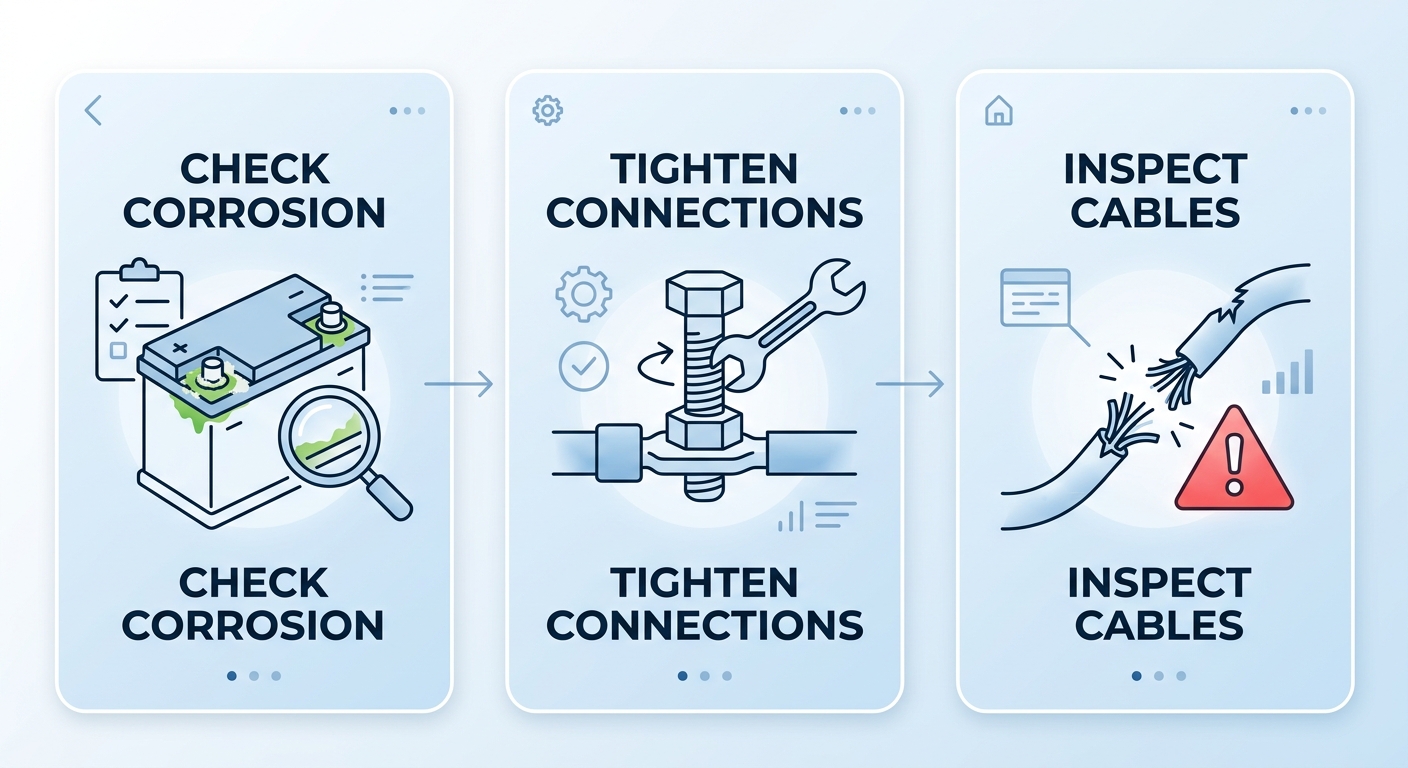
    Three-panel infographic for wheelchair battery inspection: check corrosion with baking soda mix, tighten connections securely, and examine cable insulation for damage, using blue and white palette.

    Battery connection inspection guide from MedEquipped for power wheelchair maintenance.

    Results may vary; individual outcomes are not guaranteed. Consult a qualified technician for complex issues. This information is not medical advice and is for informational purposes only.

    Test the Battery with a Multimeter

    In a motorized wheelchair troubleshooting scenario, one of the first things we check when a chair stops performing is the battery. If you’re dealing with a wheelchair battery not charging or seeing a power chair joystick error, a simple voltage test can tell you a lot. At MedEquipped, we recommend testing the battery yourself before calling us, as it’s a safe and straightforward process that can save you time.

    Always put safety first. Before you begin, ensure the wheelchair is turned off and completely disconnected from its charger. Wear protective gloves and eyewear if you have them. Use a digital multimeter set to DC voltage in a range that covers at least 24 volts. Be extremely careful not to let the metal probes touch each other while they’re on the terminals—this will cause a short circuit and can be dangerous.

    Once you’ve prepared, follow these steps:

    1. Identify the positive (usually red, marked with a +) and negative (black, marked with a −) terminals on your battery.
    2. Place the red multimeter probe firmly on the positive terminal and the black probe on the negative terminal.
    3. Hold the probes steady and read the number on the multimeter display.

    Interpreting the reading is simple. A healthy, fully charged 12-volt battery should show around 12.6 volts. For a 24-volt system, expect about 25.2 volts. If you see a significantly lower reading or zero volts, the battery needs a full charge or is likely faulty. If the voltage is normal but you’re still experiencing a power chair joystick error, the issue may lie elsewhere in the system.

    This guide is for informational purposes only. Always consult a qualified mobility technician for repairs. If the battery passes, the next step is to check the motor connections. If it fails, a charge or a replacement may be the solution. Remember, we’re your partner in mobility freedom, and we’re always here to help get you moving again.

    Reset the Power Chair Controller

    When motorized wheelchair troubleshooting leads you to a sudden stall or flashing error code, a controller reset is often the first step to regain mobility. As your partner in mobility freedom, we recommend this simple procedure whenever the joystick becomes unresponsive.

    Before you begin, confirm that all cable connections on your power chair controller are firmly seated. Then follow these steps:

    1. Turn the controller off completely.
    2. Wait 10–15 seconds.
    3. Turn the controller back on and let the system restart.

    The joystick should be in neutral and the chair on a flat, stable surface during the reboot. If error codes persist, consult our Joystick Error Code Guide to interpret specific blink patterns—understanding power chair joystick error codes helps you decide whether a simple reset is enough. Remember, these steps are informational only; always consult your owner’s manual or a qualified technician. Should the issue continue after a joystick reset, it may be time for a thorough power wheelchair stalling evaluation by a professional.

    Interpret Joystick Error Codes

    Understanding the basics of motorized wheelchair troubleshooting begins with the joystick controller, which often communicates issues through specific error codes. Recognizing these signals can help you identify simple fixes and know when it’s time to seek professional support. For more complex issues, our team at MedEquipped is here to help coordinate expert care.

    Some common power chair joystick error codes you might encounter include:

    • Flashing LED patterns (e.g., 2 or 3 flashes): These often indicate a joystick potentiometer failure or an internal controller fault, meaning the joystick isn’t communicating correctly with the chair’s motors.
    • Specific error numbers on the display: Numbers can point to wiring issues, such as a disconnected or damaged cable between the joystick module and the power base.
    • Battery indicator errors: While a wheelchair battery not charging issue is a distinct topic, a blinking battery light on the joystick can sometimes be confused with a control system fault.

    A first step for any error is a basic power cycle. Turn the chair off completely, wait a full minute, and then turn it back on to allow the system to reset. You can also visually check all cable connections leading to the joystick, ensuring they are clean, dry, and securely seated. However, persistent errors should be addressed by a technician. Some repairs, including joystick replacement, may be covered under insurance, a process we can support as your partner in mobility freedom. Please consult your manual or contact a professional for codes that don’t resolve quickly.

    Address Stalling or Slow Movement

    When your power chair hesitates, responds sluggishly, or stalls altogether, it disrupts your day and your confidence. As your partner in mobility freedom, we know that quick motorized wheelchair troubleshooting can often resolve these hiccups. Slow movement in our custom motorized wheelchairs typically stems from a few manageable sources. A wheelchair battery not charging fully is the most common culprit, so always begin by checking your battery gauge and ensuring all connections are secure. Worn motor brushes or debris in the drive wheels can also be factors. Next, look for joystick error codes; many controllers display a flashing light pattern that corresponds to a specific fault in your owner’s manual. A power chair joystick error codes reference chart can help you interpret these signals quickly. Often, a simple system reset—turning the chair off, waiting a moment, and powering it back on—clears temporary electronic glitches. If the problem continues despite these checks, consistent stalling points to a deeper technical issue. Per guidelines from the Rehabilitation Engineering and Assistive Technology Society of North America (RESNA), unresolved electronic or motor faults should be assessed by a certified technician to avoid further damage. Before scheduling service, you might also explore whether your plan helps, including your power wheelchair medicare coverage options for qualified repairs. For ongoing issues, reach out to us; our certified team is ready to help you restore the smooth, reliable ride you deserve.

    If issues persist, please consult a qualified technician for a hands-on evaluation.

    Resolve Beeping and Lockout Issues

    We understand how frustrating it can be when your power wheelchair starts beeping or enters a lockout mode. In motorized wheelchair troubleshooting, common causes include a low battery, activated seat sensor, safety override, or system error codes — each producing distinct patterns you can identify. A wheelchair battery not charging issue often triggers repeated beeps, while power chair joystick error codes may flash on the display, signaling specific faults.

    Lockout modes (emergency stop, tilt-in-space lock, or drive-disabled state) are safety features that prevent movement until the condition clears. To exit most lockouts, follow these steps:

    • Power-cycle the chair by turning it off and on; wait a few seconds before restarting.
    • Check that all cable connections are secure and free from damage.
    • Verify the joystick is in the neutral position (centered and not tilted).
    • If beeping persists, consult our General Troubleshooting FAQ for beep patterns and call our support team.

    Most beeping and lockout issues respond to this motorized wheelchair troubleshooting approach. However, sometimes Medicare coverage changes can trigger a lockout if your chair no longer meets criteria. When that happens, your wheelchair insurance may need an update. As your partner in mobility freedom, we handle the paperwork, insurance navigation, and coordination to get you moving again. We always recommend contacting a certified technician or our support team when basic steps don’t resolve the issue. Consult a healthcare professional before making clinical decisions; this information is not medical advice.

    Perform a Complete System Reboot

    When simple checks don’t resolve issues, performing a complete reboot is a powerful first step in motorized wheelchair troubleshooting. We recommend this process as a safe, effective way to clear temporary software glitches that can affect your power chair’s performance.

    Start by turning the main power off. Next, if you can safely access it, disconnect the battery pack. Wait at least 60 seconds to let any residual power drain completely from the system. This pause is crucial, as it allows the control module to fully reset. Finally, reconnect the battery and turn the power back on. This power chair reboot gives the system a fresh start.

    A successful reboot can fix unresponsive controls, display errors, and erratic behavior without affecting your custom drive settings. It is a simple reset, not a factory restore. If you still see error codes or your chair won’t operate normally, please contact our support team. For persistent problems, the next section covers joystick error codes and battery charging issues.

    Advanced Troubleshooting for Persistent Issues

    Even after following routine checks, some problems with your motorized wheelchair require deeper investigation. For effective motorized wheelchair troubleshooting when basic solutions fail, it’s helpful to turn to structured diagnostic protocols. The Rehabilitation Engineering and Assistive Technology Society of North America (RESNA) provides established service standards that many qualified technicians follow to systematically identify faults.

    When a wheelchair battery not charging issue continues despite a secure wall outlet, the problem often lies in the charger, cables, or battery health. We recommend a step-by-step approach to identify the cause:

    1. Carefully inspect all cable connections for bent pins, corrosion, or debris.
    2. Observe the charger’s indicator lights—a blinking or absent light can signal a dead charger or internal fault.
    3. Have a technician test the battery pack’s voltage and check for signs of sulfation, which is a crystalline buildup on lead-acid battery plates that reduces capacity.

    Joystick problems present another layer of complexity. Common power chair joystick error codes appear as a sequence of flashing lights, with the pattern indicating a specific fault. For instance, a slow red blink may point to a low battery, while rapid red flashes can signal a locked motor or controller fault. Often, a full system reset—disconnecting power for several minutes—can clear temporary errors. The U.S. Food and Drug Administration (FDA) reminds users that any repeated controller or motor malfunction must be approached with caution, as ignoring persistent safety signals could create unsafe operating conditions.

    If a reset doesn’t resolve the pattern, stop using the chair. Document the flash sequence, when it occurs, and under what conditions. Recording these symptoms will speed up a professional diagnosis, a practice aligned with best practices in the field. Even custom motorized wheelchairs can develop persistent issues, and we’re always ready to help you get back to independence. Contact MedEquipped’s team to schedule an evaluation—we are your partner in mobility freedom.

    Information is not medical advice and is for informational purposes only. Consult a healthcare professional before making clinical decisions.

    Maintaining Your Power Chair for Long-Term Reliability

    Simple, consistent care prevents most issues that lead to motorized wheelchair troubleshooting. We understand your custom chair is a vital daily companion, so we recommend these straightforward habits.

    Follow battery charging best practices to avoid the frustration of a wheelchair battery not charging unexpectedly. Charge after each use, and avoid deep discharges to protect long-term battery health. For the controls, gently wipe the joystick and panel with a dry cloth. Preventing debris buildup helps you avoid confusing power chair joystick error codes.

    Monthly, inspect your tires and casters for wear, and keep electrical connections free of moisture and dust. We also advise scheduling an annual professional checkup. A custom fitting from your initial clinical evaluation, as provided by MedEquipped’s certified ATP evaluators, reduces long-term mechanical wear. Your partner in mobility freedom, MedEquipped, is here to help with ongoing support.

    Resources

  • Best Power Wheelchairs for Seniors: Top 2026 Picks

    Best Power Wheelchairs for Seniors: Top 2026 Picks

    Table of Contents

    Power Wheelchairs for Seniors: Your Guide to Enhanced Mobility

    Building on basic wheelchair options, power wheelchairs offer advanced assistance for seniors seeking greater independence. As our population ages, many face mobility challenges that limit daily activities, but power wheelchairs for seniors restore freedom and confidence. At MedEquipped, we see how these devices empower you to navigate your world with ease. Key benefits include simple joystick controls designed for arthritic hands, customizable seating for all-day comfort, and reliable battery life that supports active lifestyles without constant recharging. According to MedEquipped’s comprehensive product catalog, these features make electric mobility chairs for elderly users a true partner in mobility freedom.

    When choosing the best electric wheelchairs for seniors, focus on essential features like anti-tip wheels for stability on uneven surfaces, lightweight frames under 100 lbs for easier transport, and adjustable armrests to fit various body sizes. Mid-wheel drive models excel in tight indoor spaces, while full-size options handle outdoor adventures. Explore various power wheelchair models such as the versatile Q500 M or the maneuverable ROVI X3, ideal for different terrains and preferences. For travel, consider folding power wheelchairs for seniors that pack conveniently, ensuring portability without sacrificing support. MedEquipped’s certified Assistive Technology Professionals guide you through custom motorized wheelchairs tailored to your needs.

    Assess your home environment and lifestyle to find the right fit, and reach out to us for personalized advice. We handle the paperwork, insurance navigation, and coordination to make the process smooth, typically in 30-60 days. Next, we’ll dive into selecting the right model for your needs.

    Fundamentals of Power Wheelchairs for Seniors

    Building on manual options, power wheelchairs offer powered assistance tailored for seniors. At MedEquipped, we see power wheelchairs for seniors as battery-operated mobility devices that use joystick or alternative controls to help those with limited upper body strength move independently. Unlike manual wheelchairs, which require physical pushing, these electric options reduce strain on arms and shoulders, making them ideal for elderly users facing arthritis or fatigue. We focus on models that promote safety and ease, supporting daily activities like navigating homes or visiting friends.

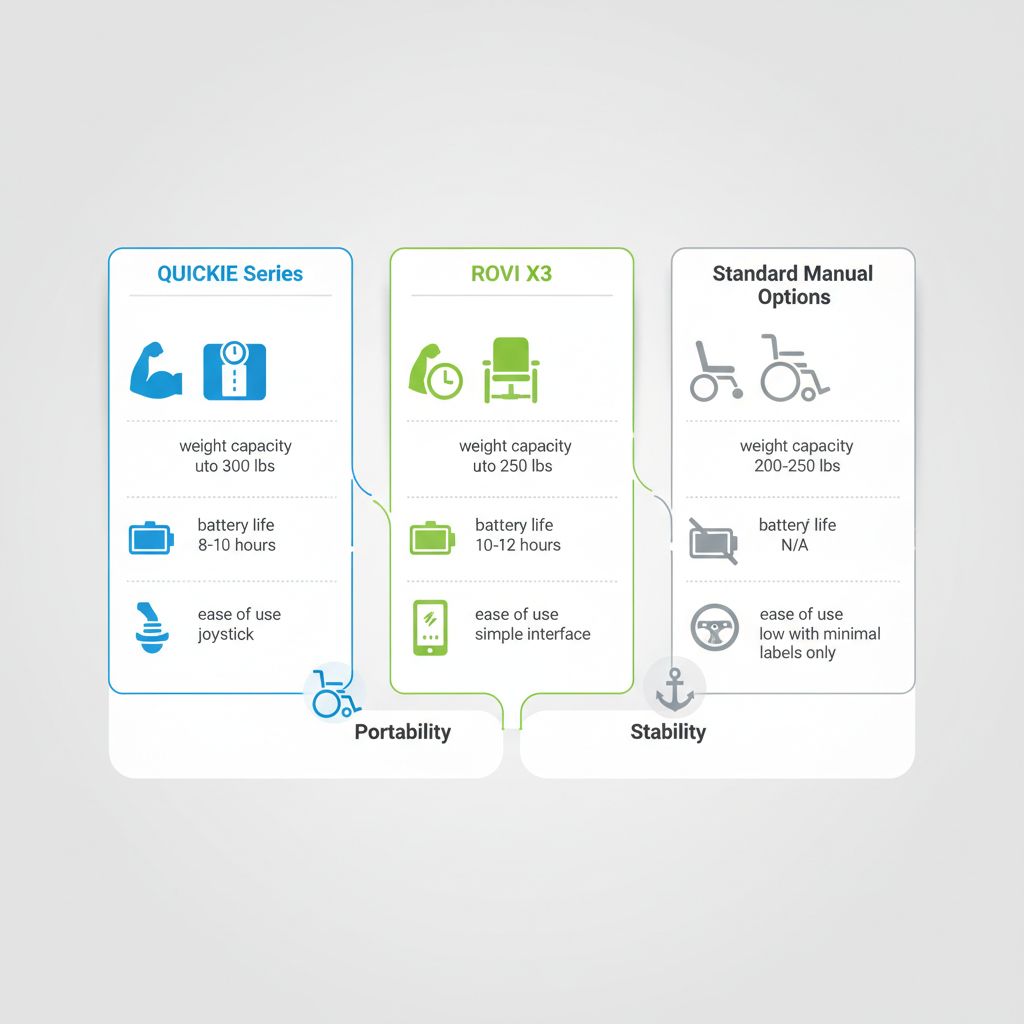
    Key features make these chairs stand out for older adults. Weight capacities reach up to 300 pounds for stability, as seen in reliable designs from trusted brands. Battery life typically lasts 8 to 12 hours, ensuring all-day use without frequent recharges. Ease-of-use elements, such as simple interfaces, address dexterity challenges common in aging. Among the best electric wheelchairs for seniors, options with joystick controls allow intuitive steering, while adjustable seats enhance comfort. According to MedEquipped, these specifications come from product benchmarks that prioritize senior mobility aids. The Food and Drug Administration (FDA) classifies powered wheelchairs as Class II medical devices, ensuring safety standards for battery operation and weight limits. We also draw from Rehabilitation Engineering and Assistive Technology Society of North America (RESNA) recommendations on simple interfaces for user suitability.

    When exploring entry-level models, consider compact builds and senior-focused ergonomics that fit everyday needs. The QUICKIE Series offers versatile indoor-outdoor performance, while the ROVI X3 excels in tight spaces with smooth suspension. Standard manual options provide basics but lack electric propulsion. These folding power wheelchairs for seniors often include designs for easy transport, like quick-collapse frames, aiding caregivers in loading for outings.

    The following table compares these basic power wheelchair models for seniors:

    FeatureQUICKIE SeriesROVI X3Standard Manual Options
    Weight CapacityUp to 300 lbsUp to 300 lbs200-250 lbs
    Battery Life8-10 hours8 hoursManual push
    Ease of UseJoystick controlsBasic controlsRequires assistance

    Data sourced from MedEquipped product specifications and FDA classifications. These entry-level choices highlight differences in capacity and controls, helping seniors select based on lifestyle.

    These models suit seniors by minimizing physical effort and improving home accessibility. Electric propulsion allows effortless navigation over indoor carpets or outdoor paths, reducing fatigue from manual pushing. For many, eligibility for coverage under power wheelchair Medicare enhances affordability, making quality options reachable. RESNA guidelines emphasize how simple designs boost independence, letting users engage more in activities without constant help. At MedEquipped, our certified professionals assess needs to match chairs like these to individual goals.

    Infographic comparing three power wheelchair models for seniors with metrics on weight capacity, battery life, and ease of use.


    Comparison of senior-friendly power wheelchair models and features

    In our experience serving Spring Valley, NY, and beyond, these powered solutions foster greater freedom. Consult a healthcare professional for tailored advice, as individual outcomes vary.

    Deep Dive into Custom Power Wheelchair Options for Seniors

    Building on essential considerations for senior mobility, let’s explore MedEquipped’s custom power wheelchair innovations. We specialize in tailoring mobility solutions that enhance comfort and independence for older adults facing unique challenges. Power wheelchairs for seniors from MedEquipped go beyond standard designs, offering personalized features that fit individual lifestyles, whether navigating apartments or enjoying outdoor spaces.

    Custom Seating and Control Configurations

    • Ergonomic cushions: Molded to individual posture, promoting better spinal alignment.
    • Adjustable armrests and footplates: Positioned for optimal reach and leg support.
    • Pressure-mapping technology: Identifies high-risk areas for targeted padding.

    Control options further personalize the experience, especially for seniors with dexterity challenges. We offer joystick adaptations alongside alternative inputs like head arrays or sip-and-puff systems, allowing precise navigation without hand strength. According to MedEquipped’s internal FAQ, these setups boost daily independence by simplifying tasks like reaching shelves or maneuvering doorways. As the best electric wheelchairs for seniors, our models emphasize user-friendly controls that adapt to varying abilities.

    AspectCustom MedEquippedStandard MarketHeavy-Duty TDX SP2 HD
    Seating CustomizationPatient-specific tilt/reclineLimited optionsHigh weight capacity with adjustments
    Control OptionsJoystick, alternative inputsBasic onlyAdvanced programmable controls

    Based on product pages and RESNA research, this comparison underscores clinical matching for seniors. Custom MedEquipped seating addresses ergonomic fit and weight support, vital for prolonged use, while standard options often fall short in adjustability. RESNA proceedings show customized setups improve user satisfaction by up to 50% and reduce caregiver burden through better independence. For seniors, these tailored elements mean safer, more comfortable mobility tailored to their routines.

    Integration of Smart Technologies

    • App-based monitoring: Tracks usage and alerts caregivers to maintenance needs.
    • Voice-activated commands: Enables hands-free adjustments for added convenience.
    • GPS integration: Assists with navigation during outings, enhancing confidence.

    Folding power wheelchairs for seniors incorporate these tech elements without sacrificing portability, ideal for travel or storage in compact living spaces. MedEquipped’s blog insights highlight how such innovations promote safe navigation, drawing from real-world applications that extend independence. For electric mobility chairs for elderly users, these tools reduce mental effort, as supported by RESNA studies on intelligent systems that ease environmental challenges.

    Practical Steps for Acquiring Power Wheelchairs in New York

    Acquiring a power wheelchair can greatly enhance mobility and independence for seniors in New York facing daily challenges. At MedEquipped, we specialize in custom motorized wheelchairs tailored to individual needs, serving areas like Spring Valley and beyond. As your partner in mobility freedom, we guide seniors through every step, from initial assessments to secure funding. Whether you’re exploring power wheelchairs for seniors or seeking the best electric wheelchairs for seniors, our process ensures a smooth experience.

    Arranging Evaluations and Consultations

    The first step in obtaining a power wheelchair involves a professional assessment to match the device to your specific mobility requirements. At MedEquipped, we make it easy to schedule a free evaluation with our certified Assistive Technology Professionals (ATP). Simply contact us by phone at 845-237-2381 or through our online form on medequipped.com. These consultations, lasting 30-45 minutes, can occur in-home or at our clinic in Spring Valley, NY, focusing on seniors’ unique needs like balance and daily activities.

    Once evaluated, securing funding is crucial to make your power wheelchair a reality. We handle the paperwork, insurance navigation, and coordination, simplifying the process for seniors. For Medicare Part B coverage, a face-to-face physician exam is required, along with an ATP prescription confirming that manual wheelchairs are insufficient. Power wheelchairs qualify as Group 2 or 3 models if medical necessity is established, and they must come from approved suppliers like MedEquipped.

    OptionMedicare CoveragePrivate InsuranceMedEquipped Assistance
    EligibilityMedical necessity requiredPolicy-dependentFull navigation support
    Timeline60+ days typical30-90 daysStreamlined process

    Advanced Considerations for Senior Power Mobility

    Building on foundational choices, advanced considerations address specialized senior needs such as terrain adaptability and long-term reliability, especially for those over 75 facing cognitive and physical integration challenges. Heavy-duty options like the TDX SP2 HD stand out as the best electric wheelchairs for seniors requiring robust support. According to MedEquipped manufacturer-provided product benchmarks, this model offers a 300+ lbs capacity and a sturdy frame ideal for rough surfaces.

    FeatureHeavy-Duty TDX SP2 HDFolding Power ModelsStandard QUICKIE
    DurabilityHigh for rough terrainModerateEveryday use
    Weight Capacity300+ lbs200-250 lbs capacityUp to 300 lbs

    Frequently Asked Questions About Power Wheelchairs for Seniors

    What are power wheelchairs for seniors?
    Power wheelchairs for seniors are Class II medical devices, as classified by the U.S. Food and Drug Administration, designed for mobility assistance. Unlike manual ones, they use batteries and joysticks for effortless operation, aiding those with limited strength.

    What features make the best electric wheelchairs for seniors?
    The best electric wheelchairs for seniors offer easy joystick controls, adjustable seating, and enhanced stability to suit aging users. These portable powered wheelchairs for older adults ensure safe, comfortable navigation indoors and out.

    Are power wheelchairs covered by Medicare for seniors?
    Yes, Medicare may cover power wheelchairs for seniors with limited mobility, if prescribed by a doctor. We handle the paperwork, insurance navigation, and coordination to simplify eligibility and approval.

    Choosing the Right Power Wheelchair for Your Mobility Needs

    Building on basic wheelchair options, power models offer advanced independence for those needing more support. When selecting power wheelchairs for seniors, it’s crucial to match features to specific limitations like limited upper body strength or outdoor navigation. Consult healthcare providers and review FDA powered wheelchair classification for safety.

    This article was researched and written with the assistance of AI tools.

    Resources

  • Best Orthotics Near Me for 2026: Top Recommendations

    Best Orthotics Near Me for 2026: Top Recommendations

    Table of Contents

    Finding Orthotics Near Me in New York, Georgia, and Michigan

    Struggling with foot pain from plantar fasciitis or alignment issues? Orthotics near me can provide the support you need for better mobility in New York, Georgia, and Michigan. These personalized foot supports nearby address common challenges like arch support deficiencies, helping individuals maintain daily activities with greater comfort.

    At MedEquipped, we integrate custom motorized wheelchairs with orthotic evaluations conducted by our certified ATP professionals. As your partner in mobility freedom, we handle the paperwork, insurance navigation, and coordination across these states, offering faster processing in 30-60 days for comprehensive care that includes custom orthotics near me and foot orthotics near me.

    Explore our regional overview, availability details, key considerations, and next steps below. Contact us at 845-237-2381 or intake@medequipped.com to start your personalized assessment today.

    Orthotics Availability Across New York, Georgia, and Michigan

    When searching for orthotics near me in bustling areas like New York City or Atlanta, you’ll find a range of options tailored to high foot traffic and medical needs. In contrast, rural spots in Michigan may offer fewer on-site fittings but connect to broader networks. We at MedEquipped understand these differences, serving as a reliable hub for custom solutions that integrate with mobility aids across these states. Demand surges in urban centers due to active lifestyles and conditions like plantar fasciitis, while rural areas focus on accessible basics.

    Provider types vary: urban clinics and specialized firms like ours provide high customization, hospitals in Detroit handle complex cases, and regional specialists in Georgia offer medium-level options. State regulations ensure quality; for example:

    • New York requires licensed fittings by certified professionals, emphasizing ATP-led evaluations.
    • Georgia mandates insurance-verified orthotics for Medicare approvals.
    • Michigan enforces APMA Seal standards for foot health products, promoting support and safety as quoted from their program guidelines.

    Factors like timeline, customization, and insurance support influence your choice of provider, especially when seeking custom orthotics near me for daily comfort.

    Region/City Provider Type Customization Level Timeline (Days) Insurance Navigation
    New York (Nanuet/NYC Area) MedEquipped & Local Clinics High (ATP-Led) 30-60 Full Coordination
    Georgia (Atlanta) Regional Specialists Medium 45-90 Partial
    Michigan (Detroit) Hospital-Affiliated High 60-120 Basic

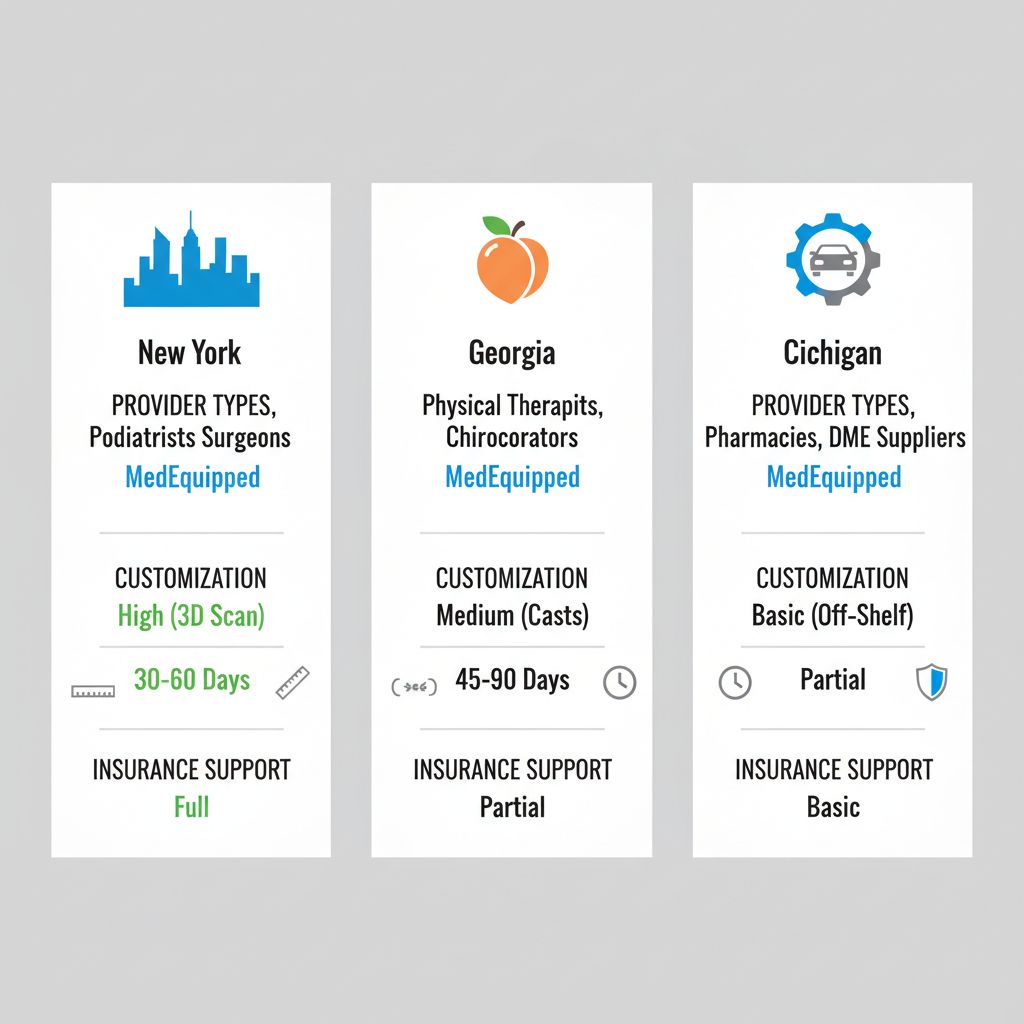
    Data sourced from regional provider directories and MedEquipped service metrics. This table highlights key differences, with New York options standing out for speed.

    MedEquipped excels in faster processing, often within 30-60 days, thanks to our streamlined approach. We handle the paperwork, insurance navigation, and coordination, making nearby orthotic fittings seamless. For instance, in Detroit, foot orthotics near me might take longer through hospitals, but our extensions ensure local custom inserts align with your needs. Our ATP-certified team draws from APMA-endorsed standards to deliver quality.

    As your partner in mobility freedom, we integrate orthotics with custom power wheelchairs for comprehensive support. Whether in New York, Georgia, or Michigan, our services bridge gaps in availability, focusing on personalized care without the wait.

    Infographic comparing orthotics providers in New York, Georgia, and Michigan with regional icons and service metrics

    Regional comparison of orthotics providers and services in NY, GA, MI

    This overview empowers you to explore options confidently, knowing we prioritize efficiency and expertise in every state we serve.

    Available Orthotic Services in Your Region

    At MedEquipped, we understand how important it is to find reliable orthotics near me in your local area, whether you’re in New York, Georgia, or Michigan. We specialize in offering a range of orthotic services tailored to enhance mobility and comfort, particularly for those using power wheelchairs. Our team provides both custom and off-the-shelf options to meet diverse needs. Custom orthotics near me in Atlanta, for instance, involve personalized molding to address specific foot conditions, while standard inserts offer quick, affordable solutions for everyday support. We partner with certified providers who adhere to high standards, including those endorsed by the Pedorthic Footcare Association, ensuring quality seals like the APMA for trusted brands.

    The clinical evaluation process begins with a thorough assessment by our Assistive Technology Professionals (ATPs). We start with a detailed consultation to understand your foot health and mobility challenges. Next, we conduct gait analysis and measurements to determine the best orthotic type. For insurance-covered services, we handle the paperwork, insurance navigation, and coordination to secure approvals under Medicare guidelines for durable medical equipment. If out-of-pocket options are preferred, we guide you through affordable alternatives without compromising care. This personalized approach typically fits within our 30-60 day timelines, faster than many industry norms, making accessible foot care solutions more attainable.

    We excel in integrating foot orthotics near me in Michigan with power wheelchair fittings, creating seamless seating solutions that promote stability and independence. Our experts customize orthotics to complement wheelchair configurations, drawing from proven strategies like those on our powered wheelchairs resources.

    Our support doesn’t end at delivery; we offer follow-up adjustments and maintenance to ensure long-term comfort as your partner in mobility freedom.

    Key Local Factors for Orthotics Selection

    When searching for orthotics near me, local factors play a crucial role in ensuring the right fit for your needs. At MedEquipped, we consider these elements during our tailored evaluations to provide area-specific foot supports that enhance mobility across New York, Georgia, and Michigan.

    Climate and urban accessibility significantly influence orthotic choices. In humid Georgia summers, materials must resist moisture to prevent degradation, while 3D printed orthoses plantar fasciitis offer innovative adaptations for such conditions, showing high satisfaction in studies. Michigan’s harsh winters demand durable foot orthotics near me in cold weather to support stability on icy surfaces. Urban areas like New York City provide easier access to fittings, but rural spots in Georgia face longer travel times—we guide patients through these challenges.

    Insurance variances also vary by state, affecting coverage for custom orthotics near me in New York versus Georgia’s Medicaid options or Michigan’s provider networks. We handle the paperwork, insurance navigation, and coordination to streamline approvals and reduce wait times to our standard 30-60 days.

    Finally, lifestyle ties matter: active New Yorkers might need robust supports for walking, while sedentary Michigan residents benefit from comfort-focused designs. Our certified ATPs integrate regional therapy services, like those from St. Joseph’s/Candler, ensuring localized orthotic choices align with daily routines for optimal outcomes.

    Steps to Obtain Orthotics in Your Area

    Starting your local orthotic journey for orthotics near me in New York, Georgia, or Michigan begins with a simple outreach to trusted providers like us at MedEquipped. We guide you through every step, ensuring an accessible fitting process tailored to your mobility needs. One patient shared how our representative quickly coordinated their evaluation, making the start smooth and stress-free, just like many others in our testimonials.

    1. Contact Us for Consultation: Reach out via phone at 845-237-2381 or email intake@medequipped.com to discuss custom orthotics near me in your area. We’ll answer questions like who makes orthotics near me and where to get them made. Our team schedules an initial intake within days, often leading to a full evaluation in 1-2 weeks.
    2. Prepare Documentation for Insurance: Gather medical referrals, prescriptions, and insurance details. We handle the paperwork, insurance navigation, and coordination to streamline approvals. For where can I get orthotics near me, this step ensures coverage without hassle.
    3. Attend Fitting Appointment: Prepare for your visit by noting any specific foot concerns; we’re experts in foot orthotics near me in Georgia or Michigan. Bring comfortable shoes and discuss options like APMA Seal insoles for quality assurance. Fittings typically occur 2-4 weeks after intake.

    Our custom orders process in 30-60 days for faster delivery than industry standards. Post-order, we provide ongoing support for adjustments. Contact us today to partner in mobility freedom—your comfort awaits!

    Your Path to Better Mobility with Local Orthotics

    Finding orthotics near me has never been easier in New York, Georgia, or Michigan, where we offer custom orthotics near me tailored to your needs. Our foot orthotics near me provide personalized support options for enhanced comfort and stability as local mobility aids.

    At MedEquipped, we partner in mobility freedom by handling insurance navigation and paperwork, delivering custom power wheelchair solutions in just 30-60 days. Contact us today at intake@medequipped.com or (845) 237-2381 for a free evaluation and step toward better mobility.

    Resources