MedEquipped

Tag: ATP clinical evaluation

  • Stair Chair Lift Installation: Affordable Options for 2026

    Stair Chair Lift Installation: Affordable Options for 2026

    Table of Contents

    Navigating stairs can be a significant challenge for seniors and those with mobility issues, limiting independence in multi-level homes across New York, Georgia, and Michigan. A stair chair lift offers a safe, reliable solution to restore freedom and reduce fall risks, allowing you to age in place comfortably without major renovations.

    At MedEquipped, we specialize in end-to-end mobility services, including certified ATP-led evaluations to assess your home layout and needs. Whether you need a straightforward straight stairlift chair for a single flight or a stair lift buying guide for more complex setups like a curved stair lift, we guide you through options. Our team handles insurance navigation and paperwork, streamlining approvals for faster processing—typically 30-60 days from custom order to delivery.

    Curious about stair lift cost? Expect ranges from $3,000 to $15,000, influenced by staircase type, features, and customizations. We provide transparent pricing insights and preview the next steps, from consultation to installation. Contact our team today at 845-237-2381 or intake@medequipped.com to get started on your home stair lift system.

    Preparing for Your Stair Chair Lift Journey

    Embarking on your stair chair lift journey starts with thoughtful preparation to ensure safety and independence in your home. We’re here to help simplify this process, especially if you’re considering a stair chair lift in Michigan, New York, or Georgia. Begin by assessing your needs and budget to make an informed decision.

    Budget Overview

    Understanding stair lift cost is crucial for planning. Straight stair lifts typically range from $3,000 to $5,000, while a curved stair lift can cost $10,000 to $15,000 due to custom fitting. According to reliable guides, average installations including labor fall between $4,000 and $5,500. Rentals offer a flexible option at $500 to $1,500 per month. Medicare generally does not cover these, though supplements or Advantage plans might under specific conditions—we handle the paperwork, insurance navigation, and coordination to explore your options. Check out this stair lift costs resource for more details. Here’s a quick pricing tier:

    • Straight: $3,000–$5,000
    • Curved: $10,000–$15,000
    • Rental: $500–$1,500/month

    These figures help you budget effectively without surprises.

    Transitioning from costs, evaluating your home ensures the right fit for your chair lift for stairs.
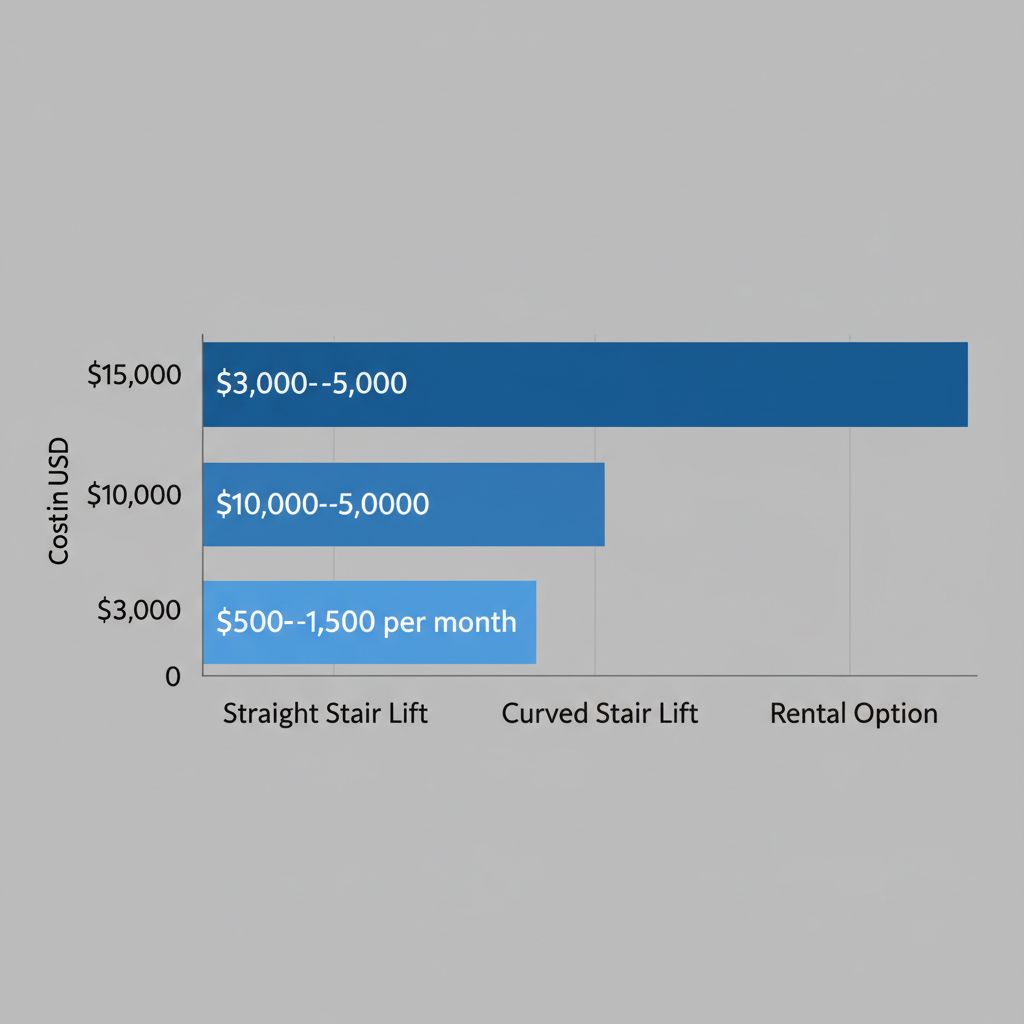
    Horizontal bar chart illustrating average costs of different types of stair chair lifts in USD.

    Average stair lift costs breakdown by type: straight, curved, and rental options.

    Home Assessment Guide

    Measure your stairs accurately: note the angle, landings, and total rise. A straight staircase suits basic designs, but a curved stair lift requires precise rail bending. Our certified team in Georgia or New York can visit for a free assessment. This stair ascent aid must align with your home’s layout to guarantee safe navigation and avoid costly adjustments later.

    Documentation Checklist

    Gather essential medical records to support your case:

    • Doctor’s prescription or mobility assessment
    • Proof of Medicare or insurance details
    • Home photos or measurements

    Contact us at 845-237-2381 for a free initial quote—we’re your partner in mobility freedom.

    Assessing Your Mobility and Staircase Needs

    We understand how important it is to maintain independence in your home, especially when mobility challenges arise. At MedEquipped, serving communities in New York, Georgia, and Michigan, we recommend beginning with a thorough assessment of your mobility needs and staircase specifications. This foundational step ensures you select the right stair chair lift, paving the way for a smoother path to installation and funding approval.

    Instructions for Measuring Your Staircase

    1. Measure the staircase length by running a tape measure from the top step to the bottom along the path, accounting for any rise or run according to standard guidelines on stair angles from accessibility experts.
    2. Check the width by measuring across the narrowest point of the staircase treads.
    3. Identify turns or curves; a straight staircase works for basic models, but a curved stair lift may be necessary for multi-level or winding designs.

    These measurements prepare you for precise quotes and help avoid surprises.

    Why It Matters

    Accurate measurements ensure the stair chair lift fits safely and functions smoothly, preventing installation issues that could lead to higher stair lift cost or safety risks. By considering your mobility level alongside staircase details, you align the solution with your daily needs, accelerating the process toward professional evaluation and funding in your area.

    Tips for a Comprehensive Assessment

    Note any obstructions like railings or furniture that might affect the stair glider path. We also suggest consulting your physician for input on your mobility limitations to inform the best choice. Our certified ATP professionals stand ready to review your findings and recommend options tailored for homes in New York, Georgia, or Michigan. For guidance, explore the best stair lifts to compare features effectively.

    Contacting MedEquipped for Consultation

    Ready to take the next step toward enhanced mobility? We’re excited to help you explore options like a stair chair lift tailored to your home in New York, Georgia, or Michigan. Contacting our team for an initial consultation is straightforward and efficient, getting you personalized advice quickly.

    To get started, call us at 845-237-2381 during our business hours—9 a.m. to 5 p.m. Monday through Thursday, and until 4 p.m. on Friday—or email intake@medequipped.com. Include key details such as your stair measurements, specific needs, and any questions about a custom motorized wheelchairs as an alternative mobility solution. You can also visit our office at 233 NY-59, Nanuet, NY, for in-person discussions. We handle the paperwork, insurance navigation, and coordination to simplify everything.

    This consultation matters because it secures expert guidance on your stair chair lift options, including preliminary insurance checks to understand coverage potential. Our certified team reviews your situation to recommend the best fit, whether straight or curved stair lift, ensuring a seamless process.

    Prepare by jotting down questions on stair lift cost, installation timelines, and maintenance. We’re ready to assist with clear answers, helping you make informed decisions for safer navigation across Michigan or support in Georgia.

    Undergoing Clinical Evaluation

    When you’re ready to explore mobility solutions like a stair chair lift, our certified ATP professionals guide you through a thorough clinical evaluation. Drawing from the expertise of our dedicated team, including Julie DeSantis-Mayer and Nichole Tahmoosh, we prioritize your comfort and ensure a personalized experience in our tri-state service area covering New York, Georgia, and Michigan. This process is key to securing funding and speeding up approvals for devices that enhance your independence.

    The evaluation typically involves an in-home or clinic visit where we conduct targeted mobility tests. We assess how you navigate stairs, your balance, and overall physical capabilities to determine the best fit for a stair chair lift. For homes with unique layouts, we evaluate options such as a curved stair lift to ensure safe and seamless installation. Our team documents every detail, creating a comprehensive report that supports insurance claims and addresses questions like whether Medicare will pay for a stair lift chair. This step usually takes about an hour and focuses on your specific needs for optimal safety and usability.

    This evaluation matters because it precisely matches the stair chair lift to your individual requirements, prioritizing safety and preventing potential risks from ill-fitting equipment. By establishing clinical appropriateness, we streamline documentation for funding sources, which can significantly influence stair lift cost coverage and reduce approval timelines. Our approach builds trust and efficiency in the process.

    To prepare effectively, bring your complete medical history, including any diagnoses related to mobility issues, and details on current medications. Also, share information about your home’s stair configuration to help us recommend solutions like a curved stair lift if needed. We handle the paperwork, insurance navigation, and coordination to make this as smooth as possible.

    Once your clinical evaluation is complete, we at MedEquipped guide you through securing funding for your stair chair lift. Our team handles the submission of evaluation reports to insurance providers, including Medicare and supplemental plans, streamlining the process for quicker approvals in New York, Georgia, and Michigan. We coordinate all necessary paperwork, verify coverage eligibility, and follow up on claims to ensure you get the support you need without the hassle. This end-to-end assistance typically fits within our 30-60 day processing timeline, making mobility solutions accessible sooner.

    Understanding insurance coverage is crucial because stair lift costs can range from $2,500 to $8,000, depending on features and installation. While traditional Medicare often does not cover stair lifts as they are considered home modifications rather than durable medical equipment, some Medicare Advantage plans may provide partial reimbursement under specific medical necessity conditions. We help explore these options to minimize out-of-pocket expenses and connect you with funding for stair aids like grants or VA benefits.

    For added flexibility, consider renting a stair chair lift before committing to a purchase, especially for a curved stair lift where custom fitting impacts the total stair lift cost. Rentals allow you to trial the equipment in your home setting, helping you assess comfort and functionality. We assist in sourcing rental programs from trusted manufacturers, ensuring a smooth experience as you move toward your final selection.

    Selecting and Customizing Your Lift

    At MedEquipped, we guide you through selecting the right stair chair lift to enhance your home’s accessibility. Whether you need a straight model for simple staircases or a curved stair lift for winding designs, our advisors review your space and lifestyle during a free consultation. We discuss features like swivel seats, foldable arms, and remote controls to ensure a seamless fit. As your partner in mobility freedom, we help you explore options that align with your daily routines, from weight support to smooth operation, making the process straightforward and personalized.

    Choosing the perfect stair chair lift matters because it ensures long-term comfort and durability tailored to your needs. A well-customized solution prevents strain and supports safe navigation, promoting independence at home. By focusing on quality builds from trusted brands, we prioritize setups that withstand regular use without frequent repairs.

    When customizing, always consider weight capacity to match your requirements—standard models handle up to 300 pounds, while heavy-duty ones go higher. Factor in stair lift cost for custom pricing, typically ranging from $3,000 to $15,000 based on features and installation. Opt for a tailored stair solution that fits your budget and home layout, and choose what fits you best for lasting mobility.

    Scheduling Installation and Delivery

    Once your stair chair lift approval is in place, we at MedEquipped guide you through confirming the schedule to kick off our efficient 30-60 day process. This timeline covers everything from custom ordering to delivery in New York, Georgia, or Michigan, ensuring your lift setup aligns perfectly with your home’s needs. We handle the coordination seamlessly, just as we do for our custom motorized wheelchairs, partnering with you every step to make mobility freedom a reality. Our experienced installers will reach out shortly after approval to discuss your preferred dates and any specific requirements, like accommodating a curved stair lift if your staircase demands it. This post-approval confirmation keeps things moving smoothly without unnecessary delays.

    Coordinating this schedule matters because it minimizes disruption to your daily routine in your home setting. A well-timed delivery and installation mean less time without essential support, helping you maintain independence faster. Our customers often share how our thoughtful timelines, backed by positive delivery experiences like those from our dedicated technicians, make the entire process feel supportive and stress-free.

    To prepare, we recommend clearing the stair area well in advance for safe access during setup. If considering add-ons that might affect stair lift cost, discuss them early to avoid surprises. For any existing equipment, note that our install notes include guidance on simple steps, such as how to remove a stair lift chair temporarily if needed. These tips ensure a hassle-free experience as we transition to usage training next.

    Learning Safe Usage and Maintenance

    After installation, mastering the safe operation of your stair chair lift is essential for daily comfort and security. We at MedEquipped guide you through this with hands-on demonstrations and detailed manuals tailored to your setup, whether it’s a straight or curved stair lift. Start by familiarizing yourself with the controls: power on the unit, select the direction via the intuitive buttons, and ensure the seat is locked before use. For cleaning, gently wipe surfaces with a damp cloth, avoiding harsh chemicals that could damage the mechanism. If maintenance requires removing the stair lift chair, consult our step-by-step instructions—typically, release the locking pins after powering off and disengaging the rail connection. Always test the reassembly to confirm smooth operation. This routine stair device care keeps everything running reliably.

    Proper usage and upkeep matter because they prevent accidents and extend the life of your equipment. Drawing from safety protocols recommended by organizations like ADANC, consistent checks reduce risks such as unexpected stops or wear-related failures, helping you navigate stairs confidently without strain.

    For optimal performance, schedule annual professional inspections to catch issues early. These visits, which factor into your overall stair lift cost, ensure compliance with safety standards and address any adjustments needed. We’re available for questions anytime to support your mobility needs, including exploring complementary options like our power wheelchair models. Remember, individual results may vary—consult your healthcare professional for personalized advice.

    Troubleshooting Common Issues

    At MedEquipped, we understand that even the most reliable stair chair lifts can encounter occasional hiccups. Whether it’s a minor glitch or a usage error, addressing these promptly keeps you moving safely in your home. Common challenges like power failures affect up to 20% of installations per the NCOA guide, but most resolve quickly with simple steps. Our goal is to empower you with fixes while ensuring our support in New York, Georgia, or Michigan is just a call away for peace of mind.

    Here are practical troubleshooting tips for frequent stair chair lift issues:

    • Power Failures: If your stair chair lift stops, first check the circuit breaker and reset it. Many models include battery backups that activate during outages, allowing 5-10 trips. For a curved stair lift, ensure the rail is clear of obstructions before retrying.
    • Seat Adjustments: Struggling with seat position? Gently loosen the adjustment knobs under the seat and reposition for comfort. Test the movement slowly to avoid strain. If it feels off, this could tie into broader stair lift malfunctions—avoid forcing it.
    • Noise Issues: Unusual sounds might indicate loose parts. Wipe the track clean and lubricate moving joints with manufacturer-approved oil. Persistent noise often signals wear, especially in high-use areas.
    • Emergency Stops: If the stop button engages accidentally, press the reset on the control panel. For safe disassembly like removing a stair lift chair, power off the unit, detach the seat from the carriage using the release latch, and consult the manual—never attempt alone if unsure.
    • Integration with Other Mobility Aids: Pairing your stair chair lift with custom power wheelchairs? Ensure clear pathways at landings. We recommend professional alignment to prevent conflicts.

    Preventive measures include monthly inspections and annual servicing, covered under standard warranties that typically last 1-3 years. Regular checks can extend life and minimize the stair lift cost of repairs, often $200-500 for minor fixes.

    When to Contact Us: For anything beyond basic resets—like ongoing malfunctions or integration tweaks—don’t hesitate to reach out. Our team handles repairs efficiently, drawing from real stories like a patient’s quick resolution after a power issue, restoring their independence fast. Call 845-237-2381 or email us; we’re your partners in mobility freedom across our service areas.

    The table below summarizes key issues for quick reference:

    IssueSolutionContact MedEquipped?
    Power FailureReset breaker; use backup batteryIf persists >1 day
    Seat AdjustmentLoosen knobs and repositionFor custom needs
    Excessive NoiseClean and lubricate trackIf noise continues
    Emergency StopPress reset on panelFor frequent triggers
    Removal/DisassemblyPower off; use release latchAlways for safety

    Achieving Mobility Freedom with Confidence

    At MedEquipped, we’ve walked you through the essential steps to secure personalized mobility solutions, from understanding stair chair lift options as a potential home aid to navigating funding and support. Our commitment shines in providing cost transparency on stair lift cost and guidance from certified Assistive Technology Professionals (ATPs), ensuring you find the right fit for lifelong mobility aid. Whether exploring a curved stair lift for unique spaces or our custom power wheelchairs, the path to independence is smoother with our partnership in mobility freedom across New York, in Georgia, and throughout Michigan.

    Our patients rave about the difference we’ve made. One shared how our team customized their electric wheelchair perfectly, ready right after rehab, while another praised technician Jim’s ongoing support for reliable comfort. These stories of satisfaction highlight our dedication to fast, efficient service that truly enhances daily life—we handle the paperwork, insurance navigation, and coordination so you can focus on what matters.

    Ready to take the next step toward enhanced independence? Join our satisfied patients by contacting us today at 845-237-2381 or email intake@medequipped.com to schedule your consultation. We’ll guide you through evaluations, custom ordering, and delivery in just 30-60 days, with continued support post-delivery. Embrace your mobility freedom with confidence—reach out now.

    Resources

  • Understanding Wheelchair Funding: Grants and Resources for 2026

    Understanding Wheelchair Funding: Grants and Resources for 2026

    Table of Contents

    Understanding Wheelchair Funding Essentials

    For many individuals facing mobility challenges, the path to independence can feel overwhelming, especially when high costs stand in the way. Power wheelchairs often exceed $10,000, creating barriers that limit access to essential equipment. This is where wheelchair funding steps in, providing vital financial support to make these life-changing devices attainable.

    At MedEquipped, we serve as your partner in mobility freedom, specializing in wheelchair funding in New York, Georgia, and Michigan. Our certified Assistive Technology Professionals (ATPs) conduct personalized clinical evaluations to match your needs with the right options, like the reliable QUICKIE series models. We handle the paperwork, insurance navigation, and coordination, guiding you through government programs such as Medicaid and Medicare, as well as custom motorized wheelchairs tailored for comfort and performance. Imagine a Georgia resident who, after battling paperwork delays, finally receives their chair in just 30-60 days—our faster processing timeline turns frustration into freedom.

    Understanding these power wheelchair assistance programs is key to unlocking mobility aid financing. From wheelchair grants to veteran wheelchair grants and VA benefits, various avenues exist to bridge financial gaps. Nonprofits and insurance also play crucial roles in easing access. In the sections ahead, we’ll explore eligibility criteria, application steps, and how our end-to-end support ensures a smoother journey toward greater independence and quality of life.

    Core Programs for Wheelchair Funding

    When navigating mobility challenges, understanding core wheelchair funding options can make a significant difference in restoring independence. These foundational government programs, including Medicare, Medicaid, and VA benefits, provide essential support for acquiring power wheelchairs, especially for residents in New York, Georgia, and Michigan. At MedEquipped, we partner in mobility freedom by guiding patients through these wheelchair funding pathways, ensuring they access the right equipment without the overwhelming bureaucracy.

    Medicare Coverage

    Medicare serves as a primary resource for many seniors and individuals with disabilities seeking durable medical equipment like custom power wheelchairs. Under Part B, medicare wheelchair coverage applies when mobility within the home is impaired, requiring a face-to-face medical examination and a written prescription from a doctor to establish medical necessity. This coverage typically handles 80% of the approved amount after the deductible, with patients responsible for the remaining 20%, and suppliers must accept Medicare assignment to avoid excess charges. For power wheelchairs, options include rental for up to 13 months before transitioning to purchase, helping manage costs for complex needs. Consider a senior in Michigan facing indoor mobility limits; our team coordinates the clinical evaluation to meet these criteria, streamlining approval so they can focus on daily life rather than paperwork.

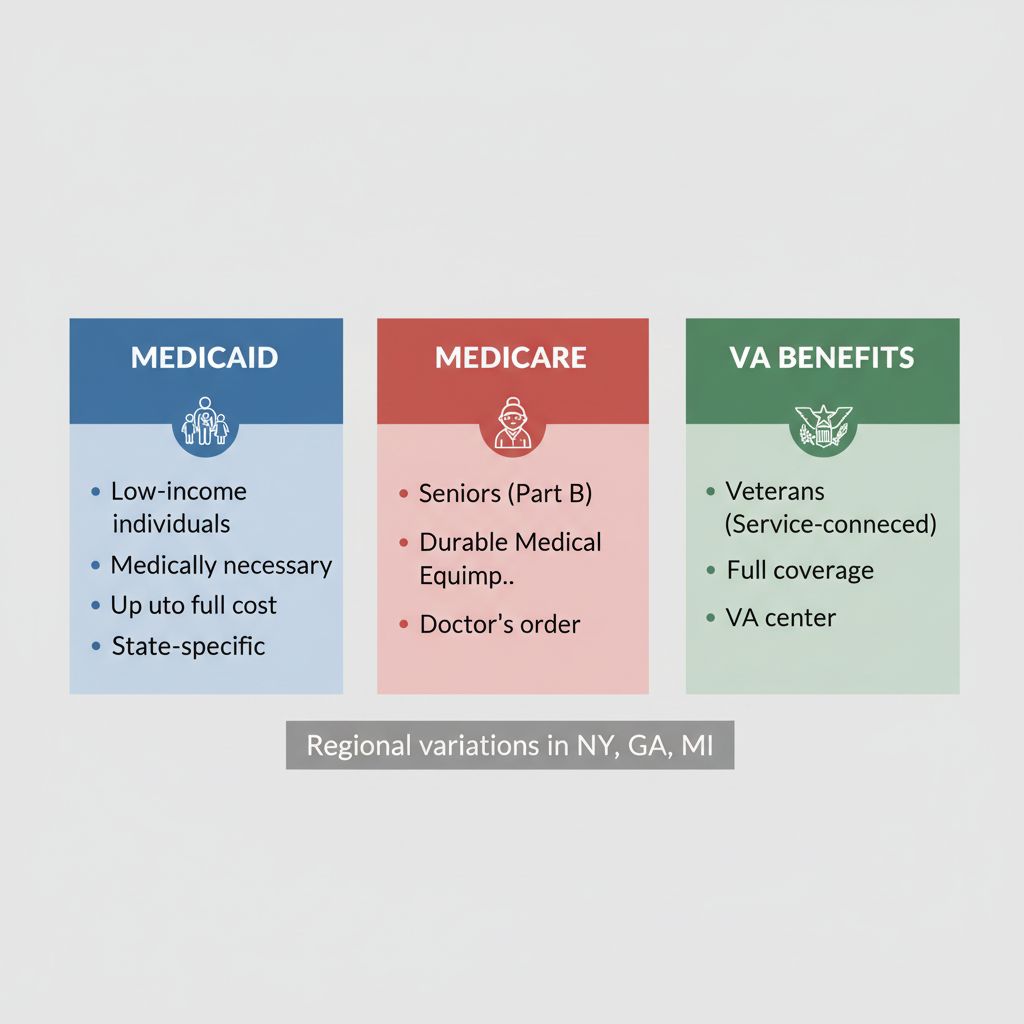
    Federal programs like Medicare set a baseline, but state variations add layers of complexity when comparing options for power wheelchairs. The following table outlines key differences to help you evaluate which might fit your situation best. Data sourced from CMS and VA guidelines ensures accuracy in eligibility and processes.

    ProgramEligibility CriteriaCoverage for Power WheelchairsApplication Process
    MedicaidLow-income individuals, medically necessaryUp to full cost if prescribedState-specific; submit medical documentation
    MedicareSeniors/disabled with Part BDurable medical equipment coverageDoctor’s order required
    VA BenefitsVeterans with service-connected disabilitiesFull coverage for eligible vetsVA medical center application

    This comparison highlights how Medicare emphasizes broad DME access for qualifying beneficiaries, while Medicaid offers flexibility through state waivers, and VA prioritizes service-related needs. Choosing the right program depends on your income, veteran status, and regional rules—factors we assess early to recommend the best path forward.

    Medicaid plays a crucial role in assistive device subsidies, particularly for low-income patients across our service areas. Coverage varies by state: in New York and Michigan, it often funds up to the full cost of prescribed power wheelchairs if deemed medically necessary, with approval rates around 85% when documentation is thorough, per CMS policies. Georgia’s Medicaid includes specific waivers for mobility funding initiatives, covering custom features for complex cases. We handle the paperwork, insurance navigation, and coordination, gathering doctor’s orders, financial statements, and home assessments to prove necessity. This empathetic approach acknowledges the financial stress of mobility loss, ensuring patients in Georgia receive tailored support without delays.

    VA Benefits

    For veterans, VA programs deliver robust wheelchair grants and adaptive equipment, covering full costs for those with service-connected disabilities. Eligibility requires enrollment in VA healthcare and a clinical evaluation confirming need, often through local medical centers. In New York, Georgia, and Michigan, we collaborate with VA providers to facilitate prescriptions and custom configurations, like heavy-duty bases for rugged lifestyles. This seamless integration restores confidence for vets pursuing active lives.

    At MedEquipped, we handle the paperwork, insurance navigation, and coordination from evaluation to delivery, typically within 30-60 days for faster processing. Our certified Assistive Technology Professionals (ATPs) conduct thorough assessments, tying clinical proof to funding requirements across these programs. Whether it’s Medicare’s rental options or Medicaid’s state-specific subsidies, we demystify the process with patient scenarios in mind, like helping a Georgia family secure VA coverage. This end-to-end service empowers you to access custom motorized wheelchairs without hassle, though results may vary and we recommend consulting healthcare professionals for personalized advice.

    Infographic comparing Medicaid, Medicare, and VA wheelchair funding programs with eligibility and coverage details

    Comparison of key wheelchair funding programs for mobility assistance

    Beyond these core options, additional wheelchair grants layer on top, offering even more tailored support for unique circumstances.

    Exploring Grants and Nonprofit Options

    When it comes to securing wheelchair funding, many individuals with mobility challenges turn to grants and nonprofit programs to make custom power wheelchairs more accessible. At MedEquipped, we specialize in guiding clients through these options, especially in New York, Georgia, and Michigan, where state-specific resources can significantly ease the financial burden. Our team integrates these funding sources into the clinical evaluation process, ensuring that your needs align with available programs for faster approvals and personalized solutions.

    Federal and State Grant Opportunities

    Federal programs like the section 5310 mobility grants play a vital role in supporting enhanced mobility for seniors and people with disabilities. Administered by the Federal Transit Administration, these grants fund capital costs for equipment such as wheelchair-accessible vehicles and lifts, with up to 80% federal matching for eligible projects. In our service areas, this translates to opportunities for individuals needing power wheelchairs to improve daily independence, often covering $5,000 or more when tied to transportation needs.

    State grants build on federal foundations, tailored to regional priorities. In New York, independence funds through the Office for People With Developmental Disabilities help cover assistive devices, requiring proof of medical necessity via clinical assessments. Georgia’s Division of Rehabilitation Services offers disability equipment subsidies for vocational rehab participants, focusing on work-related mobility. Michigan’s vocational rehabilitation program provides accessibility aid financing for those pursuing employment or education, with funding up to several thousand dollars based on case evaluations. We often help clients in these states connect their clinical needs—assessed by our certified Assistive Technology Professionals—to grant applications, streamlining documentation and highlighting how models like the ROVI X3 fit specific lifestyles.

    Eligibility typically includes being a low-income individual with a documented disability, confirmed by a physician’s letter and income verification under federal poverty guidelines. For instance, Section 5310 prioritizes those where traditional transit falls short, while state programs emphasize functional improvements. Application steps involve submitting needs assessments to designated state agencies, often coordinated with nonprofits; processing can take 60-90 days, but our expertise in paperwork navigation accelerates this.

    The following table compares key aspects of wheelchair grants versus traditional government programs, drawing from Department of Transportation and agency data:

    SourceTypical Funding AmountEligibility FocusProcessing Time
    Federal Grants (e.g., Section 5310)$5,000+ for equipmentSeniors/disabled, medical necessity60-90 days
    Nonprofit GrantsUp to full costLow-income, specific disabilities30-90 days
    Medicaid/MedicareFull/partial coverageIncome/medical necessity60+ days

    This comparison highlights how federal grants like Section 5310 offer substantial support but require coordination, while nonprofits provide quicker, flexible aid. Stacking these with state programs can cover comprehensive costs for power wheelchairs, and we assist in identifying overlaps to maximize benefits without delays.

    Nonprofit Assistance Programs

    Nonprofit organizations fill critical gaps in wheelchair grants, particularly for low-income individuals and those with disabilities seeking basic or specialized mobility aids. Groups like the free wheelchair mission distribute over 176 wheelchairs daily worldwide, focusing on underserved communities, though U.S.-based applicants can access similar domestic networks for power models. Other key players include the National Multiple Sclerosis Society and Easterseals, which offer targeted funding for adaptive equipment, often covering up to the full cost of devices like our QUICKIE Q700 M for enhanced outdoor performance.

    Eligibility centers on financial need and disability impact, with income thresholds around 200% of the federal poverty level and requirements for medical documentation, such as a functional mobility assessment. For example, programs prioritize applicants in rural Georgia or urban Michigan facing barriers to employment, using criteria like inability to self-propel manually. We see many clients qualify through these disability equipment subsidies, especially when paired with veteran benefits or low-income supports; bullet-point requirements often include:

    • Proof of disability via doctor’s certification
    • Household income statements
    • Description of how the wheelchair addresses daily challenges

    In New York, nonprofits coordinate with state aids for seamless applications, reducing hurdles like lengthy waitlists.

    At MedEquipped, our role in coordinating nonprofit assistance is hands-on—we handle the paperwork, insurance navigation, and coordination from initial intake to delivery, typically within 30-60 days for faster processing. For a client needing the TDX SP2 HD heavy-duty base, we gather eligibility proofs, align with Free Wheelchair Mission guidelines for basic funding, and submit on their behalf, ensuring custom features like adjustable seating are grant-eligible. This partnership not only simplifies the process but also educates patients on stacking funds, such as combining nonprofit grants with Medicaid for comprehensive coverage.

    To further illustrate options, here’s a comparison of grant types based on program data:

    Grant TypeTypical Funding AmountKey RequirementsBest For
    Federal$5,000+Medical necessity, state coord.Transportation integration
    State$1,000-$10,000Income proof, vocational goalsRegional needs like work
    NonprofitUp to full costDisability docs, low-income focusQuick aid for daily mobility

    Analyzing these, nonprofits often provide the speediest path for urgent needs, while federal and state layers add depth for complex cases. We encourage stacking where possible, as it empowers greater access to our custom motorized wheelchairs. This approach addresses common application challenges empathetically, helping you focus on mobility freedom rather than bureaucracy.

    Step-by-Step Application Processes

    Navigating wheelchair funding can feel overwhelming, but with clear steps, you can move forward confidently. We at MedEquipped are here as your partner in mobility freedom, handling the paperwork, insurance navigation, and coordination to simplify the process. In this section, we’ll outline general U.S. funding applications and dive into Georgia-specific wheelchair programs, empowering you with actionable guidance tailored to your needs in states like New York, Georgia, and Michigan.

    General US Funding Applications

    Applying for funding assistance for wheelchairs starts with a structured approach to ensure you’re prepared for success. We recommend beginning with a medical evaluation to establish necessity, followed by gathering essential documents. This process applies universally to programs like Medicare, Medicaid, and wheelchair grants, with some variations by state. For low-income individuals, many options prioritize accessibility, and stacking multiple funding sources is often possible to cover costs.

    Here are the seven key steps for general U.S. funding applications:

    1. Schedule a Medical Evaluation: Consult your physician for a face-to-face assessment confirming the need for a custom motorized wheelchair. This includes documenting your mobility limitations and home environment, as required by CMS guidelines for Medicare coverage.
    2. Gather Identification and Income Proof: Collect personal ID, proof of residency, and financial statements. For Medicaid, income verification is crucial, especially for low-income qualifiers.
    3. Obtain a Doctor’s Prescription: Secure a written order prior to delivery (WOPD) specifying the wheelchair type, such as a heavy-duty model for your needs.
    4. Complete Assessment Reports: Work with a certified Assistive Technology Professional (ATP) for a detailed functional evaluation, including photos or measurements of your space.
    5. Research Eligibility and Forms: Check program-specific requirements, like VA disability housing grants for veterans, which offer up to $126,526 for adaptations if you have service-connected disabilities.
    6. Submit the Application: Use online portals, mail, or in-person methods depending on the program. We handle submissions to streamline this.
    7. Follow Up and Track Progress: Monitor status via agency contacts and prepare for appeals if needed, with typical timelines ranging from 30 to 90 days.

    Preparing documentation early can prevent delays. For example, under Medicare, a doctor’s order and medical records are essential, while wheelchair grants for low-income individuals often require a needs statement. The following table compares requirements across programs, drawing from CMS and state guidelines, to help you organize:

    ProgramKey Documents NeededSubmission MethodTypical Approval Time
    MedicareDoctor’s order, medical recordsOnline/physician submit30-60 days
    Georgia MedicaidIncome proof, assessment reportState portal/mail45-90 days
    Nonprofit GrantsApplication form, photos/needs statementOnline/email30-60 days

    This comparison highlights the importance of tailoring your packet to each source. At MedEquipped, we assist with these submissions, often reducing wait times to our standard 30-60 days for processing. Tips for smooth approvals include starting with early clinical fittings to demonstrate urgency and contacting us at 845-237-2381 for personalized checklists. Remember, results may vary; individual outcomes are not guaranteed. For veterans, VA applications through regional offices can cover wheelchair-related home modifications, with eligibility based on service-connected conditions like limb loss.

    Funding amounts from wheelchair grants vary, but programs like those from nonprofits can provide $1,000 to $5,000, while federal options scale higher for complex needs. Always consult a healthcare professional for advice tailored to your situation.

    Georgia-Specific Wheelchair Programs

    In Georgia, state resources through the Department of Community Health offer robust support for wheelchair funding, particularly via Medicaid waivers for mobility aids. These programs focus on eligible residents with disabilities, emphasizing low-income access and timely processing. As a key service state for us at MedEquipped, we coordinate closely with local agencies to expedite approvals, making Georgia wheelchair programs more accessible.

    Eligibility typically requires Georgia residency, a qualifying disability, and income under state thresholds for Medicaid. For wheelchair grants, low-income individuals can access up to $10,000 through state-funded initiatives, though amounts depend on needs assessments. Grant qualification steps mirror federal ones but include state-specific forms like the Medicaid Waiver Application.

    Here’s a streamlined process for Georgia applications:

    1. Initial Intake with State Resources: Contact the Georgia Department of Community Health for a preliminary eligibility screening, providing basic ID and medical history.
    2. Medical and Functional Assessment: Undergo an in-home evaluation by a licensed provider to justify the custom motorized wheelchair.
    3. Compile State-Specific Documents: Include income proof, a physician’s certification, and details on daily living impacts, as outlined in state guidelines.
    4. Submit via Georgia Portals: Use the state’s online system or mail to the Division of Medicaid Services, often with our assistance for completeness.
    5. Await Review and Follow Up: Expect state reviews within 45 days; we track progress and handle any supplemental requests.
    6. Integrate Federal Stacking: Combine with Medicare or VA funds if applicable, maximizing coverage without duplication.

    We make the Georgia application straightforward by serving as your central coordinator. Our team at MedEquipped manages funding applications in Georgia, from document review to submission, leveraging our expertise to cut typical delays. For instance, while federal Medicaid might take 90 days, state processing often aligns closer to 45-60 days with our involvement. Reach out to intake@medequipped.com for a free consultation.

    To illustrate differences, consider this table on state versus federal timelines:

    Timeline AspectFederal Programs (e.g., Medicare)Georgia State Programs
    Initial Review30 days15-30 days
    Full Approval60-90 days45-75 days
    With Assistance30-60 days (via MedEquipped)30-45 days

    Post-approval tips include scheduling delivery fittings promptly. Information is for informational purposes only and not medical advice. We’re committed to your mobility journey in Georgia and beyond.

    Veteran and Advanced Funding Strategies

    Veterans facing mobility challenges deserve accessible paths to independence, and wheelchair funding plays a crucial role in achieving that. At MedEquipped, we specialize in guiding veterans through specialized options like VA programs and nonprofit grants, tailored for states such as New York, Georgia, and Michigan. These resources can cover custom motorized wheelchairs, ensuring you get the right fit for your needs.

    VA programs offer robust support for veterans with service-connected disabilities rated at 10% or higher. Programs like the Specially Adapted Housing (SAH) grant and CHAMPVA provide funding for adaptive equipment, including power wheelchairs essential for daily living. Eligibility typically requires proof of a qualifying disability, such as limb loss or severe vision impairment, and ownership or intent to purchase a home. We handle the paperwork, insurance navigation, and coordination to streamline applications, drawing from official VA guidelines that emphasize medical necessity. For instance, the SAH grant covers up to $126,526 for FY 2026, usable for multiple lifetime adaptations. Applications involve submitting service records and physician prescriptions through VA centers, with processing times around 30-60 days according to VA data. This veteran wheelchair grants pathway ensures comprehensive coverage for full adaptive setups, helping you regain mobility without financial strain.

    Many veterans encounter delays or gaps in standard funding, navigating bureaucratic hurdles while managing health needs. This is where comparing options becomes key to finding the best fit.

    OptionEligibilityCoverage DetailsApplication Timeline
    VA ProgramsService-connected disabilityFull adaptive equipmentVA center processing, 30-60 days
    Nonprofit Veteran GrantsHonorably discharged, need-basedSupplemental funding up to $5,000Online apps, 45 days avg

    As shown in the table, VA options provide deeper coverage but may take longer, while nonprofits offer quicker supplemental aid sourced from organizations supporting disabled vets. Sourced from VA and nonprofit resources, this comparison highlights how to layer funds effectively.

    Building on VA benefits, stacking with Medicaid can cover remaining costs for enhanced setups. For example, after VA approval, Medicaid in New York or Georgia might fund accessories not fully reimbursed. Nonprofits like those for military mobility assistance fill gaps, providing up to $5,000 for wheelchairs based on honorably discharged status and financial need. Applications are straightforward online, averaging 45 days, and often require basic documentation like DD-214 forms.

    At MedEquipped, we honor veterans by offering ATP evaluations compliant with VA standards, customizing power wheelchair models like the heavy-duty TDX SP2 HD for complex cases. Our 30-60 days processing ensures faster access. Here are key strategies:

    • Gather service records and medical notes early to speed eligibility.
    • Combine veteran adaptive funding with state Medicaid for full coverage.
    • Partner with us for ongoing support, from delivery to adjustments.

    We provide veteran-specific guidance, answering common questions on timelines and applications to ease your journey toward mobility freedom. Consult a healthcare professional for personalized advice; results may vary.

    Frequently Asked Questions on Funding

    We understand wheelchair funding can feel overwhelming, so here are answers to common queries to guide you through the process in New York, Georgia, and Michigan.

    What are the eligibility requirements for wheelchair grants? Medicare Part B covers medically necessary power wheelchairs after a doctor’s exam and prescription. We verify coverage and handle paperwork to simplify eligibility.

    How long are Medicaid wait times for wheelchair funding in Georgia? Wait times vary by state but typically range from 30-60 days; we expedite processing with evaluations to get you moving faster.

    What if my grant denial for wheelchair funding is appealed? Appeals require detailed medical documentation; our team assists with resubmissions, often resolving issues within weeks—contact us at intake@medequipped.com.

    Can I combine funds for wheelchair grants and insurance? Yes, blending Medicare, Medicaid, or private sources is common; we coordinate multiple payers to cover medequipped custom wheelchairs tailored to your needs.

    What tips help low-income patients access veteran wheelchair grants? Prioritize VA certifications and explore state aids; for veterans in Michigan, we guide applications and provide low-cost evaluation options.

    Are there deadlines for wheelchair funding in New York? Applications should start early to meet insurer timelines; our 30-60 day process ensures prompt delivery—reach us at (845) 237-2381 for help.

    In wrapping up your wheelchair funding journey, we’ve explored key options like Medicaid, wheelchair grants, and veteran wheelchair grants to secure the mobility you need. Whether navigating steps in New York, funding in Georgia, or services in Michigan, clinical evaluations ensure the perfect fit, while we handle the paperwork, insurance navigation, and coordination for a smoother process. Our 30-60 days faster processing gets you moving sooner.

    As your partner in mobility freedom, we’re here to provide personalized guidance toward independence. Contact us today at 845-237-2381 or intake@medequipped.com to start your custom motorized wheelchair path—we look forward to supporting you every step of the way.

    Resources

  • Wheelchair Fitting Services Near You: Expert Custom Seating

    Wheelchair Fitting Services Near You: Expert Custom Seating

    Table of Contents

    Understanding Wheelchair Fitting Services in Georgia

    At MedEquipped, we understand how vital proper mobility is for daily life. Wheelchair fitting services in Georgia play a crucial role for individuals with complex needs, offering comprehensive assessments to ensure optimal positioning, function, and comfort. These services, including wheelchair seating evaluations, help prevent issues like pressure sores while enhancing independence and safety in everyday activities.

    We at MedEquipped provide end-to-end custom motorized wheelchairs tailored to your unique lifestyle. Our certified Assistive Technology Professionals (ATPs) conduct personalized wheelchair configurations through clinical evaluations, guiding you from initial mobility assessment services to final delivery. Serving areas like Atlanta and surrounding regions, we handle the paperwork, insurance navigation, and coordination to streamline the process. For instance, a Georgia resident with limited mobility regained confidence navigating their home and community after our custom wheelchair seating addressed their specific posture needs. With our faster processing of 30-60 days, you can focus on what matters most as your partner in mobility freedom.

    As we explore the fundamentals of wheelchair fittings next, discover how these services transform lives in Georgia. Our ongoing support ensures long-term satisfaction, and we’re here to answer your questions. Contact us at intake@medequipped.com or call (845) 237-2381 during business hours, Monday through Friday, 9:00 a.m. to 5:00 p.m. Learn more about our custom power wheelchair solutions today.

    Fundamentals of Wheelchair Fitting Services

    At MedEquipped, we specialize in wheelchair fitting services in Georgia, ensuring every patient receives a mobility solution tailored to their unique needs. These services form the foundation of safe and effective wheelchair use, starting with a thorough wheelchair seating evaluation that matches the chair to the individual’s anatomy, lifestyle, and environment. As experts in durable medical equipment or what is dme, we integrate clinical assessments to promote long-term health and independence.

    Wheelchair fitting is a precise clinical process that aligns the equipment with a user’s physical requirements and daily activities. Key components include posture assessment to evaluate spinal alignment, pressure distribution analysis to prevent skin breakdown, and control selection for intuitive operation. Our certified Assistive Technology Professionals (ATPs), credentialed through RESNA standards, conduct these mobility positioning assessments using evidence-based tools. For instance, measurements of seat depth, back height, and armrest positioning ensure comfort during extended use. This foundational step, often called wheelchair seating evaluation, sets the stage for customized configurations that enhance functionality without compromising safety.

    Proper fitting is crucial for reducing health risks and boosting quality of life. Ill-fitted wheelchairs can lead to secondary complications like pressure ulcers, which affect up to 60% of users without adequate support, according to NCBI research. By prioritizing custom wheelchair seating, we help prevent such issues while improving posture and stability. Patients gain greater independence, whether navigating urban Atlanta streets or rural Georgia paths. For example, a tailored cushion can distribute weight evenly, minimizing pain and allowing longer periods of mobility. We handle these details to empower our clients, turning potential challenges into opportunities for freedom.

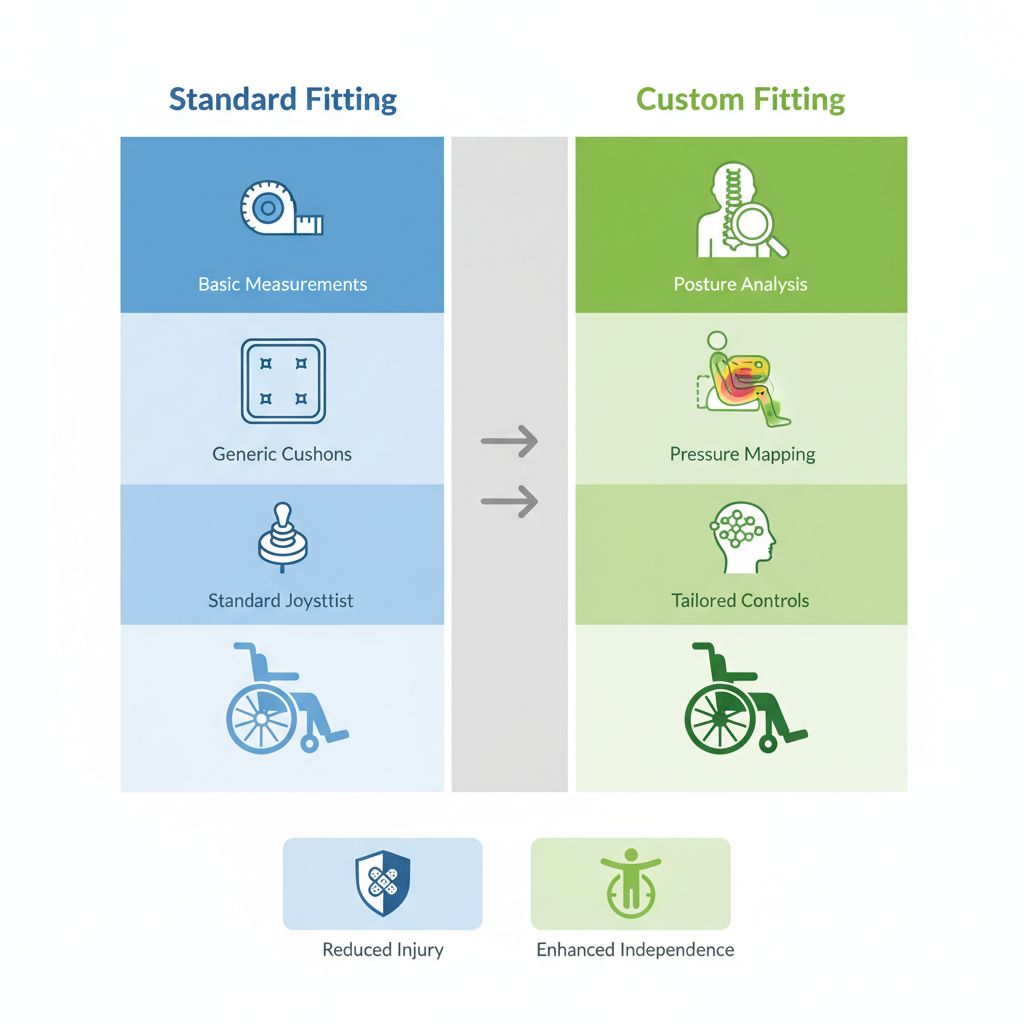
    The following table highlights the differences between basic and advanced wheelchair fitting components, showing how we go beyond generics for superior outcomes.

    Component Standard Fitting Custom Fitting (MedEquipped Approach)
    Assessment Type Basic measurements and quick setup Individualized clinical evaluation by ATPs including posture and lifestyle analysis
    Seating Customization Generic cushions Patient-specific pressure mapping and contoured seating
    Control Options Standard joystick Tailored controls like head arrays for complex needs

    Fundamentals like basic measurements provide a starting point, but they often overlook nuanced needs such as individual posture or environmental factors. At MedEquipped, we build on these by incorporating comprehensive wheelchair seating evaluations that analyze lifestyle and terrain, leading to truly adaptive solutions. This progression ensures fittings evolve from simple setups to dynamic systems that support daily activities.

    Infographic illustrating comparison between standard and custom wheelchair fitting services with icons for measurements, cushions, controls, and benefits.

    Comparison of standard vs custom wheelchair fitting components

    Deep Dive into the Wheelchair Fitting Process

    Initial Assessment and Measurements

    We begin the wheelchair fitting process with a thorough initial assessment, starting with a detailed review of your medical history and daily lifestyle. Our ATPs, certified by RESNA, discuss any existing conditions, previous mobility aids, and goals like navigating your home in Georgia or participating in community activities.

    Seating and Control Customization

    Building on the initial assessment, we dive into seating and control customization to create a truly personalized mobility solution. Our team analyzes evaluation findings to select bespoke positioning systems that address your posture and prevent complications. For instance, we use pressure mapping technology—similar to benchmarks from a wheelchair seating clinic—to identify high-risk areas and recommend cushions that distribute weight evenly.

    Stage General Provider MedEquipped (Georgia-Focused)
    Initial Assessment Basic intake, 1-2 visits ATP-led evaluation, 1 comprehensive visit
    Seating Configuration Standard options, 4-6 weeks Custom mapping, 2-4 weeks processing
    Delivery Timeline 2-3 months average Expedited 30-60 days

    Insurance and Delivery Coordination

    Navigating insurance for your custom motorized wheelchair is where our expertise shines. In Georgia, we partner closely with providers like Medicare and private insurers to secure approvals efficiently. Once approved, we coordinate production and delivery, targeting our standard 30-60 days for faster processing.

    Practical Steps for Accessing Wheelchair Fittings in Georgia

    Scheduling Your Evaluation

    1. Reach out to us to start your wheelchair seating evaluation. Call 845-237-2381 or email intake@medequipped.com.
    2. During the intake call, share basic details about your condition. Our staff will check insurance eligibility.
    3. Confirm your appointment. We offer mobile evaluations for added convenience.

    Preparing for the Fitting Session

    Item Patient Prepares MedEquipped Handles
    Medical History Provide recent records Coordinate with prescribers
    Insurance Details Gather policy info Full navigation and pre-approval

    Post-Fitting Support and Adjustments

    After delivery, our commitment continues with comprehensive adjustment services post-fitting to ensure your custom motorized wheelchair performs optimally. We schedule follow-up visits within the first few weeks to fine-tune controls and seating based on your feedback.

    Advanced Considerations for Complex Wheelchair Fittings

    When it comes to wheelchair fitting services in Georgia, complex cases require more than basic setups. We specialize in high-needs scenarios like neurological impairments or bariatric requirements. Our team uses the wheelchair evaluation process to measure factors like posture and skin integrity.

    Need Type Standard Approach MedEquipped Advanced
    Heavy-Duty Bases Basic reinforcement TDX SP2 HD with custom configs
    Neuro Conditions Generic adjustments ATP-specialized pressure mapping

    Common Questions About Wheelchair Fittings in Georgia

    What is a wheelchair seating evaluation?
    A wheelchair seating evaluation is a clinical assessment where our certified Assistive Technology Professionals (ATPs) measure your body and review medical needs to ensure proper fit.

    How long does custom wheelchair seating take in Georgia?
    Custom wheelchair seating typically takes 30-60 days with us, thanks to our streamlined process.

    Next Steps for Enhanced Mobility in Georgia

    Proper wheelchair fitting services in Georgia are essential for enhancing independence and daily comfort. Ready to get started? Contact us at 845-237-2381 or intake@medequipped.com to schedule a consultation.

    Resources