
Parent Perceptions of Powered Mobility: A Guide for Parents
Table of Contents What Parents Should Know About Powered Mobility for Children Does a Powered Wheelchair Delay Walking? How Powered Mobility Supports…
Read More
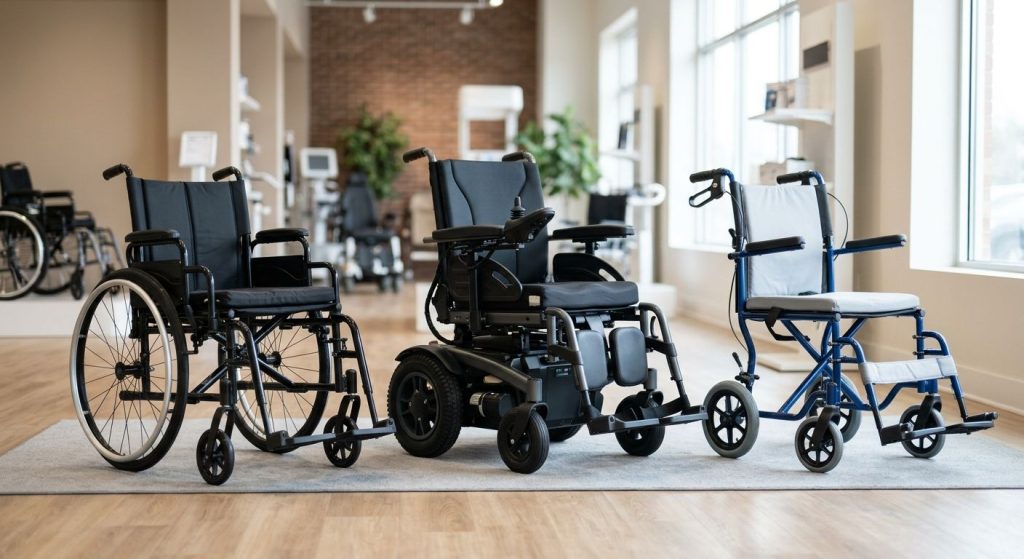
There are three kinds of wheelchairs: manual wheelchair that is either self propelled or pushed by the carer, powered wheelchair that is battery operated to provide independence for the user in moving around, and transport wheelchair that can be wheeled manually by another person for short trips only.
Choosing the appropriate wheelchair has many ramifications such as functional capability, patient usage ability, caregiver participation, payment options and pathways. Medicare Part B will cover a wheelchair if there is a lack of ability for ambulation that is medically necessary in its use, but in some cases prior authorization must be obtained via the durable medical equipment supplier. In order to qualify for this benefit, there must be a face-to-face examination performed and a written prescription from the physician treating the patient. The type of wheelchair utilized plays a major role in the approval and ultimate insurance coverage of the wheelchair.
We help patients navigate this process by conducting the initial evaluation, providing personalized fittings, and verifying Medicare benefits so the right type of chair is matched to each person’s needs. Our goal is to ensure the chosen wheelchair supports independence and comfort while aligning with funding requirements.
The rest of this guide breaks down each type in detail, examining its design, ideal user, and practical considerations to help you make an informed choice.
There are also three different kinds of wheelchair: manual, motorized and transport. Each serves its own specific purpose. Knowing what those purposes are will help the patient and carer choose which type is most appropriate for them in terms of comfort, independence, and whether it can be covered under insurance. power (motorized)
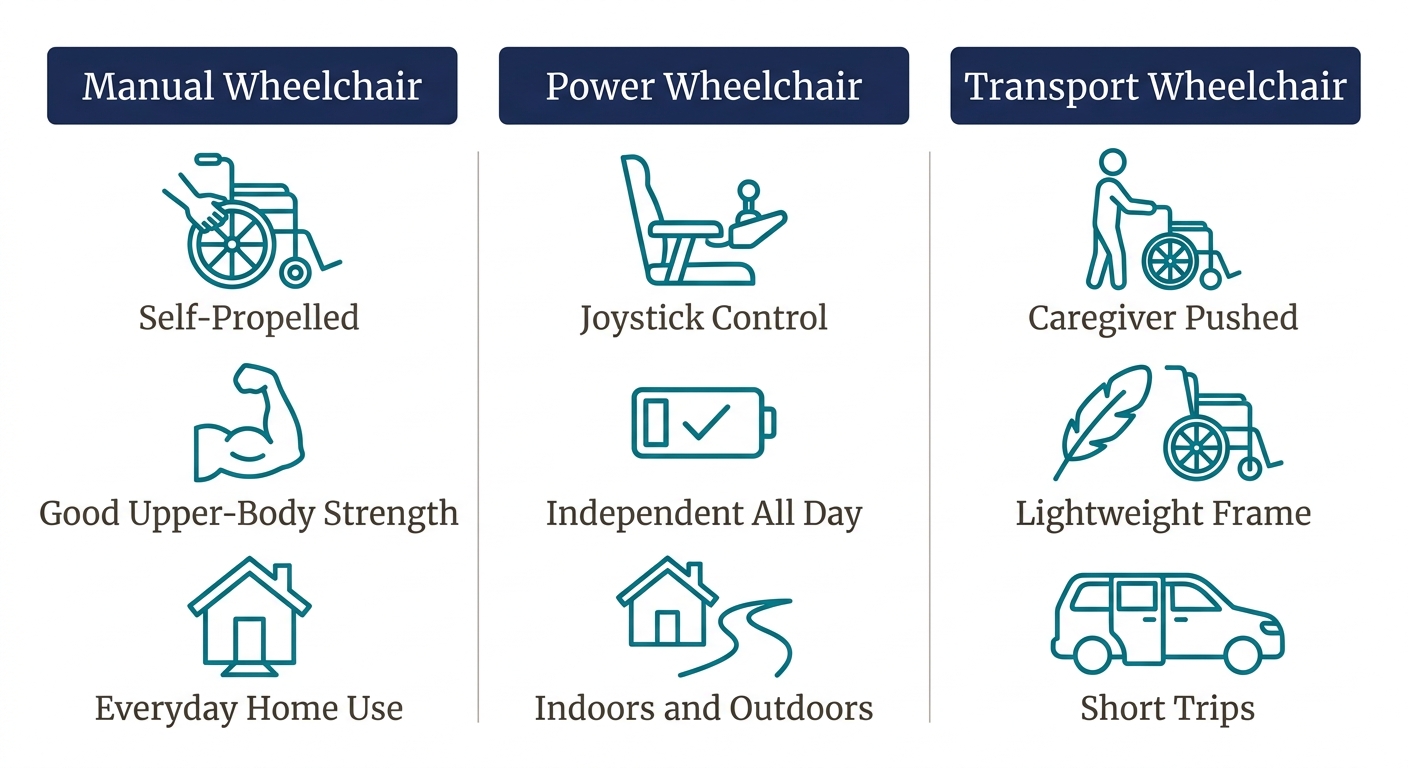
Manual wheelchairs are propelled using the user’s upper body strength or the help of a carer. These types of wheelchair are suitable for people who are able to propel themselves or those that need partial care, making them ideal for everyday use in controlled indoor settings where transfers are manageable. The simple structure of manual wheelchairs allows them to fold quickly and be moved around easily, therefore making this type of chair portable.
Power (motorized) wheelchairs operate via battery-powered motors controlled by a joystick or alternative input devices. These chairs empower users with limited mobility to navigate independently both indoors and outdoors, supporting full-day use and reducing reliance on caregivers. Their customizable seating and advanced maneuverability make them a preferred choice for individuals seeking greater independence and comfort over extended periods.
Transport wheelchairs are lightweight chairs pushed by a caregiver and are designed for short outings, medical appointments, or travel. For this reason they have little self propulsion capability and rely instead upon another individual pushing them around. Their compact size and foldability enhance convenience during brief trips and temporary use. These are typically available in smaller sizes and folding models too.
As outlined in their information, there is a difference here that can impact coverage under Part B of Medicare, as wheelchairs are considered durable medical equipment if they are necessary because of a condition. To be eligible you will need a face-to-face evaluation, a written prescription from your physician, and, with power wheelchairs, this may also include prior authorization from the vendor. Determining whether the correct type has been selected is dependent upon both clinical considerations as well as coverage issues.
| Wheelchair Type | Propulsion Method | Primary User Profile | Best Environment |
|---|---|---|---|
| Manual Wheelchair | User’s arms or caregiver’s push | Individuals with good upper-body strength or part-time mobility needs | Indoor/everyday use with transfer ability |
| Power (Motorized) Wheelchair | Joystick or electric controls | Users with limited mobility requiring independent movement | Full-day independent use indoors and outdoors |
| Transport Wheelchair | Caregiver’s push handles | Users needing seated mobility with a caregiver present | Short outings, appointments, and travel |
The information provided can be used by both the patient and the caregiver in making an informed decision about the specific wheelchair that should be prescribed based upon their ability, environment and propulsion needs.
The following explains how Medicare qualifies power wheelchairs for coverage. It turns out that Medicare Part B covers wheelchairs and power-operated scooters as Durable Medical Equipment when they are medically necessary for beneficiaries with limited walking ability. Suppliers must be enrolled in Medicare and accept assignment to ensure standard cost-sharing applies.
There are three fundamental aspects to meeting qualifications in order to acquire a power wheelchair through Medicare Part B. First, a licensed healthcare provider must determine that the chair is medically necessary for your condition. Secondly, you must have a documented diagnosis that limits your ability to walk. Lastly, you must obtain the wheelchair from a Medicare-enrolled supplier who accepts assignment. Official Medicare guidance emphasizes that coverage hinges on these medical and supplier criteria.
By prescribing power wheelchairs only when they’re necessary, we avoid waste and make sure funding goes where it benefits the greatest numbers of people. The process protects both patients and the Medicare program by confirming medical necessity through professional evaluation and documented clinical need.
Medicare necessitates a personal meeting between you and your attending physician prior to purchasing a wheelchair. At that time, the doctor will conduct an evaluation of your mobility requirements and determine why a power wheelchair is essential for you. He’ll then provide the required written prescription specifying the chair’s features and intended use.
Keeping copies of both the exam records and prescription is essential. These documents serve as the foundation for the supplier’s prior authorization request and your own records. Without them, the approval process can stall, leading to delays in receiving the equipment you need. This documentation also helps ensure that the chosen chair aligns with your clinical needs and lifestyle requirements.
Most power wheelchairs require prior authorization, a process managed by the DME supplier. The supplier submits clinical documentation to Medicare on your behalf, streamlining approval and reducing delays. After you meet the Part B deductible, you typically pay 20% of the Medicare-approved amount.
If your supplier does not accept assignment, you may owe more upfront, so confirm participation before ordering. We’re here to help verify your benefits and coordinate paperwork so you can focus on choosing the right chair for your needs.
Doctors’ prescriptions have to take into account the intended usage location, that is if the wheelchair be for indoor use, outdoor use, or both, as this can have implications for patients and their caregivers. Here we discuss which design features play different roles in these environments, as well as how the three types differ.
Power chairs offer easy maneuvering inside small spaces because their compact turning radii and responsive joysticks allow effortless navigation through doorways and around furniture. These models have wider bases and larger rear wheels that also enhance stability on indoor surfaces like tile or hardwood.
Manual wheelchairs can be used inside buildings; however, they need more force when turning around in restricted locations. Transport wheelchairs aren’t designed primarily for independent use inside structures.
The situation is different outdoors, with uneven paths and longer distances. Power chairs with suspension or larger rear wheels help when going over grassy areas, gravel, or sidewalk cracks, making it smoother than manual chairs. Furthermore, their battery range allows you to take additional trips without tiring.
Manual wheelchairs may go outside, though you’ll need lots of upper body strength to push them around rocks, sand and up hills. Transport chairs aren’t meant for going anywhere on their own out in public.
The following table compares key performance factors across the three types:
| Environment Factor | Manual Wheelchair | Power (Motorized) Wheelchair | Transport Wheelchair |
|---|---|---|---|
| Turning Radius in Tight Spaces | limited | strong | moderate |
| Terrain and Surface Handling | moderate | strong | limited |
| Distance and Endurance | moderate | strong | limited |
| User Independence | moderate | strong | limited |
Individual models vary, and these ratings reflect typical characteristics rather than specifications. Weighing these tradeoffs helps patients and caregivers choose the right type for their primary environment and lifestyle.
When people ask what are the three types of wheelchairs, the answer begins with manual wheelchairs, power wheelchairs, and scooters. Each type serves distinct mobility needs, so the best choice depends on how you plan to use the chair daily. Start by honestly assessing your usage: how many hours per day you’ll need the chair, where you’ll use it most, and whether you’ll rely on it independently or with caregiver assistance.
Full-day independent users often find powered mobility the most practical solution. A power wheelchair or scooter provides sustained energy and reduces fatigue. Occasional users with sufficient upper-body strength may manage well with a manual chair, especially if they only need it for short trips or light activity.
For caregiver-assisted short trips, the weight and transportability of a manual chair often outweigh the benefits of self-propulsion. A lightweight, foldable manual chair can simplify trips to appointments or outings.
A power wheelchair that has custom-made seating systems would be suitable if you require a certain level of pressure relief and postural support. The positioning of seating, backrests, seat cushions may all be customized easily within this kind of chair.
People who navigate confined areas benefit from compact chairs with a small turning radius. People in manual wheelchairs built specially for tight indoor spaces, as well as those in electric wheelchairs equipped with midwheel drives, have an easy time navigating these spaces.
When you’re in an outdoor environment or want to travel over greater distances, power wheelchairs and scooters come out on top. They can deal much better with uneven sidewalks, grass and hills as compared to manual chairs. outdoor terrain and longer distances
Below are some common wheelchair attributes that can help in determining which category will be most suitable for your needs:
| Your Feature Priority | Best-Matching Wheelchair Type | Why It Matters |
|---|---|---|
| Full-Day Independent Mobility | Power wheelchair or scooter | Sustained energy and reduced fatigue for active lifestyles |
| Upper-Body Strength and Occasional Use | Manual wheelchair | Lightweight and efficient for short trips with adequate strength |
| Caregiver-Assisted Short Trips | Lightweight manual wheelchair | Easier to transport and fold for trips with assistance |
| Pressure Relief and Postural Support | Power wheelchair with custom seating | Adjustable angles and cushioning prevent pressure sores and support alignment |
| Tight Indoor Spaces | Compact manual or mid-wheel power wheelchair | Small turning radius improves maneuverability in small areas |
| Outdoor Terrain and Distance | Power wheelchair or scooter | Handles uneven surfaces and long distances with less strain |
Identify your top one or two priorities in the left column and read across to see which type aligns best with your needs. Most people’s real-world answer blends priorities, so a professional evaluation is essential to fine-tune the choice.
Thereby, if you intend to buy a wheelchair or mobility scooter, please be reminded that Medicare will need a physical exam conducted by your treating doctor as well as a written prescription in order to ascertain whether the device is medically necessary or not. Our crew at MedEquipped can help patients overcome such hurdles by checking Medicare benefits and handling the paperwork needed for approval.
If a user finds his wheelchair of preference, then the next layer of the decision is about the technology involved and how well this sits over the body. Power assist technology can make a meaningful difference in comfort and long-term health, especially if your condition is complex.
These power wheelchairs activate the rear wheel as you push on the wheels, supplementing the user’s own pushes with rear-wheel torque and reducing the physical strain of manual propulsion. Peer reviewed research out of the University of Pittsburgh reports that people with tetraplegia have significantly fewer strokes per minute if they are using a Pushrim Activated Power Assist Wheelchair (PAPAW) at any resistance level. Their acromion excursion decreased from 90mm to 46mm in high resistance. This suggests less joint motion, and likely less shoulder pain. Importantly, the power assist scaled with resistance, keeping user effort relatively stable rather than eliminating the need to push entirely. This helps reduce shoulder pain due to its high occurrence rate among manual wheelchair users, which affects about 51%.
If users have certain diagnoses, their seating will often need to be configured specifically to meet clinical positioning requirements. A user’s wheelchair should match both their body as well as any medical considerations that might be relevant, ensuring that they feel comfortable when sitting in the chair and can use it properly. To determine if a patient’s seat needs configuring, we evaluate patients’ seating systems using clinical measures along with functional trials. This lets us adapt the seating system according to each patient’s individual requirements and help them avoid secondary complications while increasing daily mobility.
What are the three types of wheelchairs?
The three main categories are manual wheelchairs, standard power wheelchairs, and custom motorized wheelchairs.
Does Medicare cover wheelchairs, and what does eligibility require?
Medicare Part B covers wheelchairs and scooters as durable medical equipment when they are medically necessary for people with limited walking ability. Eligibility requires a face-to-face examination and a written prescription from your treating physician.
If I need a wheelchair under Medicare, how much will I pay out of pocket?
After the Part B deductible has been paid, the beneficiary usually pays 20% of the Medicare-approved amount. The supplier must be enrolled in the program and agree to assignment to avoid additional expenses. Our staff can assist you in securing any necessary prior approval for power wheelchairs.
Manual wheelchairs are self-propelled by the user or pushed by a caregiver and suit people with upper-body strength or part-time needs. Power wheelchairs use batteries and joysticks for independent mobility indoors and outdoors. Transport wheelchairs are lightweight, caregiver-pushed chairs designed only for short trips or appointments.
Medicare Part B covers power wheelchairs when a licensed healthcare provider determines they are medically necessary for limited walking ability. You must have a face-to-face exam, a written prescription, and the wheelchair must come from a Medicare-enrolled supplier who accepts assignment.
Power wheelchairs offer compact turning radii and responsive controls for tight indoor spaces. For outdoor travel, power wheelchairs with suspension or larger rear wheels handle uneven terrain and longer distances better than manual or transport chairs.
Both require a face-to-face physician exam and a written prescription, but power wheelchairs often need prior authorization from the supplier. Medicare documentation for manual wheelchairs focuses on mobility limitations and safe operation capability.
Consider daily usage hours, indoor versus outdoor environments, upper-body strength, need for pressure relief, and whether you require independent mobility. Power wheelchairs suit full-day use and complex needs, manual chairs work for occasional use with strength, and transport chairs assist with short trips.
Now that you understand the differences between the three types of wheelchairs, you can approach your selection with clarity and confidence. Medicare Part B covers wheelchairs and scooters when medically necessary, but coverage isn’t automatic—verify your benefits before proceeding.
This starts off with an actual physical examination as well as a written order prescribed by your medical doctor. We are here at Spring Valley to assist in any way needed.
The results can differ; please check if your Medicare/insurance plan will pay for this, because the supplier does not guarantee approval.
You now understand the three types of wheelchairs — manual, power, and transport — and how each performs indoors and outdoors for different users. You also know the Medicare pathway starts with a face-to-face examination and a written prescription from your physician. Turning that knowledge into the right chair involves personalized fittings and benefits verification, which is where MedEquipped can help. Our team in Spring Valley, New York guides patients through evaluation, funding navigation, and the paperwork Medicare requires, so results may vary but you won’t navigate it alone. We are located at 747 Chestnut Ridge Road, Spring Valley, NY 10977, and you can reach us at (845) 237-2381. Reach out today to schedule your initial evaluation and take the next step toward greater independence.
Table of Contents What Parents Should Know About Powered Mobility for Children Does a Powered Wheelchair Delay Walking? How Powered Mobility Supports…
Read More
Table of Contents The Most Difficult Challenges for Wheelchair Users in Spring Valley, New York Understanding Physical and Environmental Accessibility Barriers How…
Read More
Table of Contents The Professional Approach to Power Wheelchair Programming Before You Begin: Preparing for Programming Step 1: Understand Your Controller and…
Read More