MedEquipped

Category: Mobility Solutions

  • Lateral Trunk Supports: Essential Guide for Seating Needs

    Lateral Trunk Supports: Essential Guide for Seating Needs

    Table of Contents

    Understanding Lateral Trunk Supports for Power Wheelchairs

    Building on the power wheelchair options we examined earlier, the right seating and positioning setup can make a significant difference in long-term comfort and health. Lateral trunk supports for power wheelchairs are accessories that help stabilize the torso and prevent leaning to one side. These supports come in fixed or adjustable designs. Options like pivot, swing-away, and depth-adjustable models accommodate a wide range of body shapes. Within a custom power wheelchair seating and positioning system, lateral supports contribute to better postural alignment and can make it easier to stay comfortable throughout the day. They also help maintain a midline trunk position, which can reduce fatigue during long periods of sitting.

    Lateral trunk supports are a key element of complex rehabilitation technology, a category that addresses highly individualized mobility needs. According to standards set by RESNA, assistive technology components like trunk supports are evaluated for durability and safety. When paired with pressure redistribution cushions, trunk supports help distribute weight more evenly, which may reduce the risk of skin breakdown and musculoskeletal strain over time. Over months of daily use, this thoughtful configuration can support healthier sitting postures and contribute to greater independence.

    If you are considering lateral trunk supports for your power wheelchair, our team can help you understand which configuration suits your daily routine. In the next section, we’ll walk through the clinical evaluation and fitting process we use at MedEquipped to match supports to your body and lifestyle. As always, consult a healthcare professional before making clinical decisions.

    The Clinical Role of Lateral Trunk Supports in Power Wheelchair Seating

    Lateral trunk supports are an essential component of custom power wheelchair seating and positioning, specifically designed to maintain midline trunk alignment and counteract lateral lean. Without adequate support, gravity can pull the trunk to one side, leading to spinal curvature, pelvic obliquity, and an increased risk of pressure injuries. By keeping the torso centered over the pelvis, these supports help redistribute pressure more uniformly across the seating surface and work in tandem with pressure redistribution cushions to protect vulnerable areas. At MedEquipped, we integrate lateral supports into comprehensive mobility solutions, always guided by RESNA (Rehabilitation Engineering and Assistive Technology Society of North America) standards for wheelchair seating.

    Lateral trunk supports come in two main mounting configurations: fixed-mount and height-adjustable. A fixed-mount support attaches the pad in a static position, delivering exceptional stability with no moving parts that could loosen over time. A height-adjustable support, in contrast, allows vertical repositioning of the pad without tools, making it easier to accommodate changes in trunk posture as a patient’s condition progresses or improves.

    The following table compares these two mounting options across several clinically relevant features.

    Comparison of Fixed-Mount and Height-Adjustable Lateral Trunk Supports
    FeatureFixed-MountHeight-Adjustable
    AdjustabilityLimited; support pad position is static once installed.Allows vertical repositioning of the support pad without tools.
    StabilityVery stable; no moving parts that could loosen over time.Stable when locked; possible minor movement with repeated adjustments.
    Clinical UseBest for patients with stable trunk posture and predictable positioning needs.Ideal for patients whose trunk posture changes over time or requires fine-tuning.
    Ease of AdjustmentRequires tools and reinstallation to change position.Tool-free or minimal tool adjustment allows quick changes.
    Swing-Away CapabilityNot available; must be unbolted for transfers.Often available as swing-away model to facilitate safe transfers.

    For a patient with a stable trunk posture who does not anticipate changes, a fixed-mount support provides dependable, consistent alignment. For individuals whose positioning needs may evolve—due to progressive neurological conditions, recovery after injury, or postural improvements—height-adjustable supports offer the flexibility to fine-tune fit without the need for reinstallation. This adaptability can reduce the time a clinician spends making adjustments and help maintain optimal pressure distribution over time.

    Choosing the right type of lateral support requires a thorough clinical evaluation by a qualified professional, such as a certified Assistive Technology Professional (ATP). We at MedEquipped collaborate with you and your ATP to determine which configuration matches your stability needs, activity level, and overall seating goals. Insurance guidelines, including those from the Centers for Medicare & Medicaid Services (CMS), reinforce the requirement for clinical justification, helping ensure that your equipment truly supports your health and independence. Always consult your clinician or ATP for a personalized assessment of your positioning needs.

    When you partner with MedEquipped, you gain a dedicated team committed to optimizing every element of your seating system, from the initial evaluation through delivery and follow-up. We handle the paperwork, insurance navigation, and coordination so you can focus on living your life. As your partner in mobility freedom, we ensure every component—from lateral supports to drive controls—supports your best possible function. Up next, we’ll explore how pressure redistribution cushions and custom contouring further enhance comfort and postural stability.

    How Lateral Trunk Supports Improve Postural Alignment and Manage Trunk Lean

    Now that we’ve explored the basics of wheelchair seating, let’s examine how lateral trunk supports improve postural alignment and manage trunk lean. As a provider of mobility solutions based in Spring Valley, NY and serving New York, Georgia, and Michigan, at MedEquipped we understand that these supports are essential to a custom seating system, and they can dramatically enhance comfort and function.

    Mechanisms of Postural Alignment

    Lateral trunk supports apply gentle, consistent pressure to the sides of the torso, which stabilizes the pelvis and ribcage and guides the spine toward a neutral position. This reduces the need for compensatory muscle activity that often leads to fatigue and discomfort. According to RESNA, custom fitting is crucial because a poorly positioned support can cause pressure points or unnatural postures. When properly fitted by a certified Assistive Technology Professional (ATP), lateral supports minimize asymmetric spinal loading, which can improve upper extremity function, make breathing easier, and enhance pressure distribution across the seat. By holding the torso upright, these lateral supports also reduce the muscular work required to correct a lean, allowing the user to focus on activities rather than postural maintenance. An erect posture can improve the field of vision and social interaction. This biomechanical advantage is why RESNA and clinical specialists recommend an individualized assessment to determine the optimal height, angle, and contour. Even modest improvements in alignment can lead to significant gains in comfort and function.

    Managing Trunk Lean in Neuromuscular Conditions

    For individuals with neuromuscular conditions such as muscular dystrophy or cerebral palsy, trunk lean often emerges due to asymmetric muscle weakness, spasticity, or impaired postural reflexes. Without adequate support, the upper body may progressively collapse toward one side, causing discomfort, respiratory challenges, and difficulty with seated activities. Trunk lean can also set the stage for secondary complications, including pressure injuries and spinal deformities.

    Lateral trunk supports actively counteract these tendencies by providing a structural anchor that maintains the torso in a functional, midline orientation. This not only preserves comfort but can also protect the spine from excessive curvature over time. Clinical assessment is vital to determine the correct height, angle, and contour of the support to accommodate fluctuating muscle tone and growth in younger users. We often combine lateral trunk supports with a custom power wheelchair seating and positioning system that includes pressure redistribution cushions to manage weight distribution and skin integrity. RESNA and United Spinal Association resources highlight the need for individualized fitting, reminding us that a support that works well for one person may be inadequate for another. Even slight lateral correction can significantly improve seated endurance and user confidence, minimizing the energy spent on postural maintenance and maximizing participation in daily life.

    Choosing the Right Support Design

    When choosing lateral trunk supports, three primary designs are available: swing-away, fixed contour, and wrap-around panels. The table below compares their key attributes.

    Comparison of Lateral Trunk Support Designs
    Design FeatureSwing-AwayFixed ContourWrap-Around Panel
    Transfer AccessEasily swings open for lateral transfers without removing the support.Must be unbolted or patient must transfer over the support.Provides full lateral containment but limits transfer access.
    StabilityGood stability when locked; slight play may develop over time.Excellent stability; no moving parts.High stability due to broad contact area.
    AdjustabilityOften height-adjustable and angle-adjustable.Limited adjustability; shaped to specific posture.Moderate adjustability; usually requires tool adjustment.
    Best ForPatients who perform independent transfers and need frequent repositioning.Patients with stable seated posture where minimal adjustment is needed.Patients with significant trunk lean requiring continuous lateral support.

    The right design hinges on transfer ability, postural stability, and adjustability needs; a clinical evaluation ensures the optimal match.

    Please note: Results may vary; individual outcomes are not guaranteed. Consult a healthcare professional before making clinical decisions. This information is not medical advice and is for informational purposes only.

    Selecting the right lateral trunk support is one aspect of a complete custom seating system; next, we’ll explore pressure redistribution cushions and how they complement lateral positioning.

    Adjustment Protocols and Clinical Documentation for Lateral Trunk Supports

    Adjustment During Seating Evaluations

    Proper adjustment and thorough documentation form the cornerstone of successful lateral trunk support use. Beginning with the initial assessment, our certified Assistive Technology Professionals carefully position the lateral trunk supports to match the user’s anatomy and seating goals. We measure the torso width, palpate the iliac crests and rib cage, and attach the supports to the backrest at the correct height and depth. Our team fine-tunes the lateral width and angle to offer gentle containment without restricting breathing or arm movement. During follow-up appointments, we reassess support positioning as the user’s needs evolve—adjusting for weight fluctuation, muscle tone changes, or new activity demands. Our ATPs follow assistive technology certification and standards set by RESNA to guide every fitting. In custom power wheelchair seating and positioning evaluations, we also confirm that lateral supports integrate seamlessly with the cushion and backrest to maintain overall postural alignment. We document every adjustment in the clinical record, creating a timeline that supports future insurance claims and Medicare justification. We also perform hand checks under the supports to ensure that no excessive pressure builds, preventing skin breakdown. All these steps align with RESNA’s seating standards, reinforcing clinical best practice. Ultimately, meticulous adjustment leads to greater comfort and improved functional outcomes, laying the foundation for a successful power wheelchair experience.

    Medicare Documentation Requirements

    Medicare requires comprehensive clinical documentation to justify lateral trunk supports as a medically necessary component of a power wheelchair. According to guidelines from the Centers for Medicare & Medicaid Services (CMS), providers must submit detailed clinical notes describing the patient’s functional limitations, postural asymmetries, and why less restrictive alternatives are insufficient. Dated, high-resolution photographs are essential to visually demonstrate the postural correction achieved with the supports in place. A written prescription or letter of medical necessity must explicitly link the lateral trunk supports to improved sitting tolerance, respiratory function, or pressure redistribution. Our team at MedEquipped gathers these materials during the evaluation and coordinates the submission to streamline prior authorization. We partner with your physician and therapist to compile a compelling case that meets all local coverage determinations, reducing unnecessary stress. We ensure that the clinical rationale is clearly articulated, aligning with Medicare’s local coverage determinations to support a timely approval. By handling the paperwork, insurance navigation, and coordination, we help you avoid common delays. Our experience with CMS guidelines helps ensure all required elements are included, streamlining approval times. We also educate you on what to expect during the review process so there are no surprises. Please note that individual outcomes may vary, and this information does not constitute medical advice.

    Transfer Safety and Swing-Away Models

    Swing-away lateral trunk supports dramatically improve transfer safety by providing a wide, unobstructed path. When the user or caregiver needs to transfer, the supports can be unlatched and pivoted completely out of the way, eliminating the risk of snagging clothing or limbs.

    • Independent Lateral Transfer: Patient transfers from wheelchair to bed/chair without assistance, using a sliding board or stand-pivot. Ideal Feature: Swing-away lateral supports that open wide without obstruction; height-adjustable to clear transfer path.
    • Assisted Lateral Transfer: Caregiver assists patient with a lift or manual transfer. Ideal Feature: Swing-away or tool-free removable supports to provide unobstructed access for caregiver.
    • Stand-Pivot Transfer: Patient stands and pivots to target surface with or without assistance. Ideal Feature: Fixed or swing-away supports with padded contour to provide stability during standing.

    The comparison highlights that no single lateral support design fits every transfer scenario. For independent transfers, swing-away mechanisms with smooth, wide pivots offer the greatest independence. Assisted transfers benefit from quick-release mechanisms that reduce caregiver strain. Stand-pivot transfers often require fixed supports that provide a stable surface to push against; however, padded contours add comfort without sacrificing stability.

    Our ATPs evaluate each person’s transfer patterns during the seating assessment and recommend the most suitable lateral support configuration. We also teach proper transfer techniques to maximize safety for both the user and any caregiver.
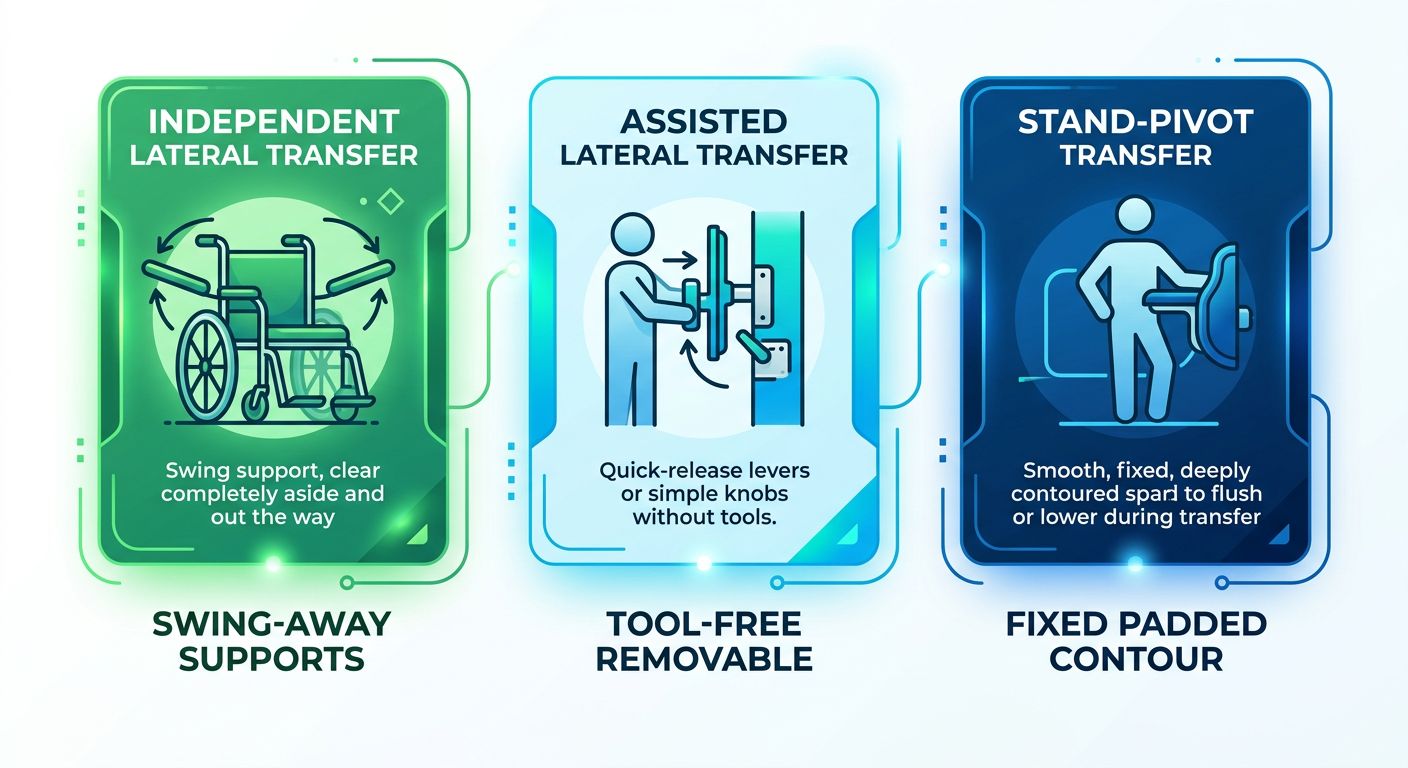
    Three-column infographic comparing independent, assisted, and stand-pivot lateral transfer types with icons and corresponding ideal lateral trunk support features, using a blue and green palette on white.

    Comparison of lateral transfer protocols and recommended lateral trunk support features for power wheelchair users.

    Advanced Considerations: Neuromuscular Scoliosis and Custom Seating Integration

    When neuromuscular scoliosis compromises postural stability, lateral trunk supports become a critical component of custom seating. The condition arises from uneven spinal curves driven by nerve or muscle disorders, leading to pelvic obliquity, trunk asymmetry and pressure-related discomfort. Pairing lateral supports with pressure redistribution cushions counteracts these effects.

    By bracing the torso, these supports guide your spine toward midline and prevent the leaning that aggravates asymmetrical forces. This realignment reduces pelvic obliquity and helps you sit with greater comfort and endurance.

    Pressure redistribution cushions protect skin and deeper tissues by mapping to your unique curvature, spreading weight evenly to lower the risk of pressure injuries. Together with lateral supports, they lock the pelvis in a neutral position, enhancing both stability and long-term skin health.

    A successful fit demands a thorough evaluation by a certified Assistive Technology Professional (ATP). The ATP-led process includes biomechanical assessment, trial fittings and iterative adjustments until you achieve a functional, pressure-relieving posture. RESNA’s international standards for seating and mobility provide the authoritative framework, ensuring that every element of custom power wheelchair seating and positioning meets safety and performance criteria.

    We at MedEquipped orchestrate this entire journey for you. Our ATP evaluators perform hands-on fittings in New York, Georgia and Michigan, fine-tuning lateral trunk supports, cushion selection and overall geometry. Because we manage documentation and insurance coordination, you stay free of administrative strain while directing every clinical decision.

    You can also access wheelchair user advocacy and support through organizations like the United Spinal Association, which offers peer mentoring, educational tools and policy updates that complement your clinical seating plan.

    This information is not medical advice and is for informational purposes only; consult a healthcare professional before making clinical decisions. A professionally guided seating assessment remains the surest path to a custom system that works with your body, not against it.

    Frequently Asked Questions About Lateral Trunk Supports

    Here are answers to common questions about lateral trunk supports.

    What are lateral trunk supports?
    Our specialists explain that lateral trunk supports are attachments on a power wheelchair backrest that provide side-to-side torso stability, helping users maintain an upright posture.

    Who needs lateral trunk supports?
    Individuals with poor trunk control from conditions such as MS, spinal cord injury, cerebral palsy, or stroke benefit from these supports after clinical evaluation.

    How do lateral trunk supports improve posture and safety?
    By stabilizing the torso, lateral supports enhance posture, reduce fatigue, and improve safety. Adding pressure redistribution cushions increases comfort.

    Does Medicare cover lateral trunk supports?
    Per CMS guidelines, Medicare Part B may cover lateral trunk supports as DME when medically necessary, with prior authorization and a physician’s prescription required.

    For readers outside the U.S., mobility equipment for children and adults in the UK is available through specialized providers.

    How can I get custom lateral trunk supports for my wheelchair?
    Contact us for a custom evaluation; our ATPs integrate lateral supports into your custom power wheelchair seating and positioning. We’re your partner in mobility freedom.

    Consult a healthcare professional before making clinical decisions.

    Partnering for Better Seating Outcomes with MedEquipped

    When you partner with MedEquipped, our certified ATP evaluators assess your needs, including lateral trunk supports, as part of custom power wheelchair seating and positioning. We handle the paperwork, insurance navigation, and coordination so you can focus on your mobility. Custom motorized wheelchairs are ordered and delivered with customized features, such as lateral trunk supports, based on your specific requirements, typically within 30–60 days. Serving patients in New York, Georgia, and Michigan, we provide ongoing post-delivery support and remain your partner in mobility freedom. Explore the specific custom wheelchair options available to fit your lifestyle.

    Resources

  • ADA Accessible Medical Equipment Deadlines 2026: Key Guide

    ADA Accessible Medical Equipment Deadlines 2026: Key Guide

    Table of Contents

    A Turning Point for Healthcare Accessibility

    A transformative shift is underway in healthcare accessibility, thanks to renewed enforcement of the Americans with Disabilities Act and new guidance from the Department of Justice. With the ada accessible medical equipment deadlines 2026 on the horizon, individuals with mobility challenges and the facilities that serve them are facing a critical but welcome opportunity to create more inclusive care environments.

    The DOJ medical diagnostic equipment rule now mandates that accessible exam table requirements be met by a specific compliance date, meaning hospitals, clinics, and practices must upgrade their spaces and equipment. At the same time, organizations like the Rehabilitation Engineering and Assistive Technology Society of North America (RESNA) continue to set the standard for rehabilitation technology, ensuring that solutions not only meet legal requirements but also serve real clinical needs.

    At MedEquipped, we view these changes as a chance to empower our clients rather than overwhelm them. We specialize in custom motorized wheelchairs tailored to each person’s unique diagnosis and lifestyle, and we handle the entire funding and paperwork process from start to finish. Our certified ATP-led evaluations ensure that every wheelchair is configured for comfort, safety, and independence—helping individuals and facilities meet the new accessibility standards without the hassle.

    We invite you to explore how MedEquipped can be your partner in mobility freedom during this pivotal moment. As regulations continue to evolve, having a dedicated team on your side makes all the difference.

    Disclaimer: This information is not medical advice and is for informational purposes only. Individual outcomes may vary. Consult a healthcare professional before making clinical decisions.

    Understanding the 2026 MDE Deadlines

    The ada accessible medical equipment deadlines 2026 represent a significant milestone in healthcare accessibility. As we discussed in the broader context of ADA regulations, the Department of Justice has established firm compliance dates that you need to know. These deadlines focus on ensuring that individuals with disabilities have equitable access to medical diagnostic equipment (MDE) — a cornerstone of the DOJ medical diagnostic equipment rule.

    The July 8, 2026, Deadline for Accessible Exam Tables

    Mark your calendar: July 8, 2026, is the date when your facility’s examination tables must be compliant with federal accessibility standards. This cut-off date, established under the DOJ medical diagnostic equipment rule, specifically targets examination tables used in patient care. The regulation requires that a specified percentage of these tables in your practice be height-adjustable and capable of accommodating patients who use wheelchairs or have other mobility limitations. Meeting the accessible exam table requirements is not just about regulatory compliance — it is about ensuring every patient receives dignified, equitable care.

    Which Medical Equipment Must Be Compliant?

    Beyond exam tables, the rule applies to several other categories of medical diagnostic equipment. Your facility must ensure that a designated percentage of equipment in each category is accessible. This includes weight scales that accommodate wheelchairs, imaging equipment such as mammography machines with adjustable platforms, and other diagnostic devices used in routine care. The Rehabilitation Engineering and Assistive Technology Society of North America (RESNA) provides the technical specifications and standards that guide equipment accessibility. According to RESNA, these standards ensure that equipment is designed for safe and independent use by patients with a wide range of disabilities.

    Who Must Comply?

    The DOJ rule casts a wide net, applying to healthcare providers that offer medical diagnostic services. This includes private practices, hospitals, outpatient clinics, and specialty diagnostic centers. If your organization uses examination tables, weight scales, or imaging equipment to evaluate patient conditions, you are likely covered. The requirement is clear: you must have accessible equipment available in each category, and your staff should be trained to use it effectively.

    We know that navigating these regulations can feel overwhelming, but you do not have to do it alone. At MedEquipped, we see ourselves as your partner in mobility freedom, and we are here to help you understand and meet these compliance requirements. Understanding these deadlines is the first step, and in the next section, we will walk you through the practical steps you can take to prepare your practice for full compliance.

    Deep Dive: Standards for Exam Tables, Scales, and Exam Chairs

    As we covered in our overview of the broader MDE equipment landscape, the ADA accessible medical equipment deadlines 2026 are driving significant attention toward clinical furnishings. Among these, accessible exam table requirements occupy a central position in any practice’s compliance planning. Understanding what makes a surface truly accessible means going beyond general accessibility principles and examining the specific dimensions, capacities, and features that the DOJ medical diagnostic equipment rule mandates.

    Exam Tables

    When we evaluate accessible exam table standards, the transfer height—the distance between the floor and the top of the compressed seat surface—is the single most critical measurement. RESNA, the Rehabilitation Engineering and Assistive Technology Society of North America, defines that an accessible transfer surface must be positioned low enough to allow a patient to slide laterally from a wheelchair without lifting their body weight vertically. For the majority of manual and power wheelchair users, this means a transfer height range that reaches down to at least 17 to 19 inches at its lowest setting. Patients who use power wheelchairs for seniors benefit from tables with extra-low transfer heights and wide adjustment ranges that accommodate the higher seat-to-floor dimensions common on heavy-duty power bases.

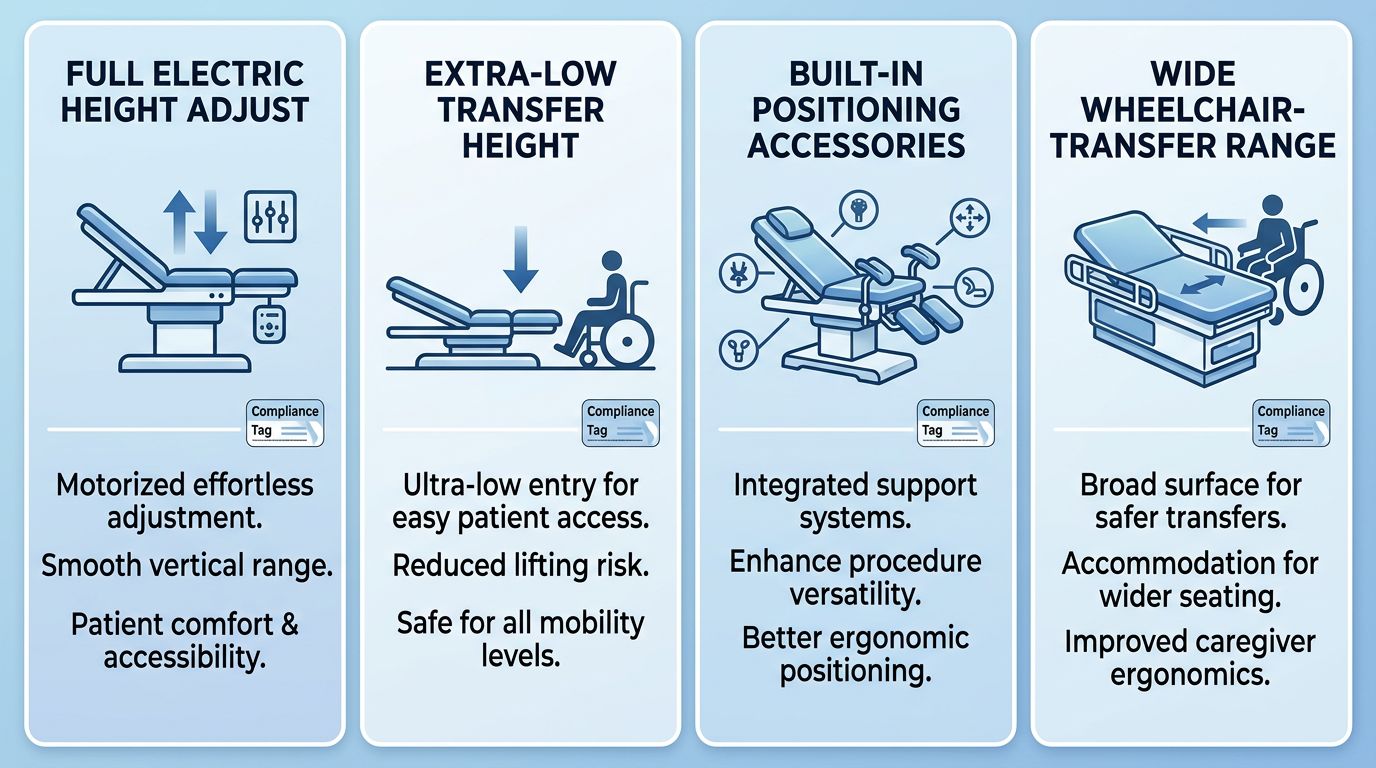
    The DOJ medical diagnostic equipment rule also establishes weight capacity benchmarks that exceed what many older fixed-height tables were designed to support. We have compiled the following models to illustrate how current-generation exam tables meet these requirements through specific exam table compliance features.

    The following table compares four accessible exam table models across transfer height range, weight capacity, and the key compliance feature that distinguishes each design:

    Model / BrandTransfer Height RangeWeight CapacityKey Compliance Feature
    Model A (Midmark 626)18–25 inches500 lbsFull electric height adjust
    Model B (Hausmann Power-Pro)17–36 inches600 lbsExtra-low transfer height
    Model C (Brewer ComfortView)19–30 inches450 lbsBuilt-in positioning accessories
    Model D (Oakworks MedPro)18–38 inches550 lbsWide range for wheelchair transfers

    Source: U.S. Access Board standards for MDE transfer surfaces and manufacturer specifications from MedEquipped.

    The Midmark 626 delivers full electric height adjustability across a solid 18-to-25-inch range, making it a dependable mainstream option for clinics upgrading from manual tables. The Hausmann Power-Pro stands out with an extra-low transfer height of just 17 inches and the highest weight capacity among these models at 600 lbs, a combination that particularly benefits bariatric patients and individuals with lower seat heights. For practices that need integrated positioning support, the Brewer ComfortView includes built-in accessories that help patients maintain stability during exams, while the Oakworks MedPro offers the widest adjustment range—spanning 20 vertical inches—to accommodate an exceptionally broad spectrum of wheelchair transfer scenarios.

    Four-panel infographic comparing exam table models: Full Electric Height Adjust, Extra-Low Transfer Height, Built-in Positioning Accessories, and Wide Wheelchair-Transfer Range, with icons and compliance tags.

    Comparison of four exam table models highlighting key compliance features.

    Selecting the right table involves balancing these dimensions against the specific patient population a practice serves. A clinic with a high volume of wheelchair users may prioritize an extra-low minimum transfer height, while a general practice might focus on overall adjustability and positioning flexibility.

    Scales

    Accessible scales address a barrier that many patients encounter before the exam even begins. Under the accessible exam table requirements framework, a compliant medical scale should feature a platform height no higher than 2 to 3 inches above the floor to allow a wheelchair to roll onto it directly, or it must accommodate a transfer board approach. Handrails on both sides provide stability during weighing, and the weight capacity should reach at least 600 lbs to safely serve bariatric patients along with their mobility devices. A wheelchair-accessible design that permits a patient to remain seated in their chair throughout the measurement eliminates the need for a potentially risky stand-and-transfer maneuver.

    Exam Chairs

    Exam chairs bridge the gap between standard waiting-room seating and full examination tables, and the DOJ medical diagnostic equipment rule applies the same transfer-surface logic to these devices. A compliant exam chair provides adjustable seat height that reaches down to a low transfer range, typically between 17 and 22 inches, allowing a patient to slide across from a wheelchair with minimal vertical displacement. Removable armrests further facilitate lateral transfers by clearing the path from the wheelchair to the chair seat. A supportive backrest and stable base round out the essential design characteristics, and we recommend confirming that any chair under consideration meets the same transfer-surface standards that govern exam tables.

    Meeting the ADA accessible medical equipment deadlines 2026 is about more than regulatory compliance. It is about ensuring that every patient who enters a medical examination room can receive care with dignity and safety. By selecting exam tables, scales, and chairs with documented exam table compliance features, practices build an environment where mobility challenges do not become barriers to quality care. In the next section, we will walk through the practical steps of purchasing and implementing this equipment so that your practice is ready well before the compliance deadline.

    This information is for informational purposes only and does not constitute medical advice. Consult a healthcare professional before making clinical equipment decisions. Results may vary; individual outcomes are not guaranteed.

    A Practical Path to Compliance for Your Facility

    Now that you understand the requirements of the DOJ medical diagnostic equipment rule, it is time to shift from awareness to action. Meeting the ADA accessible medical equipment deadlines 2026 does not have to be overwhelming—with a clear roadmap, your facility can move forward confidently. The following steps will guide you through auditing your current setup, planning upgrades and budgets, and partnering with the right specialists to ensure every exam table, stretcher, and imaging unit meets accessible exam table requirements before the July 2026 deadline.

    Conducting a Compliance Audit of Existing Equipment

    Start by inventorying all medical diagnostic equipment in your facility, including exam tables, stretchers, and imaging systems. For each piece, measure the transfer height—the distance from the floor to the top of the seat or platform—and compare it against the transfer-height standards established by the Access Board. Adjustable equipment should be able to reach a low range of 17 to 19 inches to accommodate patients who use wheelchairs. Document which units currently comply, which can be adjusted, and which need full replacement.

    To help you choose the right evaluation approach, consider the three frameworks outlined below. A self-audit, conducted by your in-house team, typically takes one to two weeks and involves minimal cost for basic measuring tools; it is ideal for an initial check and budget planning. A third-party audit brings in an external compliance consultant who completes the review in one to three days, providing a detailed gap analysis for a moderate fee. For the most comprehensive path, an ATP-led assessment involves a certified Assistive Technology Professional—such as a member of the MedEquipped team—who evaluates your entire environment over a customized timeline of one to four weeks and includes specific equipment recommendations.

    Comparison of Audit Frameworks
    Audit TypeTimelinePrimary BenefitRecommended For
    Self-Audit1–2 WeeksLow Cost / Initial PlanningFoundational assessment
    Third-Party Audit1–3 DaysExpert Gap AnalysisLiability documentation
    ATP-Led Assessment1–4 WeeksHolistic Patient-Centered SpecsFull clinical implementation

    A well-documented audit not only clarifies your compliance standing but also strengthens your position when seeking insurance reimbursement or defending against potential liability claims. Standards developed through RESNA certification and standards inform the evaluation criteria for adjustable-height exam tables and accessible stretchers, giving your documentation added credibility with regulators and funding sources.

    Planning Upgrades and Budgeting for the Deadline

    Once your audit is complete, prioritize replacements by focusing on areas with the highest patient volume, greatest safety risk, and simplest upgrade paths. Often, replacing an older fixed-height table with an adjustable exam table yields immediate benefits for both patient access and staff workflow.

    Funding these upgrades may feel daunting, but several options can help offset the expense:

    • Operational budget allocations spread costs across fiscal periods.
    • Insurance coverage may reimburse some equipment upgrades as part of facility modernization.
    • Grant programs from federal, state, or philanthropic organizations often support accessibility improvements.

    Building a multi-year budget that phases purchases leading up to 2026 ensures you can maintain financial stability while steadily improving your facility’s equipment.

    Partnering with Specialists for Seamless Implementation

    Selecting the right equipment and coordinating deliveries before the July 2026 cutoff requires hands-on expertise. We at MedEquipped recommend working with ATP-certified specialists who understand not only the technical specifications of compliant exam tables and stretchers but also the clinical workflow needs of your practice. Our team brings a structured, patient-centered process to every project—we handle the paperwork, insurance navigation, and coordination so your staff can stay focused on patient care.

    For example, when a facility partners with MedEquipped for an ATP-led assessment, we provide more than a checklist. We learn how your clinicians work, measure spaces, recommend equipment configurations that meet transfer-height standards, and then manage the entire order and delivery timeline. Our ability to complete custom orders in 30 to 60 days—significantly faster than the six months or longer that is common in the industry—gives you the scheduling confidence you need. We also remain available for post-delivery support, adjustments, and staff training to ensure the new equipment integrates smoothly.

    While our core experience lies in mobility solutions such as power wheelchairs for seniors, the same clinical rigor, documentation discipline, and coordination capabilities translate directly into MDE compliance planning. Whether you are upgrading a single exam room or rolling out a site-wide accessibility initiative, we can help you build a timeline that respects your operational realities. Results may vary; individual outcomes are not guaranteed.

    With a clear plan and the right partners, your facility can meet the 2026 deadline confidently and continue serving every patient with the dignity and respect they deserve.

    Advanced Integration: Aligning MDE Compliance with Clinical Mobility Planning

    Meeting the 2026 MDE compliance deadline means healthcare facilities must pair accessible exam tables and diagnostic equipment with a comprehensive mobility strategy. For many patients, especially those requiring a custom motorized wheelchair provider, smooth clinical care starts with the right seating and positioning long before they reach an appointment. We help our partners in New York, Georgia, and Michigan see this as one integrated workflow — not separate regulatory and clinical tasks.

    A facility that invests early in clinical mobility planning can avoid the high cost of retrofitting rooms later. RESNA, the Rehabilitation Engineering and Assistive Technology Society of North America, guides that certified Assistive Technology Professionals (ATP) evaluate the whole person — not just the wheelchair — which parallels the ADA’s emphasis on accessible diagnostic environments. Aligning these efforts may streamline both compliance documentation and patient throughput.

    That’s where we step in as your custom motorized wheelchair provider. Our team coordinates the clinical evaluation, insurance navigation, and custom chair delivery while keeping MDE accessibility in full view. Whether you’re updating an exam room with a height-adjustable table or ordering a power chair for a patient with complex positioning needs, our ATPs bring both clinical insight and regulatory awareness to the conversation. As a custom wheelchair provider and power wheelchair specialist, we handle the paperwork, funding, and coordination so you can focus on patient outcomes.

    Thinking about compliance early sets the foundation for everything that follows — from selecting the right equipment to planning a step-by-step procurement process. We work alongside facilities to map out a path that respects the 2026 deadlines without overcomplicating day-to-day operations. That integrated framework is what we explore next when we look at how to build a practical custom wheelchair acquisition plan.

    Frequently Asked Questions

    What is the process to get a custom power wheelchair from MedEquipped?

    Your journey starts with an evaluation by one of our certified Assistive Technology Professionals, following standards set by the Rehabilitation Engineering and Assistive Technology Society of North America (RESNA). We coordinate your prescription, required documentation, and conduct a fitting to match the chair to your clinical needs. Our team then handles the insurance paperwork and coordination from start to finish.

    How long does it take to receive my custom chair?

    Most orders are completed within 30–60 days (faster processing). The exact timeline can depend on insurance authorization speed and the specific customizations involved. We keep you updated at every stage so you always know the status.

    Do you help with insurance and paperwork?

    Absolutely. We handle the paperwork, insurance navigation, and coordination for you. From verifying your benefits to managing prior authorizations with your physician, our goal is to make the funding process seamless.

    Are there ADA accessible medical equipment deadlines in 2026 that affect power wheelchairs?

    Yes, recent updates to the Americans with Disabilities Act focus on improving access to accessible medical diagnostic equipment by 2026. These deadlines encourage healthcare facilities to have exam tables and diagnostic tools that accommodate wheelchair users, ensuring you receive equitable care during medical appointments.

    What is the DOJ medical diagnostic equipment rule?

    The Department of Justice rule requires certain healthcare providers to ensure their medical diagnostic equipment is accessible to people with disabilities. For our clients, this means more exam rooms will feature adjustable tables and clear floor space, making your medical visits safer and more dignified.

    Do I need a prescription for a custom motorized wheelchair?

    Yes, a face-to-face physician evaluation and a written order are required to justify medical necessity. We guide you through this step, helping your provider document your mobility limitations so the right equipment is approved.

    What kind of support comes after delivery?

    We’re your partner in mobility freedom for the long term. Our local service teams across New York, Georgia, and Michigan provide adjustments, maintenance, and troubleshooting. Most repairs are completed within 3 to 7 business days, with urgent needs getting same-day assessments.

    Consult a healthcare professional before making clinical decisions.

    Compliance in Motion

    As you plan for mobility, the ADA accessible medical equipment deadlines 2026 and the DOJ Medical Diagnostic Equipment Rule mandate that new exam tables and scales meet accessible exam table requirements. As a custom motorized wheelchair provider, we ensure your chair aligns. Key points:

    • The 2026 deadline covers new and altered equipment.
    • We handle the paperwork, insurance navigation, and coordination as your partner in mobility freedom.
    • Chairs fit accessible exam tables seamlessly.

    Proactively addressing ADA accessible medical equipment deadlines 2026 safeguards your mobility. Results may vary; individual outcomes are not guaranteed. Consult a healthcare professional before making clinical decisions.

    Resources

  • Best Sunrise Medical Quickie Power Wheelchair for 2026

    Best Sunrise Medical Quickie Power Wheelchair for 2026

    Table of Contents

    Sunrise Medical Quickie Power Wheelchairs: An In-Depth Look

    The sunrise medical quickie power wheelchair line is one of the most versatile custom motorized wheelchairs available today. Known for their lightweight frames, superior adjustability, and wide range of configurations, Quickie chairs are built to adapt to diverse clinical and lifestyle needs. Sunrise Medical has earned a reputation for precision engineering, and MedEquipped leverages that expertise to create mobility solutions tailored exactly to each individual.

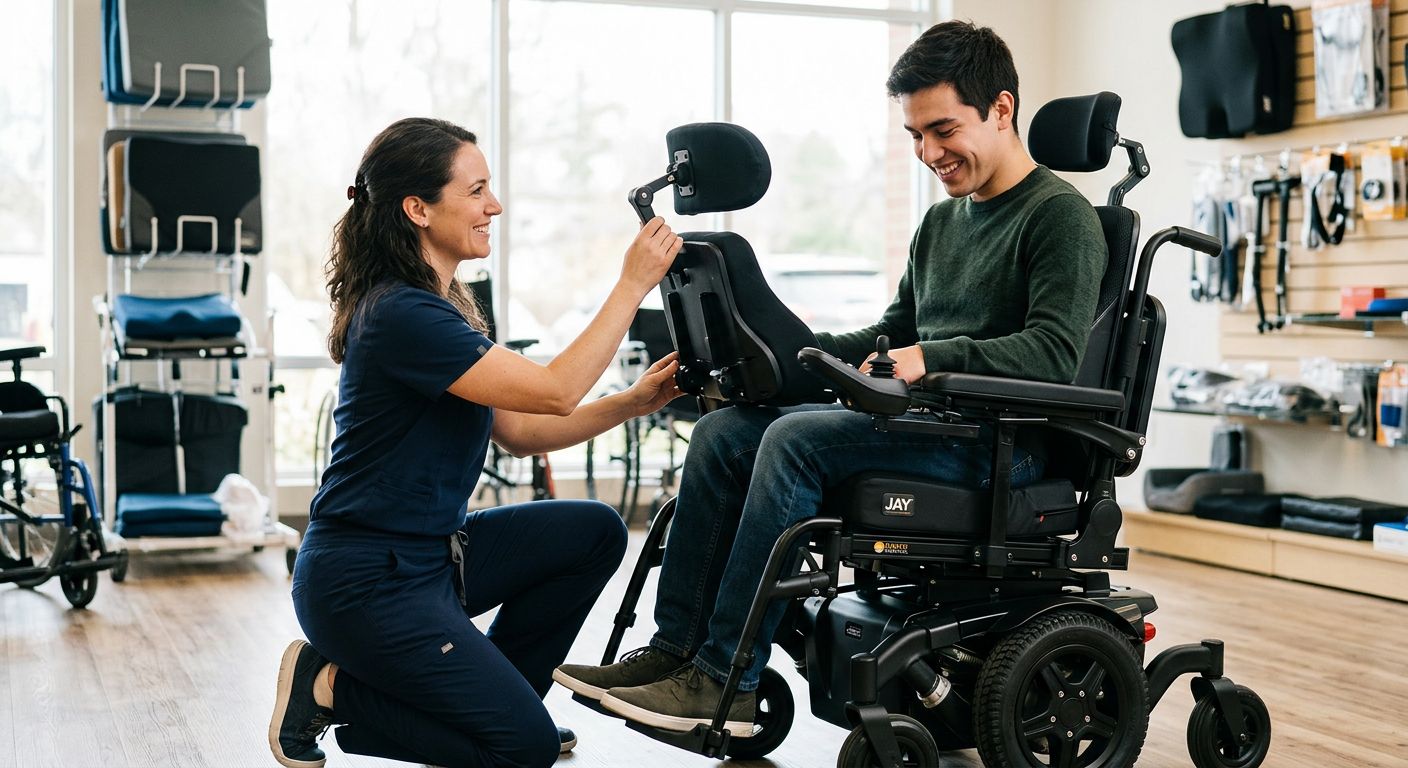
    Comfort and support are just as important as power, which is why we offer jay seating systems as an integrated upgrade. Jay cushions and backs deliver advanced pressure redistribution and postural stability, helping to reduce fatigue and improve positioning throughout the day. For users who need nonstandard driving methods, wheelchair alternative access controls—such as specialty joysticks, head arrays, or sip-and-puff inputs—can be seamlessly incorporated into a Quickie base, giving every patient a way to operate their chair safely.

    At MedEquipped, we make the process simple: our certified ATP evaluators assess your daily environment and physical requirements, then configure a Quickie that feels like it was built just for you. From there, personalized mobility solutions come together as we handle the paperwork, insurance navigation, and coordination so you don’t have to. Most orders are completed within 30–60 days (faster processing), and our team remains by your side for follow-up adjustments and education long after delivery.

    The Quickie Power Wheelchair Lineup: Design and Clinical Strengths

    MedEquipped offers a range of powered mobility devices, and the Sunrise Medical Quickie power wheelchair lineup exemplifies the innovation and clinical focus we bring to every client. As your partner in mobility freedom, we want to walk you through the standout design and clinical strengths of these chairs.

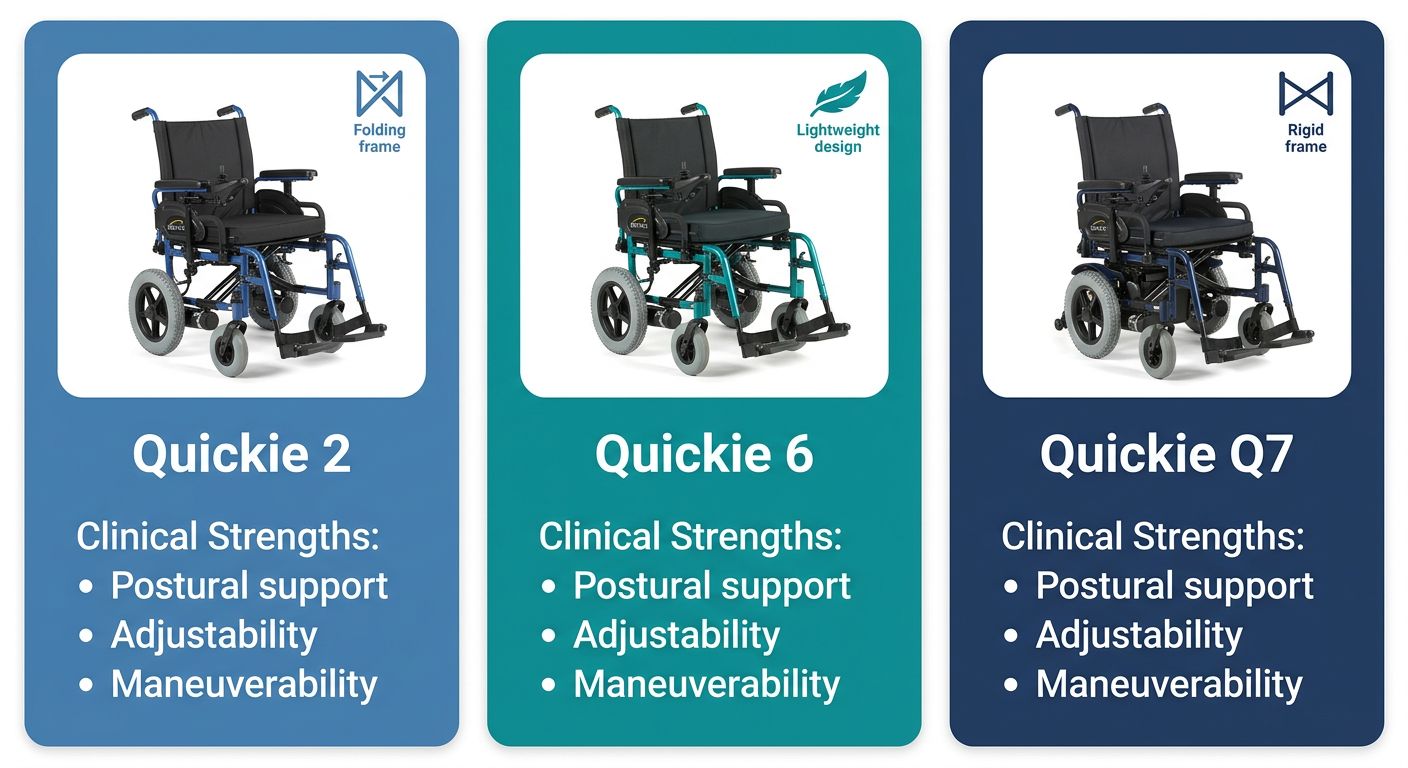
    The Quickie 2 features a dependable folding frame, making it a practical choice for easy transport and storage. Its straightforward design supports reliable daily use without sacrificing comfort. For those who prioritize agility, the Quickie 6 offers a lightweight, compact platform that excels in tight indoor spaces, proving that a smaller footprint can still deliver robust power chair performance.

    Clinically, these models are designed to support diverse needs. The Quickie Q7, with its rigid ultra-lightweight frame, maximizes energy efficiency and precise maneuverability. This rigid design can enhance driving range and responsiveness. For superior postural support, each chair can be seamlessly integrated with Jay seating systems, which are clinically designed to improve comfort and stability. For users with limited hand function, alternative access controls can be configured to ensure safe and independent operation.

    Infographic comparing three Quickie power wheelchair models: Quickie 2, Quickie 6, and Quickie Q7 with feature icons and clinical strengths
    Quickie power wheelchair lineup comparison with clinical strengths

    Each of these Quickie power wheelchairs can be tailored to your specific requirements through our custom motorized wheelchairs service.

    Comparing Quickie Power Wheelchairs to Permobil and Other Clinical Models

    Now that we’ve explored the features of Quickie power wheelchairs, let’s compare them to other leading clinical models like Permobil to help you decide which is right for you. Both brands are trusted in the mobility industry, and choosing the right chair often comes down to your individual clinical needs, daily routines, and how you use a Sunrise Medical Quickie power wheelchair versus an alternative. At MedEquipped, we guide you through these decisions with a friendly, personalized approach.

    The following table compares key features and clinical considerations:

    Quickie vs Permobil Power Wheelchair Comparison
    FeatureQuickie Q-SeriesPermobil F-SeriesWhat to Consider
    Battery RangeUp to 18 milesUp to 22 milesDaily range needs
    Outdoor TerrainExcellent with mid-wheel driveSuperior with power seatsFrequent outdoor use may favor Permobil
    Seating OptionsCompatible with JAY seriesIntegrated Permobil seatingCustom seating vs integrated system

    The battery range difference may matter if you plan extended outings, but the Quickie Q-Series still delivers capable all-day performance for most users. For outdoor terrain, the Quickie’s mid-wheel drive offers excellent stability, while Permobil’s power seating provides added comfort on uneven ground. Seating is where a key distinction emerges: Quickie chairs are compatible with jay seating systems, giving you more flexibility for custom configurations. Both brands can be equipped with wheelchair alternative access controls, though Quickie offers specific options through expert clinical evaluation. Clinical professionals, like those certified by RESNA, use standardized assessment frameworks to ensure the selected wheelchair aligns with your long-term health and mobility goals.

    After reviewing the comparison, the best match depends on your unique lifestyle and support needs. We are your partner in mobility freedom and can help you navigate insurance, coordinate paperwork, and complete a custom order—typically in 30–60 days. For a professional evaluation and guidance on which model fits your needs, consider consulting with PT Solutions physical therapy or contacting our team directly.

    Results may vary; individual outcomes are not guaranteed. Consult a healthcare professional before making clinical decisions. This information is not medical advice and is for informational purposes only.

    Pricing and Insurance Coverage for Quickie Power Wheelchairs

    When considering a Sunrise Medical Quickie power wheelchair, understanding pricing and insurance coverage is key. Because each Quickie power wheelchair is built to your exact needs, pricing is personalized rather than a fixed list price. Your configuration choices—from advanced seating options like Jay seating systems to alternative access controls such as wheelchair alternative access controls—directly influence the final quote. We provide a custom quote based on your clinical evaluation and lifestyle requirements.

    Medicare may cover Quickie power wheelchairs under Durable Medical Equipment (DME) guidelines when they are medically necessary. According to Medicare (Centers for Medicare & Medicaid Services), coverage requires a face-to-face examination, a written prescription, and sometimes prior authorization for power wheelchairs. We help you navigate medicare wheelchair coverage to determine eligibility and maximize your benefits, coordinating every step of the documentation. Results may vary; individual outcomes are not guaranteed. Our team also manages private insurance claims and handles all funding paperwork.

    As your partner in mobility freedom, we handle the paperwork, insurance navigation, and coordination. Most custom motorized wheelchairs arrive in 30–60 days (faster processing). Contact us for a personalized quote and let our certified ATPs guide you through the process.

    Selecting the Right Quickie Power Wheelchair for Your Mobility Needs

    At MedEquipped, we understand that mobility needs are unique, and selecting the right Sunrise Medical Quickie power wheelchair is a personal journey. Our team is dedicated to helping you navigate the options and find a custom solution that fits your lifestyle, mobility goals, and clinical requirements. With the right Quickie chair, you can regain confidence and freedom of movement.

    The first step is a thorough evaluation with one of our certified Assistive Technology Professionals. Our ATPs hold assistive technology professional certification from RESNA, the leading authority in assistive technology standards. During the assessment, we examine your mobility, seating, positioning, and control requirements. This comprehensive review helps us determine the ideal Quickie model, configuration, and support accessories that match your daily life.

    Quickie power chairs offer advanced customization options. You can choose Jay seating systems that provide superior pressure relief and all-day comfort, and integrate wheelchair alternative access controls such as joysticks, head arrays, or sip-and-puff devices for users with limited hand function. These adaptable solutions ensure you maintain independence and comfort throughout the day.

    As your partner in mobility freedom, we’re with you from evaluation to delivery. We handle the paperwork, insurance navigation, and coordination from start to finish. Most orders are completed in just 30–60 days (faster processing). Contact us today for a custom quote and take the next step toward greater independence. Consult a healthcare professional before making clinical decisions.

    Partnering with MedEquipped for Your Quickie Power Wheelchair Journey

    Choosing your Quickie power wheelchair is just the first step—MedEquipped is your partner in mobility freedom, guiding you from evaluation to final delivery. Our certified ATP evaluators perform detailed fittings to tailor your chair precisely to your body and lifestyle.

    We handle the paperwork, insurance navigation, and coordination, so your Sunrise Medical Quickie power wheelchair arrives within 30–60 days. For added comfort and control, we can integrate Jay seating systems and alternative access controls. We serve patients in New York, Georgia, and Michigan through in-clinic or telehealth evaluations.

    After delivery, your Quickie power wheelchair is backed by dedicated technicians handling adjustments and support for a truly personalized fit. Next, we’ll guide you through customization and ordering. Please remember that results vary; consult a healthcare professional.

    Resources

  • Best Permobil Standing Power Wheelchair: Health Benefits & Medicare Coverage

    Best Permobil Standing Power Wheelchair: Health Benefits & Medicare Coverage

    Table of Contents

    Standing Power Wheelchairs: Your Path to Greater Independence

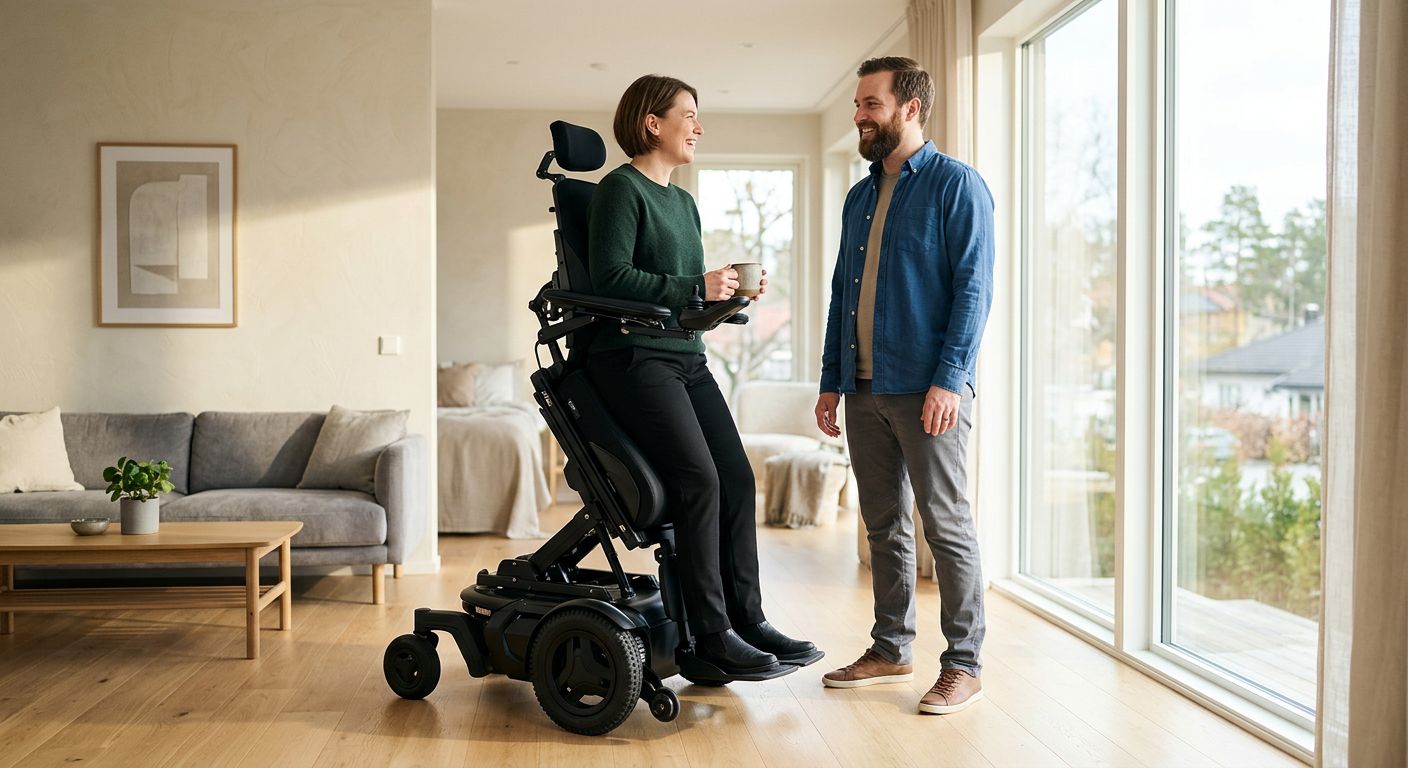
    Standard power wheelchairs deliver essential mobility, but they don’t let you stand. As your partner in mobility freedom, MedEquipped focuses on standing power wheelchairs—a category of complex power wheelchairs designed to safely lift you from a seated to a standing position. A leading example is the permobil standing power wheelchair, which makes everyday tasks easier—from reaching high shelves to holding conversations at eye level—while promoting better health.

    The standing power wheelchair health benefits are substantial. Regular standing helps improve circulation, prevent pressure ulcers, aid digestion, and boost emotional well-being. As custom motorized wheelchairs, each chair is configured to match your specific clinical and lifestyle needs.

    For those concerned about affordability, medicare coverage for standing wheelchairs is possible when your ATP clinician documents medical necessity. We handle the paperwork, insurance navigation, and coordination so you can focus on what matters: reclaiming your independence. Our trained team supports adjustments and follow-up care after delivery regularly. From evaluation to delivery, the process typically takes 30-60 days (faster processing). In the next section, we’ll walk through the clinical evaluation and ordering process in more detail.

    Key Features of the Permobil Standing Power Wheelchair

    Now let’s explore the key features that make the Permobil standing power wheelchair a standout choice for individuals seeking greater independence and therapeutic support. As your partner in mobility freedom, we believe understanding these innovations is the first step toward reclaiming daily life. At MedEquipped, we handle the paperwork, insurance navigation, and coordination to get you the right chair, but first, let’s look at what makes these custom motorized wheelchairs so unique.

    The Mechanics of Standing: Sit-to-Stand vs. Tilt-to-Stand

    When evaluating a standing power wheelchair, the mechanics of how it brings you upright are a core consideration. Permobil offers two sophisticated methods, each designed for different clinical needs. Understanding these differences helps match the chair to your specific lifestyle.

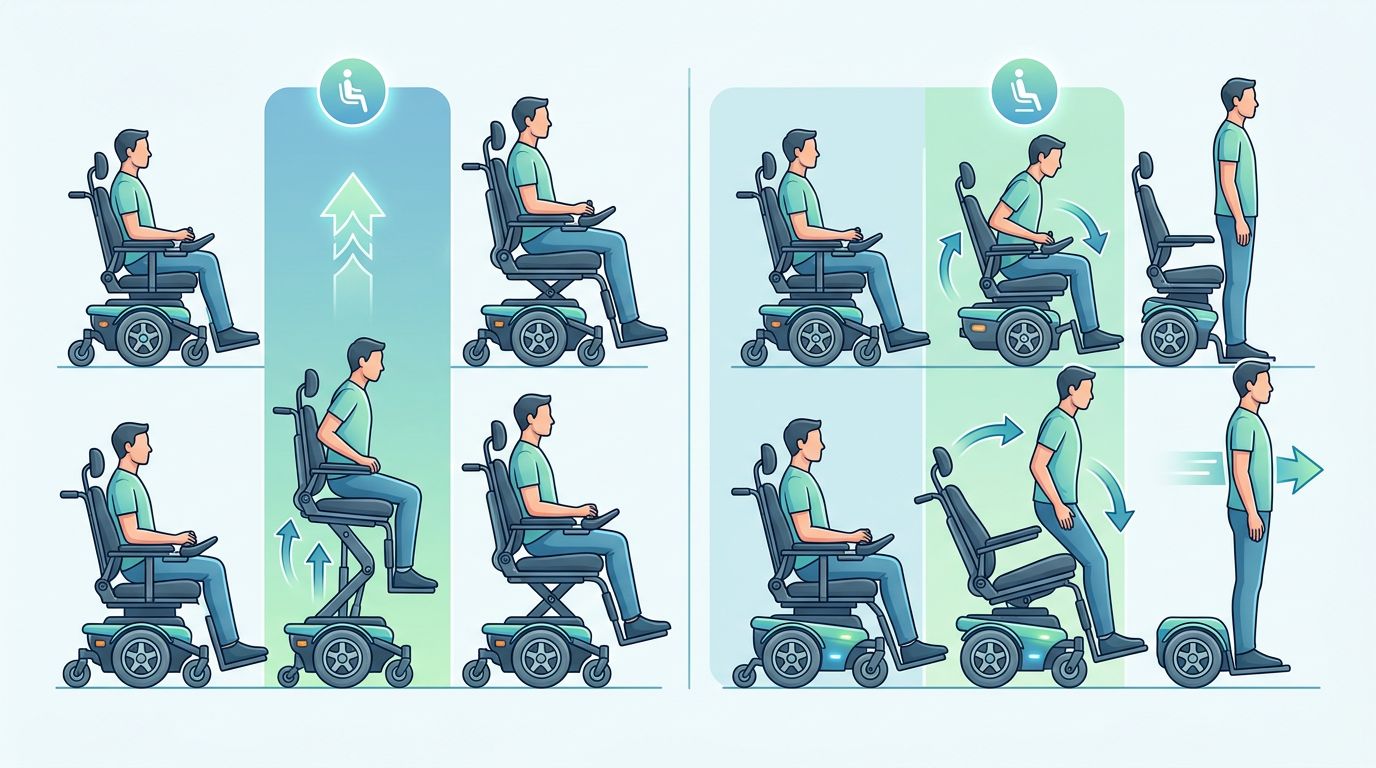
    The sit-to-stand function works by lifting the entire seat base into a vertical orientation while you remain safely seated. This method offers excellent stability because your body’s position relative to the seat does not change. It is often preferred for those who want the benefits of standing with a simpler transition or who have more limited trunk control, as the backrest and seat provide continuous support throughout the movement.

    In contrast, the tilt-to-stand mechanism actively angles the seat pan forward in coordination with the backrest rising. This subtle shift guides your body into a more natural, weight-bearing standing posture. The forward tilt encourages better hip and knee extension, which can provide deeper therapeutic advantages.

    This fundamental choice between standing methods highlights just the start of personalization available. Beyond the standing mechanism, these chairs offer extensive clinical-grade customization.

    Visual comparison of sit-to-stand and tilt-to-stand mechanisms in a Permobil standing power wheelchair.

    Two standing power wheelchair mechanisms comparison.

    Clinical-Grade Customization Options

    A Permobil standing power wheelchair is far more than a standard power base; it is a fully configurable piece of complex rehabilitation technology. A certified Assistive Technology Professional (ATP), like those on our team, conducts a detailed clinical evaluation to prescribe the exact seating and positioning components needed for your body’s unique shape and support requirements. This precision is critical for comfort and function.

    Your seating system is built from the ground up. We can specify custom-molded cushions to protect skin, adjustable backrests for lateral trunk support, and contoured headrests for those who need neck stability. These elements work together to maintain a healthy, symmetrical posture. Positioning features don’t stop there; power tilt and recline functions allow you to shift weight throughout the day, providing essential pressure relief, while elevating legrests support circulation and reduce swelling.

    Control over your environment is equally personalized. Whether you operate the chair with a standard joystick, a compact mini-joystick, or require alternative controls like a sip-and-puff switch or a head array, the system is programmed to your specific response. These programmable settings can adjust acceleration, speed, and sensitivity. Every option is matched to your clinical needs, ensuring you can access the many standing power wheelchair health benefits, including improved circulation, bone density maintenance, and better respiratory function. With this level of clinical integration, it’s worth exploring Medicare coverage for standing wheelchairs, which may apply when prescribed as medically necessary. Our team navigates that entire process for you.

    Consult a healthcare professional before making clinical decisions. Information is not medical advice and is for informational purposes only.

    With these features in mind, let’s look at the health benefits and how to get started with a custom standing wheelchair.

    Health and Lifestyle Benefits of Standing Power Wheelchairs

    Standing power wheelchairs go beyond basic mobility—they actively support your health. A Permobil standing power wheelchair, for instance, can help users achieve these health benefits while maintaining the freedom to go about their day. At MedEquipped, we see the transformation firsthand when individuals with spinal cord injury (SCI), multiple sclerosis, or other conditions integrate regular standing into their routine.

    Benefits for Spinal Cord Injury and Other Conditions

    For spinal cord injury patients, the shift to a vertical posture triggers a cascade of physiological improvements. According to the Academy of Spinal Cord Injury Professionals, a leading spinal cord injury professional society, regular standing can help reduce secondary complications. One of the most immediate benefits is improved circulation. Standing counteracts venous pooling in the legs and helps prevent orthostatic hypotension—a sudden drop in blood pressure many chair users experience.

    Weight-bearing through the hips and spine is another critical advantage. Because SCI often accelerates bone mineral loss, standing may help maintain or improve bone density, lowering fracture risk. Our team at MedEquipped frequently hears from physical therapists who note that consistent standing can contribute to better bone health.

    Pressure relief is equally important. By offloading the glutes and sacrum, standing helps prevent pressure ulcers. The Academy recommends standing for at least 30 minutes daily to maximize tissue offloading and promote skin integrity. Finally, regular standing can preserve range of motion in the hips, knees, and ankles, reducing contractures and stiffness.

    Long-Term Health Outcomes and Quality of Life

    While these immediate benefits are compelling, the long-term health outcomes truly change daily life. Research on standing power wheelchair health benefits shows that consistent pressure relief significantly reduces the incidence of pressure ulcers—a leading cause of hospitalization for SCI patients. By routinely offloading high-risk areas, users can avoid painful wounds and lengthy recoveries.

    Respiratory function also improves over time. Standing expands the chest cavity, allowing the lungs to fully inflate and helping to clear secretions. For individuals with limited respiratory muscle function, this can reduce the risk of pneumonia and respiratory infections. MedEquipped’s ATPs (Assistive Technology Professionals) often emphasize these lung benefits during clinical evaluations.

    Beyond physical health, standing wheelchairs open doors to greater independence and social engagement. Reaching a high shelf, holding an eye-level conversation, or simply standing beside a friend at a gathering can dramatically boost psychological well-being. Users frequently tell us they feel more included and confident, which is a cornerstone of quality of life.

    To experience these benefits, it’s essential to work with a provider who understands both the clinical and insurance landscape. At MedEquipped, we offer custom standing power wheelchairs from trusted brands, including Permobil, and we handle the paperwork, insurance navigation, and coordination—so you can focus on what matters: your health and mobility. In the next section, we’ll explain how we simplify the insurance process to get you the right chair faster.

    Results may vary; individual outcomes are not guaranteed. Consult a healthcare professional before making clinical decisions. Information is not medical advice and is for informational purposes only.

    How MedEquipped Delivers Your Permobil Standing Wheelchair

    The Permobil standing power wheelchair’s advanced features open the door to a healthier, more independent life. Now, let’s walk through exactly how our team at MedEquipped works to get this life-changing technology into your daily routine. As your partner in mobility freedom, we manage every step of the process—from a precise clinical assessment to insurance paperwork and final delivery—so you can focus on your mobility, not logistics.

    Clinical Evaluation and Custom Fitting

    Your journey begins with a comprehensive evaluation led by one of our certified Assistive Technology Professionals (ATPs) . This specialist doesn’t just take basic measurements; they conduct an in-depth assessment to understand your unique medical needs, physical dimensions, and daily living environment. The goal is to build a complete picture, which is the foundation of our custom fitting process.

    To achieve the significant standing power wheelchair health benefits, the ATP carefully configures every component of the chair. This involves capturing precise data points for custom seating to ensure proper postural support and pressure relief. The controls are also personalized, whether you require a standard joystick, a head array, or a sip-and-puff system. This exacting, data-driven method ensures your Permobil standing power wheelchair is truly tailored to your body and capabilities, working in concert with recognized standards from rehabilitation technology supplier resources.

    Insurance Navigation and Paperwork

    Once your custom specifications are defined, our team shifts to handling one of the most daunting parts of the process: securing funding. We take charge of the insurance navigation, working directly with your provider to build a strong case for medical necessity, which is often the key to unlocking Medicare coverage for standing wheelchairs.

    We handle the paperwork, insurance navigation, and coordination from start to finish, compiling all required documentation, clinical justifications, and ATP reports to present to your insurer. This dedicated advocacy addresses common questions about approval criteria directly, turning a potentially stressful hurdle into a streamlined administrative path for you.

    Delivery and Ongoing Support

    After approval, we place your custom order, triggering a targeted fulfillment window of just 30-60 days—a faster processing timeline than industry norms. We then coordinate the delivery of your fully assembled and fitted motorized wheelchair.

    Our service doesn’t end at your doorstep. We remain your dedicated support system, ready to assist with adjustments, troubleshooting, and any questions that arise as you begin using your device. This ongoing partnership is central to our mission of providing custom motorized wheelchairs that empower you for the long term. For residents across our service area, additional information on disability services can also be found through the Commonwealth of Massachusetts’ official government portal.

    Results may vary; individual outcomes are not guaranteed.

    Selecting the Right Standing Power Wheelchair for Your Needs

    Choosing the right permobil standing power wheelchair starts with understanding the proven standing power wheelchair health benefits—improved circulation, bone density maintenance, and pressure relief—and how those benefits apply to your daily life. To turn those clinical advantages into a safe, comfortable reality, you’ll need to meet a few key eligibility requirements and provide the right documentation. We’re here to guide you through every step.

    Qualification Criteria and Medical Documentation

    Before a custom motorized wheelchair can be configured for standing functionality, a physician must confirm that you have a medical need for it. Consult a healthcare professional before making clinical decisions—your doctor will evaluate whether standing is medically beneficial for you and safe to perform independently. The primary documents you’ll need include:

    1. A detailed prescription or referral from your primary care or specialist physician that specifically requests a standing power wheelchair.
    2. A clinical evaluation performed by a physical or occupational therapist, or directly by one of our certified ATPs, that documents your mobility limitations and the clinical justification for standing.
    3. Supporting medical records—such as progress notes, imaging reports, or therapy summaries—that demonstrate a long-term need for a standing feature as part of your daily care plan.

    Once we have your prescription and evaluation results, our team works directly with your healthcare providers to confirm medical necessity and prepare your file for funding submission.

    Funding Options and Medicare Coverage

    When it comes to paying for your custom chair, you have several potential paths. Medicare coverage through Part B often applies when the equipment is deemed medically necessary and you can safely operate the stand function independently. We help you verify whether you meet medicare coverage for standing wheelchairs requirements, and we can also pursue Medicaid, private insurance policies, and assistive technology funding programs on your behalf. Because every chair is custom-built to your exact body dimensions and clinical needs, pricing is available only through a personalized quote—we do not list prices online. From the moment you contact us, we handle the paperwork, insurance navigation, and coordination so you can focus on your mobility, not on administrative hurdles.

    Most funding approvals and custom configurations are completed in 30-60 days (faster processing) compared to many national suppliers. If a stand-up power chair isn’t covered by your primary insurance, we’ll help you explore alternative funding sources and guide you through any appeals.

    Working with a Certified ATP Evaluator

    The final—and arguably most critical—step is a hands-on evaluation with a certified ATP evaluator. Our certified ATPs collaborate closely with your clinical team, including any PT solutions physical therapy providers you already see, to fine-tune your seating, drive controls, and standing configuration. By matching you to the right base, seating system, and positioning supports, we maximize both your safety and the likelihood of insurance approval.

    When you’re ready to schedule an evaluation, just give us a call or send an email to intake@medequipped.com. Please note: we never sell your personal information. SMS communications may be subject to message and data rates; reply STOP to unsubscribe. Results may vary, and individual outcomes are not guaranteed.

    Let’s get you moving—and standing—on a timeline that works for your life.

    Take the Next Step Toward Standing Mobility

    The benefits of a permobil standing power wheelchair for your health and independence are clear. Now, it’s time to take action. We are your partner in mobility freedom, and we’re ready to guide you through every step of the process to get you into the perfect standing wheelchair.

    Our team handles all the complex details so you can focus on what matters most. We manage the insurance paperwork, coordinate funding, and work directly with your clinician to build a custom Permobil mobility solution tailored just for you. Often, we can explore helpful resources like the Massachusetts government portal for potential assistance, ensuring no stone is left unturned in securing your equipment. Typically, our comprehensive process takes just 30 to 60 days—from your initial consultation to the final delivery of your power standing wheelchair.

    From our locations across New York, Georgia, and Michigan, we provide end-to-end support, including clinical evaluation, custom ordering, and ongoing adjustment services after delivery. If you’ve been researching the standing power wheelchair health benefits and are ready to experience them for yourself, or if you have questions about medicare coverage for standing wheelchairs, we invite you to start the conversation. Contact us today, and let’s begin your journey to greater mobility and freedom.

    Results may vary; individual outcomes are not guaranteed.

    Resources

  • Collision Avoidance Systems: Complete Guide to Smart Wheelchair Tech

    Collision Avoidance Systems: Complete Guide to Smart Wheelchair Tech

    Table of Contents

    Collision Avoidance Systems and Power Wheelchair Safety

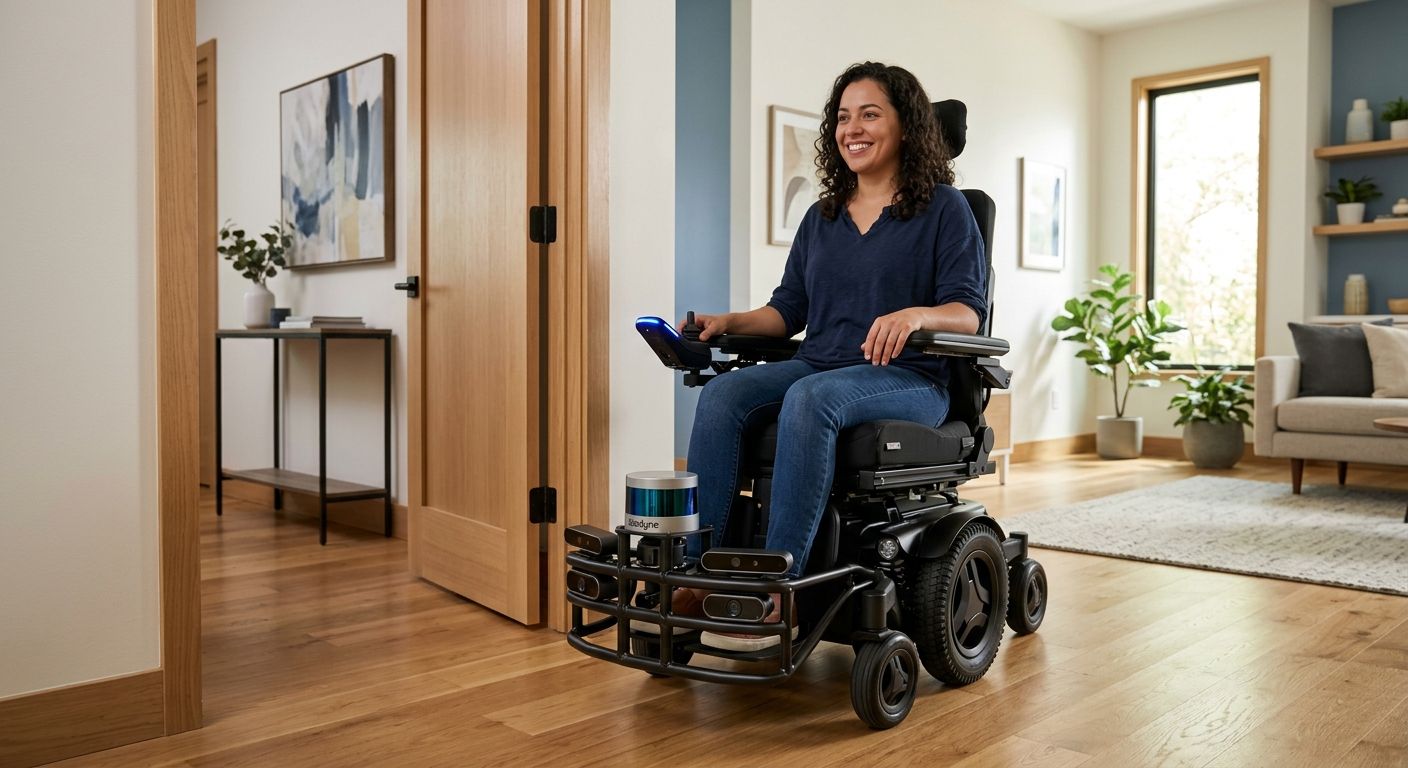
    Building on the core safety features that protect power wheelchair users, collision avoidance systems represent a significant leap forward in smart mobility. These sensor-based technologies work continuously to detect obstacles in your path—whether a piece of furniture, a wall, or a person—and can alert you or even automatically apply the brakes to help prevent a collision. By reducing the risk of unexpected bumps and scrapes, collision avoidance technology allows you to move through tight indoor spaces and busy outdoor areas with greater confidence.

    At MedEquipped, we understand that navigating your environment shouldn’t be a source of stress. Integrating collision avoidance into your custom chair reduces the cognitive load required to monitor every angle simultaneously, freeing you to focus on going about your day. This same approach aligns with broader smart wheelchair technology, which aims to make power mobility safer, more intuitive, and better adapted to your life.

    We offer custom power wheelchairs that can be equipped with these advanced features, and because we handle the paperwork and insurance coordination, understanding your coverage options is straightforward. For example, our team can help you determine whether you qualify for a power wheelchair medicare funding pathway for a chair that includes collision avoidance. Our typical 30-60 day processing window means you spend less time waiting and more time enjoying the independence a thoughtfully configured chair provides. Results vary and this information is for educational purposes; please consult a healthcare professional before making clinical decisions about safety equipment.

    How Collision Avoidance Systems Work in Power Wheelchairs

    Building on the expanding world of smart wheelchairs, collision avoidance systems are a transformative addition that uses advanced sensor technology to help you navigate more safely and independently. These systems are designed to detect obstacles in your chair’s path and either warn you or take automatic action to prevent a collision, giving you greater confidence as you move through indoor and outdoor environments. This technology doesn’t replace your driving judgment but acts as an extra set of eyes, offering a helpful safety net for users with limited visibility or slower reaction times.

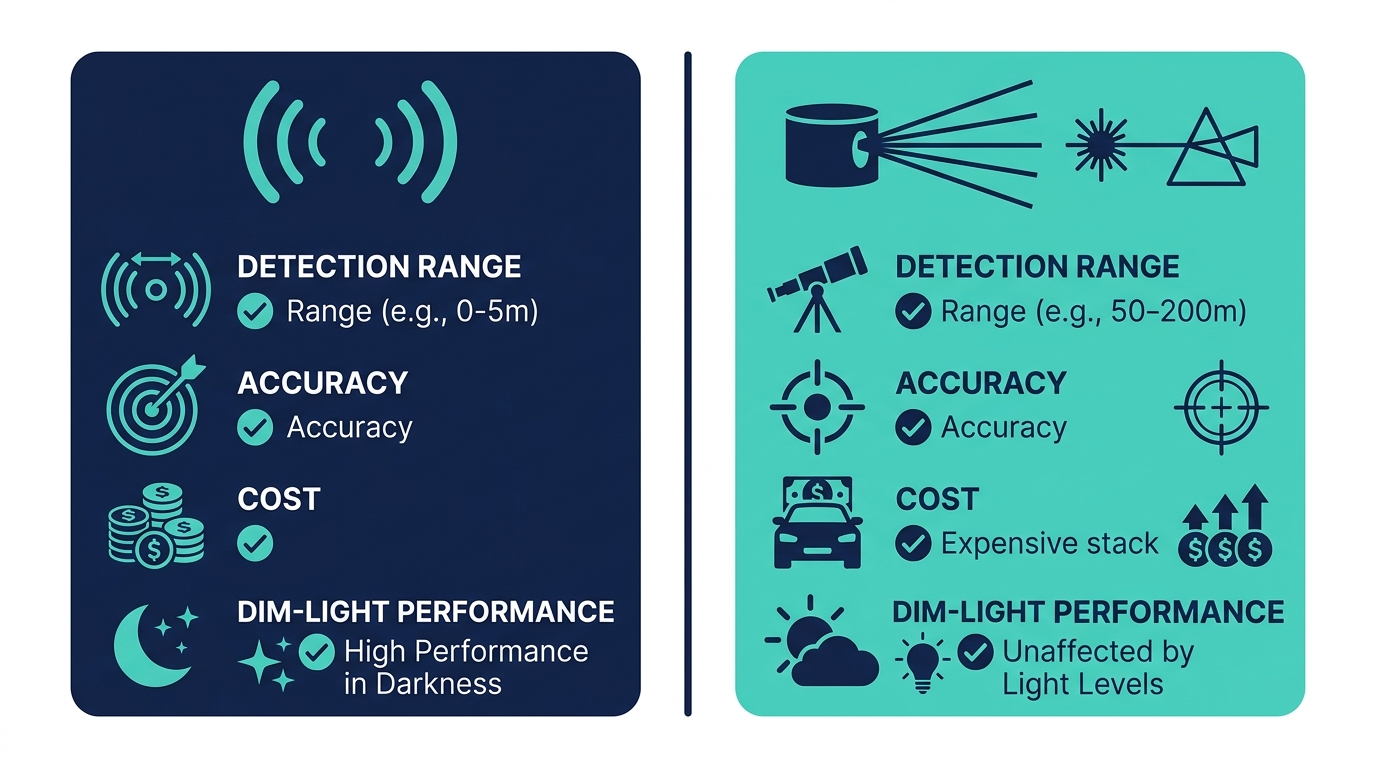
    At the core of these systems are two primary sensor technologies: ultrasonic and LiDAR. An ultrasonic sensor works much like a bat using echolocation. It emits high-frequency sound waves that bounce off nearby objects, and by measuring how long the echo takes to return, the system calculates the object’s distance. These sensors typically detect obstacles within a range of 0.2 to 4.5 meters with centimeter-level accuracy and function reliably regardless of lighting conditions. Ultrasonic sensors provide a cost-effective solution for basic detection needs, making them a common starting point for collision avoidance in power wheelchairs.

    A LiDAR sensor takes a different approach by using rapid pulses of laser light to create a detailed, millimeter-accurate map of the surroundings. With a detection range that can reach up to 30 meters, LiDAR excels at identifying objects at greater distances and in more complex layouts, giving the system a richer picture of the environment. Like ultrasonic technology, LiDAR remains completely unaffected by dim light or darkness, ensuring dependable performance no matter the time of day. This higher precision typically comes at a higher cost, reflecting the more sophisticated hardware involved.

    Sensor Technologies Comparison
    FeatureUltrasonicLiDAR
    Detection Range 0.2–4.5 meters up to 30 meters
    Accuracy centimeter-level millimeter-level
    Cost lower cost higher cost
    Performance in Dim Light unaffected unaffected

    For many users, the choice between sensor types comes down to balancing budget with the level of environmental detail needed. Ultrasonic sensors deliver reliable close-range protection and simplicity while LiDAR offers expansive, high-resolution awareness that can be especially useful in crowded or dynamic spaces. Regardless of the sensor type the system integrates directly with your wheelchair’s drive controller to interpret incoming data in real time and trigger responses that keep you safer.

    Side-by-side comparison infographic of ultrasonic and LiDAR sensor technologies used in power wheelchair collision avoidance systems

    Ultrasonic vs LiDAR sensor comparison for power wheelchair safety.

    When a potential collision is detected the system typically provides an auditory alert or haptic feedback such as a vibration in the joystick to get your attention. If you don’t react in time it can go a step further by automatically slowing the chair or applying the brakes to prevent contact. This seamless integration transforms your power chair into a true example of smart wheelchair technology that adapts to its environment. Obstacle detection technology like this makes daily mobility less stressful and more intuitive especially when navigating tight doorways, crowded rooms, or unfamiliar routes.

    According to MedEquipped’s internal product knowledge, collision avoidance systems are an important layer of protection but are not a substitute for safe driving practices. You remain in control of your chair at all times and anti-collision systems are meant to assist rather than replace your awareness. We help you navigate your options when selecting a power wheelchair equipped with these features ensuring the technology matches your daily needs and clinical requirements.

    For expert guidance on finding a reliable safety equipment supplier near me contact our team. We handle the paperwork, insurance navigation, and coordination so you can focus on what matters most: reclaiming your independence and exploring the world with a true partner in mobility freedom.

    Advanced Sensor Fusion and Smart Wheelchair Technology

    Building on the overview of core mobility features, the next frontier in power wheelchair design lies in intelligent environmental awareness. Modern collision avoidance systems transform how you interact with your surroundings, using advanced technology to create a safer, more intuitive driving experience. These systems do not replace attentive driving, but they provide a critical assistive layer, helping you navigate busy corridors, tight doorways, and crowded public spaces with greater confidence. At MedEquipped, we believe this smart wheelchair technology represents a true partnership between user and machine, enhancing independence without taking control away from you.

    How LiDAR and Ultrasonic Sensors Integrate in Multi-Sensor Systems

    The core of any advanced obstacle detection network is sensor fusion. This process combines data from multiple sensor types—primarily LiDAR and ultrasonic—to build a comprehensive, real-time picture of the environment. A single sensor type has inherent weaknesses; for example, ultrasonic sensors can struggle with very soft or angled surfaces, while LiDAR performance can degrade in heavy rain or fog. By fusing their data streams, the wheelchair’s processor compensates for these individual limitations, dramatically improving detection accuracy and reducing false positives.

    LiDAR, or Light Detection and Ranging, uses pulsed laser beams to measure distances with exceptional precision, creating a detailed 3D point cloud of the space ahead. According to MedEquipped’s technical resources, these lasers can map objects at significant ranges, providing crucial early warning for faster-moving chairs. Ultrasonic sensors, in contrast, emit high-frequency sound waves and measure their reflection, excelling at close-range detection of both soft and hard obstacles, like a person walking nearby or a piece of furniture. When these technologies work in tandem, the system cross-references LiDAR’s precise spatial map with the ultrasonic array’s reliable proximity data. This creates a redundant, robust safety net where one sensor type instantly verifies the other’s readings before triggering a response.

    The Role of AI in Obstacle Detection and Avoidance

    The raw data from a sensor array is just information; it takes artificial intelligence to turn that information into action. AI acts as the wheelchair’s brain, processing the fused sensor data in real-time to make split-second decisions. It is not simply reacting to a pre-set distance threshold. Instead, the AI classifies objects—distinguishing a static wall from a moving shopping cart—and predicts their future path, enabling adaptive navigation that feels smooth and natural rather than jarring.

    This intelligent system also learns and adapts to your personal driving style over time. If you prefer wider turns or a slower approach to doorways, the AI can adjust its intervention parameters accordingly. This personalization is a key step toward intuitive alternative driving interfaces, where the chair not only avoids obstacles on its own but also interprets subtle user commands more effectively. The following table highlights several premier models available through MedEquipped that showcase these cutting-edge capabilities, each offering a unique approach to sensor integration.

    Smart Wheelchair Models with Collision Avoidance Capabilities
    ModelSensor TypeDetection RangeAdditional Features
    QUICKIE Q700 M Ultrasonic + optional LiDAR 4.5m ultrasonic Adaptive cruise control
    ROVI X3 360° LiDAR up to 30m Autonomous navigation
    TDX SP2 HD Ultrasonic Proximity 2m range Adjustable sensitivity

    Source: Manufacturer specifications and MedEquipped product database.

    Understanding 360-Degree Collision Protection Systems

    A full-perimeter sensing system provides an invisible safety cocoon around your wheelchair. This is achieved by strategically placing multiple sensors around the base, creating a continuous detection zone that leaves no blind spots. The system constantly monitors this zone, ready to provide an alert, slow your speed, or execute a controlled stop if an obstacle is detected in your path. This is especially critical in dynamic, complex environments where hazards can appear from the side or rear.

    These collision avoidance systems rely on a concept called a ‘danger zone’, which is a digitally mapped area around the chair where objects trigger a response. When you drift too close to a wall or a person approaches from behind, the system can engage automatic braking or, in more advanced models, plot an alternative path around the hazard. For example, if a pedestrian suddenly steps in front of you, the system’s reaction time, measured in milliseconds, can augment your own reflexes, helping to mitigate an impact. Navigating the process of securing one of these advanced chairs can seem complex, but our team simplifies every step. These smart wheelchairs are often covered under wheelchair insurance — learn how we handle the process for you, managing paperwork and funding so you can focus on experiencing the freedom these technologies provide.

    Selecting and Configuring Collision Avoidance Systems for Your Power Wheelchair

    Choosing collision avoidance systems for your power wheelchair begins with a careful look at your daily life. We help you match the right obstacle detection technology to your home, your routines and your personal mobility goals. At MedEquipped, we view these safety sensors as a key part of smart wheelchair technology that gives you greater confidence behind the joystick.

    Evaluating Your Mobility Needs and Environment

    Start by thinking about where you drive most often. Indoor spaces like narrow hallways, tight doorways and crowded kitchens call for precise front and rear sensors. Outdoor environments add uneven terrain, curbs and moving obstacles such as pedestrians or shopping carts, so broader side detection becomes more valuable. We recommend listing your most common routes and noting every potential hazard you encounter.

    Collision avoidance systems come in several forms. Ultrasonic sensors use sound waves to detect objects within a set range and work well for general proximity warnings. Laser based systems offer finer distance measurement, which helps with precise positioning near furniture or doorways. Camera systems give you a visual feed of the surrounding area and can be paired with audible alerts. The right choice depends on whether you mostly navigate cluttered indoor rooms, open outdoor spaces or a mix of both.

    Funding can feel complicated, but we handle that part for you. Insurance coverage varies by payer, and you can check with Maryland state services for potential assistance through Medicaid or other programs.

    Working with a Certified ATP for System Selection

    A certified Assistive Technology Professional evaluates your clinical needs before any equipment decision is made. We coordinate with your ATP to review your posture, functional abilities, vision and reaction time. This step ensures the collision avoidance systems in your wheelchair complement your driving style rather than overwhelming you with unnecessary alerts. Smart wheelchair technology works best when it is tailored to you, not added as a one size fits all solution.

    We work with your ATP throughout the process, bringing our experience with custom motorized wheelchairs and insurance navigation to every case. Our team handles the paperwork, insurance navigation and coordination so you and your ATP can focus on clinical priorities. This partnership leads to a faster timeline from evaluation to delivery, typically within our 30 to 60 day processing window.

    Installation, Calibration, and Post-Delivery Support

    Once your ATP signs off on the recommendation, we move into the installation phase. We begin with a pre evaluation of your wheelchair to plan sensor placement. Our technicians mount the sensors securely and route wiring to avoid pinch points. Calibration follows immediately, adjusting sensitivity and range to match the obstacles identified during your ATP evaluation.

    Real world testing is our final quality check. We ask you to drive through doorways, navigate around furniture and back into your usual parking spot. This hands on validation confirms that the obstacle detection systems work reliably in the spaces you actually use. We fine tune settings on the spot so your chair feels responsive and predictable from day one.

    After delivery, we remain your partner in mobility freedom. Our team provides ongoing adjustments as your driving skills improve or your home environment changes. Proper configuration of your safety sensors keeps everyday driving smooth and sets the stage for the daily use and maintenance habits covered in the next section.

    AI Integration and Autonomous Navigation in Smart Wheelchairs

    Modern smart wheelchairs increasingly rely on artificial intelligence to transform how users navigate their environments, with collision avoidance systems playing a central role in this evolution. At MedEquipped, we see AI integration as the use of machine learning, computer vision, and sensor fusion to enable real-time decision-making and autonomous obstacle handling. Rather than simply reacting to nearby objects, these intelligent systems interpret surroundings, classify potential hazards, and plan the safest, most efficient path forward.

    Standard collision avoidance relies on basic proximity sensors that detect objects only when they are immediately near the chair. This reactive approach leaves the user responsible for manually steering around obstacles. In contrast, AI-enhanced systems use camera and LiDAR data together, allowing the chair to identify what an object is, predict where it might move, and generate an optimal route around it. This shift from reactive to predictive navigation represents a fundamental advance in smart wheelchair technology, offering smoother, safer movement through crowded or dynamic spaces.

    Over time, AI-powered navigation learns from user behavior, adapting to your preferred routes and improving efficiency with repeated use. This capability means the chair becomes more personalized, anticipating turns, doorways, and common stopping points in your home or workplace. For individuals with limited hand function or other physical constraints, alternative driving interfaces such as voice control, head arrays, and sip-and-puff systems can serve as input methods paired with AI navigation. According to MedEquipped, these interfaces integrate with advanced navigation systems to ensure that autonomous obstacle detection and intelligent path planning remain accessible regardless of a user’s physical capabilities.

    These AI capabilities set modern power wheelchairs apart by enhancing both safety and independence, letting you move through daily environments with greater confidence. We believe this technology is a natural extension of our commitment to being a partner in mobility freedom. Information is not medical advice and is for informational purposes only.

    Common Questions About Collision Avoidance for Power Wheelchairs

    You might be wondering how collision avoidance systems actually work in daily life. Here are clear answers to help.

    What is a collision avoidance system for power wheelchairs?
    It’s a smart wheelchair technology that uses sensors to detect nearby obstacles. Depending on the setup, the system can alert you or automatically slow and stop the chair.

    How does collision avoidance technology work?
    Sensors scan the area around your chair. When an object is too close, the system sends a signal to reduce speed or stop, helping prevent bumps and scrapes.

    What are the benefits of collision avoidance for wheelchair users?
    This safety system increases confidence, reduces caregiver stress, and makes navigating tight spaces easier. It’s a helpful aid, not a replacement for your attention.

    Can collision avoidance systems prevent all accidents?
    No. While the technology helps reduce the risk of collisions, user awareness is still essential. Please consult your healthcare professional for personalized advice.

    Does MedEquipped offer this on custom wheelchairs?
    Yes! We include collision avoidance options on our custom motorized wheelchairs. We’re here as your partner in mobility freedom, ready to tailor the right solution for you.

    Partner in Mobility Freedom: MedEquipped’s Commitment to Safety and Independence

    At MedEquipped, we serve as your partner in mobility freedom, delivering custom motorized wheelchairs built around your clinical needs and lifestyle. Our certified ATP evaluators perform thorough assessments so every chair integrates advanced features like collision avoidance systems and smart wheelchair technology to help you move with greater confidence. We handle the paperwork, insurance navigation, and coordination across New York, Georgia, and Michigan, typically completing orders in 30–60 days. If alternative driving interfaces fit your needs, we configure them and provide ongoing support long after delivery because your independence isn’t a one-time transaction, it’s an ongoing journey we walk together.

    Resources

  • Get Custom Motorized Wheelchair for Adults: Fast Delivery 2026

    Get Custom Motorized Wheelchair for Adults: Fast Delivery 2026

    Table of Contents

    Custom Motorized Wheelchairs for Adults: A Path to Greater Independence

    Achieving true independence starts with a mobility solution designed around you — not the other way around. A custom motorized wheelchair for adults is a precisely fitted power chair built to match your unique body shape, clinical needs, and daily lifestyle. At MedEquipped, we see ourselves as your partner in mobility freedom, combining advanced clinical evaluations with end-to-end coordination so you can focus on living fully.

    A properly tailored custom fit does more than improve comfort. It promotes better posture, distributes pressure evenly, and helps reduce the risk of long-term secondary health issues. Our certified ATP evaluators and dedicated technicians use clinical assessments to inform every decision, ensuring your chair integrates the right combination of complex rehab technology and power seat functions for superior support and accessibility. As part of this process, we often conduct a wheelchair pressure mapping evaluation to verify that your seating system protects your skin and maximizes stability.

    We handle the paperwork, insurance navigation, and coordination from evaluation to delivery — including serving families across New York, Georgia, and Michigan. Most custom motorized wheelchairs for adults move from initial assessment to your doorstep in 30 to 60 days, with faster processing available when needed. Everything we do is built around one goal: getting you mobile with confidence.

    Many customization options go into designing your ideal chair, from seating geometry and control placement to specialized power adjustments. Exploring these choices is the next step toward a wheelchair that truly supports your independence.

    Disclaimer: Results may vary; individual outcomes are not guaranteed. Consult a healthcare professional before making clinical decisions. This information is not medical advice and is for informational purposes only. Privacy notice: we do not sell personal information (see Privacy Policy). SMS terms: message and data rates may apply; reply STOP to unsubscribe.

    Understanding Custom Motorized Wheelchairs and Complex Rehab Technology

    A custom motorized wheelchair for adults is far more than a standard power chair—it is a precisely engineered mobility solution tailored to an individual’s unique physical and functional needs. At MedEquipped, we see these devices as a true complex rehab technology (CRT), a formal classification for wheelchairs that require extensive evaluation, configuration, and fitting by certified professionals. Unlike a one-size-fits-most device, a CRT wheelchair is designed from the ground up to provide customized support, positioning, and independent control for daily indoor and outdoor use.

    The following table illustrates the key differences between a standard power wheelchair and a custom CRT wheelchair.

    Standard Power Wheelchair vs Complex Rehab Technology Wheelchair
    FeatureStandard Power WheelchairCRT Wheelchair
    Customization LevelLimited; pre-configured optionsHighly customizable; fully adjustable seating and controls
    Seating OptionsBasic cushion; minimal positioningCustom cushions, power tilt/recline, elevating legrests, seat elevation
    Drive Control AdjustabilityStandard joystick; limited programmabilityProgrammable joystick, head array, sip-and-puff; fully customizable
    Frame DurabilityModerate; designed for light to moderate useHeavy-duty; built for frequent, long-term use
    Insurance ClassificationStandard DME (durable medical equipment)CRT (complex rehab technology); higher documentation needs
    Typical Use CasesIntermittent indoor mobilityDaily indoor and outdoor mobility for complex conditions

    A standard power chair is often adequate for temporary or limited mobility, but a CRT wheelchair is essential when long-term positioning and advanced functionality are required. The heavy-duty frame of a custom chair is not just about durability; it serves as a stable platform for integrating advanced power seat functions. These functions, such as power tilt and recline or elevator-like seat elevation, are not luxury add-ons. They are medically necessary for pressure relief, improved respiration, and safe, independent participation in daily activities. As part of our clinical process, a wheelchair pressure mapping evaluation is an invaluable tool we use to guide the selection of a custom cushion, ensuring pressure is distributed evenly to protect skin health.

    Side-by-side comparison infographic showing standard power wheelchair with icons for basic features on left and complex rehab technology wheelchair with advanced feature icons including power tilt/recline and programmable controls on right.

    Comparison of standard power wheelchairs versus CRT wheelchairs highlighting key feature differences.

    Drive controls on a custom motorized wheelchair represent another leap forward in customization. While a standard chair offers a simple joystick, a CRT system’s programmability is limitless. We can integrate specialty drive controls like a head array or sip-and-puff system for individuals with limited hand function. This level of adjustment, down to the acceleration and braking sensitivity, is a cornerstone of the complex rehab technology definition endorsed by the Rehabilitation Engineering and Assistive Technology Society of North America (RESNA), the industry standard for quality and safety. These RESNA standards guide our equipment selection process to ensure your chair is safe, durable, and perfectly adjusted.

    From a practical standpoint, these clinical differences translate into a distinct insurance pathway. Standard power wheelchairs are classified as Durable Medical Equipment (DME), a broad category. A CRT wheelchair, however, is in its own class, requiring detailed medical documentation and a face-to-face clinical evaluation. At MedEquipped, we are your partner in mobility freedom. We handle the paperwork, insurance navigation, and coordination as a core part of our service, leveraging our certified ATP-led evaluations to build a compelling case for the equipment you truly need. This comprehensive approach is what transforms a complex process into a clear, manageable path toward gaining a custom power wheelchair.

    Exploring Power Seat Functions and Customization Options

    We at MedEquipped know that a truly custom motorized wheelchair for adults is more than just a base and a seat—it’s a system designed to adapt to your unique body and daily life. Power seat functions turn a standard power wheelchair into a dynamic tool for health management, comfort, and independence. By adding these features, you gain the ability to reposition yourself throughout the day without help, which is central to our mission as your partner in mobility freedom.

    Primary Power Seat Functions and Their Benefits

    Power tilt is a function that angles the entire seating system backward while maintaining the hip and knee angles, redistributing pressure away from the sitting bones. This movement is critical for pressure relief; according to our pressure mapping evaluation data, shifting weight through tilt can significantly lower a user’s Peak Pressure Index, reducing the risk of pressure ulcers. Power recline, which changes the angle between the backrest and the seat, works differently by opening the hip angle. This function is often used for managing muscle tone, preventing contractures, and providing an alternative pressure relief surface by changing the body’s contact area with the cushion.

    Elevating legrests raise the lower extremities independently, which is an essential feature for controlling edema, improving circulation, and simply finding a more comfortable leg position after long periods of sitting. Seat elevation moves the user vertically from a seated to a standing position’s height, enabling independent reach to high shelves, safer and easier transfers, and more natural eye-to-eye social interactions. For those with the necessary medical clearance, power standing takes this further by bringing the user into a fully upright, weight-bearing posture, which can offer profound benefits for bone density, circulation, and psychological well-being. Each of these complex rehab technology power seat functions serves a distinct clinical purpose, and their inclusion must be justified for insurance coverage.

    Customizing Control Systems and Drive Interfaces

    The most advanced power seat functions are only useful if you can command them effortlessly. An assistive technology professional near me plays the central role in identifying a custom motorized wheelchair for adults with the right drive interface. This specialist evaluates your strength, range of motion, and coordination to select from options like a standard or mini proportional joystick for precise hand control, or a compact joystick for users with limited finger dexterity. For those who cannot use their hands reliably, a head array built into the headrest can activate switches through gentle head movements, while sip-and-puff controls interpret breath pressure through a tube for precise, sequential commands.

    Another innovative solution uses proximity switches, which are fiber-optic or infrared sensors that require no physical force to activate—simply bringing a finger or head within a short distance of the switch is enough. The selection process is deeply personal, and we work with you and your therapist to match the technology to your most consistent and fatigue-free movements. The goal is an interface that feels intuitive and dependable, letting you focus on where you are going and not on how to get there. We handle the paperwork, insurance navigation, and coordination for these critical components just as we do for the chair itself. Results may vary; individual outcomes are not guaranteed. Consult a healthcare professional before making clinical decisions. This information is not medical advice.

    Indoor and Outdoor Mobility Considerations

    Customizing a power wheelchair means considering your environment, from tight, carpeted hallways to grassy parks. The drive wheel configuration is a major factor. A center-wheel drive base offers an exceptionally tight turning radius, making it a top performer for maneuvering around furniture and through narrow doorways in a home or office. Rear-wheel drive chairs, conversely, provide excellent stability and tracking at higher speeds, which is ideal for outdoor use, while front-wheel drive excels at climbing curbs and handling uneven surfaces with a smoother ride.

    A proper suspension system is vital for comfort and safety when moving from a smooth floor to a bumpy sidewalk; active suspension absorbs shocks, keeping all wheels on the ground and reducing spasticity triggers. Your tire choice also matters. Pneumatic tires, filled with air, cushion the ride effectively outdoors but require maintenance, while solid or foam-filled inserts are puncture-proof and require less upkeep, though they offer a firmer ride. We consider these variables during our comprehensive evaluation, balancing your primary daily environments with your recreational desires. After we finalize the specifications, our team manages the entire order, and you can typically expect delivery within 30-60 days (faster processing). We handle the paperwork, insurance navigation, and coordination, ensuring your new customized mobility system arrives ready for your world. Results may vary; individual outcomes are not guaranteed. Consult a healthcare professional before making clinical decisions. This information is not medical advice.

    The Complete Process: From Clinical Evaluation to Delivery

    Getting a custom motorized wheelchair for adults involves several important steps, and we guide you through each one. At MedEquipped, we handle the paperwork, insurance navigation, and coordination so you can focus on what matters most — regaining your independence and mobility. From your very first evaluation with a certified professional to the day your fully fitted chair arrives, we’re your partner in mobility freedom.

    Clinical Assessment and Evaluation

    The process begins with a comprehensive clinical evaluation led by a certified Assistive Technology Professional (ATP). This step is essential — not only to ensure your chair fits your body perfectly, but also because Medicare and most private insurers require an ATP-led assessment for complex rehab technology. During the evaluation, we conduct a detailed mobility needs assessment, analyzing how you move through your daily environment and what functional challenges you face.

    Seating and positioning analysis is a cornerstone of the evaluation. Our ATP examines your posture, spinal alignment, and weight distribution to prevent secondary complications like pressure injuries and skin breakdown. We use pressure mapping technology to visualize high-risk areas and identify optimal cushioning and support surfaces. The assessment also covers control assessment, where we evaluate your strength, range of motion, and coordination to determine the best drive control — whether a standard joystick, alternative input like sip-and-puff, or advanced power seat functions such as tilt and recline. MedEquipped recommends consulting assistive technology professional resources for further information on ATP certification standards.

    Insurance Navigation and Funding Approval

    Once the clinical evaluation is complete, the next phase focuses on securing funding. We know that insurance paperwork can feel overwhelming, which is why MedEquipped takes the lead in identifying your coverage options and managing the entire approval process. Our team reviews your benefits under Medicare, Medicaid, and private insurance plans, determining exactly what documentation each payer requires.

    We compile the ATP’s clinical findings into a detailed letter of medical necessity — the primary evidence insurers use to justify coverage. For Medicare beneficiaries, this means meeting CRT criteria with a face-to-face exam and a written order containing seven required elements. Medicaid guidelines vary by state, often requiring prior authorization and state-specific forms. Private insurance plans typically need a customized medical necessity letter along with clinical notes and the seating evaluation report. Our staff coordinates directly with physicians, therapists, and insurance case managers to minimize delays and keep your application moving forward.

    Custom Ordering, Delivery, and Follow-Up

    After funding approval, we move into the custom ordering phase. Our ATP configures your chair precisely to the specifications determined during the evaluation — frame type, seating system, power seat functions, drive controls, and any additional accessories. We source from leading manufacturers to ensure your custom power wheelchair matches both your clinical needs and your lifestyle. Once the order is submitted, the typical timeline from final configuration to delivery is 30-60 days, and we actively work toward faster processing whenever possible.

    When your chair arrives, we handle delivery and fitting personally. Our technician ensures every component is adjusted correctly, verifies that all controls respond as expected, and provides hands-on education so you feel confident operating your new equipment. But our relationship doesn’t end at delivery. We provide ongoing support for adjustments, repairs, and patient education — because a well-maintained chair is essential for long-term mobility and health. Once your chair is delivered, our ongoing support ensures it stays in top condition. Results may vary; individual outcomes are not guaranteed. Information is not medical advice and is for informational purposes only.

    Advanced Considerations for Complex Rehab Technology

    Now that we’ve defined complex rehab technology, let’s talk about the paperwork that makes it possible to get you the wheelchair you need. At MedEquipped, we guide you through every required form and clinical justification, so your custom motorized wheelchair moves from evaluation to delivery on our typical 30–60 day timeline.

    Among the documented requirements, three pitfalls cause the most delays: missing signatures or dates on the written order, vague medical necessity statements that fail to demonstrate functional need, and face-to-face exams performed outside the six-month window. Our ATP (Assistive Technology Professional) evaluators review every document for completeness, drawing on standards from the Rehabilitation Engineering and Assistive Technology Society of North America (RESNA) and the Assistive Technology Industry Association (ATIA) to help you avoid these common errors. When listing additional options such as power seat functions, we ensure each is justified in the narrative.

    Frequently Asked Questions

    What is a custom motorized wheelchair for adults?
    A custom motorized wheelchair for adults is built to your unique measurements, clinical needs, and lifestyle, incorporating complex rehab technology for superior comfort and function.

    What is pressure mapping and why is it important?
    Pressure mapping measures how your body weight distributes on the seat cushion, allowing us to select the right support and prevent skin breakdown.

    What are power seat functions and what options are available?
    Power seat functions include tilt, recline, and elevating leg rests, helping you change position independently for pressure relief and circulation.

    How long does it take to get a custom motorized wheelchair?
    After funding is approved, delivery typically takes 30–60 days (faster processing) thanks to our streamlined coordination and paperwork handling.

    Contact us at 845-237-2381 or intake@medequipped.com. We’re your partner in mobility freedom. Results may vary; individual outcomes are not guaranteed.

    Empower Your Independence with a Custom Motorized Wheelchair

    A custom motorized wheelchair for adults is more than just mobility equipment — it’s a personalized solution crafted around your body, lifestyle, and daily needs. At MedEquipped, we serve as your partner in mobility freedom, managing every step from clinical evaluation and ATP-led fitting to insurance paperwork and final delivery. Our team brings together advanced complex rehab technology and thoughtful configurations like power seat functions to create a chair that truly fits you. We coordinate the entire process so you can focus on living independently, with typical turnaround times of 30–60 days. We proudly support clients in New York, in Georgia, and in Michigan through dedicated technicians and ongoing service. Ready to see how the evaluation works? Learn about the simple steps ahead to start your journey toward greater freedom.

    Resources

  • Best Motorized Mobility Scooters for Home Use: 2026 Guide

    Best Motorized Mobility Scooters for Home Use: 2026 Guide

    Table of Contents

    Motorized Mobility Scooters for Home Use in New York, Georgia, and Michigan

    At MedEquipped, we believe everyone deserves to move through their home with confidence and ease, which is why we are a partner in mobility freedom for clients seeking motorized mobility scooters for home use. We help residents in New York, in Georgia, and in Michigan find home-friendly scooters that make everyday tasks—like navigating from the bedroom to the kitchen or rolling out to the backyard—simpler and more enjoyable. For those with good upper-body strength and trunk control, a motorized scooter offers a practical alternative to a custom motorized wheelchair, providing targeted support for distance mobility without the full postural-support systems built into our power chair options.

    When choosing an indoor mobility scooter, maneuverability is key: 3-wheel mobility scooters typically offer a tighter turning radius that works well in narrow hallways, while 4-wheel models often feel more stable crossing uneven thresholds at home. Many clients also love how folding mobility scooters tuck into a closet or car trunk, making storage effortless between uses. These scooters built for living spaces can directly support mobility related activities of daily living (mradls)—the essential tasks like transferring and moving inside the house that the Assistive Technology Industry Association helps set standards for through its professional network. We handle the paperwork, insurance navigation, and coordination for your scooter procurement in all three states, with a typical processing window of 30–60 days (faster processing).

    If your needs require more postural support, our custom motorized wheelchairs may be the right choice. Reach out to our team to explore which mobility solution fits your home best.

    Information is not medical advice and is for informational purposes only. Consult a healthcare professional before making clinical decisions.

    Understanding Motorized Scooters for Indoor Mobility

    While power wheelchairs offer extensive customization for postural needs, motorized scooters provide a more compact option for navigating smaller indoor spaces. For many individuals, motorized mobility scooters for home use provide a convenient balance of maneuverability and comfort. We serve as your partner in mobility freedom, guiding you through the options to find the right indoor scooter.

    Key Differences Between Power Wheelchairs and Mobility Scooters

    From a structural standpoint, power wheelchairs and mobility scooters are distinct categories. Mobility scooters typically feature a tiller or handlebar for steering, a captain-style seat, and a longer wheelbase. In contrast, custom motorized wheelchairs are controlled by a joystick and are far more customizable for individuals with severe postural needs, offering specialized seating and support systems.

    These differences directly affect where each device excels. An indoor scooter is ideal for someone who can sit upright and has adequate arm strength, while a power wheelchair is suited for those needing full postural support and power functions like tilt or recline. Clinically, a assistive technology professional certification holder, such as an ATP from RESNA, conducts a mobility evaluation to ensure the device matches your specific medical and functional needs within your home.

    According to MedEquipped’s educational resources, an evaluation looks at how you function in different home areas. A detailed clinical assessment is crucial because it documents your specific in-home mobility challenges, which determines whether a scooter or a power chair is the safest and most effective solution for your daily life.

    3-Wheel vs. 4-Wheel Scooters for Tight Spaces

    Choosing between a 3-wheel and a 4-wheel scooter will greatly influence your experience in small apartments and narrow hallways. The following comparison provides a quick-reference guide based on your home layout.

    3-Wheel vs. 4-Wheel Mobility Scooters for Home Use
    Feature3-Wheel Scooter4-Wheel Scooter
    Turning RadiusTighter turning radius (typically 30–40 inches)Wider turning radius (typically 45–55 inches)
    Stability on Carpet/TileLess stable on uneven surfaces; adequate on firm indoor flooringMore stable on thick carpet and transitions
    Doorway ClearanceNarrower width (often fits 30-inch doorways)Wider base (may require 32-inch or wider doors)
    Best ForSmall apartments, tight hallways, indoor-only useHomes with thicker carpet, larger rooms, or mixed indoor/outdoor use

    As RESNA guidelines confirm, the turning radius for a 3-wheel scooter is typically between 30 and 40 inches, making it excellent for navigating tight spaces. Its narrower width is often compatible with a standard doorway clearance of 30 inches, a critical measurement for any home. Your decision should prioritize the primary environment where the scooter will be used.

    For those who will primarily use an indoor scooter in small apartments with narrow doorways and tile floors, 3-wheel mobility scooters offer unmatched agility. However, if your home has thicker plush carpeting or multiple floor transitions, the superior stability of a 4-wheel model is worth the trade-off in turning radius. This stability is key for confidently moving from tile to a carpeted living room.

    Comparative infographic showing a blue 3-wheel scooter icon with tighter turning radius label on the left, a green 4-wheel scooter icon with increased stability label on the right, and small icons of a folding scooter and house below.
    Comparison of 3-wheel and 4-wheel mobility scooters for indoor maneuverability and stability.

    Folding and Lightweight Scooters for Home Storage

    Storage is a common concern, and folding mobility scooters elegantly solve the problem of limited space. These compact mobility scooters typically weigh between 30 and 50 pounds and can be collapsed to a fraction of their assembled size, small enough to store in a closet or a car trunk. Despite their lightweight design, most offer a battery range of 8 to 12 miles, which is more than sufficient for a full day of indoor activities.

    We find these models to be an excellent choice for anyone who values convenience without sacrificing essential mobility. A folding scooter’s true advantage is how it facilitates a spontaneous lifestyle in small apartments where every square foot matters. For outdoor or long-distance travel, however, a 4-wheel or heavy-duty scooter may ultimately be more appropriate.

    Results may vary; individual outcomes are not guaranteed. Consult a healthcare professional before making clinical decisions. This information is not medical advice and is for informational purposes only. Privacy notice: we do not sell personal information (see Privacy Policy). SMS terms: message and data rates may apply; reply STOP to unsubscribe.

    Benefits of Choosing the Right Home Scooter

    Once you understand the types of scooters available, the next question is: how will the right one actually improve your daily life? At MedEquipped, we know that selecting ideal motorized mobility scooters for home use transforms everyday routines. The right scooter becomes a seamless part of your home, not an obstacle. From navigating narrow hallways to maintaining independence in daily tasks, it brings freedom and comfort into every corner of your space. Below, we explore three key benefits — better maneuverability, greater independence, and easy storage.

    Improved Maneuverability in Tight Spaces

    Imagine turning into a narrow bathroom doorway without struggling — that’s what a scooter designed for indoor use can offer. Many home-use scooters feature a tight turning radius of just 27–32 inches, allowing you to glide through standard 32-inch doorways and kitchen galley layouts with ease. This means you can pull up to the bathroom sink, turn around in the kitchen, or enter a closet without repeatedly backing up. Unlike larger outdoor models that require multiple back-and-forth adjustments, a lightweight frame and compact design make repositioning in bedrooms or hallways nearly effortless. 3-wheel mobility scooters often excel here, offering a smaller footprint that handles sharp corners and confined spaces more gracefully. With a lower overall weight, they also reduce the strain on flooring and are easier to maneuver on tile or hardwood. Precise steering and responsive controls let you navigate around furniture and tight corridors without losing momentum, so daily movement feels natural rather than stressful.

    Greater Independence in Daily Activities

    Choosing a scooter that supports mobility related activities of daily living (mradls), such as moving from the bedroom to the living room or accessing bathroom counters, directly impacts your independence. As defined in our guide on these MRADLs, these essential tasks include transfers, walking, wheeling, and bed mobility — all activities that take place within the home. Instead of struggling with a walker or manual wheelchair, you glide from the bedroom to the breakfast table with ease. With properly fitted motorized mobility scooters for home use, you can reach kitchen countertops to prepare meals, join family at the dinner table, and move between rooms without exhausting transfers. By reducing the physical strain of moving from one spot to another, you preserve energy for the moments that matter most. This independence means you can participate more fully in family life and daily routines. Our team helps match you with a scooter that fits your body and home layout. We handle the paperwork, insurance navigation, and coordination, so you can focus on your mobility freedom.

    Convenient Storage and Portability

    Folding mobility scooters solve storage challenges in small apartments or senior living suites. Many models fold to about 19 inches high, fitting into a closet or car trunk. We coordinate your order, and your scooter typically arrives within 30–60 days — ready to use and easy to store.

    Now, let’s look at which features make these benefits a reality for your home.

    How It Works: Evaluating and Selecting a Scooter

    Now, let’s walk through exactly how we help you get the right scooter—from evaluation to delivery. Finding the ideal motorized mobility scooters for home use might seem complicated at first, but with MedEquipped, it’s a structured, worry-free process. As your partner in mobility freedom, we truly handle the heavy lifting at every stage so you can focus on what matters most: regaining your independence.

    Clinical Assessment and Funding Coordination

    Our process begins with a thorough clinical assessment led by a certified Assistive Technology Professional (ATP). This evaluation is the foundation for selecting the perfect device. Our ATPs take precise measurements of your home environment—checking door widths, thresholds, and available turning space—to ensure your new scooter will navigate your daily life seamlessly. We also carefully evaluate key specifications like turning radius and weight capacity. For instance, 3-wheel mobility scooters often provide a tighter turning circle, which can be a game-changer for maneuvering in smaller indoor spaces. Your comfort and safety are our top priorities, and we use these clinical findings to build the foundation for a successful funding application.

    Insurance Navigation and Paperwork Support

    Once your clinical needs are defined, our team takes over the complex world of insurance. We truly are the partner that handles the paperwork, insurance navigation, and coordination, so you don’t have to manage it alone. Our specialists complete all required insurance forms, obtain pre-authorizations, and coordinate with a wide range of funding sources, from Medicare and Medicaid to private insurance plans. Because every funding situation is unique, we provide a custom quote—much like we do for electric wheelchair cost estimation—to ensure full transparency. Our goal is to secure the necessary approvals efficiently, letting you rest easy while we advocate on your behalf.

    Timelines, Delivery, and Ongoing Support

    After funding is secured, we order your custom motorized scooter. A custom order typically takes 30–60 days (faster processing) from finalization to delivery. We will coordinate a convenient delivery time, either in your home or at a clinic, where your scooter is hand-fitted to you. Your comfort and ease of use are paramount, and we don’t stop when we hand you the keys. If your selection includes folding mobility scooters for easier transport and storage, we’ll make sure you know exactly how to operate and stow it. Our post-delivery support includes adjustments, user training, and education to ensure you remain confident and mobile for years to come. Once you’ve chosen your scooter, the next step is exploring the features and options available.

    Information is not medical advice and is for informational purposes only.

    Best Practices for Using a Motorized Scooter at Home

    Once you have your scooter, these best practices will help you use it safely and lastingly at home. When using motorized mobility scooters for home use, a little preparation and consistent care go a long way toward maintaining your independence and comfort. We at MedEquipped believe that navigating your living space should feel natural and empowering, and these practical steps are designed to help you do just that.

    Preparing Your Home for Safe Scooter Use

    A safe home environment is the foundation of independent mobility. The goal is to create clear, accessible pathways between the key areas that support your daily life—the bedroom, bathroom, and kitchen. As our team explains, mobility-related activities of daily living, or MRADLs, are the essential tasks a scooter supports, and your home setup can either enable or hinder them.

    Start by removing potential hazards:

    • Secure or remove loose rugs that can bunch up and cause a wheel to catch.
    • Clear clutter from floors and tuck away electrical cords against baseboards.
    • Measure your door widths. Standard scooters typically need about 32 inches of clearance; if your home has narrower openings, users often find 3-wheel mobility scooters easier to turn in tight hallways, or consider how folding mobility scooters can be especially practical for homes with limited storage.
    • Map a wide, unobstructed path between frequently used rooms.

    These adjustments make daily movement smoother and safer. Remember, these are general tips. Always consult your owner’s manual and your healthcare provider for advice specific to your medical needs and equipment.

    Routine Maintenance and Battery Care

    A little routine care keeps your power scooter reliable every day. The best charging habit is simple: plug in after each use. Avoid letting the battery drain completely, as deep discharges can shorten its overall lifespan.

    A weekly checklist can become second nature:

    • Check tire pressure and visually inspect tires for cracks or embedded debris.
    • Wipe down the scooter frame, seat, and tiller with a soft, slightly damp cloth to prevent dust and grime buildup.
    • Test the lights and horn to ensure they are functioning.
    • Confirm that the tiller lock and seat swivel operate freely.

    Consistent checks help you catch small issues before they grow, supporting your mobility without interruption. For personalized maintenance schedules, you can always ask our team.

    When to Upgrade or Replace Your Scooter

    Scooters, like all technology, eventually need an upgrade. Recognizing the right time to make a change can keep you moving comfortably and safely at home. As our resources on power wheelchair types explain, what works today may not be the best fit tomorrow, especially if your in-home needs evolve.

    Common signs that an upgrade is worth exploring include:

    • A noticeable drop in battery range, requiring more frequent charges to complete your daily routine.
    • Difficulty maneuvering in hallways or rooms that once felt spacious.
    • An increase in repair needs that disrupts your daily independence.
    • A significant change in your mobility level, where you may benefit from a more customized motorized wheelchair.

    If you recognize any of these signs, we can help you evaluate your options—just reach out. Upgrading is not about failure; it is about adapting to ensure your equipment continues to support your freedom of movement.

    Next, we’ll cover how to maintain your scooter outdoors and on different terrains.

    Your Path to Home Mobility Freedom

    Getting your custom chair is a simple, guided process. Here is your path to home mobility freedom. We are your partner in mobility freedom, working alongside you every step of the way. While you focus on regaining independence with tools like motorized mobility scooters for home use, we handle the paperwork, insurance navigation, and coordination from start to finish.

    1. Free Consultation and Coverage Check: Your journey begins with a free, no-obligation consultation. We take the time to understand your daily mobility challenges at home and verify your insurance benefits to set clear expectations.
    2. In-Home Clinical Evaluation: Our certified Assistive Technology Professionals (ATPs) conduct a thorough in-home assessment. We evaluate your specific needs to determine the best positioning and controls, whether you need the stability of 3-wheel mobility scooters or the portability of folding mobility scooters.
    3. Insurance Navigation and Approvals: Once your needs are documented, our dedicated team takes over. We submit all required paperwork, manage prior authorizations, and handle any appeals necessary to secure funding.
    4. Ordering and Fast Manufacturing: After approval, we order your custom-built chair from leading, trusted manufacturers. With our expedited coordination process, your chair is typically built and ready in 30–60 days (faster processing) rather than the industry-standard longer wait.
    5. Delivery, Fitting, and Training: We deliver your new power wheelchair directly to your home in New York, Georgia, or Michigan. Our team ensures a perfect fit and provides in-person training so you and your family are confident in its safe operation.

    After your chair is delivered, our support continues. We remain your dedicated point of contact for any adjustments, service needs, or questions, ensuring you always have a team in your corner.

    Results may vary; individual outcomes are not guaranteed.

    Resources

  • Get Power Wheelchair Joystick Alternatives: Upgrade Your Mobility

    Table of Contents

    Exploring Joystick Alternatives for Power Wheelchairs

    While a standard joystick works well for many, some users benefit from power wheelchair joystick alternatives that match their specific abilities and physical limitations. We assess each person’s abilities to recommend the best method available. We see a head array power wheelchair system as a practical solution for those with limited hand function—the user steers by gently pressing against a padded headrest, turning subtle head movements into confident direction changes. Another option is sip and puff wheelchair control, where the driver uses soft puffs and sips into a tube to command forward, reverse, and turning motions, making it ideal for users with no limb mobility.

    MedEquipped provides custom wheelchair controls for head arrays, sip-and-puff, and other non-joystick inputs, following RESNA guidelines. As your partner in mobility freedom, we handle the clinical evaluation, insurance navigation, and final fitting so you receive a setup that truly fits. Our team works closely with each client to explore every suitable alternative driving input before finalizing a configuration.

    Individual outcomes may vary, and this information is not medical advice. Always consult a healthcare professional before making clinical decisions.

    Head Array Power Wheelchair Control

    For users who cannot operate a standard joystick, head array technology offers a compelling solution as a power wheelchair joystick alternative. This hands-free system translates subtle head movements into precise steering and speed commands, eliminating the need for hand function entirely and opening a world of independent mobility.

    Overview

    A head array system uses directional head movements tilt forward, back, and side-to-side or rotationto control a power wheelchair’s direction and speed. Sensors built into the headrest continuously detect these motions and relay them to the chair’s drive electronics, providing a touchless driving experience for individuals with minimal upper-body control.

    Features

    The head array power wheelchair system incorporates multiple sensors for reliable, continuous tracking, ensuring responsive performance during everyday use. Compatible with major power wheelchair bases such as Permobil and Quickie, these arrays adjust sensitivity settings to reduce accidental input while maintaining full hands-free operation. As part of our custom motorized wheelchairs, we configure every array to match your clinical profile and driving style.

    Pricing

    Because every configuration is unique, we provide a custom quote tailored to your needs. Head array systems are often covered by wheelchair insurance when supported by proper clinical documentation, and we handle the paperwork, insurance navigation, and coordination so you can focus on reclaiming your independence.

    Pros and Cons

    The main advantage of head array control is that it requires no hand function while delivering precise directional control. However, users should expect an initial learning curve while they adjust to steering with their head, and some may experience head fatigue during extended use. Compared to a sip and puff wheelchair control, head arrays often feel more intuitive for driving but demand greater neck endurance.

    Best For

    Ideal candidates include individuals with minimal hand function, those living with C1–C4 spinal cord injuries, ALS (amyotrophic lateral sclerosis), or severe arthritis affecting the hands. A clinical evaluation by our certified ATP team determines the most appropriate control method for each person’s physical abilities and lifestyle needs.

    Results may vary; individual outcomes are not guaranteed. Consult a healthcare professional before making clinical decisions. This information is for educational purposes only and does not constitute medical advice.

    Sip-and-Puff Wheelchair Control

    One of the most reliable power wheelchair joystick alternatives is sip-and-puff wheelchair control. This pneumatic technology translates a user’s breath into precise driving and functional commands, removing the need for any hand or arm movement entirely. As a partner in mobility freedom, we see this option transform daily independence for individuals who have been told traditional controls aren’t possible.

    Overview

    Sip and puff wheelchair control uses a tube positioned near the mouth to detect inhalation (sip) and exhalation (puff) signals. Light pressure from your breath tells the wheelchair to move forward, reverse, turn, or stop. Auxiliary functions — like sounding a horn or adjusting seating — can be programmed as well. No hand or arm movement is required, which opens new pathways for people living with high-level spinal cord injuries, tetraplegia, or neuromuscular conditions.

    Features

    When our team fits a sip-and-puff system, we program it to match each individual’s breathing pattern and lifestyle needs. Key performance characteristics include:

    • Proportional breath control – The intensity of each sip or puff determines speed and turning radius, so you get smooth, intuitive driving that feels responsive rather than jerky.
    • All-weather reliability – Because the system uses pneumatic switches rather than exposed electronics, it performs consistently in rain, snow, and humidity without false triggers.
    • Multiple programmable commands – Beyond forward, reverse, left, and right, the setup can incorporate five or more distinct commands. Horn activation, seat elevation, power leg rests, and environmental controls can be added based on your evaluation.
    • Zero upper-extremity requirement – The system works entirely from oral input, making it one of the most accessible wheelchair driving methods for someone with no functional arm or hand movement.

    Pricing

    While stair lift cost varies based on installation and home layout, sip-and-puff wheelchair control is typically covered by insurance. Medicare, Medicaid, and private insurance plans will usually fund a breath-controlled power wheelchair when a letter of medical necessity accompanies the order. We handle the paperwork, insurance navigation, and coordination from start to finish. Our 30-60 days (faster processing) timeline means you receive a fully fitted custom motorized wheelchair sooner than through most national suppliers.

    Pros and Cons

    No single control method fits every situation, so we walk you through the trade-offs honestly:

    Pros:

    • Intuitive learning curve – Many users report that sip-and-puff signals feel natural within a few training sessions because breath control is an innate motor pattern.
    • Low mechanical maintenance – Without joystick gimbals or delicate touchpads, there are fewer components to wear out.
    • Lightweight interface – The sip-and-puff tube and switch box add minimal weight compared to head arrays or chin controls.

    Cons:

    • Consistent breathing capacity required – Individuals with compromised respiratory function may find sustained sip-and-puff driving fatiguing.
    • Respiratory illness considerations – A respiratory infection or seasonal allergy flare-up can temporarily alter your breathing precision.
    • Attention to oral hygiene – Because the tube resides near the mouth, saliva management and regular cleaning are part of the daily routine.

    Best For

    Sip-and-puff wheelchair control often becomes the primary driving method for individuals who lack functional hand or arm movement. Common diagnoses we see: Tetraplegia (C1–C4), High-level spinal cord injury, Muscular dystrophy, ALS, Arthrogryposis, and Severe cerebral palsy.

    Results may vary; individual outcomes are not guaranteed. Consult a healthcare professional before making clinical decisions. Information is not medical advice and is for informational purposes only.

    Touchless Infrared and Proximity Controls

    If traditional joystick controls present challenges, touchless infrared or proximity switches offer another hands-free option. These systems detect hand or finger proximity without physical contact, serving as effective power wheelchair joystick alternatives for individuals with limited dexterity or strength.

    Overview

    Infrared and proximity controls use sensors to detect a hand or finger nearby, triggering movement without requiring physical force. They are discreet and support users who find manual joysticks difficult to manage.

    Features

    These controls eliminate the need to grip or push a joystick. Key features include an adjustable detection range, mounting on a headrest or armrest, and minimal ongoing maintenance. Settings can be fine-tuned during a clinical evaluation.

    Pricing

    Covered under most insurance plans when prescribed by a specialist; MedEquipped provides free estimates. We handle the paperwork, insurance navigation, and coordination so families can focus on mobility.

    Pros and Cons

    On the plus side, touchless controls require very little movement and maintain a discreet appearance. On the downside, consistent positioning of the hand or finger within the sensor range is essential for dependable operation.

    Best For

    These controls are especially helpful for users with very limited movement, severe tremors, or conditions such as cerebral palsy or ALS. For real-world experiences, see our power wheelchair reviews.

    Comparing Power Wheelchair Joystick Alternatives

    To help you decide, here is how the top power wheelchair joystick alternatives stack up against each other for different mobility needs.

    At-a-Glance Comparison Table

    Joystick Alternative Comparison
    AlternativeControl MethodBest ForLearning CurveTypical Cost
    Head ArrayHead movementsLimited hand functionModerateCustom quote (insurance covers)
    Sip-and-PuffBreath inputsTetraplegia/ALSLowCustom quote (insurance covers)
    Touchless/ProximityHand proximitySevere tremorsLow-ModerateCustom quote (insurance covers)

    According to RESNA clinical standards, these alternative controls are proven solutions for complex mobility cases. All three options are available on QUICKIE, ROVI X3, and TDX SP2 HD power bases.

    Results may vary; individual outcomes are not guaranteed. Consult a healthcare professional before making clinical decisions.

    Find Your Perfect Control Solution with MedEquipped

    For individuals seeking power wheelchair joystick alternatives, MedEquipped takes a collaborative and clinical approach. We go beyond standard input methods, offering a range of alternative joystick options for power wheelchairs, such as a supportive head array power wheelchair configuration or an intuitive sip and puff wheelchair control system.

    Our comprehensive process starts with a thorough evaluation. As certified ATP evaluators, we assess your physical abilities, daily challenges, and personal goals to identify the most effective, non-joystick wheelchair controls for you. This may include matching you with a system like the modular ROVI X3, which is designed for complete personalization. Unlike generic suppliers, we are your partner in mobility freedom. We handle the paperwork, insurance navigation, and coordination, aiming to complete most custom orders within 30–60 days (faster processing). Our thorough evaluation ensures that you receive custom wheelchair controls tailored to your specific needs.

    If you’re ready to explore advanced driving options, contact us today to schedule your evaluation and find your perfect control solution. Results may vary; individual outcomes are not guaranteed.

    Resources

  • Power Wheelchair Benefits: Enhanced Mobility and Independence

    Power Wheelchair Benefits: Enhanced Mobility and Independence

    Table of Contents

    Discovering the Transformative Benefits of Power Wheelchairs

    Beyond basic mobility, discover how power wheelchair benefits transform lives. These custom motorized wheelchairs deliver enhanced mobility, allowing effortless navigation indoors and outdoors while reducing physical strain.

    According to authoritative guidelines from the American Academy of Physical Medicine and Rehabilitation (AAPMR), power wheelchairs suit those with limited upper limb function, promoting participation in daily activities and preventing complications like pressure ulcers. We partner in your mobility freedom through clinical evaluations and custom fittings.

    Power wheelchair benefits also include increased independence, enabling self-propelled travel to stores or social events. Insights from the United Spinal Association highlight how complex rehab technology protects freedom and promotes long-term health. Professional guidelines on wheelchair power mobility options emphasize prescription and training for optimal use. We handle the paperwork, insurance navigation, and coordination for faster processing in 30-60 days.

    Explore wheelchair power mobility options with our custom solutions and ongoing support. Contact us for personalized guidance. Results may vary; individual outcomes are not guaranteed. Consult a healthcare professional before making clinical decisions.

    Fundamental Advantages of Power Wheelchairs

    Beyond manual options, power wheelchairs offer transformative advantages that deliver essential power wheelchair benefits for users facing weakness, fatigue, or limited endurance. These battery-powered devices eliminate manual propulsion effort, allowing smoother control via joysticks or alternative interfaces. At MedEquipped, we see daily how these custom motorized wheelchairs restore enhanced mobility and increased independence, enabling users to navigate life with greater ease and confidence.

    Power wheelchairs excel in providing enhanced mobility by effortlessly handling inclines, uneven surfaces, and long distances indoors or outdoors, without caregiver assistance. According to MedEquipped’s internal FAQ guidance on powered mobility solutions, users with severe impairments benefit from tight turning radii under 30 inches and battery life up to 20 miles per charge, as seen in reliable models like Jazzy. This improved freedom of movement reduces physical strain and expands daily possibilities.

    Another core power wheelchair benefit is increased independence, empowering self-operation for activities like shopping or visiting friends. For conditions such as multiple sclerosis, ALS, or spinal cord injuries, where manual wheelchairs prove impractical, these devices shine. MedEquipped’s internal expert FAQ highlights ease of use and suitability for long-term needs, with features like adjustable seating incorporating complex rehab technology benefits to support better positioning and health.

    • Effortless navigation across varied terrains, boosting daily confidence.
    • Autonomous control for greater self-reliance in personal routines.
    • Custom seating tailored to individual needs for sustained comfort.
    • Long-range battery supporting full-day outings without recharging worries.
    • Safety integrations like anti-tippers for secure mobility.
    Modern icon set depicting six key advantages of power wheelchairs including mobility, independence, safety, comfort, health support, and customization

    Icon set illustrating fundamental advantages of power wheelchairs

    These icons capture how power wheelchair benefits elevate quality of life through customization from trusted brands. As your partner in mobility freedom, we conduct clinical evaluations, fittings, and handle the paperwork, insurance navigation, and coordination to deliver in 30-60 days (faster processing). These benefits are accessible through our end-to-end support, including insurance navigation. Consult a healthcare professional before making clinical decisions; information is not medical advice.

    Enhancing Mobility with Power Wheelchairs

    Building on the basics of power wheelchairs, we see firsthand the profound power wheelchair benefits for individuals with limited strength or stamina. These custom motorized wheelchairs restore movement, enabling users to navigate daily life with greater ease and confidence. At MedEquipped, we prioritize enhanced mobility through features like powered navigation over varied terrain, making outings and routines more accessible. Features like adjustable speed settings, compact folding designs, and durable batteries improve usability for travel and daily tasks.

    Our clinical evaluation process ensures the perfect match for each user’s needs. MedEquipped’s internal expert guidance on evaluation protocols includes thorough assessments, fitting trials, and safe power wheelchair selection. Certified Assistive Technology Professionals assess posture, transfer needs, home and travel environments, and recommend fitting trials, safety accessories, or heavier-duty bases when clinically indicated to support long-term independence. This personalized approach, available in New York, Georgia, and Michigan, confirms the chair handles everyday challenges effectively. We conduct these evaluations with certified professionals to deliver boosted freedom of movement tailored to lifestyle demands.

    Custom seating takes increased independence to the next level. Drawing from MedEquipped’s internal FAQ on personalized seating solutions, we use pressure mapping and positioning for optimal comfort, stability, and function. Customizable controls and seating in our custom motorized wheelchairs reduce reliance on caregivers, empowering users to engage in hobbies, errands, and social activities independently. After delivery, we provide follow-up adjustments, user training on controls, and ongoing support to optimize comfort, durability, and daily function, while coordinating necessary maintenance or accessory orders. As your partner in mobility freedom, we handle the paperwork, insurance navigation, and coordination—learn more about wheelchair insurance—with faster processing in 30-60 days.

    Once fitted, navigating funding is seamless with our help. Contact us to start your journey toward greater self-reliance.

    Results may vary; individual outcomes are not guaranteed. Consult a healthcare professional before making clinical decisions. Information is not medical advice and is for informational purposes only.

    Power Wheelchair Benefits for Seniors

    Building on the core features of power wheelchairs, we explore the power wheelchair benefits for seniors that restore daily freedom. At MedEquipped, your partner in mobility freedom, we’ve seen how our custom motorized wheelchairs transform lives by providing enhanced mobility around homes and communities. Seniors regain control over routines, navigating spaces effortlessly without constant help from family caregivers.

    These chairs deliver increased independence, letting users reach kitchens, bathrooms, and outdoor areas on their own. Safety stands out too, with stable navigation over varied terrains and lower fall risks than manual options. Comfort features like adjustable seating and smooth power operation support extended use without fatigue. Our seating specialists tailor cushions, back supports, and pressure relief options to each user’s needs, reducing discomfort during long periods of use and promoting healthier posture. We also configure intuitive control interfaces—sip-and-puff, joystick, or switch-access—so users with varying dexterity can operate confidently. Regular follow-ups ensure adjustments are made as mobility needs change and to optimize battery performance for daily schedules. Our certified technicians demonstrate maintenance tips and provide training, helping caregivers and patients troubleshoot minor issues and extend the life of the equipment. This hands-on education fosters confidence and safer daily use. We follow up proactively regularly.

    Social and emotional gains are equally vital. Reliable mobility helps seniors maintain family connections and join community events, boosting confidence and joy.

    We enhance these power wheelchair benefits through end-to-end support. We handle the paperwork, insurance navigation, and coordination for 30-60 days (faster processing). Our custom chair ordering and delivery support, including home assessments and professional setup from MedEquipped, ensures seamless integration as per our dedicated processes.

    For lasting performance, our wheelchair service repair via certified technicians sustains these advantages with quick assessments and maintenance, as MedEquipped’s ongoing patient service confirms.

    Ready to experience these benefits? We guide you through customization and insurance. Results may vary; individual outcomes are not guaranteed. Consult a healthcare professional.

    Health Benefits of Power Wheelchairs

    Beyond convenience, power wheelchairs offer profound health advantages—here’s how. We see firsthand how power wheelchair benefits transform daily routines for our clients. By eliminating the physical strain of manual pushing, these custom motorized wheelchairs promote enhanced mobility that reduces fatigue and joint stress. This supports more active lifestyles, allowing users to navigate their homes and communities with greater ease.

    One key area is increased independence, which fosters mental well-being and social engagement. Users gain the freedom to attend family gatherings, run errands, or simply enjoy outings without relying on others. This boosted freedom of movement helps combat isolation and boosts confidence. Consult a healthcare professional before making clinical decisions. Power wheelchairs pair well with complementary home aids like stair lifts for full accessibility—see stair lift cost details from MedEquipped’s internal FAQ, as referenced for alternative mobility benchmarks.

    Here are specific benefits of power wheelchairs:

    • Improved posture and pressure sore prevention: Stable seating and customizable positioning encourage proper alignment, reducing skin breakdown risks during extended use. We fit these features precisely during clinical evaluations to support long-term comfort.
    • Easier access to healthcare appointments: With reliable navigation, users reach doctor’s visits independently, promoting consistent medical care and preventive health measures without added exhaustion.
    • Reduced fall risks through stable operation: Power controls and anti-tip features enable smooth, controlled movement over varied terrain, minimizing accidents compared to manual options.
    • Overall fatigue reduction for sustained activity: Less physical effort means more energy for hobbies, exercise, or social activities, enhancing quality of life holistically.

    As your partner in mobility freedom, we handle the paperwork, insurance navigation, and coordination for your custom motorized wheelchairs—often in 30-60 days (faster processing). MedEquipped’s internal guidance on wheelchair insurance, per our FAQs, streamlines funding access to make these benefits reality. Ready to experience power wheelchair benefits? Contact us in Spring Valley, NY, for your next steps.

    Information is not medical advice and is for informational purposes only. Results may vary; individual outcomes are not guaranteed.

    Custom Power Wheelchairs for Complex Needs

    For individuals facing more complex mobility challenges beyond standard wheelchairs, our custom power wheelchairs provide life-changing solutions. These custom motorized wheelchairs are designed for severe physical limitations or multiple disabilities, delivering key power wheelchair benefits like superior maneuverability and comfort for daily life. According to MedEquipped’s authoritative internal guidance on power wheelchair selection, models such as Jazzy offer a tight turning radius under 30 inches and battery life up to 20 miles, enhancing safety and usability right from the start.

    Key features make these chairs perfectly suited to your unique anatomy and lifestyle. Customizable seating ensures optimal positioning, while advanced controls allow intuitive operation even with limited dexterity. Robust construction supports extended indoor and outdoor use, promoting enhanced mobility for errands, social outings, or home navigation. Power wheelchair benefits shine here, with options like portable folding frames under 60 pounds for travel convenience.

    Our clinical evaluation process guarantees the ideal fit, led by certified ATP evaluators following MedEquipped’s expert internal protocols. We conduct thorough assessments, including trials to match seating, controls, and drive bases like the ROVI X3 or TDX SP2 HD to your needs. This personalized approach maximizes power wheelchair benefits for boosted freedom of movement and greater self-reliance.

    We handle the paperwork, insurance navigation, and coordination to streamline everything. Serving patients in New York, in Georgia, and in Michigan, we deliver fully fitted chairs in 30-60 days (faster processing) compared to typical timelines. Post-delivery, our dedicated technicians provide ongoing support for adjustments and maintenance, fostering increased independence over the long term.

    As your partner in mobility freedom, we invite you to contact us at 845-237-2381 or intake@medequipped.com for a custom quote and personalized fitting. Start your clinical evaluation today! Results may vary; individual outcomes are not guaranteed. Information is not medical advice and is for informational purposes only. Privacy notice: we do not sell personal information (see Privacy Policy). SMS terms: message and data rates may apply; reply STOP to unsubscribe.

    Embracing Power Wheelchair Freedom

    Building on the basics of power wheelchairs, at MedEquipped, we celebrate the power wheelchair benefits that transform lives. These custom motorized wheelchairs deliver enhanced mobility, allowing users to navigate homes, communities, and daily activities with boosted freedom of movement.

    According to evidence-based insights from the United Spinal Association, complex rehab technology like power wheelchairs protects user freedom and promotes health by enabling independent task performance and social engagement. This leads to increased independence and greater self-reliance in everyday routines. Professional medical rehabilitation guidelines from the American Academy of Physical Medicine and Rehabilitation (AAPMR) emphasize proper prescription for improved function and participation.

    We handle the paperwork, insurance navigation, and coordination with certified ATP evaluators, delivering tailored solutions in 30-60 days. As your partner in mobility freedom across New York, Georgia, and Michigan, contact us for a custom quote.

    Ready to experience this freedom? We guide you every step. Results may vary; individual outcomes are not guaranteed. Consult a healthcare professional before making clinical decisions.

    This article was researched and written with the assistance of AI tools.

    Resources

  • Jazzy Power Wheelchairs Comparison: Elite HD vs Carbon

    Jazzy Power Wheelchairs Comparison: Elite HD vs Carbon

    Table of Contents

    Jazzy Power Wheelchairs: Reliable Mobility Solutions

    Jazzy power wheelchairs from Pride Mobility deliver reliable, customizable mobility solutions that enhance independence for daily life. As your partner in mobility freedom, we guide you to the right model tailored to your needs.

    The heavy-duty Jazzy Elite HD offers robust support with superior weight capacity, ideal for demanding use, while the lightweight Jazzy Carbon provides portable convenience for travel. According to Centers for Medicare & Medicaid Services (CMS), qualifying users may access Group 2 power wheelchairs like these under the medicare wheelchair coverage policy, as detailed in MedEquipped’s FAQ.

    We handle the paperwork, insurance navigation, and coordination—from clinical evaluations and custom fittings to ordering, delivery, and ongoing support—in 30-60 days (faster processing). Contact us today for your personalized evaluation.

    Information is not medical advice and is for informational purposes only.

    1. Heavy-Duty Jazzy Elite HD Performance

    Building on its heavy-duty design, the Jazzy Elite HD stands out among jazzy power wheelchairs as a robust choice for active daily use. This heavy-duty model supports users up to 450 pounds, according to MedEquipped reliable internal FAQ benchmarks for capacity and endurance (FAQ #993).

    Key performance specs from MedEquipped authoritative internal product FAQ details on real-world metrics (FAQ #865) include:

    • Top speed of 4 mph
    • Driving range up to 22 miles per charge with reliable battery life
    • Turning radius of 25.75 inches for easy indoor maneuvers
    • 3 inches ground clearance and hill-climbing ability up to 6 degrees for safe outdoor use

    These capabilities promote independence for bariatric users and power wheelchairs for seniors with demanding lifestyles. We partner in mobility freedom through clinical evaluations and custom fittings, contrasting lighter options like the Jazzy Carbon. We handle the paperwork, insurance navigation, and coordination for delivery in 30-60 days (faster processing). Contact us for a personalized assessment.

    Results may vary; individual outcomes are not guaranteed. Consult a healthcare professional.

    Beyond performance, the Jazzy Elite HD offers customizable features tailored to you.

    Square icon set illustrating Jazzy Elite HD wheelchair performance: heavy-duty frame, battery endurance, turning radius, ground clearance, terrain capability

    Icon set of Jazzy Elite HD power wheelchair performance features

    2. Medicare Approved Jazzy Wheelchairs

    Jazzy power wheelchairs are a top choice for Medicare beneficiaries seeking reliable mobility solutions. These durable models offer the stability and performance needed for everyday independence, making them ideal for those qualifying under Medicare guidelines.

    Medicare approves specific Jazzy models like the Jazzy Elite HD for heavy-duty use and the Jazzy Carbon for lightweight portability, per Centers for Medicare & Medicaid Services (CMS) criteria for power mobility devices. Coverage requires medical necessity documented by a doctor, a face-to-face exam, and supplier standards, including assistive technology professional (ATP) assessments. Our expertise in wheelchair insurance streamlines this process, as outlined in MedEquipped internal guidance.

    As your partner in mobility freedom, we handle the paperwork, insurance navigation, and coordination for custom motorized wheelchairs with 30-60 days faster processing. Contact us for a clinical evaluation and custom chair ordering in New York, Georgia, and Michigan.

    Results may vary; individual outcomes are not guaranteed. Consult a healthcare professional before making clinical decisions. Information is not medical advice and is for informational purposes only.

    3. Jazzy Elite HD Reviews and Comparisons

    Customers rave about the Jazzy Elite HD in our jazzy power wheelchairs lineup, praising its exceptional stability and comfort for heavier users. We’ve helped many clients discover how this model delivers reliable performance indoors and outdoors.

    Key pros include its heavy-duty construction with up to 450 lbs capacity and smooth handling on varied terrain. Cons are its higher overall weight and wider turning radius compared to lighter jazzy power wheelchairs. According to MedEquipped’s internal expert FAQ guidance from our powered wheelchair specialists, common inquiries highlight easy troubleshooting for optimal use.

    The Jazzy Elite HD outperforms the Jazzy Carbon in weight capacity and durability for bariatric needs, while the Jazzy Carbon offers a lighter frame for greater agility.

    We perform clinical evaluations to match the right jazzy power wheelchair, handling the paperwork, insurance navigation, and coordination. As your partner in mobility freedom, contact us in Spring Valley, NY for a personalized Jazzy Elite HD assessment. Results may vary; consult a healthcare professional.

    4. Lightweight Jazzy Carbon for Travel

    Unlike bulkier Jazzy options, the Jazzy Carbon prioritizes travel portability for active users seeking jazzy power wheelchairs. This lightweight, foldable power wheelchair weighs under 50 lbs, making it ideal for air travel compliance and frequent trips.

    Key features include a carbon fiber frame for reduced weight, compact folding design, airline-approved battery, and 300 lb weight capacity, per MedEquipped internal product FAQ guidance. We customize the Jazzy Carbon lightweight model through ATP-certified clinical evaluations, offering adjustable seating, specialized controls, and travel accessories to fit your needs.

    We handle the paperwork, insurance navigation, and coordination in New York, Georgia, and Michigan, aiming for 30-60 days faster processing with delivery. As your partner in mobility freedom, contact us for a custom quote and fitting. Results may vary; individual outcomes are not guaranteed. Consult a healthcare professional.

    While we focus on custom motorized wheelchairs like the Jazzy Carbon, explore stair lift cost for home access alternatives. For even more robust needs, explore Jazzy Elite HD.

    5. Jazzy Carbon vs Passport Comparison

    Both the Jazzy Carbon and Passport stand out as lightweight options among our jazzy power wheelchairs lineup, sharing traits with models like the Jazzy Elite HD for easy transport and daily use. We recommend comparing their specs to find your ideal custom motorized wheelchair.

    According to MedEquipped’s authoritative internal FAQ on wheelchair model comparisons:

    • Weight: Jazzy Carbon at 43.6 lbs transport weight beats Passport for ultra-portability.
    • Climb Ability: Jazzy Carbon handles 20-degree inclines; Passport suits flatter terrains.
    • Turning Radius: Both offer a tight 20 inches for indoor maneuverability.

    The Jazzy Carbon model’s carbon fiber frame enhances travel-friendly folding, while Passport’s design excels in everyday folding convenience. Jazzy Carbon suits frequent travelers; Passport fits routine activities. Results may vary; individual outcomes are not guaranteed.

    As your partner in mobility freedom, our team helps with clinical evaluations, insurance navigation, and 30-60 days processing across New York, Georgia, and Michigan. Contact us for a custom quote and fitting.

    6. Custom Jazzy Fittings by Experts

    Building on Jazzy’s advanced features, our experts provide custom fittings for jazzy power wheelchairs tailored to your unique mobility needs. As your partner in mobility freedom, we ensure every custom motorized wheelchair fits perfectly for comfort and independence.

    Certified ATP evaluators at MedEquipped conduct thorough clinical assessments, matching models like the Jazzy Elite HD and Jazzy Carbon to your specific requirements, according to our official internal FAQ providing procedural guidance on custom fittings. Dedicated technicians then perform hands-on adjustments for optimal safety and functionality:

    • Precise seating and control configurations
    • Personalized positioning for daily use
    • Testing for seamless operation

    We handle the paperwork, insurance navigation, and coordination, often delivering results in 30-60 days (faster processing). Once fitted, we coordinate your custom chair ordering and delivery. Contact us for your custom quote today. Results may vary; individual outcomes are not guaranteed. Information is not medical advice and is for informational purposes only.

    7. Fast 30-60 Day Jazzy Delivery

    Building on our custom Jazzy expertise, we deliver jazzy power wheelchairs like the Jazzy Elite HD and Jazzy Carbon in typically 30-60 days (faster processing). Our dedicated team makes this possible by streamlining every step for your mobility needs.

    We handle the paperwork, insurance navigation, and coordination from clinical evaluation to custom chair ordering and delivery. Certified ATP evaluators ensure the perfect fit, while our technicians oversee assembly and setup. We also offer follow-up adjustments and phone-based support after delivery. According to MedEquipped’s firsthand blog insights, this process averages 30-60 days for Jazzy motorized wheelchairs, including popular models like the jazzy elite hd and jazzy carbon.

    Post-delivery, we provide ongoing support in New York, Georgia, and Michigan as your partner in mobility freedom.

    Contact us today for a custom quote and your personalized timeline. Results may vary; individual outcomes are not guaranteed.

    8. Ongoing Jazzy Support Services

    Once your custom Jazzy power wheelchair arrives, our support continues seamlessly. We handle the paperwork, insurance navigation, and coordination even after delivery, extending our role as your partner in mobility freedom. At MedEquipped, our certified ATP evaluators and dedicated technicians provide reliable ongoing care for your Jazzy power wheelchairs.

    We offer these key post-delivery services:

    • Routine maintenance checks and professional inspections every six months
    • Repair coordination for Jazzy Elite HD and Jazzy Carbon models, including battery replacements and motor fixes
    • Troubleshooting via phone, email, or on-site visits across New York, Georgia, and Michigan

    As per our official internal FAQ guidance, support requests typically process faster in 30-60 days for parts and repairs. Contact us today for your ongoing Jazzy needs or custom support inquiries.

    Results may vary; individual outcomes are not guaranteed. Consult a healthcare professional before making clinical decisions. Information is not medical advice.

    Choose MedEquipped for Jazzy Wheelchairs

    Discover the best jazzy power wheelchairs with MedEquipped, your partner in mobility freedom. We specialize in custom motorized wheelchairs from the Jazzy brand, offering models like the jazzy elite hd for heavy-duty needs and jazzy carbon for lightweight portability. Our certified ATP evaluators conduct clinical evaluations and fittings, while dedicated technicians handle patient-specific customizations.

    We handle the paperwork, insurance navigation, and coordination for faster processing in 30-60 days (faster processing), including custom chair ordering, delivery, and ongoing support in New York, Georgia, and Michigan. As noted in MedEquipped FAQ #917, Jazzy power wheelchairs deliver reliable performance and comfort. Contact us today for your custom quote and get started on your Jazzy-brand power chair.

    This article was researched and written with the assistance of AI tools.

    Resources