Table of Contents
- Understanding Power Wheelchair Benefits
- The Core Benefits of Power Wheelchairs
- Health and Independence Advantages
- Enhancing Daily Life with Power Wheelchairs
- Selecting the Right Custom Motorized Wheelchair
- Frequently Asked Questions About Power Wheelchair Benefits
- Embracing Greater Independence with Power Wheelchairs
Understanding Power Wheelchair Benefits
For individuals with limited mobility, power wheelchair benefits extend far beyond simple transportation. A custom motorized wheelchair is a gateway to enhanced mobility, greater comfort, and a renewed sense of autonomy in daily life. They can improve community access broadly.
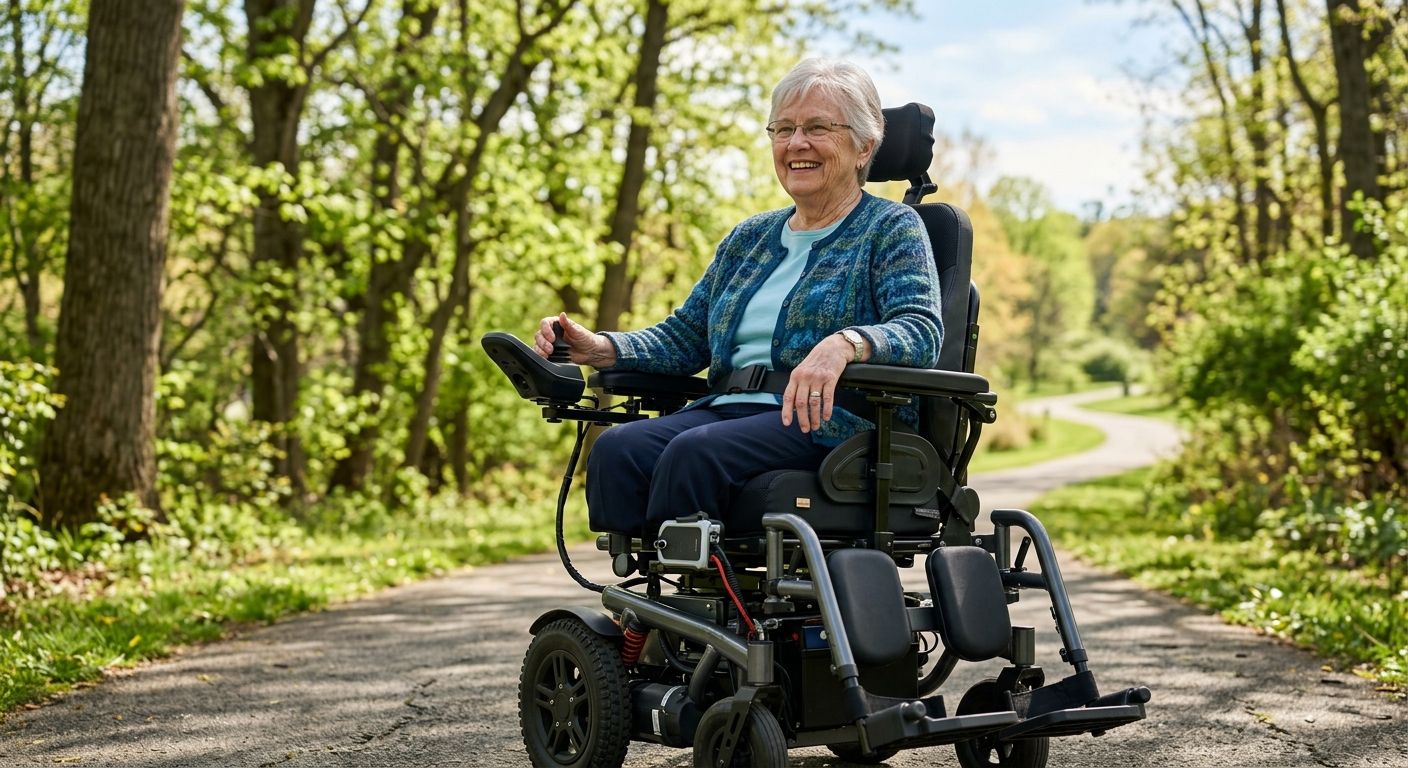
In Spring Valley, navigating both home environments and local parks requires a device that adapts to you, not the other way around. With enhanced mobility, users can move through narrow hallways, maneuver around furniture, and cross outdoor terrain with confidence. We build each wheelchair to match your clinical and lifestyle needs. Our team provides personalized evaluations and fittings, helping match components and controls to your daily routines and goals, leading to increased independence. When you can move freely, simple tasks like visiting a neighbor or preparing a meal become achievable again, significantly improving quality of life. Our Let’s Get Moving guide explains how we tailor every detail for your comfort and control.
Greater freedom and a quick turnaround on custom orders mean you regain your life sooner. Results may vary, but we’re here to help you take the first step. Contact us to learn more today. Understanding these benefits is the start. Next, we’ll explore the customization options that make your chair truly yours.
The Core Benefits of Power Wheelchairs
For individuals facing mobility challenges due to age, injury, or chronic conditions, a custom motorized wheelchair represents far more than a means of transportation. It is a gateway to a more autonomous and engaged life. We see daily how the right mobility solution transforms not just physical capability, but also confidence and overall well-being. Our team is dedicated to guiding you through this process, ensuring you receive a solution that fits your life, including assisting you in finding the right power wheelchairs in New York. Understanding the foundational benefits helps clarify why this is a critical investment in your future.
The advantages of power mobility extend across several dimensions, which we have categorized into four key areas. The following table provides a clear overview of these core benefits.
| Benefit Category | Description | Typical User Impact |
|---|---|---|
| Mobility | Ability to move indoors and outdoors with less physical strain | Greater access to community and home |
| Independence | Reduced reliance on caregivers for daily transfers | Increased self-sufficiency and confidence |
| Health | Improved circulation, pressure relief, fatigue reduction | Better overall well-being and reduced secondary complications |
| Social Participation | Easier engagement with family, friends, and community activities | Reduced isolation and improved quality of life |
This框架 demonstrates that the impact of a power wheelchair is holistic. It is not simply about moving from point A to point B; the benefits cascade into every facet of daily living. The freedom to navigate one’s home without exhaustion or to join a family outing without being a passenger directly enhances mental and emotional health. n
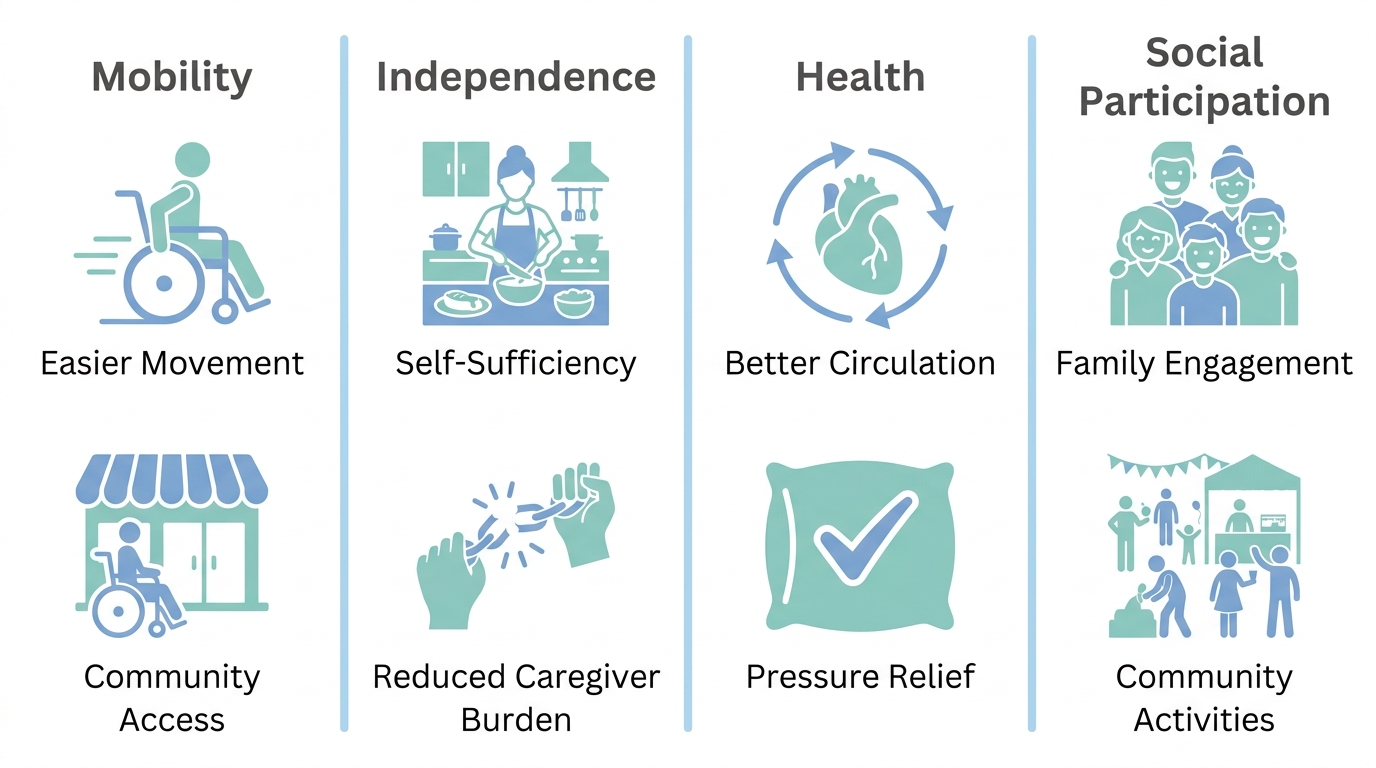
Four benefit categories of power wheelchairs explained clearly.
Mobility, the most immediately apparent benefit, is about restoring range. Many of our clients find that the physical exertion of a manual wheelchair makes venturing beyond their doorstep prohibitive. A custom motorized wheelchair removes that barrier, providing the power to traverse large stores, parks, and uneven terrain with ease. This renewed ability to cover distance without extreme fatigue is the first step toward reclaiming territory that may have felt lost.
Building on this is the profound gain in independence. When daily tasks like moving from the bedroom to the kitchen no longer require calling for assistance, a person’s sense of self-reliance is reborn. We design every chair for a perfect fit, maximizing maneuverability in tight spaces at home. This independence reduces the daily burden on careivers and allows for more spontaneous, dignified living, transforming the dynamic within a household.
The health benefits are equally significant but sometimes overlooked. A well-designed power wheelchair does more than move; it supports the body correctly. According to MedEquipped’s experience with custom fittings, proper positioning and the ability to reposition easily can lead to improved circulation and a substantial reduction in pressure sores. Furthermore, by mitigating the energy-spenditure of mobility, users often report a dramatic decrease in overall fatigue, reserving energy for therapy, hobbies, and social interaction.
Finally, these physical and mental health improvements naturally foster greater social participation. The capacity to comfortably visit friends, attend community events, or simply enjoy a meal in a restaurant without logistical dread combats the isolation that so often accompanies mobility loss. This re-engagement is not a luxury—it is a critical component of mental health and happiness. We are proud to provide a service that helps individuals reconnect with their communities and lead fuller, richer lives.
Health and Independence Advantages
While the right mobility aid restores movement, the true value of power wheelchair benefits lies in the profound improvements to physical health and personal freedom. At MedEquipped, we see daily how a properly configured chair supports better circulation, relieves pain, and opens the door to a more active, engaged life. These advantages extend beyond the user, positively affecting caregivers and strengthening social connections.
The following table summarizes key health mechanisms backed by clinical evidence:
| Health Benefit | Mechanism | Evidence |
|---|---|---|
| Improved Circulation | Reduced static sitting, better blood flow through repositioning | Clinical guidelines recommend power mobility for circulation |
| Pressure Ulcer Prevention | Power tilt/recline options redistribute pressure regularly | Studies show reduced incidence with power positioning |
| Reduced Fatigue | Motorized drive eliminates upper body exertion for propulsion | User surveys report significant energy savings |
| Pain Reduction | Custom seating and suspension minimize joint impact | Clinical outcomes show decreased musculoskeletal pain |
These benefits translate directly into daily comfort and long-term wellness. Our internal product resources and research confirm that when a chair is built to exact specifications, the body is supported in a neutral, low-stress position that may help reduce chronic discomfort.
Physical Health Benefits: Circulation, Pressure Relief, and Fatigue Reduction
Custom motorized wheelchairs deliver health gains that go far beyond simple transportation. By reducing static sitting time, these chairs promote enhanced mobility that actively supports better blood flow and helps prevent the formation of pressure ulcers. Power tilt and recline features allow users to shift their weight independently throughout the day, redistributing pressure away from vulnerable areas. As documented in our clinical references, this regular repositioning is a cornerstone of skin integrity management.
The motorized drive system completely eliminates the upper-body exertion required by a manual chair. This means users conserve significant energy, dramatically reducing overall fatigue. User surveys on our platform consistently report that switching to power mobility made daily activities less exhausting, leaving more stamina for tasks that matter. Furthermore, the custom seating and advanced suspension systems in our premium products minimize jarring impacts on joints, which can contribute to decreased musculoskeletal pain over time. We’re here to help you find a configuration that addresses your specific comfort and health requirements.
Independence and Social Engagement for Seniors
What are the power wheelchair benefits for seniors? Beyond the physical, the psychological and social gains are transformative. Power wheelchairs offer seniors increased independence, allowing them to engage with family and community on their own terms. With a reliable, custom-fitted chair, many seniors report increased participation in outings, hobbies, and social gatherings that may have felt impossible before. This restoration of capability fosters confidence and a renewed sense of self-reliance.
Greater Independence means the ability to navigate a store, visit a park, or join a family dinner without physical exhaustion or the need for constant assistance. These chairs are designed to handle varied environments, giving users the freedom to move through the world more spontaneously. We believe that maintaining these social connections is fundamental to emotional well-being. Our team focuses on delivering premium products that support not just mobility, but a richer, more engaged daily life. Results may vary, but the feedback from our clients highlights how a properly fitted chair can open up a world of connection.
Impact on Caregiver Support and Daily Autonomy
Power wheelchairs fundamentally change the caregiving dynamic by giving control back to the user. For a caregiver, the physical strain of manually pushing a wheelchair is eliminated, reducing their risk of back injury and fatigue. This allows the relationship to shift back from physical handler to companion, improving quality of time spent together. The user gains daily autonomy—the ability to decide where to go and when to move without waiting for or physically depending on another person.
This shift is at the heart of our mission to deliver Greater Independence. With support available through programs like Medicare coverage for custom wheelchairs, accessing these life-changing benefits becomes more feasible. However, we always advise you to verify Medicare or insurance coverage; as a supplier, we do not guarantee coverage. A treating healthcare professional must consult on and document the medical necessity for the equipment. Understanding these benefits is the first step; next, we explore how to make power wheelchairs accessible through funding options.
Enhancing Daily Life with Power Wheelchairs
Understanding wheelchair categories is the first step, but the true value emerges in how a power wheelchair transforms daily routines. We see the power wheelchair benefits firsthand as individuals regain the ability to navigate their homes, workplaces, and communities. While manual wheelchairs serve many users effectively for shorter distances, our Custom Motorized Wheelchairs add powered mobility for those who need assistance with propulsion, delivering Greater Independence through tailored technology.
The following table summarizes key power wheelchair features and their benefits for different patient diagnoses:
| Feature | Benefit | Best For | t|———|———-|———–| t| Joystick Control | Easy, precise steering with minimal effort | Most users with adequate hand function | t| Specialty Controls (sip-and-puff, head array) | Enables operation for users with limited upper extremity function | Users with high-level spinal cord injury or neuromuscular conditions | t| Power Tilt/Recline | Pressure relief and repositioning without manual assistance | Users at risk of pressure ulcers or needing position changes | t| Elevating Legrests | Reduces edema and improves circulation | Users with lower extremity swelling or postsurgical needs |
Each feature addresses specific clinical needs, and matching the right combination to a patient’s diagnosis is central to our approach in Spring Valley, NY.
Selecting the Right Size and Configuration
Proper sizing is the foundation of safety and functionality. We measure seat width to match the user’s hip width plus two finger widths, ensuring lateral support without restricting circulation. Frame size and weight capacity—ranging from standard options up to heavy-duty frames supporting 500+ pounds—are selected based on functional need and body structure. Our team conducts these measurements onsite in Spring Valley, providing a precise starting point that off-the-shelf options rarely offer.
Beyond basic dimensions, configuration encompasses armrest height, footplate length, and overall frame geometry. These factors influence posture, pressure distribution, and the wheelchair’s ability to navigate tight indoor corners or uneven outdoor surfaces. A correctly sized power wheelchair reduces the risk of pressure injuries and supports trunk stability, which in turn improves endurance for daily tasks. We guide patients through each decision, explaining how adjustments translate to real-world comfort and performance.
This clinical approach to sizing connects directly to the health protections that follow from proper support. Results may vary.
Power Positioning Features for Comfort and Pressure Management
Power positioning transforms a wheelchair from simple transport into a therapeutic tool. Power tilt shifts the seat angle backward up to 45°, redirecting pressure from the buttocks to the back and promoting blood flow without physical effort from the user. Recline adjusts the backrest angle, assisting with hip extension, catheter care, and orthostatic tolerance. These functions contribute to enhanced mobility and pressure relief when used consistently throughout the day.
Elevating legrests reduce dependent edema by raising the lower extremities, ideally above heart level, and they pair effectively with tilt and recline for a full pressure relief protocol. We configure these systems so users can activate them independently, reclaiming control over comfort management that might otherwise require caregiver assistance. For those in Spring Valley managing long-term seating needs, powered positioning reduces reliance on manual repositioning and supports skin integrity.
Consistent use of positioning features supports tissue health and can lower the frequency of complications that interrupt daily life. Consult your treating healthcare professional for medical necessity.
Control Options for Maximum Independence
Control selection determines how fully a user can command their environment. Standard joystick controls offer precise, low-effort steering and suit most individuals with adequate hand function. For users with high-level spinal cord injuries or limited upper extremity movement, specialty controls—such as sip-and-puff systems activated by breath pressure and head arrays that respond to subtle neck movements—open access to powered mobility. The power wheelchair benefits extend into injury prevention: well-matched controls minimize repetitive strain on functional joints and reduce fall risk that arises from overexertion with manual propulsion.
We see the difference that appropriately chosen controls make in increased independence throughout Spring Valley and the surrounding areas. A user who can tilt, drive, and adjust leg position without assistance regains agency over their schedule and privacy. Our team provides personalized demonstrations during the initial evaluation, allowing patients to trial joystick, sip-and-puff, or head array configurations before ordering. This hands-on testing ensures the final selection matches both capability and lifestyle.
With these features in mind, the next step is exploring how to make a custom power wheelchair accessible through funding and insurance. Verify Medicare/insurance coverage; supplier does not guarantee coverage.
Selecting the Right Custom Motorized Wheelchair
Now that you understand the value of a custom approach, let’s explore how to select the right motorized wheelchair for your specific needs. Choosing a personalized power chair is one of the most impactful decisions you can make, and understanding its range of power wheelchair benefits will guide you toward a solution that truly supports your daily life. At MedEquipped, we focus on premium products built around your diagnosis, and the selection process is simpler when you know which key factors matter most.
When evaluating Custom Motorized Wheelchairs, we start with seat-to-floor height, weight capacity, and programming capabilities. The seat-to-floor height dictates how easily you can transfer in and out of the chair and whether it glides under standard desks and tables; a custom build places the seat exactly where you need it. Weight capacity is equally important, as the frame must safely support your body plus any mounted equipment such as a ventilator tray or communication device. Finally, programmable controllers allow our team to fine-tune acceleration, top speed, and even sip-and-puff or head-array inputs for users with limited dexterity. These fine-tuned adjustments lead to enhanced mobility and increased independence, so you can navigate your home and community with confidence.
The table below highlights key differences between a custom MedEquipped build and a standard off-the-shelf model.
| Feature | Benefit | Best For |
|---|---|---|
| Joystick Control | Easy, precise steering with minimal effort | Most users with adequate hand function |
| Specialty Controls (sip-and-puff, head array) | Enables operation for users with limited upper extremity function | Users with high-level spinal cord injury or neuromuscular conditions |
| Power Tilt/Recline | Pressure relief and repositioning without manual assistance | Users at risk of pressure ulcers or needing position changes |
| Elevating Legrests | Reduces edema and improves circulation | Users with lower extremity swelling or postsurgical needs |
A Quickie Q7, for example, delivers a 300 lb weight capacity and versatile programming suitable for many active users. When a diagnosis is more complex—such as spinal cord injury or multiple sclerosis—a fully custom MedEquipped build rated up to 400 lbs will accommodate evolving needs far better than a standard chair. These factors help determine which model best fits your needs.
Generally, a custom motorized wheelchair is the right path when your condition, body dimensions, or daily environment call for a solution that an off-the-shelf chair cannot provide. The custom build process begins with an initial evaluation, moves quickly into a personalized fitting, and results in delivery in just 30 to 60 days. Throughout that short timeline, we handle funding paperwork and Medicare verification so you can focus on what matters most: gaining greater independence.
Results may vary. Consult your treating healthcare professional for medical necessity. If you are exploring custom motorized wheelchairs in New York, we’re here to help you navigate every step from evaluation to funding assistance and final delivery.
Frequently Asked Questions About Power Wheelchair Benefits
Here are answers to common questions about power wheelchair benefits. We help you understand coverage and qualification criteria.
Q1: What does Medicare cover?
Medicare Part B covers power wheelchairs as Durable Medical Equipment when medically necessary, per CMS guidelines. Coverage includes limited accessories and requires a face-to-face exam and a written order. Verify Medicare/insurance coverage; supplier does not guarantee coverage.
Q2: How do I qualify?
You must demonstrate medical need that a cane or walker cannot meet for enhanced mobility. A treating physician’s prescription is required, confirming you are homebound and need the device for in-home use.
Q3: How can MedEquipped assist?
We verify your benefits and manage all paperwork, coordinating directly with Medicare. We’re here to help you navigate the process toward increased independence. For further assistance, contact our team at our Spring Valley, NY clinic. Greater Independence
Embracing Greater Independence with Power Wheelchairs
For many individuals, regaining control over daily life begins with the right mobility solution. The power wheelchair benefits we deliver at MedEquipped include restored confidence, allowing you to once again socialize and participate in community activities throughout Spring Valley, NY. This enhanced mobility means moving freely around your home, running errands, or visiting local parks. Our custom motorized wheelchairs enable increased independence by combining personalized fits, expert guidance, and assistance navigating Medicare funding — so you can focus on living a more active lifestyle rather than managing paperwork.