
MedEquipped

Category: Mobility Equipment Comparison

  • Best Manual Wheelchairs 2026: Spring Valley NY Options

    Best Manual Wheelchairs 2026: Spring Valley NY Options

    Table of Contents

    Choosing the Best Manual Wheelchair for Daily Independence

    Selecting the right manual wheelchairs is a critical decision that can significantly enhance daily independence and overall quality of life. To ensure optimal comfort and function, key features like precise seat width and depth adjustments, supportive backrest height, and a durable yet lightweight frame must be carefully considered. Proper measurements and professional fittings, like those offered by MedEquipped, are essential, especially when exploring advanced mobility solutions. While standard self-propelled chairs can meet basic needs, modern power wheelchairs offer a different level of support. For those seeking the ultimate in freedom, custom motorized wheelchairs provide superior independence, with our experienced team typically delivering Premium products in a Quick turnaround of just 30–60 days.

    1. Lightweight Models for Simpler Maneuvering

    For residents seeking easier daily navigation, we provide lightweight manual wheelchairs in Bronx that prioritize portability without sacrificing the durability or support you need. These manual wheelchairs typically weigh under 30 lbs, making them easier to self-propel through narrow doorways, crowded sidewalks, and other tight indoor spaces.

    The primary advantage of a self-propelled wheelchair is the reduced strain during daily use. When a chair weighs significantly less than standard models, every push consumes less energy, allowing you to travel farther with greater comfort. MedEquipped recommends these lightweight manual aids for individuals with sufficient upper-body strength or for those who want a reliable secondary chair for travel and quick errands. Based on RESNA guidelines for proper seating and mobility assessment, we emphasize professional fitting to protect your posture and provide appropriate pressure relief — a critical step in supporting long-term health.

    We make these premium products accessible to customers throughout the Bronx area, with delivery and personalized setup included in the process. Our team can customize your chair with various seat cushions, armrests, and footrests so your anatomy is properly supported. While most models support up to 250 lbs, we will help you select the right configuration for your daily routine.

    We’re here to help manage the paperwork too. MedEquipped assists with Medicare and insurance documentation, although coverage is not guaranteed and must be verified individually. For those who find that self-propelled chairs do not fully meet their needs, power wheelchairs provide an alternative solution. Contact us to explore our selection and take the next step toward greater independence.

    2. Custom Seating for Superior Comfort

    Whether you use a manual wheelchair or a power wheelchair, custom seating is essential for achieving genuine, all-day comfort and proper postural support. At MedEquipped, we begin every custom motorized wheelchair with a thorough patient evaluation that includes body measurements and pressure mapping to identify risk areas. This detailed process, aligned with standards from national seating and mobility experts, ensures that each component is tailored to provide optimal stability and relief.

    Our process integrates an assessment of your unique needs, whether conducted in your home or at our clinic. Following best practices and resources such as manual wheelchair fitting guides from professional bodies, we design a comprehensive seating system. We then assemble your custom solution with features like contoured cushions for pressure redistribution, adjustable backrests for dynamic support, and lateral supports to maintain a secure, aligned posture. Specialized headrests and configurable controls are also integrated to enhance daily function and independence.
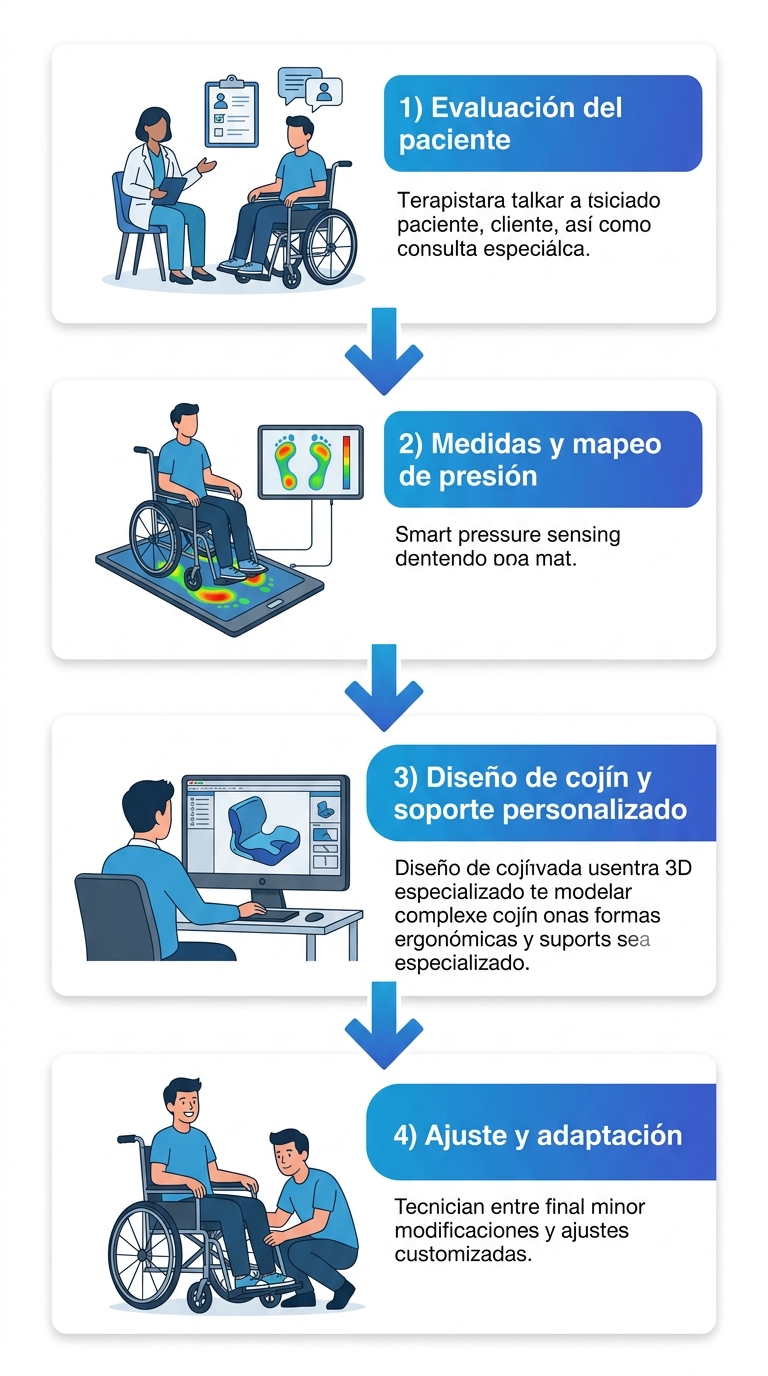
    Vertical diagram illustrating the four-step custom seating process for motorized wheelchairs at MedEquipped

    Custom seating process evaluation measurements design fitting

    This personalized approach to power wheelchairs can help reduce the risk of pressure injuries and discomfort from extended sitting by ensuring weight is evenly distributed. A properly fitted system significantly improves posture and ease of wheelchair operation, allowing you to navigate your daily environment with greater confidence. Unlike off-the-shelf options, our custom seating is a standard part of your motorized wheelchair package, not an add-on feature.

    As the Assistive Technology Industry Association (ATIA) defines it, assistive technology is any item or system used to increase functional capabilities. We see custom seating as a perfect example of this, enhancing your everyday life. Our efficient build process means you receive your fully customized wheelchair in just 30 to 60 days.

    Contact us today to schedule your personal seating evaluation.

    3. Medicare Coverage Made Straightforward

    Whether you need a manual wheelchair or a custom motorized wheelchair, dealing with Medicare coverage can feel overwhelming. At MedEquipped, we eliminate the guesswork so you can focus on what matters—regaining your mobility and independence. Our team knows the Medicare rules for mobility devices inside and out, and we handle the entire process on your behalf.

    Medicare Part B may cover a Custom Motorized Wheelchair if a few key requirements are met. First, you must have a face-to-face examination with your physician to document your condition. Second, your doctor must provide a written prescription confirming the medical necessity of a power wheelchair. Third, the documentation must demonstrate that your condition prevents you from safely performing daily activities—like moving around your home—with a cane, walker, or manual wheelchair. According to the Centers for Medicare & Medicaid Services (CMS), these criteria are part of the National Coverage Determination for power mobility devices.

    MedEquipped takes over from there. Before any order is processed, we verify your Medicare benefits so you understand what your plan may cover and what, if any, out-of-pocket costs you could face. If you are considering powered wheelchairs in Spring Valley, we manage every piece of paperwork—from collecting your prescription and medical records to submitting the claim to Medicare. Our experienced staff leverages in-depth knowledge of national seating and mobility standards to recommend the right equipment and build a complete documentation package. This expertise often results in a significantly faster process, with many of our clients receiving their custom wheelchairs within 30 to 60 days.

    Coverage is not guaranteed and depends on your individual Medicare plan and medical necessity. Verify with your provider and consult your physician.

    Once your coverage is confirmed, our team arranges a personalized delivery and setup so you can begin enjoying a new level of comfort and freedom. We’re here to help you navigate every step toward Greater Independence.

    4. Manual vs. Power: Matching Mobility Needs

    When selecting your ideal mobility solution, the first decision is usually between manual wheelchairs and power wheelchairs. While manual wheelchairs remain a viable choice for some, understanding the key differences ensures you invest in the right path toward greater independence.

    Manual wheelchairs require significant upper body strength and endurance, making them best suited for users with good arm function who need a lightweight, portable option. These chairs work well in small indoor spaces and for short, flat distances. However, they offer limited independence for individuals with progressive weakness, fatigue, or conditions like multiple sclerosis or spinal cord injury. Our team at MedEquipped often sees patients who find that manual wheelchairs simply cannot support their daily activity goals or varied terrain, shifting the focus toward power wheelchairs.

    In contrast, custom motorized wheelchairs handle diverse environments—from tight apartment corners to outdoor sidewalks and hills—without exhausting the user. Since National Seating and Mobility experts and industry standards emphasize proper positioning, our power solutions are configured to your exact body measurements and diagnosis, ensuring optimal pressure relief and posture. Although manual chairs generally carry a lower upfront cost, power wheelchairs frequently qualify for Medicare funding when medical necessity is documented, offsetting the investment while granting life-changing autonomy.

    Once you decide on power, the next step is tailoring it to your exact needs. We guide you through every stage, helping you verify benefits and navigate the Medicare coverage determination process. Results may vary, and we encourage you to consult your treating healthcare professional to establish medical necessity.

    5. Evaluating Mobility Equipment Providers

    After you’ve chosen a mobility device—whether manual wheelchairs or a custom motorized model—selecting the right provider is essential. Focus on these evaluation criteria to ensure you receive expert care and a reliable wheelchair.

    A provider should offer Custom Motorized Wheelchairs built to individual measurements and provide thorough in-person evaluations and personalized fittings. At our Spring Valley, NY clinic, we tailor each power wheelchair to your exact needs for superior comfort.

    Look for deep knowledge of wheelchair seating assistive technology and national seating and mobility standards. Proper seating and positioning reduce pressure sores and enhance postural support; our team configures chairs for long-term comfort and safety.

    A reliable provider manages funding and paperwork for you. We handle Medicare benefits verification and billing, though results may vary. Verify Medicare/insurance coverage; supplier does not guarantee coverage. Consult treating healthcare professional for medical necessity. Our goal is to take the stress out of the funding process.

    A 30–60–day turnaround with delivery and setup demonstrates efficiency. Our premium products arrive fast with expert installation, helping you achieve greater independence sooner.

    We’re here to help you start the process. Contact MedEquipped in Spring Valley for an evaluation—our patient-focused team is ready to guide you every step of the way.

    6. When a Custom Motorized Wheelchair Changes Everything

    Once your custom wheelchair is built and fitted, the real transformation begins. For many users who have relied on manual wheelchairs, upgrading to a custom motorized mobility solution can dramatically enhance daily independence—allowing them to navigate their home, prepare meals, and engage in personal care with far less physical strain. According to MedEquipped, personalized fittings from RESNA-certified Seating and Mobility Specialists ensure every chair is built to exact specifications for superior comfort and maneuverability, following national seating and mobility best practices in Spring Valley, NY.

    Greater Independence comes from a precise, individualized approach. A personalized fitting that addresses your unique diagnosis and mobility needs improves posture, pressure distribution, and control—overcoming the discomfort common with standard power wheelchairs. MedEquipped delivers this custom solution with a quick turnaround of 30 to 60 days, a timeline notably shorter than the industry benchmarks of four to six months. Additionally, we assist with funding sources and paperwork, verifying your Medicare benefits and preparing the medical necessity documentation as required by CMS standards to reduce your administrative stress.

    Results may vary, and we encourage you to verify your Medicare coverage, as we do not guarantee insurance approval. Please consult your treating healthcare professional to establish the medical necessity of a custom motorized wheelchair before proceeding. We’re here to help you take the first step toward greater independence.

    Please note: Results may vary; individual outcomes depend on medical necessity and insurance coverage. Verify Medicare/insurance coverage; supplier does not guarantee coverage. Consult treating healthcare professional for medical necessity.

    Greater Independence Starts with the Right Wheelchair

    While standard manual wheelchairs serve basic mobility needs, the right custom motorized wheelchair unlocks true independence. A custom-built chair, tailored to your body and lifestyle, offers greater freedom and quality of life than any off-the-shelf option. Power wheelchairs designed for your specific needs can transform daily routines, providing effortless navigation and reducing physical strain.

    At MedEquipped in Spring Valley, we make this transformation possible through custom builds, personalized fittings, and dedicated assistance with Medicare and funding paperwork. With proper evaluation and medical guidance, the right chair can transform daily life—and that starts with understanding your unique needs, a process we perfected at MedEquipped. Our 30–60 day quick turnaround ensures you receive your premium mobility solution faster than typical industry timelines.
    Resources

  • Rovi X3 vs Pride Jazzy 600 ES: Which Power Chair Wins?

    Rovi X3 vs Pride Jazzy 600 ES: Which Power Chair Wins?

    Table of Contents

    ROVI X3 vs Pride Jazzy 600 ES: Finding Your Ideal Power Wheelchair Base

    When comparing the ROVI X3 vs Pride Jazzy 600 ES, the choice often comes down to drive type and intended use. Both models offer reliable mobility, but each performs differently in real-world scenarios.

    The ROVI X3’s mid-wheel drive provides a tight turning radius for indoor navigation, while the Jazzy 600 ES’s front-wheel drive delivers stability on loose or uneven terrain. MedEquipped notes that ROVI X3 models built after April 2024 now include integrated lighting for enhanced safety. According to RESNA’s wheelchair service provision standards, a clinical evaluation is essential to match your needs to the right base.

    Now that you see how these stock models differ, explore our personalized power wheelchairs — custom motorized wheelchairs tailored to your body and lifestyle. We’re your partner in mobility freedom, handling every step from insurance to delivery so you can focus on living.

    1. Turning Radius for Tight Spaces

    When navigating tight indoor spaces, a power wheelchair’s turning radius determines how easily it can pivot in place. The ROVI X3, a popular choice for home use, features a turning radius of under 20 inches — a specification that makes it well-suited for doorways, bathrooms, and narrow hallways. For those comparing the Rovi X3 vs Pride Jazzy 600 ES, understanding turning radius helps weigh maneuverability differences without focusing on a single brand.

    For many families evaluating electric wheelchair cost, maneuverability is an equally important factor. A tighter turning radius improves daily usability in confined areas. We at MedEquipped help you evaluate these specifications during clinical assessments to ensure the chosen model fits your environment. While electric wheelchair cost is part of the discussion, our focus is on matching you with the right mobility solution. Consult a healthcare professional before making clinical decisions.

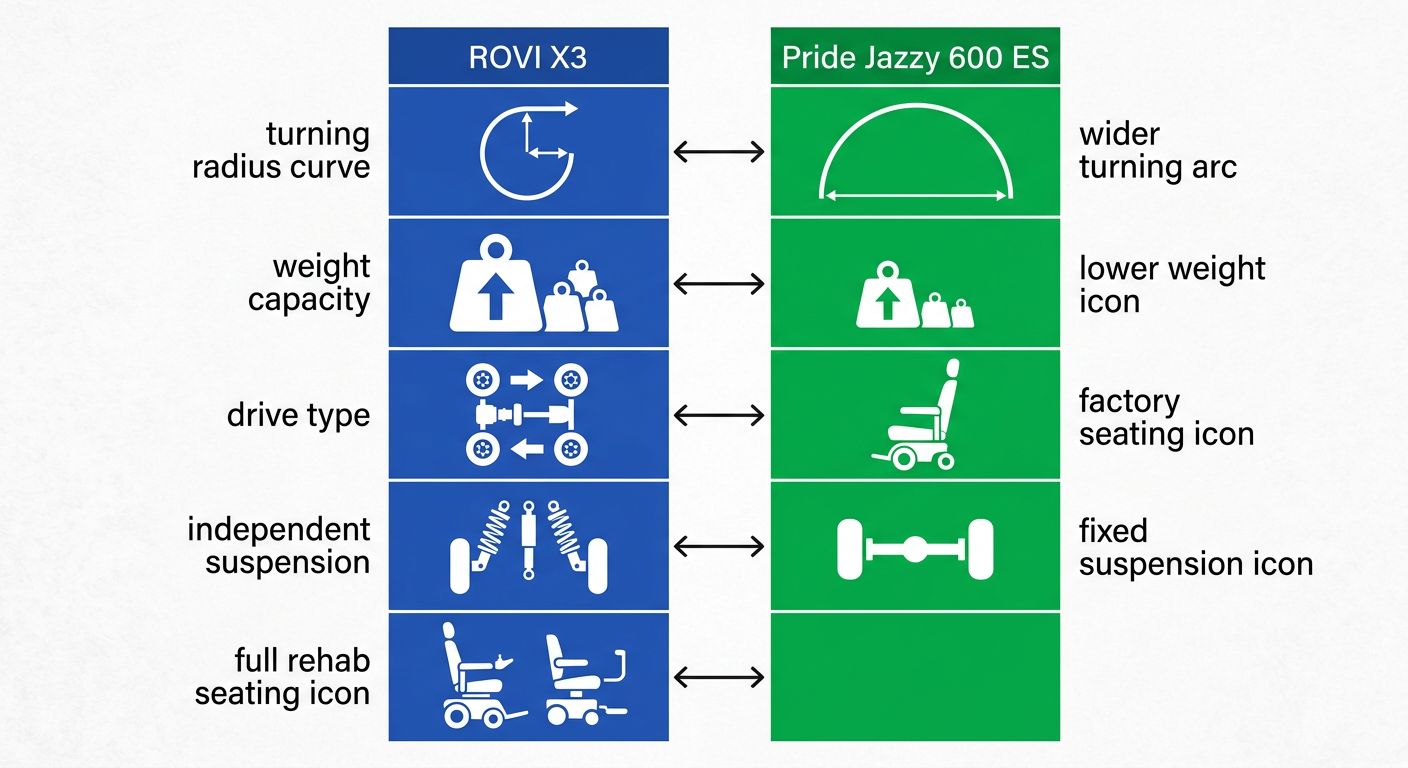
    Product comparison infographic showing ROVI X3 in blue column versus Pride Jazzy 600 ES in green column with icons for turning radius, weight capacity, drive type, suspension, and seating compatibility

    ROVI X3 vs Pride Jazzy 600 ES comparison infographic

    Beyond turning radius, the ROVI X3’s seating and weight capacity enhance comfort for everyday use. Our next section explores these ergonomic features in detail.

    2. Indoor Maneuverability Precision

    While outdoor performance matters, precise indoor navigation is equally critical for daily independence. We understand your home’s layout matters, and the Pride Jazzy 600 ES delivers exceptional indoor maneuverability precision with a turning radius of under 30 inches—a figure confirmed by Med Equipped’s product specifications.

    This agile in-home performance aligns with the benchmarks set by RESNA for accessible corridor widths and turning spaces. The chair’s programmable joystick sensitivity allows fine-speed control in tight areas like elevators and bathrooms, and multiple sensitivity profiles can be set for different tasks, ensuring tight-space maneuvering capability. Even a 36-inch doorway is manageable: you can angle the chair and pivot around the frame without needing to reverse, thanks to the Jazzy 600 ES’s sub-30-inch turning radius and compact footprint. Adjustable seating options such as power tilt and recline help maintain that footprint and turning radius, maintaining agile in-home performance.

    For multi-story homes, exploring stair lift cost can supplement your plan, but our wheelchairs excel indoors. We provide tailored adjustments and full insurance coordination for your custom motorized wheelchair—your partner in mobility freedom.

    3. Weight Capacity for Heavy-Duty Needs

    When heavy-duty needs arise, weight capacity becomes a central specification. A bariatric power wheelchair must safely support higher maximum weight limits—often up to 500 pounds or more—to prevent frame fatigue, motor strain, and stability issues. Selecting the right load rating from the start keeps your chair dependable through years of daily use.

    Beyond structural strength, weight capacity guides how we configure every component—from reinforced seating to high-torque motors—to match your needs. Our team follows established wheelchair service provision standards to ensure your heavy-duty wheelchair meets safety and performance criteria. Each base is custom-configured after a thorough clinical evaluation, factoring in your body dimensions, lifestyle, and mobility goals; we never simply pick a model off the shelf.

    Power wheelchairs are regulated as medical devices by the U.S. Food and Drug Administration, underscoring the importance of proper selection and fit. Let’s begin your journey to greater independence together—contact us to find the perfect weight capacity for your needs. We’re your partner in mobility freedom.

    Information is not medical advice and is for informational purposes only.

    4. Custom Rehab Seating Compatibility

    Beyond the core features of a power wheelchair, custom seating compatibility is essential for long-term comfort and postural support. Our custom motorized wheelchairs are engineered to work with most rehab seating systems, including trusted brands like Roho and Jay. All frames meet RESNA seating standards, ensuring structural integrity and safety for seating integration. During your evaluation, our ATP-certified therapists assess your specific needs and pair you with the ideal seating system and wheelchair base. We coordinate mounting hardware, positioning adjustments, and accessories—pressure relief cushions, back supports, laterals, and headrests—so everything functions as one cohesive system. Whether you are considering the Rovi X3 or the Pride Jazzy 600 ES, custom rehab seating can be integrated into either model. As your partner in mobility freedom, we then manage the entire ordering and delivery process. All MedEquipped custom seating systems comply with FDA medical device requirements; for any safety concerns, we encourage you to use the FDA medical device feedback portal. Results may vary; individual outcomes are not guaranteed.

    5. Suspension Quality and Ride Comfort

    In the previous section we surveyed overarching wheelchair categories; now we zero in on suspension quality—the wheelchair’s ability to absorb shocks and maintain stability across varied surfaces, directly shaping your comfort and safety on every ride. In a rovi x3 vs pride jazzy 600 es comparison, the suspension system stands as a major differentiator.

    In the Rovi X3, independent front suspension with air-based damping often provides a smoother ride over bumps, cracks, and uneven outdoor ground. In the Pride Jazzy 600 ES, a mid-wheel drive design with anti-tip stability delivers predictable handling and tight maneuverability indoors. MedEquipped’s electric wheelchair cost-comparison article details these suspension specifications, and both models are registered with the U.S. Food and Drug Administration (FDA) as medical devices. The rovi x3 vs pride jazzy 600 es comparison highlights these suspension trade-offs.

    A well-tuned suspension reduces fatigue and pressure points during extended outdoor use. Our certified ATP evaluators examine your terrain to recommend the best-fit suspension. Ride comfort is one factor—next we cover battery range. For a custom quote, contact us. Results may vary; consult with a healthcare professional before making clinical decisions.

    6. Mid-Wheel Drive Stability

    Mid-wheel drive (MWD) power wheelchairs position the drive wheel between front and rear casters, giving them the tightest turning radius of all drive configurations. This design creates excellent indoor maneuverability but can reduce static stability on slopes, so anti-tip wheels are often required.

    RESNA (Rehabilitation Engineering and Assistive Technology Society of North America) establishes rigorous static and dynamic stability testing standards that guide safe wheelchair design. These benchmarks help ensure mid-wheel drive chairs remain secure during daily use. At MedEquipped, we configure custom MWD chairs with proper anti-tip systems, seating adjustments, and suspension tuning based on your home layout and personal routine. By integrating safety safeguards with responsive indoor handling, our team helps you move confidently. As your partner in mobility freedom, we weigh all drive configuration options during clinical evaluations to match your lifestyle.

    7. Heavy-Duty Frame Durability

    When we help patients explore power wheelchairs, heavy-duty frame durability is one of the first topics we discuss. A heavy-duty frame is engineered for higher weight capacities, typically supporting 300 pounds or more, using reinforced steel or aircraft-grade aluminum. These materials and the wider base designs they allow are what separate a heavy-duty power wheelchair from a standard model. Our product catalog includes several heavy-duty bases, and the FAQ resources we share with patients address common questions about how these frames hold up over time and the rugged terrain they can handle.

    Frame stability directly shapes ride quality and long-term performance. A sturdy construction with reinforced cross-bracing minimizes flex and keeps the chair tracking true, even on uneven ground. In our experience, heavy-duty frame durability means patients feel secure knowing their equipment will maintain structural integrity through daily use, whether navigating a grassy yard or a gravel driveway.

    The following table outlines how three common frame materials compare in terms of strength, support capacity, and service life:

    Frame Material Primary Strength Support Capacity Service Life
    Reinforced Steel Maximum Durability Up to 600+ lbs 10+ Years
    Aircraft-Grade Aluminum Strength-to-Weight Ratio 300 – 450 lbs 7 – 10 Years
    Carbon Fiber Composite Ultra-Lightweight Up to 300 lbs 5 – 8 Years

    Choosing a frame involves a natural trade-off. The strongest reinforced steel frames offer exceptional durability and weight capacity but add considerable weight, making transport more challenging. Aircraft-grade aluminum strikes a balance between strength and manageability. Carbon fiber composites reduce weight further while maintaining respectable capacity, though they typically cost more up front.

    We always remind patients that a heavy-duty frame’s value goes beyond numbers on a spec sheet. It is about matching the chair to real-world requirements, whether that means supporting a higher user weight, enduring daily outdoor travel, or simply providing the peace of mind that your equipment will not let you down. Results may vary, and we encourage you to speak with our team about which frame material aligns with your mobility goals. Next, we will look at how these heavy-duty platforms perform across different environments and use cases, helping you identify the right fit for your lifestyle.

    8. Long-Term Support and Adjustments

    After your custom motorized wheelchair arrives, our support continues. As your partner in mobility freedom, we offer long-term adjustments and post-delivery care. Our certified technicians can make fit refinements, performance tweaks, and comfort updates to match your evolving needs and offer ongoing training for users and caregivers.

    We handle the paperwork, insurance navigation, and coordination before delivery, and we’re just as committed afterward. Patients in New York, Georgia, and Michigan can reach us for adjustments by phone at 845-237-2381, by email at intake@medequipped.com, or through our website. Our team is available Monday through Friday, 9 AM to 5 PM EST.

    For specific ROVI X3 support processes, consult our ROVI X3 FAQ; for seating comfort tips, see our custom seating blog. We treat every relationship as a long-term partnership. If you need assistance, contact us anytime. Results may vary; individual outcomes are not guaranteed.

    Selecting the Right Power Wheelchair with MedEquipped’s Support

    Finding the right mobility solution can feel overwhelming, but we make selecting the right power wheelchair a guided, personalized experience. Our certified ATP evaluators conduct in-depth clinical assessments to match your mobility and lifestyle needs exactly.

    From there, we handle the paperwork, insurance navigation, and coordination—saving you time and stress so you can focus on selecting the right power wheelchair. Most orders are delivered within 30–60 days, a faster turnaround than typical providers. We fully support patients in New York, Georgia, and Michigan with ongoing care after delivery.

    As your partner in mobility freedom, we provide custom motorized wheelchairs from industry-leading brands, configured precisely for your body and daily environment. Contact us for a custom quote, and explore our model options to find your perfect fit. Always consult a healthcare professional for personal mobility recommendations.

    Resources
