
Category: Clinical Seating & Positioning

  • Managing Shoulder Pain in Wheelchair Users: A Practical Guide

    Managing Shoulder Pain in Wheelchair Users: A Practical Guide

    Table of Contents

    Protecting Your Shoulders as a Wheelchair User

    Managing shoulder pain in wheelchair users starts with understanding how repetitive manual propulsion places heavy demand on the shoulder joints over time. For those who rely on manual wheelchairs, the constant pushing motion can contribute to overuse injuries and chronic discomfort that affect daily life. Power assist technology, which provides motorized torque during manual propulsion, is designed to reduce stroke frequency and joint excursion, helping mitigate shoulder strain during everyday mobility.

    This article will teach you what effect mobility equipment has on your joints over time and how to choose the equipment that is right for your shoulders. We will go over some ways to look ahead when choosing equipment and make sure your chosen mobility aid will be comfortable and support your posture for the long term.

    Key Takeaways

    • The shoulder pain that often occurs in people who use a wheelchair starts with actions that give them independence such as transfers and propulsion.
    • Because pushing down on the handrim strains your shoulders, shifting to a pulling motion can reduce impact shock and encourage a more upright posture.
    • Repetitive manual transfers can strain the shoulder tendons, especially the biceps and supraspinatus.
    • Managing shoulder pain as a wheelchair user starts with daily conditioning.
    • Our team helps patients transition from their professional evaluation to the right mobility solution when faced between two main options: power assist systems or power wheelchairs.

    Before You Begin

    If you’re deciding whether to go for a power chair or a power-assist chair, we advise being honest about your upper body strength and endurance, as well as what you typically navigate on a daily basis. Your physical limitations determine how much less your shoulders will be strained over time. Power assist systems can help by adding motorized torque to the manual push, which lowers stroke rate and joint excursion. But again, only when you have the appropriate power assist system that matches your lifestyle and physical ability.

    It’s also vital to gather everything needed for your new equipment. For example, Medicare Part B requires a face-to-face doctor exam and documented proof that you’re medically necessary for the equipment prior to coverage being approved. Make sure you check with your physician and funding source before ordering to confirm that you will be eligible for the new equipment. MedEquipped manages Medicare benefit verification and related documentation as part of their standard patient service, which can streamline the process for you. Their in-person clinical evaluation and personal fitting at our location in Spring Valley, New York makes sure you get the right mobility solution for you.

    Understanding what is causing your shoulder pain is the true starting point of this process, so you can make an informed decision about the right mobility solution.

    Step 1: Identify What Causes Your Shoulder Pain

    The shoulder pain that often occurs in people who use a wheelchair starts with actions that give them independence such as transfers and propulsion. Studies from RESNA show that repeating transfers can injure the shoulder’s tendons, with a quantitative ultrasound study showing changes to the biceps and supraspinatus structures after only 18 transfers. Tendon alterations also were correlated with higher WUSPI scores, suggesting that transfers increase the risk for a chronic injury.

    Pain intensity is not the same for all. A RESNA pilot study of wheelchair rugby athletes revealed that individuals with higher cervical-level spinal cord injuries experienced more intense pain, possibly because they had higher stroke frequency and transfer demands. The athletes with higher classification scores also felt more discomfort, indicating that activity level and injury characteristics can influence how much pain someone feels.

    Start noticing which of the movements – transfers, reaching or propelling – causes you pain. This is your first step towards discovering the reason for your pain. If this pain continues or gets worse, see a professional instead of trying to figure it out yourself.

    Step 2: Refine Your Propulsion Technique

    Because pushing down on the handrim strains your shoulders, shifting to a pulling motion can reduce impact shock and encourage a more upright posture. It appears that pulling upward on the handrim spreads the force over a larger portion of the rim, which may lower peak vertical shoulder joint reaction forces compared to conventional pushing.

    Reverse propulsion takes this further by promoting a larger angular range of motion, 108.9 degrees versus 66.6 degrees in forward propulsion, while minimizing torso deviation and kyphosis. To make these adjustments stick, focus on maximizing your contact angle and lowering stroke frequency; a brief instructional video paired with supervised practice has been shown to improve both measures in adolescents aged 13–18 on carpet and tile surfaces. Even with refined technique, remember that propulsion still loads the upper limbs, so safe transfer methods in the next step will help protect your shoulders long-term.

    Step 3: Master Safer Transfer Techniques

    Repetitive manual transfers can strain the shoulder tendons, especially the biceps and supraspinatus. Quantitative ultrasound research indicates that a single session of transfers causes fibers to become misaligned and decreases the echogenicity of the tendon, changes that correlate with increased pain scores on valid shoulder assessments for wheelchair users in the US. These acute physical changes could lead to chronic shoulder pain if transfers are performed frequently without correct technique.

    We believe that proper setup and body positioning can reduce shoulder involvement. Little tweaks in how you transfer can reduce cumulative shoulder strain over time, protecting your shoulders without requiring extra effort. If transfers consistently cause discomfort, consult a physical therapist to review your approach and identify personalized strategies for safer movement.

    Step 4: Build a Daily Stretching and Strengthening Routine

    Managing shoulder pain as a wheelchair user starts with daily conditioning. A consistent routine helps maintain scapular mobility, strengthens the muscles that stabilize the shoulder blade, and counteracts the postural changes that can develop from prolonged wheelchair use.

    Start your day with a quick check-in of your posture to see how your shoulders and upper back feel. Follow that up with two or three gentle chest and shoulder stretches to release any tightness, and then add two or three strengthening exercises like scapular retraction or seated row. Pick the same time of day to do this routine, so you can make it a habit.

    Increase repetitions or hold times gradually and slowly, and stop any movement that causes sharp pain. As a home-made routine, it’s best to validate it against your body and equipment and consider it more of a starting point than anything else until you have a chance to see a professional for an evaluation and fitting.

    Step 5: Get a Professional Evaluation and Fitting

    The first step for managing shoulder pain in wheelchair users is to undergo a thorough evaluation from a professional that evaluates how strong and how long your upper body can hold up, as well as what environments you spend most of your day in. Our team then looks at this information to help determine if you would be best suited for a power assist system or a full power wheelchair, which helps reduce the strain on your shoulders.

    A proper fit prevents pressure injuries and helps maintain correct body posture over time. Before purchasing any equipment, get a face-to-face exam by your doctor and make sure that the doctor documents that you need the equipment for medical necessity, as Medicare Part B only covers these if they are prescribed. We take care of all benefit verifications and paperwork so you can focus on getting better.

    Step 6: Explore Power-Assist and Custom Power Options

    Our team helps patients transition from their professional evaluation to the right mobility solution when faced between two main options: power assist systems or power wheelchairs. Power assist systems are attachment devices to manual wheelchairs that motorize the pushrim to take some of the load off the shoulders as well as reducing the amount of strokes needed to go, which can help keep joints healthy and strong. On the flip side, power wheelchairs are controlled by a joystick and allow those who need more than just powered assistance to be totally independent.

    It all depends on your upper body strength and endurance as well as the environments you find yourself navigating each day. If you’re not sure what’s right for you, our experts in Spring Valley, NY are here to assist you Monday-Friday from 9:00 am until 5:00 pm and can talk about your mobility goals and what to do next.
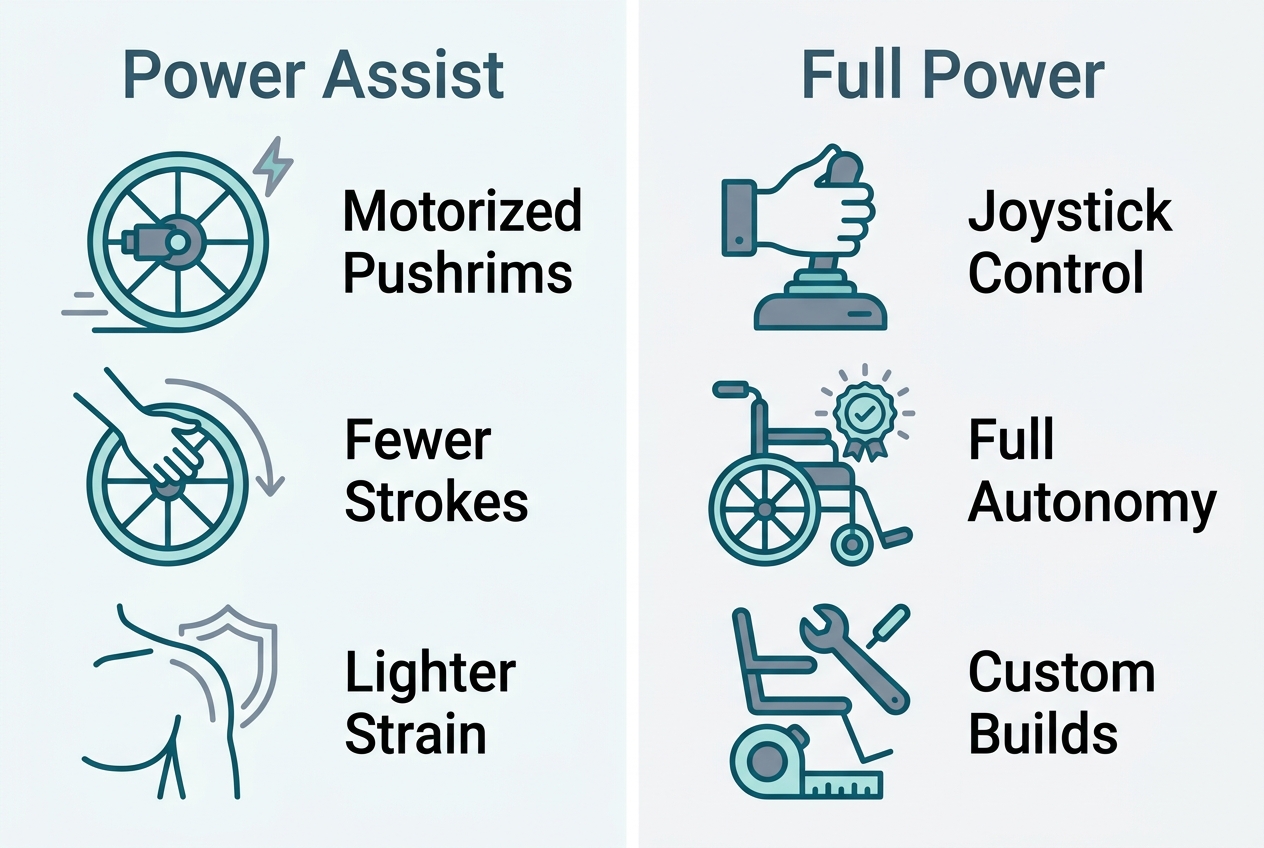
    Two-column infographic comparing power-assist wheelchair options and full power wheelchair options with labeled icons
    Side-by-side comparison of power assist vs full power wheelchair features

    Recognize Warning Signs That Need Medical Attention

    Even with all our best equipment and technique, the shoulders are sending us messages that they need attention. Research shows that repeated transfers can cause changes in the tendon structure and acute micro-injuries can build up into bigger, chronic problems if we ignore them.

    Take these warning signs seriously and discuss them with a clinician:

    • Pain that lingers or worsens after transfers or propulsion
    • New weakness when lifting or transferring
    • Pain that interferes with independent transfers
    • Symptoms that do not ease with rest

    Discuss with your care team what activity is causing the pain and for how long. This information will help determine if it’s an overuse tendon issue versus something else and will guide what’s next.

    Troubleshooting Common Setbacks

    That’s just one part of the job; applying the right correction can keep shoulder strain from becoming a chronic condition. While dealing with shoulder pain can be difficult for wheelchair users, studies indicate that most instances respond well to dedicated practice and self-awareness. Managing shoulder pain in wheelchair users

    When you have one-sided pushing, this may be improved by distributing your effort more evenly between each arm. Research showed that pediatric wheelchair users have significantly greater side-to-side differences when measuring shoulder movement, which means asking a clinician to look at your technique may help to target areas where you need to make adjustments.

    An inefficient stroke pattern wastes energy and puts strain on the shoulders. Only three out of six young users used the suggested semi-circular propulsion, so practicing longer, smoother strokes that maximize contact with the pushrim reduces wasted motion and load.

    The rushed, high frequency stroke feels as though the only way to continue is fast, but the faster you go, the more injury you’re going to incur. A few minutes of instruction followed by practice greatly increased the contact angle and lowered stroke frequency for both carpet and tile in adolescents, proving that retraining does change behaviour, even if it’s just for a short time. rushed, high-frequency stroke

    If self-correction does not fix the problem, a personal equipment evaluation and fitting might help tackle issues you can’t fix on your own. The team at MedEquipped in Spring Valley, NY can provide an evaluation and fitting that is custom to your needs and can verify your setup supports shoulder-friendly movement.

    Stop troubleshooting through pain. If you have persistent symptoms while pushing, you could be at risk for impingement, so if you’re still feeling pain, stop and get evaluated instead of pushing yourself.

    Frequently Asked Questions

    What are the most common causes of shoulder pain in manual wheelchair users?

    Shoulder pain in manual wheelchair users often results from repetitive transfers and propulsion. Research shows these actions can injure shoulder tendons like the biceps and supraspinatus, with measurable structural changes after as few as 18 transfers. Higher stroke frequency and transfer demands increase pain intensity, especially for those with higher-level spinal cord injuries.

    How can a professional custom wheelchair fitting help reduce long-term shoulder strain?

    A professional custom wheelchair fitting ensures the equipment supports correct posture and reduces pressure on the shoulders. Proper adjustments to seat width, depth, and backrest height prevent secondary complications like pressure injuries and postural strain that contribute to chronic shoulder issues over time.

    What are some effective daily stretches and exercises to prevent shoulder injuries for wheelchair users?

    Daily conditioning routines should include gentle chest and shoulder stretches to release tightness, along with strengthening exercises like scapular retraction or seated rows. These movements maintain scapular mobility, strengthen stabilizing muscles, and counteract postural changes from prolonged wheelchair use.

    Can a power-assist device or custom power wheelchair help manage or alleviate chronic shoulder pain?

    Power-assist devices reduce stroke frequency and joint excursion during manual propulsion, lowering shoulder strain. Custom power wheelchairs allow joystick-controlled mobility, significantly reducing upper-body exertion and fatigue compared to manual propulsion, which can help manage chronic shoulder pain.

    What signs indicate that shoulder pain from wheelchair use requires medical evaluation or intervention?

    Pain that lingers or worsens after transfers or propulsion, new weakness when lifting or transferring, pain interfering with independent transfers, or symptoms that do not ease with rest are signs that require medical attention. These may indicate overuse tendon issues or other conditions needing professional assessment.

    Take the Next Step Toward Greater Shoulder Health

    If your shoulders ache when you’re moving around in your wheelchair, your mobility may be the problem. How you manage shoulder pain as a wheelchair user typically starts with getting the proper wheelchair for yourself. If your days involve plenty of upper body endurance or you navigate different environments, you’ll need to decide if you should go with a power wheelchair or power assist model based on your strength, stamina and environment.

    We work to help you move forward with confidence by verifying Medicare benefits, showing you how to document your medical need and scheduling you for a personal evaluation and fitting at our Spring Valley, NY clinic. Your chair will be adjusted for optimal posture and pressure release so that you can minimize any strain on your shoulders and other joints over the long term.

    Call us now at (845) 237-2381 to schedule your appointment, or come to 747 Chestnut Ridge Road and see how a custom fit can support your mobility goals. Results may vary, verify your coverage and consult your treating healthcare provider for medical necessity.

    Get Your Professional Evaluation Today

    You’ve now worked through the practical steps for managing shoulder pain in wheelchair users, from identifying trigger movements to refining propulsion technique and building a daily routine. As this guide has shown, whether a power assist system or a full power wheelchair makes sense depends on your upper-body strength, endurance, and the environments you navigate every day. A professional evaluation and fitting is the step that turns that self-assessment into the right equipment decision. our Spring Valley clinic provides custom-ordered motorized wheelchairs along with hands-on fitting support. Keep in mind that Medicare Part B coverage requires a face-to-face physician examination and documented proof of medical necessity, so it’s worth verifying your eligibility before equipment selection. Our team can help you navigate the paperwork and funding verification from start to delivery. Reach us at (845) 237-2381 to schedule your evaluation and take the next step toward protecting your shoulders.

    Get Your Professional Evaluation Today

    Resources

  • Lateral Trunk Supports: Essential Guide for Seating Needs

    Lateral Trunk Supports: Essential Guide for Seating Needs

    Table of Contents

    Understanding Lateral Trunk Supports for Power Wheelchairs

    Building on the power wheelchair options we examined earlier, the right seating and positioning setup can make a significant difference in long-term comfort and health. Lateral trunk supports for power wheelchairs are accessories that help stabilize the torso and prevent leaning to one side. These supports come in fixed or adjustable designs. Options like pivot, swing-away, and depth-adjustable models accommodate a wide range of body shapes. Within a custom power wheelchair seating and positioning system, lateral supports contribute to better postural alignment and can make it easier to stay comfortable throughout the day. They also help maintain a midline trunk position, which can reduce fatigue during long periods of sitting.

    Lateral trunk supports are a key element of complex rehabilitation technology, a category that addresses highly individualized mobility needs. According to standards set by RESNA, assistive technology components like trunk supports are evaluated for durability and safety. When paired with pressure redistribution cushions, trunk supports help distribute weight more evenly, which may reduce the risk of skin breakdown and musculoskeletal strain over time. Over months of daily use, this thoughtful configuration can support healthier sitting postures and contribute to greater independence.

    If you are considering lateral trunk supports for your power wheelchair, our team can help you understand which configuration suits your daily routine. In the next section, we’ll walk through the clinical evaluation and fitting process we use at MedEquipped to match supports to your body and lifestyle. As always, consult a healthcare professional before making clinical decisions.

    The Clinical Role of Lateral Trunk Supports in Power Wheelchair Seating

    Lateral trunk supports are an essential component of custom power wheelchair seating and positioning, specifically designed to maintain midline trunk alignment and counteract lateral lean. Without adequate support, gravity can pull the trunk to one side, leading to spinal curvature, pelvic obliquity, and an increased risk of pressure injuries. By keeping the torso centered over the pelvis, these supports help redistribute pressure more uniformly across the seating surface and work in tandem with pressure redistribution cushions to protect vulnerable areas. At MedEquipped, we integrate lateral supports into comprehensive mobility solutions, always guided by RESNA (Rehabilitation Engineering and Assistive Technology Society of North America) standards for wheelchair seating.

    Lateral trunk supports come in two main mounting configurations: fixed-mount and height-adjustable. A fixed-mount support attaches the pad in a static position, delivering exceptional stability with no moving parts that could loosen over time. A height-adjustable support, in contrast, allows vertical repositioning of the pad without tools, making it easier to accommodate changes in trunk posture as a patient’s condition progresses or improves.

    The following table compares these two mounting options across several clinically relevant features.

    Comparison of Fixed-Mount and Height-Adjustable Lateral Trunk Supports
    FeatureFixed-MountHeight-Adjustable
    AdjustabilityLimited; support pad position is static once installed.Allows vertical repositioning of the support pad without tools.
    StabilityVery stable; no moving parts that could loosen over time.Stable when locked; possible minor movement with repeated adjustments.
    Clinical UseBest for patients with stable trunk posture and predictable positioning needs.Ideal for patients whose trunk posture changes over time or requires fine-tuning.
    Ease of AdjustmentRequires tools and reinstallation to change position.Tool-free or minimal tool adjustment allows quick changes.
    Swing-Away CapabilityNot available; must be unbolted for transfers.Often available as swing-away model to facilitate safe transfers.

    For a patient with a stable trunk posture who does not anticipate changes, a fixed-mount support provides dependable, consistent alignment. For individuals whose positioning needs may evolve—due to progressive neurological conditions, recovery after injury, or postural improvements—height-adjustable supports offer the flexibility to fine-tune fit without the need for reinstallation. This adaptability can reduce the time a clinician spends making adjustments and help maintain optimal pressure distribution over time.

    Choosing the right type of lateral support requires a thorough clinical evaluation by a qualified professional, such as a certified Assistive Technology Professional (ATP). We at MedEquipped collaborate with you and your ATP to determine which configuration matches your stability needs, activity level, and overall seating goals. Insurance guidelines, including those from the Centers for Medicare & Medicaid Services (CMS), reinforce the requirement for clinical justification, helping ensure that your equipment truly supports your health and independence. Always consult your clinician or ATP for a personalized assessment of your positioning needs.

    When you partner with MedEquipped, you gain a dedicated team committed to optimizing every element of your seating system, from the initial evaluation through delivery and follow-up. We handle the paperwork, insurance navigation, and coordination so you can focus on living your life. As your partner in mobility freedom, we ensure every component—from lateral supports to drive controls—supports your best possible function. Up next, we’ll explore how pressure redistribution cushions and custom contouring further enhance comfort and postural stability.

    How Lateral Trunk Supports Improve Postural Alignment and Manage Trunk Lean

    Now that we’ve explored the basics of wheelchair seating, let’s examine how lateral trunk supports improve postural alignment and manage trunk lean. As a provider of mobility solutions based in Spring Valley, NY and serving New York, Georgia, and Michigan, at MedEquipped we understand that these supports are essential to a custom seating system, and they can dramatically enhance comfort and function.

    Mechanisms of Postural Alignment

    Lateral trunk supports apply gentle, consistent pressure to the sides of the torso, which stabilizes the pelvis and ribcage and guides the spine toward a neutral position. This reduces the need for compensatory muscle activity that often leads to fatigue and discomfort. According to RESNA, custom fitting is crucial because a poorly positioned support can cause pressure points or unnatural postures. When properly fitted by a certified Assistive Technology Professional (ATP), lateral supports minimize asymmetric spinal loading, which can improve upper extremity function, make breathing easier, and enhance pressure distribution across the seat. By holding the torso upright, these lateral supports also reduce the muscular work required to correct a lean, allowing the user to focus on activities rather than postural maintenance. An erect posture can improve the field of vision and social interaction. This biomechanical advantage is why RESNA and clinical specialists recommend an individualized assessment to determine the optimal height, angle, and contour. Even modest improvements in alignment can lead to significant gains in comfort and function.

    Managing Trunk Lean in Neuromuscular Conditions

    For individuals with neuromuscular conditions such as muscular dystrophy or cerebral palsy, trunk lean often emerges due to asymmetric muscle weakness, spasticity, or impaired postural reflexes. Without adequate support, the upper body may progressively collapse toward one side, causing discomfort, respiratory challenges, and difficulty with seated activities. Trunk lean can also set the stage for secondary complications, including pressure injuries and spinal deformities.

    Lateral trunk supports actively counteract these tendencies by providing a structural anchor that maintains the torso in a functional, midline orientation. This not only preserves comfort but can also protect the spine from excessive curvature over time. Clinical assessment is vital to determine the correct height, angle, and contour of the support to accommodate fluctuating muscle tone and growth in younger users. We often combine lateral trunk supports with a custom power wheelchair seating and positioning system that includes pressure redistribution cushions to manage weight distribution and skin integrity. RESNA and United Spinal Association resources highlight the need for individualized fitting, reminding us that a support that works well for one person may be inadequate for another. Even slight lateral correction can significantly improve seated endurance and user confidence, minimizing the energy spent on postural maintenance and maximizing participation in daily life.

    Choosing the Right Support Design

    When choosing lateral trunk supports, three primary designs are available: swing-away, fixed contour, and wrap-around panels. The table below compares their key attributes.

    Comparison of Lateral Trunk Support Designs
    Design FeatureSwing-AwayFixed ContourWrap-Around Panel
    Transfer AccessEasily swings open for lateral transfers without removing the support.Must be unbolted or patient must transfer over the support.Provides full lateral containment but limits transfer access.
    StabilityGood stability when locked; slight play may develop over time.Excellent stability; no moving parts.High stability due to broad contact area.
    AdjustabilityOften height-adjustable and angle-adjustable.Limited adjustability; shaped to specific posture.Moderate adjustability; usually requires tool adjustment.
    Best ForPatients who perform independent transfers and need frequent repositioning.Patients with stable seated posture where minimal adjustment is needed.Patients with significant trunk lean requiring continuous lateral support.

    The right design hinges on transfer ability, postural stability, and adjustability needs; a clinical evaluation ensures the optimal match.

    Please note: Results may vary; individual outcomes are not guaranteed. Consult a healthcare professional before making clinical decisions. This information is not medical advice and is for informational purposes only.

    Selecting the right lateral trunk support is one aspect of a complete custom seating system; next, we’ll explore pressure redistribution cushions and how they complement lateral positioning.

    Adjustment Protocols and Clinical Documentation for Lateral Trunk Supports

    Adjustment During Seating Evaluations

    Proper adjustment and thorough documentation form the cornerstone of successful lateral trunk support use. Beginning with the initial assessment, our certified Assistive Technology Professionals carefully position the lateral trunk supports to match the user’s anatomy and seating goals. We measure the torso width, palpate the iliac crests and rib cage, and attach the supports to the backrest at the correct height and depth. Our team fine-tunes the lateral width and angle to offer gentle containment without restricting breathing or arm movement. During follow-up appointments, we reassess support positioning as the user’s needs evolve—adjusting for weight fluctuation, muscle tone changes, or new activity demands. Our ATPs follow assistive technology certification and standards set by RESNA to guide every fitting. In custom power wheelchair seating and positioning evaluations, we also confirm that lateral supports integrate seamlessly with the cushion and backrest to maintain overall postural alignment. We document every adjustment in the clinical record, creating a timeline that supports future insurance claims and Medicare justification. We also perform hand checks under the supports to ensure that no excessive pressure builds, preventing skin breakdown. All these steps align with RESNA’s seating standards, reinforcing clinical best practice. Ultimately, meticulous adjustment leads to greater comfort and improved functional outcomes, laying the foundation for a successful power wheelchair experience.

    Medicare Documentation Requirements

    Medicare requires comprehensive clinical documentation to justify lateral trunk supports as a medically necessary component of a power wheelchair. According to guidelines from the Centers for Medicare & Medicaid Services (CMS), providers must submit detailed clinical notes describing the patient’s functional limitations, postural asymmetries, and why less restrictive alternatives are insufficient. Dated, high-resolution photographs are essential to visually demonstrate the postural correction achieved with the supports in place. A written prescription or letter of medical necessity must explicitly link the lateral trunk supports to improved sitting tolerance, respiratory function, or pressure redistribution. Our team at MedEquipped gathers these materials during the evaluation and coordinates the submission to streamline prior authorization. We partner with your physician and therapist to compile a compelling case that meets all local coverage determinations, reducing unnecessary stress. We ensure that the clinical rationale is clearly articulated, aligning with Medicare’s local coverage determinations to support a timely approval. By handling the paperwork, insurance navigation, and coordination, we help you avoid common delays. Our experience with CMS guidelines helps ensure all required elements are included, streamlining approval times. We also educate you on what to expect during the review process so there are no surprises. Please note that individual outcomes may vary, and this information does not constitute medical advice.

    Transfer Safety and Swing-Away Models

    Swing-away lateral trunk supports dramatically improve transfer safety by providing a wide, unobstructed path. When the user or caregiver needs to transfer, the supports can be unlatched and pivoted completely out of the way, eliminating the risk of snagging clothing or limbs.

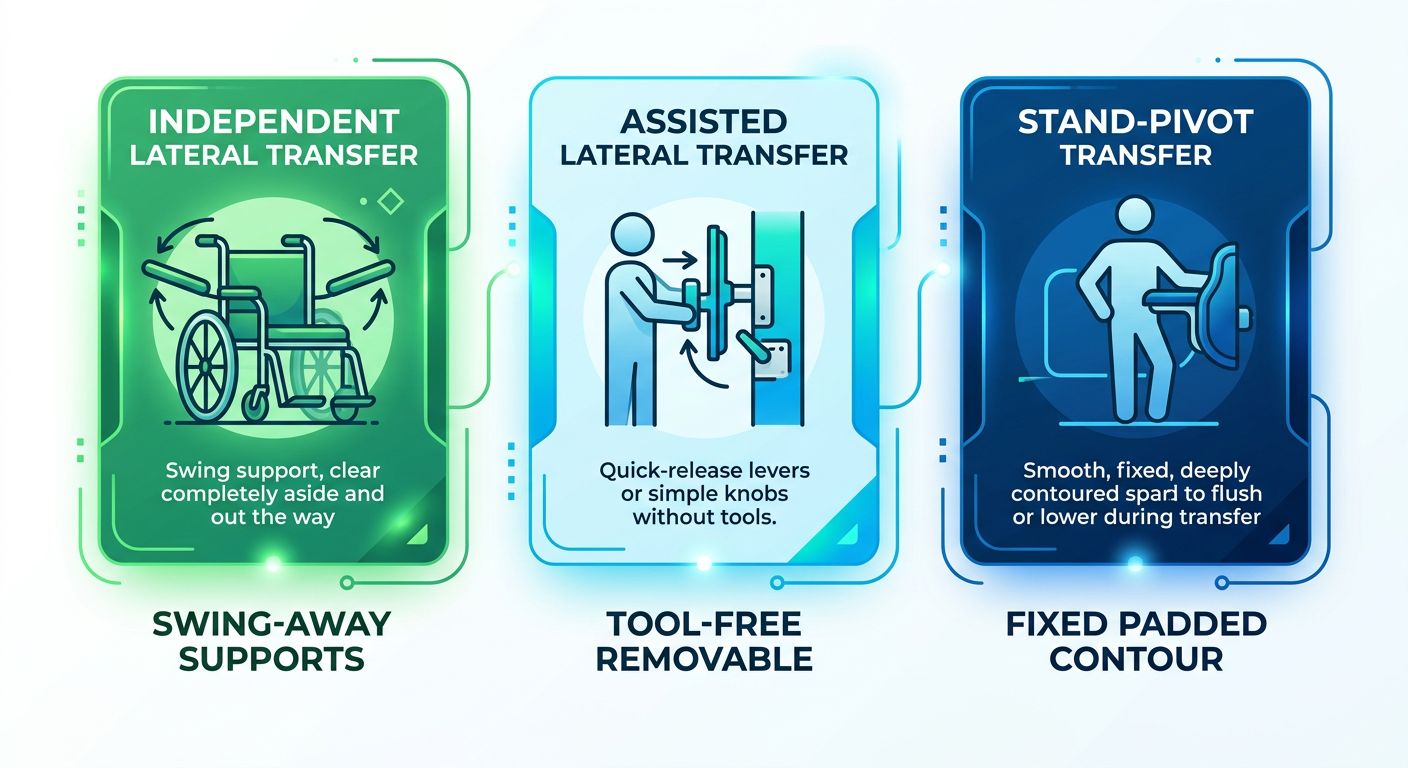
    • Independent Lateral Transfer: Patient transfers from wheelchair to bed/chair without assistance, using a sliding board or stand-pivot. Ideal Feature: Swing-away lateral supports that open wide without obstruction; height-adjustable to clear transfer path.
    • Assisted Lateral Transfer: Caregiver assists patient with a lift or manual transfer. Ideal Feature: Swing-away or tool-free removable supports to provide unobstructed access for caregiver.
    • Stand-Pivot Transfer: Patient stands and pivots to target surface with or without assistance. Ideal Feature: Fixed or swing-away supports with padded contour to provide stability during standing.

    The comparison highlights that no single lateral support design fits every transfer scenario. For independent transfers, swing-away mechanisms with smooth, wide pivots offer the greatest independence. Assisted transfers benefit from quick-release mechanisms that reduce caregiver strain. Stand-pivot transfers often require fixed supports that provide a stable surface to push against; however, padded contours add comfort without sacrificing stability.

    Our ATPs evaluate each person’s transfer patterns during the seating assessment and recommend the most suitable lateral support configuration. We also teach proper transfer techniques to maximize safety for both the user and any caregiver.

    Three-column infographic comparing independent, assisted, and stand-pivot lateral transfer types with icons and corresponding ideal lateral trunk support features, using a blue and green palette on white.

    Comparison of lateral transfer protocols and recommended lateral trunk support features for power wheelchair users.

    Advanced Considerations: Neuromuscular Scoliosis and Custom Seating Integration

    When neuromuscular scoliosis compromises postural stability, lateral trunk supports become a critical component of custom seating. The condition arises from uneven spinal curves driven by nerve or muscle disorders, leading to pelvic obliquity, trunk asymmetry and pressure-related discomfort. Pairing lateral supports with pressure redistribution cushions counteracts these effects.

    By bracing the torso, these supports guide your spine toward midline and prevent the leaning that aggravates asymmetrical forces. This realignment reduces pelvic obliquity and helps you sit with greater comfort and endurance.

    Pressure redistribution cushions protect skin and deeper tissues by mapping to your unique curvature, spreading weight evenly to lower the risk of pressure injuries. Together with lateral supports, they lock the pelvis in a neutral position, enhancing both stability and long-term skin health.

    A successful fit demands a thorough evaluation by a certified Assistive Technology Professional (ATP). The ATP-led process includes biomechanical assessment, trial fittings and iterative adjustments until you achieve a functional, pressure-relieving posture. RESNA’s international standards for seating and mobility provide the authoritative framework, ensuring that every element of custom power wheelchair seating and positioning meets safety and performance criteria.

    We at MedEquipped orchestrate this entire journey for you. Our ATP evaluators perform hands-on fittings in New York, Georgia and Michigan, fine-tuning lateral trunk supports, cushion selection and overall geometry. Because we manage documentation and insurance coordination, you stay free of administrative strain while directing every clinical decision.

    You can also access wheelchair user advocacy and support through organizations like the United Spinal Association, which offers peer mentoring, educational tools and policy updates that complement your clinical seating plan.

    This information is not medical advice and is for informational purposes only; consult a healthcare professional before making clinical decisions. A professionally guided seating assessment remains the surest path to a custom system that works with your body, not against it.

    Frequently Asked Questions About Lateral Trunk Supports

    Here are answers to common questions about lateral trunk supports.

    What are lateral trunk supports?
    Our specialists explain that lateral trunk supports are attachments on a power wheelchair backrest that provide side-to-side torso stability, helping users maintain an upright posture.

    Who needs lateral trunk supports?
    Individuals with poor trunk control from conditions such as MS, spinal cord injury, cerebral palsy, or stroke benefit from these supports after clinical evaluation.

    How do lateral trunk supports improve posture and safety?
    By stabilizing the torso, lateral supports enhance posture, reduce fatigue, and improve safety. Adding pressure redistribution cushions increases comfort.

    Does Medicare cover lateral trunk supports?
    Per CMS guidelines, Medicare Part B may cover lateral trunk supports as DME when medically necessary, with prior authorization and a physician’s prescription required.

    For readers outside the U.S., mobility equipment for children and adults in the UK is available through specialized providers.

    How can I get custom lateral trunk supports for my wheelchair?
    Contact us for a custom evaluation; our ATPs integrate lateral supports into your custom power wheelchair seating and positioning. We’re your partner in mobility freedom.

    Consult a healthcare professional before making clinical decisions.

    Partnering for Better Seating Outcomes with MedEquipped

    When you partner with MedEquipped, our certified ATP evaluators assess your needs, including lateral trunk supports, as part of custom power wheelchair seating and positioning. We handle the paperwork, insurance navigation, and coordination so you can focus on your mobility. Custom motorized wheelchairs are ordered and delivered with customized features, such as lateral trunk supports, based on your specific requirements, typically within 30–60 days. Serving patients in New York, Georgia, and Michigan, we provide ongoing post-delivery support and remain your partner in mobility freedom. Explore the specific custom wheelchair options available to fit your lifestyle.

    Resources