
Parent Perceptions of Powered Mobility: A Guide for Parents
Table of Contents What Parents Should Know About Powered Mobility for Children Does a Powered Wheelchair Delay Walking? How Powered Mobility Supports…
Read More
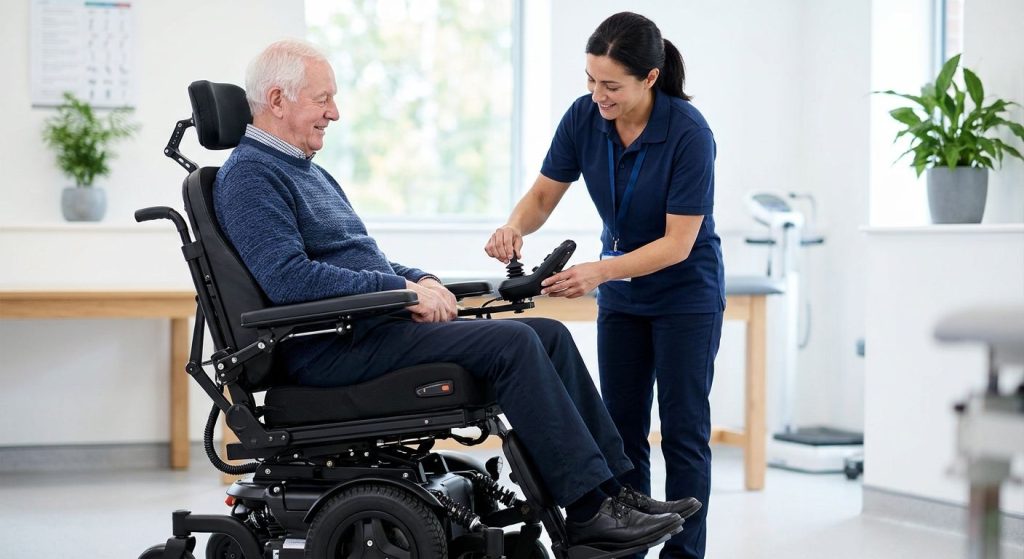
Comparing a loaner wheelchair and a custom wheelchair shows the difference between temporary use and long-term, personalized comfort. While a loaner chair provides some short time mobility until the right chair can come in, a custom motorized wheelchair is made just according to your body needs for all day, daily usage.
MedEquipped specializes in Custom Motorized Wheelchairs that are ordered to fit each patient’s unique diagnostic and functional needs. Our clinical fittings are done at our Spring Valley clinic by experienced staff to ensure measurement and setup. Unlike the typical six-month industry timeline, our team in Spring Valley aims to complete the entire process—from initial evaluation and personalized fitting to Medicare paperwork and final delivery—within 30 to 60 days. We handle the full lifecycle of equipment acquisition, verifying benefits, coordinating with manufacturers, and ensuring every chair maximizes comfort and maneuverability. This approach removes the administrative burden so you can focus on regaining independence with equipment that truly matches how you live.
Ultimately, the right chair depends on your specific purpose and daily routine, which is why a professional evaluation is the essential next step.
The type of mobility that a chair serves, be it for self propelling or motorizing, affects the way in which the wheelchair is selected.
For people with sufficient upper-body strength and reasonably good arm function, manual wheelchairs are suitable. According to our wheelchair guide light weight manual type normally weighs less than 30 lbs, so you don’t get tired from moving your arms and you also won’t be restricted in how you maneuver around in tight areas. Manual models are ideal because anyone who is able to operate them will find this particular kind of equipment simple to employ as well as easy enough to make it possible for some kind of activity in their lives and improve their upper body health.
Mobility aids can provide greater independence to individuals that might fatigue quickly or be lacking the muscle tone to move using their hands. A motorized chair will be specifically made in order that it meets the individual’s physical requirements. It is configured to the individual’s anatomy and functional needs, allowing navigation across diverse environments, from smooth indoor floors to uneven outdoor terrain, and the custom seating system distributes weight evenly and helps prevent pressure injuries during prolonged seating. This makes motorized chairs especially suitable for users who require extended periods of mobility throughout the day.
All of our wheelchair assessments align with nationally recognized standards for seating and mobility like RESNA. In addition to assessing a person’s ability to utilize their upper body strength, we take into account their home set-up, medical necessity, and which type would be most beneficial. Personalized fittings will help prevent secondary complications such as skin breakdown (pressure sores). With a professional assessment the user can gain confidence.
The true purpose of a wheelchair emerges when matched to the individual’s condition and daily demands. With the right evaluation, each user can find a mobility solution.
Custom motorized wheelchairs take around 30-60 days for delivery once the funding has been approved. That time reflects the timeline necessary to evaluate our patient’s condition clinically, fill out any necessary paperwork regarding insurance claims, as well as make the precise motorization. Our method makes it easier compared to how long most people have to wait, which is about six months or more. By taking care of everything ourselves, we’re able to tell our patients what we’re doing at all times, allowing them to maintain the progress toward reaching their own mobility goals.
Funding approval marks the starting point for the manufacturing phase, which generally requires two to four weeks. During this period, the wheelchair is built to the patient’s exact clinical specifications and body dimensions, ensuring optimal comfort and maneuverability. Once fabrication is complete, local delivery and home setup are scheduled, typically adding one to three days before the equipment is fully operational in the patient’s residence.
The amount of time required will be determined based on several factors. Individual insurance policies will impact the length of the funding verification process and extended waiting times may occur if the patient has unique seating needs that require extra assembly time. Our employees communicate with Medicare and any other funding source involved in order to avoid delays. This means verifying benefits and completing necessary paperwork, allowing the patient to focus more on preparation.
Because each order is custom-configured, availability is driven by the clinical evaluation and funding approval rather than off-the-shelf inventory. Patients who have completed their evaluation and submitted the necessary paperwork can expect regular updates as their chair moves through fabrication toward delivery. We’re here to help with questions about scheduling, paperwork, or fitting appointments.
Unlike many generic solutions, MedEquipped is aware that one size does not always fit all. If you have a motorised wheelchair that doesn’t suit your body type, weight balance and other functional requirements then it may lead to pressure points, reduced postural supports and decreased level of independence. MedEquipped addresses this through a hands-on, collaborative evaluation during the order fulfillment window to ensure every component is selected for their exact dimensions.
Our process begins at the Spring Valley clinic, where our team conducts an in-person assessment of your mobility challenges, diagnosis, and daily activities. Working closely with you and your healthcare providers, we help select the appropriate drive system—whether rear-wheel, mid-wheel, or front-wheel drive—based on maneuverability requirements and indoor versus outdoor use. Next, we guide you through seating options, including contour cushions, adjustable backrests, and positioning belts, always testing configurations to confirm proper weight distribution and pressure relief. Frame dimensions, armrest height, and footplate angle are refined iteratively to achieve a balanced, comfortable fit. This collaborative, back-and-forth approach ensures that the wheelchair not only fits mechanically but also supports your functional goals.
Fit makes the difference. It directly supports comfort and pressure relief during extended sitting, which is essential for tissue health and day-to-day ease. Instead of forcing yourself onto a standard chair design, building the wheelchair around the contours of your body promotes optimal long term well being.
Comfort and support don’t just mean a perfect fit, they need to last too if people are spending time on their wheelchair all day. While considering what kind of wheelchair you should get when looking at the loaner wheelchair vs custom wheelchair difference, long term sitting comfort might be the key factor here. If there isn’t any sort of support whatsoever, muscles can become fatigued, pain spots appear and overall tolerating sitting in your chair for an extended period gets tougher.
A RESNA Research Study looked at the effects of customizable versus non-customizable positioning on upper body movements. Although this study found little difference among many different measures of motion, the custom-positioned system did have more significant lateral displacement of the body’s center of force when performing ellipsoidal movements. This means that the custom-positioning does affect where the pressure is being placed during wheelchair activity, making them comfortable for people to remain positioned on for extended periods of time. Custom wheelchairs can provide tailored postural support that helps users maintain a stable, aligned position and reduces the risk of discomfort and pressure injuries.
Posture matters because it allows body weight distribution to be as even as possible while minimizing strain on the spine and hips. With custom configurations, we can address each patient’s unique anatomical needs—from cushion selection to backrest contouring and seating angles. By properly fitting the patient into their chair we make sure the motorized wheelchair supports healthy sitting postures that sustain comfort even after hours of use. This is critical since it helps prevent the fatigue and skin breakdown that can arise from ill-fitting loaner solutions.
Having looked into how comfortable and supportive a custom wheelchair can be, the next consideration is navigating funding and insurance options to make it accessible.
Getting coverage through insurance for a custom wheelchair can be stressful. We will handle the paperwork needed to receive funds from your insurance. We help patients evaluate funding options for a customized wheelchair compared to temporary alternatives. We work with the patient’s medical insurer or Medicare to complete the paperwork. We also navigate the complex insurance and Medicare paperwork, verify benefits, and coordinate the documentation required for approval.
Under Medicare Part B, power wheelchairs have specific regulations to be met in order to get covered under their plans. One requires a face to face exam with a doctor within six months of submitting your claim. The physician will then need to complete a seven element order form in 45 days. At MedEquipped, our Certified ATP’s are able to meet all the requirements for proper clinical evaluations based on RESNA standards, making sure every wheelchair fits each individual patients unique diagnostic and functional need.
We streamline the funding journey from start to finish:
We can deliver most custom wheelchairs within 30 to 60 days following funding confirmation, which falls well under the six-month industry average for delivery. We handle all paperwork and authorizations in-house.
Once funds have been received and the chair is in the patient’s possession, the next consideration is selecting a mobility option built for long-term durability and ease of maintenance. The custom-built wheelchairs we make are designed for dependable daily use and to minimize the need for repairs, thereby helping our patients remain mobile for years without interruption.
Securing funding for a custom motorized wheelchair is a significant step, and protecting that investment through consistent care ensures the equipment delivers reliable performance for years. Power wheelchairs are classified as durable medical equipment, a designation that reflects their engineered longevity when supported by proper routine maintenance.
Daily charging of the battery is the foundation of reliable powerchair operation. Plug the unit in at night to prevent deep discharges that can shorten battery life and to ensure full range is available each morning. Cleaning the battery terminals monthly should be done in order to remove any possible buildup of corrosion on the contact metals, which might otherwise disrupt proper operation of the electrical circuit and cause the battery to lose its charge or the controller actuation to be irregular.
It’s vital to perform weekly tire inspections as well. Examine for uneven wear signs and ensure that pneumatic tires have the appropriate air pressure in order to lower rolling friction and save the motor from undue stress.
Beyond these specific actions, the more general habits of structural awareness support overall longevity. Wiping down the frame with a dry or barely damp rag helps get rid of dust and other foreign materials that can contaminate moving parts. Meanwhile, just inspecting whether anything feels loose or hearing any odd noises will let you catch smaller things before they become serious. We provide maintenance guidance as part of our commitment to supporting patients beyond the day of delivery, helping each user build confidence in caring for their equipment.
Regular maintenance allows our team to check posture, weight distribution, and joystick response, as real-world use can reveal issues.
The evaluation and fitting process at MedEquipped begins with a thorough clinical assessment designed to understand your specific medical needs, functional abilities, and daily mobility requirements. Our clinical team analyzes your physical condition, posture, range of motion, and any positioning challenges that must be addressed through proper wheelchair configuration. This initial evaluation also considers your lifestyle demands—including home environment, typical activities, and transportation needs—to ensure the final equipment supports your independence across all settings.
Then, a personal fit session turns all the medical information we have collected into concrete wheelchair parts that will actually be used. It starts off as taking exact body measurements for the size of the chair, weight balance points, and pressure points. Every adjustment—from seat depth and backrest angle to joystick placement and footplate height—is tuned to your individual anatomy, keeping you comfortable during extended use and reducing the risk of pressure injuries or postural strain.
If you reside in Rockland County we can go on house calls to make sure the wheelchair you have picked out fits the house perfectly. We examine the width of doors, hallway clearances, where ramps can be installed and the area around furniture to determine if any problems might happen once the wheelchair is here.
Following construction of the wheelchair, we will arrange for professional delivery & set-up at your home. Our team will position the equipment appropriately, demonstrate how to operate key controls and perform adjustments, and confirm that you can operate the chair safely and confidently in your own environment. On completion of this process we’ll turn our attention to securing coverage and managing the documentation required through Medicare.
Medicare Part B will pay for custom motorized wheelchairs if the beneficiary’s disability necessitates more than the benefits available in either the standard manual wheelchair or a scooter. There are two steps to get the coverage: First the applicant must have a face-to-face mobility examination within six months of claim submission. The doctor then has 45 days from when he examined you to sign off on seven elements verifying his assessment of your need.
A certified Assistive Technology Professional (ATP) then conducts a comprehensive clinical assessment aligned with RESNA standards. The ATP evaluates functional mobility, seating needs, and the environment where the wheelchair will be used, producing a detailed report that substantiates the claim. The compiled packet—combining the exam note, physician order, and ATP evaluation—forms the foundation of the prior authorization request.
Our company will take care of all of your paperwork, from start-to-finish and our office location covers the Hudson valley including the clinic located in Spring Valley, NY and evaluations that can be done at Orange County & Westchester County sites. Our staff will verify your benefits, assemble the required paperwork, and submit accurate prior authorizations to avoid delays. The follow up is taken care of by us until funding is confirmed, allowing patients to focus on the mobility improvements ahead. Then, we order the custom motorized wheelchair and it is typically delivered within 30 to 60 days, ready to restore independent daily function. We accept Medicare in Spring Valley, NY.
After navigating insurance and documentation requirements, the more immediate reality sets in—the daily physical obstacles that make a wheelchair essential. Limited walking endurance often forces individuals to cut outings short or avoid them altogether. Persistent fatigue can turn a simple trip from the bedroom to the kitchen into an exhausting ordeal. Navigating doorways, thresholds, and furniture within the home introduces a constant risk of falls, while extended sitting without proper support raises the serious threat of pressure injuries. These struggles are not merely inconvenient; they erode autonomy and safety in nearly every activity.
According to our selection guide, a lightweight, manually pushed chair that weighs less than 30 pounds could work well for users who retain adequate upper-body strength, reducing shoulder strain and making the chair easier to lift into a vehicle for short, transportable trips. If endurance is the limiting factor, or the user needs autonomy across varied terrains, the right tool would likely be a powered wheelchair instead. The choice hinges on a clear-eyed assessment of stamina and the user’s real-world environment—not just a diagnosis on paper.
The difference between a custom seat and a loaner is what separates a true solution from a temporary fix in a motorized wheelchair. In this case, professional configuration ensures that the patient’s weight is distributed evenly across their seat. This helps to prevent any pressure injuries, which could develop into serious problems over time, especially for patients who spend all day in their chairs. Our team follows RESNA standards when evaluating chairs, ensuring that each chair has the proper seat, backrest and postural supports to meet the patient’s anatomical needs. Once the patient’s daily needs have been determined, it is clear whether they need to stick with a loaner chair or move onto a custom chair built specifically for them.
If users are dissatisfied because their loaner chair does not fit them properly or perform as expected, they will often move up to a permanent, customized powered chair. Moving from a loaner wheelchair to a custom solution begins with an in-person evaluation at our Spring Valley Clinic, where our team determines the client’s specific mobility requirements and candidacy for complex rehab technology.
Customization experts then guide the selection of the appropriate drive system, seating configuration, and frame type based on precise body dimensions and functional needs. This personalized fitting directly addresses the comfort and postural shortcomings common with loaner chairs, which typically feature one-size-fits-most designs that cannot accommodate individual diagnostic requirements. Loaner units also lack the durability needed for daily, long-term use, whereas a custom wheelchair is built to withstand the demands of the user’s specific lifestyle.
We process funding from start-to-finish, verifying Medicare benefits and billing, while handling the documentation that supports medical necessity. When funding is approved, manufacturing typically takes 30 to 60 days. The process concludes with delivery and on-site setup, where we ensure the chair operates safely within the user’s home environment.
The everyday annoyance caused by using someone else’s equipment in place of your own fades away when you have an adapted system based on how YOU move. And the advantages of a custom-made wheelchair become clear, especially when measured against the compromises temporary equipment demands.
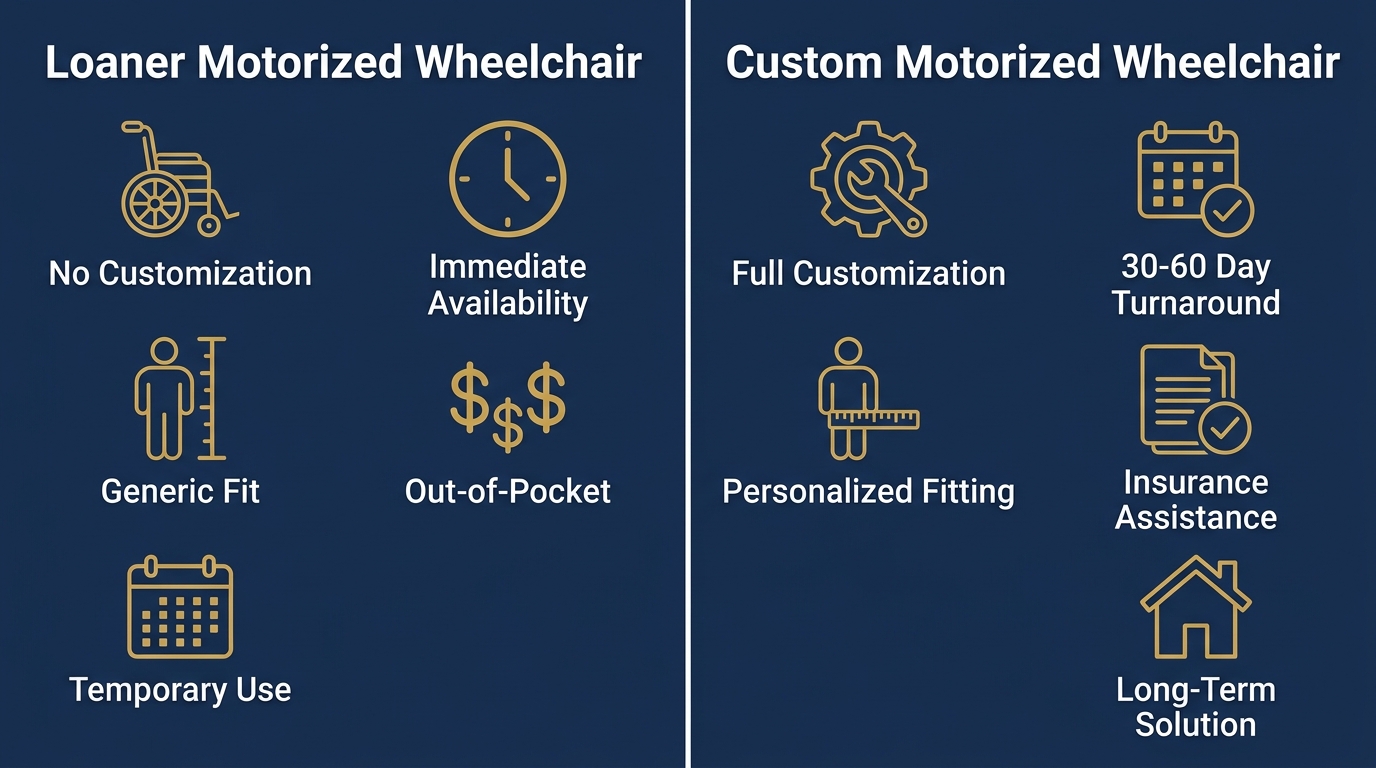
When comparing a loaner wheelchair and a custom wheelchair, the most significant difference is the depth of personalization each offers.
| Feature | Loaner Motorized Wheelchair | Custom Motorized Wheelchair |
|---|---|---|
| Customization | None (generic) | Full customization tailored to diagnosis |
| Turnaround Time | Available immediately | 30–60 days after funding approval |
| Fit | Limited adjustability | Personalized evaluation and fitting |
| Funding / Insurance | Out-of-pocket rental | Assistance with insurance/Medicare paperwork available |
| Long-Term Use | Temporary / transitional | Permanent mobility solution |
We handle all aspects of custom chairing at MedEquipped, including evaluation, insurance approval and delivery, making sure you have a device that meets your needs for the future.
The loaner wheelchair vs custom wheelchair decision is best resolved by consulting with a specialist who can assess your clinical needs and match equipment to your daily routines. We handle evaluation, funding paperwork, and custom fitting, delivering your chair in 30 to 60 days—far shorter than the six-month industry average. Unlike a loaner, a custom chair is built to your exact specifications, improving posture, reducing pressure sores, and supporting your daily activities. At our Spring Valley clinic, certified Assistive Technology Professionals conduct your mobility assessment, and we manage all Medicare and insurance paperwork, from the face-to-face exam to prior authorization. To begin, call (845) 237-2381 or visit our office at 747 Chestnut Ridge Road, Spring Valley, NY 10977, Monday through Friday, 9:00 am to 5:00 pm. Our team will help verify your coverage, though results may vary and coverage is not guaranteed; always consult your treating healthcare professional about medical necessity. A few simple steps today can open the door to the independence and comfort a custom motorized wheelchair brings.
Now that you’ve compared the benefits of custom motorized wheelchairs over generic loaners, it’s time to take the next step. MedEquipped specializes in tailored mobility solutions, with a turnaround of just 30 to 60 days—far faster than the industry average. Their team guides you through the entire process from evaluation to delivery, and handles Medicare and insurance paperwork on your behalf. You can also reach them at (845) 237-2381 to discuss your needs or visit their Spring Valley office. Visit their website to learn more and start your evaluation.
Table of Contents What Parents Should Know About Powered Mobility for Children Does a Powered Wheelchair Delay Walking? How Powered Mobility Supports…
Read More
Table of Contents Understanding the Three Types of Wheelchairs The Fundamentals of Manual, Power, and Transport Wheelchairs Medicare Qualification and Documentation for…
Read More
Table of Contents The Most Difficult Challenges for Wheelchair Users in Spring Valley, New York Understanding Physical and Environmental Accessibility Barriers How…
Read More