Understanding Medicare Power Wheelchair Coverage in 2026
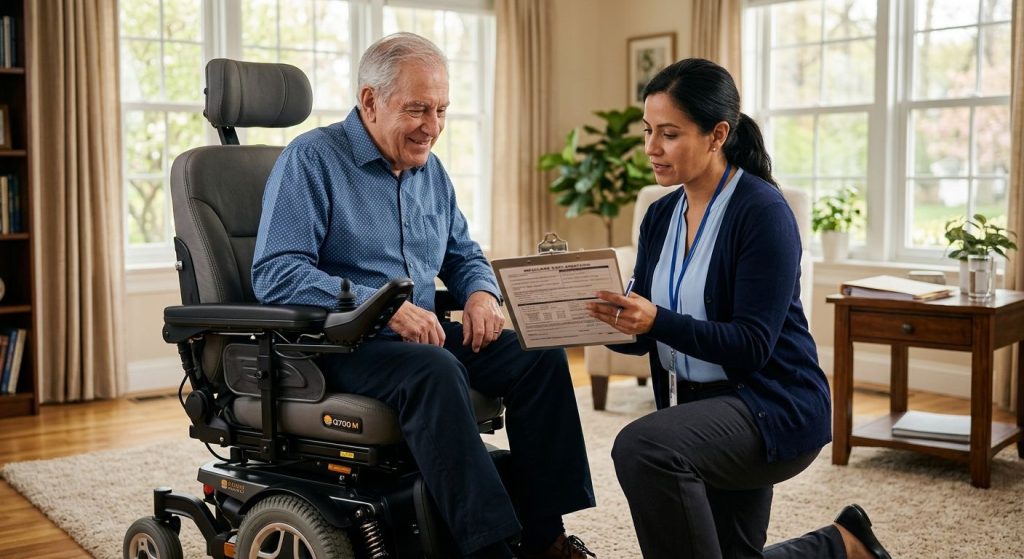
Medicare power wheelchair eligibility 2026 follows established Medicare Part B guidelines that classify power wheelchairs as durable medical equipment (DME). At MedEquipped, we help patients meet these requirements by providing custom motorized wheelchairs tailored to their specific mobility needs. To qualify for coverage, a patient must demonstrate medical necessity through a face-to-face examination with their treating physician, which must occur within six months of the claim submission. The physician then provides a written prescription and a 7-element order confirming the need for a power wheelchair. Eligibility hinges on the patient’s inability to perform mobility-related activities of daily living (MRADLs) — such as walking, transferring, or toileting — without the assistance of a power wheelchair, even when using a manual aid like a cane or walker. According to the Centers for Medicare & Medicaid Services, the core criteria remain consistent, but 2026 may bring updated documentation requirements. Our comprehensive coverage guide details these potential changes and helps patients understand what records Medicare expects. At MedEquipped, we specialize in assisting with Medicare benefits verification and the necessary paperwork to streamline the application process, reducing the risk of common claim denials. Our experienced team handles everything from the initial evaluation to the final delivery and setup, ensuring each custom motorized wheelchair is fitted precisely to the patient’s requirements. In the following section, we break down the 2026 eligibility rules at a glance.
2026 Medicare Power Wheelchair Eligibility Rules at a Glance
With that foundation in mind, here are the specific eligibility rules at a glance. For a complete breakdown of medicare power wheelchair coverage criteria 2026, see our detailed guide—but what follows is the essential checklist you need to begin.
The Centers for Medicare & Medicaid Services establishes criteria that every power wheelchair claim must satisfy before approval; Medicare administrative contractor guidelines from organizations like CGS Medicare outline how those standards are applied in practice.
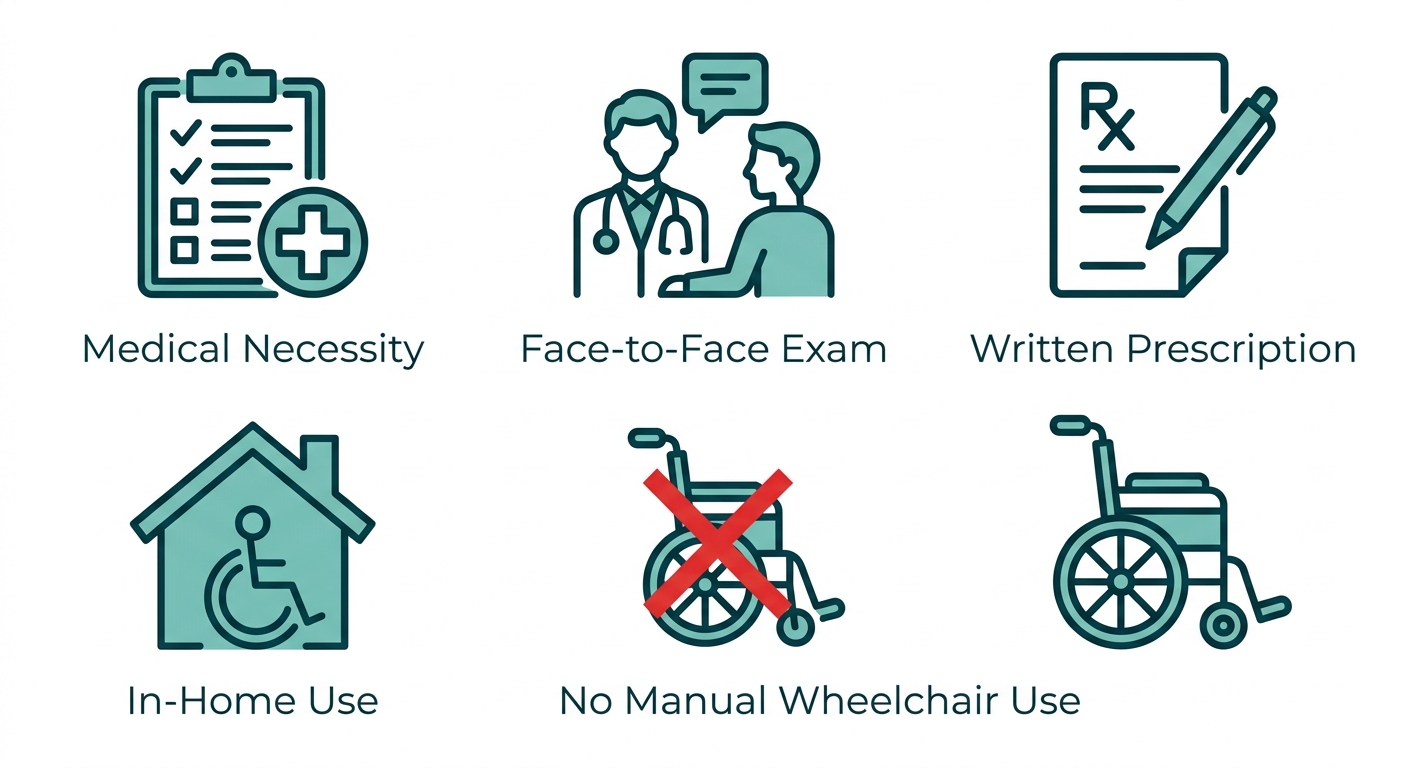
Five key Medicare coverage criteria for power wheelchairs in 2026.
Medical Necessity with a Qualifying Mobility Limitation
The patient must have a documented mobility limitation that significantly impairs their ability to perform Mobility Related Activities of Daily Living (MRADLs), such as walking, transferring, or toileting, and be unable to complete these tasks safely at home even with a cane, walker, or other manual aid.
Face-to-Face Examination by a Qualified Practitioner
A face-to-face examination must be conducted by a treating physician (MD, DO, NP, or PA) within six months prior to claim submission to establish medical necessity and document the mobility limitation and the clinical reasoning for the power wheelchair. Claims without an exam within this window may be denied.
Written Prescription from the Treating Physician
The physician must provide a signed, dated 7-Element Order during the face-to-face visit containing specific diagnostic information, clinical justification, and confirmation that less-intensive mobility aids were considered. Without this order, the claim cannot proceed.
In-Home Use Requirement
Medicare Part B classifies power wheelchairs as Durable Medical Equipment and requires they be needed primarily for in-home use. Documentation must show the patient cannot navigate essential living areas—bedroom, bathroom, kitchen—without the powered device.
Inability to Safely Operate a Manual Wheelchair
The patient must be unable to safely and effectively propel a manual wheelchair due to factors such as poor upper-body strength, balance issues, or respiratory limitations. Clinical documentation should specify which deficits preclude manual use to justify a powered system.
The necessary documentation for any claim includes the written 7-Element Order, comprehensive medical records that substantiate the mobility limitation, and a Certificate of Medical Necessity or similar formal documentation tying the clinical findings to the equipment requested.
Once eligibility is confirmed, the next critical step is the face-to-face mobility examination, which we will walk through in the next section.
The Face-to-Face Mobility Examination: Step-by-Step
Now that you understand the rules for Medicare coverage of power wheelchairs in 2026, let’s walk through the face-to-face mobility examination step by step.
Understanding the Face-to-Face Examination
The Medicare face-to-face mobility exam requirements are established by the Centers for Medicare & Medicaid Services (CMS) to verify that a beneficiary truly needs a power wheelchair for use inside the home. In the Face-to-Face mobility examination, a qualified healthcare professional evaluates whether a patient’s mobility limitations are severe enough to justify coverage under Medicare Part B. This in-person (or, in limited cases, telehealth) assessment is mandatory for power wheelchairs; scooters and power-operated vehicles (POVs) are exempt. The exam focuses on documenting actual difficulties with mobility-related activities of daily living (MRADLs) — such as transferring, walking, and maintaining standing balance — rather than relying solely on a diagnosis.
Authorized Examiners and Exam Settings
The exam must be performed by a Medicare-approved practitioner. Authorized clinicians include:
Physician (MD or DO)
Nurse practitioner (NP)
Clinical nurse specialist (CNS)
Physician assistant (PA)
The standard setting is an in-person visit at the practitioner’s office, clinic, or hospital. CMS permits a telehealth examination only under specific conditions. During a telehealth visit, the same mobility observations must be made via secure, real-time audio-visual communication and the provider must document the telecommunication method.
Face-to-Face Exam Comparison: In-Person vs. Telehealth Options
Requirement
In-Person Exam
Telehealth Exam (If Allowed)
Notes
Location of Exam
Physician office, clinic, or hospital setting
Remote via secure audio-visual platform
Telehealth allowed only under CMS conditions
Approved Practitioners
Physician (MD/DO), NP, CNS, PA in person
Same practitioners via telehealth
Provider must hold a valid license and be able to assess mobility remotely
Mobility Assessment
Direct observation of walking, transferring, standing balance, and MRADL tasks
Observation through telehealth; limited physical assistance
If visualization is insufficient, an in-person exam may be required
Documentation Requirements
Written order with diagnosis, mobility deficits, date, signature, and NPI; order valid for 7 months
Same documentation plus notation of telecommunication method
All Medicare documentation standards apply
Mobility Assessments During the Exam
The examiner must directly observe the beneficiary’s ability to perform MRADLs. Key evaluations include transfers between surfaces, walking (with or without an assistive device), and standing balance. The practitioner must determine that a cane or walker is insufficient and that a manual wheelchair cannot safely meet in-home mobility needs. If the patient already uses a wheelchair, the evaluation may assess capacity to operate a powered device, including upper-extremity strength and coordination for joystick control.
Documentation and Timeline After the Exam
After the face-to-face evaluation, the clinician issues a detailed written order that includes the patient’s diagnosis, the observed mobility deficits, the recommended power wheelchair type, the date of the encounter, the examiner’s signature, and the examiner’s NPI. CMS requires that the exam occur no more than 45 days before wheelchair delivery if the order is based solely on that exam; longer intervals are allowed only with documentation of stability. CGS Medicare enforces a 7-month claim submission window from the exam date—if that window lapses, a new face-to-face exam and order are required.
At MedEquipped, we’re here to help you manage deadlines and gather the necessary paperwork for a complete submission. With the examination completed and documented, the next step is documenting medical necessity to build a strong power wheelchair claim.
Documenting Medical Necessity: How to Build a Strong Power Wheelchair Claim
After completing the face-to-face mobility examination, the next critical step is to properly document medical necessity. Properly documenting medical necessity for power wheelchairs is the foundation of a successful Medicare claim. Medicare requires clear evidence that a power wheelchair is medically necessary. Below we outline the documentation requirements and best practices to build a strong claim.
Documenting MRADL Deficits for Medical Necessity
MRADL deficits form the clinical justification for a power wheelchair. Medicare medical necessity hinges on the patient’s inability to perform Mobility-Related Activities of Daily Living (MRADLs). During the face-to-face exam, at least two documented deficits are required, such as impaired ambulation, difficulty with transfers, or limited fine motor skills. The clinician must record specific examples, not generic statements. According to CMS guidelines, the documentation must demonstrate that the patient cannot safely accomplish these tasks without the device. CGS Medicare emphasizes that detailed functional descriptions—such as “patient cannot independently transfer from bed to wheelchair”—strengthen the claim. This level of detail establishes the medical necessity backbone.
The 7-Element Order for Power Wheelchairs
The 7-element order serves as the official prescription for a power wheelchair. It must include: the patient’s full name, primary diagnosis, the exact date of the face-to-face exam, the specific wheelchair type, all prescribed accessories, the physician’s signature, and the date the order is signed. According to CMS 2026 rules, the order must be signed and dated within 45 calendar days of the face-to-face exam. If the order is signed too early or late, Medicare will deny the claim. Each element must be individually listed on the prescription; a generic note is insufficient. We review orders for completeness and alignment with exam findings, ensuring no element is overlooked.
Submitting a Complete Claim Package
A complete claim package includes the signed 7-element order, the medical records from the face-to-face examination, and any therapy notes that support MRADL deficits. A certificate of medical necessity (CMN) may also be required, completed by the physician to formally attest to the need. For certain payers, a prior authorization letter is needed before delivery. Coordination among the physician, therapist, and DME supplier is essential to gather all documents. At MedEquipped, we use a detailed checklist to verify that each document meets Medicare’s latest requirements. A quick turnaround on assembly and submission helps prevent processing delays and ensures patients receive their custom power wheelchair promptly.
Common Pitfalls to Avoid
Common documentation errors cause unnecessary denials. The most critical mistake is omitting the face-to-face exam date on the 7-element order—Medicare treats this as an automatic denial. Other pitfalls include missing signatures, relying on medical records that are older than six months without updated functional assessments, and insufficient detail in MRADL descriptions. We recommend using a pre-submission checklist to confirm every document’s completeness. Ensuring the order is signed within 45 days of the exam and that all dates are consistent will significantly reduce denial risk. By addressing these issues upfront, providers build a stronger claim.
Once a strong claim is built, providers should also understand special coverage scenarios such as outdoor use and telehealth exams, covered next.
Special Coverage Scenarios: Outdoor Use, Telehealth Exams, and More
Beyond standard documentation for medicare power wheelchair eligibility 2026, certain special coverage scenarios require additional consideration. Under CMS guidelines, Medicare primarily covers power wheelchairs for indoor use to navigate within the home, but coverage may extend to outdoor use when the home environment presents significant barriers. A long or unpaved driveway, a rural setting without nearby sidewalks, or the need to access essential outdoor areas like a garden or mailbox can establish medical necessity. Proper documentation from the treating physician and a mobility assessment that outlines these environmental challenges is essential.
Telehealth assessments have become an accepted method for verifying medical necessity under Medicare. The Centers for Medicare & Medicaid Services has expanded telehealth options, allowing qualified clinicians to evaluate a patient’s functional limitations and mobility needs via secure video consultation. This approach eliminates the need for an in-person clinic visit, which can be especially beneficial for those with severe mobility restrictions. We work with patients and their clinicians to facilitate the telehealth evaluation and ensure all Medicare documentation requirements are met, including detailed notes about the beneficiary’s ability to perform mobility-related activities safely.
Other special circumstances may also warrant coverage. Patients recovering from joint replacement surgery may need a power wheelchair temporarily to navigate their home during rehabilitation, while individuals with progressively degenerative conditions such as ALS or MS may require a custom chair earlier than the typical course to maintain independence as the disease advances. Each situation requires thorough clinical justification and careful documentation of medical necessity. Working with a custom power wheelchair provider can simplify the process for these unique cases, as they manage funding paperwork and coordinate with Medicare for accurate verification. Our team serves clients in Spring Valley, NY, guiding them through documentation for outdoor use, telehealth assessments, and other special scenarios. These scenarios often raise common questions, which we address in the next section.
Frequently Asked Medicare Power Wheelchair Eligibility Questions
What are the core eligibility and documentation requirements?
Medicare Part B requires that you have a mobility limitation interfering with daily activities, cannot operate a manual wheelchair, and can safely use a power wheelchair. The primary need must be for in-home use, though outdoor coverage may follow once that need is established. Documentation must include a written order from your treating physician, a face-to-face in-person exam within six months, a Certificate of Medical Necessity (CMN), a detailed exam report, and a prescription. The evidence must demonstrate that you cannot perform mobility-related activities of daily living (MRADLs) without the power wheelchair.
Does a telehealth exam satisfy the face-to-face requirement?
No; Medicare mandates an in-person examination. Virtual visits cannot establish the required medical necessity.
Take the Next Step Toward Your Custom Power Wheelchair
Still have questions about Medicare power wheelchair eligibility 2026? Our experts can help you determine if you qualify and take the next step toward a custom power wheelchair. We provide personalized fittings, handle Medicare paperwork, and deliver custom wheelchairs in as little as 30 days. Call (845) 237-2381 or visit our clinic in Spring Valley, NY to start your evaluation. Coverage verification is required; results may vary. A healthcare professional must determine medical necessity.
Start Your Custom Wheelchair Journey
Now that you understand the 2026 Medicare eligibility requirements for power wheelchairs, including the face-to-face exam and documenting MRADL deficits, the next step is to get personalized guidance. MedEquipped specializes in custom motorized wheelchairs designed to meet your specific mobility needs. Our team can assist with Medicare verification and help you compile the necessary documentation. We serve clients in Spring Valley, New York and throughout the region. Call us at (845) 237-2381 or visit our office to start your consultation. A custom power wheelchair can restore your independence and improve your quality of life. Take the next step toward your new mobility solution today.