
Medicare Power Wheelchair Eligibility 2026: Complete Guide
Table of Contents Understanding Medicare Power Wheelchair Coverage in 2026 2026 Medicare Power Wheelchair Eligibility Rules at a Glance The Face-to-Face Mobility…
Read More
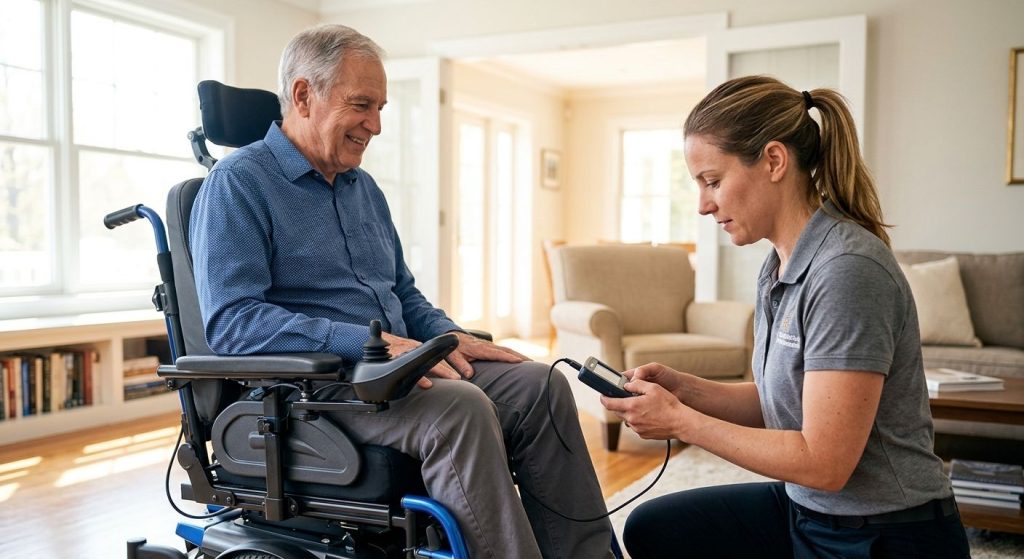
Medicaid mobility device coverage by state can differ greatly, as each state administers its own rules. Understanding those differences is the first step toward getting your equipment. One universal requirement is medical necessity — your physician must document that a power wheelchair is crucial for your safety and daily function.
You’ll also likely need the Medicaid prior authorization for power wheelchairs process, which can be detailed and overwhelming. Our team at MedEquipped helps patients in New York, Georgia, and Michigan navigate this process, including assistance with Medicaid prior authorization for power wheelchairs, and it can take 30 to 60 days depending on the state. Federal rules set the floor, but each state decides how to run its program. We handle the paperwork and provider coordination, so you can focus on your mobility goals.
In the next section, we break down the authorization steps one by one, making it easier to follow.
When comparing medicaid mobility device coverage by state, the rules for qualifying for a power wheelchair can look very different. For official details, see medicaid motorized wheelchair coverage in New York. The table below summarizes key criteria side by side.
| Feature | New York | Georgia | Michigan |
|---|---|---|---|
| Eligibility Criteria | Medical necessity determined by physician and ATP evaluation; specific functional limitations required | Must meet in-home mobility need and be unable to operate a manual wheelchair; physician prescription required | Requires prior authorization and documentation of severe mobility impairment; home use demonstration |
| Prior Authorization | Required; typically handled by provider with clinical justification | Required; provider submits DME prior authorization form | Required; must include detailed evaluation and letter of medical necessity |
| Required Documentation | Physician prescription, detailed clinical evaluation, face-to-face exam documentation | Script from treating physician, face-to-face visit note, functional assessment | Prescription, clinical summary, home assessment, ATP report |
| Replacement Frequency | Every 5 years unless change in condition warrants earlier replacement | Every 5 years; re-evaluation required for medical necessity | Every 5 years; earlier replacement possible with documented need |
Understanding these requirements helps, but each state also requires medicaid prior authorization for power wheelchairs, and documenting the medical necessity for custom power wheelchairs is critical for approval.
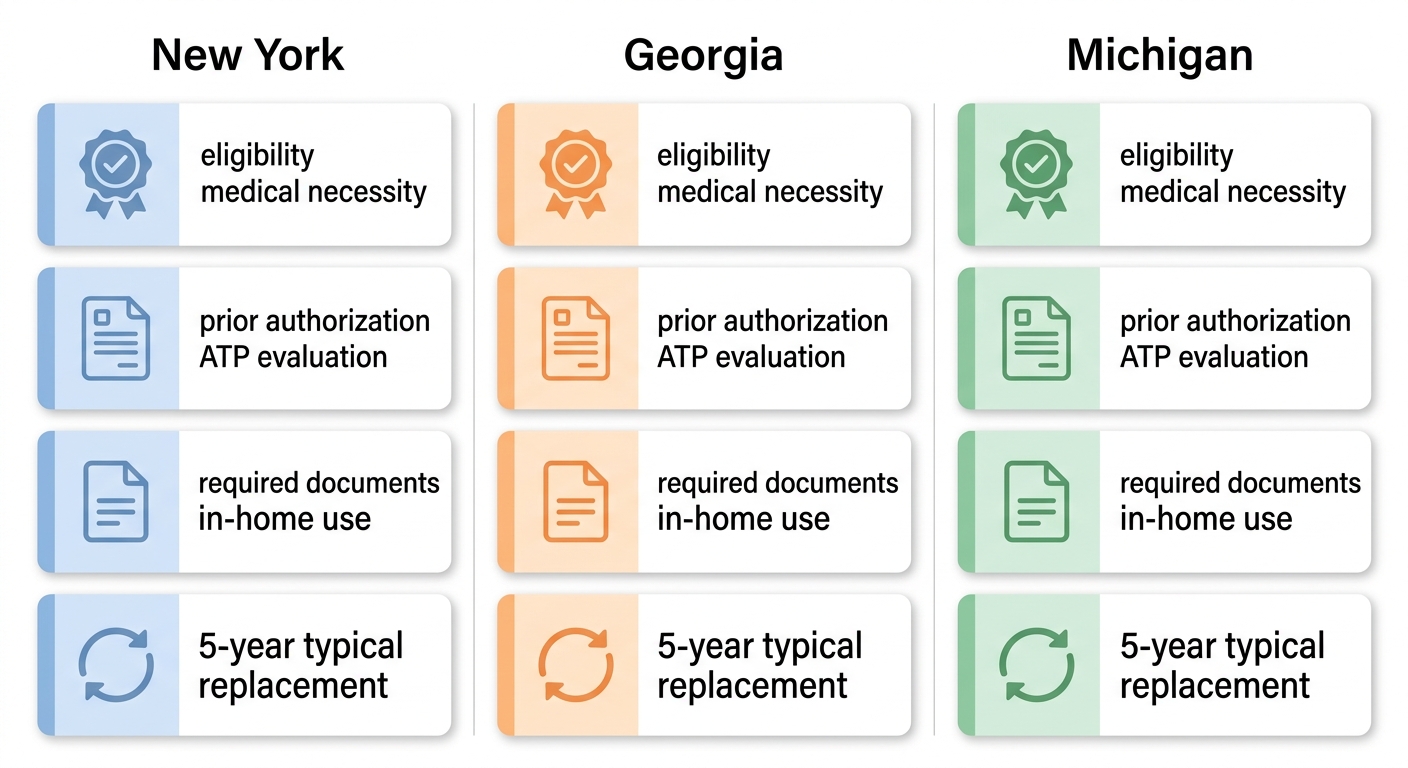
Medicaid power wheelchair coverage comparison across three states
Every state program is unique, but we can help simplify the process. As your partner in mobility freedom, we handle the paperwork, insurance navigation, and coordination so you can focus on what matters most.
While understanding the process is valuable, partnering with MedEquipped makes it effortless. Medicaid mobility device coverage by state varies, which is why MedEquipped simplifies the entire process for clinicians and case managers. We are your partner in mobility freedom for Medicaid patients—handling every step from eligibility to delivery.
When you partner with MedEquipped, we take on the full administrative weight. We handle the paperwork, insurance navigation, and coordination, managing medicaid prior authorization for power wheelchairs and ensuring all documentation meets state-specific requirements. Our certified ATP evaluators thoroughly document medical necessity for custom power wheelchairs, giving every application the strongest clinical foundation possible.
We serve providers across New York, Georgia, and Michigan. In Georgia, we help you navigate Medicaid wheelchair eligibility requirements in Georgia so your patients can qualify quickly. The typical processing timeline is 30–60 days, significantly faster than many other pathways. By partnering with us, you reduce your team’s administrative burden and free up time for direct patient care. We monitor each state’s Medicaid policy changes so you don’t have to. From initial evaluation to final delivery, our team coordinates every detail, including custom motorized wheelchairs built to exact clinical specifications.
We are your partner in mobility freedom. Contact us to discuss how we can support your patients’ Medicaid wheelchair needs. Once you partner with us, the next step is a streamlined ordering process tailored to each patient. Results may vary; individual outcomes are not guaranteed.
While the general Medicaid approval process has common steps, local considerations can dramatically affect timelines and requirements. Medicaid mobility device coverage by state can vary significantly, affecting how approvals are handled locally.
Medicaid prior authorization for power wheelchairs requires different documentation: in New York, providers may need detailed functional assessments, while in Georgia, home environment verification is key. In Michigan, prior authorization turnaround times are often shorter, but medical necessity for custom power wheelchairs must be clearly established through a thorough clinical evaluation, and supporting documentation from treating clinicians is typically also required.
Our professional wheelchair fitting services are designed to meet each state’s evaluation requirements, ensuring your documentation includes the necessary clinical measurements and functional assessments.
As your partner in mobility freedom, we track each state’s changing requirements. Results may vary; individual outcomes are not guaranteed. Understanding these local factors is the first step; next, we’ll outline how professional wheelchair fitting services directly address these documentation needs.
Applying for a power wheelchair through Medicaid can feel overwhelming, but you don’t have to navigate it alone. Understanding medicaid mobility device coverage by state is the first step, and our team is here to simplify every stage of the process.
The journey begins with a clinical evaluation led by a certified Assistive Technology Professional (ATP). During the evaluation, our wheelchair fitting services ensure the chair is customized to your exact needs, from seating to controls. Next, you’ll need a physician’s prescription, relevant medical records, and documentation that establishes medical necessity for custom power wheelchairs—showing why a standard wheelchair won’t meet your mobility limitations.
Medicaid requires medicaid prior authorization for power wheelchairs, and coverage rules vary by state. We stay current with the requirements in New York, in Georgia, and in Michigan, and we handle all the paperwork and coordination so you don’t have to. The typical approval and delivery timeline runs 30–60 days—much faster than many patients expect.
We’re ready to help. Contact MedEquipped to start your application, and we’ll guide you through every detail.
Information is not medical advice; consult a healthcare professional. Results may vary.
Understanding medicaid mobility device coverage by state is the first step, but we’re here to handle the rest. We manage everything from your clinical evaluation and medical necessity for custom power wheelchairs documentation to medicaid prior authorization for power wheelchairs and final delivery, typically within 30-60 days. We serve New York, Georgia, and Michigan with certified ATP evaluators, building your custom chair from trusted brands. Whether you need a custom power wheelchair or a stair chair lift, we can help. As your partner in mobility freedom, next we’ll detail the clinical evaluation and required documentation.
Results may vary; individual outcomes are not guaranteed. Consult a healthcare professional before making clinical decisions. This information is not medical advice and is for informational purposes only.
Table of Contents Understanding Medicare Power Wheelchair Coverage in 2026 2026 Medicare Power Wheelchair Eligibility Rules at a Glance The Face-to-Face Mobility…
Read More
Table of Contents Understanding Medicare Power Wheelchair Coverage in 2026 Prerequisites for Your Medicare Power Wheelchair Application Confirm Your Medical Necessity for…
Read More
Table of Contents The Medicare Mobility Assistive Equipment Algorithm Explained Prerequisites for Medicare Motorized Wheelchair Coverage Assess Your Daily Mobility and Functional…
Read More