ADA Accessible Medical Equipment Deadlines 2026: Complete Compliance Guide
Table of Contents The 2026 ADA Accessible Medical Equipment Compliance Landscape Understanding the ADA's 2026 Medical Equipment Accessibility Mandate The DOJ and…
Read More
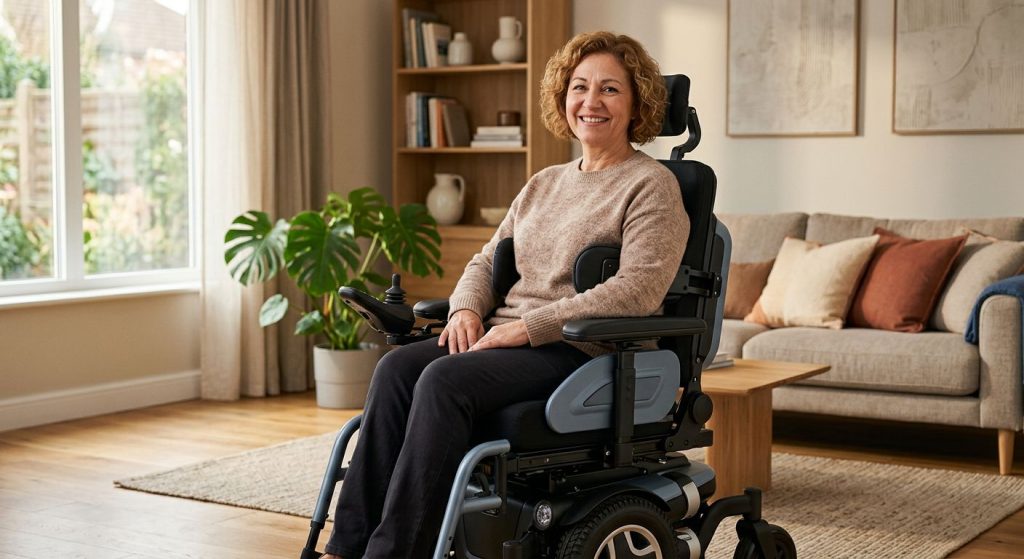
Building on the power wheelchair options we examined earlier, the right seating and positioning setup can make a significant difference in long-term comfort and health. Lateral trunk supports for power wheelchairs are accessories that help stabilize the torso and prevent leaning to one side. These supports come in fixed or adjustable designs. Options like pivot, swing-away, and depth-adjustable models accommodate a wide range of body shapes. Within a custom power wheelchair seating and positioning system, lateral supports contribute to better postural alignment and can make it easier to stay comfortable throughout the day. They also help maintain a midline trunk position, which can reduce fatigue during long periods of sitting.
Lateral trunk supports are a key element of complex rehabilitation technology, a category that addresses highly individualized mobility needs. According to standards set by RESNA, assistive technology components like trunk supports are evaluated for durability and safety. When paired with pressure redistribution cushions, trunk supports help distribute weight more evenly, which may reduce the risk of skin breakdown and musculoskeletal strain over time. Over months of daily use, this thoughtful configuration can support healthier sitting postures and contribute to greater independence.
If you are considering lateral trunk supports for your power wheelchair, our team can help you understand which configuration suits your daily routine. In the next section, we’ll walk through the clinical evaluation and fitting process we use at MedEquipped to match supports to your body and lifestyle. As always, consult a healthcare professional before making clinical decisions.
Lateral trunk supports are an essential component of custom power wheelchair seating and positioning, specifically designed to maintain midline trunk alignment and counteract lateral lean. Without adequate support, gravity can pull the trunk to one side, leading to spinal curvature, pelvic obliquity, and an increased risk of pressure injuries. By keeping the torso centered over the pelvis, these supports help redistribute pressure more uniformly across the seating surface and work in tandem with pressure redistribution cushions to protect vulnerable areas. At MedEquipped, we integrate lateral supports into comprehensive mobility solutions, always guided by RESNA (Rehabilitation Engineering and Assistive Technology Society of North America) standards for wheelchair seating.
Lateral trunk supports come in two main mounting configurations: fixed-mount and height-adjustable. A fixed-mount support attaches the pad in a static position, delivering exceptional stability with no moving parts that could loosen over time. A height-adjustable support, in contrast, allows vertical repositioning of the pad without tools, making it easier to accommodate changes in trunk posture as a patient’s condition progresses or improves.
The following table compares these two mounting options across several clinically relevant features.
| Feature | Fixed-Mount | Height-Adjustable |
|---|---|---|
| Adjustability | Limited; support pad position is static once installed. | Allows vertical repositioning of the support pad without tools. |
| Stability | Very stable; no moving parts that could loosen over time. | Stable when locked; possible minor movement with repeated adjustments. |
| Clinical Use | Best for patients with stable trunk posture and predictable positioning needs. | Ideal for patients whose trunk posture changes over time or requires fine-tuning. |
| Ease of Adjustment | Requires tools and reinstallation to change position. | Tool-free or minimal tool adjustment allows quick changes. |
| Swing-Away Capability | Not available; must be unbolted for transfers. | Often available as swing-away model to facilitate safe transfers. |
For a patient with a stable trunk posture who does not anticipate changes, a fixed-mount support provides dependable, consistent alignment. For individuals whose positioning needs may evolve—due to progressive neurological conditions, recovery after injury, or postural improvements—height-adjustable supports offer the flexibility to fine-tune fit without the need for reinstallation. This adaptability can reduce the time a clinician spends making adjustments and help maintain optimal pressure distribution over time.
Choosing the right type of lateral support requires a thorough clinical evaluation by a qualified professional, such as a certified Assistive Technology Professional (ATP). We at MedEquipped collaborate with you and your ATP to determine which configuration matches your stability needs, activity level, and overall seating goals. Insurance guidelines, including those from the Centers for Medicare & Medicaid Services (CMS), reinforce the requirement for clinical justification, helping ensure that your equipment truly supports your health and independence. Always consult your clinician or ATP for a personalized assessment of your positioning needs.
When you partner with MedEquipped, you gain a dedicated team committed to optimizing every element of your seating system, from the initial evaluation through delivery and follow-up. We handle the paperwork, insurance navigation, and coordination so you can focus on living your life. As your partner in mobility freedom, we ensure every component—from lateral supports to drive controls—supports your best possible function. Up next, we’ll explore how pressure redistribution cushions and custom contouring further enhance comfort and postural stability.
Now that we’ve explored the basics of wheelchair seating, let’s examine how lateral trunk supports improve postural alignment and manage trunk lean. As a provider of mobility solutions based in Spring Valley, NY and serving New York, Georgia, and Michigan, at MedEquipped we understand that these supports are essential to a custom seating system, and they can dramatically enhance comfort and function.
Lateral trunk supports apply gentle, consistent pressure to the sides of the torso, which stabilizes the pelvis and ribcage and guides the spine toward a neutral position. This reduces the need for compensatory muscle activity that often leads to fatigue and discomfort. According to RESNA, custom fitting is crucial because a poorly positioned support can cause pressure points or unnatural postures. When properly fitted by a certified Assistive Technology Professional (ATP), lateral supports minimize asymmetric spinal loading, which can improve upper extremity function, make breathing easier, and enhance pressure distribution across the seat. By holding the torso upright, these lateral supports also reduce the muscular work required to correct a lean, allowing the user to focus on activities rather than postural maintenance. An erect posture can improve the field of vision and social interaction. This biomechanical advantage is why RESNA and clinical specialists recommend an individualized assessment to determine the optimal height, angle, and contour. Even modest improvements in alignment can lead to significant gains in comfort and function.
For individuals with neuromuscular conditions such as muscular dystrophy or cerebral palsy, trunk lean often emerges due to asymmetric muscle weakness, spasticity, or impaired postural reflexes. Without adequate support, the upper body may progressively collapse toward one side, causing discomfort, respiratory challenges, and difficulty with seated activities. Trunk lean can also set the stage for secondary complications, including pressure injuries and spinal deformities.
Lateral trunk supports actively counteract these tendencies by providing a structural anchor that maintains the torso in a functional, midline orientation. This not only preserves comfort but can also protect the spine from excessive curvature over time. Clinical assessment is vital to determine the correct height, angle, and contour of the support to accommodate fluctuating muscle tone and growth in younger users. We often combine lateral trunk supports with a custom power wheelchair seating and positioning system that includes pressure redistribution cushions to manage weight distribution and skin integrity. RESNA and United Spinal Association resources highlight the need for individualized fitting, reminding us that a support that works well for one person may be inadequate for another. Even slight lateral correction can significantly improve seated endurance and user confidence, minimizing the energy spent on postural maintenance and maximizing participation in daily life.
When choosing lateral trunk supports, three primary designs are available: swing-away, fixed contour, and wrap-around panels. The table below compares their key attributes.
| Design Feature | Swing-Away | Fixed Contour | Wrap-Around Panel |
|---|---|---|---|
| Transfer Access | Easily swings open for lateral transfers without removing the support. | Must be unbolted or patient must transfer over the support. | Provides full lateral containment but limits transfer access. |
| Stability | Good stability when locked; slight play may develop over time. | Excellent stability; no moving parts. | High stability due to broad contact area. |
| Adjustability | Often height-adjustable and angle-adjustable. | Limited adjustability; shaped to specific posture. | Moderate adjustability; usually requires tool adjustment. |
| Best For | Patients who perform independent transfers and need frequent repositioning. | Patients with stable seated posture where minimal adjustment is needed. | Patients with significant trunk lean requiring continuous lateral support. |
The right design hinges on transfer ability, postural stability, and adjustability needs; a clinical evaluation ensures the optimal match.
Please note: Results may vary; individual outcomes are not guaranteed. Consult a healthcare professional before making clinical decisions. This information is not medical advice and is for informational purposes only.
Selecting the right lateral trunk support is one aspect of a complete custom seating system; next, we’ll explore pressure redistribution cushions and how they complement lateral positioning.
Proper adjustment and thorough documentation form the cornerstone of successful lateral trunk support use. Beginning with the initial assessment, our certified Assistive Technology Professionals carefully position the lateral trunk supports to match the user’s anatomy and seating goals. We measure the torso width, palpate the iliac crests and rib cage, and attach the supports to the backrest at the correct height and depth. Our team fine-tunes the lateral width and angle to offer gentle containment without restricting breathing or arm movement. During follow-up appointments, we reassess support positioning as the user’s needs evolve—adjusting for weight fluctuation, muscle tone changes, or new activity demands. Our ATPs follow assistive technology certification and standards set by RESNA to guide every fitting. In custom power wheelchair seating and positioning evaluations, we also confirm that lateral supports integrate seamlessly with the cushion and backrest to maintain overall postural alignment. We document every adjustment in the clinical record, creating a timeline that supports future insurance claims and Medicare justification. We also perform hand checks under the supports to ensure that no excessive pressure builds, preventing skin breakdown. All these steps align with RESNA’s seating standards, reinforcing clinical best practice. Ultimately, meticulous adjustment leads to greater comfort and improved functional outcomes, laying the foundation for a successful power wheelchair experience.
Medicare requires comprehensive clinical documentation to justify lateral trunk supports as a medically necessary component of a power wheelchair. According to guidelines from the Centers for Medicare & Medicaid Services (CMS), providers must submit detailed clinical notes describing the patient’s functional limitations, postural asymmetries, and why less restrictive alternatives are insufficient. Dated, high-resolution photographs are essential to visually demonstrate the postural correction achieved with the supports in place. A written prescription or letter of medical necessity must explicitly link the lateral trunk supports to improved sitting tolerance, respiratory function, or pressure redistribution. Our team at MedEquipped gathers these materials during the evaluation and coordinates the submission to streamline prior authorization. We partner with your physician and therapist to compile a compelling case that meets all local coverage determinations, reducing unnecessary stress. We ensure that the clinical rationale is clearly articulated, aligning with Medicare’s local coverage determinations to support a timely approval. By handling the paperwork, insurance navigation, and coordination, we help you avoid common delays. Our experience with CMS guidelines helps ensure all required elements are included, streamlining approval times. We also educate you on what to expect during the review process so there are no surprises. Please note that individual outcomes may vary, and this information does not constitute medical advice.
Swing-away lateral trunk supports dramatically improve transfer safety by providing a wide, unobstructed path. When the user or caregiver needs to transfer, the supports can be unlatched and pivoted completely out of the way, eliminating the risk of snagging clothing or limbs.
The comparison highlights that no single lateral support design fits every transfer scenario. For independent transfers, swing-away mechanisms with smooth, wide pivots offer the greatest independence. Assisted transfers benefit from quick-release mechanisms that reduce caregiver strain. Stand-pivot transfers often require fixed supports that provide a stable surface to push against; however, padded contours add comfort without sacrificing stability.
Our ATPs evaluate each person’s transfer patterns during the seating assessment and recommend the most suitable lateral support configuration. We also teach proper transfer techniques to maximize safety for both the user and any caregiver.
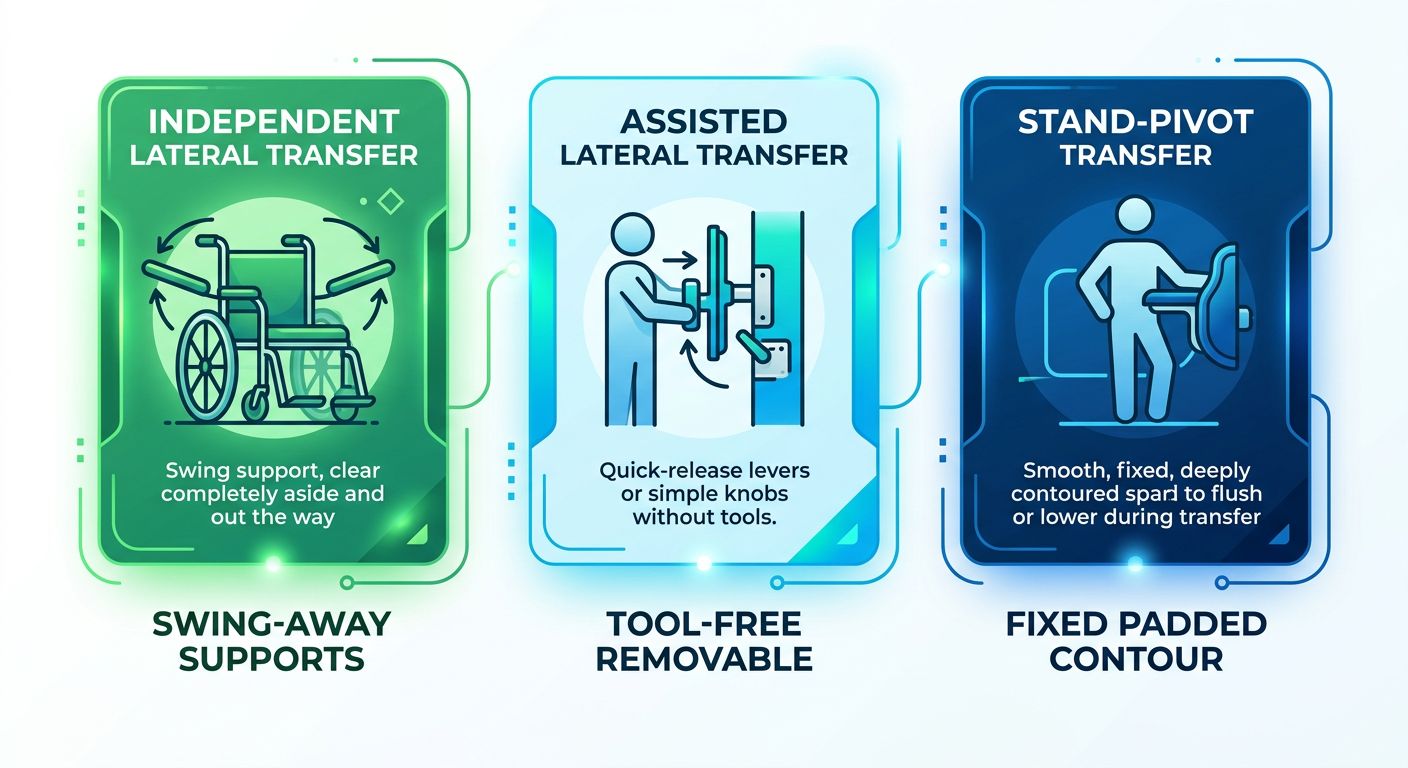
Comparison of lateral transfer protocols and recommended lateral trunk support features for power wheelchair users.
When neuromuscular scoliosis compromises postural stability, lateral trunk supports become a critical component of custom seating. The condition arises from uneven spinal curves driven by nerve or muscle disorders, leading to pelvic obliquity, trunk asymmetry and pressure-related discomfort. Pairing lateral supports with pressure redistribution cushions counteracts these effects.
By bracing the torso, these supports guide your spine toward midline and prevent the leaning that aggravates asymmetrical forces. This realignment reduces pelvic obliquity and helps you sit with greater comfort and endurance.
Pressure redistribution cushions protect skin and deeper tissues by mapping to your unique curvature, spreading weight evenly to lower the risk of pressure injuries. Together with lateral supports, they lock the pelvis in a neutral position, enhancing both stability and long-term skin health.
A successful fit demands a thorough evaluation by a certified Assistive Technology Professional (ATP). The ATP-led process includes biomechanical assessment, trial fittings and iterative adjustments until you achieve a functional, pressure-relieving posture. RESNA’s international standards for seating and mobility provide the authoritative framework, ensuring that every element of custom power wheelchair seating and positioning meets safety and performance criteria.
We at MedEquipped orchestrate this entire journey for you. Our ATP evaluators perform hands-on fittings in New York, Georgia and Michigan, fine-tuning lateral trunk supports, cushion selection and overall geometry. Because we manage documentation and insurance coordination, you stay free of administrative strain while directing every clinical decision.
You can also access wheelchair user advocacy and support through organizations like the United Spinal Association, which offers peer mentoring, educational tools and policy updates that complement your clinical seating plan.
This information is not medical advice and is for informational purposes only; consult a healthcare professional before making clinical decisions. A professionally guided seating assessment remains the surest path to a custom system that works with your body, not against it.
Here are answers to common questions about lateral trunk supports.
What are lateral trunk supports?
Our specialists explain that lateral trunk supports are attachments on a power wheelchair backrest that provide side-to-side torso stability, helping users maintain an upright posture.
Who needs lateral trunk supports?
Individuals with poor trunk control from conditions such as MS, spinal cord injury, cerebral palsy, or stroke benefit from these supports after clinical evaluation.
How do lateral trunk supports improve posture and safety?
By stabilizing the torso, lateral supports enhance posture, reduce fatigue, and improve safety. Adding pressure redistribution cushions increases comfort.
Does Medicare cover lateral trunk supports?
Per CMS guidelines, Medicare Part B may cover lateral trunk supports as DME when medically necessary, with prior authorization and a physician’s prescription required.
For readers outside the U.S., mobility equipment for children and adults in the UK is available through specialized providers.
How can I get custom lateral trunk supports for my wheelchair?
Contact us for a custom evaluation; our ATPs integrate lateral supports into your custom power wheelchair seating and positioning. We’re your partner in mobility freedom.
Consult a healthcare professional before making clinical decisions.
When you partner with MedEquipped, our certified ATP evaluators assess your needs, including lateral trunk supports, as part of custom power wheelchair seating and positioning. We handle the paperwork, insurance navigation, and coordination so you can focus on your mobility. Custom motorized wheelchairs are ordered and delivered with customized features, such as lateral trunk supports, based on your specific requirements, typically within 30–60 days. Serving patients in New York, Georgia, and Michigan, we provide ongoing post-delivery support and remain your partner in mobility freedom. Explore the specific custom wheelchair options available to fit your lifestyle.
Table of Contents The 2026 ADA Accessible Medical Equipment Compliance Landscape Understanding the ADA's 2026 Medical Equipment Accessibility Mandate The DOJ and…
Read More
Table of Contents Understanding Collision Avoidance Systems for Power Wheelchairs Comparing Collision Avoidance Technologies for Wheelchairs Understanding Sensor Technology Differences How to…
Read More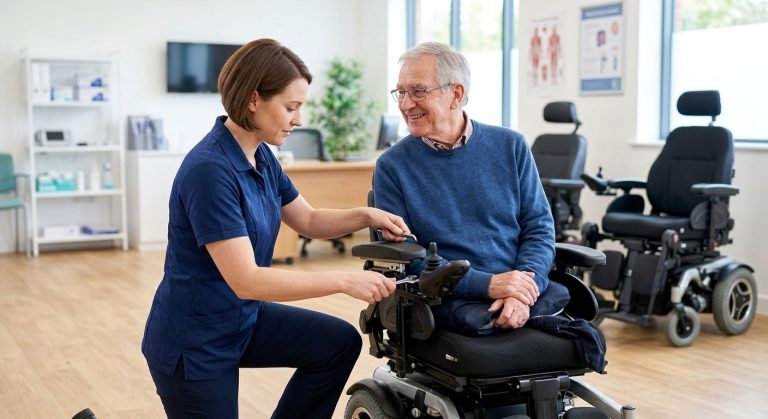
Table of Contents Front-Wheel Drive Power Wheelchairs: Built for Real-World Mobility Opening Hook & Article Preview Superior Curb Climbing Opening Explanation Example/Tip…
Read More