Medicare Power Wheelchair Eligibility 2026: Complete Guide
Table of Contents Understanding Medicare Power Wheelchair Coverage in 2026 2026 Medicare Power Wheelchair Eligibility Rules at a Glance The Face-to-Face Mobility…
Read More
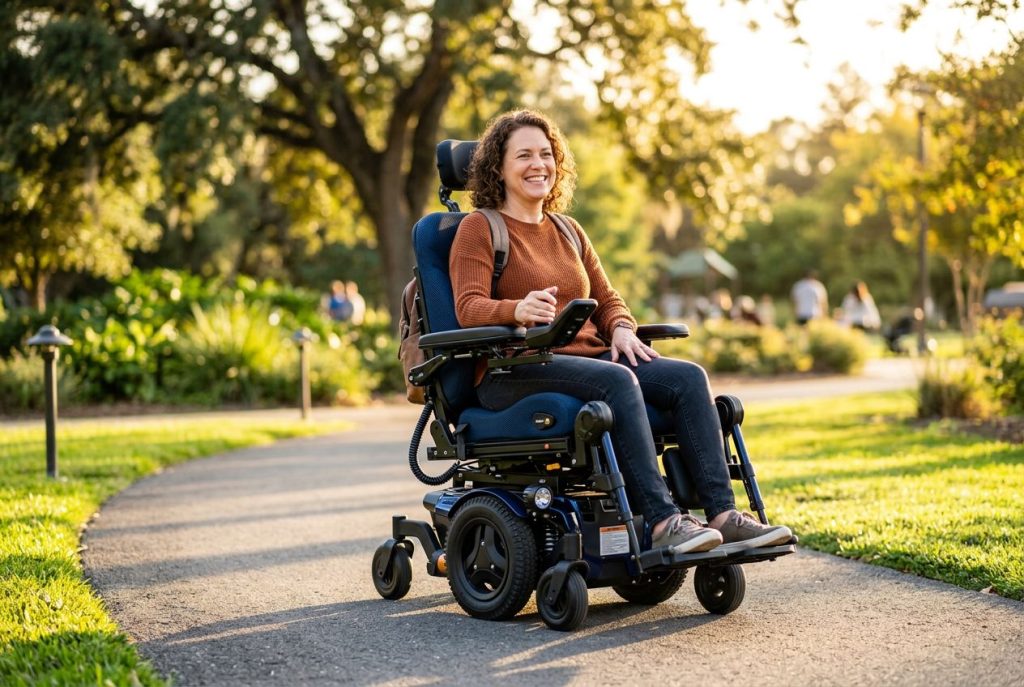
Achieving true independence starts with a mobility solution designed around you — not the other way around. A custom motorized wheelchair for adults is a precisely fitted power chair built to match your unique body shape, clinical needs, and daily lifestyle. At MedEquipped, we see ourselves as your partner in mobility freedom, combining advanced clinical evaluations with end-to-end coordination so you can focus on living fully.
A properly tailored custom fit does more than improve comfort. It promotes better posture, distributes pressure evenly, and helps reduce the risk of long-term secondary health issues. Our certified ATP evaluators and dedicated technicians use clinical assessments to inform every decision, ensuring your chair integrates the right combination of complex rehab technology and power seat functions for superior support and accessibility. As part of this process, we often conduct a wheelchair pressure mapping evaluation to verify that your seating system protects your skin and maximizes stability.
We handle the paperwork, insurance navigation, and coordination from evaluation to delivery — including serving families across New York, Georgia, and Michigan. Most custom motorized wheelchairs for adults move from initial assessment to your doorstep in 30 to 60 days, with faster processing available when needed. Everything we do is built around one goal: getting you mobile with confidence.
Many customization options go into designing your ideal chair, from seating geometry and control placement to specialized power adjustments. Exploring these choices is the next step toward a wheelchair that truly supports your independence.
Disclaimer: Results may vary; individual outcomes are not guaranteed. Consult a healthcare professional before making clinical decisions. This information is not medical advice and is for informational purposes only. Privacy notice: we do not sell personal information (see Privacy Policy). SMS terms: message and data rates may apply; reply STOP to unsubscribe.
A custom motorized wheelchair for adults is far more than a standard power chair—it is a precisely engineered mobility solution tailored to an individual’s unique physical and functional needs. At MedEquipped, we see these devices as a true complex rehab technology (CRT), a formal classification for wheelchairs that require extensive evaluation, configuration, and fitting by certified professionals. Unlike a one-size-fits-most device, a CRT wheelchair is designed from the ground up to provide customized support, positioning, and independent control for daily indoor and outdoor use.
The following table illustrates the key differences between a standard power wheelchair and a custom CRT wheelchair.
| Feature | Standard Power Wheelchair | CRT Wheelchair |
|---|---|---|
| Customization Level | Limited; pre-configured options | Highly customizable; fully adjustable seating and controls |
| Seating Options | Basic cushion; minimal positioning | Custom cushions, power tilt/recline, elevating legrests, seat elevation |
| Drive Control Adjustability | Standard joystick; limited programmability | Programmable joystick, head array, sip-and-puff; fully customizable |
| Frame Durability | Moderate; designed for light to moderate use | Heavy-duty; built for frequent, long-term use |
| Insurance Classification | Standard DME (durable medical equipment) | CRT (complex rehab technology); higher documentation needs |
| Typical Use Cases | Intermittent indoor mobility | Daily indoor and outdoor mobility for complex conditions |
A standard power chair is often adequate for temporary or limited mobility, but a CRT wheelchair is essential when long-term positioning and advanced functionality are required. The heavy-duty frame of a custom chair is not just about durability; it serves as a stable platform for integrating advanced power seat functions. These functions, such as power tilt and recline or elevator-like seat elevation, are not luxury add-ons. They are medically necessary for pressure relief, improved respiration, and safe, independent participation in daily activities. As part of our clinical process, a wheelchair pressure mapping evaluation is an invaluable tool we use to guide the selection of a custom cushion, ensuring pressure is distributed evenly to protect skin health.
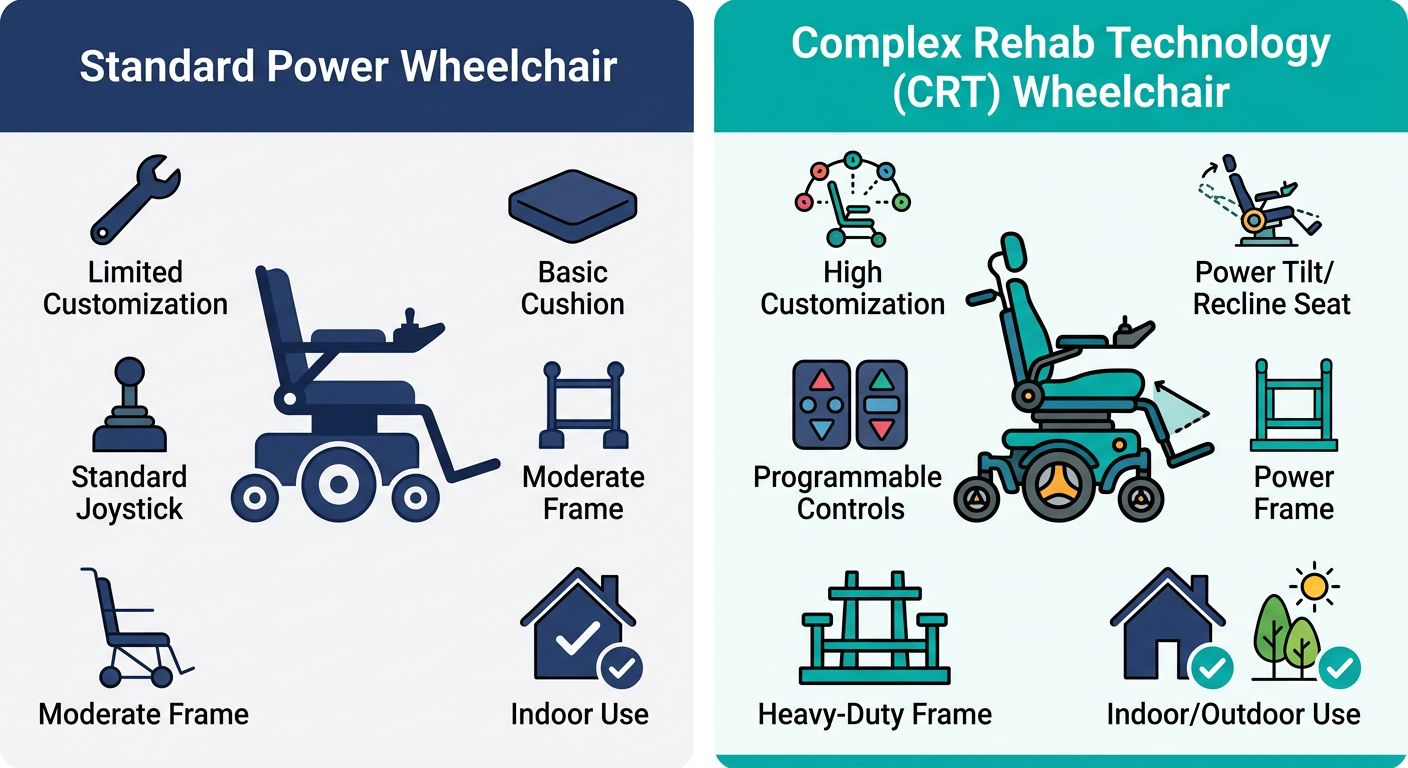
Comparison of standard power wheelchairs versus CRT wheelchairs highlighting key feature differences.
Drive controls on a custom motorized wheelchair represent another leap forward in customization. While a standard chair offers a simple joystick, a CRT system’s programmability is limitless. We can integrate specialty drive controls like a head array or sip-and-puff system for individuals with limited hand function. This level of adjustment, down to the acceleration and braking sensitivity, is a cornerstone of the complex rehab technology definition endorsed by the Rehabilitation Engineering and Assistive Technology Society of North America (RESNA), the industry standard for quality and safety. These RESNA standards guide our equipment selection process to ensure your chair is safe, durable, and perfectly adjusted.
From a practical standpoint, these clinical differences translate into a distinct insurance pathway. Standard power wheelchairs are classified as Durable Medical Equipment (DME), a broad category. A CRT wheelchair, however, is in its own class, requiring detailed medical documentation and a face-to-face clinical evaluation. At MedEquipped, we are your partner in mobility freedom. We handle the paperwork, insurance navigation, and coordination as a core part of our service, leveraging our certified ATP-led evaluations to build a compelling case for the equipment you truly need. This comprehensive approach is what transforms a complex process into a clear, manageable path toward gaining a custom power wheelchair.
We at MedEquipped know that a truly custom motorized wheelchair for adults is more than just a base and a seat—it’s a system designed to adapt to your unique body and daily life. Power seat functions turn a standard power wheelchair into a dynamic tool for health management, comfort, and independence. By adding these features, you gain the ability to reposition yourself throughout the day without help, which is central to our mission as your partner in mobility freedom.
Power tilt is a function that angles the entire seating system backward while maintaining the hip and knee angles, redistributing pressure away from the sitting bones. This movement is critical for pressure relief; according to our pressure mapping evaluation data, shifting weight through tilt can significantly lower a user’s Peak Pressure Index, reducing the risk of pressure ulcers. Power recline, which changes the angle between the backrest and the seat, works differently by opening the hip angle. This function is often used for managing muscle tone, preventing contractures, and providing an alternative pressure relief surface by changing the body’s contact area with the cushion.
Elevating legrests raise the lower extremities independently, which is an essential feature for controlling edema, improving circulation, and simply finding a more comfortable leg position after long periods of sitting. Seat elevation moves the user vertically from a seated to a standing position’s height, enabling independent reach to high shelves, safer and easier transfers, and more natural eye-to-eye social interactions. For those with the necessary medical clearance, power standing takes this further by bringing the user into a fully upright, weight-bearing posture, which can offer profound benefits for bone density, circulation, and psychological well-being. Each of these complex rehab technology power seat functions serves a distinct clinical purpose, and their inclusion must be justified for insurance coverage.
The most advanced power seat functions are only useful if you can command them effortlessly. An assistive technology professional near me plays the central role in identifying a custom motorized wheelchair for adults with the right drive interface. This specialist evaluates your strength, range of motion, and coordination to select from options like a standard or mini proportional joystick for precise hand control, or a compact joystick for users with limited finger dexterity. For those who cannot use their hands reliably, a head array built into the headrest can activate switches through gentle head movements, while sip-and-puff controls interpret breath pressure through a tube for precise, sequential commands.
Another innovative solution uses proximity switches, which are fiber-optic or infrared sensors that require no physical force to activate—simply bringing a finger or head within a short distance of the switch is enough. The selection process is deeply personal, and we work with you and your therapist to match the technology to your most consistent and fatigue-free movements. The goal is an interface that feels intuitive and dependable, letting you focus on where you are going and not on how to get there. We handle the paperwork, insurance navigation, and coordination for these critical components just as we do for the chair itself. Results may vary; individual outcomes are not guaranteed. Consult a healthcare professional before making clinical decisions. This information is not medical advice.
Customizing a power wheelchair means considering your environment, from tight, carpeted hallways to grassy parks. The drive wheel configuration is a major factor. A center-wheel drive base offers an exceptionally tight turning radius, making it a top performer for maneuvering around furniture and through narrow doorways in a home or office. Rear-wheel drive chairs, conversely, provide excellent stability and tracking at higher speeds, which is ideal for outdoor use, while front-wheel drive excels at climbing curbs and handling uneven surfaces with a smoother ride.
A proper suspension system is vital for comfort and safety when moving from a smooth floor to a bumpy sidewalk; active suspension absorbs shocks, keeping all wheels on the ground and reducing spasticity triggers. Your tire choice also matters. Pneumatic tires, filled with air, cushion the ride effectively outdoors but require maintenance, while solid or foam-filled inserts are puncture-proof and require less upkeep, though they offer a firmer ride. We consider these variables during our comprehensive evaluation, balancing your primary daily environments with your recreational desires. After we finalize the specifications, our team manages the entire order, and you can typically expect delivery within 30-60 days (faster processing). We handle the paperwork, insurance navigation, and coordination, ensuring your new customized mobility system arrives ready for your world. Results may vary; individual outcomes are not guaranteed. Consult a healthcare professional before making clinical decisions. This information is not medical advice.
Getting a custom motorized wheelchair for adults involves several important steps, and we guide you through each one. At MedEquipped, we handle the paperwork, insurance navigation, and coordination so you can focus on what matters most — regaining your independence and mobility. From your very first evaluation with a certified professional to the day your fully fitted chair arrives, we’re your partner in mobility freedom.
The process begins with a comprehensive clinical evaluation led by a certified Assistive Technology Professional (ATP). This step is essential — not only to ensure your chair fits your body perfectly, but also because Medicare and most private insurers require an ATP-led assessment for complex rehab technology. During the evaluation, we conduct a detailed mobility needs assessment, analyzing how you move through your daily environment and what functional challenges you face.
Seating and positioning analysis is a cornerstone of the evaluation. Our ATP examines your posture, spinal alignment, and weight distribution to prevent secondary complications like pressure injuries and skin breakdown. We use pressure mapping technology to visualize high-risk areas and identify optimal cushioning and support surfaces. The assessment also covers control assessment, where we evaluate your strength, range of motion, and coordination to determine the best drive control — whether a standard joystick, alternative input like sip-and-puff, or advanced power seat functions such as tilt and recline. MedEquipped recommends consulting assistive technology professional resources for further information on ATP certification standards.
Once the clinical evaluation is complete, the next phase focuses on securing funding. We know that insurance paperwork can feel overwhelming, which is why MedEquipped takes the lead in identifying your coverage options and managing the entire approval process. Our team reviews your benefits under Medicare, Medicaid, and private insurance plans, determining exactly what documentation each payer requires.
We compile the ATP’s clinical findings into a detailed letter of medical necessity — the primary evidence insurers use to justify coverage. For Medicare beneficiaries, this means meeting CRT criteria with a face-to-face exam and a written order containing seven required elements. Medicaid guidelines vary by state, often requiring prior authorization and state-specific forms. Private insurance plans typically need a customized medical necessity letter along with clinical notes and the seating evaluation report. Our staff coordinates directly with physicians, therapists, and insurance case managers to minimize delays and keep your application moving forward.
After funding approval, we move into the custom ordering phase. Our ATP configures your chair precisely to the specifications determined during the evaluation — frame type, seating system, power seat functions, drive controls, and any additional accessories. We source from leading manufacturers to ensure your custom power wheelchair matches both your clinical needs and your lifestyle. Once the order is submitted, the typical timeline from final configuration to delivery is 30-60 days, and we actively work toward faster processing whenever possible.
When your chair arrives, we handle delivery and fitting personally. Our technician ensures every component is adjusted correctly, verifies that all controls respond as expected, and provides hands-on education so you feel confident operating your new equipment. But our relationship doesn’t end at delivery. We provide ongoing support for adjustments, repairs, and patient education — because a well-maintained chair is essential for long-term mobility and health. Once your chair is delivered, our ongoing support ensures it stays in top condition. Results may vary; individual outcomes are not guaranteed. Information is not medical advice and is for informational purposes only.
Now that we’ve defined complex rehab technology, let’s talk about the paperwork that makes it possible to get you the wheelchair you need. At MedEquipped, we guide you through every required form and clinical justification, so your custom motorized wheelchair moves from evaluation to delivery on our typical 30–60 day timeline.
Among the documented requirements, three pitfalls cause the most delays: missing signatures or dates on the written order, vague medical necessity statements that fail to demonstrate functional need, and face-to-face exams performed outside the six-month window. Our ATP (Assistive Technology Professional) evaluators review every document for completeness, drawing on standards from the Rehabilitation Engineering and Assistive Technology Society of North America (RESNA) and the Assistive Technology Industry Association (ATIA) to help you avoid these common errors. When listing additional options such as power seat functions, we ensure each is justified in the narrative.
Frequently Asked Questions
What is a custom motorized wheelchair for adults?
A custom motorized wheelchair for adults is built to your unique measurements, clinical needs, and lifestyle, incorporating complex rehab technology for superior comfort and function.
What is pressure mapping and why is it important?
Pressure mapping measures how your body weight distributes on the seat cushion, allowing us to select the right support and prevent skin breakdown.
What are power seat functions and what options are available?
Power seat functions include tilt, recline, and elevating leg rests, helping you change position independently for pressure relief and circulation.
How long does it take to get a custom motorized wheelchair?
After funding is approved, delivery typically takes 30–60 days (faster processing) thanks to our streamlined coordination and paperwork handling.
Contact us at 845-237-2381 or intake@medequipped.com. We’re your partner in mobility freedom. Results may vary; individual outcomes are not guaranteed.
A custom motorized wheelchair for adults is more than just mobility equipment — it’s a personalized solution crafted around your body, lifestyle, and daily needs. At MedEquipped, we serve as your partner in mobility freedom, managing every step from clinical evaluation and ATP-led fitting to insurance paperwork and final delivery. Our team brings together advanced complex rehab technology and thoughtful configurations like power seat functions to create a chair that truly fits you. We coordinate the entire process so you can focus on living independently, with typical turnaround times of 30–60 days. We proudly support clients in New York, in Georgia, and in Michigan through dedicated technicians and ongoing service. Ready to see how the evaluation works? Learn about the simple steps ahead to start your journey toward greater freedom.
Table of Contents Understanding Medicare Power Wheelchair Coverage in 2026 2026 Medicare Power Wheelchair Eligibility Rules at a Glance The Face-to-Face Mobility…
Read More
Table of Contents Understanding Medicare Power Wheelchair Coverage in 2026 Prerequisites for Your Medicare Power Wheelchair Application Confirm Your Medical Necessity for…
Read More
Table of Contents The Medicare Mobility Assistive Equipment Algorithm Explained Prerequisites for Medicare Motorized Wheelchair Coverage Assess Your Daily Mobility and Functional…
Read More