Medicare Power Wheelchair Eligibility 2026: Complete Guide
Table of Contents Understanding Medicare Power Wheelchair Coverage in 2026 2026 Medicare Power Wheelchair Eligibility Rules at a Glance The Face-to-Face Mobility…
Read More
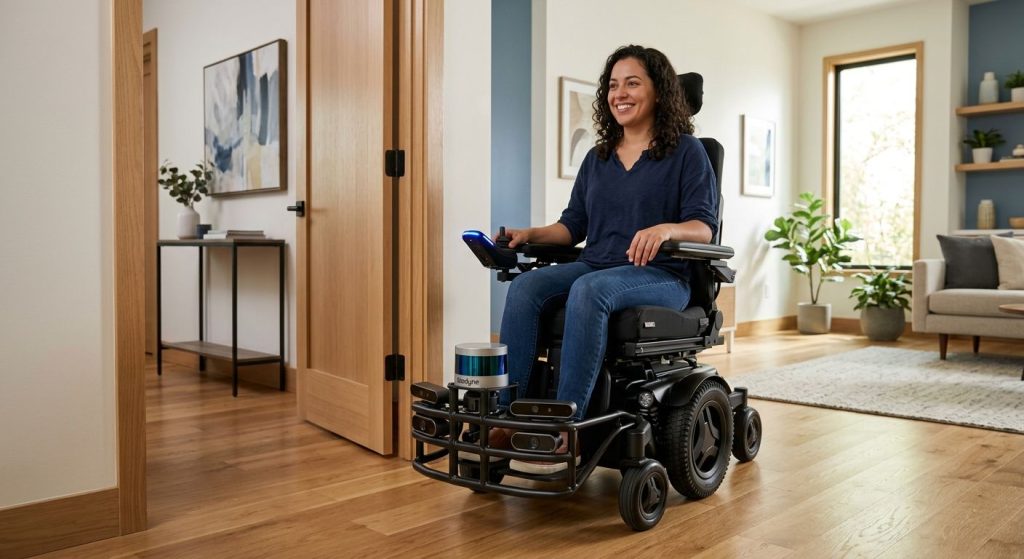
Building on the core safety features that protect power wheelchair users, collision avoidance systems represent a significant leap forward in smart mobility. These sensor-based technologies work continuously to detect obstacles in your path—whether a piece of furniture, a wall, or a person—and can alert you or even automatically apply the brakes to help prevent a collision. By reducing the risk of unexpected bumps and scrapes, collision avoidance technology allows you to move through tight indoor spaces and busy outdoor areas with greater confidence.
At MedEquipped, we understand that navigating your environment shouldn’t be a source of stress. Integrating collision avoidance into your custom chair reduces the cognitive load required to monitor every angle simultaneously, freeing you to focus on going about your day. This same approach aligns with broader smart wheelchair technology, which aims to make power mobility safer, more intuitive, and better adapted to your life.
We offer custom power wheelchairs that can be equipped with these advanced features, and because we handle the paperwork and insurance coordination, understanding your coverage options is straightforward. For example, our team can help you determine whether you qualify for a power wheelchair medicare funding pathway for a chair that includes collision avoidance. Our typical 30-60 day processing window means you spend less time waiting and more time enjoying the independence a thoughtfully configured chair provides. Results vary and this information is for educational purposes; please consult a healthcare professional before making clinical decisions about safety equipment.
Building on the expanding world of smart wheelchairs, collision avoidance systems are a transformative addition that uses advanced sensor technology to help you navigate more safely and independently. These systems are designed to detect obstacles in your chair’s path and either warn you or take automatic action to prevent a collision, giving you greater confidence as you move through indoor and outdoor environments. This technology doesn’t replace your driving judgment but acts as an extra set of eyes, offering a helpful safety net for users with limited visibility or slower reaction times.
At the core of these systems are two primary sensor technologies: ultrasonic and LiDAR. An ultrasonic sensor works much like a bat using echolocation. It emits high-frequency sound waves that bounce off nearby objects, and by measuring how long the echo takes to return, the system calculates the object’s distance. These sensors typically detect obstacles within a range of 0.2 to 4.5 meters with centimeter-level accuracy and function reliably regardless of lighting conditions. Ultrasonic sensors provide a cost-effective solution for basic detection needs, making them a common starting point for collision avoidance in power wheelchairs.
A LiDAR sensor takes a different approach by using rapid pulses of laser light to create a detailed, millimeter-accurate map of the surroundings. With a detection range that can reach up to 30 meters, LiDAR excels at identifying objects at greater distances and in more complex layouts, giving the system a richer picture of the environment. Like ultrasonic technology, LiDAR remains completely unaffected by dim light or darkness, ensuring dependable performance no matter the time of day. This higher precision typically comes at a higher cost, reflecting the more sophisticated hardware involved.
| Feature | Ultrasonic | LiDAR |
|---|---|---|
| Detection Range | 0.2–4.5 meters | up to 30 meters |
| Accuracy | centimeter-level | millimeter-level |
| Cost | lower cost | higher cost |
| Performance in Dim Light | unaffected | unaffected |
For many users, the choice between sensor types comes down to balancing budget with the level of environmental detail needed. Ultrasonic sensors deliver reliable close-range protection and simplicity while LiDAR offers expansive, high-resolution awareness that can be especially useful in crowded or dynamic spaces. Regardless of the sensor type the system integrates directly with your wheelchair’s drive controller to interpret incoming data in real time and trigger responses that keep you safer.
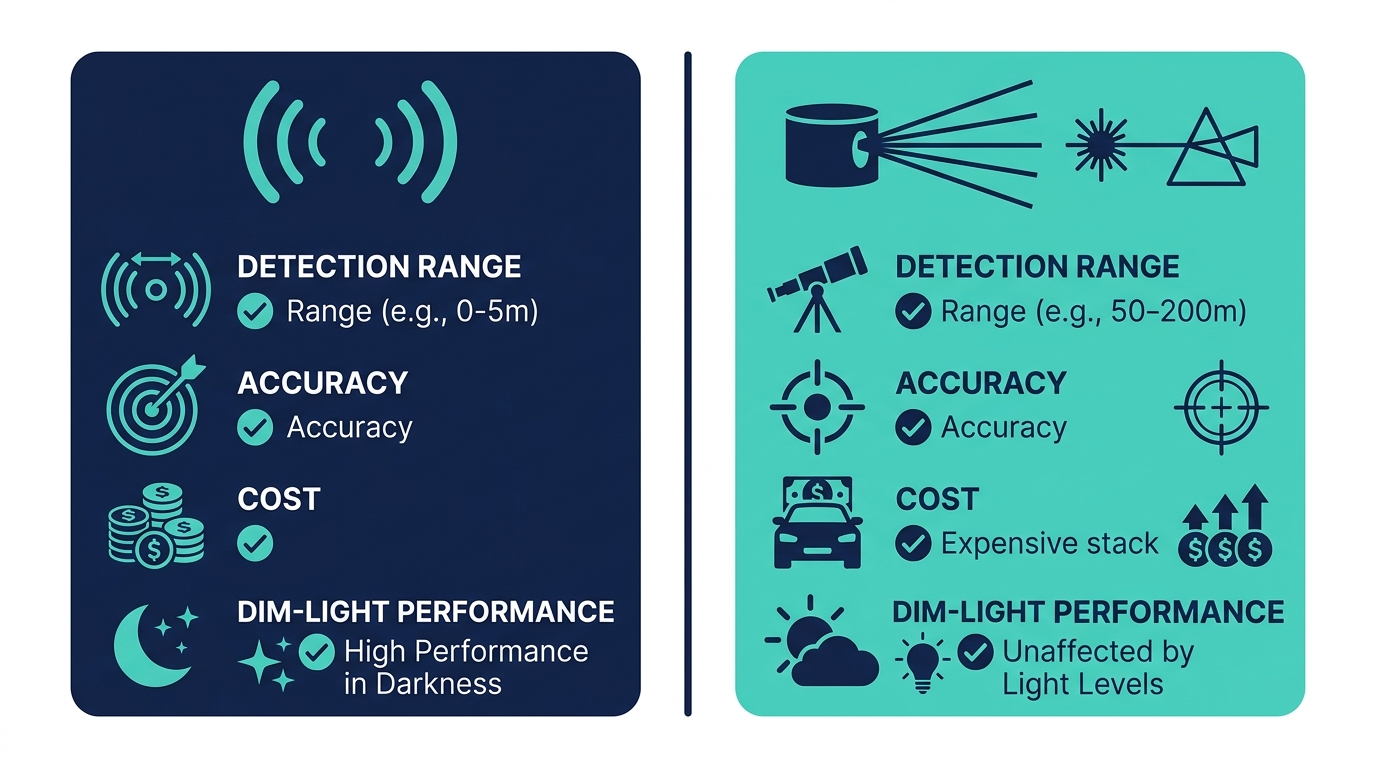
Ultrasonic vs LiDAR sensor comparison for power wheelchair safety.
When a potential collision is detected the system typically provides an auditory alert or haptic feedback such as a vibration in the joystick to get your attention. If you don’t react in time it can go a step further by automatically slowing the chair or applying the brakes to prevent contact. This seamless integration transforms your power chair into a true example of smart wheelchair technology that adapts to its environment. Obstacle detection technology like this makes daily mobility less stressful and more intuitive especially when navigating tight doorways, crowded rooms, or unfamiliar routes.
According to MedEquipped’s internal product knowledge, collision avoidance systems are an important layer of protection but are not a substitute for safe driving practices. You remain in control of your chair at all times and anti-collision systems are meant to assist rather than replace your awareness. We help you navigate your options when selecting a power wheelchair equipped with these features ensuring the technology matches your daily needs and clinical requirements.
For expert guidance on finding a reliable safety equipment supplier near me contact our team. We handle the paperwork, insurance navigation, and coordination so you can focus on what matters most: reclaiming your independence and exploring the world with a true partner in mobility freedom.
Building on the overview of core mobility features, the next frontier in power wheelchair design lies in intelligent environmental awareness. Modern collision avoidance systems transform how you interact with your surroundings, using advanced technology to create a safer, more intuitive driving experience. These systems do not replace attentive driving, but they provide a critical assistive layer, helping you navigate busy corridors, tight doorways, and crowded public spaces with greater confidence. At MedEquipped, we believe this smart wheelchair technology represents a true partnership between user and machine, enhancing independence without taking control away from you.
The core of any advanced obstacle detection network is sensor fusion. This process combines data from multiple sensor types—primarily LiDAR and ultrasonic—to build a comprehensive, real-time picture of the environment. A single sensor type has inherent weaknesses; for example, ultrasonic sensors can struggle with very soft or angled surfaces, while LiDAR performance can degrade in heavy rain or fog. By fusing their data streams, the wheelchair’s processor compensates for these individual limitations, dramatically improving detection accuracy and reducing false positives.
LiDAR, or Light Detection and Ranging, uses pulsed laser beams to measure distances with exceptional precision, creating a detailed 3D point cloud of the space ahead. According to MedEquipped’s technical resources, these lasers can map objects at significant ranges, providing crucial early warning for faster-moving chairs. Ultrasonic sensors, in contrast, emit high-frequency sound waves and measure their reflection, excelling at close-range detection of both soft and hard obstacles, like a person walking nearby or a piece of furniture. When these technologies work in tandem, the system cross-references LiDAR’s precise spatial map with the ultrasonic array’s reliable proximity data. This creates a redundant, robust safety net where one sensor type instantly verifies the other’s readings before triggering a response.
The raw data from a sensor array is just information; it takes artificial intelligence to turn that information into action. AI acts as the wheelchair’s brain, processing the fused sensor data in real-time to make split-second decisions. It is not simply reacting to a pre-set distance threshold. Instead, the AI classifies objects—distinguishing a static wall from a moving shopping cart—and predicts their future path, enabling adaptive navigation that feels smooth and natural rather than jarring.
This intelligent system also learns and adapts to your personal driving style over time. If you prefer wider turns or a slower approach to doorways, the AI can adjust its intervention parameters accordingly. This personalization is a key step toward intuitive alternative driving interfaces, where the chair not only avoids obstacles on its own but also interprets subtle user commands more effectively. The following table highlights several premier models available through MedEquipped that showcase these cutting-edge capabilities, each offering a unique approach to sensor integration.
| Model | Sensor Type | Detection Range | Additional Features |
|---|---|---|---|
| QUICKIE Q700 M | Ultrasonic + optional LiDAR | 4.5m ultrasonic | Adaptive cruise control |
| ROVI X3 | 360° LiDAR | up to 30m | Autonomous navigation |
| TDX SP2 HD | Ultrasonic Proximity | 2m range | Adjustable sensitivity |
Source: Manufacturer specifications and MedEquipped product database.
A full-perimeter sensing system provides an invisible safety cocoon around your wheelchair. This is achieved by strategically placing multiple sensors around the base, creating a continuous detection zone that leaves no blind spots. The system constantly monitors this zone, ready to provide an alert, slow your speed, or execute a controlled stop if an obstacle is detected in your path. This is especially critical in dynamic, complex environments where hazards can appear from the side or rear.
These collision avoidance systems rely on a concept called a ‘danger zone’, which is a digitally mapped area around the chair where objects trigger a response. When you drift too close to a wall or a person approaches from behind, the system can engage automatic braking or, in more advanced models, plot an alternative path around the hazard. For example, if a pedestrian suddenly steps in front of you, the system’s reaction time, measured in milliseconds, can augment your own reflexes, helping to mitigate an impact. Navigating the process of securing one of these advanced chairs can seem complex, but our team simplifies every step. These smart wheelchairs are often covered under wheelchair insurance — learn how we handle the process for you, managing paperwork and funding so you can focus on experiencing the freedom these technologies provide.
Choosing collision avoidance systems for your power wheelchair begins with a careful look at your daily life. We help you match the right obstacle detection technology to your home, your routines and your personal mobility goals. At MedEquipped, we view these safety sensors as a key part of smart wheelchair technology that gives you greater confidence behind the joystick.
Start by thinking about where you drive most often. Indoor spaces like narrow hallways, tight doorways and crowded kitchens call for precise front and rear sensors. Outdoor environments add uneven terrain, curbs and moving obstacles such as pedestrians or shopping carts, so broader side detection becomes more valuable. We recommend listing your most common routes and noting every potential hazard you encounter.
Collision avoidance systems come in several forms. Ultrasonic sensors use sound waves to detect objects within a set range and work well for general proximity warnings. Laser based systems offer finer distance measurement, which helps with precise positioning near furniture or doorways. Camera systems give you a visual feed of the surrounding area and can be paired with audible alerts. The right choice depends on whether you mostly navigate cluttered indoor rooms, open outdoor spaces or a mix of both.
Funding can feel complicated, but we handle that part for you. Insurance coverage varies by payer, and you can check with Maryland state services for potential assistance through Medicaid or other programs.
A certified Assistive Technology Professional evaluates your clinical needs before any equipment decision is made. We coordinate with your ATP to review your posture, functional abilities, vision and reaction time. This step ensures the collision avoidance systems in your wheelchair complement your driving style rather than overwhelming you with unnecessary alerts. Smart wheelchair technology works best when it is tailored to you, not added as a one size fits all solution.
We work with your ATP throughout the process, bringing our experience with custom motorized wheelchairs and insurance navigation to every case. Our team handles the paperwork, insurance navigation and coordination so you and your ATP can focus on clinical priorities. This partnership leads to a faster timeline from evaluation to delivery, typically within our 30 to 60 day processing window.
Once your ATP signs off on the recommendation, we move into the installation phase. We begin with a pre evaluation of your wheelchair to plan sensor placement. Our technicians mount the sensors securely and route wiring to avoid pinch points. Calibration follows immediately, adjusting sensitivity and range to match the obstacles identified during your ATP evaluation.
Real world testing is our final quality check. We ask you to drive through doorways, navigate around furniture and back into your usual parking spot. This hands on validation confirms that the obstacle detection systems work reliably in the spaces you actually use. We fine tune settings on the spot so your chair feels responsive and predictable from day one.
After delivery, we remain your partner in mobility freedom. Our team provides ongoing adjustments as your driving skills improve or your home environment changes. Proper configuration of your safety sensors keeps everyday driving smooth and sets the stage for the daily use and maintenance habits covered in the next section.
Modern smart wheelchairs increasingly rely on artificial intelligence to transform how users navigate their environments, with collision avoidance systems playing a central role in this evolution. At MedEquipped, we see AI integration as the use of machine learning, computer vision, and sensor fusion to enable real-time decision-making and autonomous obstacle handling. Rather than simply reacting to nearby objects, these intelligent systems interpret surroundings, classify potential hazards, and plan the safest, most efficient path forward.
Standard collision avoidance relies on basic proximity sensors that detect objects only when they are immediately near the chair. This reactive approach leaves the user responsible for manually steering around obstacles. In contrast, AI-enhanced systems use camera and LiDAR data together, allowing the chair to identify what an object is, predict where it might move, and generate an optimal route around it. This shift from reactive to predictive navigation represents a fundamental advance in smart wheelchair technology, offering smoother, safer movement through crowded or dynamic spaces.
Over time, AI-powered navigation learns from user behavior, adapting to your preferred routes and improving efficiency with repeated use. This capability means the chair becomes more personalized, anticipating turns, doorways, and common stopping points in your home or workplace. For individuals with limited hand function or other physical constraints, alternative driving interfaces such as voice control, head arrays, and sip-and-puff systems can serve as input methods paired with AI navigation. According to MedEquipped, these interfaces integrate with advanced navigation systems to ensure that autonomous obstacle detection and intelligent path planning remain accessible regardless of a user’s physical capabilities.
These AI capabilities set modern power wheelchairs apart by enhancing both safety and independence, letting you move through daily environments with greater confidence. We believe this technology is a natural extension of our commitment to being a partner in mobility freedom. Information is not medical advice and is for informational purposes only.
You might be wondering how collision avoidance systems actually work in daily life. Here are clear answers to help.
What is a collision avoidance system for power wheelchairs?
It’s a smart wheelchair technology that uses sensors to detect nearby obstacles. Depending on the setup, the system can alert you or automatically slow and stop the chair.
How does collision avoidance technology work?
Sensors scan the area around your chair. When an object is too close, the system sends a signal to reduce speed or stop, helping prevent bumps and scrapes.
What are the benefits of collision avoidance for wheelchair users?
This safety system increases confidence, reduces caregiver stress, and makes navigating tight spaces easier. It’s a helpful aid, not a replacement for your attention.
Can collision avoidance systems prevent all accidents?
No. While the technology helps reduce the risk of collisions, user awareness is still essential. Please consult your healthcare professional for personalized advice.
Does MedEquipped offer this on custom wheelchairs?
Yes! We include collision avoidance options on our custom motorized wheelchairs. We’re here as your partner in mobility freedom, ready to tailor the right solution for you.
At MedEquipped, we serve as your partner in mobility freedom, delivering custom motorized wheelchairs built around your clinical needs and lifestyle. Our certified ATP evaluators perform thorough assessments so every chair integrates advanced features like collision avoidance systems and smart wheelchair technology to help you move with greater confidence. We handle the paperwork, insurance navigation, and coordination across New York, Georgia, and Michigan, typically completing orders in 30–60 days. If alternative driving interfaces fit your needs, we configure them and provide ongoing support long after delivery because your independence isn’t a one-time transaction, it’s an ongoing journey we walk together.
Table of Contents Understanding Medicare Power Wheelchair Coverage in 2026 2026 Medicare Power Wheelchair Eligibility Rules at a Glance The Face-to-Face Mobility…
Read More
Table of Contents Understanding Medicare Power Wheelchair Coverage in 2026 Prerequisites for Your Medicare Power Wheelchair Application Confirm Your Medical Necessity for…
Read More
Table of Contents The Medicare Mobility Assistive Equipment Algorithm Explained Prerequisites for Medicare Motorized Wheelchair Coverage Assess Your Daily Mobility and Functional…
Read More