
ADA Accessible Medical Equipment Deadlines 2026: Complete Compliance Guide
Table of Contents The 2026 ADA Accessible Medical Equipment Compliance Landscape Understanding the ADA's 2026 Medical Equipment Accessibility Mandate The DOJ and…
Read More
Beyond the general rules for durable medical equipment, Medicare eligibility for a motorized chair centers on your ability to perform everyday tasks in your home. These are your Mobility Related Activities of Daily Living (MRADLs), and they are the foundation of the medical necessity determination. Unlike general daily activities, MRADLs specifically refer to the core movements required for self-care: bathing, toileting, transferring in and out of a chair or bed, dressing, and feeding yourself. We focus on these tasks because they are essential for a safe and dignified home life.
Medicare stipulates that you must be unable to perform one or more of these MRADLs even while using a cane or walker. According to our understanding of power wheelchair Medicare guidelines, the assessment of your in-home mobility activities is the key factor in the approval process. A physical or occupational therapist will watch how you manage these daily mobility tasks during your evaluation. We see this step as part of a broader power wheelchair medical necessity checklist, creating a clear record that supports your case.
Documenting this inability is the central purpose of the required face-to-face mobility evaluation requirements. Your physician must conduct this exam and provide a written prescription that reports your specific MRADL limitations. We help you navigate this process by coordinating the clinical evaluation and managing the paperwork, so you can focus on your well-being.
Understanding MRADLs sets the stage for the face-to-face evaluation. As your partner in mobility freedom, we handle the coordination, allowing you to benefit from our expertise with insurers. This information is not medical advice and is for informational purposes only. Consult a healthcare professional before making clinical decisions.
To understand how Medicare determines medical necessity for a power wheelchair, we first need to define the core criteria: Mobility Related Activities of Daily Living (MRADLs). These are the specific mobility tasks that a patient must be able to perform safely and efficiently within their own home. Unlike broader self-care assessments, MRADLs zoom in on the fundamental movements Medicare uses to evaluate whether a power mobility device is justified.
The five key MRADL tasks, as defined by Medicare’s Local Coverage Determination, include bed mobility, transfers to and from a bed, chair, or toilet, walking, wheeling, and the ability to negotiate stairs. An impairment in one or more of these areas, when it prevents a person from completing essential daily routines in the home environment, forms the basis of the medical necessity argument for a power wheelchair. Importantly, a deficit must exist within the home setting—not just in the community—to meet coverage criteria.
The table below distinguishes MRADLs from standard ADLs in key areas that directly affect power wheelchair eligibility.
| Category | Standard ADLs | MRADLs |
|---|---|---|
| Mobility | Bathing, dressing, toileting, feeding | Bed mobility, transfers (to/from bed/chair/toilet), walking, wheeling, stairs |
| Purpose | Assessing overall functional independence | Evaluating specific mobility deficits that require a wheelchair |
| Documentation Focus | Level of assistance required (independent, standby, total) | Specific deficits impacting mobility within the home environment, justifying need for a power mobility device |
As the table shows, MRADLs zero in on the specific mobility deficits Medicare requires for a power wheelchair. Standard ADLs help gauge a person’s overall functional status, but it is the inability to manage these mobility-related daily activities safely that triggers the need for powered support. This is where the power wheelchair medical necessity checklist begins: the MRADL assessment itself.
Documenting these deficits requires more than a simple patient report. Medicare mandates a face-to-face mobility evaluation conducted by a qualified practitioner, such as a physician, physician assistant, nurse practitioner, or clinical nurse specialist. During this exam, the clinician must record objective findings of MRADL impairment, connecting them directly to the rationale for a power mobility device. By doing so, the practitioner fulfills the face-to-face mobility evaluation requirements that are essential for prior authorization. Our mobility solutions FAQ provides further details on how MRADL deficits are assessed during the clinical evaluation.
Comparación clínica de MRADLs vs. ADLs estándar para elegibilidad de sillas de ruedas.
With MRADLs clearly defined, the next step is understanding how to document these deficits in a formal medical evaluation. While MRADL impairment is the foundation, it alone does not guarantee approval—every piece of clinical evidence must work together to paint a complete picture of medical necessity.
This information is not medical advice and is for informational purposes only. Consult a healthcare professional before making clinical decisions.
Now that we understand the evaluation process, we must focus on documenting Mobility Related Activities of Daily Living (MRADLs) specifically for Medicare medical necessity. As your partner in mobility freedom, we at MedEquipped handle the paperwork, insurance navigation, and coordination to secure your custom motorized wheelchairs in a seamless 30-60 days (faster processing) window. Proper documentation is the cornerstone: Medicare’s primary coverage criteria require that you prove an inability to perform daily mobility tasks inside the home environment. The following table highlights the different documentation focus for in-home versus community mobility.
| Documentation Aspect | In-Home Mobility (Primary Criteria) | Community Mobility (Secondary Criteria) |
|---|---|---|
| Primary Focus | Bedroom, bathroom, kitchen, hallway transfers and mobility | Curb hopping, uneven terrain, public access, transportation |
| Mobility Device Consideration | Power wheelchair vs. manual wheelchair vs. walker vs. cane | Power wheelchair vs. power scooter vs. power add-on |
| Documentation Requirement | Specific deficits in MRADLs, safety concerns, and caregiver assistance needs inside the home | Functional deficits outside the home, work, or school environments |
| Medicare Impact | Primary basis for medical necessity determination and coverage | Supports primary criteria but cannot solely justify a power wheelchair |
Understanding this distinction is vital. The in-home criteria form the foundation of your claim, while community mobility needs serve as supportive but not standalone evidence.
Medicare’s “within the home” rule dictates that Mobility Related Activities of Daily Living (MRADLs) must be documented exclusively as deficits occurring inside the residence. We at MedEquipped frequently guide clinicians to evaluate functioning in the bedroom, bathroom, kitchen, and hallways. Community mobility challenges—such as navigating a parking lot or crossing uneven terrain—cannot satisfy the primary coverage criteria for a power wheelchair, per the U.S. Food and Drug Administration’s coverage guidelines. Instead, the medical record must capture specific, observable limitations: can the patient transfer from bed to chair without hands-on assistance? Is a manual wheelchair impossible to propel across the kitchen floor? Does the individual require caregiver support to access the bathroom? According to our internal clinical support resources, these in-home deficits are the benchmark for medical necessity. Without detailed notes confined to the living quarters, Medicare reviewers will likely deny the claim.
A question we often answer at MedEquipped is whether a patient who uses a walker or cane can still qualify for a power wheelchair. The answer is yes—but only if the documentation demonstrates why the assistive device is insufficient for safe functional mobility limitations inside the home. Our internal FAQ clarifies that partial independence does not equal total independence. If a patient can walk a few steps with a cane but requires hands-on assistance to stand for transfers or exhibits significant safety concerns, the device is not meeting their needs. The record must detail the reason: unsteady gait, fatigue mid-task, pain exacerbation, or caregiver intervention required. Merely noting that a walker is used does not disqualify the patient; failing to explain why it fails to enable daily mobility tasks does.
To meet Medicare power wheelchair coverage criteria, your documentation must include precise clinical language that demonstrates a need for a power drive system due to weakness, pain, or endurance limitations. In line with the power wheelchair medical necessity checklist, our team advises including the following examples for Group 2 and Group 3 qualifications:
Group 3 documentation, which supports complex rehabilitation chairs, adds language around tilt, recline, or custom seating to address skin integrity or postural support. Our team ensures that face-to-face mobility evaluation requirements are met by detailing the specific medical condition, functional deficits, and the rationale for selecting a particular power base. With proper documentation in place, we move to selecting and ordering your custom power wheelchair.
Consult a healthcare professional before making clinical decisions. Information is not medical advice and is for informational purposes only.
Now that you understand the evaluation overview, here is a practical checklist to ensure you and your clinician are fully prepared. As your partner in mobility freedom, we handle the paperwork, insurance navigation, and coordination to streamline your process, typically completing custom orders within a 30-60 day timeframe across our service areas in New York, Georgia, and Michigan. This guide focuses on the power wheelchair medical necessity checklist requirements, particularly how your clinician documents Mobility Related Activities of Daily Living (MRADLs). Below, we differentiate a standard visit from a dedicated mobility evaluation.
The following table compares a standard office visit with a face-to-face mobility evaluation, highlighting the specific documentation needed for a power wheelchair claim.
| Aspect | Standard Office Visit | Face-to-Face Mobility Evaluation |
|---|---|---|
| Primary Purpose | General health check, medication management, acute illness | Assess mobility limitations and medical necessity for a power wheelchair |
| Required Components | History, physical exam, assessment, plan | Detailed functional assessment of mobility, MRADL limitations, strength, tone, coordination, and safety awareness |
| Documentation Focus | Diagnosis and treatment of acute/chronic conditions | Specific deficits in bed mobility, transfers, walking, wheeling, and justification for a power mobility device |
| Clinician Type | Physician (MD/DO), NP, PA | Physician, NP, PA, or a physical therapist (with physician finalizing the order) |
| Valid for Telehealth? | Yes, under certain telehealth provisions | Generally requires in-person presence for the functional assessment component |
This comparison underscores why the face-to-face mobility evaluation requirements are more rigorous. Our team coordinates this appointment timeline to ensure the face-to-face encounter occurs within the CMS-required 45 days prior to the written order.
Bringing the right materials streamlines your evaluation. Gathering these documents in advance helps your clinician focus on assessing your MRADL deficits without administrative delays.
During the evaluation itself, your clinician will conduct a hands-on physical exam. According to our internal resources, this must include documentation of your range of motion, muscle strength, and endurance—particularly in your upper extremities if self-propulsion is a goal. The exam also assesses coordination, balance, sitting tolerance, and your safety awareness to determine the right device configuration. We recommend you wear comfortable clothing and be ready to demonstrate your current mobility abilities.
Beyond the physical exam, your clinician’s progress notes must create a compelling narrative of medical necessity. This is the core of meeting the power wheelchair medical necessity checklist and justifying the specific device selected.
Our certified ATP evaluators guide clinicians through these specifics during our in-person assessments, ensuring the rationale for the chosen power wheelchair is watertight for a smoother review process.
Even with thorough preparation, claims can encounter hurdles. Understanding the most frequent denial triggers helps you and your clinician fortify your application from the start.
We navigate these challenges daily. While this checklist focuses on power wheelchair evaluations, if your home requires additional accessibility modifications such as outdoor stair lifts, we can also help coordinate those solutions for complete home access. Our expertise in managing the paperwork helps preempt many of these common pitfalls.
With this checklist in hand, you are ready for a smooth evaluation process. We handle the insurance navigation, so you can focus on regaining your mobility freedom. Remember, this information is for informational purposes only and does not constitute medical advice. Results may vary; individual outcomes are not guaranteed. Always consult a healthcare professional before making clinical decisions.
Meeting clinical requirements is essential to justify a Group 3 power chair to Medicare. At its core, “medical necessity” means the patient cannot perform key Mobility Related Activities of Daily Living (MRADLs) — such as getting to the bed, bathroom, or kitchen — without a powered base in the home. We focus on documenting how specific indoor mobility deficits make a standard wheelchair insufficient.
A mandatory face-to-face mobility evaluation by a licensed professional confirms exactly which MRADLs are affected and why the patient needs a Group 3 chair rather than a lower-tier device. The evaluation must show that specialized seating, positioning, or power tilt and recline are clinically required for daily function, not simply for comfort. Our certified staff hold an assistive technology professional certification from the Rehabilitation Engineering and Assistive Technology Society of North America (RESNA), ensuring your evaluation meets the highest industry standards.
Medicare’s power wheelchair medical necessity checklist turns on whether the primary mobility limitation exists inside the home; outdoor use alone does not establish coverage. The face-to-face mobility evaluation requirements also confirm that the patient’s condition cannot be managed with a cane, walker, or manual chair. This in-home focus, combined with documentation of the clinical need for power positioning, satisfies the formal criteria insurers look for.
We handle the paperwork, insurance navigation, and coordination so families are not left piecing together forms and clinical notes on their own. Our team manages the full clinical documentation, ensuring each element of the face-to-face evaluation and home-use justification aligns with Medicare’s standards while keeping the process manageable. To strengthen claims, we also follow up with clinicians and suppliers to streamline approvals, resolve documentation gaps, and confirm MRADLs are clearly documented for in-home use.
Here are answers to common questions about the MRADLs and the evaluation process.
What are MRADLs? Mobility Related Activities of Daily Living (MRADLs) are the essential tasks you perform every day inside your home, such as toileting, feeding, dressing, bathing, and functional mobility. A power wheelchair is designed to help you complete these MRADLs safely and independently.
Why is a face-to-face evaluation required? Meeting with a qualified healthcare professional is a prerequisite for insurance funding. This examination validates your specific mobility limitations and confirms that a complex power wheelchair is necessary to complete your daily living tasks.
What happens during the evaluation? Our clinicians use this standard visit to understand how you move through your home environment. The findings are then used to document medical necessity and build a strong support package for your insurance claim.
How do MRADLs and the evaluation connect? The face-to-face evaluation requirements help your provider demonstrate how equipment overcomes specific barriers to performing daily tasks. We use these details to advocate for coverage, managing the paperwork so you can focus on preparing for your custom motorized wheelchair.
We encourage you to reach out for a custom quote so we can learn more about your unique needs.
Information is not medical advice and is for informational purposes only.
So, how do you get started? Your path to eligibility begins with demonstrating a medical need for a power wheelchair based on your ability to perform Mobility Related Activities of Daily Living (MRADLs) in your Spring Valley home. Our team at MedEquipped, your partner in mobility freedom, then steps in to handle the paperwork, insurance navigation, and coordination, aiming for approval and delivery within 30-60 days (faster processing). A mandatory face-to-face mobility evaluation with your physician is required, followed by our certified ATP clinical evaluation to define the right custom motorized wheelchairs. We then manage the power wheelchair medical necessity checklist and secure pre-authorization, all while you focus on what matters most.
Table of Contents The 2026 ADA Accessible Medical Equipment Compliance Landscape Understanding the ADA's 2026 Medical Equipment Accessibility Mandate The DOJ and…
Read More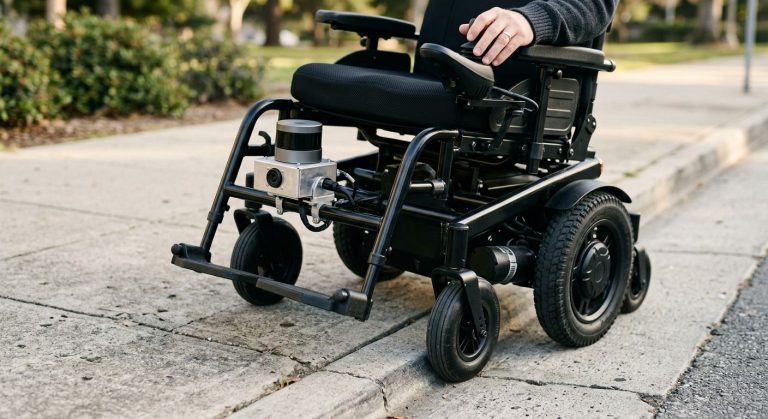
Table of Contents Understanding Collision Avoidance Systems for Power Wheelchairs Comparing Collision Avoidance Technologies for Wheelchairs Understanding Sensor Technology Differences How to…
Read More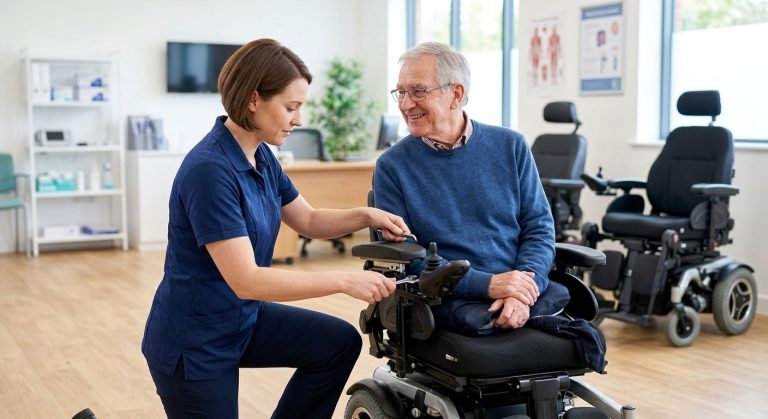
Table of Contents Front-Wheel Drive Power Wheelchairs: Built for Real-World Mobility Opening Hook & Article Preview Superior Curb Climbing Opening Explanation Example/Tip…
Read More