ADA Accessible Medical Equipment Deadlines 2026: Complete Compliance Guide
Table of Contents The 2026 ADA Accessible Medical Equipment Compliance Landscape Understanding the ADA's 2026 Medical Equipment Accessibility Mandate The DOJ and…
Read More
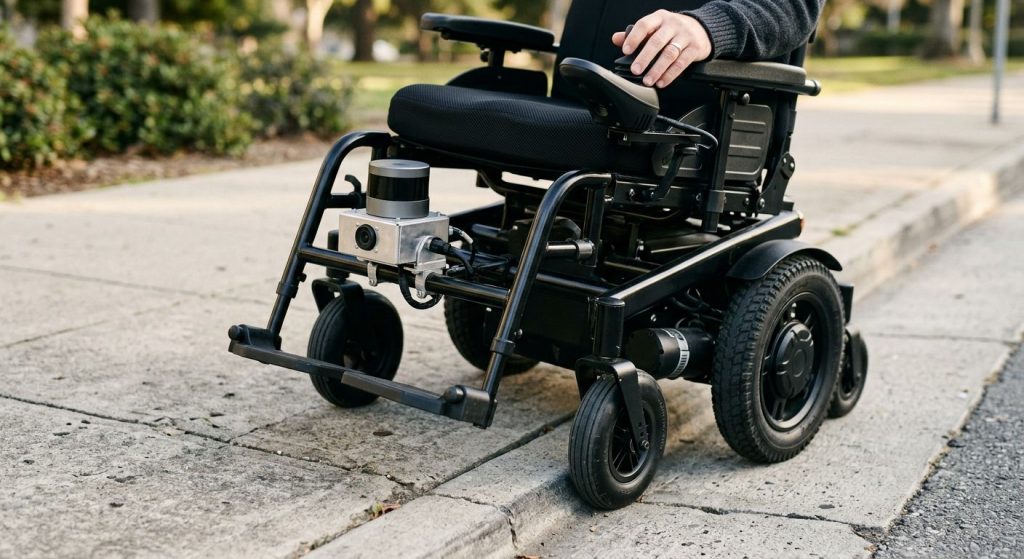
At MedEquipped, we integrate collision avoidance systems into our custom motorized wheelchairs as a vital smart wheelchair technology. Using sensors, these systems detect obstacles and provide alerts or automatic braking, helping users navigate tight spaces and curbs with greater independence. This smart sensing capability reduces the risk of collisions and supports confident mobility in daily life.
Our front-wheel drive power wheelchairs demonstrate this advantage as explained in our front-wheel drive FAQ: they are engineered to climb curbs smoothly, aided by collision avoidance systems. These alternative driving interfaces and obstacle detection technologies allow users to move with greater confidence. Results may vary; consult your healthcare professional for medical necessity.
When it comes to collision avoidance systems for motorized wheelchairs, ultrasonic sensors offer a retrofit solution. They detect obstacles with high-frequency sound waves.
Features include detection up to 2 meters, sensitivity adjustments, and integration with smart wheelchair technology. It works with most joystick controls and folding or rigid frames, with weather resistance (IP65).
Kits cost $200–$600. Medicare coverage for aging and disability services; verify. We do not guarantee coverage.
| Product | Sensor Type | Price Range | Best For |
|---|---|---|---|
| Ultrasonic Collision Avoidance System | Ultrasonic | $200–$600 | Affordable aftermarket add‑on |
| Lidar‑Powered Smart Wheelchair Sensor | Lidar | $1,000–$3,000 | High‑end custom chairs, indoor/outdoor |
| 360‑Degree Infrared Collision Shield | Infrared | $500–$1,200 | Crowded indoor environments |
| Radar‑Based Proximity Warning System | Radar | $800–$2,000 | Outdoor high‑speed travel |
| Camera Vision Obstacle Detection Module | Depth‑sensing camera | $600–$1,500 | Retrofit with caregiver monitoring |
| Bumper‑Activated Emergency Stop Sensor | Mechanical contact | $50–$200 | Last‑resort safety backup |
| Acoustic Sonar Safety Package | Sonar | $300–$800 | Wet or rainy environments |
| Multi‑Sensor Fusion Collision Protector | Hybrid (ultrasonic, lidar, camera) | $2,000–$5,000 | Premium custom wheelchairs |
| Bluetooth‑Enabled Collision Alert System | Bluetooth sensors + app | $150–$400 | Caregiver remote monitoring |
| AI‑Enhanced Predictive Avoidance Controller | AI + multiple sensors | $3,000–$6,000 | Tech‑savvy users, advanced mobility needs |
Results may vary.
Best for users wanting a cost-effective retrofit solution for their existing chair.
Lidar, or Light Detection and Ranging, uses pulsed laser beams to build a high-resolution 3-D map of the environment. This sensor delivers centimeter-level accuracy that forms the backbone of advanced collision avoidance systems, even in complete darkness.
· High angular resolution (down to 0.1°) for precise obstacle detection · Night-vision capability – needs no ambient light · Compatible with smart wheelchair technology via CAN bus or USB · Adjustable field of view from 90° to 360° These capabilities feed real-time data into collision avoidance systems, enhancing safety.
As a premium lidar solution, this sensor typically ranges from $1,000 to $3,000. We assist with funding sources and paperwork, but coverage is not guaranteed—verify with your supplier.
Pros: Extremely accurate detection in all light conditions; identifies objects as small as 2 cm at 20 m. Cons: Higher cost and installation may require professional fitting, which we provide through our personalized fittings service.
Ideal for high-end custom motorized wheelchairs where active users need Greater Independence indoors and outdoors. Our Quick turnaround on custom builds ensures your lidar-equipped chair is ready within 30–60 days, and the system works with alternative driving interfaces for tailored control.
As part of our commitment to offering premium products, we integrate advanced safety features like the 360-degree infrared collision shield. Building on our suite of safety enhancements, this system offers a comprehensive approach to obstacle detection. It operates as a state-of-the-art collision avoidance system, utilizing a ring of infrared sensors that encircle the wheelchair base to provide full 360-degree coverage without blind spots. This design greatly reduces collision risk, especially in dynamic environments.
The shield functions through multiple sensors positioned around the wheelchair’s perimeter, constantly scanning for obstacles. This 360-degree detection capability ensures that objects approaching from any direction trigger a response, enhancing safety in all orientations. It is a crucial component for users who require reliable perimeter awareness during daily navigation.
The 360-degree infrared collision shield is typically available as an optional upgrade on our premium Custom Motorized Wheelchairs. The pricing generally falls within an approximate range of $500 to $1,200. The final cost can vary based on the selected wheelchair model and the specific integration requirements. We’re here to help you determine the best configuration for your needs; we recommend consulting with our team for a detailed quote.
This collision shield is best suited for users who navigate crowded indoor settings regularly, such as hospitals, shopping malls, rehabilitation centers, and airports. It provides an added layer of security that can support greater independence in complex spaces. Beyond the infrared shield, integrating additional sensor technologies can offer layered protection for diverse mobility needs.
Radar-based collision avoidance systems, beyond ultrasonic, detect objects up to 10 meters via radio waves, measuring velocity.
We find that smart wheelchair technology leveraging radar offers long-range detection, outdoor reliability, resistance to temperature and light changes, and velocity-based alarms that very significantly enhance safety.
Premium products radar systems cost roughly $800–$2,000, depending on configuration.
Radar-based proximity systems offer pros: reliable outdoor performance and long detection range. Cons: higher purchase cost and heavier weight compared to other sensor types, in our experience.
Active users at higher speeds outdoors gain greater independence; next we compare alternative driving interfaces.
Camera vision obstacle detection modules can be added to existing motorized wheelchairs as an aftermarket retrofit, making them a practical choice for users seeking enhanced safety features. These systems use depth-sensing cameras — such as stereo or structured light configurations — to identify obstacles in real time, effectively bringing the benefits of collision avoidance systems to your current chair. Object classification helps distinguish between a person and a wall, reducing false alarms and improving everyday reliability.
The module performs continuous real-time video analysis, classifying objects as people, walls, or furniture so the chair can respond appropriately. Distance alerts are customizable — available as audible tones, visual indicators on a display, or haptic feedback through the seat — and many units offer video recording for safety monitoring. Caregivers can review recorded footage to better understand daily challenges, and the system exemplifies smart wheelchair technology by combining environmental perception with safety-focused feedback. Because the cameras rely on depth mapping, results may vary based on lighting and environmental conditions.
A camera vision module typically costs between $600 and $1,500, with the price reflecting camera quality and the sophistication of the embedded software. While this represents an investment, it adds a layer of intelligent safety that can provide significant peace of mind for both users and family members.
While the visual data stream offers unique insights, proper installation and periodic recalibration are essential for consistent operation. We recommend having a technician perform the first setup to ensure accurate object detection.
This module is best for users who want a safety system that doubles as a monitoring tool for family members, supporting Greater Independence while keeping loved ones informed. It also works well alongside alternative driving interfaces — such as sip-and-puff or head arrays — that can be integrated into our Custom Motorized Wheelchairs for a fully adaptive mobility solution.
Results may vary based on environment and installation.
Unlike proximity sensors, this sensor integrates into collision avoidance systems and uses a tactile bumper strip to cut motor power.
Pricing ranges from $50 to $200; often integrated.
Best as a last-resort backup for any power wheelchair, integrated into collision avoidance systems for greater independence.
This sonar-based collision avoidance system emits sound waves and measures reflections, similar to marine sonar, working reliably in wet indoor and outdoor environments.
Key features include a waterproof IPX7 sensor housing, a 120° detection cone, adjustable sensitivity, and compatibility with power wheelchair controllers like PG Drives and Dynamic. This smart wheelchair technology integrates seamlessly.
Pricing is $300–$800, depending on the number of sonar units (usually one to three sensors).
Pros: reliable wet-weather detection; rugged durability. Cons: soft, sound-absorbing surfaces (curtains, foam padding) can cause false readings; slower update rate at ~5 Hz versus lidar’s 10–20 Hz.
Best for users in rainy climates or near water, particularly those using alternative driving interfaces in rainy regions.
For reliable wet-condition detection, this acoustic sonar option is a smart addition to your custom motorized wheelchair.
Building on simpler protective guards, we elevate safety to an entirely new level by merging data from multiple sensor types into a single, intelligent safety barrier. This fusion-based architecture creates 360-degree awareness that responds to both stationary obstacles and unpredictable movement, greatly reducing the chance of collisions in daily environments. The Multi-Sensor Fusion Collision Protector represents a premium tier of collision avoidance systems in custom motorized wheelchairs and is engineered exclusively for our custom builds.
At its core, this system combines three complementary sensing modalities: ultrasonic sensors for close-range, low-speed detection; lidar for mid-range spatial mapping and navigation feedback; and high-resolution cameras for visual scene understanding. Ultrasonic pings continuously monitor the immediate perimeter, catching objects within inches of the chair. Lidar pulses build a real-time 3D map of the surroundings, enabling the system to anticipate upcoming obstacles. The cameras then feed visual data into the AI engine, which classifies what it sees—distinguishing a doorway from a person or a piece of furniture from a moving pet. Together, these sensors create overlapping fields of view that eliminate blind spots and deliver context-aware awareness far beyond what any single sensor could achieve on its own.
The system’s sensor fusion logic processes inputs simultaneously, weighting each sensor’s confidence based on lighting, distance, and object dynamics. Redundant coverage ensures that if one sensor channel becomes temporarily occluded, the remaining sensors maintain a complete safety envelope—so protection never depends on a single point of failure. This architecture works seamlessly with a wide range of driving methods, integrating with joysticks, as well as alternative driving interfaces such as sip-and-puff tubes, head arrays, and chin controls. Patients retain consistent collision prevention regardless of which input device they operate.
The onboard AI augments obstacle classification in ways that directly improve reaction accuracy. By employing deep-learning models, the system distinguishes static elements (walls, chairs, door frames) from dynamic ones (people, service animals, rolling IV poles), suppressing false alarms that could otherwise disrupt navigation. This AI-driven interpretation represents a generational leap forward in smart wheelchair technology, enabling the chair to make nuanced safety decisions rather than simply halt at every detected object. The fusion engine processes these decisions in milliseconds, gently decelerating or redirecting the chair as needed while minimizing jarring stops.
Integration extends to our entire custom wheelchair platform. Because the sensors are embedded during the assembly phase, the system’s weight distribution and wiring are optimized for each individual chair’s dimensions. The result is a cohesive unit that feels natural to operate and maintains the chair’s intended maneuverability.
This advanced safety system is offered as an engineered, factory-integrated option on our custom motorized wheelchairs, not as a standalone retrofit. The price range typically falls between $2,000 and $5,000, reflecting the hardware, calibration, and proprietary software that go into each installation. Final cost depends on the specific chair model, the number of sensor nodes, and any additional integration work required during the personalized fitting process.
This protector is the ideal choice for patients who require the highest possible level of situational awareness—those with limited field of vision, cognitive conditions that affect spatial judgment, or lifestyles that demand frequent navigation of crowded or unpredictable spaces. It is especially valuable for individuals who operate their chair using non-traditional inputs, as the safety net remains fully active regardless of the chosen control method. The investment fits best for users who prioritize uncompromising protection and have the budget for a premium, custom-integrated solution. This fusion system represents the apex of our safety offerings, seamlessly complementing the overarching configuration of the wheelchair to support greater independence.
Results may vary. Consult your treating healthcare professional for medical necessity.
In contrast to integrated collision sensors, Bluetooth-enabled alert systems provide an affordable aftermarket option that enhances safety without major modifications. For users who prefer a budget-friendly, easy-to-install solution, our Bluetooth alert system fills the gap.
This Bluetooth-enabled system is one of the most accessible collision avoidance systems available today. It uses small, lightweight sensors that mount to the wheelchair frame and connect via Bluetooth to a paired smartphone or caregiver device. Because the sensors rely on standard Bluetooth Low Energy, they can run for months on a single coin-cell battery, and the setup requires no complex wiring—making it a simple addition to most motorized wheelchairs.
Our system integrates seamlessly with smart wheelchair technology to deliver practical, real-time awareness. Key features include:
The app is available for both iOS and Android, ensuring broad accessibility.
The upfront cost for the Bluetooth collision alert system ranges from $150 to $400, depending on the sensor package and whether you choose the basic or enhanced kit. Advanced app features, such as detailed analytics and multi-user caregiver access, may require an optional subscription. We keep the pricing consumer-friendly to make this technology available to more families.
Our system offers distinct advantages, but like any wireless technology, it has limitations.
Pros
Cons
Results may vary based on environmental factors. This system is an alert tool and does not replace careful driving.
This system is ideal for caregivers who want remote monitoring capabilities and for users who are comfortable using smartphone apps. It perfectly suits individuals who already use alternative driving interfaces and desire an additional safety layer without heavy modification to their chair.
After reviewing the features and cost, let’s explore how this system compares to other collision avoidance technologies. Understanding these trade-offs will help you decide which safety system best matches your lifestyle and budget.
For users who need the most advanced protection available, the AI-Enhanced Predictive Avoidance Controller represents the next step in proactive safety.
The AI-Enhanced Predictive Avoidance Controller represents an advanced tier of collision avoidance systems that uses machine learning to model your movement patterns and fuse data from onboard sensors to anticipate hazards.
Pricing ranges from $3,000 to $6,000 as a premium add-on for next-generation power wheelchair packages; exact cost varies by configuration and is available through authorized dealers like MedEquipped.
Pros
Cons
Ideal for tech-savvy users with complex mobility needs in crowded campuses or tight indoor spaces who prioritize maximal collision prevention. For those requiring specialized control, alternative driving interfaces can also be integrated. Because this controller is only available in select next-generation packages, working with a specialist provider like MedEquipped ensures you get a system that matches both your mobility needs and budget. Results may vary. We’re here to help you achieve greater independence with custom motorized wheelchairs and advanced safety technology.
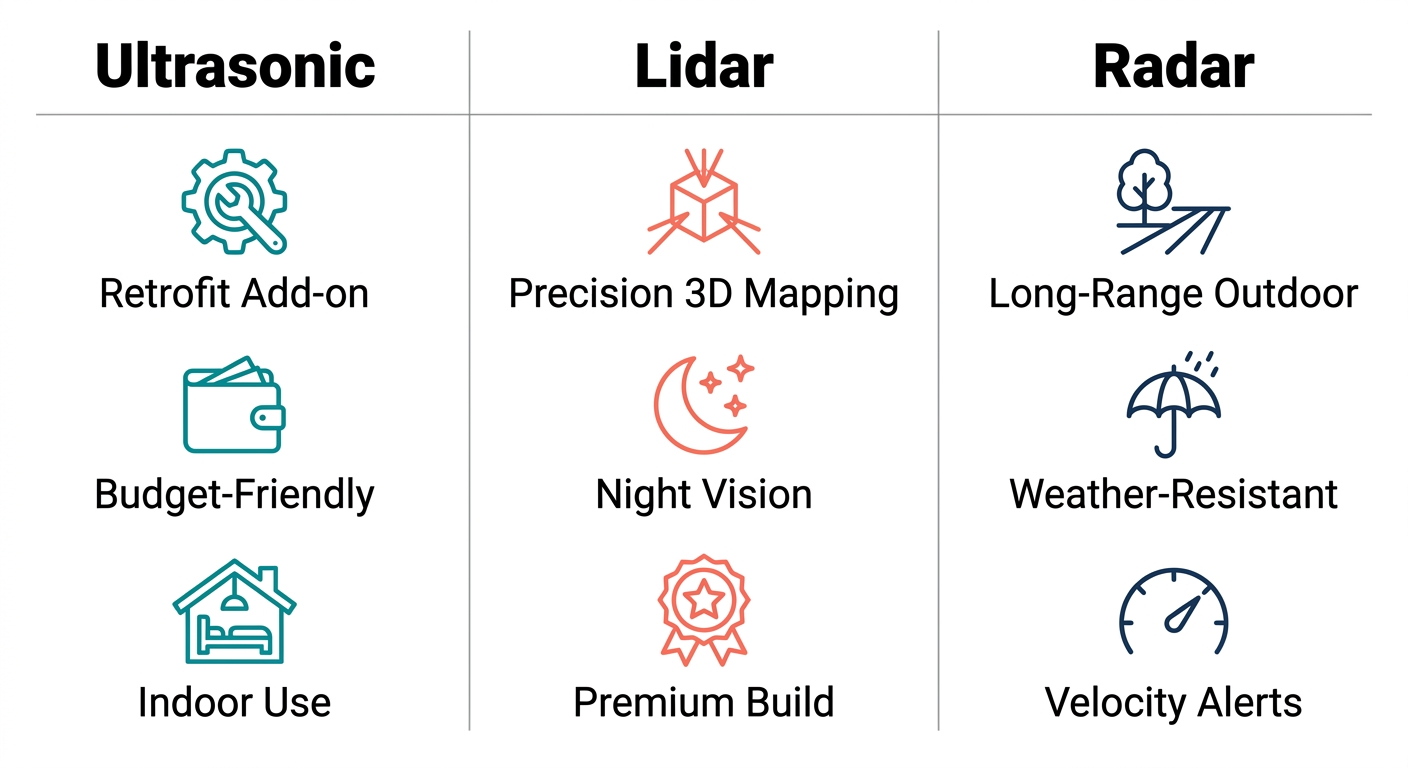
Infographic comparing Ultrasonic, Lidar, and Radar collision avoidance technologies for wheelchairs.
Now that we understand obstacle detection, let’s compare collision avoidance systems for wheelchairs—smart wheelchair technology. Each balances cost against accuracy and environment suitability.
| Product | Sensor Type | Price Range | Best For |
|---|---|---|---|
| Ultrasonic Collision Avoidance System | Ultrasonic | $200–$600 | Affordable aftermarket add-on |
| Lidar-Powered Smart Wheelchair Sensor | Lidar | $1,000–$3,000 | High-end custom chairs, indoor/outdoor |
| 360-Degree Infrared Collision Shield | Infrared | $500–$1,200 | Crowded indoor environments |
| Radar-Based Proximity Warning System | Radar | $800–$2,000 | Outdoor high-speed travel |
| Camera Vision Obstacle Detection Module | Depth-sensing camera | $600–$1,500 | Retrofit with caregiver monitoring |
| Bumper-Activated Emergency Stop Sensor | Mechanical contact | $50–$200 | Last-resort safety backup |
| Acoustic Sonar Safety Package | Sonar | $300–$800 | Wet or rainy environments |
| Multi-Sensor Fusion Collision Protector | Hybrid (ultrasonic, lidar, camera) | $2,000–$5,000 | Premium custom wheelchairs |
| Bluetooth-Enabled Collision Alert System | Bluetooth sensors + app | $150–$400 | Caregiver remote monitoring |
| AI-Enhanced Predictive Avoidance Controller | AI + multiple sensors | $3,000–$6,000 | Tech-savvy users, advanced mobility needs |
Once you’ve identified the right sensor type, our team integrates it into your custom motorized wheelchair, ensuring the system meets your needs. We verify Medicare coverage.
Ultrasonic sensors ($200–$600) offer affordability but can struggle outdoors. Lidar ($1,000–$3,000) provides high-precision 3D mapping that significantly reduces collision risk indoors and out.
MedEquipped evaluates your needs to recommend and integrate the best collision avoidance system. Alternative driving interfaces pair with it for greater independence. We verify insurance coverage and we’re here to help.
MedEquipped’s custom motorized wheelchairs integrate collision avoidance systems as a standard safety feature, as our front-wheel drive guide details. These sensors reduce accident risk for users with limited vision, slower reaction times, or cognitive impairments. Paired with alternative driving interfaces, the system enhances independence and safety.
Smart wheelchair technology, including collision avoidance, delivers greater independence, enhanced safety, and caregiver confidence. It lowers the chance of collisions with walls and furniture, giving users and caregivers peace of mind.
Contact MedEquipped for guidance on collision-avoidance options and funding. We help you access aging and disability services and manage Medicare paperwork for a quick turnaround. Verify coverage; results may vary. Consult your healthcare professional.
Table of Contents The 2026 ADA Accessible Medical Equipment Compliance Landscape Understanding the ADA's 2026 Medical Equipment Accessibility Mandate The DOJ and…
Read More
Table of Contents Front-Wheel Drive Power Wheelchairs: Built for Real-World Mobility Opening Hook & Article Preview Superior Curb Climbing Opening Explanation Example/Tip…
Read More
Table of Contents Jazzy Power Wheelchairs: Personalized Mobility from Spring Valley MedEquipped Custom Jazzy Power Wheelchairs in New York Jazzy Elite HD…
Read More