
Medicare Power Wheelchair Eligibility 2026: Complete Guide
Table of Contents Understanding Medicare Power Wheelchair Coverage in 2026 2026 Medicare Power Wheelchair Eligibility Rules at a Glance The Face-to-Face Mobility…
Read More
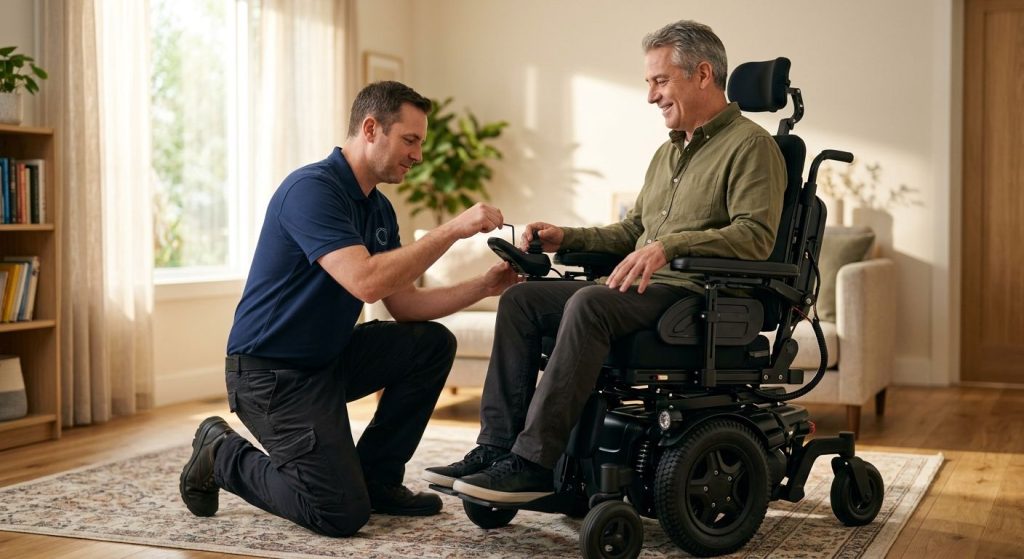
Now that you understand the basics of power wheelchairs, let’s explore how to choose the right heavy duty power wheelchair bases. A heavy duty power wheelchair base is a reinforced frame built to support higher weight capacities, typically ranging from 300 to over 600 pounds. This robust construction ensures stability and durability for individuals with complex mobility needs.
The most important specification is bariatric power wheelchair weight capacity, which determines how much weight the chair can safely accommodate. Selecting a base that matches your weight ensures reliable performance and longevity, so you can move through daily life with confidence.
Another key consideration is the drive type. A mid-wheel drive bariatric base offers exceptional maneuverability and a tight turning radius, making it ideal for navigating indoor spaces while still providing a stable platform for heavier users. This design balances agility with the strength needed for daily use.
At MedEquipped, we specialize in custom motorized wheelchairs, and we’re proud to be your partner in mobility freedom. We’ll help you select the perfect base configuration from trusted brands, with certified ATP evaluations available in New York, Georgia, and Michigan.
Once you’ve considered these factors, our team can help design a chair that fits you perfectly—read on to learn how we manage the entire process. For a free consultation, reach out to us today, and let our experts guide you toward the right solution. As a leading motorized wheelchair provider, we’re here to support your journey every step of the way. (Remember, results may vary; always consult a healthcare professional for personalized recommendations.)
Now that we’ve covered the basics of power wheelchairs, let’s focus on the heavy duty power wheelchair bases that support higher weight capacities. When we talk about heavy duty in the mobility world, we’re typically referring to power bases engineered to accommodate users weighing 400 pounds or more. The right weight capacity rating is critical—it must account for the user’s body weight plus the chair’s own structural weight, ensuring safe, reliable performance every day. Choosing a base rated too close to your actual weight can strain motors, shorten battery life, and compromise stability over uneven terrain.
Understanding bariatric power wheelchair weight capacity goes beyond just looking at a single number on a spec sheet. The measurement represents the maximum combined load the base can safely carry, including the seating system, batteries, and any accessories you might add. A chair rated at 450 or 500 pounds provides a generous safety margin that translates into durability and peace of mind. Manufacturers determine these limits through rigorous testing, and the standards we reference come from respected industry bodies including the Rehabilitation Engineering & Assistive Technology Society of North America (RESNA).
Drive type dramatically affects how a heavy duty chair handles indoors and outdoors. A mid-wheel drive bariatric base positions the drive wheels directly beneath the user’s center of gravity, which naturally produces a tighter turning radius—often 24 to 26 inches. This means navigating doorways, bathrooms, and crowded spaces becomes far more manageable. Front-wheel drive designs, by contrast, pull the chair rather than push it, offering superior outdoor stability when climbing curbs or traversing soft ground, but they typically require more room to pivot, with turning radii extending to 31 inches or more. For bariatric users who split time between home and community, the trade-off matters: mid-wheel configurations provide the agility needed indoors without sacrificing the power to handle outdoor conditions.
The table below compares three heavy duty power bases we frequently configure for clients across New York, Georgia, and Michigan. Each model brings distinct strengths to the conversation.
| Model | Max Weight Capacity | Drive Type | Turning Radius |
|---|---|---|---|
| QUICKIE Q700-ULTRA | 450 lbs | Mid-Wheel Drive | 24.5 in |
| ROVI X3 | 400 lbs | Front-Wheel Drive | 31 in |
| TDX SP2 HD | 500 lbs | Mid-Wheel Drive | 26 in |
The TDX SP2 HD stands out with the highest capacity at 500 pounds and a mid-wheel configuration that keeps the turning radius to a still-compact 26 inches. The QUICKIE Q700-ULTRA achieves the tightest turning circle at 24.5 inches, making it an excellent choice for users who prioritize indoor maneuverability. The ROVI X3, with its front-wheel drive and 31-inch turning radius, leans toward outdoor stability and straight-line tracking. These weight capacities come from MedEquipped’s own product specification data, while the turning radius measurements are based on RESNA industry standards.
Once you’ve identified the right base weight capacity, our clinical team will help match you with a custom chair during your evaluation. As your safety equipment supplier near me, MedEquipped carries the heavy duty bases reviewed above and will help you select the perfect fit. We handle the paperwork, insurance navigation, and coordination so that your power chair arrives configured to your exact clinical needs, typically within 30 to 60 days.
Weight capacities and dimensions are manufacturer specifications; individual needs should be evaluated by a qualified clinician. Results may vary.
Now that you understand the importance of a custom fit, let’s explore the engineering behind the chair. When evaluating heavy duty power wheelchair bases, two factors rise above the rest: how much weight the chair can support safely and the drive system that moves it. At MedEquipped, our certified ATP evaluators use these criteria daily to match patients across New York, Georgia, and Michigan with the perfect base for their lives. A deep understanding of these technical details ensures your next power wheelchair isn’t just capable but truly comfortable and reliable.
A bariatric power wheelchair weight capacity is not a single number printed on a brochure; it is the result of careful engineering. The frame’s construction is the cornerstone. Heavy duty power wheelchair bases use reinforced steel or aircraft-grade aluminum, which prevents dangerous frame flexing and motor strain under higher loads. From there, the axle configuration plays a critical role. Wider, reinforced axles distribute weight more evenly, creating a stable footprint that resists tipping. Tire ratings also matter, as the rubber must withstand constant pressure without deforming. These elements are not tested arbitrarily. Weight capacity and overall safety are validated by rigorous industry standards, such as those set by the leading assistive technology professional organization, which defines the testing protocols that manufacturers must meet to certify their chairs.
The drive system determines where your chair can go and how it feels to get there. Each configuration offers distinct advantages for bariatric users, balancing maneuverability against terrain handling. A mid-wheel drive bariatric base features a center drive wheel, enabling it to spin in place with a very tight turning radius. This makes it the ideal choice for navigating the tight corners of a home or office. In contrast, a front-wheel drive system pulls the chair over obstacles, making it a champion on uneven outdoor terrain, though it requires a wider area to turn. Rear-wheel drive sits between them, offering great traction for climbing inclines while still handling well indoors. As we help you decide, our team can demonstrate how each system feels at our clinic.
The table below summarizes how each drive type performs in key bariatric scenarios.
| Drive Type | Turning Radius | Indoor Stability | Outdoor Terrain |
|---|---|---|---|
| Mid-Wheel Drive | 23–26 in (very tight) | Excellent – point turns in narrow spaces | Good – can handle grass and light gravel |
| Front-Wheel Drive | 30–35 in (wider) | Very good – straight-line tracking is strong | Excellent – handles curbs and uneven ground well |
| Rear-Wheel Drive | 24–28 in (moderate) | Good – less maneuverable in tight spaces | Very good – good traction on inclines |
Selecting the right drive type is a personal decision that weighs your indoor space against your outdoor ambitions. A front-wheel drive base might be the right path if your day involves unpaved paths and curbs, while a mid-wheel drive simplifies life in a more compact living space. Understanding these differences helps us guide you with confidence, but the final choice often comes down to feeling the chair in motion during a clinical evaluation.
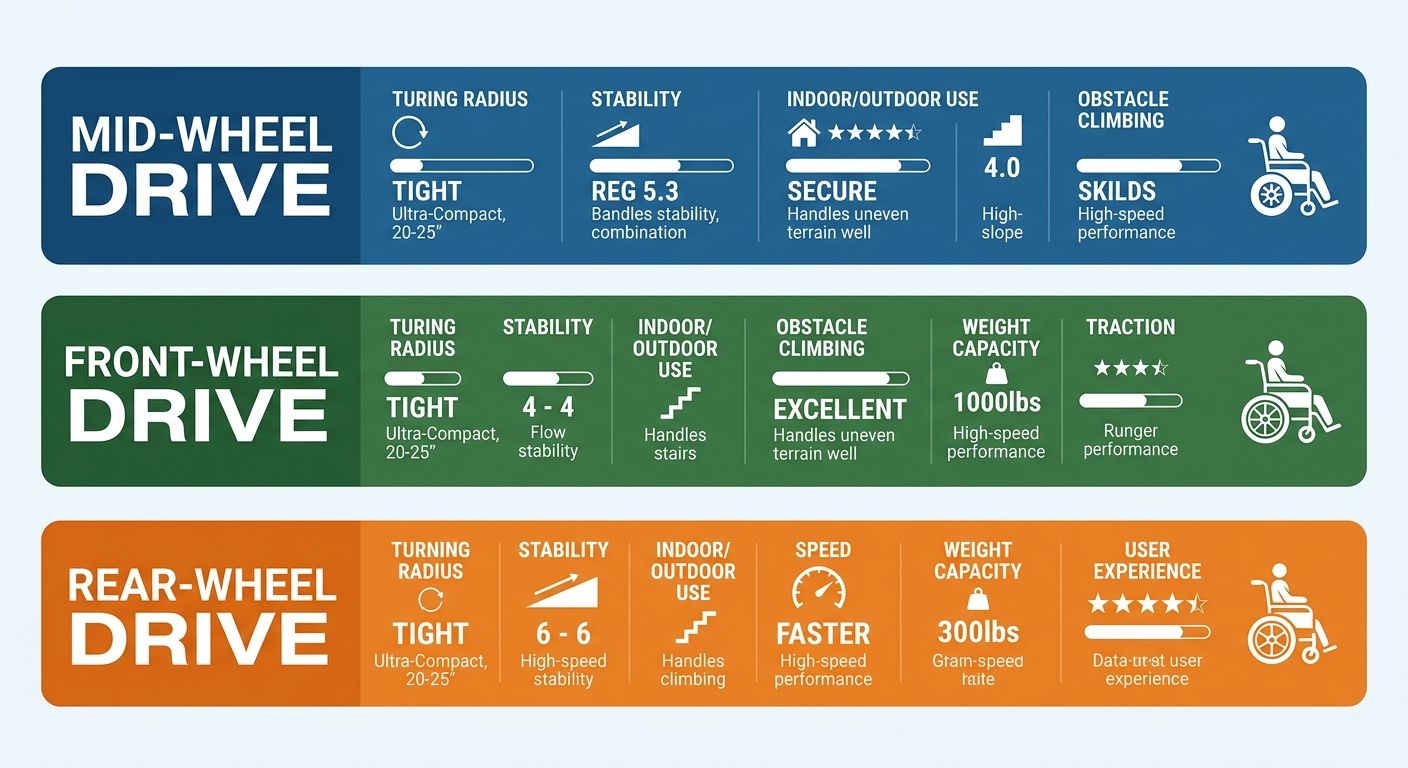
Drive system comparison across mid-wheel front-wheel and rear-wheel types.
Once you’ve considered capacity and drive, it’s time to look at the specific models we trust. The TDX SP2 HD is a cornerstone in the heavy-duty category, and our MedEquipped FAQ highlights its suitability for bariatric users who need a stable mid-wheel drive platform. Its design prioritizes strength and a smooth, controlled ride that protects both the user and the chair’s components. Another excellent option is the QUICKIE series, which offers thoughtful engineering and versatile configurations that perform reliably for a wide range of users. For those who prioritize extreme indoor maneuverability, the ROVI X3 provides a remarkably tight turning radius. We pair this model with professional rehab seating systems to create a truly custom solution. Each of these heavy duty power wheelchair bases brings something unique to the table, and our role is to translate those features into real-world benefits for your daily routine. With these evaluation criteria in mind, you’re ready to explore how our team handles the entire process, from your first fitting to final delivery.
At MedEquipped, choosing from the available heavy duty power wheelchair bases is a critical step, but we make the entire process simple and supportive. Our end-to-end service in New York, in Georgia, and in Michigan delivers a custom motorized wheelchair perfectly tailored to your needs. Here’s how your journey unfolds.
Your journey starts with a home visit from a certified Assistive Technology Professional (ATP) who reviews your medical history, daily routines, and mobility goals. Using precise measurement tools, they capture seating dimensions and postural support needs. Next, they evaluate your control preferences—joystick sensitivity, switch access, or specialty inputs. For bariatric users, the ATP assesses bariatric power wheelchair weight capacity up to 500 lbs to ensure safe support. They also consider your environment: tight indoor spaces may be best served by a mid-wheel drive bariatric base with a compact turning radius, while outdoor terrain calls for front-wheel stability. After the assessment, the ATP recommends a custom heavy duty power base—such as the QUICKIE Q700-ULTRA, TDX SP2 HD, or ROVI X3—matched precisely to your needs, ensuring both comfort and independence.
Based on your evaluation profile, your ATP will recommend a heavy duty power base that suits your daily life. For quick reference, here’s a selection guide matching common profiles to our leading heavy duty power wheelchair bases:
| User Profile | Recommended Base | Key Features |
|---|---|---|
| Bariatric 300–400 lbs, indoor use | QUICKIE Q700-ULTRA | 450 lb capacity, mid-wheel drive, 24.5 in turning radius, adjustable seating |
| Bariatric 400–500 lbs, indoor/outdoor mix | TDX SP2 HD | 500 lb capacity, mid-wheel drive, 26 in turning radius, HD frame |
| Bariatric 300–400 lbs, frequent outdoor use | ROVI X3 | 400 lb capacity, front-wheel drive, 31 in turning radius, excellent terrain handling |
Once your ATP pinpoints the right model, our team begins the insurance navigation to secure coverage.
After your evaluation, our funding specialists manage prior authorization by submitting your clinical records, ATP recommendation, and physician-signed medical necessity letter. We handle all required documentation, including common billing codes like E1161 (heavy duty power wheelchair) and K0108 (specialized seating). According to MedEquipped’s internal insurance FAQ, we also coordinate with secondary payers to reduce your out-of-pocket costs. While our core service is custom motorized wheelchairs, we apply cost transparency to all mobility equipment—for example, you can explore clear information on stair lift cost to understand funding details. Each wheelchair is custom-quoted, and we work to maximize your insurance benefits. As your partner in mobility freedom, we handle the paperwork, insurance navigation, and coordination from start to finish, serving you in New York, in Georgia, and in Michigan.
Once funding is approved, we order your fully customized power wheelchair from the manufacturer. Every component—frame, seating, controls—is built to your exact specifications. After assembly and quality checks, we schedule in-home delivery and fitting. A certified technician sets up your chair, adjusts positioning, and provides hands-on training for you and your caregivers. The entire process typically takes just 30–60 days (faster processing)—as detailed in our custom order FAQ. We stay with you post-delivery for adjustments, maintenance, and ongoing clinical support. MedEquipped remains your partner in mobility freedom far beyond delivery. Please note: This information is not medical advice and is for informational purposes only. Results may vary; individual outcomes are not guaranteed. Consult a healthcare professional before making clinical decisions. We do not sell personal information (see Privacy Policy). Message and data rates may apply; reply STOP to unsubscribe for SMS communications. In our next guide, we’ll cover wheelchair maintenance and warranty to protect your investment.
Now that we’ve reviewed the key models, let’s examine advanced factors that impact daily use. When considering heavy duty power wheelchair bases, terrain adaptability and battery life determine how freely you move through your day. While all recommended bases support substantial bariatric power wheelchair weight capacity, each handles outdoor surfaces differently. A mid-wheel drive bariatric base offers tight indoor maneuverability, though its slope characteristics differ from rear-wheel configurations.
The following table compares battery range and terrain performance across three recommended heavy duty bases, drawn from manufacturer specifications and our ATPs’ field testing.
| Model | Estimated Battery Range | Max Incline Rating |
|---|---|---|
| QUICKIE Q700-ULTRA | 14–17 miles | 8° |
| TDX SP2 HD | 12–15 miles | 9° |
| ROVI X3 | 10–13 miles | 10° |
Actual range varies with user weight, speed, terrain, and battery condition. The QUICKIE Q700-ULTRA leads in range at 14 to 17 miles, making it a strong pick for all-day use on flatter ground. The ROVI X3 stands out with a 10° slope rating, the highest available, making it the best choice for steep hills and uneven terrain. The TDX SP2 HD balances dependable outdoor capability with solid range for mixed-use lifestyles. We recommend matching your primary environment, whether urban streets in New York, rural routes in Georgia, or hilly neighborhoods in Michigan, to the base best suited for those conditions.
Long-term support matters just as much as initial performance. Our team provides ongoing adjustments, repairs, and parts coordination long after delivery. For industry standards and advocacy, the Assistive Technology Industry Association offers valuable resources. We handle the paperwork, insurance navigation, and coordination so you can focus on what matters. Our processing runs 30-60 days (faster processing), and we work with your insurance to maximize coverage. Results may vary; individual outcomes are not guaranteed.
Understanding these considerations ensures you choose a base that fits your lifestyle. Our team helps you navigate every option. Reach out for personalized guidance and a custom quote. We are your partner in mobility freedom, designing custom motorized wheelchairs that match your clinical needs and daily environment.
What is the weight capacity of a heavy duty power base? The standard bariatric power wheelchair weight capacity typically ranges from 400 to 600 pounds, allowing us to accommodate a wide variety of needs. Our reinforced frames use heavy-gauge steel to prevent fatigue and ensure lasting durability, so you get a reliable mobility partner.
What is the difference between a mid-wheel drive bariatric base and a rear-wheel drive model? A mid-wheel drive bariatric base offers a tight turning radius, making it ideal for navigating indoor spaces, while rear-wheel drive provides superior stability and tracking at higher outdoor speeds. We assess your home environment and daily routine during a clinical evaluation to recommend the best drive configuration for your lifestyle.
Can I get a custom heavy duty wheelchair base? Yes, every heavy duty wheelchair base is a custom solution. We configure the seating, positioning supports, and controls to match your specific clinical requirements, often integrating professional seating brands to maximize comfort and pressure relief.
Will insurance cover my bariatric base? Medicare, Medicaid, and many private insurance plans may cover heavy duty power wheelchair bases when we document medical necessity properly. We handle the paperwork, insurance navigation, and coordination so you can focus on regaining your freedom, not the bureaucracy.
How much does a heavy duty power wheelchair base cost? We don’t publish standard pricing because every heavy duty power base is a custom-quote item. Once our certified ATP completes your evaluation, we provide a personalized quote that reflects the exact configuration, funding coverage, and any out-of-pocket responsibility.
What is the TDX SP2 HD heavy duty base? The TDX SP2 HD is a high-weight-capacity power base available through MedEquipped. It combines a reinforced frame with advanced mid-wheel drive and supports highly customized rehab seating, and we can typically deliver it within 30-60 days (faster processing) after final approval.
Still have questions about finding the right heavy duty power base for your needs? Contact our team in New York, Georgia, or Michigan, and we’ll guide you through a professional evaluation — often on a faster timeline than larger national suppliers.
The foundation of true mobility freedom is a custom power wheelchair base. We match heavy duty power wheelchair bases to your measurements, bariatric power wheelchair weight capacity, and drive needs like a mid-wheel drive bariatric base. This personalization ensures stability, comfort, and easy maneuverability.
We’re your partner in mobility freedom. Our clinical team guides every choice, and we handle the paperwork, insurance navigation, and coordination for families in New York, Georgia, and Michigan — making a perfect fit simple and stress-free.
Table of Contents Understanding Medicare Power Wheelchair Coverage in 2026 2026 Medicare Power Wheelchair Eligibility Rules at a Glance The Face-to-Face Mobility…
Read More
Table of Contents Understanding Medicare Power Wheelchair Coverage in 2026 Prerequisites for Your Medicare Power Wheelchair Application Confirm Your Medical Necessity for…
Read More
Table of Contents The Medicare Mobility Assistive Equipment Algorithm Explained Prerequisites for Medicare Motorized Wheelchair Coverage Assess Your Daily Mobility and Functional…
Read More