

Tag: Power Wheelchair Insurance Navigation

  • Which Is Better for Me, a Power Wheelchair or a Power Assist Wheelchair

    Which Is Better for Me, a Power Wheelchair or a Power Assist Wheelchair

    Table of Contents

    Choosing Between a Power Wheelchair and Power Assist Wheelchair

    Determining which is better for you—a power wheelchair or a power assist wheelchair—depends on your upper body strength, daily activities, and any progressive health conditions. Power assist wheelchairs use motorized pushrims that reduce stroke frequency and joint excursion, as power assist wheelchairs research shows, helping mitigate shoulder pain in manual chair users while allowing many to stay active longer. A full power wheelchair offers complete independence: no manual propulsion is required, making it essential when upper body strength is limited or a progressive condition affects mobility. We design custom motorized wheelchairs tailored to each patient’s diagnosis and functional requirements, ensuring safe, strain-free movement. Each option suits a different profile, so the first step is to identify your daily mobility needs.

    Key Takeaways

    • For individuals in Spring Valley, NY, deciding between a power wheelchair and a power assist wheelchair begins with a look at daily mobility needs.
    • Understanding these differences will help you identify the right device.
    • The best mobility solution for you depends on your daily environment, upper-body strength, and long-term comfort.
    • If you are wondering which is better for you, a power wheelchair or a power assist wheelchair, the answer begins with how easy it is to push a manual wheelchair.
    • While manual wheelchairs may involve simpler documentation, navigating the power wheelchair eligibility criteria in Spring Valley requires a more detailed process.

    1. Identify Your Daily Mobility Needs

    For individuals in Spring Valley, NY, deciding between a power wheelchair and a power assist wheelchair begins with a look at daily mobility needs. Thorough self-assessment of your strength, endurance, travel distances, and the environments you navigate will indicate which device best supports your independence.

    • Evaluate whether your condition is progressive. MedEquipped’s guidance highlights that custom motorized wheelchairs deliver superior long-term independence to individuals with progressive conditions or significant limitations.
    • Assess your upper-body strength and stamina. Manual wheelchairs and power assist systems typically suit short-distance travel only when you have adequate arm and shoulder function.
    • Prioritize seating and posture. Proper fitting prevents pressure injuries and safeguards postural health, so comfort and fit must be part of your evaluation.
    • Consider your everyday environments. Indoor surfaces like carpet and thresholds, as well as uneven sidewalks outdoors, affect the practicality of a manual or power assist approach.

    Once you have identified your daily needs, you can compare the features of power wheelchairs and power assist technology.

    2. Compare Power Wheelchair and Power Assist Technology

    We’re here to help.

    • Propulsion: Power wheelchairs use a joystick, while power assist devices reduce stroke frequency and joint excursion via proportional motor assistance.
    • Portability: Power assist units attach to a manual chair; power chairs are heavier.
    FeaturePower WheelchairPower Assist Device
    PropulsionFully motorized (joystick)Pushrim-activated proportional assistance
    Physical EffortMinimalReduced stroke frequency and joint excursion
    Best ForLimited upper-body strength, progressive conditionsSome pushing ability, reduce fatigue and injury
    Health ImpactEliminates strainMitigates shoulder pain
    PortabilityHeavierLighter, attaches to manual wheelchair
    Customization & FittingProper fitting needed for pressure injuries and postureSame
    Power Wheelchair vs. Power Assist Device: Key Feature Comparison

    Understanding these differences will help you identify the right device.

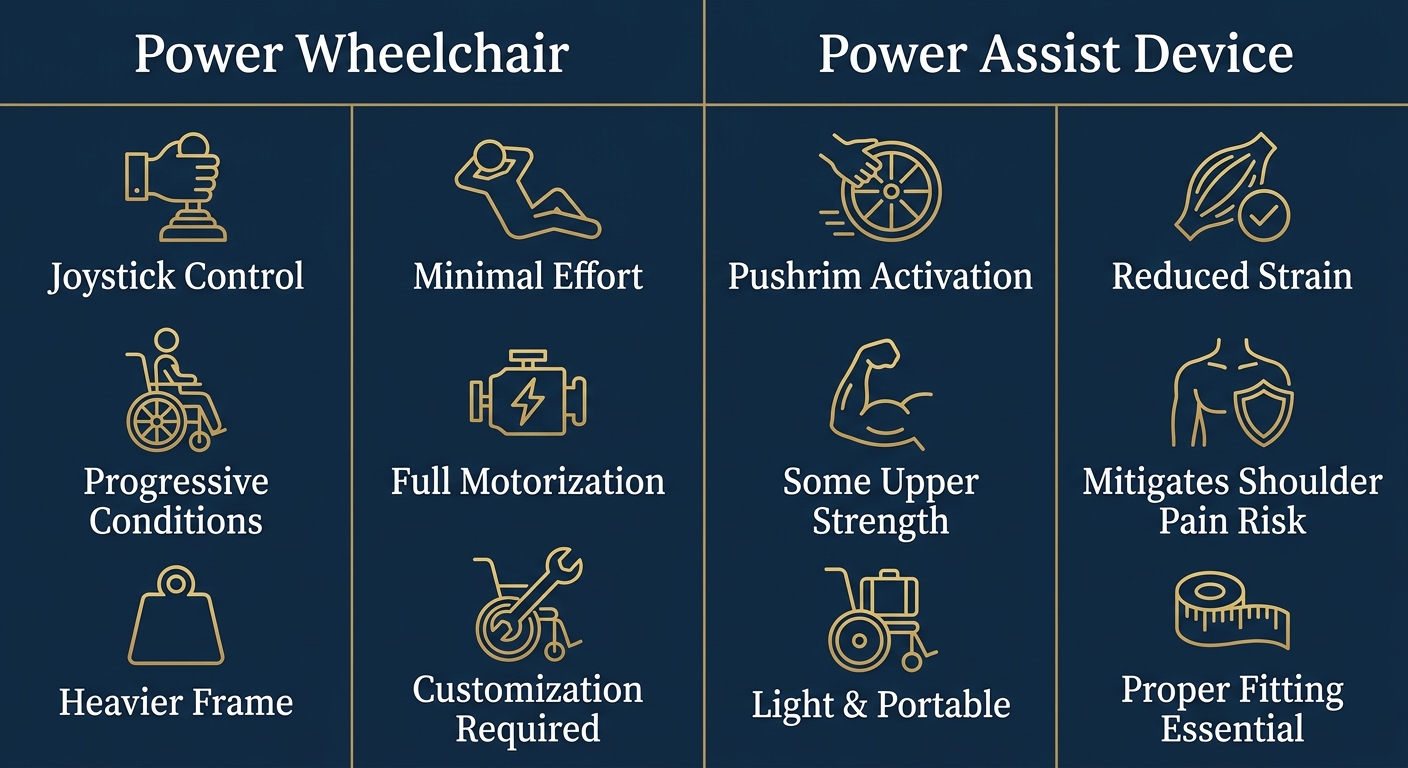
    Infographic comparing Power Wheelchair and Power Assist Device, each column has six icon and label pairs.
    Side-by-side comparison of power wheelchair and power assist device features.

    3. Find the Best Power Assist Device for You

    The best mobility solution for you depends on your daily environment, upper-body strength, and long-term comfort. A power assist device reduces effort by adding motorized torque to manual pushes, while a full power wheelchair handles all propulsion independently. We recommend starting with a self-assessment to determine which option aligns with your mobility goals.

    • Consider your daily terrain: full power chairs handle long distances and varied surfaces, while power assist devices suit moderate challenges.
    • Assess your upper-body strength and shoulder pain. Power assist technology reduces strain on the upper body, and research by RESNA found significant reductions in shoulder strain and helps protect against overuse injuries.
    • Evaluate comfort: full power chairs require no manual effort, whereas power assist systems let you stay engaged while minimizing fatigue.

    Understanding your needs helps you choose a wheelchair that fits your daily life. Schedule an evaluation and trial—a hands-on test reveals which device feels easiest to push and protects your shoulders. This approach safeguards your long-term comfort.

    4. Discover the Easiest Wheelchairs to Push

    If you are wondering which is better for you, a power wheelchair or a power assist wheelchair, the answer begins with how easy it is to push a manual wheelchair. Many users can propel a manual chair comfortably when it is tailored to their body and daily routines.

    • Lightweight frame: A chair built with aluminum or titanium reduces rolling resistance and requires less effort over long distances.
    • Proper seat fit: A seat that matches your hip width and thigh length keeps your posture aligned, so each push delivers more efficient forward movement.
    • Adjustable components: Rear-wheel position, caster angle, and hand-rim design all affect how much energy you expend with every stroke.

    Our MedEquipped guide on manual versus motorized wheelchairs highlights that personalized fitting and customization are what make a manual wheelchair truly easy to push. For users who find self-propulsion too demanding, understanding power wheelchair eligibility in Spring Valley, New York can reveal whether a fully powered option is right for them.

    5. Navigate Power Wheelchair Eligibility Criteria in Spring Valley, New York

    While manual wheelchairs may involve simpler documentation, navigating the power wheelchair eligibility criteria in Spring Valley requires a more detailed process. Medicare Part B mandates a face-to-face examination with a physician and a written order demonstrating that the power wheelchair is medically necessary for use inside the home.

    According to the Centers for Medicare & Medicaid Services (CMS), power-operated seat elevation equipment is covered when prescribed with a complex rehabilitative power wheelchair and following a specialty evaluation by a licensed physical therapist or occupational therapist. The CMS coverage criteria require safe operation and need for seat elevation to assist with transfers or reaching for daily activities like feeding, dressing, or grooming.

    Our initial patient evaluation and personalized fittings at MedEquipped help document these clinical needs, satisfying the medical necessity requirements. We verify Medicare benefits and assist with required paperwork to streamline the approval process. Once eligibility is confirmed, we focus on customizing the power wheelchair to your precise diagnostic and lifestyle requirements.

    6. Personalize with Custom Motorized Wheelchair Features

    Once coverage eligibility has been determined, residents in Spring Valley can concentrate on tailoring their motorized wheelchair. Personalization turns a standard mobility device into a precise clinical tool that matches the user’s body and routine.

    Medicare’s national coverage policy now reimburses power-operated seat elevation equipment when prescribed for a complex-rehabilitative power-driven wheelchair—this is not an option for basic power chairs. A specialty evaluation by a licensed physical or occupational therapist is mandatory, confirming that the patient can operate the equipment safely at home. Coverage applies to three specific clinical scenarios: weight-bearing transfers, non-weight-bearing (dependent) transfers, and reaching assistance for mobility-related activities of daily living like feeding, dressing, or grooming. These guidelines direct which features are funded, and we incorporate them while also customizing seating, positioning cushions, and control interfaces to suit each diagnosis.

    Our team navigates the documentation; custom choices are finalized at fitting and completed in 30–60 days.

    7. Benefit from Rapid 30–60 Day Turnaround and In-Person Fitting

    Custom motorized wheelchair orders often entail half-year waits, but we have refined the process to deliver in as quickly as 30 days. We handle Medicare benefits verification and funding paperwork up front, eliminating delays that can stretch timelines elsewhere. Most custom wheelchairs are ready for fitting within 30 to 60 days, substantially faster than the industry norm of six months or more.

    Once your wheelchair arrives, we schedule a personalized fitting at our clinic in Spring Valley. Proper fitting is essential for preventing pressure injuries, supporting healthy posture, and achieving all-day comfort. During this appointment, our team fine-tunes seat depth, back support, footrest height, and control positioning to your exact needs. The in-person fitting process enables immediate adjustments that optimize safety and long-term satisfaction.

    Your first step is a personalized mobility evaluation at our location in Spring Valley, where we complete a comprehensive assessment of your clinical needs and daily activities. Contact us at (845) 237-2381 to schedule your evaluation.

    8. Schedule a Personalized Mobility Evaluation in Spring Valley

    The rapid 30–60 day turnaround and precise in-person fittings you’ve read about begin with one essential step: a personalized mobility evaluation. During this comprehensive assessment, we evaluate your strength, mobility, and daily activity requirements to determine the right wheelchair for your needs. We also discuss the daily activities most important to you, such as transferring from bed to chair, preparing meals, or navigating community spaces, to ensure the wheelchair’s features align with your life. Our evaluation prioritizes a proper fit to prevent pressure injuries and support postural health — key considerations for long-term comfort. If you are considering a power wheelchair with seat elevation equipment, Medicare coverage policy requires a specialty evaluation by a licensed professional, such as a physical therapist or occupational therapist, to verify medical necessity. To schedule your evaluation, call us at (845) 237-2381 or visit our clinic at 747 Chestnut Ridge Road. Your custom mobility solution begins with a comprehensive evaluation. Schedule yours today.

    Your Custom Mobility Solution Starts Here

    Deciding which is better for you, a power wheelchair or a power assist wheelchair, in Spring Valley starts with a personalized evaluation—your first step toward a custom solution from our team. Our custom motorized wheelchairs provide superior independence for those with progressive conditions or significant mobility limitations. Every chair is custom-fitted to your exact measurements and clinical needs for optimal comfort. We complete orders in 30 to 60 days—far faster than the six-month industry average—and manage all Medicare paperwork on your behalf. Contact us at (845) 237-2381 or visit 747 Chestnut Ridge Road, Spring Valley, NY 10977 to begin your journey toward greater independence.

    Results may vary. Verify Medicare/insurance coverage; supplier does not guarantee coverage. Consult your treating healthcare professional for medical necessity.

    Start Your Personalized Evaluation

    You’ve now explored the key differences between power wheelchairs and power assist devices, including research showing reduced stroke frequency and joint excursion with pushrim-activated power assist. The article guided you through identifying daily mobility needs and comparing technology features. The most impactful next step is to experience these options firsthand through a personalized evaluation. At MedEquipped in Spring Valley, New York, a comprehensive assessment ensures the right custom mobility solution for your lifestyle and health. Their team manages Medicare paperwork and funding verification, simplifying the path to a custom motorized wheelchair that promotes independence. A rapid 30–60 day turnaround means you won’t wait months for the equipment you need. Taking this step can lead to greater comfort, safety, and daily freedom.

    Start Your Personalized Evaluation

    Resources

  • Electric Wheelchair Cost Comparison: Prices and Insurance Coverage

    Table of Contents

    Understanding Electric Wheelchair Costs and Financing

    Navigating electric wheelchair cost can feel overwhelming, especially when a custom power chair is essential for maintaining independence and quality of life. As your partner in mobility freedom, we understand these challenges and are here to help simplify the process.

    Power chair pricing varies significantly because each chair is built to match individual clinical and lifestyle requirements. The powered wheelchair price range depends on features like specialized seating, advanced control systems, and heavy-duty bases designed for durability. Understanding the cost of a power wheelchair starts with recognizing that insurance coverage through programs like Medicare and Medicaid can offset much of the expense, making a custom solution more accessible than many people realize.

    As a trusted custom power wheelchair provider, MedEquipped takes the burden out of funding. We handle the paperwork, insurance navigation, and coordination, guiding you through every step from clinical evaluation to delivery. Rather than facing a confusing web of power wheelchair insurance coverage rules alone, you have a dedicated team managing the details so you can focus on what matters most: your mobility and well-being.

    Information is for informational purposes only and is not medical advice. Results may vary; individual outcomes are not guaranteed. Now, let’s explore the specific factors that influence electric wheelchair costs and how financing options can make the right chair affordable for you.

    Foundations of Electric Wheelchair Pricing

    Understanding the electric wheelchair cost starts with a clear picture of what type of chair matches your needs, your daily environment, and your clinical requirements. Prices aren’t determined by a single sticker on a showroom model — they reflect the features, durability, and fit that let you move through life with confidence. We see pricing as a spectrum, and our goal is to make that spectrum easy to navigate so you can focus on what matters: finding the right mobility solution.

    To understand the electric wheelchair cost spectrum, here’s how the main types break down.

    Estimates only; actual cost depends on insurance and customization. Results may vary; individual outcomes are not guaranteed.

    Standard models serve well for indoor spaces and smooth surfaces, while heavy-duty chairs add the structural strength for outdoor terrain and higher weight capacities. At the top of the range, custom-configured power wheelchairs reflect unique clinical needs — specialized seating, alternative drive controls, and integrated electronics — and the powered wheelchair price range varies dramatically by type. Those custom details explain why prices climb above $25,000: every component is matched to a specific pressure-distribution, postural, or functional goal, and that tailoring demands both clinical expertise and precision manufacturing.

    The out-of-pocket figure becomes clearer once you factor in insurance. Medicare power wheelchair insurance sets baseline coverage rules that many private plans follow. The Centers for Medicare & Medicaid Services classify chairs into groups, and that classification directly shapes what gets funded and how much you might pay after deductibles and coinsurance. Power wheelchair insurance coverage rarely pays the entire bill — Medicare Part B typically covers 80% of the approved amount for medically necessary equipment — but it dramatically reduces the financial load for those who qualify.

    Because every user’s needs are different, we provide a custom quote after a clinical evaluation — starting with insurance coverage. We handle the paperwork, insurance navigation, and coordination so the numbers on a price sheet become a real plan that fits your life. With these price ranges in mind, the next step is understanding how insurance coverage — especially Medicare — can bring those costs within reach.

    Results may vary; individual outcomes are not guaranteed. Information is not medical advice and is for informational purposes only. Consult a healthcare professional before making clinical decisions.

    Key Factors That Influence Electric Wheelchair Costs

    لا يوجد سعر واحد ثابت لأن عدة عوامل تؤثر على التكلفة النهائية للكرسي المتحرك الكهربائي. فعند التفكير في هذه الأجهزة الطبية المعقدة، يجب فهم أن كل كرسي هو مزيج فريد من التكنولوجيا والتخصيص السريري. يعتمد electric wheelchair cost النهائي على احتياجاتك الطبية المحددة، وتكوين الجلوس، ونظام الدفع، ونوع البطارية، ومدى تغطية التأمين الصحي الخاصة بك. نحن في MedEquipped نتعامل مع كل هذه العوامل لنضمن حصولك على جهاز مناسب تمامًا وبأفضل قيمة ممكنة.

    The following table summarizes the primary factors and their typical impact on pricing. Remember, these are general estimates based on industry standards, and your personalized quote will reflect your unique clinical and lifestyle needs.

    Types of Power Wheelchairs and Typical Price Ranges
    TypeDescriptionEstimated Price RangeBest For
    Standard Power WheelchairBasic model for indoor use with limited adjustability$3,000 – $5,000Indoor use, flat surfaces
    Heavy-Duty Power WheelchairReinforced frame for higher weight capacity and outdoor use$6,000 – $10,000High weight capacity, varied terrain
    Custom-Configured Power WheelchairFully tailored seating, controls, and drive system$10,000 – $25,000+Complex clinical needs, long-term use

    هذه العوامل لا تؤثر فقط على السعر، بل تحدد أيضًا مدى راحة وفعالية الكرسي في حياتك اليومية. اختيار المكونات المناسبة بناءً على تقييم دقيق هو ما يميز الكرسي الذي يغير الحياة عن جهاز لا يناسب احتياجاتك.

    Customization and Seating Configuration

    تكوين الجلوس المخصص هو أهم عامل يحدد راحة المستخدم ووقايته من المضاعفات الصحية. خيارات مثل وسائد تخفيف الضغط، وأنظمة الإمالة (Tilt)، والاستلقاء (Recline)، ومساند الظهر المخصصة، ليست مجرد كماليات، بل ضرورات طبية للكثيرين. هذه التكوينات تزيد من التكلفة لأنها تتطلب تقييمًا سريريًا دقيقًا وتصنيعًا متخصصًا لا يتوفر في الكراسي الجاهزة. تضع assistive technology industry association معايير لتقييمات الجلوس التي تؤثر على التصميم المخصص، وتؤكد منظمات مثل RESNA على أهمية هذا التقييم لتجنب تقرحات الفراش وتشوهات العمود الفقري. لهذا السبب، يختلف powered wheelchair price range بشكل كبير بناءً على درجة التخصيص المطلوبة.

    نحن في MedEquipped، بصفتنا شريك في حرية التنقل، نبدأ دائمًا بتقييم سريري شامل يجريه أخصائيو التكنولوجيا المساعدة (ATP) المعتمدون لدينا. نقوم خلاله بتحليل وضعية جلوسك، وتوزيع الضغط، واحتياجاتك الوظيفية اليومية لاختيار التكوين الأمثل لك. هذا الاستثمار في التخصيص هو استثمار في صحتك على المدى الطويل، ونحن نضمن أن كل دولار يُنفق على الجلوس المخصص يعود عليك بفائدة صحية ووظيفية.

    Drive System and Power Specifications

    نظام الدفع هو قلب الكرسي المتحرك، ولهذا فإن مواصفاته تؤثر تأثيرًا مباشرًا على السعر. المحور الأساسي هنا هو نوع وحدة التحكم وطريقة التحكم بها. عصا التحكم النسبية القياسية هي الخيار الأساسي، لكن العديد من المستخدمين يحتاجون إلى أنظمة تحكم بديلة مثل مصفوفات الرأس (Head Arrays)، أو أنظمة التحكم بالشفط والنفخ (Sip-and-Puff)، أو مفاتيح المسح الضوئي. هذه الأنظمة البديلة أغلى ثمنًا بسبب تعقيدها التقني العالي والحساسات المتطورة التي تستخدمها. إضافة إلى ذلك، فإن إضافة أنظمة مساعدة مثل الدفع المساعد (Power Assist) تزيد من الكلفة، ولكنها تمنح المستخدم استقلالية أكبر.

    اختيار البطارية يلعب دورًا محوريًا أيضًا. بطاريات الرصاص الحمضية (Lead-Acid) هي الأقل تكلفة، لكنها أثقل وزنًا وتوفر مدى أقل للحركة. في المقابل، بطاريات الليثيوم أيون (Lithium-Ion) أخف بكثير، وتدوم لفترة أطول، وتوفر مدى أكبر للحركة، لكنها تزيد من السعر النهائي. هذا القرار يعتمد على نمط حياتك: هل تحتاج إلى بطارية خفيفة للسفر، أم أن مدى حركة طويل داخل المنزل هو الأولوية؟ نحن نقدم لك استشارة مفصلة لموازنة هذه الخيارات بناءً على احتياجاتك وميزانيتك.

    Insurance and Funding Eligibility

    أهلية التأمين والتمويل هي العامل الأكثر تأثيرًا على ما ستدفعه من جيبك الخاص. فهم كيفية عمل التغطية التأمينية هو المفتاح لتجنب التكاليف غير المتوقعة. برنامج Medicare الجزء B يغطي الكراسي المتحركة الكهربائية كمعدات طبية متينة (DME)، ولكنه يتطلب وثائق محددة للغاية، بما في ذلك وصفة طبية، وتقرير تقييم وجهًا لوجه مع الطبيب، وإثبات أن الكرسي ضروري للاستخدام داخل المنزل. من ناحية أخرى، تختلف برامج Medicaid وإعفاءات الخدمات المنزلية والمجتمعية (HCBS) بشكل كبير من ولاية إلى أخرى، مما قد يوسع أو يقيد خيارات التغطية. هذا هو مجال power wheelchair insurance coverage الذي قد يبدو معقدًا للوهلة الأولى.

    وهنا يأتي دورنا. عبارتنا “نحن نتولى الأعمال الورقية والتنقل بين التأمين” ليست مجرد شعار، بل هي جوهر خدمتنا. نقوم بجمع كل المستندات المطلوبة، والتواصل مع شركات التأمين الخاصة وبرامج Medicare و Medicaid، ومتابعة الطلب حتى الموافقة النهائية. هدفنا هو تقليل العبء عنك وتسريع العملية، حيث نعالج الطلبات عادةً في غضون 30-60 يومًا. هذا النهج الشفاف والمخصص هو ما يجعلنا مختلفين، وهو ما يمكننا من تحويل عملية قد تكون مرهقة إلى تجربة سلسة ومباشرة. هذه المعلومات ليست نصيحة طبية. النتائج قد تختلف.

    When evaluating electric wheelchair cost, it is important to consider both what insurance may contribute and what out-of-pocket factors could shape your final investment. A power wheelchair is a life-changing piece of durable medical equipment, and understanding the financial landscape before you start helps you make a confident, informed decision. We believe that clarity around pricing and coverage—combined with a personalized, clinical approach—removes stress from the journey. Rather than offering a single sticker price, we guide you through the reimbursement puzzle so you can focus on finding the right mobility solution for your everyday life.

    Exploring Power Wheelchair Insurance Coverage

    Power wheelchair insurance coverage often begins with Medicare Part B, which typically considers a power chair medically necessary when a face-to-face mobility evaluation confirms you need it for in-home use. Private insurers in New York, Georgia, and Michigan may have additional or slightly different requirements, so coverage is never identical from one policy to another. Before any approval moves forward, documentation from a clinician—a prescription and summary of the in-person evaluation—must demonstrate medical necessity. Because benefits vary by plan, a chair that qualifies for full reimbursement under one policy may involve cost-sharing under another. Results may vary; individual outcomes are not guaranteed. We encourage you to consult a healthcare professional before making clinical decisions, and please remember that this information is not medical advice and is for informational purposes only. Privacy notice: we do not sell personal information (see Privacy Policy). SMS terms: message and data rates may apply; reply STOP to unsubscribe.

    Comparing Budget-Friendly and Premium Models

    Once you have a sense of what your insurance may cover, the next step is matching a chair’s capabilities to your daily routine. One budget-friendly option is the Quickie wheelchair, a reliable line that balances dependable engineering with accessible features. At the upper end, models such as the ROVI X3 offer advanced power positioning, programmable drive controls, and fully configurable seating systems. Understanding the powered wheelchair price range helps you weigh how different features affect both initial cost and long-term satisfaction.

    The table below compares a popular budget option (Quickie) with a premium model (ROVI X3).

    Comparison of Popular Models
    FeatureQuickie (Budget-Friendly)ROVI X3 (Premium)
    Drive SystemStandard Rear-Wheel DriveAdvanced Mid-Wheel Drive
    SeatingAdjustable Seat FrameProgrammable Power Positioning
    Typical UseGeneral MobilityComplex Clinical Needs

    The cost implications in this table reflect typical ranges found in clinical practice, and your final out-of-pocket responsibility depends on your specific insurance benefits, the customization your clinician prescribes, and where you live. Because every power wheelchair we provide is custom-quoted, the figures above serve as illustrative examples rather than fixed prices. We encourage you to contact us for a personalized quote built around your clinical needs and funding profile.

    How MedEquipped Streamlines the Process

    The financial pathway can feel complex, but we have designed our service to keep things straightforward and patient-focused. It starts with a clinical evaluation conducted by one of our certified Assistive Technology Professionals, who assesses your physical requirements, seating needs, and lifestyle goals. We then handle the paperwork, insurance navigation, and coordination—gathering the necessary clinical documentation, submitting to your carrier, and tracking progress so you are never left guessing. Once funding is confirmed, we custom-order your chair, and from that point the process typically wraps up in a 30- to 60-day window. Delivery and fitting happen directly through our local team, and we remain available afterward to support adjustments, routine servicing, and any questions that arise.

    Every plan we manage reflects real-world timelines and documentation standards, but nothing about insurance approval or delivery can be guaranteed. Results may vary; individual outcomes are not guaranteed. Consult a healthcare professional before making clinical decisions, and please treat all content here as informational—not medical advice. Privacy notice: we do not sell personal information (see Privacy Policy). SMS terms: message and data rates may apply; reply STOP to unsubscribe. With our streamlined process, you are one step closer to mobility freedom—let us discuss your options.

    Advanced Configurations and Customization Costs

    Beyond basic options, power wheelchair customization can extend to advanced features tailored for complex clinical needs. The overall electric wheelchair cost increases with each specialized addition, but these upgrades are instrumental in restoring independence for users with severe mobility or medical requirements. Because pricing varies depending on individual assessments and equipment compatibility, understanding the typical premium ranges can help you anticipate the investment while exploring powered wheelchair price range options. We handle the paperwork, insurance navigation, and coordination, leveraging expert insights into power wheelchair insurance coverage to secure the necessary funding for your custom configuration.

    The table below outlines popular advanced options and their estimated price premiums.

    Factors That Influence Cost and Their Impact
    FactorImpact on PriceExamples
    Seating and PositioningHigh – customized cushions, tilt, recline add $1,000–$5,000Pressure relief cushions, custom backrests
    Drive SystemModerate to High – power assist, joystick type, speed controlProportional joystick, head array, sip-and-puff
    Battery and RangeModerate – larger batteries increase range but add weight and costLead-acid vs. lithium-ion, 10–20 mile range options
    Insurance CoverageVariable – determines out-of-pocket; Medicare caps categoriesMedicare Part B, Medicaid HCBS waivers

    This table illustrates how advanced control interfaces, such as head arrays and eye-gaze systems, empower users with severe mobility restrictions. Similarly, custom molded seating distributes pressure evenly for those requiring postural support, while extended range batteries sustain all-day activity. Integrated medical mounts accommodate respiratory equipment, ensuring safety and convenience at all times. Please note all costs are estimates — your custom quote will reflect your specific needs and insurance coverage. Information is not medical advice; results may vary.

    All customizations adhere to RESNA assistive technology organization standards, guaranteeing that your advanced configuration meets rigorous safety and performance benchmarks. Because these upgrades influence the final budget, we encourage you to contact MedEquipped for a personalized estimate. Our team evaluates your clinical profile, coordinates with your insurer, and designs a seat-and-control package that transforms a complex process into a seamless journey. With our dedicated support, we become your partner in mobility freedom.

    Regional delivery for businesses is often within 48 hours. Service processing can be faster, typically 30-60 days. Consult a healthcare professional before making clinical decisions. Privacy notice: we do not sell personal information (see Privacy Policy). SMS terms: message and data rates may apply; reply STOP to unsubscribe.

    Common Questions About Electric Wheelchair Costs

    We get these questions often from our clients — here are quick answers to help you move forward.

    How much does an electric wheelchair cost?

    The electric wheelchair cost reflects the extent of clinical customization needed. As MedEquipped explains in their FAQ, costs vary based on custom seating, control systems, and power base selection tailored to your medical needs.

    Does insurance cover power wheelchairs?

    Yes, power wheelchair insurance coverage is often available. We handle the paperwork, insurance navigation, and coordination, working directly with your plan to secure maximum benefits and reduce your out-of-pocket responsibility.

    What is the powered wheelchair price range?

    The powered wheelchair price range depends on required features and clinical complexity. Per MedEquipped’s budget options FAQ, financing solutions are available to help manage costs while still obtaining a fully customized mobility solution.

    How can I get a personalized quote?

    As a custom motorized wheelchair provider, we offer a complimentary consultation. Contact us to start your assessment; you can expect your custom order completed in 30-60 days (faster processing).

    Information is not medical advice and is for informational purposes only.

    Your Path to the Right Power Wheelchair

    If you’ve been researching electric wheelchair cost, the path forward is clearer than you might think. At MedEquipped, we simplify the entire journey by offering custom motorized wheelchairs tailored to your exact needs. We handle the paperwork, insurance navigation, and coordination so you can focus on what matters most—your mobility. Our team guides you through power wheelchair insurance coverage and helps you request a personalized quote that fits your powered wheelchair price range without the stress of managing it alone. From your first evaluation to the final fitting, we typically complete the process in 30-60 days (faster processing) and provide service across New York, Georgia, and Michigan. As your partner in mobility freedom, we make it easy to take the next step. Contact us today to schedule your free consultation and discover just how simple obtaining the right chair can be. Results may vary; individual outcomes are not guaranteed.

    Resources