
MedEquipped

Tag: MRADLs

  • Best Motorized Mobility Scooters for Home Use: 2026 Guide

    Best Motorized Mobility Scooters for Home Use: 2026 Guide

    Table of Contents

    Motorized Mobility Scooters for Home Use in New York, Georgia, and Michigan

    At MedEquipped, we believe everyone deserves to move through their home with confidence and ease, which is why we are a partner in mobility freedom for clients seeking motorized mobility scooters for home use. We help residents in New York, in Georgia, and in Michigan find home-friendly scooters that make everyday tasks—like navigating from the bedroom to the kitchen or rolling out to the backyard—simpler and more enjoyable. For those with good upper-body strength and trunk control, a motorized scooter offers a practical alternative to a custom motorized wheelchair, providing targeted support for distance mobility without the full postural-support systems built into our power chair options.

    When choosing an indoor mobility scooter, maneuverability is key: 3-wheel mobility scooters typically offer a tighter turning radius that works well in narrow hallways, while 4-wheel models often feel more stable crossing uneven thresholds at home. Many clients also love how folding mobility scooters tuck into a closet or car trunk, making storage effortless between uses. These scooters built for living spaces can directly support mobility related activities of daily living (mradls)—the essential tasks like transferring and moving inside the house that the Assistive Technology Industry Association helps set standards for through its professional network. We handle the paperwork, insurance navigation, and coordination for your scooter procurement in all three states, with a typical processing window of 30–60 days (faster processing).

    If your needs require more postural support, our custom motorized wheelchairs may be the right choice. Reach out to our team to explore which mobility solution fits your home best.

    Information is not medical advice and is for informational purposes only. Consult a healthcare professional before making clinical decisions.

    Understanding Motorized Scooters for Indoor Mobility

    While power wheelchairs offer extensive customization for postural needs, motorized scooters provide a more compact option for navigating smaller indoor spaces. For many individuals, motorized mobility scooters for home use provide a convenient balance of maneuverability and comfort. We serve as your partner in mobility freedom, guiding you through the options to find the right indoor scooter.

    Key Differences Between Power Wheelchairs and Mobility Scooters

    From a structural standpoint, power wheelchairs and mobility scooters are distinct categories. Mobility scooters typically feature a tiller or handlebar for steering, a captain-style seat, and a longer wheelbase. In contrast, custom motorized wheelchairs are controlled by a joystick and are far more customizable for individuals with severe postural needs, offering specialized seating and support systems.

    These differences directly affect where each device excels. An indoor scooter is ideal for someone who can sit upright and has adequate arm strength, while a power wheelchair is suited for those needing full postural support and power functions like tilt or recline. Clinically, a assistive technology professional certification holder, such as an ATP from RESNA, conducts a mobility evaluation to ensure the device matches your specific medical and functional needs within your home.

    According to MedEquipped’s educational resources, an evaluation looks at how you function in different home areas. A detailed clinical assessment is crucial because it documents your specific in-home mobility challenges, which determines whether a scooter or a power chair is the safest and most effective solution for your daily life.

    3-Wheel vs. 4-Wheel Scooters for Tight Spaces

    Choosing between a 3-wheel and a 4-wheel scooter will greatly influence your experience in small apartments and narrow hallways. The following comparison provides a quick-reference guide based on your home layout.

    3-Wheel vs. 4-Wheel Mobility Scooters for Home Use
    Feature3-Wheel Scooter4-Wheel Scooter
    Turning RadiusTighter turning radius (typically 30–40 inches)Wider turning radius (typically 45–55 inches)
    Stability on Carpet/TileLess stable on uneven surfaces; adequate on firm indoor flooringMore stable on thick carpet and transitions
    Doorway ClearanceNarrower width (often fits 30-inch doorways)Wider base (may require 32-inch or wider doors)
    Best ForSmall apartments, tight hallways, indoor-only useHomes with thicker carpet, larger rooms, or mixed indoor/outdoor use

    As RESNA guidelines confirm, the turning radius for a 3-wheel scooter is typically between 30 and 40 inches, making it excellent for navigating tight spaces. Its narrower width is often compatible with a standard doorway clearance of 30 inches, a critical measurement for any home. Your decision should prioritize the primary environment where the scooter will be used.

    For those who will primarily use an indoor scooter in small apartments with narrow doorways and tile floors, 3-wheel mobility scooters offer unmatched agility. However, if your home has thicker plush carpeting or multiple floor transitions, the superior stability of a 4-wheel model is worth the trade-off in turning radius. This stability is key for confidently moving from tile to a carpeted living room.
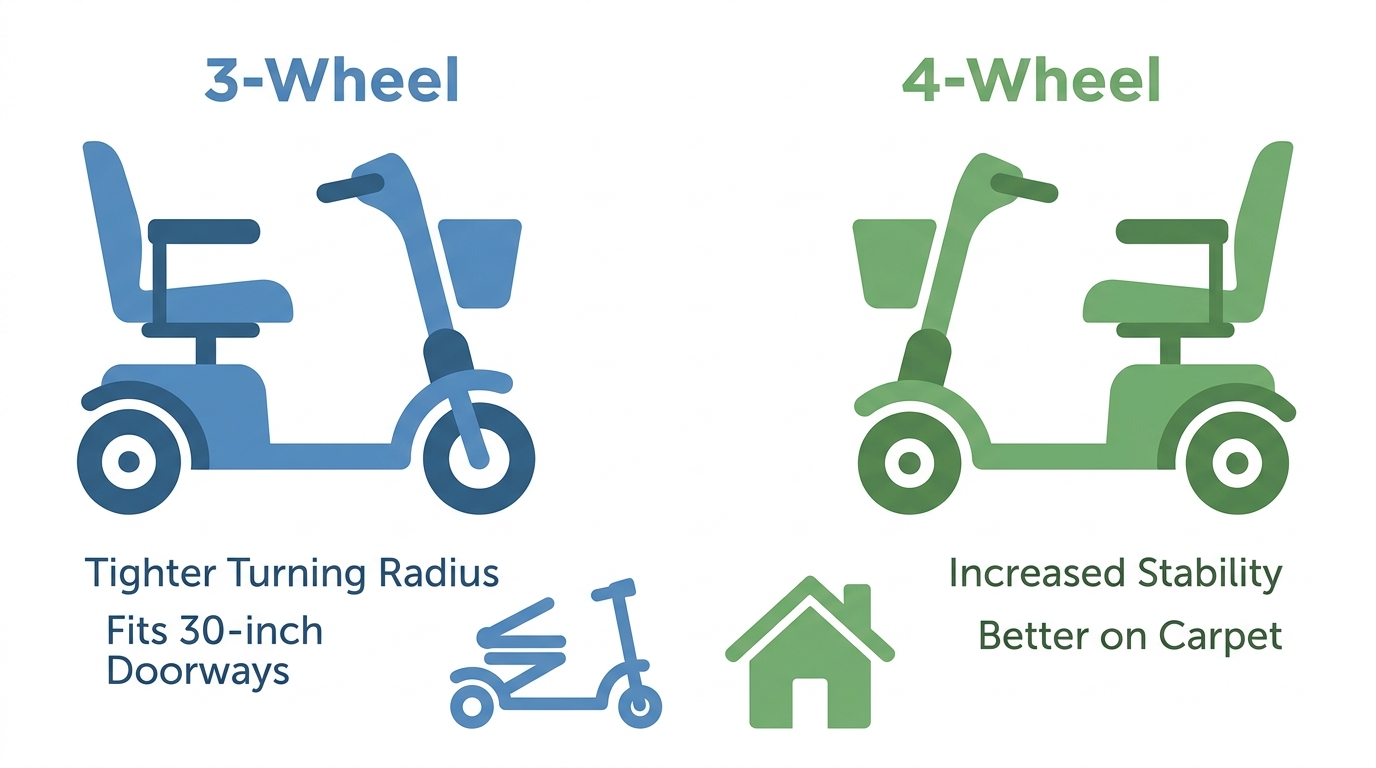
    Comparative infographic showing a blue 3-wheel scooter icon with tighter turning radius label on the left, a green 4-wheel scooter icon with increased stability label on the right, and small icons of a folding scooter and house below.
    Comparison of 3-wheel and 4-wheel mobility scooters for indoor maneuverability and stability.

    Folding and Lightweight Scooters for Home Storage

    Storage is a common concern, and folding mobility scooters elegantly solve the problem of limited space. These compact mobility scooters typically weigh between 30 and 50 pounds and can be collapsed to a fraction of their assembled size, small enough to store in a closet or a car trunk. Despite their lightweight design, most offer a battery range of 8 to 12 miles, which is more than sufficient for a full day of indoor activities.

    We find these models to be an excellent choice for anyone who values convenience without sacrificing essential mobility. A folding scooter’s true advantage is how it facilitates a spontaneous lifestyle in small apartments where every square foot matters. For outdoor or long-distance travel, however, a 4-wheel or heavy-duty scooter may ultimately be more appropriate.

    Results may vary; individual outcomes are not guaranteed. Consult a healthcare professional before making clinical decisions. This information is not medical advice and is for informational purposes only. Privacy notice: we do not sell personal information (see Privacy Policy). SMS terms: message and data rates may apply; reply STOP to unsubscribe.

    Benefits of Choosing the Right Home Scooter

    Once you understand the types of scooters available, the next question is: how will the right one actually improve your daily life? At MedEquipped, we know that selecting ideal motorized mobility scooters for home use transforms everyday routines. The right scooter becomes a seamless part of your home, not an obstacle. From navigating narrow hallways to maintaining independence in daily tasks, it brings freedom and comfort into every corner of your space. Below, we explore three key benefits — better maneuverability, greater independence, and easy storage.

    Improved Maneuverability in Tight Spaces

    Imagine turning into a narrow bathroom doorway without struggling — that’s what a scooter designed for indoor use can offer. Many home-use scooters feature a tight turning radius of just 27–32 inches, allowing you to glide through standard 32-inch doorways and kitchen galley layouts with ease. This means you can pull up to the bathroom sink, turn around in the kitchen, or enter a closet without repeatedly backing up. Unlike larger outdoor models that require multiple back-and-forth adjustments, a lightweight frame and compact design make repositioning in bedrooms or hallways nearly effortless. 3-wheel mobility scooters often excel here, offering a smaller footprint that handles sharp corners and confined spaces more gracefully. With a lower overall weight, they also reduce the strain on flooring and are easier to maneuver on tile or hardwood. Precise steering and responsive controls let you navigate around furniture and tight corridors without losing momentum, so daily movement feels natural rather than stressful.

    Greater Independence in Daily Activities

    Choosing a scooter that supports mobility related activities of daily living (mradls), such as moving from the bedroom to the living room or accessing bathroom counters, directly impacts your independence. As defined in our guide on these MRADLs, these essential tasks include transfers, walking, wheeling, and bed mobility — all activities that take place within the home. Instead of struggling with a walker or manual wheelchair, you glide from the bedroom to the breakfast table with ease. With properly fitted motorized mobility scooters for home use, you can reach kitchen countertops to prepare meals, join family at the dinner table, and move between rooms without exhausting transfers. By reducing the physical strain of moving from one spot to another, you preserve energy for the moments that matter most. This independence means you can participate more fully in family life and daily routines. Our team helps match you with a scooter that fits your body and home layout. We handle the paperwork, insurance navigation, and coordination, so you can focus on your mobility freedom.

    Convenient Storage and Portability

    Folding mobility scooters solve storage challenges in small apartments or senior living suites. Many models fold to about 19 inches high, fitting into a closet or car trunk. We coordinate your order, and your scooter typically arrives within 30–60 days — ready to use and easy to store.

    Now, let’s look at which features make these benefits a reality for your home.

    How It Works: Evaluating and Selecting a Scooter

    Now, let’s walk through exactly how we help you get the right scooter—from evaluation to delivery. Finding the ideal motorized mobility scooters for home use might seem complicated at first, but with MedEquipped, it’s a structured, worry-free process. As your partner in mobility freedom, we truly handle the heavy lifting at every stage so you can focus on what matters most: regaining your independence.

    Clinical Assessment and Funding Coordination

    Our process begins with a thorough clinical assessment led by a certified Assistive Technology Professional (ATP). This evaluation is the foundation for selecting the perfect device. Our ATPs take precise measurements of your home environment—checking door widths, thresholds, and available turning space—to ensure your new scooter will navigate your daily life seamlessly. We also carefully evaluate key specifications like turning radius and weight capacity. For instance, 3-wheel mobility scooters often provide a tighter turning circle, which can be a game-changer for maneuvering in smaller indoor spaces. Your comfort and safety are our top priorities, and we use these clinical findings to build the foundation for a successful funding application.

    Insurance Navigation and Paperwork Support

    Once your clinical needs are defined, our team takes over the complex world of insurance. We truly are the partner that handles the paperwork, insurance navigation, and coordination, so you don’t have to manage it alone. Our specialists complete all required insurance forms, obtain pre-authorizations, and coordinate with a wide range of funding sources, from Medicare and Medicaid to private insurance plans. Because every funding situation is unique, we provide a custom quote—much like we do for electric wheelchair cost estimation—to ensure full transparency. Our goal is to secure the necessary approvals efficiently, letting you rest easy while we advocate on your behalf.

    Timelines, Delivery, and Ongoing Support

    After funding is secured, we order your custom motorized scooter. A custom order typically takes 30–60 days (faster processing) from finalization to delivery. We will coordinate a convenient delivery time, either in your home or at a clinic, where your scooter is hand-fitted to you. Your comfort and ease of use are paramount, and we don’t stop when we hand you the keys. If your selection includes folding mobility scooters for easier transport and storage, we’ll make sure you know exactly how to operate and stow it. Our post-delivery support includes adjustments, user training, and education to ensure you remain confident and mobile for years to come. Once you’ve chosen your scooter, the next step is exploring the features and options available.

    Information is not medical advice and is for informational purposes only.

    Best Practices for Using a Motorized Scooter at Home

    Once you have your scooter, these best practices will help you use it safely and lastingly at home. When using motorized mobility scooters for home use, a little preparation and consistent care go a long way toward maintaining your independence and comfort. We at MedEquipped believe that navigating your living space should feel natural and empowering, and these practical steps are designed to help you do just that.

    Preparing Your Home for Safe Scooter Use

    A safe home environment is the foundation of independent mobility. The goal is to create clear, accessible pathways between the key areas that support your daily life—the bedroom, bathroom, and kitchen. As our team explains, mobility-related activities of daily living, or MRADLs, are the essential tasks a scooter supports, and your home setup can either enable or hinder them.

    Start by removing potential hazards:

    • Secure or remove loose rugs that can bunch up and cause a wheel to catch.
    • Clear clutter from floors and tuck away electrical cords against baseboards.
    • Measure your door widths. Standard scooters typically need about 32 inches of clearance; if your home has narrower openings, users often find 3-wheel mobility scooters easier to turn in tight hallways, or consider how folding mobility scooters can be especially practical for homes with limited storage.
    • Map a wide, unobstructed path between frequently used rooms.

    These adjustments make daily movement smoother and safer. Remember, these are general tips. Always consult your owner’s manual and your healthcare provider for advice specific to your medical needs and equipment.

    Routine Maintenance and Battery Care

    A little routine care keeps your power scooter reliable every day. The best charging habit is simple: plug in after each use. Avoid letting the battery drain completely, as deep discharges can shorten its overall lifespan.

    A weekly checklist can become second nature:

    • Check tire pressure and visually inspect tires for cracks or embedded debris.
    • Wipe down the scooter frame, seat, and tiller with a soft, slightly damp cloth to prevent dust and grime buildup.
    • Test the lights and horn to ensure they are functioning.
    • Confirm that the tiller lock and seat swivel operate freely.

    Consistent checks help you catch small issues before they grow, supporting your mobility without interruption. For personalized maintenance schedules, you can always ask our team.

    When to Upgrade or Replace Your Scooter

    Scooters, like all technology, eventually need an upgrade. Recognizing the right time to make a change can keep you moving comfortably and safely at home. As our resources on power wheelchair types explain, what works today may not be the best fit tomorrow, especially if your in-home needs evolve.

    Common signs that an upgrade is worth exploring include:

    • A noticeable drop in battery range, requiring more frequent charges to complete your daily routine.
    • Difficulty maneuvering in hallways or rooms that once felt spacious.
    • An increase in repair needs that disrupts your daily independence.
    • A significant change in your mobility level, where you may benefit from a more customized motorized wheelchair.

    If you recognize any of these signs, we can help you evaluate your options—just reach out. Upgrading is not about failure; it is about adapting to ensure your equipment continues to support your freedom of movement.

    Next, we’ll cover how to maintain your scooter outdoors and on different terrains.

    Your Path to Home Mobility Freedom

    Getting your custom chair is a simple, guided process. Here is your path to home mobility freedom. We are your partner in mobility freedom, working alongside you every step of the way. While you focus on regaining independence with tools like motorized mobility scooters for home use, we handle the paperwork, insurance navigation, and coordination from start to finish.

    1. Free Consultation and Coverage Check: Your journey begins with a free, no-obligation consultation. We take the time to understand your daily mobility challenges at home and verify your insurance benefits to set clear expectations.
    2. In-Home Clinical Evaluation: Our certified Assistive Technology Professionals (ATPs) conduct a thorough in-home assessment. We evaluate your specific needs to determine the best positioning and controls, whether you need the stability of 3-wheel mobility scooters or the portability of folding mobility scooters.
    3. Insurance Navigation and Approvals: Once your needs are documented, our dedicated team takes over. We submit all required paperwork, manage prior authorizations, and handle any appeals necessary to secure funding.
    4. Ordering and Fast Manufacturing: After approval, we order your custom-built chair from leading, trusted manufacturers. With our expedited coordination process, your chair is typically built and ready in 30–60 days (faster processing) rather than the industry-standard longer wait.
    5. Delivery, Fitting, and Training: We deliver your new power wheelchair directly to your home in New York, Georgia, or Michigan. Our team ensures a perfect fit and provides in-person training so you and your family are confident in its safe operation.

    After your chair is delivered, our support continues. We remain your dedicated point of contact for any adjustments, service needs, or questions, ensuring you always have a team in your corner.

    Results may vary; individual outcomes are not guaranteed.

    Resources

  • How to Assess Mobility Related Activities of Daily Living (MRADLs)

    Table of Contents

    The Role of MRADLs in Power Wheelchair Eligibility

    Beyond the general rules for durable medical equipment, Medicare eligibility for a motorized chair centers on your ability to perform everyday tasks in your home. These are your Mobility Related Activities of Daily Living (MRADLs), and they are the foundation of the medical necessity determination. Unlike general daily activities, MRADLs specifically refer to the core movements required for self-care: bathing, toileting, transferring in and out of a chair or bed, dressing, and feeding yourself. We focus on these tasks because they are essential for a safe and dignified home life.

    Medicare stipulates that you must be unable to perform one or more of these MRADLs even while using a cane or walker. According to our understanding of power wheelchair Medicare guidelines, the assessment of your in-home mobility activities is the key factor in the approval process. A physical or occupational therapist will watch how you manage these daily mobility tasks during your evaluation. We see this step as part of a broader power wheelchair medical necessity checklist, creating a clear record that supports your case.

    Documenting this inability is the central purpose of the required face-to-face mobility evaluation requirements. Your physician must conduct this exam and provide a written prescription that reports your specific MRADL limitations. We help you navigate this process by coordinating the clinical evaluation and managing the paperwork, so you can focus on your well-being.

    Understanding MRADLs sets the stage for the face-to-face evaluation. As your partner in mobility freedom, we handle the coordination, allowing you to benefit from our expertise with insurers. This information is not medical advice and is for informational purposes only. Consult a healthcare professional before making clinical decisions.

    MRADLs Defined: The Foundation of Power Wheelchair Eligibility

    To understand how Medicare determines medical necessity for a power wheelchair, we first need to define the core criteria: Mobility Related Activities of Daily Living (MRADLs). These are the specific mobility tasks that a patient must be able to perform safely and efficiently within their own home. Unlike broader self-care assessments, MRADLs zoom in on the fundamental movements Medicare uses to evaluate whether a power mobility device is justified.

    The five key MRADL tasks, as defined by Medicare’s Local Coverage Determination, include bed mobility, transfers to and from a bed, chair, or toilet, walking, wheeling, and the ability to negotiate stairs. An impairment in one or more of these areas, when it prevents a person from completing essential daily routines in the home environment, forms the basis of the medical necessity argument for a power wheelchair. Importantly, a deficit must exist within the home setting—not just in the community—to meet coverage criteria.

    The table below distinguishes MRADLs from standard ADLs in key areas that directly affect power wheelchair eligibility.

    MRADLs vs. Standard ADLs
    CategoryStandard ADLsMRADLs
    MobilityBathing, dressing, toileting, feedingBed mobility, transfers (to/from bed/chair/toilet), walking, wheeling, stairs
    PurposeAssessing overall functional independenceEvaluating specific mobility deficits that require a wheelchair
    Documentation FocusLevel of assistance required (independent, standby, total)Specific deficits impacting mobility within the home environment, justifying need for a power mobility device

    As the table shows, MRADLs zero in on the specific mobility deficits Medicare requires for a power wheelchair. Standard ADLs help gauge a person’s overall functional status, but it is the inability to manage these mobility-related daily activities safely that triggers the need for powered support. This is where the power wheelchair medical necessity checklist begins: the MRADL assessment itself.

    Documenting these deficits requires more than a simple patient report. Medicare mandates a face-to-face mobility evaluation conducted by a qualified practitioner, such as a physician, physician assistant, nurse practitioner, or clinical nurse specialist. During this exam, the clinician must record objective findings of MRADL impairment, connecting them directly to the rationale for a power mobility device. By doing so, the practitioner fulfills the face-to-face mobility evaluation requirements that are essential for prior authorization. Our mobility solutions FAQ provides further details on how MRADL deficits are assessed during the clinical evaluation.

    Comparación clínica de MRADLs vs. ADLs estándar para elegibilidad de sillas de ruedas.

    With MRADLs clearly defined, the next step is understanding how to document these deficits in a formal medical evaluation. While MRADL impairment is the foundation, it alone does not guarantee approval—every piece of clinical evidence must work together to paint a complete picture of medical necessity.

    This information is not medical advice and is for informational purposes only. Consult a healthcare professional before making clinical decisions.

    Documenting MRADL Limitations for Medical Necessity

    Now that we understand the evaluation process, we must focus on documenting Mobility Related Activities of Daily Living (MRADLs) specifically for Medicare medical necessity. As your partner in mobility freedom, we at MedEquipped handle the paperwork, insurance navigation, and coordination to secure your custom motorized wheelchairs in a seamless 30-60 days (faster processing) window. Proper documentation is the cornerstone: Medicare’s primary coverage criteria require that you prove an inability to perform daily mobility tasks inside the home environment. The following table highlights the different documentation focus for in-home versus community mobility.

    In-Home vs. Community Mobility Documentation
    Documentation AspectIn-Home Mobility (Primary Criteria)Community Mobility (Secondary Criteria)
    Primary FocusBedroom, bathroom, kitchen, hallway transfers and mobilityCurb hopping, uneven terrain, public access, transportation
    Mobility Device ConsiderationPower wheelchair vs. manual wheelchair vs. walker vs. canePower wheelchair vs. power scooter vs. power add-on
    Documentation RequirementSpecific deficits in MRADLs, safety concerns, and caregiver assistance needs inside the homeFunctional deficits outside the home, work, or school environments
    Medicare ImpactPrimary basis for medical necessity determination and coverageSupports primary criteria but cannot solely justify a power wheelchair

    Understanding this distinction is vital. The in-home criteria form the foundation of your claim, while community mobility needs serve as supportive but not standalone evidence.

    The “Within the Home” Rule for MRADL Deficits

    Medicare’s “within the home” rule dictates that Mobility Related Activities of Daily Living (MRADLs) must be documented exclusively as deficits occurring inside the residence. We at MedEquipped frequently guide clinicians to evaluate functioning in the bedroom, bathroom, kitchen, and hallways. Community mobility challenges—such as navigating a parking lot or crossing uneven terrain—cannot satisfy the primary coverage criteria for a power wheelchair, per the U.S. Food and Drug Administration’s coverage guidelines. Instead, the medical record must capture specific, observable limitations: can the patient transfer from bed to chair without hands-on assistance? Is a manual wheelchair impossible to propel across the kitchen floor? Does the individual require caregiver support to access the bathroom? According to our internal clinical support resources, these in-home deficits are the benchmark for medical necessity. Without detailed notes confined to the living quarters, Medicare reviewers will likely deny the claim.

    The Role of a Walker or Cane in MRADL Assessment

    A question we often answer at MedEquipped is whether a patient who uses a walker or cane can still qualify for a power wheelchair. The answer is yes—but only if the documentation demonstrates why the assistive device is insufficient for safe functional mobility limitations inside the home. Our internal FAQ clarifies that partial independence does not equal total independence. If a patient can walk a few steps with a cane but requires hands-on assistance to stand for transfers or exhibits significant safety concerns, the device is not meeting their needs. The record must detail the reason: unsteady gait, fatigue mid-task, pain exacerbation, or caregiver intervention required. Merely noting that a walker is used does not disqualify the patient; failing to explain why it fails to enable daily mobility tasks does.

    Specific Medical Necessity Language for Medicare

    To meet Medicare power wheelchair coverage criteria, your documentation must include precise clinical language that demonstrates a need for a power drive system due to weakness, pain, or endurance limitations. In line with the power wheelchair medical necessity checklist, our team advises including the following examples for Group 2 and Group 3 qualifications:

    • “Unable to propel a manual wheelchair inside the home due to bilateral upper extremity weakness, rating 3/5 on the MMT. The patient requires a power drive system for basic bedroom and bathroom navigation.”
    • “Requires hands-on assistance for bed-to-chair transfers. The patient cannot perform this Mobility Related Activities of Daily Living (MRADLs) task with a walker or cane alone due to severe balance deficits and pain.”

    Group 3 documentation, which supports complex rehabilitation chairs, adds language around tilt, recline, or custom seating to address skin integrity or postural support. Our team ensures that face-to-face mobility evaluation requirements are met by detailing the specific medical condition, functional deficits, and the rationale for selecting a particular power base. With proper documentation in place, we move to selecting and ordering your custom power wheelchair.

    Consult a healthcare professional before making clinical decisions. Information is not medical advice and is for informational purposes only.

    A Practical Checklist for Your Power Wheelchair Evaluation

    Now that you understand the evaluation overview, here is a practical checklist to ensure you and your clinician are fully prepared. As your partner in mobility freedom, we handle the paperwork, insurance navigation, and coordination to streamline your process, typically completing custom orders within a 30-60 day timeframe across our service areas in New York, Georgia, and Michigan. This guide focuses on the power wheelchair medical necessity checklist requirements, particularly how your clinician documents Mobility Related Activities of Daily Living (MRADLs). Below, we differentiate a standard visit from a dedicated mobility evaluation.

    The following table compares a standard office visit with a face-to-face mobility evaluation, highlighting the specific documentation needed for a power wheelchair claim.

    Standard Office Visit vs. Face-to-Face Mobility Evaluation
    AspectStandard Office VisitFace-to-Face Mobility Evaluation
    Primary PurposeGeneral health check, medication management, acute illnessAssess mobility limitations and medical necessity for a power wheelchair
    Required ComponentsHistory, physical exam, assessment, planDetailed functional assessment of mobility, MRADL limitations, strength, tone, coordination, and safety awareness
    Documentation FocusDiagnosis and treatment of acute/chronic conditionsSpecific deficits in bed mobility, transfers, walking, wheeling, and justification for a power mobility device
    Clinician TypePhysician (MD/DO), NP, PAPhysician, NP, PA, or a physical therapist (with physician finalizing the order)
    Valid for Telehealth?Yes, under certain telehealth provisionsGenerally requires in-person presence for the functional assessment component

    This comparison underscores why the face-to-face mobility evaluation requirements are more rigorous. Our team coordinates this appointment timeline to ensure the face-to-face encounter occurs within the CMS-required 45 days prior to the written order.

    Preparing for the Face-to-Face Mobility Evaluation

    Bringing the right materials streamlines your evaluation. Gathering these documents in advance helps your clinician focus on assessing your MRADL deficits without administrative delays.

    • Referral and Prior Authorization: Bring a referral from your primary care provider and any prior authorization numbers from your insurance.
    • Identification and Insurance: Have your photo ID and insurance card ready.
    • Medical History: Compile a list of current medications and any records of previous mobility devices you have used.
    • Personal Notes: Jot down specific daily tasks that are challenging, such as moving from your bed to a chair, bathing, or preparing meals, to clearly articulate your activities of daily living limitations.

    During the evaluation itself, your clinician will conduct a hands-on physical exam. According to our internal resources, this must include documentation of your range of motion, muscle strength, and endurance—particularly in your upper extremities if self-propulsion is a goal. The exam also assesses coordination, balance, sitting tolerance, and your safety awareness to determine the right device configuration. We recommend you wear comfortable clothing and be ready to demonstrate your current mobility abilities.

    Key Documentation Your Clinician Must Include

    Beyond the physical exam, your clinician’s progress notes must create a compelling narrative of medical necessity. This is the core of meeting the power wheelchair medical necessity checklist and justifying the specific device selected.

    • Explicit MRADL Limitations: The notes must detail specific deficits in mobility-related ADLs. This means clearly stating your limitations in bed mobility, transferring (e.g., from bed to wheelchair), toilet use, bathing, and walking or wheeling.
    • Why a Power Wheelchair is Necessary: The documentation must explain why you cannot operate a manual wheelchair safely and effectively to complete your MRADLs. It should also justify why a scooter is insufficient, often citing postural support needs, strength deficits, or the need for powered seating functions like tilt and recline.
    • Rationale for Device Type: If a specific drive configuration (center-wheel drive vs. front-wheel drive) or seating system is recommended, the notes must connect those features directly to your physical findings and daily environment.

    Our certified ATP evaluators guide clinicians through these specifics during our in-person assessments, ensuring the rationale for the chosen power wheelchair is watertight for a smoother review process.

    Common Reasons for Power Wheelchair Insurance Denials

    Even with thorough preparation, claims can encounter hurdles. Understanding the most frequent denial triggers helps you and your clinician fortify your application from the start.

    • Insufficient MRADL Documentation: The most common setback is a failure to specifically document which MRADLs the patient cannot complete. Generic notes about “difficulty walking” are insufficient; the record must detail, for instance, an inability to independently transfer to the toilet or propel a manual chair across carpet.
    • Incomplete Physical Exam Findings: Claims are often denied when the physical exam lacks specific measurements of range of motion, muscle strength, or coordination needed to justify the chair’s features.
    • Lack of Specific Device Justification: Ordering a high-end power wheelchair without a clear narrative explaining why a less complex device is inadequate frequently leads to denial. The notes must connect your specific physical deficits to the required technology.

    We navigate these challenges daily. While this checklist focuses on power wheelchair evaluations, if your home requires additional accessibility modifications such as outdoor stair lifts, we can also help coordinate those solutions for complete home access. Our expertise in managing the paperwork helps preempt many of these common pitfalls.

    With this checklist in hand, you are ready for a smooth evaluation process. We handle the insurance navigation, so you can focus on regaining your mobility freedom. Remember, this information is for informational purposes only and does not constitute medical advice. Results may vary; individual outcomes are not guaranteed. Always consult a healthcare professional before making clinical decisions.

    Proving Medical Necessity for Group 3 Power Chairs

    Meeting clinical requirements is essential to justify a Group 3 power chair to Medicare. At its core, “medical necessity” means the patient cannot perform key Mobility Related Activities of Daily Living (MRADLs) — such as getting to the bed, bathroom, or kitchen — without a powered base in the home. We focus on documenting how specific indoor mobility deficits make a standard wheelchair insufficient.

    A mandatory face-to-face mobility evaluation by a licensed professional confirms exactly which MRADLs are affected and why the patient needs a Group 3 chair rather than a lower-tier device. The evaluation must show that specialized seating, positioning, or power tilt and recline are clinically required for daily function, not simply for comfort. Our certified staff hold an assistive technology professional certification from the Rehabilitation Engineering and Assistive Technology Society of North America (RESNA), ensuring your evaluation meets the highest industry standards.

    Medicare’s power wheelchair medical necessity checklist turns on whether the primary mobility limitation exists inside the home; outdoor use alone does not establish coverage. The face-to-face mobility evaluation requirements also confirm that the patient’s condition cannot be managed with a cane, walker, or manual chair. This in-home focus, combined with documentation of the clinical need for power positioning, satisfies the formal criteria insurers look for.

    We handle the paperwork, insurance navigation, and coordination so families are not left piecing together forms and clinical notes on their own. Our team manages the full clinical documentation, ensuring each element of the face-to-face evaluation and home-use justification aligns with Medicare’s standards while keeping the process manageable. To strengthen claims, we also follow up with clinicians and suppliers to streamline approvals, resolve documentation gaps, and confirm MRADLs are clearly documented for in-home use.

    Common Questions About MRADLs and Face-to-Face Evaluations

    Here are answers to common questions about the MRADLs and the evaluation process.

    What are MRADLs? Mobility Related Activities of Daily Living (MRADLs) are the essential tasks you perform every day inside your home, such as toileting, feeding, dressing, bathing, and functional mobility. A power wheelchair is designed to help you complete these MRADLs safely and independently.

    Why is a face-to-face evaluation required? Meeting with a qualified healthcare professional is a prerequisite for insurance funding. This examination validates your specific mobility limitations and confirms that a complex power wheelchair is necessary to complete your daily living tasks.

    What happens during the evaluation? Our clinicians use this standard visit to understand how you move through your home environment. The findings are then used to document medical necessity and build a strong support package for your insurance claim.

    How do MRADLs and the evaluation connect? The face-to-face evaluation requirements help your provider demonstrate how equipment overcomes specific barriers to performing daily tasks. We use these details to advocate for coverage, managing the paperwork so you can focus on preparing for your custom motorized wheelchair.

    We encourage you to reach out for a custom quote so we can learn more about your unique needs.

    Information is not medical advice and is for informational purposes only.

    Your Path to Power Wheelchair Eligibility with MedEquipped

    So, how do you get started? Your path to eligibility begins with demonstrating a medical need for a power wheelchair based on your ability to perform Mobility Related Activities of Daily Living (MRADLs) in your Spring Valley home. Our team at MedEquipped, your partner in mobility freedom, then steps in to handle the paperwork, insurance navigation, and coordination, aiming for approval and delivery within 30-60 days (faster processing). A mandatory face-to-face mobility evaluation with your physician is required, followed by our certified ATP clinical evaluation to define the right custom motorized wheelchairs. We then manage the power wheelchair medical necessity checklist and secure pre-authorization, all while you focus on what matters most.

    Resources
