Table of Contents
1. Understanding K0823 Weight Capacity Requirements
Meeting Medicare K0823 requirements starts with understanding that this HCPCS code classifies a heavy duty power wheelchair built for users whose body weight does not exceed 300 pounds. Accurate weight classification is the foundation of a smooth approval process, so we begin every patient journey by confirming that your clinical profile aligns with this specific capacity. When your weight falls within that threshold, the K0823 designation becomes the most appropriate funding pathway under Medicare DMEPOS guidelines, and we at MedEquipped work diligently to build a complete documentation package that supports timely authorization.
Individuals who require heavy duty power wheelchairs 450 lbs or greater capacity typically qualify for a higher-tier code such as K0824, which accommodates users up to 450 pounds. Your evaluating Assistive Technology Professional reviews your medical history, mobility limitations, and functional needs to determine which classification best matches your daily life. Getting this classification right is critical because a mismatch can delay funding or lead to a chair that simply cannot support you safely. Our team acts as your partner in mobility freedom by verifying your weight measurement against current clinical records and helping you understand why Medicare requires this precise categorization before approving equipment.
To support a K0823 claim, Medicare expects several pieces of documentation, which we help you gather and submit:
- A physician’s prescription that clearly states the medical necessity for a heavy duty power wheelchair.
- A recent clinical evaluation completed by a certified ATP or qualified clinician, documenting mobility deficits and functional limitations.
- A documented weight measurement, typically recorded during an in-person assessment within a reasonable timeframe of the order.
- A functional mobility assessment that demonstrates your inability to perform daily activities without powered assistance.
MedEquipped simplifies what can otherwise feel like a daunting paperwork process. When you contact our intake team in Nanuet, New York, we collect your existing records, coordinate with your referring physician, and schedule an evaluation with an ATP who understands exactly what Medicare reviewers need to see. Our familiarity with Medicare K0823 requirements helps us flag missing details early so your submission is as clean as possible, which supports our goal of delivering your custom motorized wheelchair within a typical 30- to 60-day processing window.
Beyond the weight-based classification itself, we also consider bariatric power wheelchair seating and positioning factors that influence safety and long-term comfort. Even within the 300-pound capacity, your body dimensions, pressure distribution risks, and postural support needs shape the seating configuration we recommend. In the next section, we explore those critical seating and positioning considerations in greater depth.
Disclaimer: Results may vary; individual outcomes are not guaranteed. The information provided here is for informational purposes only and is not medical advice. Consult a healthcare professional before making clinical decisions.
2. Qualifying for a Medicare Heavy Duty Chair
Understanding Medicare K0823 requirements is the first step toward obtaining a heavy duty power wheelchair, building on the overview of chair options from the previous section. Medicare classifies power wheelchairs as durable medical equipment, so you will need a prescription from your treating physician and a face-to-face examination that documents your mobility limitations within the home. To establish medical necessity, you must demonstrate that you cannot safely operate a manual wheelchair because of a condition such as severe arthritis or a neurological disorder.
For those who need heavy duty power wheelchairs 450 lbs and above, the K0823 code applies and covers weight capacities from 450 to 600 pounds. If your weight falls below 450 pounds, other K-codes like K0822 may be appropriate. Proper bariatric power wheelchair seating and positioning also plays a critical role in comfort and safety for larger users. According to MedEquipped’s qualification guide, an Assistive Technology Professional evaluation can strengthen your case by detailing how the chair supports your independence. Our team helps you gather the right documentation so you can move through the process smoothly. Consult a healthcare professional before making clinical decisions. Once you meet the eligibility criteria, we shift to paperwork and insurance navigation — the topic of the next section, where we walk you through applying with MedEquipped’s end-to-end support.
3. Medical Documentation You Need
Getting your Medicare K0823 power wheelchair approved starts with having the right medical documentation. Meeting Medicare K0823 requirements doesn’t have to be complicated — it’s about gathering specific paperwork that shows why you need this particular type of heavy duty power wheelchair documentation for your daily life at home.
Here are the core documents Medicare needs to review:
- Written Order (Prescription). This is your doctor’s official prescription for the wheelchair, confirming it’s medically necessary. It’s the foundation of your K0823 paperwork.
- Face-to-Face Examination Record. Medicare requires a record showing your doctor evaluated you in person within a specific timeframe before they write the prescription. This note links the exam findings directly to the mobility recommendation.
- Medical Necessity Statement (Detailed Written Order). This detailed narrative must clearly describe your physical functional limitations, why the wheelchair is necessary for activities inside your home, and the clinical reasons for the specific chair configuration and seating components being ordered.
Your doctor and MedEquipped’s certified ATP evaluator work together to make sure these documents connect — the prescription aligns with the exam observations, and the medical necessity statement reflects exactly what the evaluation uncovered about your strength, range of motion, and daily mobility challenges.
We guide you and your physician through every piece of this documentation so nothing gets missed. We handle the paperwork, insurance navigation, and coordination, turning a process that often feels overwhelming into a clear, step-by-step partnership. When your documents are complete and well-organized from the start, the typical timeline from evaluation to delivery stays within 30–60 days — much faster than trying to manage it alone.
Once your paperwork is ready, the next stage is submitting it through the right channels. We’ll walk you through exactly what happens after your doctor signs the order.
4. Medicare Part B Coverage for K0823
Now let’s look at how Medicare Part B covers this code. Medicare K0823 requirements specify that this code applies to a standard power-operated vehicle designed primarily for indoor use. Under Medicare Part B, you may qualify for coverage when your physician certifies medical necessity — for example, when you cannot safely ambulate indoors without assistance.
For heavy duty wheelchair medicare questions beyond standard K0823 criteria, additional documentation may be necessary. We handle the paperwork, insurance navigation, and coordination so you can focus on what matters most. Generally, the typical timeline for custom-fitted power chairs runs 30 to 60 days from evaluation to delivery.
Your supplier must be enrolled in Medicare and meet all accreditation requirements. While Medicare picks up the majority of approved costs, some cost-sharing through deductibles and coinsurance still applies. Contact MedEquipped for a custom estimate of your out-of-pocket responsibility. Results may vary; individual outcomes are not guaranteed. Once coverage is confirmed, MedEquipped guides you through the next steps.
Privacy notice: we do not sell personal information (see Privacy Policy). SMS terms: message and data rates may apply; reply STOP to unsubscribe. Consult a healthcare professional before making clinical decisions.
5. Group 2 vs Group 3 Heavy Duty Chairs
Understanding the difference between Group 2 and Group 3 heavy duty power wheelchairs is essential for finding the right fit. These categories, defined by RESNA (Rehabilitation Engineering and Assistive Technology Society of North America), help match equipment to your weight and lifestyle needs.
| Feature | Group 2 Heavy Duty | Group 3 Heavy Duty |
|---|---|---|
| Weight Capacity | Up to 300 lbs (K0823) | 300 – 600 lbs+ |
| Intended Use | Primary indoor mobility | Indoor/Outdoor & All-Terrain |
| Medicare Code | K0823 / K0822 | K0848 – K0864 |
While both groups offer exceptional support, Group 3 chairs are built for all-terrain mobility, while Group 2 models excel in everyday indoor environments.
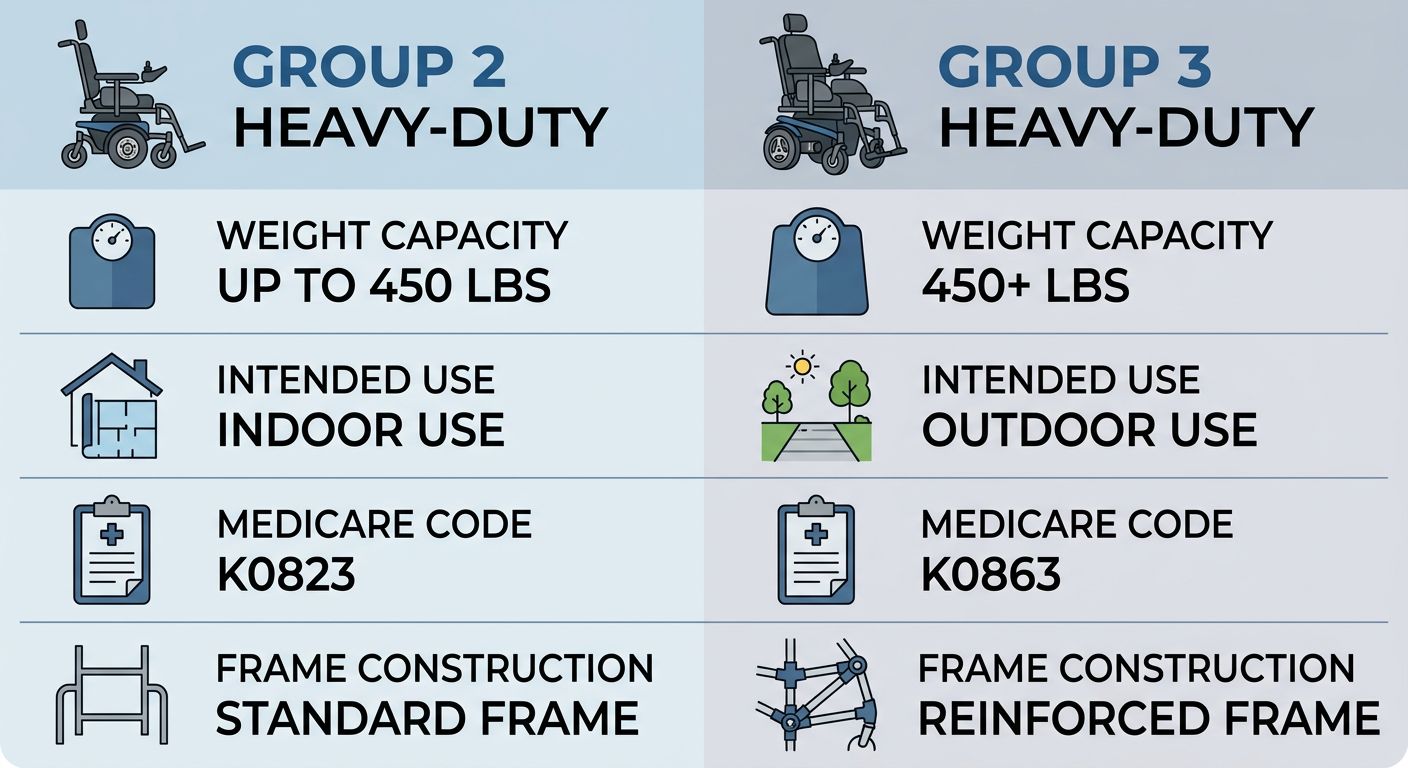
Group 2 vs Group 3 heavy duty power wheelchair comparison.
If you need a heavy duty power wheelchair rated for 450 lbs or more, or require specialized bariatric power wheelchair seating systems, we can help. Our certified ATP evaluators will assess your clinical needs and recommend the right group, ensuring your custom motorized wheelchair becomes a partner in mobility freedom. We handle the paperwork, insurance navigation, and coordination for you. Remember, Medicare K0823 requirements apply for Group 2, while Group 3 needs medical necessity documentation.
Consult your healthcare provider to determine which group is right for you, or reach out to us for a personalized evaluation.
6. Scheduling Your Face-to-Face Evaluation
Once you and your physician have decided that a custom power wheelchair is the right path, the next step is a face-to-face clinical evaluation. This appointment is a standard part of meeting Medicare K0823 requirements and other insurer guidelines, ensuring your unique needs are properly documented before a chair is ordered. Think of it as your personal mobility consultation, where we become your partner in mobility freedom by getting to know you and your daily life.
Scheduling is simple. Here’s how the process works:
- Contact us by phone or through our website. An intake coordinator will gather your initial information.
- You’ll need to provide a written prescription from your doctor, relevant medical records, and your insurance details.
- We then schedule your evaluation with a certified Assistive Technology Professional (ATP) at a time and place convenient for you.
The ATP will assess your mobility, take precise measurements, and discuss your needs, including options for heavy duty power wheelchairs 450 lbs or specialized bariatric power wheelchair seating and positioning if they apply to you. We handle all the paperwork and insurance navigation, so your only job is to attend. The evaluation is typically scheduled within days, and we’ll have your chair ordered within 1–2 weeks. Results may vary; individual outcomes are not guaranteed. Bring your current mobility device and a list of questions. After the evaluation, our team takes the reins to process your custom order and guide you swiftly toward the delivery day we’ll cover next.
Message and data rates may apply; reply STOP to unsubscribe.
7. Configuring Bariatric Seating and Positioning
After choosing from available bariatric power mobility bases, the next essential step is configuring the seating and positioning system. This process directly impacts comfort, pressure distribution, and overall safety during daily use. Proper configuration also helps meet key regulatory standards, including Medicare K0823 requirements, which define specifications for heavy-duty seating.
We recommend starting with precise measurements. A minimum seat width of 22 inches is typical, but the depth and back height must match the patient’s body for optimal support. Weight capacity is equally critical; seating frames and cushions on heavy duty power wheelchairs 450 lbs and above need careful selection to ensure durability and safety.
For a better fitting bariatric power wheelchair seating and positioning setup, consider these accessories:
- Elevating leg rests to improve circulation and reduce swelling.
- Tilt-in-space functionality to manage pressure and enhance comfort.
- Adjustable armrests for easier transfers and upper body support.
We believe that a clinical evaluation by a certified ATP, like MedEquipped’s team, is vital for achieving the best fit. Once this configuration is complete, the final steps involve testing all adjustments and preparing for delivery.
Consult a healthcare professional before making clinical decisions related to wheelchair seating.
8. Working with Certified ATP Professionals
After understanding the complex world of insurance and wheelchair selection, working with a Certified ATP Professional simplifies everything. A Certified ATP Professional is a specialist trained to match mobility needs with appropriate powered devices, and their involvement is key to satisfying Medicare K0823 requirements for coverage.
During evaluations, our ATPs assess critical areas like weight capacity for heavy duty power wheelchairs 450 lbs and seating support for bariatric power wheelchair seating and positioning, ensuring every adjustment aligns with your clinical picture and documented medical necessity.
At MedEquipped, our ATPs coordinate with your clinicians and insurance providers, handling paperwork to streamline approvals. As your partner in mobility freedom, we specify chair configurations that match your needs, including custom adjustments for bariatric users. While we advocate for coverage, insurance outcomes depend on individual plans.
Our certified team stays current with industry advances, offering informed guidance from evaluation through to ordering. With professional ATP support in place, the next step is delivery and long-term care.
Partnering with MedEquipped for Your K0823 Journey
Navigating Medicare K0823 requirements can feel overwhelming, but MedEquipped is here to simplify every step. We provide end-to-end support, from your initial clinical evaluation through insurance paperwork, custom ordering, delivery, and ongoing care. Our certified ATP evaluators across New York, Georgia, and Michigan work closely with you to configure chairs for complex needs, including mobility solutions like heavy duty power wheelchairs 450 lbs and specialized bariatric power wheelchair seating and positioning. We handle the paperwork, insurance navigation, and coordination so you don’t have to, typically completing the process in 30–60 days. As your partner in mobility freedom, we’re ready when you are—contact us to start your journey.
Consult a healthcare professional before making clinical decisions.
Resources
- Find Weather-Resistant Outdoor Stair Lifts with Safety Features
- Find Medicare Power Wheelchair Coverage Requirements for 2026
- Get High-Performance Power Wheelchairs with Insurance Support
- Find Stair Lift Cost Breakdown for Straight and Curved Models
- Disable Garmin Let’s Get Moving Activity Reminders
- Discover Outdoor Stair Lift Weatherproofing and Safety Features
- Get Custom Motorized Wheelchair Services from MedEquipped
- Submit Feedback to Improve FDA.gov User Experience
- Explore RESNA Certification and Assistive Technology Resources