
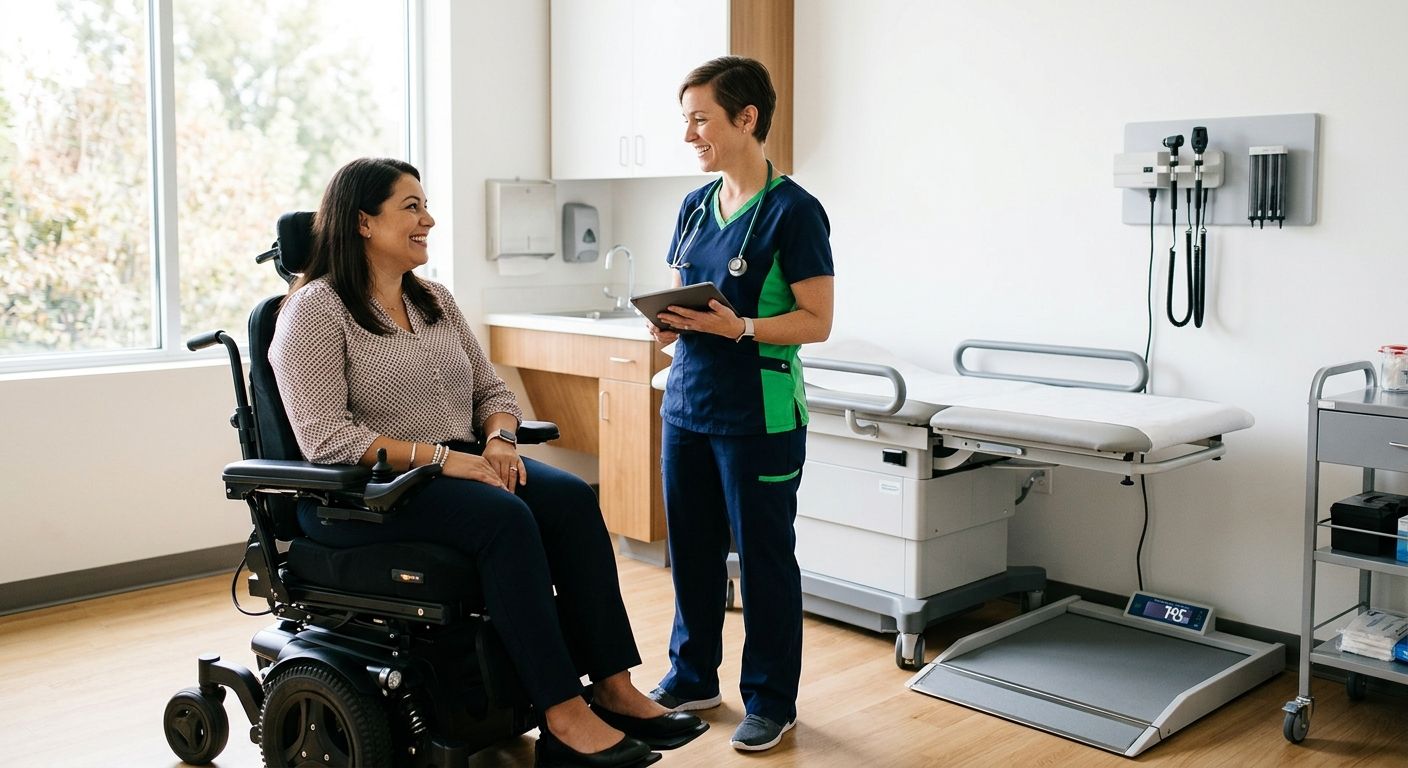
Tag: DOJ MDE rule

  • ADA Accessible Medical Equipment Deadlines 2026: Complete Compliance Guide

    ADA Accessible Medical Equipment Deadlines 2026: Complete Compliance Guide

    Table of Contents

    The 2026 ADA Accessible Medical Equipment Compliance Landscape

    The 2026 ADA accessible medical equipment deadlines mark a major shift in healthcare accessibility, requiring providers to upgrade or replace diagnostic tools to better serve patients with disabilities. The U.S. Department of Justice’s final rule on ADA medical diagnostic equipment rules establishes specific requirements for exam tables, scales, mammography equipment, dental chairs, and other medical diagnostic equipment (MDE). The rule applies to newly purchased, leased, or substantially altered equipment; existing equipment may follow different timelines. These new standards are a key part of the ADA’s goal to eliminate barriers in medical settings.

    The DOJ medical diagnostic equipment rule addresses Title II entities (such as public hospitals and government health clinics) and Title III public accommodations (including private medical practices and clinics). Accessible exam table requirements mandate height adjustability, transfer supports, and sufficient clear floor space to allow independent access. Key compliance deadlines include:

    • Title II: All new MDE must be compliant by 2026.
    • Title III: New MDE in certain categories, such as exam tables and scales, must meet standards by 2026; other categories may have later dates.
    • Existing MDE: Facilities must implement a transition plan for phased-in compliance.

    We at MedEquipped understand that navigating these deadlines can be complex, and healthcare providers should consult the U.S. Department of Health and Human Services and the official ADA.gov resources for detailed guidance. Understanding these deadlines is the first step; the following section outlines practical actions facilities can take to achieve compliance. For patients seeking greater independence, custom motorized wheelchairs can complement accessible exam rooms, and MedEquipped’s rapid turnaround helps ensure that mobility solutions are in place well before deadlines.

    Understanding the ADA’s 2026 Medical Equipment Accessibility Mandate

    The ada accessible medical equipment deadlines 2026 mark a significant advancement in healthcare civil rights. The U.S. Department of Justice has issued a final rule, titled “Nondiscrimination on the Basis of Disability; Accessibility of Medical Diagnostic Equipment of State and Local Government Entities and Public Accommodations,” that requires covered medical facilities to make their diagnostic equipment usable by individuals with disabilities. This rule applies to both public entities (Title II) and private health care providers (Title III).

    Under the DOJ medical diagnostic equipment rule, facilities must evaluate their existing equipment and replace or retrofit non-compliant devices. The rule’s technical specifications are based on the U.S. Access Board’s Medical Diagnostic Equipment Accessibility Standards, originally published in 2017. The accessible exam table requirements, for example, specify that examination tables used for patients in a supine or semi-supine position must be height-adjustable to allow independent transfer from a wheelchair. Accessible weight scales must have a platform that accommodates a wheelchair and allow a patient to weigh while seated. Mammography equipment must permit examinations in a seated position. Other diagnostic machines—such as those used for blood draws, ultrasound, or gynecological exams—that require a patient to assume a specific position also fall under the mandate.

    Key compliance milestones include:

    • Existing medical facilities must have the required accessibility features in place by January 1, 2026. New construction and alterations must meet the standards at the time the facility is first occupied or the alteration is completed.
    • Covered equipment types: height-adjustable exam tables, accessible weight scales, mammography machines, and any other diagnostic equipment used when a patient is lying down or in a fixed position.
    • Affected entities: all public hospitals and clinics (Title II) as well as private medical practices, specialty centers, and healthcare providers (Title III).

    These requirements foster greater independence and reduce the risk of injury during transfers. For patients, accessible equipment means they can participate in their own healthcare without relying on staff to lift or carry them, preserving dignity and improving diagnostic accuracy.

    Understanding what is DME is important in the context of this mandate. Durable medical equipment includes items like power wheelchairs that are medically necessary for daily mobility. A person who relies on a custom motorized wheelchair will need exam tables that lower to wheelchair height, and scales that accommodate a wheelchair base—otherwise, routine checkups can become unsafe or impossible. By aligning diagnostic environments with the capabilities of DME users, the DOJ rule ensures that patients with mobility disabilities can receive thorough medical evaluations comparable to those of non-disabled individuals.

    Meeting these accessibility requirements often begins with selecting a wheelchair that provides stable positioning and maneuverability. At MedEquipped, we assist individuals in Spring Valley, NY by evaluating their clinical needs, fitting them with custom motorized wheelchairs, and managing the Medicare funding process so they can access the medical care they deserve with greater independence. Results may vary. Verify Medicare/insurance coverage; supplier does not guarantee coverage. Consult treating healthcare professional for medical necessity.

    The DOJ and HHS Rules: Impact on Mobility Specialists and Equipment Standards

    The U.S. Department of Justice (DOJ), together with the U.S. Department of Health and Human Services, has jointly released new Medical Diagnostic Equipment (MDE) rules that establish enforceable accessibility standards for healthcare providers. The ada accessible medical equipment deadlines 2026 mark the date when facilities must ensure that exam tables, weight scales, and procedure chairs fully accommodate patients with disabilities. This shift moves many previously voluntary guidelines into mandatory requirements, compelling clinics and hospitals to re-evaluate their equipment and patient-handling workflows.

    How the DOJ Medical Diagnostic Equipment Rule Redefines Accessibility Standards

    The doj medical diagnostic equipment rule sets precise technical specifications that directly affect clinical environments. Exam tables must now offer slidable height adjustment—typically between 17 and 19 inches—so that patients who use wheelchairs can transfer safely. A weight capacity of at least 400 pounds is required, though many standards from the DOJ and HHS recommend up to 600 pounds to serve bariatric individuals. The transfer surface must be slip-resistant to reduce fall risks, one of the most critical accessible exam table requirements for patient safety.

    Weight scales also face new mandates. The platform needs to accommodate wheelchair occupancy without requiring a separate transfer, and it must feature a non-slip surface with ramp access. A weight capacity rated for bariatric patients—generally 600 pounds or more—is the expected benchmark. Procedure and exam chairs are held to equally strict guidelines: full power height adjustment with tilt and recline capabilities, a minimum weight capacity of 350 pounds (ideally up to 500 pounds), and integrated transfer arms or standing aids that facilitate independent or assisted movement. Many of these specifications had existed only as voluntary recommendations under earlier ADA guidelines; the 2026 deadline makes them legally enforceable for every covered entity.

    Accessibility Standards for Weight Scales, Exam Tables, and Chairs — A Comparative Overview

    The following table distills the key accessibility specifications that healthcare providers must address before the enforcement date.

    ADA Accessibility Specifications for Exam Tables, Weight Scales, and Procedure Chairs
    Equipment Type Height Adjustability Weight Capacity Transfer Surface Compliance Standard
    Exam Table Slidable height adjustable, minimum 17–19 inches Minimum 400 lbs (some standards at least 600 lbs) Slip-resistant transfer surface ADA 2010 Standards, 2026 MDE rule
    Weight Scale Platform must accommodate wheelchair occupancy Rated for bariatric patients, typically ≥ 600 lbs Non-slip surface, ramp access ADA MDE standards
    Procedure / Exam Chair Full power height adjustment, tilt/recline Minimum 350 lbs (ideally up to 500 lbs) Transfer arms, integrated standing aid ADA MDE standards

    These standards were once advisory but are now obligatory under the 2026 mandate. The required weight capacities and transfer surfaces directly support the accessible exam table requirements that form a core part of the DOJ rule. Meeting these specifications will not only ensure legal compliance but also improve patient outcomes and dignity. The visual below illustrates the key accessibility features mandated across the three equipment categories.
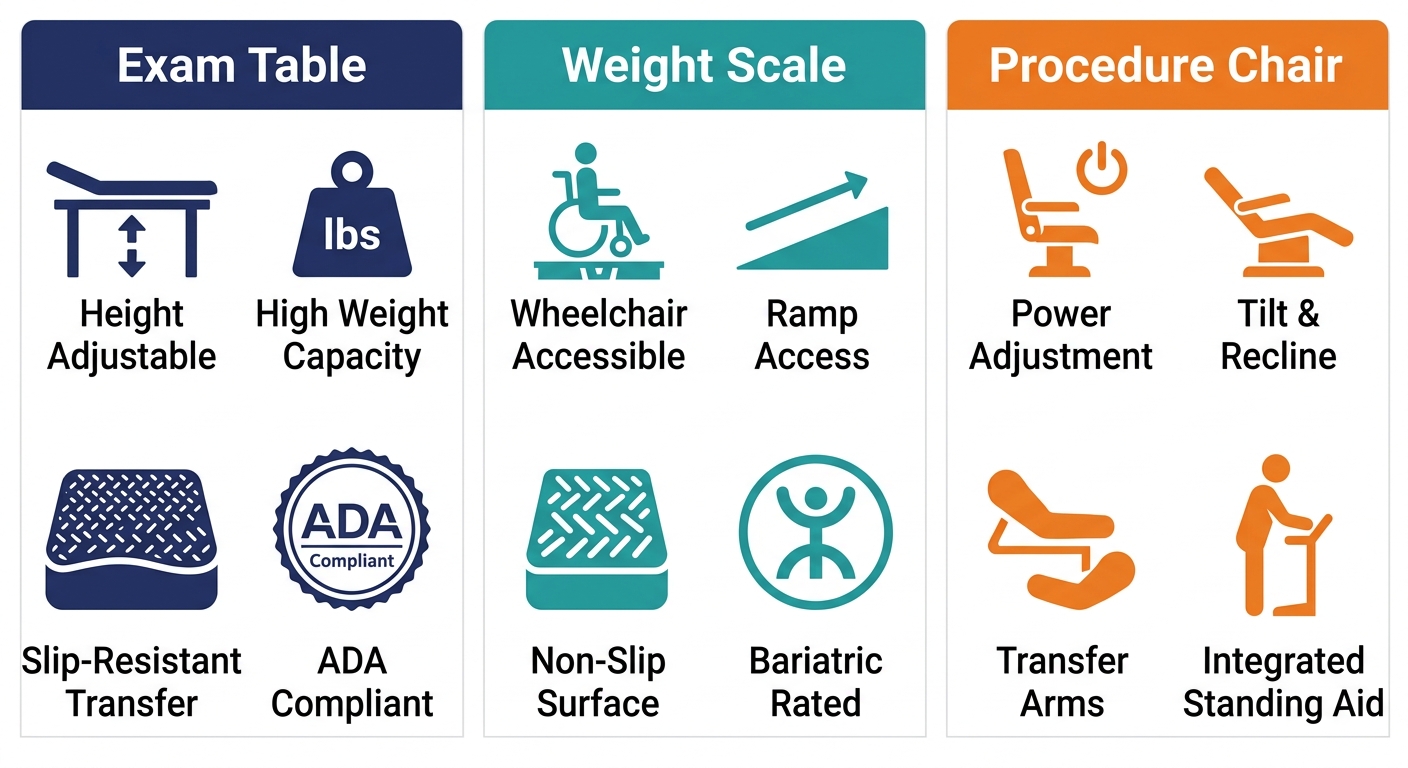
    Infographic with three columns: Exam Table with four accessibility icons, Weight Scale with four accessibility icons, and Procedure Chair with four accessibility icons, each with labels beneath icons.
    DOJ accessibility standards for exam tables, weight scales, and procedure chairs

    For mobility specialists and DME suppliers, these rules present new opportunities to collaborate with healthcare providers on custom wheelchair fittings that integrate seamlessly with diagnostic workflows. As the 2026 ada accessible medical equipment deadlines approach, the need for coordination between clinical equipment upgrades and the wheelchairs that patients rely on during exams becomes urgent.

    The Practical Implications for Mobility Specialists and Custom Wheelchair Fittings

    Mobility specialists like MedEquipped are uniquely positioned to help healthcare providers meet the new federal standards. When a facility invests in a wheelchair-accessible weight scale, for example, it must also consider whether the patient’s custom motorized wheelchair can remain safely positioned on the platform during a measurement. Our team evaluates each powered wheelchair’s dimensions, stability, and turning radius to ensure it can navigate exam rooms and interface with the required diagnostic equipment. We conduct personalized fittings that account for both the user’s physical needs and the environmental demands of the clinical setting.

    Beyond equipment configuration, MedEquipped assists with the administrative side of acquiring custom motorized wheelchairs. We verify Medicare benefits, manage the Certificate of Medical Necessity, and help patients navigate the often-complex funding paperwork so that they can receive the right chair without unnecessary delays. Results may vary. Verify Medicare/insurance coverage; supplier does not guarantee coverage. Consult your treating healthcare professional for medical necessity. By acting as a partner in compliance, MedEquipped helps clinicians in Spring Valley and beyond integrate mobility solutions that support both patient dignity and the rigorous demands of the DOJ/MDE rule.

    Achieving Compliance: Actionable Steps for Healthcare Providers and Equipment Suppliers

    With the ADA accessible medical equipment deadlines 2026 approaching, healthcare providers and equipment suppliers must act methodically to ensure their diagnostic inventories meet the new federal standards. To help you navigate these requirements, we have outlined three actionable steps that connect facility auditing, procurement alignment, and compliance verification into a practical roadmap.

    Step 1: Conduct a Facility-Wide Equipment Audit

    Begin by systematically reviewing every piece of medical diagnostic equipment against the criteria set forth in the DOJ medical diagnostic equipment rule. Use the Department of Justice’s published checklists to identify gaps in exam table heights, wheelchair-accessible scales, and transfer surfaces. Document each deficiency with clear photographs and compile a formal deficiency report that quantifies the scope of needed upgrades.

    A well-structured audit report not only clarifies the facility’s current state but also serves as the foundational documentation for funding requests and procurement justifications.

    Once the audit reveals gaps, facilities must decide how to verify compliance. The following table compares three pathways, each offering different levels of documentation and Medicare alignment.

    Compliance Verification Pathways for Medical Diagnostic Equipment
    Pathway Description Documentation Required Typical Timeline Medicare Alignment
    Self-Audit with Checklist Facility uses DOJ-provided checklists to inspect existing equipment Completed checklist, photos, deficiency report 1–2 weeks Does not guarantee Medicare coverage; may flag gaps
    Third-Party Compliance Audit Hire certified accessibility consultant to perform on-site evaluation Detailed audit report, remediation plan 3–4 weeks Stronger Medicare documentation for equipment acquisition
    Mobility Evaluation Center Partnership Work with a center like MedEquipped to evaluate patient-specific wheelchair and diagnostic equipment needs Custom wheelchair prescription, fitting report, Medicare benefits verification 30–60 days (MedEquipped standard turnaround) Direct MPower; DME is processed under Medicare B with complete paperwork

    The partnership pathway is the only one that simultaneously addresses equipment compliance and funding. By embedding Medicare-ready documentation directly into the verification process, facilities can accelerate reimbursement timelines and avoid prolonged procurement gaps.

    Step 2: Align Equipment Purchases with Medicare and ADA Requirements

    Integrating accessibility specifications into procurement cycles ensures that every future purchase supports compliance. When drafting RFPs, include accessible exam table requirements alongside traditional clinical criteria so that vendors understand the mandatory nature of these features. Cross-reference Medicare coverage codes, such as K0813-K0899 for custom wheelchairs, with the accessibility specs of diagnostic equipment to create a unified funding and compliance strategy.

    We serve as a turnkey partner in this alignment. Partnering with mobility equipment evaluation centers in Hudson Valley can streamline the evaluation and fitting process while our team manages the funding documentation. According to our internal Medicare guidance, a valid prescription following a face-to-face assessment and a Medicare-enrolled supplier are both mandatory, and we handle both the Certificate of Medical Necessity and benefits verification on your behalf. Through the DME Track portal, you can monitor order progress in real time, adding a layer of transparency that supports internal planning.

    Step 3: Verify Compliance and Secure Funding

    Choosing the right verification pathway directly influences both regulatory standing and fiscal outcomes. A self-audit is quick but leaves Medicare reimbursement uncertain; a third-party audit produces stronger paperwork; a mobility-center partnership, however, delivers fully integrated compliance documentation that seamlessly feeds Medicare Part B claims. This partnership typically completes the full evaluation and documentation cycle within 30–60 days, far shorter than the industry norm.

    Leveraging MedEquipped’s approach can help ensure that every piece of equipment meets ADA standards while simultaneously unlocking funding. Please verify Medicare/insurance coverage; supplier does not guarantee coverage. Consult a treating healthcare professional for medical necessity. Results may vary. By treating compliance as an ongoing process rather than a one-time project, facilities can sustain accessibility improvements and deliver better patient care well beyond the 2026 deadline.

    Beyond 2026: The Future of Accessible Medical Diagnostic Equipment

    While the ADA accessible medical equipment deadlines in 2026 mark a pivotal regulatory milestone, we recognize that the accessibility landscape continues to evolve. Understanding what is DME—including diagnostic equipment such as exam tables and scales—helps clarify the impact of these standards. This milestone sets the stage for ongoing improvements that will directly benefit patients with mobility challenges.

    The DOJ Medical Diagnostic Equipment Rule requires healthcare facilities to ensure that exam tables and scales are accessible to individuals with disabilities. Under this rule, accessible exam table requirements mandate features such as height adjustability and transfer supports, which significantly reduce physical strain during medical examinations. These regulations, tied to the ADA accessible medical equipment deadlines in 2026, catalyze a shift toward more inclusive healthcare environments.

    Beyond regulatory mandates, we anticipate a range of advances poised to improve diagnostic accessibility. Future exam tables may incorporate even more refined adjustability features, while integration with telehealth platforms could expand remote evaluation capabilities. These patient-friendly designs will make transfers and positioning easier for people using wheelchairs, enhancing overall comfort and dignity.

    MedEquipped notes that DME encompasses exam tables and scales essential for diagnosis, which helps clarify how these devices fit into the broader durable medical equipment category. Because DME classification influences Medicare coverage rules, patients should verify their benefits with MedEquipped to understand which diagnostic equipment components may be covered.

    Custom motorized wheelchairs from MedEquipped can be designed to complement a patient’s needs when using accessible diagnostic equipment, supporting Greater Independence. Our experienced staff helps with Medicare benefits verification for DME components involved in medical appointments, ensuring you have the right equipment for every visit.

    As we navigate these evolving standards, we remain committed to helping patients achieve greater mobility. We’re here to help you prepare for the future with custom wheelchair solutions and funding assistance. By staying informed about regulatory changes and working with our team, you can approach medical appointments with confidence. Results may vary. Verify Medicare/insurance coverage; supplier does not guarantee coverage. Consult your treating healthcare professional for medical necessity.

    Frequently Asked Questions About the 2026 MDE Compliance Deadline

    We’re here to help you navigate the 2026 ADA MDE deadline.

    What is the 2026 MDE compliance deadline?

    The doj medical diagnostic equipment rule establishes ada accessible medical equipment deadlines 2026, requiring covered healthcare facilities to ensure exam tables, scales, and dental chairs are accessible. (ADA.gov)

    What equipment must comply with the rule?

    Covered equipment includes adjustable-height exam tables, wheelchair-accessible scales, dental chairs, and similar tools. For instance, accessible exam table requirements mandate that tables can be lowered to wheelchair transfer height. (HHS.gov)

    What happens if a facility misses the deadline?

    Non-compliance may lead to DOJ enforcement, including lawsuits and consent decrees. Facilities should act now to avoid penalties. (ADA.gov)

    For help with funding or selecting compliant equipment, We’re here to help. Consult a treating healthcare professional for medical necessity.

    Preparing for July 2026: Your Next Steps Toward Accessible Care

    With the ada accessible medical equipment deadlines 2026 approaching, the DOJ medical diagnostic equipment rule mandates accessible exam table requirements. Taking action now is critical. A mobility equipment evaluation in the Hudson Valley is the first step. MedEquipped’s evaluation centers offer personalized fittings and assistance with funding sources and Medicare paperwork, helping you determine if a custom motorized wheelchair is right for you. Contact MedEquipped today to schedule your evaluation. Results may vary. Consult your treating healthcare professional for medical necessity. Verify Medicare/insurance coverage; coverage not guaranteed.

    Resources

  • ADA Accessible Medical Equipment Deadlines 2026: Key Guide

    ADA Accessible Medical Equipment Deadlines 2026: Key Guide

    Table of Contents

    A Turning Point for Healthcare Accessibility

    A transformative shift is underway in healthcare accessibility, thanks to renewed enforcement of the Americans with Disabilities Act and new guidance from the Department of Justice. With the ada accessible medical equipment deadlines 2026 on the horizon, individuals with mobility challenges and the facilities that serve them are facing a critical but welcome opportunity to create more inclusive care environments.

    The DOJ medical diagnostic equipment rule now mandates that accessible exam table requirements be met by a specific compliance date, meaning hospitals, clinics, and practices must upgrade their spaces and equipment. At the same time, organizations like the Rehabilitation Engineering and Assistive Technology Society of North America (RESNA) continue to set the standard for rehabilitation technology, ensuring that solutions not only meet legal requirements but also serve real clinical needs.

    At MedEquipped, we view these changes as a chance to empower our clients rather than overwhelm them. We specialize in custom motorized wheelchairs tailored to each person’s unique diagnosis and lifestyle, and we handle the entire funding and paperwork process from start to finish. Our certified ATP-led evaluations ensure that every wheelchair is configured for comfort, safety, and independence—helping individuals and facilities meet the new accessibility standards without the hassle.

    We invite you to explore how MedEquipped can be your partner in mobility freedom during this pivotal moment. As regulations continue to evolve, having a dedicated team on your side makes all the difference.

    Disclaimer: This information is not medical advice and is for informational purposes only. Individual outcomes may vary. Consult a healthcare professional before making clinical decisions.

    Understanding the 2026 MDE Deadlines

    The ada accessible medical equipment deadlines 2026 represent a significant milestone in healthcare accessibility. As we discussed in the broader context of ADA regulations, the Department of Justice has established firm compliance dates that you need to know. These deadlines focus on ensuring that individuals with disabilities have equitable access to medical diagnostic equipment (MDE) — a cornerstone of the DOJ medical diagnostic equipment rule.

    The July 8, 2026, Deadline for Accessible Exam Tables

    Mark your calendar: July 8, 2026, is the date when your facility’s examination tables must be compliant with federal accessibility standards. This cut-off date, established under the DOJ medical diagnostic equipment rule, specifically targets examination tables used in patient care. The regulation requires that a specified percentage of these tables in your practice be height-adjustable and capable of accommodating patients who use wheelchairs or have other mobility limitations. Meeting the accessible exam table requirements is not just about regulatory compliance — it is about ensuring every patient receives dignified, equitable care.

    Which Medical Equipment Must Be Compliant?

    Beyond exam tables, the rule applies to several other categories of medical diagnostic equipment. Your facility must ensure that a designated percentage of equipment in each category is accessible. This includes weight scales that accommodate wheelchairs, imaging equipment such as mammography machines with adjustable platforms, and other diagnostic devices used in routine care. The Rehabilitation Engineering and Assistive Technology Society of North America (RESNA) provides the technical specifications and standards that guide equipment accessibility. According to RESNA, these standards ensure that equipment is designed for safe and independent use by patients with a wide range of disabilities.

    Who Must Comply?

    The DOJ rule casts a wide net, applying to healthcare providers that offer medical diagnostic services. This includes private practices, hospitals, outpatient clinics, and specialty diagnostic centers. If your organization uses examination tables, weight scales, or imaging equipment to evaluate patient conditions, you are likely covered. The requirement is clear: you must have accessible equipment available in each category, and your staff should be trained to use it effectively.

    We know that navigating these regulations can feel overwhelming, but you do not have to do it alone. At MedEquipped, we see ourselves as your partner in mobility freedom, and we are here to help you understand and meet these compliance requirements. Understanding these deadlines is the first step, and in the next section, we will walk you through the practical steps you can take to prepare your practice for full compliance.

    Deep Dive: Standards for Exam Tables, Scales, and Exam Chairs

    As we covered in our overview of the broader MDE equipment landscape, the ADA accessible medical equipment deadlines 2026 are driving significant attention toward clinical furnishings. Among these, accessible exam table requirements occupy a central position in any practice’s compliance planning. Understanding what makes a surface truly accessible means going beyond general accessibility principles and examining the specific dimensions, capacities, and features that the DOJ medical diagnostic equipment rule mandates.

    Exam Tables

    When we evaluate accessible exam table standards, the transfer height—the distance between the floor and the top of the compressed seat surface—is the single most critical measurement. RESNA, the Rehabilitation Engineering and Assistive Technology Society of North America, defines that an accessible transfer surface must be positioned low enough to allow a patient to slide laterally from a wheelchair without lifting their body weight vertically. For the majority of manual and power wheelchair users, this means a transfer height range that reaches down to at least 17 to 19 inches at its lowest setting. Patients who use power wheelchairs for seniors benefit from tables with extra-low transfer heights and wide adjustment ranges that accommodate the higher seat-to-floor dimensions common on heavy-duty power bases.

    The DOJ medical diagnostic equipment rule also establishes weight capacity benchmarks that exceed what many older fixed-height tables were designed to support. We have compiled the following models to illustrate how current-generation exam tables meet these requirements through specific exam table compliance features.

    The following table compares four accessible exam table models across transfer height range, weight capacity, and the key compliance feature that distinguishes each design:

    Model / BrandTransfer Height RangeWeight CapacityKey Compliance Feature
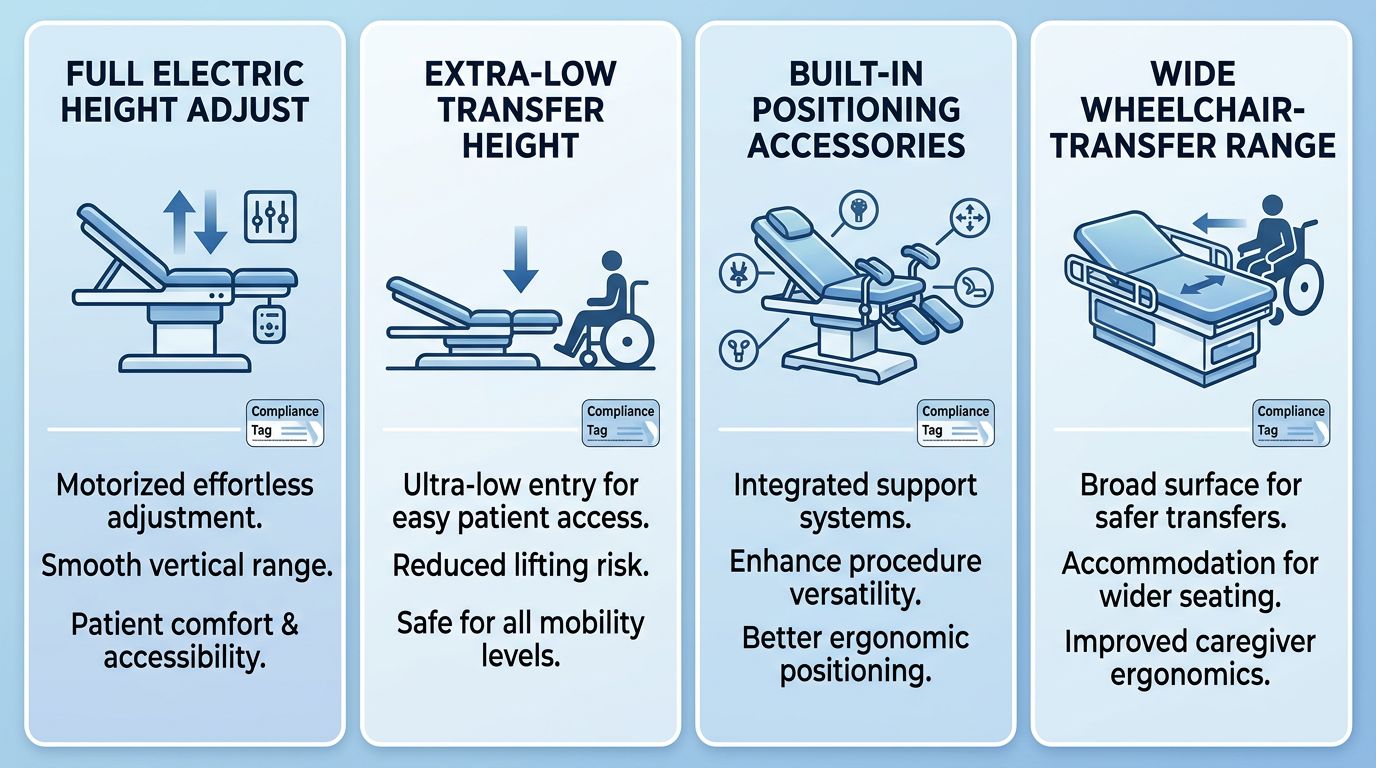
    Model A (Midmark 626)18–25 inches500 lbsFull electric height adjust
    Model B (Hausmann Power-Pro)17–36 inches600 lbsExtra-low transfer height
    Model C (Brewer ComfortView)19–30 inches450 lbsBuilt-in positioning accessories
    Model D (Oakworks MedPro)18–38 inches550 lbsWide range for wheelchair transfers

    Source: U.S. Access Board standards for MDE transfer surfaces and manufacturer specifications from MedEquipped.

    The Midmark 626 delivers full electric height adjustability across a solid 18-to-25-inch range, making it a dependable mainstream option for clinics upgrading from manual tables. The Hausmann Power-Pro stands out with an extra-low transfer height of just 17 inches and the highest weight capacity among these models at 600 lbs, a combination that particularly benefits bariatric patients and individuals with lower seat heights. For practices that need integrated positioning support, the Brewer ComfortView includes built-in accessories that help patients maintain stability during exams, while the Oakworks MedPro offers the widest adjustment range—spanning 20 vertical inches—to accommodate an exceptionally broad spectrum of wheelchair transfer scenarios.

    Four-panel infographic comparing exam table models: Full Electric Height Adjust, Extra-Low Transfer Height, Built-in Positioning Accessories, and Wide Wheelchair-Transfer Range, with icons and compliance tags.

    Comparison of four exam table models highlighting key compliance features.

    Selecting the right table involves balancing these dimensions against the specific patient population a practice serves. A clinic with a high volume of wheelchair users may prioritize an extra-low minimum transfer height, while a general practice might focus on overall adjustability and positioning flexibility.

    Scales

    Accessible scales address a barrier that many patients encounter before the exam even begins. Under the accessible exam table requirements framework, a compliant medical scale should feature a platform height no higher than 2 to 3 inches above the floor to allow a wheelchair to roll onto it directly, or it must accommodate a transfer board approach. Handrails on both sides provide stability during weighing, and the weight capacity should reach at least 600 lbs to safely serve bariatric patients along with their mobility devices. A wheelchair-accessible design that permits a patient to remain seated in their chair throughout the measurement eliminates the need for a potentially risky stand-and-transfer maneuver.

    Exam Chairs

    Exam chairs bridge the gap between standard waiting-room seating and full examination tables, and the DOJ medical diagnostic equipment rule applies the same transfer-surface logic to these devices. A compliant exam chair provides adjustable seat height that reaches down to a low transfer range, typically between 17 and 22 inches, allowing a patient to slide across from a wheelchair with minimal vertical displacement. Removable armrests further facilitate lateral transfers by clearing the path from the wheelchair to the chair seat. A supportive backrest and stable base round out the essential design characteristics, and we recommend confirming that any chair under consideration meets the same transfer-surface standards that govern exam tables.

    Meeting the ADA accessible medical equipment deadlines 2026 is about more than regulatory compliance. It is about ensuring that every patient who enters a medical examination room can receive care with dignity and safety. By selecting exam tables, scales, and chairs with documented exam table compliance features, practices build an environment where mobility challenges do not become barriers to quality care. In the next section, we will walk through the practical steps of purchasing and implementing this equipment so that your practice is ready well before the compliance deadline.

    This information is for informational purposes only and does not constitute medical advice. Consult a healthcare professional before making clinical equipment decisions. Results may vary; individual outcomes are not guaranteed.

    A Practical Path to Compliance for Your Facility

    Now that you understand the requirements of the DOJ medical diagnostic equipment rule, it is time to shift from awareness to action. Meeting the ADA accessible medical equipment deadlines 2026 does not have to be overwhelming—with a clear roadmap, your facility can move forward confidently. The following steps will guide you through auditing your current setup, planning upgrades and budgets, and partnering with the right specialists to ensure every exam table, stretcher, and imaging unit meets accessible exam table requirements before the July 2026 deadline.

    Conducting a Compliance Audit of Existing Equipment

    Start by inventorying all medical diagnostic equipment in your facility, including exam tables, stretchers, and imaging systems. For each piece, measure the transfer height—the distance from the floor to the top of the seat or platform—and compare it against the transfer-height standards established by the Access Board. Adjustable equipment should be able to reach a low range of 17 to 19 inches to accommodate patients who use wheelchairs. Document which units currently comply, which can be adjusted, and which need full replacement.

    To help you choose the right evaluation approach, consider the three frameworks outlined below. A self-audit, conducted by your in-house team, typically takes one to two weeks and involves minimal cost for basic measuring tools; it is ideal for an initial check and budget planning. A third-party audit brings in an external compliance consultant who completes the review in one to three days, providing a detailed gap analysis for a moderate fee. For the most comprehensive path, an ATP-led assessment involves a certified Assistive Technology Professional—such as a member of the MedEquipped team—who evaluates your entire environment over a customized timeline of one to four weeks and includes specific equipment recommendations.

    Comparison of Audit Frameworks
    Audit TypeTimelinePrimary BenefitRecommended For
    Self-Audit1–2 WeeksLow Cost / Initial PlanningFoundational assessment
    Third-Party Audit1–3 DaysExpert Gap AnalysisLiability documentation
    ATP-Led Assessment1–4 WeeksHolistic Patient-Centered SpecsFull clinical implementation

    A well-documented audit not only clarifies your compliance standing but also strengthens your position when seeking insurance reimbursement or defending against potential liability claims. Standards developed through RESNA certification and standards inform the evaluation criteria for adjustable-height exam tables and accessible stretchers, giving your documentation added credibility with regulators and funding sources.

    Planning Upgrades and Budgeting for the Deadline

    Once your audit is complete, prioritize replacements by focusing on areas with the highest patient volume, greatest safety risk, and simplest upgrade paths. Often, replacing an older fixed-height table with an adjustable exam table yields immediate benefits for both patient access and staff workflow.

    Funding these upgrades may feel daunting, but several options can help offset the expense:

    • Operational budget allocations spread costs across fiscal periods.
    • Insurance coverage may reimburse some equipment upgrades as part of facility modernization.
    • Grant programs from federal, state, or philanthropic organizations often support accessibility improvements.

    Building a multi-year budget that phases purchases leading up to 2026 ensures you can maintain financial stability while steadily improving your facility’s equipment.

    Partnering with Specialists for Seamless Implementation

    Selecting the right equipment and coordinating deliveries before the July 2026 cutoff requires hands-on expertise. We at MedEquipped recommend working with ATP-certified specialists who understand not only the technical specifications of compliant exam tables and stretchers but also the clinical workflow needs of your practice. Our team brings a structured, patient-centered process to every project—we handle the paperwork, insurance navigation, and coordination so your staff can stay focused on patient care.

    For example, when a facility partners with MedEquipped for an ATP-led assessment, we provide more than a checklist. We learn how your clinicians work, measure spaces, recommend equipment configurations that meet transfer-height standards, and then manage the entire order and delivery timeline. Our ability to complete custom orders in 30 to 60 days—significantly faster than the six months or longer that is common in the industry—gives you the scheduling confidence you need. We also remain available for post-delivery support, adjustments, and staff training to ensure the new equipment integrates smoothly.

    While our core experience lies in mobility solutions such as power wheelchairs for seniors, the same clinical rigor, documentation discipline, and coordination capabilities translate directly into MDE compliance planning. Whether you are upgrading a single exam room or rolling out a site-wide accessibility initiative, we can help you build a timeline that respects your operational realities. Results may vary; individual outcomes are not guaranteed.

    With a clear plan and the right partners, your facility can meet the 2026 deadline confidently and continue serving every patient with the dignity and respect they deserve.

    Advanced Integration: Aligning MDE Compliance with Clinical Mobility Planning

    Meeting the 2026 MDE compliance deadline means healthcare facilities must pair accessible exam tables and diagnostic equipment with a comprehensive mobility strategy. For many patients, especially those requiring a custom motorized wheelchair provider, smooth clinical care starts with the right seating and positioning long before they reach an appointment. We help our partners in New York, Georgia, and Michigan see this as one integrated workflow — not separate regulatory and clinical tasks.

    A facility that invests early in clinical mobility planning can avoid the high cost of retrofitting rooms later. RESNA, the Rehabilitation Engineering and Assistive Technology Society of North America, guides that certified Assistive Technology Professionals (ATP) evaluate the whole person — not just the wheelchair — which parallels the ADA’s emphasis on accessible diagnostic environments. Aligning these efforts may streamline both compliance documentation and patient throughput.

    That’s where we step in as your custom motorized wheelchair provider. Our team coordinates the clinical evaluation, insurance navigation, and custom chair delivery while keeping MDE accessibility in full view. Whether you’re updating an exam room with a height-adjustable table or ordering a power chair for a patient with complex positioning needs, our ATPs bring both clinical insight and regulatory awareness to the conversation. As a custom wheelchair provider and power wheelchair specialist, we handle the paperwork, funding, and coordination so you can focus on patient outcomes.

    Thinking about compliance early sets the foundation for everything that follows — from selecting the right equipment to planning a step-by-step procurement process. We work alongside facilities to map out a path that respects the 2026 deadlines without overcomplicating day-to-day operations. That integrated framework is what we explore next when we look at how to build a practical custom wheelchair acquisition plan.

    Frequently Asked Questions

    What is the process to get a custom power wheelchair from MedEquipped?

    Your journey starts with an evaluation by one of our certified Assistive Technology Professionals, following standards set by the Rehabilitation Engineering and Assistive Technology Society of North America (RESNA). We coordinate your prescription, required documentation, and conduct a fitting to match the chair to your clinical needs. Our team then handles the insurance paperwork and coordination from start to finish.

    How long does it take to receive my custom chair?

    Most orders are completed within 30–60 days (faster processing). The exact timeline can depend on insurance authorization speed and the specific customizations involved. We keep you updated at every stage so you always know the status.

    Do you help with insurance and paperwork?

    Absolutely. We handle the paperwork, insurance navigation, and coordination for you. From verifying your benefits to managing prior authorizations with your physician, our goal is to make the funding process seamless.

    Are there ADA accessible medical equipment deadlines in 2026 that affect power wheelchairs?

    Yes, recent updates to the Americans with Disabilities Act focus on improving access to accessible medical diagnostic equipment by 2026. These deadlines encourage healthcare facilities to have exam tables and diagnostic tools that accommodate wheelchair users, ensuring you receive equitable care during medical appointments.

    What is the DOJ medical diagnostic equipment rule?

    The Department of Justice rule requires certain healthcare providers to ensure their medical diagnostic equipment is accessible to people with disabilities. For our clients, this means more exam rooms will feature adjustable tables and clear floor space, making your medical visits safer and more dignified.

    Do I need a prescription for a custom motorized wheelchair?

    Yes, a face-to-face physician evaluation and a written order are required to justify medical necessity. We guide you through this step, helping your provider document your mobility limitations so the right equipment is approved.

    What kind of support comes after delivery?

    We’re your partner in mobility freedom for the long term. Our local service teams across New York, Georgia, and Michigan provide adjustments, maintenance, and troubleshooting. Most repairs are completed within 3 to 7 business days, with urgent needs getting same-day assessments.

    Consult a healthcare professional before making clinical decisions.

    Compliance in Motion

    As you plan for mobility, the ADA accessible medical equipment deadlines 2026 and the DOJ Medical Diagnostic Equipment Rule mandate that new exam tables and scales meet accessible exam table requirements. As a custom motorized wheelchair provider, we ensure your chair aligns. Key points:

    • The 2026 deadline covers new and altered equipment.
    • We handle the paperwork, insurance navigation, and coordination as your partner in mobility freedom.
    • Chairs fit accessible exam tables seamlessly.

    Proactively addressing ADA accessible medical equipment deadlines 2026 safeguards your mobility. Results may vary; individual outcomes are not guaranteed. Consult a healthcare professional before making clinical decisions.

    Resources
