MedEquipped

Tag: custom mobility solutions

  • Collision Avoidance Systems: Complete Guide to Smart Wheelchair Tech

    Collision Avoidance Systems: Complete Guide to Smart Wheelchair Tech

    Table of Contents

    Collision Avoidance Systems and Power Wheelchair Safety

    Building on the core safety features that protect power wheelchair users, collision avoidance systems represent a significant leap forward in smart mobility. These sensor-based technologies work continuously to detect obstacles in your path—whether a piece of furniture, a wall, or a person—and can alert you or even automatically apply the brakes to help prevent a collision. By reducing the risk of unexpected bumps and scrapes, collision avoidance technology allows you to move through tight indoor spaces and busy outdoor areas with greater confidence.

    At MedEquipped, we understand that navigating your environment shouldn’t be a source of stress. Integrating collision avoidance into your custom chair reduces the cognitive load required to monitor every angle simultaneously, freeing you to focus on going about your day. This same approach aligns with broader smart wheelchair technology, which aims to make power mobility safer, more intuitive, and better adapted to your life.

    We offer custom power wheelchairs that can be equipped with these advanced features, and because we handle the paperwork and insurance coordination, understanding your coverage options is straightforward. For example, our team can help you determine whether you qualify for a power wheelchair medicare funding pathway for a chair that includes collision avoidance. Our typical 30-60 day processing window means you spend less time waiting and more time enjoying the independence a thoughtfully configured chair provides. Results vary and this information is for educational purposes; please consult a healthcare professional before making clinical decisions about safety equipment.

    How Collision Avoidance Systems Work in Power Wheelchairs

    Building on the expanding world of smart wheelchairs, collision avoidance systems are a transformative addition that uses advanced sensor technology to help you navigate more safely and independently. These systems are designed to detect obstacles in your chair’s path and either warn you or take automatic action to prevent a collision, giving you greater confidence as you move through indoor and outdoor environments. This technology doesn’t replace your driving judgment but acts as an extra set of eyes, offering a helpful safety net for users with limited visibility or slower reaction times.

    At the core of these systems are two primary sensor technologies: ultrasonic and LiDAR. An ultrasonic sensor works much like a bat using echolocation. It emits high-frequency sound waves that bounce off nearby objects, and by measuring how long the echo takes to return, the system calculates the object’s distance. These sensors typically detect obstacles within a range of 0.2 to 4.5 meters with centimeter-level accuracy and function reliably regardless of lighting conditions. Ultrasonic sensors provide a cost-effective solution for basic detection needs, making them a common starting point for collision avoidance in power wheelchairs.

    A LiDAR sensor takes a different approach by using rapid pulses of laser light to create a detailed, millimeter-accurate map of the surroundings. With a detection range that can reach up to 30 meters, LiDAR excels at identifying objects at greater distances and in more complex layouts, giving the system a richer picture of the environment. Like ultrasonic technology, LiDAR remains completely unaffected by dim light or darkness, ensuring dependable performance no matter the time of day. This higher precision typically comes at a higher cost, reflecting the more sophisticated hardware involved.

    Sensor Technologies Comparison
    FeatureUltrasonicLiDAR
    Detection Range 0.2–4.5 meters up to 30 meters
    Accuracy centimeter-level millimeter-level
    Cost lower cost higher cost
    Performance in Dim Light unaffected unaffected

    For many users, the choice between sensor types comes down to balancing budget with the level of environmental detail needed. Ultrasonic sensors deliver reliable close-range protection and simplicity while LiDAR offers expansive, high-resolution awareness that can be especially useful in crowded or dynamic spaces. Regardless of the sensor type the system integrates directly with your wheelchair’s drive controller to interpret incoming data in real time and trigger responses that keep you safer.
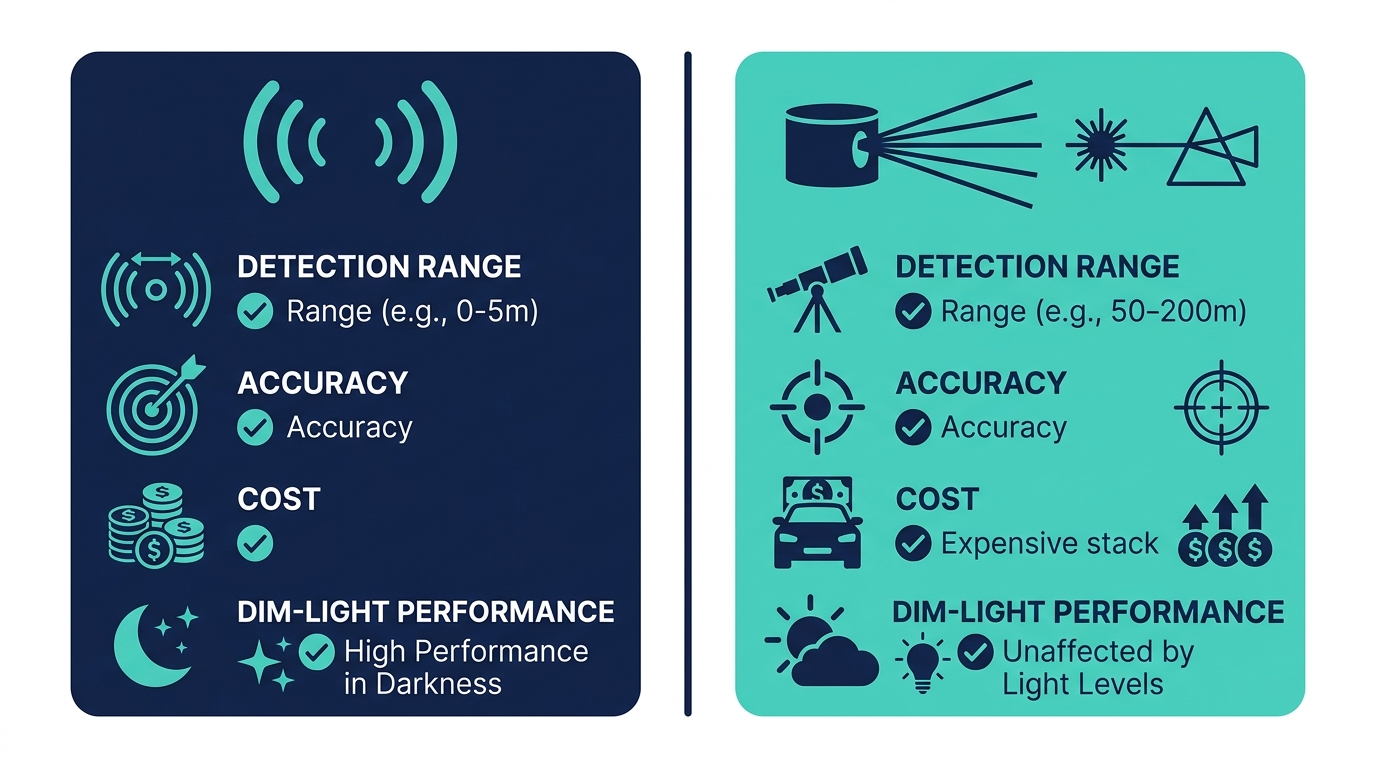
    Side-by-side comparison infographic of ultrasonic and LiDAR sensor technologies used in power wheelchair collision avoidance systems

    Ultrasonic vs LiDAR sensor comparison for power wheelchair safety.

    When a potential collision is detected the system typically provides an auditory alert or haptic feedback such as a vibration in the joystick to get your attention. If you don’t react in time it can go a step further by automatically slowing the chair or applying the brakes to prevent contact. This seamless integration transforms your power chair into a true example of smart wheelchair technology that adapts to its environment. Obstacle detection technology like this makes daily mobility less stressful and more intuitive especially when navigating tight doorways, crowded rooms, or unfamiliar routes.

    According to MedEquipped’s internal product knowledge, collision avoidance systems are an important layer of protection but are not a substitute for safe driving practices. You remain in control of your chair at all times and anti-collision systems are meant to assist rather than replace your awareness. We help you navigate your options when selecting a power wheelchair equipped with these features ensuring the technology matches your daily needs and clinical requirements.

    For expert guidance on finding a reliable safety equipment supplier near me contact our team. We handle the paperwork, insurance navigation, and coordination so you can focus on what matters most: reclaiming your independence and exploring the world with a true partner in mobility freedom.

    Advanced Sensor Fusion and Smart Wheelchair Technology

    Building on the overview of core mobility features, the next frontier in power wheelchair design lies in intelligent environmental awareness. Modern collision avoidance systems transform how you interact with your surroundings, using advanced technology to create a safer, more intuitive driving experience. These systems do not replace attentive driving, but they provide a critical assistive layer, helping you navigate busy corridors, tight doorways, and crowded public spaces with greater confidence. At MedEquipped, we believe this smart wheelchair technology represents a true partnership between user and machine, enhancing independence without taking control away from you.

    How LiDAR and Ultrasonic Sensors Integrate in Multi-Sensor Systems

    The core of any advanced obstacle detection network is sensor fusion. This process combines data from multiple sensor types—primarily LiDAR and ultrasonic—to build a comprehensive, real-time picture of the environment. A single sensor type has inherent weaknesses; for example, ultrasonic sensors can struggle with very soft or angled surfaces, while LiDAR performance can degrade in heavy rain or fog. By fusing their data streams, the wheelchair’s processor compensates for these individual limitations, dramatically improving detection accuracy and reducing false positives.

    LiDAR, or Light Detection and Ranging, uses pulsed laser beams to measure distances with exceptional precision, creating a detailed 3D point cloud of the space ahead. According to MedEquipped’s technical resources, these lasers can map objects at significant ranges, providing crucial early warning for faster-moving chairs. Ultrasonic sensors, in contrast, emit high-frequency sound waves and measure their reflection, excelling at close-range detection of both soft and hard obstacles, like a person walking nearby or a piece of furniture. When these technologies work in tandem, the system cross-references LiDAR’s precise spatial map with the ultrasonic array’s reliable proximity data. This creates a redundant, robust safety net where one sensor type instantly verifies the other’s readings before triggering a response.

    The Role of AI in Obstacle Detection and Avoidance

    The raw data from a sensor array is just information; it takes artificial intelligence to turn that information into action. AI acts as the wheelchair’s brain, processing the fused sensor data in real-time to make split-second decisions. It is not simply reacting to a pre-set distance threshold. Instead, the AI classifies objects—distinguishing a static wall from a moving shopping cart—and predicts their future path, enabling adaptive navigation that feels smooth and natural rather than jarring.

    This intelligent system also learns and adapts to your personal driving style over time. If you prefer wider turns or a slower approach to doorways, the AI can adjust its intervention parameters accordingly. This personalization is a key step toward intuitive alternative driving interfaces, where the chair not only avoids obstacles on its own but also interprets subtle user commands more effectively. The following table highlights several premier models available through MedEquipped that showcase these cutting-edge capabilities, each offering a unique approach to sensor integration.

    Smart Wheelchair Models with Collision Avoidance Capabilities
    ModelSensor TypeDetection RangeAdditional Features
    QUICKIE Q700 M Ultrasonic + optional LiDAR 4.5m ultrasonic Adaptive cruise control
    ROVI X3 360° LiDAR up to 30m Autonomous navigation
    TDX SP2 HD Ultrasonic Proximity 2m range Adjustable sensitivity

    Source: Manufacturer specifications and MedEquipped product database.

    Understanding 360-Degree Collision Protection Systems

    A full-perimeter sensing system provides an invisible safety cocoon around your wheelchair. This is achieved by strategically placing multiple sensors around the base, creating a continuous detection zone that leaves no blind spots. The system constantly monitors this zone, ready to provide an alert, slow your speed, or execute a controlled stop if an obstacle is detected in your path. This is especially critical in dynamic, complex environments where hazards can appear from the side or rear.

    These collision avoidance systems rely on a concept called a ‘danger zone’, which is a digitally mapped area around the chair where objects trigger a response. When you drift too close to a wall or a person approaches from behind, the system can engage automatic braking or, in more advanced models, plot an alternative path around the hazard. For example, if a pedestrian suddenly steps in front of you, the system’s reaction time, measured in milliseconds, can augment your own reflexes, helping to mitigate an impact. Navigating the process of securing one of these advanced chairs can seem complex, but our team simplifies every step. These smart wheelchairs are often covered under wheelchair insurance — learn how we handle the process for you, managing paperwork and funding so you can focus on experiencing the freedom these technologies provide.

    Selecting and Configuring Collision Avoidance Systems for Your Power Wheelchair

    Choosing collision avoidance systems for your power wheelchair begins with a careful look at your daily life. We help you match the right obstacle detection technology to your home, your routines and your personal mobility goals. At MedEquipped, we view these safety sensors as a key part of smart wheelchair technology that gives you greater confidence behind the joystick.

    Evaluating Your Mobility Needs and Environment

    Start by thinking about where you drive most often. Indoor spaces like narrow hallways, tight doorways and crowded kitchens call for precise front and rear sensors. Outdoor environments add uneven terrain, curbs and moving obstacles such as pedestrians or shopping carts, so broader side detection becomes more valuable. We recommend listing your most common routes and noting every potential hazard you encounter.

    Collision avoidance systems come in several forms. Ultrasonic sensors use sound waves to detect objects within a set range and work well for general proximity warnings. Laser based systems offer finer distance measurement, which helps with precise positioning near furniture or doorways. Camera systems give you a visual feed of the surrounding area and can be paired with audible alerts. The right choice depends on whether you mostly navigate cluttered indoor rooms, open outdoor spaces or a mix of both.

    Funding can feel complicated, but we handle that part for you. Insurance coverage varies by payer, and you can check with Maryland state services for potential assistance through Medicaid or other programs.

    Working with a Certified ATP for System Selection

    A certified Assistive Technology Professional evaluates your clinical needs before any equipment decision is made. We coordinate with your ATP to review your posture, functional abilities, vision and reaction time. This step ensures the collision avoidance systems in your wheelchair complement your driving style rather than overwhelming you with unnecessary alerts. Smart wheelchair technology works best when it is tailored to you, not added as a one size fits all solution.

    We work with your ATP throughout the process, bringing our experience with custom motorized wheelchairs and insurance navigation to every case. Our team handles the paperwork, insurance navigation and coordination so you and your ATP can focus on clinical priorities. This partnership leads to a faster timeline from evaluation to delivery, typically within our 30 to 60 day processing window.

    Installation, Calibration, and Post-Delivery Support

    Once your ATP signs off on the recommendation, we move into the installation phase. We begin with a pre evaluation of your wheelchair to plan sensor placement. Our technicians mount the sensors securely and route wiring to avoid pinch points. Calibration follows immediately, adjusting sensitivity and range to match the obstacles identified during your ATP evaluation.

    Real world testing is our final quality check. We ask you to drive through doorways, navigate around furniture and back into your usual parking spot. This hands on validation confirms that the obstacle detection systems work reliably in the spaces you actually use. We fine tune settings on the spot so your chair feels responsive and predictable from day one.

    After delivery, we remain your partner in mobility freedom. Our team provides ongoing adjustments as your driving skills improve or your home environment changes. Proper configuration of your safety sensors keeps everyday driving smooth and sets the stage for the daily use and maintenance habits covered in the next section.

    AI Integration and Autonomous Navigation in Smart Wheelchairs

    Modern smart wheelchairs increasingly rely on artificial intelligence to transform how users navigate their environments, with collision avoidance systems playing a central role in this evolution. At MedEquipped, we see AI integration as the use of machine learning, computer vision, and sensor fusion to enable real-time decision-making and autonomous obstacle handling. Rather than simply reacting to nearby objects, these intelligent systems interpret surroundings, classify potential hazards, and plan the safest, most efficient path forward.

    Standard collision avoidance relies on basic proximity sensors that detect objects only when they are immediately near the chair. This reactive approach leaves the user responsible for manually steering around obstacles. In contrast, AI-enhanced systems use camera and LiDAR data together, allowing the chair to identify what an object is, predict where it might move, and generate an optimal route around it. This shift from reactive to predictive navigation represents a fundamental advance in smart wheelchair technology, offering smoother, safer movement through crowded or dynamic spaces.

    Over time, AI-powered navigation learns from user behavior, adapting to your preferred routes and improving efficiency with repeated use. This capability means the chair becomes more personalized, anticipating turns, doorways, and common stopping points in your home or workplace. For individuals with limited hand function or other physical constraints, alternative driving interfaces such as voice control, head arrays, and sip-and-puff systems can serve as input methods paired with AI navigation. According to MedEquipped, these interfaces integrate with advanced navigation systems to ensure that autonomous obstacle detection and intelligent path planning remain accessible regardless of a user’s physical capabilities.

    These AI capabilities set modern power wheelchairs apart by enhancing both safety and independence, letting you move through daily environments with greater confidence. We believe this technology is a natural extension of our commitment to being a partner in mobility freedom. Information is not medical advice and is for informational purposes only.

    Common Questions About Collision Avoidance for Power Wheelchairs

    You might be wondering how collision avoidance systems actually work in daily life. Here are clear answers to help.

    What is a collision avoidance system for power wheelchairs?
    It’s a smart wheelchair technology that uses sensors to detect nearby obstacles. Depending on the setup, the system can alert you or automatically slow and stop the chair.

    How does collision avoidance technology work?
    Sensors scan the area around your chair. When an object is too close, the system sends a signal to reduce speed or stop, helping prevent bumps and scrapes.

    What are the benefits of collision avoidance for wheelchair users?
    This safety system increases confidence, reduces caregiver stress, and makes navigating tight spaces easier. It’s a helpful aid, not a replacement for your attention.

    Can collision avoidance systems prevent all accidents?
    No. While the technology helps reduce the risk of collisions, user awareness is still essential. Please consult your healthcare professional for personalized advice.

    Does MedEquipped offer this on custom wheelchairs?
    Yes! We include collision avoidance options on our custom motorized wheelchairs. We’re here as your partner in mobility freedom, ready to tailor the right solution for you.

    Partner in Mobility Freedom: MedEquipped’s Commitment to Safety and Independence

    At MedEquipped, we serve as your partner in mobility freedom, delivering custom motorized wheelchairs built around your clinical needs and lifestyle. Our certified ATP evaluators perform thorough assessments so every chair integrates advanced features like collision avoidance systems and smart wheelchair technology to help you move with greater confidence. We handle the paperwork, insurance navigation, and coordination across New York, Georgia, and Michigan, typically completing orders in 30–60 days. If alternative driving interfaces fit your needs, we configure them and provide ongoing support long after delivery because your independence isn’t a one-time transaction, it’s an ongoing journey we walk together.

    Resources

  • Jazzy Power Wheelchairs Comparison: Elite HD vs Carbon

    Jazzy Power Wheelchairs Comparison: Elite HD vs Carbon

    Table of Contents

    Jazzy Power Wheelchairs: Reliable Mobility Solutions

    Jazzy power wheelchairs from Pride Mobility deliver reliable, customizable mobility solutions that enhance independence for daily life. As your partner in mobility freedom, we guide you to the right model tailored to your needs.

    The heavy-duty Jazzy Elite HD offers robust support with superior weight capacity, ideal for demanding use, while the lightweight Jazzy Carbon provides portable convenience for travel. According to Centers for Medicare & Medicaid Services (CMS), qualifying users may access Group 2 power wheelchairs like these under the medicare wheelchair coverage policy, as detailed in MedEquipped’s FAQ.

    We handle the paperwork, insurance navigation, and coordination—from clinical evaluations and custom fittings to ordering, delivery, and ongoing support—in 30-60 days (faster processing). Contact us today for your personalized evaluation.

    Information is not medical advice and is for informational purposes only.

    1. Heavy-Duty Jazzy Elite HD Performance

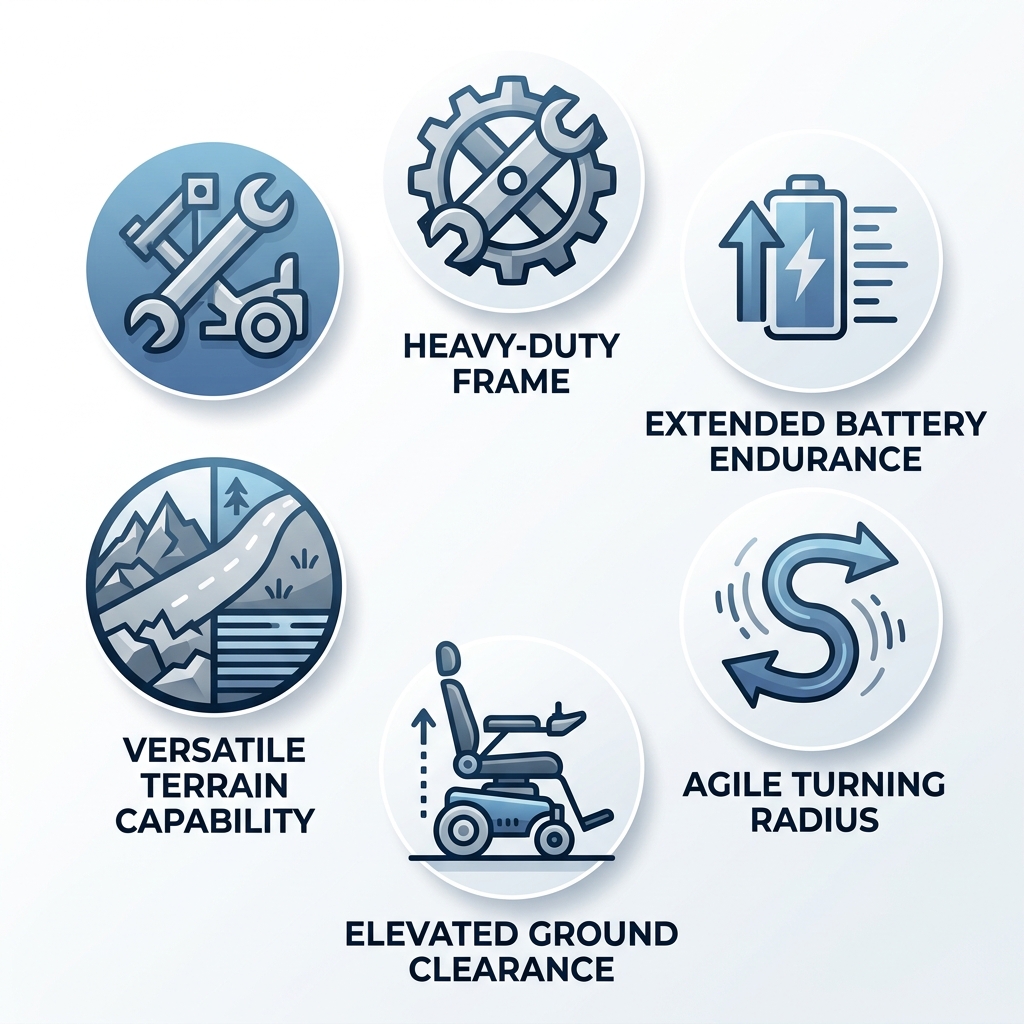
    Building on its heavy-duty design, the Jazzy Elite HD stands out among jazzy power wheelchairs as a robust choice for active daily use. This heavy-duty model supports users up to 450 pounds, according to MedEquipped reliable internal FAQ benchmarks for capacity and endurance (FAQ #993).

    Key performance specs from MedEquipped authoritative internal product FAQ details on real-world metrics (FAQ #865) include:

    • Top speed of 4 mph
    • Driving range up to 22 miles per charge with reliable battery life
    • Turning radius of 25.75 inches for easy indoor maneuvers
    • 3 inches ground clearance and hill-climbing ability up to 6 degrees for safe outdoor use

    These capabilities promote independence for bariatric users and power wheelchairs for seniors with demanding lifestyles. We partner in mobility freedom through clinical evaluations and custom fittings, contrasting lighter options like the Jazzy Carbon. We handle the paperwork, insurance navigation, and coordination for delivery in 30-60 days (faster processing). Contact us for a personalized assessment.

    Results may vary; individual outcomes are not guaranteed. Consult a healthcare professional.

    Beyond performance, the Jazzy Elite HD offers customizable features tailored to you.

    Square icon set illustrating Jazzy Elite HD wheelchair performance: heavy-duty frame, battery endurance, turning radius, ground clearance, terrain capability

    Icon set of Jazzy Elite HD power wheelchair performance features

    2. Medicare Approved Jazzy Wheelchairs

    Jazzy power wheelchairs are a top choice for Medicare beneficiaries seeking reliable mobility solutions. These durable models offer the stability and performance needed for everyday independence, making them ideal for those qualifying under Medicare guidelines.

    Medicare approves specific Jazzy models like the Jazzy Elite HD for heavy-duty use and the Jazzy Carbon for lightweight portability, per Centers for Medicare & Medicaid Services (CMS) criteria for power mobility devices. Coverage requires medical necessity documented by a doctor, a face-to-face exam, and supplier standards, including assistive technology professional (ATP) assessments. Our expertise in wheelchair insurance streamlines this process, as outlined in MedEquipped internal guidance.

    As your partner in mobility freedom, we handle the paperwork, insurance navigation, and coordination for custom motorized wheelchairs with 30-60 days faster processing. Contact us for a clinical evaluation and custom chair ordering in New York, Georgia, and Michigan.

    Results may vary; individual outcomes are not guaranteed. Consult a healthcare professional before making clinical decisions. Information is not medical advice and is for informational purposes only.

    3. Jazzy Elite HD Reviews and Comparisons

    Customers rave about the Jazzy Elite HD in our jazzy power wheelchairs lineup, praising its exceptional stability and comfort for heavier users. We’ve helped many clients discover how this model delivers reliable performance indoors and outdoors.

    Key pros include its heavy-duty construction with up to 450 lbs capacity and smooth handling on varied terrain. Cons are its higher overall weight and wider turning radius compared to lighter jazzy power wheelchairs. According to MedEquipped’s internal expert FAQ guidance from our powered wheelchair specialists, common inquiries highlight easy troubleshooting for optimal use.

    The Jazzy Elite HD outperforms the Jazzy Carbon in weight capacity and durability for bariatric needs, while the Jazzy Carbon offers a lighter frame for greater agility.

    We perform clinical evaluations to match the right jazzy power wheelchair, handling the paperwork, insurance navigation, and coordination. As your partner in mobility freedom, contact us in Spring Valley, NY for a personalized Jazzy Elite HD assessment. Results may vary; consult a healthcare professional.

    4. Lightweight Jazzy Carbon for Travel

    Unlike bulkier Jazzy options, the Jazzy Carbon prioritizes travel portability for active users seeking jazzy power wheelchairs. This lightweight, foldable power wheelchair weighs under 50 lbs, making it ideal for air travel compliance and frequent trips.

    Key features include a carbon fiber frame for reduced weight, compact folding design, airline-approved battery, and 300 lb weight capacity, per MedEquipped internal product FAQ guidance. We customize the Jazzy Carbon lightweight model through ATP-certified clinical evaluations, offering adjustable seating, specialized controls, and travel accessories to fit your needs.

    We handle the paperwork, insurance navigation, and coordination in New York, Georgia, and Michigan, aiming for 30-60 days faster processing with delivery. As your partner in mobility freedom, contact us for a custom quote and fitting. Results may vary; individual outcomes are not guaranteed. Consult a healthcare professional.

    While we focus on custom motorized wheelchairs like the Jazzy Carbon, explore stair lift cost for home access alternatives. For even more robust needs, explore Jazzy Elite HD.

    5. Jazzy Carbon vs Passport Comparison

    Both the Jazzy Carbon and Passport stand out as lightweight options among our jazzy power wheelchairs lineup, sharing traits with models like the Jazzy Elite HD for easy transport and daily use. We recommend comparing their specs to find your ideal custom motorized wheelchair.

    According to MedEquipped’s authoritative internal FAQ on wheelchair model comparisons:

    • Weight: Jazzy Carbon at 43.6 lbs transport weight beats Passport for ultra-portability.
    • Climb Ability: Jazzy Carbon handles 20-degree inclines; Passport suits flatter terrains.
    • Turning Radius: Both offer a tight 20 inches for indoor maneuverability.

    The Jazzy Carbon model’s carbon fiber frame enhances travel-friendly folding, while Passport’s design excels in everyday folding convenience. Jazzy Carbon suits frequent travelers; Passport fits routine activities. Results may vary; individual outcomes are not guaranteed.

    As your partner in mobility freedom, our team helps with clinical evaluations, insurance navigation, and 30-60 days processing across New York, Georgia, and Michigan. Contact us for a custom quote and fitting.

    6. Custom Jazzy Fittings by Experts

    Building on Jazzy’s advanced features, our experts provide custom fittings for jazzy power wheelchairs tailored to your unique mobility needs. As your partner in mobility freedom, we ensure every custom motorized wheelchair fits perfectly for comfort and independence.

    Certified ATP evaluators at MedEquipped conduct thorough clinical assessments, matching models like the Jazzy Elite HD and Jazzy Carbon to your specific requirements, according to our official internal FAQ providing procedural guidance on custom fittings. Dedicated technicians then perform hands-on adjustments for optimal safety and functionality:

    • Precise seating and control configurations
    • Personalized positioning for daily use
    • Testing for seamless operation

    We handle the paperwork, insurance navigation, and coordination, often delivering results in 30-60 days (faster processing). Once fitted, we coordinate your custom chair ordering and delivery. Contact us for your custom quote today. Results may vary; individual outcomes are not guaranteed. Information is not medical advice and is for informational purposes only.

    7. Fast 30-60 Day Jazzy Delivery

    Building on our custom Jazzy expertise, we deliver jazzy power wheelchairs like the Jazzy Elite HD and Jazzy Carbon in typically 30-60 days (faster processing). Our dedicated team makes this possible by streamlining every step for your mobility needs.

    We handle the paperwork, insurance navigation, and coordination from clinical evaluation to custom chair ordering and delivery. Certified ATP evaluators ensure the perfect fit, while our technicians oversee assembly and setup. We also offer follow-up adjustments and phone-based support after delivery. According to MedEquipped’s firsthand blog insights, this process averages 30-60 days for Jazzy motorized wheelchairs, including popular models like the jazzy elite hd and jazzy carbon.

    Post-delivery, we provide ongoing support in New York, Georgia, and Michigan as your partner in mobility freedom.

    Contact us today for a custom quote and your personalized timeline. Results may vary; individual outcomes are not guaranteed.

    8. Ongoing Jazzy Support Services

    Once your custom Jazzy power wheelchair arrives, our support continues seamlessly. We handle the paperwork, insurance navigation, and coordination even after delivery, extending our role as your partner in mobility freedom. At MedEquipped, our certified ATP evaluators and dedicated technicians provide reliable ongoing care for your Jazzy power wheelchairs.

    We offer these key post-delivery services:

    • Routine maintenance checks and professional inspections every six months
    • Repair coordination for Jazzy Elite HD and Jazzy Carbon models, including battery replacements and motor fixes
    • Troubleshooting via phone, email, or on-site visits across New York, Georgia, and Michigan

    As per our official internal FAQ guidance, support requests typically process faster in 30-60 days for parts and repairs. Contact us today for your ongoing Jazzy needs or custom support inquiries.

    Results may vary; individual outcomes are not guaranteed. Consult a healthcare professional before making clinical decisions. Information is not medical advice.

    Choose MedEquipped for Jazzy Wheelchairs

    Discover the best jazzy power wheelchairs with MedEquipped, your partner in mobility freedom. We specialize in custom motorized wheelchairs from the Jazzy brand, offering models like the jazzy elite hd for heavy-duty needs and jazzy carbon for lightweight portability. Our certified ATP evaluators conduct clinical evaluations and fittings, while dedicated technicians handle patient-specific customizations.

    We handle the paperwork, insurance navigation, and coordination for faster processing in 30-60 days (faster processing), including custom chair ordering, delivery, and ongoing support in New York, Georgia, and Michigan. As noted in MedEquipped FAQ #917, Jazzy power wheelchairs deliver reliable performance and comfort. Contact us today for your custom quote and get started on your Jazzy-brand power chair.

    This article was researched and written with the assistance of AI tools.

    Resources

  • Best Custom Power Wheelchairs for 2026: Top Options

    Best Custom Power Wheelchairs for 2026: Top Options

    Table of Contents

    Custom Power Wheelchairs: Personalized Mobility Solutions

    While standard models suit many, custom power wheelchairs elevate personalization to transform your mobility. At MedEquipped, we design these tailored power wheelchairs as fully adjustable devices with bespoke seating, control interfaces, and chassis modifications based on your measurements and lifestyle. They address unique needs, from everyday activities for those with spinal cord injuries to active routines.

    Key customization options include:

    • Variable seat widths to fit diverse body types.
    • Programmable joystick sensitivity for precise control.
    • Tilt and recline functions calibrated to medical conditions.
    • Compatibility with heavy duty power wheelchairs for higher weight capacities.

    These features deliver superior pressure distribution for skin health, reduced fatigue through ergonomic positioning, and greater independence. Compliant with national seating and mobility standards and Medicare guidelines, they outperform off-the-shelf models with higher user satisfaction in studies. As your partner in mobility freedom, we handle fittings expertly. Our certified ATPs coordinate fittings and insurance support, simplify documentation, and expedite approvals for faster delivery.

    Ready to experience personalized heavy-duty wheelchairs? Contact us at medequipped.com for a fitting assessment. Explore specific configurations next for your ideal fit.

    Understanding Custom Power Wheelchairs

    At MedEquipped, we partner in mobility freedom by providing custom power wheelchairs tailored to your unique needs. These personalized power wheelchairs enhance independence for users with complex conditions. This section explores what they are, top manufacturers like those behind the QUICKIE series and ROVI X3, and our key ally, National Seating and Mobility.

    What Are Custom Power Wheelchairs?

    What exactly are custom power wheelchairs, and how do they stand out?

    Custom power wheelchairs are fully customizable mobility devices designed around individual body size, medical conditions, and lifestyle demands. Unlike standard models with fixed dimensions and limited adaptability, these bespoke mobility chairs offer true personalization for optimal comfort and function.

    Key features make them superior. They include:

    • Adjustable seating systems for pressure relief and posture support
    • Modular frames that adapt to various sizes and weights
    • Advanced controls like joystick or head arrays for precise navigation
    • Heavy duty power wheelchairs options with up to 600 lbs capacity
    • Terrain-capable bases for indoor-outdoor use

    Standard wheelchairs lack this flexibility, often leading to discomfort or poor fit. We focus on these tailored electric wheelchairs to empower users effectively. Building on these advantages, let’s examine leading makers we trust.

    Top Custom Power Wheelchair Manufacturers

    Which brands lead in custom power wheelchairs, and what models do we use at MedEquipped?

    Top manufacturers deliver innovative custom motorized wheelchairs. Sunrise Medical offers the QUICKIE series, known for lightweight frames and high maneuverability. Pride Mobility provides the ROVI X3, excelling in stability with robust suspension for uneven surfaces.

    These models support weight capacities up to 600 lbs in heavy-duty variants and feature programmable electronics for user-specific speeds. National Seating and Mobility collaborates with such brands for expert configurations. At MedEquipped, we select QUICKIE and ROVI X3 for custom fittings, ensuring seamless integration with your daily life. Other notables include Invacare and Permobil for specialized rehab tech.

    A key partner in accessing these is National Seating and Mobility, powering our service excellence.

    National Seating and Mobility Overview

    What role does National Seating and Mobility play in custom wheelchair solutions?

    National Seating and Mobility (NSM) stands as a leading U.S. provider of complex rehab technology. Founded in 1994, it now boasts over 100 locations nationwide after PatientCare Solutions acquired it in 2021.

    NSM excels in prescribing, funding, and servicing custom power wheelchairs through certified clinicians. They handle intricate evaluations and insurance navigation, much like our streamlined approach at MedEquipped. Partnerships enable us to deliver robust heavy-duty powerchairs with 30-60 days processing—faster than industry norms.

    With NSM’s backing, we manage paperwork, fittings, and ongoing support. Discover how our process starts with your consultation next.

    Benefits of Custom Power Wheelchairs

    Beyond standard models, custom power wheelchairs offer tailored benefits that boost satisfaction by 70%, transforming everyday mobility for users like you.

    Enhanced Comfort and Independence

    At MedEquipped, we see how custom power wheelchairs elevate daily life through precise personalization.

    • Adjustable seating with custom foam contours reduces pressure ulcers by 30-50%, allowing longer periods of comfort during outings.
    • Joystick customization enables one-handed operation, empowering self-feeding and other independent tasks without assistance.
    • Tailored controls match your grip strength and preferences, minimizing fatigue on extended trips.
    • Users share stories of enjoying full-day adventures, from park visits to family gatherings, free from discomfort.

    Our certified ATPs complete individualized fittings and follow-up adjustments to ensure each seating and control modification continues to match daily routines and medical needs. That hands-on process reduces trial-and-error time, letting you enjoy outings sooner.

    These features make custom power wheelchairs a true partner in mobility freedom, enhancing your independence significantly.

    Cost Considerations for Custom Models

    Investing in custom power wheelchairs makes financial sense when you consider their long-term value over standard options.

    • Pricing ranges from $5,000 to $15,000, influenced by motor power (300W-800W), battery life (12-24 hours), and add-ons like tilt and recline functions.
    • Heavy duty power wheelchairs boast superior durability, leading to 20% lower lifetime costs through fewer repairs.
    • Medicare Part B often covers up to 80%, and we handle the paperwork, insurance navigation, and coordination to simplify the process.

    We also offer routine maintenance plans, clear warranty options, and proactive repair coordination to keep downtime minimal. Our team assists with documentation so insurance approvals proceed smoothly, with timely follow-up and communication regularly.

    Building on comfort, these robust custom power chairs deliver exceptional value, making them a smart choice for sustained use.

    Ideal Options for Adult Users

    For adult users, custom power wheelchairs with heavy-duty features provide the reliability needed for active lifestyles.

    • 400+ lb weight capacity supports diverse body types, paired with 5-8 mph top speeds and 15+ mile ranges for versatile travel.
    • Reinforced aluminum frames ensure stability on varied terrains, from urban streets to home environments.
    • Integration with national seating and mobility standards optimizes ergonomics for prolonged comfort.

    Our selection includes reinforced bases, upgraded suspension systems, and modular components that adapt to transfers, active lifestyles, and varying home layouts—ensuring stability and confidence across environments for everyday use and long-term reliability too.

    We configure these heavy duty power wheelchairs to fit your needs perfectly in Spring Valley, NY. Explore top models next to find your ideal match.

    How Our Custom Power Wheelchair Process Works

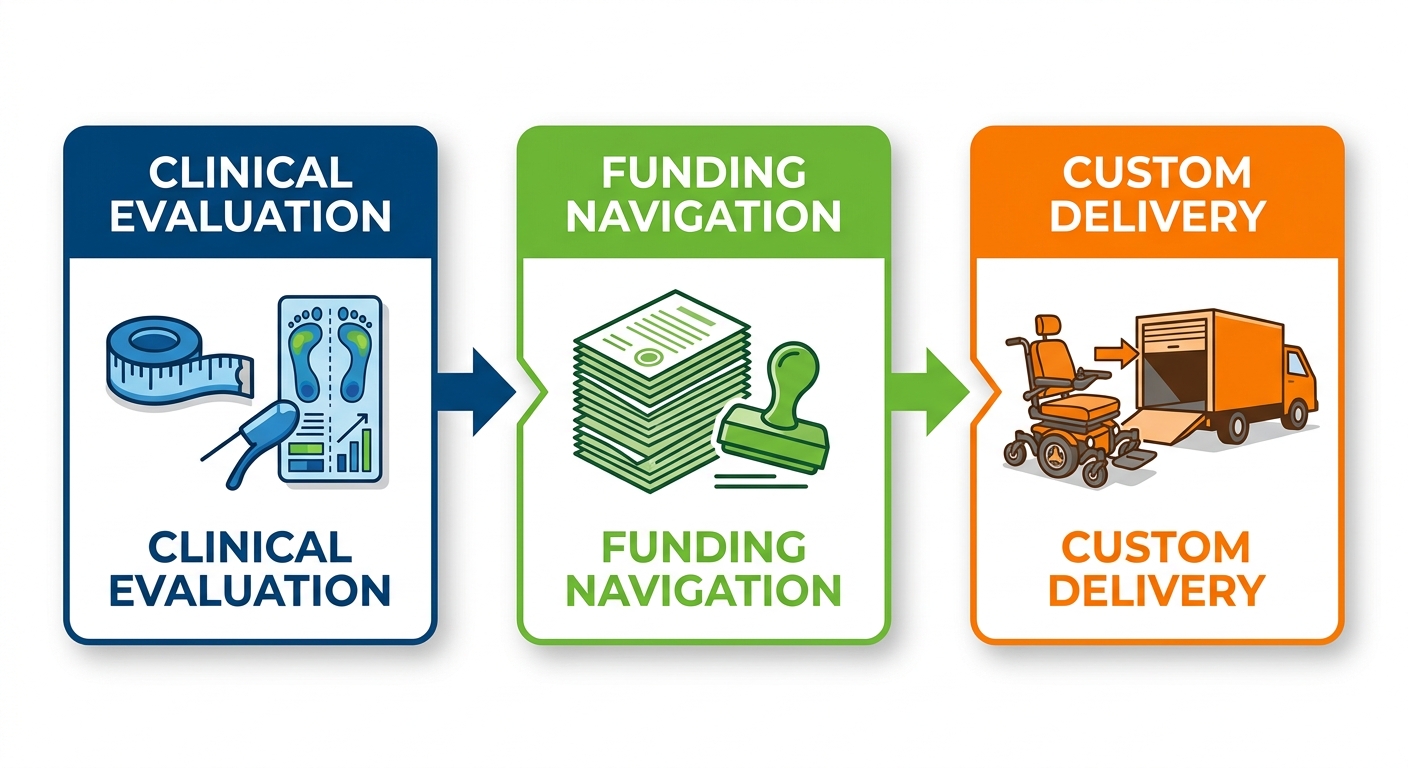
    Now, see how our process makes getting your custom power wheelchair effortless. At MedEquipped, we guide you through a seamless, ATP-led journey from evaluation to delivery. We handle the details, ensuring personalized fitting and hassle-free funding as your partner in mobility freedom.

    Horizontal process flow diagram of three stages for custom power wheelchair service: clinical evaluation, funding navigation, and delivery.

    Custom power wheelchair process: evaluation, funding, and delivery stages

    This visual outlines our three key stages, making it easy to follow your path to enhanced mobility.

    Clinical Evaluation and Fitting

    Our certified Assistive Technology Professionals (ATPs), adhering to RESNA standards, start with a thorough assessment. We conduct in-home or clinic visits tailored to your needs across New York, Georgia, and Michigan.

    1. Gather client history and goals to understand lifestyle demands.
    2. Take precise measurements using goniometers and inclinometers for posture alignment.
    3. Perform pressure mapping to prevent skin issues and optimize seating.
    4. Conduct trial fittings with drive simulations on models like QUICKIE or ROVI X3.
    5. Document findings for medical necessity.

    This personalized approach ensures your power wheelchair matches your body and daily activities perfectly. Once fitted, we tackle funding seamlessly.

    Insurance and Funding Navigation

    We handle the paperwork, insurance navigation, and coordination so you don’t have to. Our dedicated team manages everything for Medicare Part B, which covers custom motorized wheelchairs for those with functional mobility loss from diagnoses like ALS or spinal cord injury.

    Required documents include:

    • Physician prescription outlining needs.
    • Letter of Medical Necessity (LMN) justifying customization.

    We submit for pre-authorization, typically taking 30-60 days with our faster processing. If needed, we handle appeals and explore VA benefits or private insurance alternatives. You focus on recovery while we secure approval efficiently. With our expertise akin to national seating and mobility leaders, funding becomes straightforward. Next, we order your chair.

    Ordering, Configuration, and Delivery

    Your input shapes the perfect setup. We configure seating, controls, and accessories—like heavy duty power wheelchair bases such as TDX SP2 HD—for durability and comfort.

    The process includes:

    1. Review evaluation data and preferences.
    2. Select components from trusted brands.
    3. Place custom order with 30-60 days faster processing.
    4. White-glove delivery to your door.
    5. On-site setup and training (2-4 hours) for safe use.
    6. Provide 1-year warranty and ongoing support contracts.

    Our team ensures everything fits your life, with adjustments as needed. We’re with you every step for lasting mobility.

    Ready to begin? Contact us at 845-237-2381 or intake@medequipped.com to schedule your evaluation today. Trust MedEquipped for reliable custom power wheelchairs.

    Best Practices for Custom Power Wheelchairs

    When it comes to custom power wheelchairs, the right fit makes all the difference for bariatric or high-need users. We at MedEquipped focus on heavy-duty options that ensure stability, comfort, and independence as your partner in mobility freedom.

    Selecting Heavy-Duty Models

    Selecting heavy duty power wheelchairs starts with weight capacities over 300 lbs to support bariatric users safely. Look for robust base stability on varied terrain and Medicare Group 3 approval, which covers complex power seating like tilt and recline. We recommend models like the ROVI X3 for active adults or QUICKIE Heavy-Duty Base for complex needs. These offer mid-wheel drive agility or stable power bases, prioritizing durability and maneuverability in daily life. Prioritize certified evaluations to match your lifestyle.

    The following table compares key features of popular heavy-duty models we offer:

    Heavy-Duty Power Wheelchair Model Comparison
    FeatureROVI X3TDX SP2 HDQUICKIE Heavy-Duty Base
    Up to 300 lbs400 lbs350 lbs
    Mid-wheel driveHeavy-duty trackedStable power base
    YesYes (Group 3)Yes
    Active adultsBariatric usersComplex needs

    This comparison, drawn from our clinical expertise, highlights how each excels in specific scenarios. Contact us at 845-237-2381 for personalized guidance.

    Key Features of TDX SP2 HD

    The TDX SP2 HD stands out among heavy duty power wheelchairs with its heavy-duty tracked base, conquering rough terrain effortlessly. Boasting a 400 lb capacity, it supports bariatric users with exceptional stability. Adjustable seating ensures custom comfort, while power tilt and recline promote pressure relief and positioning for all-day use. Integrated controls and spacious seating enhance independence for high-need individuals. We configure these custom power wheelchairs with precise fittings during our clinical evaluations. Its robust construction handles demanding environments, from home to outdoors. As certified ATPs, we tailor the TDX SP2 HD to your needs, delivering in 30-60 days with ongoing support. Ready to explore? Email intake@medequipped.com.

    Local Availability and Considerations

    Finding custom power wheelchairs locally is straightforward through national seating and mobility networks. In NY, especially the NYC metro and our Spring Valley base, we offer in-home assessments for seamless fittings. In GA, our Atlanta-area services provide evaluations and delivery. In MI, Detroit and Grand Rapids clients benefit from our dedicated teams. We handle everything from clinical visits to custom configurations across these regions. Consider terrain, home access, and daily routines during assessments. Our faster processing gets you mobile sooner. We manage insurance navigation too, so you focus on freedom. Schedule your consultation today at 845-237-2381.

    Medicare and Purchase Options

    For Medicare, Group 3 custom power wheelchairs require a doctor’s prescription and mobility justification via A&A study. We guide rentals for trials or purchases for ownership, often with competitive pricing and financing. As your local A&A provider, we streamline approvals and paperwork. Explore cash-pay options for flexibility. Contact MedEquipped to start your process efficiently.

    Start Your Journey with MedEquipped Custom Power Wheelchairs

    Tired of mobility holding you back? Custom power wheelchairs from MedEquipped unlock your independence, tailored precisely to your unique needs and lifestyle. We are your partner in mobility freedom, transforming everyday challenges into seamless adventures.

    Our process starts with a personalized clinical evaluation in Spring Valley, NY. Our certified ATP team conducts thorough assessments to configure seating, controls, and accessories, ensuring each motorized chair meets your clinical needs and daily lifestyle demands and activity goals. We design custom motorized wheelchairs that fit your body type, usage scenarios, and preferences perfectly. Need robust support? Explore our heavy duty power wheelchairs for higher weight capacities, all integrated with national seating and mobility standards for safety and compliance.

    We prioritize quality, comfort, and innovation in every build. Our certified ATP team handles paperwork, insurance navigation, and coordination, delivering your chair in just 30-60 days. Key benefits include:

    • Perfect fit for enhanced comfort
    • Faster processing than industry averages
    • Ongoing support for lasting reliability

    Ready to discover how we build your ideal chair next? Schedule your free consultation today—call 845-237-2381 or email intake@medequipped.com!

    Resources

    This article was researched and written with the assistance of AI tools.

  • Wheelchair Service Repair Near You: Fast Expert Fixes

    Wheelchair Service Repair Near You: Fast Expert Fixes

    Table of Contents

    Wheelchair Service and Repair in Spring Valley, NY

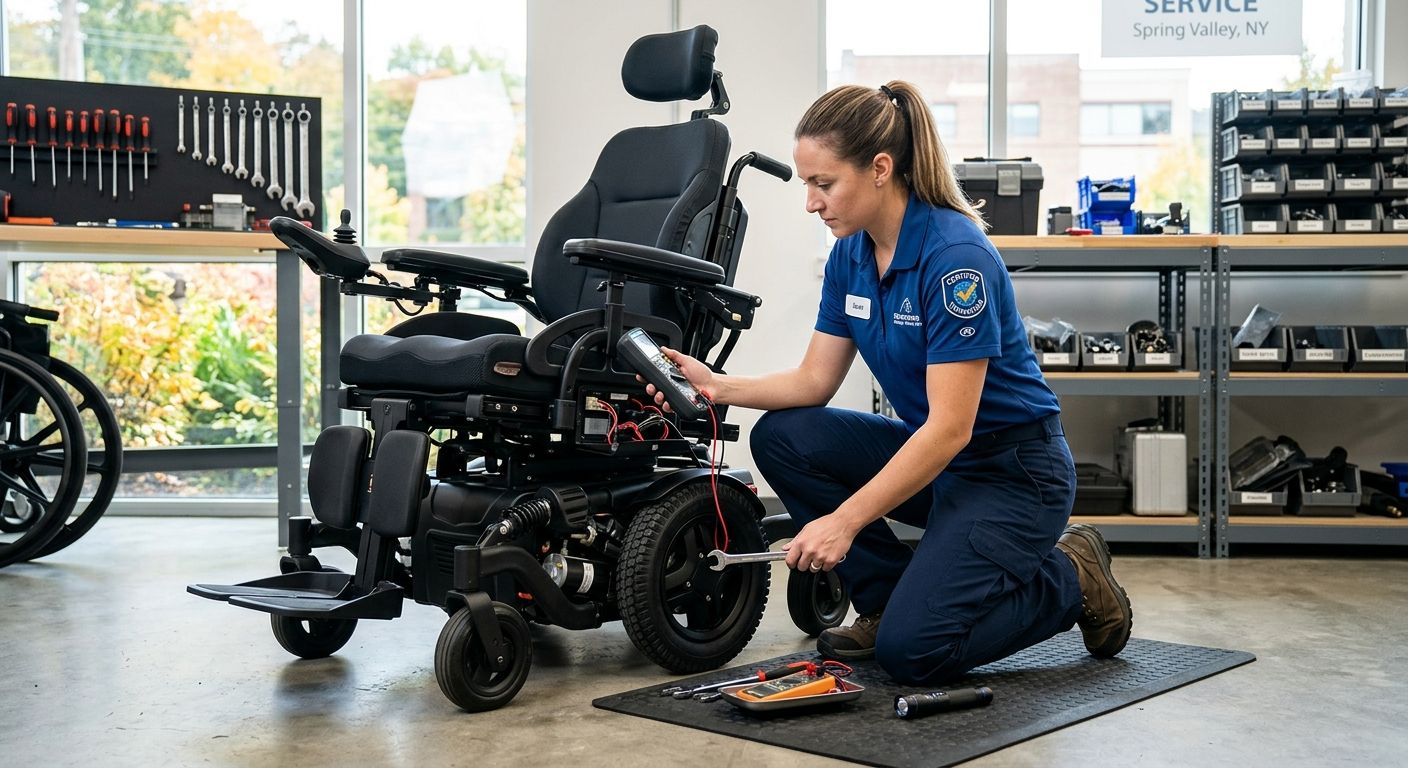
    In Spring Valley, NY, reliable wheelchair service repair is essential to keep users mobile and independent. Delays in maintenance can lead to breakdowns, limiting daily activities for those relying on power wheelchairs. At MedEquipped, we prioritize prompt service right here in our Spring Valley location to prevent these issues.

    Routine wheelchair maintenance services for power wheelchairs include battery checks, wheel alignment, and motor inspections. According to our MedEquipped overview on power wheelchair features, these steps ensure long battery life and smooth performance, like the 18-20 mile ranges on models such as QUICKIE and ROVI X3. We handle these mobility aid repairs efficiently for local residents.

    For advanced needs, specialized repairs cover complex rehabilitation technology wheelchairs, including custom seating and adaptive controls. Our MedEquipped FAQ explains CRT specifics, Medicare coverage like K0005 coding, and fitting by certified ATPs. National seating and mobility contractors also serve Spring Valley, NY, for complex rehab tech.

    Ready for service? Contact us at 845-237-2381 or intake@medequipped.com to schedule. We’re your partner in mobility freedom in Spring Valley, NY. Beyond repairs, consider custom fittings for optimal comfort today.

    Understanding Wheelchair Service and Repair

    Once you’ve selected the right power wheelchair, proper wheelchair service repair ensures its longevity and your continued mobility freedom. At MedEquipped, we know how vital reliable wheelchair service repair is for safety and independence. Sudden breakdowns can disrupt daily life, while regular upkeep prevents issues and extends usability. We partner in mobility freedom by offering expert repairs that keep you moving confidently.

    Common Issues with Power Wheelchairs

    Power wheelchairs face common problems that signal the need for prompt service. Watch for these signs and contact professionals right away.

    • Battery failure: Sudden power loss, failure to charge, or dim lights indicate worn cells. RESNA standards emphasize regular checks for safe operation.
    • Motor issues: Grinding noises, jerky movement, or reduced speed point to worn gears or brushes needing replacement.
    • Control malfunctions: Unresponsive joystick or erratic speed changes often stem from dirty connections or faulty electronics.

    These power wheelchair repairs restore function quickly. Delaying service risks falls or stranding. We guide you through safe fixes.

    Power Wheelchair Maintenance Basics

    Simple routines keep your power wheelchair running smoothly and delay major wheelchair maintenance and fixes. Follow these steps for longevity.

    Weekly checks:

    • Inspect tire pressure to avoid flats.
    • Clean battery terminals to prevent corrosion.
    • Wipe control surfaces for responsive handling.

    Monthly inspections:

    • Tighten loose bolts and cables.
    • Check wiring for frays.

    Seek professional service after six months, or sooner if vibrations or odd noises appear. MedEquipped shares these tips as internal expertise to empower you.

    Complex Rehab Wheelchair Specifics

    Complex rehab wheelchairs, designed for severe mobility needs with custom features, require specialized attention. These models use advanced seating to prevent pressure sores and precise controls for stability.

    Key repairs include:

    • Custom seating systems: Foam compression or frame misalignment needs realignment per RESNA wheelchair standards.
    • Advanced controls: Calibration fixes integration glitches with positioning devices.

    Specialized technicians, like those from national seating and mobility providers, handle these. RESNA guidelines ensure safety in repairs. We match expertise to your custom motorized wheelchairs.

    These steps maintain positioning accuracy vital for health.

    Local Service Availability in NY, GA, MI

    Finding wheelchair service repair near you is easy in Spring Valley, NY, and surrounding areas in New York, Georgia, and Michigan. At MedEquipped, our Spring Valley, NY office serves these regions with dedicated support.

    • Contact us: Call 845-237-2381 or email intake@medequipped.com.
    • Turnaround: Typically 3-7 days for most repairs.
    • Emergency options: Same-day assessments for urgent needs.

    We handle evaluations, parts, and delivery. Our ATP professionals ensure quick, reliable service. Reach out today for seamless mobility support.

    Benefits of Professional Wheelchair Repair Services

    Building on the urgency of timely wheelchair maintenance, professional wheelchair service repair delivers peace of mind through enhanced safety, cost efficiency, local expertise, and user empowerment. At MedEquipped, we prioritize your mobility freedom with certified support that restores confidence in your daily routines.

    Enhanced Safety and Reliability

    Certified technicians identify hidden issues like worn brakes or battery faults before they lead to falls or breakdowns. According to RESNA professional standards for certified technicians ensuring repair quality, as outlined in the ATP certification FAQs, Assistive Technology Professionals (ATPs) possess the expertise to maintain wheelchair reliability. This prevents accidents during commuting or home navigation, ensuring uninterrupted mobility.

    Key benefits include:

    • Proactive fault detection to avoid sudden failures.
    • Component testing aligned with industry benchmarks, comparable to national seating and mobility practices.
    • Restored braking and power systems for secure travel.

    Beyond prevention, these repairs deliver financial value over time.

    Cost Savings Over Time

    Opting for wheelchair service repair extends your wheelchair’s lifespan, making it far more economical than full replacement. Fixing specific parts like motors or controls preserves the frame and customization, avoiding the need for a new unit. For power wheelchairs, targeted professional wheelchair servicing keeps your investment viable for years.

    Consider these advantages:

    • Part-specific fixes versus total overhauls.
    • Prolonged usability through routine upkeep.
    • Avoided downtime that disrupts life.

    This approach not only saves resources but also transitions seamlessly into tailored local care.

    Personalized Local Support

    We at MedEquipped bring regional expertise to power wheelchairs in NY, GA, and MI, with quick response times and knowledge of local regulations. Our teams understand the unique demands of these areas, from urban streets in New York to varied terrains in Georgia and Michigan. This ensures compliant, efficient repairs tailored to your needs.

    Our local strengths feature:

    • Rapid service calls for minimal wait times.
    • Familiarity with state-specific rules for powered wheelchair maintenance.
    • Custom solutions matching your lifestyle.

    Personalization like this pairs perfectly with comprehensive post-repair guidance.

    Ongoing Patient Education

    MedEquipped’s company-specific patient education and support practices include hands-on sessions after every wheelchair service repair. We teach simple maintenance checks, troubleshooting signals, and safe usage tips to empower you. For power wheelchairs, this covers battery care and control adjustments, maximizing long-term benefits.

    Essential training covers:

    • Daily inspections for early issue spotting.
    • Error code interpretation for self-reliance.
    • Usage best practices to prevent wear.

    Ready to experience these advantages? Contact us to schedule your service today.

    How Wheelchair Service and Repair Works

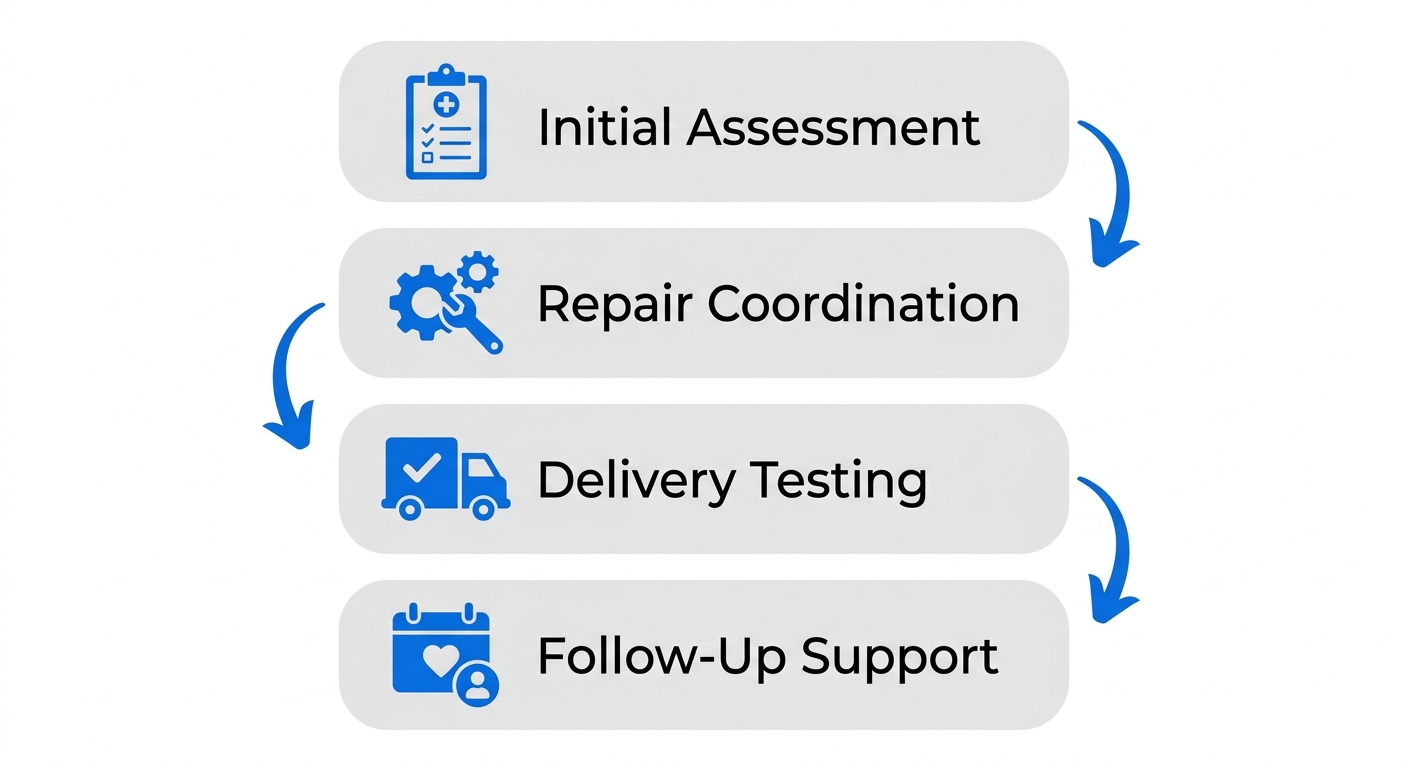
    Our streamlined wheelchair service repair process sets us apart from others. At MedEquipped, your partner in mobility freedom, we handle every step with care, from initial contact to ongoing support. Whether you need wheelchair maintenance and repair in Spring Valley, NY, or surrounding areas, our friendly team ensures quick, reliable service for custom motorized wheelchairs.

    Vertical process flow diagram of MedEquipped wheelchair service and repair: initial assessment with clipboard, repair coordination with wrench, delivery testing with truck, follow-up support with calendar.

    Wheelchair service and repair process at MedEquipped

    Initial Assessment and Intake

    We start your wheelchair service repair journey with a simple contact. Call us at 845-237-2381 or email intake@medequipped.com to begin. Our certified Assistive Technology Professionals (ATPs) conduct a thorough clinical evaluation, assessing your mobility needs, measuring your wheelchair, and reviewing usage patterns.

    MedEquipped’s official FAQ outlines the standard service workflow, including:

    • Scheduling an intake appointment within 24 hours.
    • Documenting specific issues like comfort or functionality.
    • Prioritizing safety and compliance with seating and mobility services standards.

    This personalized approach builds trust and sets clear expectations for efficient repairs.

    Repair Coordination and Parts

    Once assessed, we dive into diagnostics for common issues like battery failure or frame damage. Our technicians use advanced testing to pinpoint problems accurately. We source OEM or compatible parts quickly, ensuring compliance with national seating and mobility standards.

    As detailed in MedEquipped’s official FAQ, typical timelines are 3-7 business days for most repairs:

    • Order parts from trusted suppliers.
    • Perform precise fixes, including models like foldable electric wheelchairs.
    • Update you on progress via phone or email.

    We keep wait times short so you regain independence fast.

    Delivery and Testing

    After repairs, our team handles delivery or pickup with ease. Technicians bring your wheelchair right to your door in Spring Valley, NY, or coordinate on-site service. We conduct full functional testing of controls, safety features, and power systems.

    MedEquipped’s delivery and support guidelines cover:

    • On-site fitting for optimal comfort.
    • Specialized checks for power wheelchairs.
    • Hands-on training so you feel confident using it.

    This step ensures everything works perfectly before you roll out.

    Follow-Up Support

    Our commitment continues post-repair with comprehensive plans. Schedule annual inspections to prevent issues and extend warranties. Access our 24/7 support hotline anytime for adjustments or advice.

    Reference MedEquipped’s delivery and support guidelines for:

    • Routine maintenance reminders.
    • Quick response for unexpected needs.
    • Long-term partnership in your mobility.

    We handle the paperwork, insurance navigation, and coordination every step.

    Ready to start your service? Contact us today!

    Best Practices for Wheelchair Maintenance and Repair

    At MedEquipped, we know that regular wheelchair service repair keeps your mobility device reliable and safe. Simple habits prevent breakdowns and extend lifespan, empowering you as our partner in mobility freedom. Following these practices helps prevent unexpected failures, reduces repair costs, and keeps you using your device with confidence day-to-day. We guide you through daily checks to professional support across New York, Georgia, and Michigan.

    Daily User Checks

    Start your day with quick inspections to catch issues early. These at-home steps, recommended as supplementary user education resources by MedEquipped, take just minutes but safeguard your independence.

    • Inspect tires for wear: Look for cracks, bulges, or low tread. Inflate pneumatic tires to the recommended PSI marked on the sidewall.
    • Check brakes for responsiveness: Test if they engage firmly without slipping, especially on inclines.
    • Verify battery charge levels: Ensure indicators show full charge overnight; clean terminals if corroded.
    • Test joystick controls: Confirm smooth, precise operation without sticking or delay.

    Perform these daily to detect wear before it worsens. We handle the paperwork, insurance navigation, and coordination for any needed fixes.

    Scheduling Professional Services

    Routine professional care ensures optimal performance. MedEquipped’s practical service guidelines recommend annual inspections for all models and quarterly checks for power wheelchairs to address battery health and alignment.

    Contact us immediately for unusual noises, reduced speed, or mobility issues. Our certified technicians provide powered wheelchair maintenance, often within our 30-60 days faster processing timeline. Timely professional attention can identify emerging issues early and often avoids more extensive, costly repairs or prolonged service delays. Regular wheelchair service repair minimizes downtime and supports long-term reliability.

    Compliance with Standards

    Adhering to industry benchmarks protects users and providers. Follow RESNA (Rehabilitation Engineering and Assistive Technology Society of North America) guidelines for wheelchair servicing, which outline maintenance protocols. FDA regulations govern medical devices, requiring documented repairs.

    The HHS OIG work plan medical equipment, as authoritative federal oversight from the HHS Office of Inspector General, monitors audits and compliance for wheelchair suppliers to prevent fraud. Partner with national seating and mobility providers like us for certified standards.

    Regional Service Tips

    Local factors influence access. In New York, leverage state Medicaid for repair coverage; we coordinate from our Spring Valley base. Georgia users benefit from authorized dealer networks for quick parts. Michigan’s accessibility laws ensure service availability.

    Find certified technicians via state programs. For wheelchair service repair in NY, GA, or MI, call us at 845-237-2381. We streamline evaluations and delivery, focusing on your area for timely support.

    Next Steps for Wheelchair Service in Spring Valley

    Now that you’ve identified the wheelchair issue in Spring Valley, take swift action for wheelchair service repair. We understand mobility disruptions feel urgent. Don’t let a breakdown sideline you – we’re your partner in mobility freedom at MedEquipped, right here in Spring Valley. Our certified technicians prioritize fast assessments and repairs to help restore independence as quickly as possible for you.

    Start by assessing your wheelchair type and repair urgency. For manual wheelchairs or power wheelchairs, prepare key details like model, serial number, and issue description, as outlined in MedEquipped’s official contact and service FAQ.

    Follow these steps:

    • Call MedEquipped at 845-237-2381 or email intake@medequipped.com to schedule wheelchair service repair in Spring Valley.
    • Gather info ahead: wheelchair model, serial number, and a clear issue summary for faster service.
    • Discuss options: Mention if it’s manual or power wheelchair needs.
    • Explore backups like national seating and mobility if local timing doesn’t align.
    • Book promptly to minimize downtime and stay mobile.

    Reach out today using the info below. We handle coordination for quick wheelchair maintenance repair in Spring Valley.

    This article was researched and written with the assistance of AI tools.

    Resources

  • Best Foldable Electric Wheelchairs for Travel in 2026

    Best Foldable Electric Wheelchairs for Travel in 2026

    Table of Contents

    Discovering Top Foldable Electric Wheelchairs

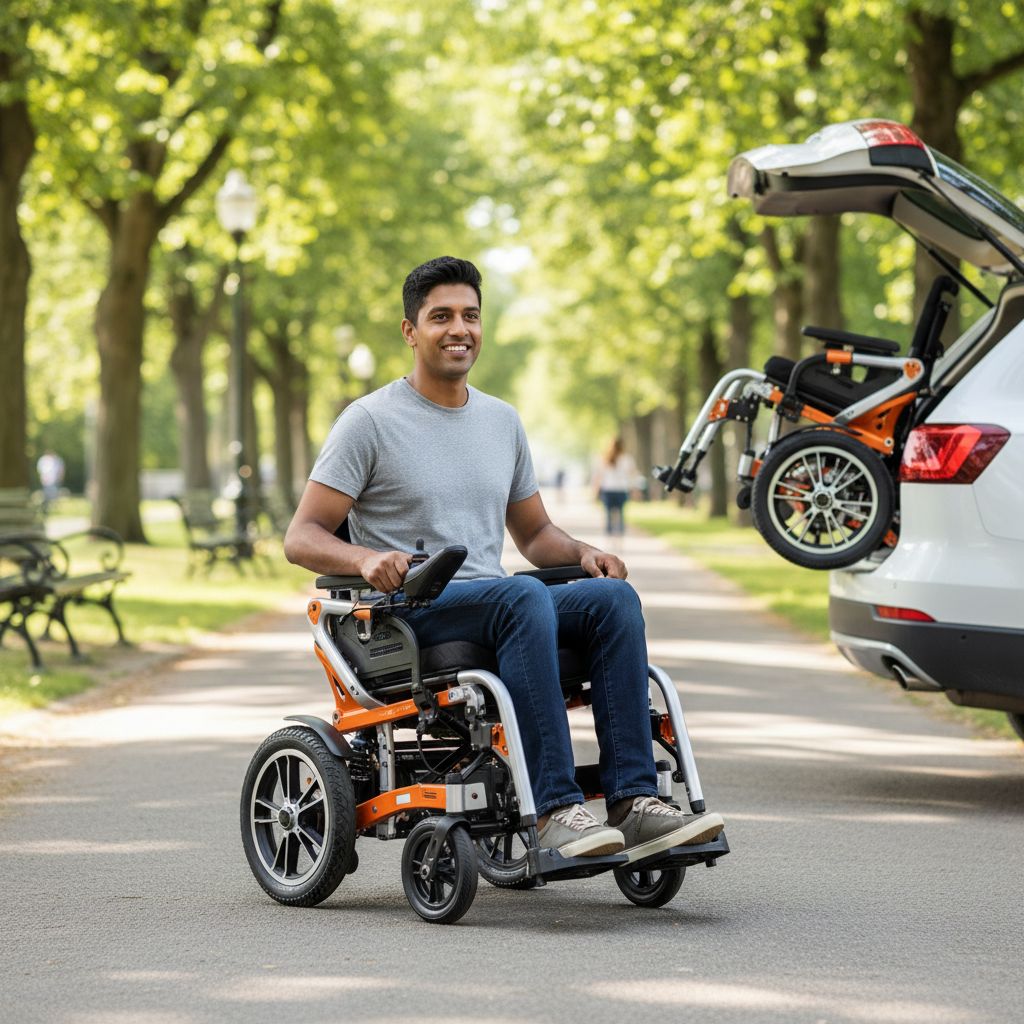
    Imagine the freedom of foldable electric wheelchairs transforming your weekend trips or daily routines. These compact powered mobility aids offer portability without sacrificing performance, making them ideal for enhancing independence on the go.

    As lightweight power wheelchairs, they excel in ease of storage and travel compatibility, folding quickly to fit in car trunks or airplane overheads. Key factors to evaluate include folding mechanisms, overall weight, battery life for extended outings, and compliance with safety standards.

    At MedEquipped, we partner in mobility freedom through personalized ATP evaluations, selecting top options like QUICKIE and ROVI models tailored to your needs. We handle the paperwork, insurance navigation, and coordination for services in New York, Georgia, and Michigan, with delivery in 30-60 days to get you moving sooner.

    1. Effortless Folding for Travel

    Traveling with mobility challenges can feel overwhelming, but foldable electric wheelchairs change that by offering quick and simple designs that fit seamlessly into your lifestyle. At MedEquipped, we prioritize these innovative solutions during our clinical evaluations in New York and Georgia, ensuring they match your daily routines as a true partner in mobility freedom.

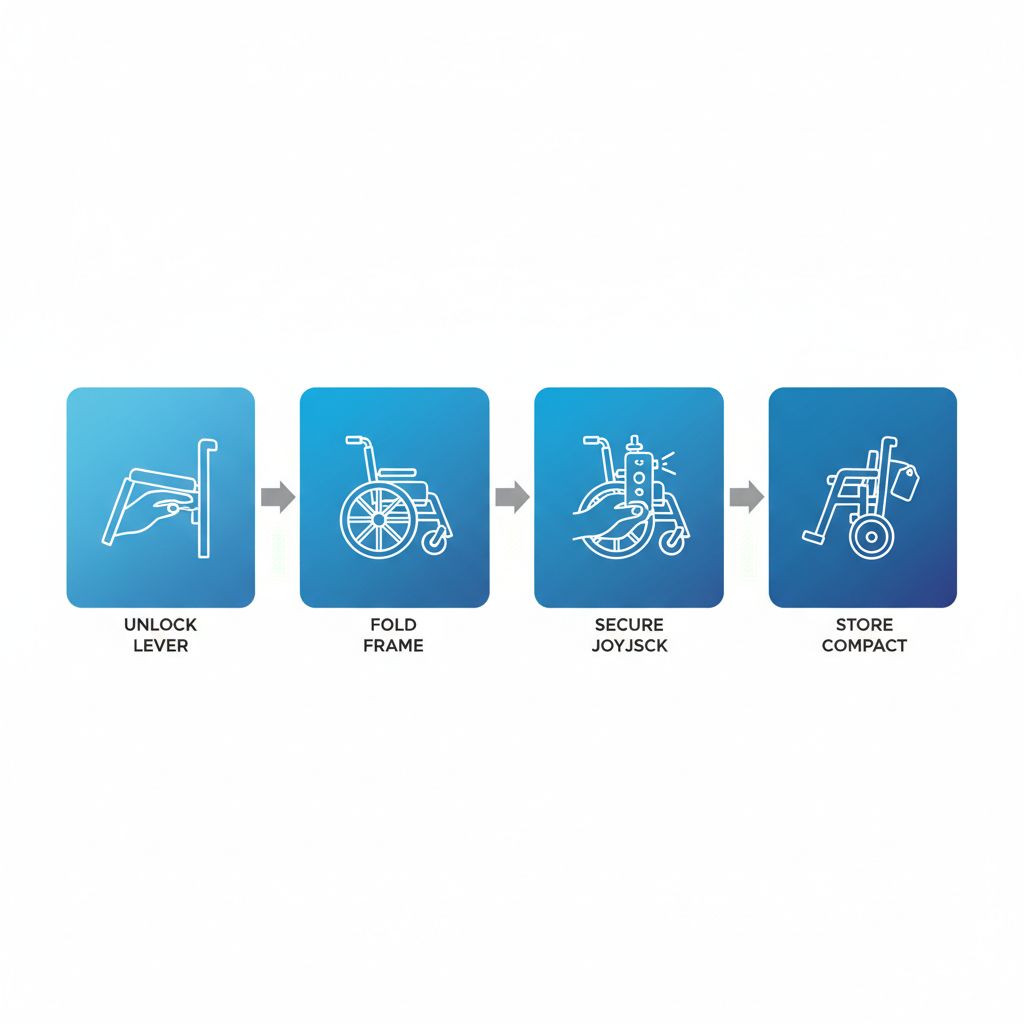
    Many foldable electric wheelchairs feature one-touch levers or automatic systems for effortless operation. For instance, the QUICKIE model we often recommend folds in typically under 30 seconds—far quicker than traditional manual wheelchairs, which might take a full minute. Here’s a simple process we guide patients through:

    • Unlock the lever near the armrest.
    • Gently push the frame inward until it clicks.
    • Secure the joystick and footrests.
    • Compact travel wheelchairs like these then measure just 12 inches wide, saving precious space in car trunks or airplane overhead bins.
    Horizontal process flow diagram showing four steps to fold a foldable electric wheelchair: unlock lever, fold frame, secure joystick, and store compact, with icons and arrows.


    Effortless folding process for traveling with a foldable electric wheelchair

    We customize these easy-fold mobility chairs based on dexterity needs during ATP assessments, and our certified technicians advise on maintenance to keep folding parts reliable. For airline trips, pack your portable electric wheelchair alongside lightweight power wheelchairs in a dedicated bag—we handle delivery and setup to make travel empowering and stress-free.

    2. Lightweight Designs for Easy Portability

    Struggling with heavy mobility aids that make travel a chore? Lightweight power wheelchairs under 60 pounds change that, easing the burden on you and your caregivers. At MedEquipped, we help select custom motorized wheelchairs that prioritize ease, ensuring you stay mobile without the strain.

    These ultra-light mobility devices feature innovative designs like aluminum frames, which slash weight while maintaining durability. Aluminum’s strength-to-weight ratio enhances maneuverability, allowing smooth navigation indoors through tight doorways or outdoors on uneven paths. Battery integration keeps things sleek, avoiding extra bulk for better portability. Featherweight electric chairs like our recommended models suit seniors with ergonomic seats that reduce fatigue during daily use. We draw from ATP evaluations to confirm these options handle real-world demands, with capacities supporting diverse needs.

    To illustrate, here’s a quick comparison of popular lightweight models:

    ModelWeight (lbs)Fold TimeBattery Range (miles)Capacity (lbs)Price Range
    QUICKIE Series55<30 seconds18300$3,000-$8,000
    ROVI X35220 seconds20350$2,500-$7,500
    TDX SP2 HD6545 seconds15400$5,000-$10,000

    As your partner in mobility freedom, we highlight the pros of these builds:

    • Effortless lifting and transport for caregivers
    • Improved independence for users with limited strength
    • Seamless integration with foldable electric wheelchairs for trips

    For safe handling, we suggest caregivers use two-person lifts or transfer aids during moves. Our post-delivery support includes training on these techniques, plus ongoing adjustments in New York, Georgia, and Michigan to keep your portable electric wheelchair performing perfectly.

    3. Airline-Approved Travel Options

    We understand how air travel anxieties can arise for those relying on portable electric wheelchairs, especially on flights from New York to Michigan destinations. At MedEquipped, our certified Assistive Technology Professionals evaluate options to ensure lightweight power wheelchairs meet FAA and airline standards, allowing worry-free cabin or cargo transport.

    Foldable electric wheelchairs must comply with strict FAA battery regulations, including lithium-ion limits under 300 watt-hours for carry-on approval. Size constraints typically cap dimensions at 22x14x9 inches to fit overhead bins, as with compact QUICKIE models. Proper labeling on batteries and devices speeds check-in, while disassembly at gates facilitates gate-to-plane transfers. We incorporate these travel-ready customizations during clinical evaluations, tying them to our funding assistance for seamless insurance navigation. For extended trips, we discuss battery considerations to enhance TSA-friendly mobility chairs.

    Before your flight, follow this pre-flight checklist: remove batteries for security screening, verify airline policies on flight-compatible power aids, and confirm disassembly ease. Our consultations guide these steps, ensuring your custom motorized wheelchair supports mobility freedom every step of the way.

    4. Long Battery Life for Adventures

    Imagine exploring Georgia’s rolling hills or coastal paths without worrying about power fading midway. At MedEquipped, we configure lightweight power wheelchairs to deliver up to 20 miles per charge, empowering day-long adventures tailored to your active lifestyle. As your partner in mobility freedom, we match battery options to ensure reliable power chairs keep you moving freely.

    Battery performance varies by type and conditions. Lithium-ion batteries offer lighter weight and faster charging compared to gel options, ideal for portable electric wheelchairs on varied terrains. Factors like speed, incline, and load influence runtime, with our certified ATPs assessing needs for optimal endurance-focused electric mobility.

    5. High Weight Capacity Options

    At MedEquipped, we prioritize safety and inclusivity for all users, ensuring our custom motorized wheelchairs support diverse body types in New York, Georgia, and Michigan. Foldable electric wheelchairs with high weight capacities make robust electric mobility accessible, allowing active lifestyles without compromise. We customize heavy-duty bases like the TDX SP2 HD for stability in Michigan’s demanding settings, extending from battery performance to reliable load-bearing for everyday adventures.

    These options handle capacities from 250 to 400 pounds, with frame reinforcements like thicker tubing and reinforced welds to prevent flexing under load. Compared to lightweight power wheelchairs, which may cap at 250 pounds and sacrifice durability, high-capacity models offer superior posture support through clinical fittings by our certified ATPs. This balances strength with portability in sturdy portable chairs, while warranties often extend coverage for heavier loads to ensure long-term reliability.

    Pros of high-capacity designs include enhanced stability, better weight distribution for comfort, and versatility for users up to 400 pounds, all tailored via our 30-60 day processing.

    For the best fit, we recommend precise measurements during evaluations—consider torso length and leg positioning to optimize posture. As your partner in mobility freedom, contact us in Georgia and Michigan for a consultation to match the right portable electric wheelchair to your needs, leading seamlessly to enhanced senior comfort solutions.

    6. Senior-Friendly Comfort Features

    We understand that as we age, comfort becomes essential for daily mobility, especially in bustling urban settings like those in New York. Our custom motorized wheelchairs prioritize elderly-optimized mobility, ensuring seniors stay independent and at ease during everyday activities or travel.

    At MedEquipped, we design lightweight power wheelchairs with ergonomic features tailored through our certified ATP evaluations. Key comfort elements include:

    • Cushioned seating and padded armrests that reduce pressure points for prolonged use.
    • Intuitive joystick controls accessible for arthritic hands, making navigation simple and fatigue-free.
    • Anti-tip wheels for added stability on uneven sidewalks or during turns.

    We feature QUICKIE senior models as comfortable foldable aids, often customized under insurance coverage to fit individual needs across New York, Georgia, and Michigan. These portable electric wheelchairs enhance long-term usability for caregivers and loved ones.

    For vacations or adjustments, we guide you on selecting foldable electric wheelchairs that fold easily. Contact our team at 845-237-2381—we handle the paperwork and provide ongoing support as your partner in mobility freedom.

    7. Outdoor Durability for Daily Use

    Exploring the outdoors shouldn’t mean compromising on mobility. At MedEquipped, we design our foldable electric wheelchairs to handle Georgia’s parks and rugged paths with ease, keeping you active and independent as your partner in mobility freedom.

    When it comes to lightweight power wheelchairs, durability shines through features like all-terrain tires and advanced suspension systems that absorb bumps on uneven surfaces. These rugged portable chairs excel in urban sidewalks or rural trails, while weather-ready electrics like the ROVI X3 resist rain and dust without sacrificing foldability. Folding mechanisms maintain structural integrity for daily use, and our ongoing support includes post-delivery repairs to ensure long-term reliability. For daily commutes, they reduce fatigue on varied terrains.

    Key durability factors include reinforced frames, IP-rated electronics, and shock absorbers. We recommend regular tire checks and cleaning after outings to preserve performance—simple steps that extend your chair’s life for countless adventures.

    8. Value Pricing for Quality

    At MedEquipped, we believe in delivering custom motorized wheelchairs that offer true value without compromising quality. Foldable electric wheelchairs typically range from $2,000 to $10,000, depending on features and customizations. We help make these portable electric wheelchairs accessible through our streamlined process, ensuring you get budget-friendly mobility options tailored to your needs in New York, Georgia, and Michigan.

    Understanding the price breakdown helps highlight the investment in independence. Base models start around $2,000 for basic foldable electric wheelchairs, while customized versions with advanced seating or controls can reach $10,000. Our end-to-end billing and insurance navigation save time and reduce out-of-pocket costs. These tiers provide excellent ROI by promoting daily independence and reducing long-term care expenses.

    A helpful tip: We handle the paperwork, insurance navigation, and coordination to maximize funding coverage, often within our 30-60 days faster processing timeline. This approach makes affordable seniors options more attainable, letting you focus on mobility freedom as our partner.

    Selecting Your Perfect Foldable Wheelchair

    As we wrap up our guide to foldable electric wheelchairs, remember how these innovative devices enhance independence with effortless folding ease and impressive battery life up to 20 miles. Ideal for seniors seeking lightweight power wheelchairs or portable electric wheelchairs for vacations, they offer reliable travel mobility solutions. Looking ahead to 2026 trends, expect even smarter custom power aids tailored to clinical needs.

    For quick evaluation, consider standout features like the ROVI X3’s swift 20-second fold and 350-pound capacity, balancing portability and durability for daily use. We focus on MedEquipped-customizable options from trusted brands to match your lifestyle.

    Data based on MedEquipped configurations; actual specs vary by customization. All models are airline-compliant with proper battery handling.

    Through our certified ATP evaluations, we customize these wheelchairs for the best fit, ensuring seamless integration into your routine. As your partner in mobility freedom, we handle the paperwork, insurance navigation, and coordination for faster processing in 30-60 days.

    Ready to find your ideal solution? Contact us today at 845-237-2381 or intake@medequipped.com for personalized consultations, funding assistance, and delivery services in New York, Georgia, or Michigan.

    Resources

  • Wheelchair Insurance: Complete Guide to Medicare Coverage

    Wheelchair Insurance: Complete Guide to Medicare Coverage

    Table of Contents

    Understanding Wheelchair Insurance Basics

    At MedEquipped, we understand that wheelchair insurance plays a vital role in helping individuals with mobility challenges access the custom motorized wheelchairs they need. Whether you’re navigating coverage in New York, Georgia, or Michigan, securing the right financial support can make all the difference in achieving greater independence and comfort in daily life. As your partner in mobility freedom, we simplify this process from start to finish.

    Wheelchair insurance typically refers to financial support for durable medical equipment like power wheelchairs, covering sources such as Medicare wheelchair coverage, Medicaid, and private insurers. For Medicare, eligibility hinges on medical necessity, requiring a face-to-face examination and written prescription from your provider to qualify. We handle the paperwork, insurance navigation, and coordination, using our certified ATP-led evaluations to justify needs for models like the QUICKIE series or ROVI X3. This often leads to wheelchair insurance reimbursement after meeting deductibles, with patients paying about 20% of approved costs. Our end-to-end services, including clinical fittings and funding assistance, streamline approvals on a faster 30-60 days timeline, as seen in cases like a Michigan patient who received their custom chair without hassle.

    In the sections ahead, we’ll dive deeper into coverage details, benefits, application steps, and best practices tailored to your region. Stick with us to learn how we can support your power wheelchair financing options and ensure you get the mobility aid funding that fits your life.

    Key Concepts in Wheelchair Insurance

    At MedEquipped, we understand that navigating wheelchair insurance can feel overwhelming, but grasping the key concepts empowers you to access the right mobility solutions. We specialize in guiding patients through coverage for custom power wheelchairs like the TDX SP2 HD, handling everything from evaluations to approvals. This section breaks down essential ideas to help you see how insurance opens doors to greater independence.

    Types of Coverage for Power Wheelchairs

    Wheelchair insurance plays a crucial role in making advanced mobility equipment affordable. We often see patients relying on Medicare, Medicaid, or private plans to cover custom models from the QUICKIE series, which are designed for specific needs like heavy-duty support or precise controls.

    Medicare Part B serves as a primary source of medicare wheelchair coverage, paying 80% of the cost after your deductible for durable medical equipment (DME) that’s deemed medically necessary. According to CMS guidelines, this includes power wheelchairs if a physician confirms they’re essential for daily activities. Medicaid, a state-federal program, offers DME insurance options tailored to low-income individuals, often providing full coverage for items like the ROVI X3 when justified by clinical evaluations. Private insurance varies by policy but frequently mirrors Medicare, covering upgrades or custom features with co-pays based on your network.

    These options highlight power mobility funding pathways, ensuring patients get fitted chairs that enhance their lifestyle. We at MedEquipped partner with you as a partner in mobility freedom, coordinating claims to simplify the process.

    The following table provides an overview of wheelchair insurance types, comparing key aspects to clarify how each might apply to your situation:

    Coverage TypeEligibility CriteriaCoverage LimitsApplication Process
    Medicare Part BCovers 80% after deductible for medically necessary equipmentIn-home assessment requiredSupplier handles prior authorization
    MedicaidVaries by state, often full coverage for low-incomeState-specific documentationCoordination with state programs
    Private InsurancePolicy-dependent, often similar to MedicareCo-pays and networks applyClaims submission required

    This comparison shows Medicare’s structured approach versus Medicaid’s flexibility for underserved groups, while private plans add personalization. At MedEquipped, we streamline applications across these types, leveraging our expertise to boost approval rates and reduce wait times to our typical 30-60 days. By aligning your needs with the right coverage, we help secure custom motorized wheelchairs that fit seamlessly into your life.

    Infographic comparing Medicare Part B, Medicaid, and Private Insurance coverage for wheelchairs, showing eligibility, limits, and processes with icons and key stats.
    Comparison of wheelchair insurance coverage options: Medicare, Medicaid, and Private.

    Building on these coverage basics, let’s explore how eligibility ties into getting the equipment you need. Our team often assists with documentation to meet these standards, ensuring a smoother path forward.

    Eligibility and Medical Necessity Requirements

    Securing wheelchair insurance reimbursement starts with proving medical necessity, a step we at MedEquipped guide you through every time. A physician’s certification is essential, typically including a face-to-face exam and a detailed letter of medical necessity outlining why a power wheelchair improves your function and quality of life.

    Functional assessments, like those conducted by our certified Assistive Technology Professionals (ATPs), evaluate mobility limitations and recommend specific features. Drawing from the assistive technology funding guide, these evaluations align with insurer requirements, such as documenting how the chair addresses impairments in ambulation or daily tasks. Common criteria include:

    • Inability to use a manual wheelchair or cane independently due to conditions like muscular dystrophy or spinal cord injury.
    • Home and community mobility needs that standard walkers can’t meet.
    • Physician orders specifying the model, like the QUICKIE for lightweight versatility.

    We handle the paperwork, insurance navigation, and coordination to compile these elements, often speeding up approvals. Remember, results may vary, and we recommend consulting your healthcare professional for personalized advice. This thorough process ensures your custom motorized wheelchair meets DME standards and supports long-term independence.

    Regional Variations in New York, Georgia, and Michigan

    While core wheelchair insurance principles remain consistent, regional differences across our service areas in New York, Georgia, and Michigan add important nuances, especially for Medicaid processes. In Michigan, the Department of Health and Human Services (DHHS) oversees robust DME reimbursements, with prior authorizations required for complex items like power wheelchairs. Their guidelines emphasize ATP evaluations and state-specific forms, often covering full costs for eligible low-income residents; Medicaid wheelchair insurance here approves custom bases if documentation shows necessity.

    New York and Georgia share similarities, such as income thresholds for Medicaid and alignment with federal Medicare rules, but Michigan stands out for its detailed fee schedules and liaison meetings for providers. For instance, Michigan’s DMEPOS database lists codes for models like the TDX SP2 HD, facilitating faster claims. Across all states, private insurance follows policy networks, but state Medicaid waivers can expand options for specialized seating.

    We at MedEquipped navigate these variations seamlessly, from New York’s urban delivery logistics to Georgia’s rural access needs and Michigan’s reimbursement protocols. By understanding local rules, we maximize your coverage and deliver ongoing support, helping you focus on mobility rather than bureaucracy.

    Benefits of Proper Wheelchair Insurance Coverage

    At MedEquipped, we understand how vital wheelchair insurance can be for accessing the mobility solutions you need. As your partner in mobility freedom, we help patients navigate coverage to unlock financial relief, advanced options, and ongoing support across New York, Georgia, and Michigan. Proper coverage transforms challenges into opportunities for independence, ensuring custom motorized wheelchairs fit your life without overwhelming costs.

    Financial Relief and Reimbursement Advantages

    Securing wheelchair insurance provides essential financial relief by minimizing out-of-pocket expenses for high-quality power wheelchairs. Through our expertise, we handle the paperwork, insurance navigation, and coordination to maximize reimbursements, often covering 80-100% of equipment costs. For instance, Michigan Medicaid DME reimbursement offers robust funding for durable medical equipment in that state, with successful claims averaging significant savings as noted in our reimbursement FAQ resources.

    Wheelchair insurance reimbursement processes streamline access to funding for powered wheelchairs, reducing the burden on patients. Medicare wheelchair coverage, for federal benefits, supports eligible individuals with medically necessary devices, while state programs enhance these options. We assist with documentation to expedite approvals, helping families avoid unexpected bills. Key advantages include:

    • Coverage for custom features that standard plans might overlook.
    • Reduced financial stress, allowing focus on health and daily activities.
    • Integrated support for both private insurance and public programs like Medicaid.

    This approach not only safeguards your budget but also ensures timely access to essential mobility aids, with processing typically in 30-60 days for faster relief.

    Access to Advanced Mobility Solutions

    Wheelchair insurance opens doors to advanced mobility solutions, enabling personalized access to models like the ROVI X3 that match your unique needs. Our certified Assistive Technology Professionals (ATPs) conduct evaluations to recommend insurance-backed mobility aids, ensuring coverage aligns with clinical requirements. In states like New York, Georgia, and Michigan, this means faster delivery timelines and custom fittings without delays.

    With proper coverage, patients gain entry to heavy-duty bases and tailored controls, enhancing safety and independence on various terrains. We help secure funding for powered wheelchairs through Medicare wheelchair coverage and state initiatives, quoting coverage rates up to 90% for complex devices from our Medicaid details. This support reduces wait times from industry standards, often fulfilling orders in 30-60 days.

    Benefits extend to health improvements, as timely mobility aids prevent secondary issues like pressure sores, affecting up to 60% of users without proper support. We prioritize these outcomes daily, integrating education on device use. Advantages include:

    • Personalized seating for optimal posture and comfort.
    • Access to premium brands with advanced joystick options.
    • Streamlined approvals for lifestyle-specific customizations.

    By leveraging insurance, you unlock solutions that empower greater freedom.

    Long-Term Support and Adjustments

    Beyond initial acquisition, wheelchair insurance delivers long-term support for repairs, adjustments, and education, sustaining your mobility investment. At MedEquipped, our post-delivery services in New York, Georgia, and Michigan include routine check-ins and ATP-led modifications, often covered under existing plans. This ongoing care ensures devices remain effective as needs evolve.

    Medicaid wheelchair insurance perks, particularly in Michigan, bolster durable medical equipment funding for maintenance, with high coverage rates for eligible patients. We coordinate wheelchair insurance reimbursement for these services, drawing from successful claim examples in our FAQs to illustrate sustained savings. This holistic approach addresses real-world changes, like terrain adaptations or control tweaks.

    Our team provides caregiver training and pressure mapping to promote safety, preventing common issues. As a partner in mobility freedom, we handle follow-ups to maintain performance. Key benefits encompass:

    • Covered repairs for wear and tear on custom components.
    • Adjustments for changing health conditions without extra costs.
    • Educational resources for independent use and longevity.

    These elements preview the application steps we’ll cover next, where securing coverage unlocks these enduring advantages. Results may vary; consult a healthcare professional for personalized advice.

    How Wheelchair Insurance Processes Work

    Navigating wheelchair insurance can feel overwhelming, but at MedEquipped, we partner in mobility freedom by handling the details for you. Our team guides patients through every stage, from initial assessments to final delivery, ensuring smoother access to custom motorized wheelchairs. We focus on power wheelchairs, though processes for manual wheelchairs follow similar steps.

    Initial Evaluation and Documentation

    The journey begins with a physician referral, where your doctor assesses your mobility needs and determines if a power wheelchair is medically necessary. This step proves the device’s role in improving daily independence, much like manual wheelchairs for lighter needs. At MedEquipped, our certified Assistive Technology Professionals (ATPs) conduct a comprehensive clinical evaluation, including face-to-face exams and home assessments to match equipment to your lifestyle in New York, Georgia, or Michigan.

    Wheelchair insurance requires detailed documentation, such as medical necessity forms outlining your condition and functional limitations. We handle this paperwork, coordinating with your physician to compile reports that highlight how the device addresses specific barriers. Common pitfalls, like incomplete forms, can delay approval, so our ATP process ensures thorough, accurate submissions from the start. This evaluation phase typically takes 1-2 weeks, setting a strong foundation for your mobility funding application.

    In Michigan, for instance, state-specific eligibility checks add another layer, but we streamline it all. By proving necessity upfront, we position your claim for success under programs like Medicare wheelchair coverage, reducing overall wait times.

    Submission and Approval Steps

    Once documentation is ready, we submit your application to the insurer, initiating prior authorization for wheelchair insurance reimbursement. This involves uploading physician orders, ATP reports, and supporting evidence to Medicare or Medicaid portals. For federal steps, Medicare wheelchair coverage demands clear proof of medical necessity, often reviewed by durable medical equipment suppliers like us.

    Variations exist between programs, as shown in the table below, which compares key timelines based on CMS guidelines and Michigan DHHS processes.

    StepMedicareMedicaid (Michigan Focus)
    EvaluationFace-to-face exam + ATP report (1-2 weeks)State eligibility check (1 week)
    SubmissionPrior auth via supplier (2-4 weeks)Coordination with MedEquipped (2-3 weeks)
    Approval to Delivery30-60 days totalSimilar, with state variations (30-60 days)

    Medicare often moves faster for straightforward cases, while Medicaid in Michigan requires extra coordination for state funding, including appeals if initial denials occur. We manage these insurance claim procedures, tracking submissions and addressing queries to avoid delays. Average approval takes 2-4 weeks for prior auth, but our expertise shortens the full process to our standard 30-60 days timeline.

    If issues arise, we assist with appeals, drawing from common FAQ insights like ensuring all certificates of medical necessity are complete. Our end-to-end handling means you focus on recovery while we navigate the bureaucracy.

    Delivery and Post-Approval Support

    Approval unlocks custom ordering, where we configure your power wheelchair with features like tilt-in-space or specialized seating for optimal comfort. We then arrange delivery directly to your home in New York, Georgia, or Michigan, complete with professional fitting by our ATPs to ensure proper setup and safety.

    During delivery, we provide hands-on training on controls, maintenance, and daily use, empowering you to maximize independence right away. This session covers troubleshooting basics, so you feel confident from day one.

    Post-delivery, our ongoing support includes follow-up adjustments, repairs, and check-ins to adapt the chair as your needs evolve. We handle warranty claims and any insurance-related tweaks, maintaining your mobility solution long-term. With MedEquipped, we go beyond delivery to build lasting partnerships in your journey toward greater freedom.

    Best Practices for Securing Wheelchair Insurance

    Securing funding for a power wheelchair can feel overwhelming, but with the right steps, you can streamline the process and achieve mobility freedom faster. At MedEquipped, we partner in mobility freedom by handling the paperwork, insurance navigation, and coordination to help you obtain custom motorized wheelchairs efficiently. Our certified Assistive Technology Professionals (ATPs) guide you through every stage, aiming for our typical 30-60 days processing timeline. Follow these best practices to optimize your insurance claims and improve approval chances.

    Preparing Documentation and Evaluations

    Start your journey toward wheelchair insurance by gathering comprehensive records early. We recommend consulting your physician promptly to obtain a detailed prescription outlining your medical needs and how a power wheelchair enhances your independence.

    1. Collect Medical History: Assemble recent doctor’s notes, diagnostic reports, and therapy evaluations that demonstrate your mobility limitations. This builds a strong case for medical necessity.
    2. Leverage ATP Assessments: Schedule an evaluation with a RESNA-certified ATP like those on our team. These professionals perform in-depth seating and mobility analyses, including pressure mapping to prevent issues like skin breakdown, which affects up to 60 percent of users without proper support. Their reports justify the need for customized features.
    3. Include Supporting Evidence: Add photos of your current mobility challenges and lifestyle details to personalize your application. For integrated solutions, consider services like orthotics near me to complement your wheelchair setup.

    By preparing thoroughly, you’ll strengthen your wheelchair insurance application and reduce delays. Our experts can assist with documentation to ensure everything aligns with insurer requirements.

    Insurance rules vary by location, so tailor your approach to your state’s guidelines. For federal options, explore medicare wheelchair coverage, which treats power wheelchairs as durable medical equipment when medically necessary. We handle these details to simplify reimbursement.

    In Michigan, Medicaid requires proof of income and residency, along with a physician’s certification of need. Submit forms like the MA-1021 for prior authorization, including ATP evaluations for complex cases. Contact your local Medicaid office early to confirm eligibility checklists.

    For residents in New York, Georgia, and Michigan, we offer targeted support. Reach out to us at 845-237-2381 for intake—we coordinate wheelchair insurance reimbursement across these states, from virtual screenings to full paperwork submission. Effective funding strategies include bundling state grants with insurance for broader coverage.

    Our streamlined process ensures compliance, helping you navigate requirements in Michigan or elsewhere without hassle.

    Common Pitfalls and How to Avoid Them

    Even strong applications can face hurdles, but proactive steps minimize risks. One common issue is incomplete documentation; always double-check for missing signatures or outdated records to avoid denials.

    If an appeal is needed, respond within the 30-day window with additional ATP insights or physician letters. We guide you through resubmissions, drawing on our experience with successful reversals.

    Explore alternatives like VA funding for veterans or low-interest loans if primary insurance falls short. Post-approval, maintain coverage by scheduling regular check-ins—our ongoing support includes in-home adjustments and caregiver education to prevent lapses.

    Timely submissions keep you on track for 30-60 days fulfillment. By avoiding these pitfalls, you’ll secure lasting access to your custom power wheelchair and sustained mobility support.

    Securing Mobility Through Insurance

    Navigating wheelchair insurance can unlock vital mobility solutions, ensuring access to devices that enhance daily life. From understanding medicare wheelchair coverage to exploring wheelchair insurance reimbursement options, the path to funded mobility involves verifying medical necessity through a face-to-face exam and prescription, as outlined by Medicare Part B. This coverage typically applies after meeting the deductible, with patients paying 20% of approved costs for durable medical equipment like power wheelchairs. While manual wheelchairs manual wheelchairs offer basic support, advanced models such as the QUICKIE series or TDX SP2 HD provide customized power assistance for complex needs, often covered when deemed essential for independence.

    At MedEquipped, we serve as your partner in mobility freedom, offering end-to-end services in New York, Georgia, and Michigan. Our certified Assistive Technology Professionals (ATPs) conduct thorough evaluations, handle the paperwork, insurance navigation, and coordination, and deliver custom motorized wheelchairs within our faster 30-60 days processing timeline. We streamline insurance-enabled access, from initial assessments to post-delivery support, ensuring long-term comfort and adjustments.

    Ready to take the next step? We’re here to help with personalized consultations. Reach out at intake@medequipped.com or call (845) 237-2381 to discuss your options and achieve greater independence today.

    Resources