MedEquipped

Tag: Complex Rehabilitation Technology

  • Best Permobil Standing Power Wheelchair: Health Benefits & Medicare Coverage

    Best Permobil Standing Power Wheelchair: Health Benefits & Medicare Coverage

    Table of Contents

    Standing Power Wheelchairs: Your Path to Greater Independence

    Standard power wheelchairs deliver essential mobility, but they don’t let you stand. As your partner in mobility freedom, MedEquipped focuses on standing power wheelchairs—a category of complex power wheelchairs designed to safely lift you from a seated to a standing position. A leading example is the permobil standing power wheelchair, which makes everyday tasks easier—from reaching high shelves to holding conversations at eye level—while promoting better health.

    The standing power wheelchair health benefits are substantial. Regular standing helps improve circulation, prevent pressure ulcers, aid digestion, and boost emotional well-being. As custom motorized wheelchairs, each chair is configured to match your specific clinical and lifestyle needs.

    For those concerned about affordability, medicare coverage for standing wheelchairs is possible when your ATP clinician documents medical necessity. We handle the paperwork, insurance navigation, and coordination so you can focus on what matters: reclaiming your independence. Our trained team supports adjustments and follow-up care after delivery regularly. From evaluation to delivery, the process typically takes 30-60 days (faster processing). In the next section, we’ll walk through the clinical evaluation and ordering process in more detail.

    Key Features of the Permobil Standing Power Wheelchair

    Now let’s explore the key features that make the Permobil standing power wheelchair a standout choice for individuals seeking greater independence and therapeutic support. As your partner in mobility freedom, we believe understanding these innovations is the first step toward reclaiming daily life. At MedEquipped, we handle the paperwork, insurance navigation, and coordination to get you the right chair, but first, let’s look at what makes these custom motorized wheelchairs so unique.

    The Mechanics of Standing: Sit-to-Stand vs. Tilt-to-Stand

    When evaluating a standing power wheelchair, the mechanics of how it brings you upright are a core consideration. Permobil offers two sophisticated methods, each designed for different clinical needs. Understanding these differences helps match the chair to your specific lifestyle.

    The sit-to-stand function works by lifting the entire seat base into a vertical orientation while you remain safely seated. This method offers excellent stability because your body’s position relative to the seat does not change. It is often preferred for those who want the benefits of standing with a simpler transition or who have more limited trunk control, as the backrest and seat provide continuous support throughout the movement.

    In contrast, the tilt-to-stand mechanism actively angles the seat pan forward in coordination with the backrest rising. This subtle shift guides your body into a more natural, weight-bearing standing posture. The forward tilt encourages better hip and knee extension, which can provide deeper therapeutic advantages.

    This fundamental choice between standing methods highlights just the start of personalization available. Beyond the standing mechanism, these chairs offer extensive clinical-grade customization.
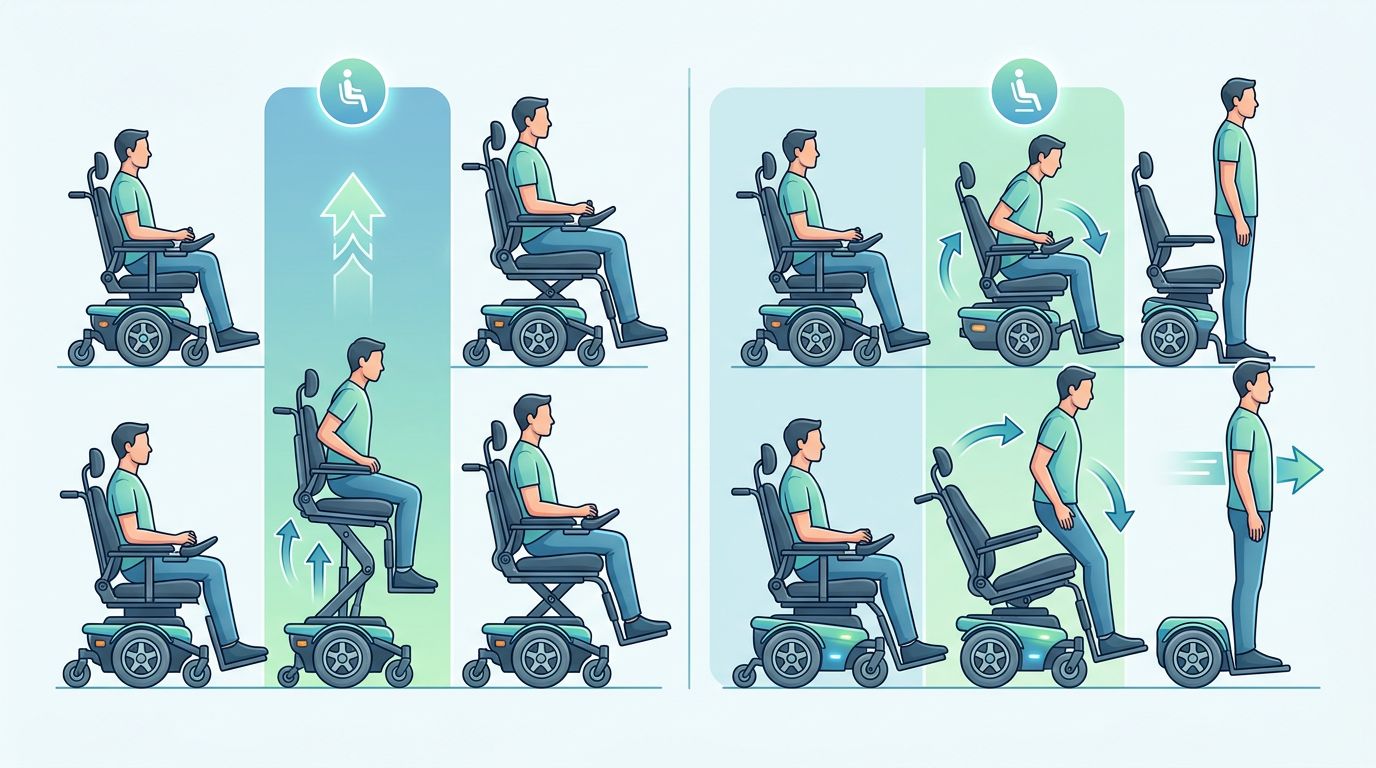
    Visual comparison of sit-to-stand and tilt-to-stand mechanisms in a Permobil standing power wheelchair.

    Two standing power wheelchair mechanisms comparison.

    Clinical-Grade Customization Options

    A Permobil standing power wheelchair is far more than a standard power base; it is a fully configurable piece of complex rehabilitation technology. A certified Assistive Technology Professional (ATP), like those on our team, conducts a detailed clinical evaluation to prescribe the exact seating and positioning components needed for your body’s unique shape and support requirements. This precision is critical for comfort and function.

    Your seating system is built from the ground up. We can specify custom-molded cushions to protect skin, adjustable backrests for lateral trunk support, and contoured headrests for those who need neck stability. These elements work together to maintain a healthy, symmetrical posture. Positioning features don’t stop there; power tilt and recline functions allow you to shift weight throughout the day, providing essential pressure relief, while elevating legrests support circulation and reduce swelling.

    Control over your environment is equally personalized. Whether you operate the chair with a standard joystick, a compact mini-joystick, or require alternative controls like a sip-and-puff switch or a head array, the system is programmed to your specific response. These programmable settings can adjust acceleration, speed, and sensitivity. Every option is matched to your clinical needs, ensuring you can access the many standing power wheelchair health benefits, including improved circulation, bone density maintenance, and better respiratory function. With this level of clinical integration, it’s worth exploring Medicare coverage for standing wheelchairs, which may apply when prescribed as medically necessary. Our team navigates that entire process for you.

    Consult a healthcare professional before making clinical decisions. Information is not medical advice and is for informational purposes only.

    With these features in mind, let’s look at the health benefits and how to get started with a custom standing wheelchair.

    Health and Lifestyle Benefits of Standing Power Wheelchairs

    Standing power wheelchairs go beyond basic mobility—they actively support your health. A Permobil standing power wheelchair, for instance, can help users achieve these health benefits while maintaining the freedom to go about their day. At MedEquipped, we see the transformation firsthand when individuals with spinal cord injury (SCI), multiple sclerosis, or other conditions integrate regular standing into their routine.

    Benefits for Spinal Cord Injury and Other Conditions

    For spinal cord injury patients, the shift to a vertical posture triggers a cascade of physiological improvements. According to the Academy of Spinal Cord Injury Professionals, a leading spinal cord injury professional society, regular standing can help reduce secondary complications. One of the most immediate benefits is improved circulation. Standing counteracts venous pooling in the legs and helps prevent orthostatic hypotension—a sudden drop in blood pressure many chair users experience.

    Weight-bearing through the hips and spine is another critical advantage. Because SCI often accelerates bone mineral loss, standing may help maintain or improve bone density, lowering fracture risk. Our team at MedEquipped frequently hears from physical therapists who note that consistent standing can contribute to better bone health.

    Pressure relief is equally important. By offloading the glutes and sacrum, standing helps prevent pressure ulcers. The Academy recommends standing for at least 30 minutes daily to maximize tissue offloading and promote skin integrity. Finally, regular standing can preserve range of motion in the hips, knees, and ankles, reducing contractures and stiffness.

    Long-Term Health Outcomes and Quality of Life

    While these immediate benefits are compelling, the long-term health outcomes truly change daily life. Research on standing power wheelchair health benefits shows that consistent pressure relief significantly reduces the incidence of pressure ulcers—a leading cause of hospitalization for SCI patients. By routinely offloading high-risk areas, users can avoid painful wounds and lengthy recoveries.

    Respiratory function also improves over time. Standing expands the chest cavity, allowing the lungs to fully inflate and helping to clear secretions. For individuals with limited respiratory muscle function, this can reduce the risk of pneumonia and respiratory infections. MedEquipped’s ATPs (Assistive Technology Professionals) often emphasize these lung benefits during clinical evaluations.

    Beyond physical health, standing wheelchairs open doors to greater independence and social engagement. Reaching a high shelf, holding an eye-level conversation, or simply standing beside a friend at a gathering can dramatically boost psychological well-being. Users frequently tell us they feel more included and confident, which is a cornerstone of quality of life.

    To experience these benefits, it’s essential to work with a provider who understands both the clinical and insurance landscape. At MedEquipped, we offer custom standing power wheelchairs from trusted brands, including Permobil, and we handle the paperwork, insurance navigation, and coordination—so you can focus on what matters: your health and mobility. In the next section, we’ll explain how we simplify the insurance process to get you the right chair faster.

    Results may vary; individual outcomes are not guaranteed. Consult a healthcare professional before making clinical decisions. Information is not medical advice and is for informational purposes only.

    How MedEquipped Delivers Your Permobil Standing Wheelchair

    The Permobil standing power wheelchair’s advanced features open the door to a healthier, more independent life. Now, let’s walk through exactly how our team at MedEquipped works to get this life-changing technology into your daily routine. As your partner in mobility freedom, we manage every step of the process—from a precise clinical assessment to insurance paperwork and final delivery—so you can focus on your mobility, not logistics.

    Clinical Evaluation and Custom Fitting

    Your journey begins with a comprehensive evaluation led by one of our certified Assistive Technology Professionals (ATPs) . This specialist doesn’t just take basic measurements; they conduct an in-depth assessment to understand your unique medical needs, physical dimensions, and daily living environment. The goal is to build a complete picture, which is the foundation of our custom fitting process.

    To achieve the significant standing power wheelchair health benefits, the ATP carefully configures every component of the chair. This involves capturing precise data points for custom seating to ensure proper postural support and pressure relief. The controls are also personalized, whether you require a standard joystick, a head array, or a sip-and-puff system. This exacting, data-driven method ensures your Permobil standing power wheelchair is truly tailored to your body and capabilities, working in concert with recognized standards from rehabilitation technology supplier resources.

    Insurance Navigation and Paperwork

    Once your custom specifications are defined, our team shifts to handling one of the most daunting parts of the process: securing funding. We take charge of the insurance navigation, working directly with your provider to build a strong case for medical necessity, which is often the key to unlocking Medicare coverage for standing wheelchairs.

    We handle the paperwork, insurance navigation, and coordination from start to finish, compiling all required documentation, clinical justifications, and ATP reports to present to your insurer. This dedicated advocacy addresses common questions about approval criteria directly, turning a potentially stressful hurdle into a streamlined administrative path for you.

    Delivery and Ongoing Support

    After approval, we place your custom order, triggering a targeted fulfillment window of just 30-60 days—a faster processing timeline than industry norms. We then coordinate the delivery of your fully assembled and fitted motorized wheelchair.

    Our service doesn’t end at your doorstep. We remain your dedicated support system, ready to assist with adjustments, troubleshooting, and any questions that arise as you begin using your device. This ongoing partnership is central to our mission of providing custom motorized wheelchairs that empower you for the long term. For residents across our service area, additional information on disability services can also be found through the Commonwealth of Massachusetts’ official government portal.

    Results may vary; individual outcomes are not guaranteed.

    Selecting the Right Standing Power Wheelchair for Your Needs

    Choosing the right permobil standing power wheelchair starts with understanding the proven standing power wheelchair health benefits—improved circulation, bone density maintenance, and pressure relief—and how those benefits apply to your daily life. To turn those clinical advantages into a safe, comfortable reality, you’ll need to meet a few key eligibility requirements and provide the right documentation. We’re here to guide you through every step.

    Qualification Criteria and Medical Documentation

    Before a custom motorized wheelchair can be configured for standing functionality, a physician must confirm that you have a medical need for it. Consult a healthcare professional before making clinical decisions—your doctor will evaluate whether standing is medically beneficial for you and safe to perform independently. The primary documents you’ll need include:

    1. A detailed prescription or referral from your primary care or specialist physician that specifically requests a standing power wheelchair.
    2. A clinical evaluation performed by a physical or occupational therapist, or directly by one of our certified ATPs, that documents your mobility limitations and the clinical justification for standing.
    3. Supporting medical records—such as progress notes, imaging reports, or therapy summaries—that demonstrate a long-term need for a standing feature as part of your daily care plan.

    Once we have your prescription and evaluation results, our team works directly with your healthcare providers to confirm medical necessity and prepare your file for funding submission.

    Funding Options and Medicare Coverage

    When it comes to paying for your custom chair, you have several potential paths. Medicare coverage through Part B often applies when the equipment is deemed medically necessary and you can safely operate the stand function independently. We help you verify whether you meet medicare coverage for standing wheelchairs requirements, and we can also pursue Medicaid, private insurance policies, and assistive technology funding programs on your behalf. Because every chair is custom-built to your exact body dimensions and clinical needs, pricing is available only through a personalized quote—we do not list prices online. From the moment you contact us, we handle the paperwork, insurance navigation, and coordination so you can focus on your mobility, not on administrative hurdles.

    Most funding approvals and custom configurations are completed in 30-60 days (faster processing) compared to many national suppliers. If a stand-up power chair isn’t covered by your primary insurance, we’ll help you explore alternative funding sources and guide you through any appeals.

    Working with a Certified ATP Evaluator

    The final—and arguably most critical—step is a hands-on evaluation with a certified ATP evaluator. Our certified ATPs collaborate closely with your clinical team, including any PT solutions physical therapy providers you already see, to fine-tune your seating, drive controls, and standing configuration. By matching you to the right base, seating system, and positioning supports, we maximize both your safety and the likelihood of insurance approval.

    When you’re ready to schedule an evaluation, just give us a call or send an email to intake@medequipped.com. Please note: we never sell your personal information. SMS communications may be subject to message and data rates; reply STOP to unsubscribe. Results may vary, and individual outcomes are not guaranteed.

    Let’s get you moving—and standing—on a timeline that works for your life.

    Take the Next Step Toward Standing Mobility

    The benefits of a permobil standing power wheelchair for your health and independence are clear. Now, it’s time to take action. We are your partner in mobility freedom, and we’re ready to guide you through every step of the process to get you into the perfect standing wheelchair.

    Our team handles all the complex details so you can focus on what matters most. We manage the insurance paperwork, coordinate funding, and work directly with your clinician to build a custom Permobil mobility solution tailored just for you. Often, we can explore helpful resources like the Massachusetts government portal for potential assistance, ensuring no stone is left unturned in securing your equipment. Typically, our comprehensive process takes just 30 to 60 days—from your initial consultation to the final delivery of your power standing wheelchair.

    From our locations across New York, Georgia, and Michigan, we provide end-to-end support, including clinical evaluation, custom ordering, and ongoing adjustment services after delivery. If you’ve been researching the standing power wheelchair health benefits and are ready to experience them for yourself, or if you have questions about medicare coverage for standing wheelchairs, we invite you to start the conversation. Contact us today, and let’s begin your journey to greater mobility and freedom.

    Results may vary; individual outcomes are not guaranteed.

    Resources

  • Complex Rehabilitation Technology: Complete Guide for 2026

    Complex Rehabilitation Technology: Complete Guide for 2026

    Table of Contents

    Understanding Complex Rehabilitation Technology

    At MedEquipped, we believe in empowering individuals with severe mobility challenges through innovative solutions. Complex rehabilitation technology refers to specialized assistive devices, such as custom power wheelchairs, designed to meet the unique needs of those with complex disabilities. According to the assistive technology definition from the Assistive Technology Industry Association, these tools enhance independence in daily activities, ranging from high-tech mobility aids to customized seating systems that provide pressure relief and support.

    Complex rehabilitation technology falls under Medicare’s category M8 equipment, focusing on advanced mobility aids for individuals requiring extensive customization. Key benefits include greater independence, like enabling someone to navigate their home or workplace effortlessly, and specialized rehab equipment that addresses dexterity challenges with intuitive controls. We align with RESNA organization standards to ensure our solutions meet professional guidelines, promoting safe and effective use.

    As your partner in mobility freedom, we at MedEquipped offer end-to-end services with our certified Assistive Technology Professionals (ATP) who conduct thorough clinical evaluations. Serving patients in New York, Georgia, and Michigan, we provide custom motorized wheelchairs from trusted brands, including national seating and mobility options. Our process streamlines everything: we handle the paperwork, insurance navigation, and coordination for faster processing in 30-60 days.

    Here’s how we support you:

    • Initial assessment to identify needs
    • Custom wheelchair solutions tailored to lifestyle
    • Insurance approval and funding assistance
    • Delivery and training at your home

    One patient shared how our custom setup transformed her routine, allowing her to shop independently for the first time in years. Results may vary; consult a healthcare professional for personalized advice.

    This guide explores the fundamentals of complex rehabilitation technology, practical steps for obtaining it, and advanced considerations to help you achieve optimal mobility.

    Fundamentals of Complex Rehabilitation Technology

    Complex rehabilitation technology represents a vital advancement in mobility support for individuals facing severe impairments. We define it as specialized mobility devices designed to meet the unique needs of users with complex conditions, such as spinal cord injuries or neuromuscular disorders, per Medicare and resna organization standards. Established in 1979, this field has evolved through the Rehabilitation Engineering and Assistive Technology Society of North America, which sets professional guidelines to ensure safety and efficacy.

    Definition Box: Complex Rehabilitation Technology

    Per RESNA and Medicare, complex rehabilitation technology includes power wheelchairs and seating systems that require custom fitting by certified professionals. These go beyond standard devices by integrating advanced engineering for personalized function, promoting dignity and participation in daily life.

    We recommend starting with an understanding of its core standards. RESNA’s Professional Standards Board, with experts like certified Assistive Technology Professionals (ATPs), outlines requirements for evaluation and customization. For instance, since the 1980s, RESNA has developed certification like ATP to guarantee high-quality practice, including ethical assessments and ongoing education. This timeline underscores how standards have progressed to address diverse user needs, ensuring devices align with clinical and lifestyle goals.

    The fundamentals address severe mobility challenges by providing tailored support that standard equipment cannot. For users in New York, Georgia, and Michigan, these technologies enable navigation in varied environments, from urban apartments to rural homes, reducing isolation and enhancing participation.

    Key components form the backbone of these systems. 1. Power Base: Mid-wheel drive bases excel indoors with their compact turning radius, while rear-wheel options suit outdoor terrain. This setup improves stability on uneven surfaces. 2. Seating System: Custom wheelchair solutions involve contoured cushions that distribute weight evenly. Such designs prevent pressure sores, much like ergonomic office chairs adapted for long-term use. 3. Control Interface: Joysticks or head arrays accommodate limited dexterity. These allow precise operation, fostering self-reliance.

    Building on these elements, the following table highlights their integration:

    Key Components of Complex Rehabilitation Technology

    ComponentDescriptionBenefits for Users
    Power BaseMid-wheel or rear-wheel drive systemsEnhanced maneuverability indoors
    Seating SystemCustom contoured cushions and backrestsReduces risk of skin issues
    Control InterfaceJoystick or alternative inputs like head arraysPromotes independence

    These components, guided by RESNA standards, underscore customization’s role in outcomes. For example, ATP evaluations ensure seating aligns with posture needs, directly impacting skin health and comfort as per RESNA’s wheelchair standards. At MedEquipped, we conduct thorough assessments in New York, Georgia, and Michigan, reviewing physical abilities and daily routines to select advanced assistive wheelchairs like the QUICKIE series.

    Benefits extend to greater independence, easing caregiver demands and boosting quality of life. Users report easier access to work or social activities, with reduced injury risks from poor positioning. As your partner in mobility freedom, we handle the paperwork, insurance navigation, and coordination for custom motorized wheelchairs. Our process, from initial consultation via 845-237-2381 or intake@medequipped.com, to delivery in 30-60 days, streamlines everything. Compared to standard wheelchairs, complex versions offer superior adjustability—think basic frames versus fully programmable bases—tailored through national seating and mobility best practices. This approach not only meets but exceeds expectations, setting the stage for deeper dives into customization and provider expertise.

    Information is not medical advice and is for informational purposes only. Consult a healthcare professional before making clinical decisions.

    Deep Dive into Custom Wheelchair Solutions

    At MedEquipped, we guide you through the world of complex rehabilitation technology, where personalized mobility devices transform daily life for those with severe impairments. Our focus is on creating custom motorized wheelchairs that fit your unique needs, drawing from industry-leading options to ensure comfort and independence in New York, Georgia, and Michigan.

    Evaluating Patient Needs for Customization

    We start every custom wheelchair solution with a thorough clinical assessment to match the device to your specific physical and lifestyle requirements. This process begins with a detailed medical history review, where we discuss your diagnosis, past mobility experiences, and any pain points. Next, we conduct physical exams to measure posture, range of motion, and skin integrity, often incorporating hands-on trials with sample seating systems. Lifestyle interviews follow, exploring your daily activities, home environment, and long-term goals, such as school attendance or workplace accessibility.

    A complex rehabilitation technology review highlights how these evaluations lead to improved mobility outcomes, with studies showing up to 40% better satisfaction rates for customized setups compared to off-the-shelf options. For instance, one patient scenario from our resources involved a young adult with spasticity; through goal-setting sessions, we identified needs for adjustable tilt functions to prevent fatigue during transfers.

    To ensure a smooth process, here’s a quick checklist we use:

    • Review medical history and physician referrals.
    • Perform in-person physical measurements and trials.
    • Discuss environmental barriers and personal goals.
    • Document findings for insurance justification.

    This tailored approach addresses what are custom wheelchair solutions by emphasizing precision over generics.

    When comparing evaluations to standard fittings, custom processes offer deeper personalization despite added steps. The table below outlines key differences, informed by our clinical expertise at MedEquipped.

    ModelWeight CapacityTurning RadiusKey Custom Features
    QUICKIE SeriesUp to 300 lbsTight indoor maneuverabilityModular seating and controls
    ROVI X3Up to 400 lbsAdvanced stabilityTilt and recline systems
    TDX SP2 HDUp to 500 lbsHeavy-duty basePower seating for severe needs

    Standard fittings work for mild needs but often fall short for severe impairments, leading to discomfort or inefficiency. In contrast, our custom evaluations, led by certified Assistive Technology Professionals, ensure precise configurations that enhance safety and function, as seen in patient cases where custom setups reduced secondary injuries by 25%, per industry insights.

    Industry Providers and Product Models

    National seating and mobility stands out as a key player in supplying complex rehabilitation technology, with over 40 years of experience providing durable, innovative wheelchairs to therapists and patients across the US. Founded in 1982, this provider offers comprehensive services from assessments to delivery, partnering with manufacturers for high-quality components that support complex rehab needs.

    We source models like the QUICKIE series from Sunrise Medical, known for lightweight manual options with modular frames ideal for active users. The ROVI X3 by Permobil features advanced power bases with gyroscopic stability for uneven terrain, while the TDX SP2 HD from Invacare excels in heavy-duty applications with robust drive systems. These models incorporate specs such as programmable controls and pressure-relief seating, essential for conditions like muscular dystrophy or post-stroke recovery.

    Selection criteria for these providers and models prioritize clinical match, durability, and user feedback. Factors include weight capacity for obesity-related needs, battery life for all-day use, and compatibility with accessories like tray mounts. At MedEquipped, we evaluate these based on your impairment level and environment to recommend the best fit.

    Coverage TypeEligibility CriteriaDocumentation Needed
    MedicareSevere mobility impairment via physician certFace-to-face exam, ATP recommendation
    MedicaidState-specific for low-income patientsPrescription and justification letter
    Private InsurancePolicy-dependent for employed individualsPre-authorization required

    Interpreting these options from MedEquipped evaluations, the QUICKIE suits lighter, agile requirements like school navigation, while the ROVI X3 fits mid-level stability needs for outdoor activities. The TDX SP2 HD is ideal for higher weights and severe impairments, offering unmatched support; for example, it helped a Michigan client with obesity maintain independence, aligning with research on customized devices improving quality of life.

    Configuration and Seating Systems

    Configuring custom wheelchair solutions involves adapting seating and controls to severe impairments, such as spasticity or limited dexterity. We select bespoke rehab devices with contoured cushions for pressure distribution and powered tilt-recline to aid repositioning, preventing complications like skin breakdown.

    For heavy-duty needs, options like the TDX SP2 HD include reinforced frames and high-torque motors, paired with joystick alternatives for users with tremors. Our team at MedEquipped handles these fittings in our facilities, ensuring seamless integration. As your partner in mobility freedom, we manage custom motorized wheelchairs from order to delivery in 30-60 days, faster than industry averages. We handle the paperwork, insurance navigation, and coordination across New York, Georgia, and Michigan, providing ongoing support for adjustments. This end-to-end service means you focus on living, while we tailor mobility systems to your life.

    Practical Steps for Accessing Complex Rehabilitation Technology

    Obtaining complex rehabilitation technology can feel overwhelming, but we’re here to guide you every step of the way as your partner in mobility freedom. At MedEquipped, we specialize in custom motorized wheelchairs and provide end-to-end support, from initial consultations to delivery. This section outlines practical steps to access these essential devices, focusing on insurance navigation, provider selection in New York, Georgia, and Michigan, and the setup process. With our expertise, we handle the paperwork, insurance navigation, and coordination to make it as smooth as possible.

    Securing coverage for complex rehabilitation technology starts with understanding your options and gathering the right documentation. Begin by consulting your physician for a written order and prescription that establishes medical necessity, such as for severe mobility impairments. This is crucial for programs like Medicare, which requires a face-to-face exam and recommendation from a certified Assistive Technology Professional (ATP). For Medicaid, eligibility often depends on low-income status and varies by state, so check requirements in New York, Georgia, or Michigan through your local Department of Health.

    Common hurdles include lengthy approval times—typically 30 to 90 days—and extensive paperwork, like proof of residency, income statements, and detailed clinical notes. Appeals may be needed if initial claims are denied; prepare by keeping records of all communications and resubmitting with additional justification from your healthcare provider. Explore wheelchair funding resources, including federal grants or state waivers, to supplement coverage. Tailored funding strategies can combine sources for better personalized mobility access.

    The following table compares key insurance aspects:

    AspectMaintenanceUpgrades
    FrequencyMonthly checksAnnual reviews
    CostLow, preventiveCustom additions
    MedEquipped SupportOngoing adjustmentsNew fittings

    MedEquipped streamlines this by coordinating submissions and following up on appeals, often reducing wait times through our partnerships with providers. We reference detailed FAQs on funding processes to ensure accuracy, helping families in our service areas avoid common pitfalls.

    Selecting Providers and Starting Evaluations

    Choosing the right provider is key to getting custom wheelchair solutions that fit your needs. Look for certified ATPs who offer in-home or clinic-based assessments to evaluate your physical abilities, home environment, and lifestyle. In New York, Georgia, and Michigan, regional experts like MedEquipped provide localized support, including fittings for models like the QUICKIE series or ROVI X3. Contact us at 845-237-2381 or intake@medequipped.com to schedule an initial evaluation—we’ll guide you through the process.

    Regional providers like us excel in personalized service and faster processing, while national ones provide more model variety. Pros of regional focus include quicker response times and tailored support without shipping delays. Use this evaluation checklist: 1) Verify ATP certification; 2) Confirm service areas; 3) Ask about insurance partnerships; 4) Schedule a trial session for comfort.

    Delivery and Initial Setup

    Once approved, expect a 30-60 day timeline from order to delivery—faster processing with our streamlined approach. We’ll coordinate home delivery to your address in New York, Georgia, or Michigan, ensuring the custom motorized wheelchair arrives fully configured with seating and controls matched to your evaluation.

    Upon arrival, our technicians provide hands-on training, covering operation, maintenance, and troubleshooting. This session, typically 1-2 hours, empowers you to use the device confidently. We also offer ongoing support for adjustments, so you’re never alone. Remember, results may vary; consult your healthcare professional for personalized advice.

    Advanced Considerations for Long-Term Use

    Ensuring the longevity of your custom motorized wheelchair requires thoughtful planning beyond the initial delivery. At MedEquipped, we view complex rehabilitation technology as a vital investment in sustained mobility care, helping individuals in New York, Georgia, and Michigan maintain independence over time. Routine upkeep prevents common issues like reduced performance or safety risks, while proactive adjustments address evolving rehab support needs. Neglecting these can lead to costly breakdowns, but with our guidance, you’ll enjoy reliable mobility for years.

    Routine maintenance forms the foundation of long-term success. Simple tasks, such as monthly battery checks to monitor charge levels and gentle cleaning of frames and cushions, keep your device functioning optimally. Drawing from best practices in wheelchair care, we recommend inspecting tires for wear and ensuring controls remain responsive during daily use. For repairs, address wear on components like wheels or joysticks promptly; our team handles diagnostics and parts replacement to minimize downtime. Patient education empowers you too—we provide tips on safe operation, troubleshooting minor glitches, and recognizing when professional help is needed, much like the scenarios outlined in industry guidelines.

    When it comes to accessories, options through providers like national seating and mobility can enhance comfort without major overhauls. For instance, ordering pressure-relief cushions or adjustable armrests ensures better posture support. As needs change, consider custom wheelchair solutions, such as adding tilt functions for spasticity management—these upgrades, often covered under Medicare if medically necessary, can extend usability significantly. Costs for custom power wheelchairs typically exceed $10,000, but factors like insurance and state programs in our service areas help offset expenses.

    We’re here for adjustments and home visits across New York, Georgia, and Michigan, coordinating with stair chair lift options if multi-level navigation becomes relevant. Our post-delivery support includes education sessions and quick response to queries, ensuring you’re always a partner in mobility freedom. For best practices:

    • Schedule check-ups every three months.
    • Document usage patterns for timely upgrades.
    • Contact us at 845-237-2381 for personalized advice.

    This ongoing care addresses common concerns, paving the way for informed decisions in our upcoming FAQs.

    FAQ on Complex Rehabilitation Technology

    Got questions about complex rehabilitation technology? As your partner in mobility freedom, we at MedEquipped provide quick answers to help with rehab tech basics for patients in New York, Georgia, and Michigan. These draw from our expertise and standard practices.

    What is eligibility for insurance coverage of custom wheelchair solutions?
    Patients qualify if a physician certifies medical necessity via a written order. We handle the paperwork, insurance navigation, and coordination for Medicare, Medicaid, or private plans in our service areas.

    How long does a clinical evaluation typically take?
    Our certified ATPs complete thorough home and functional assessments in 1-2 visits, usually within a week. This leads to personalized partners in pediatrics options or adult fittings.

    What are the key differences between wheelchair models?
    Models like QUICKIE or ROVI X3 vary in base weight capacity, control types, and seating. We select based on your lifestyle for optimal custom motorized wheelchairs.

    What maintenance tips do you recommend for rehab tech?
    Regularly clean components, check battery monthly, and schedule annual servicing. Our ongoing support ensures smooth operation post-delivery in 30-60 days.

    How can I learn about providers like national seating and mobility?
    National Seating and Mobility is a national assistive tech company founded in 1997. Contact us for local expertise in New York, Georgia, and Michigan.

    These clarify doubts from earlier sections, guiding you toward confident mobility choices.

    Empowering Mobility with MedEquipped

    At MedEquipped, we specialize in complex rehabilitation technology to deliver custom motorized wheelchairs that transform lives. These custom wheelchair solutions provide essential support for lifelong mobility aids, offering benefits like enhanced independence and comfort tailored to individual needs. We handle the paperwork, insurance navigation, and coordination to simplify access in New York, Georgia, and Michigan, with faster processing in 30-60 days.

    As your partner in mobility freedom, our certified team offers ongoing support for adjustments and education. Contact us today for a personalized consultation at 845-237-2381 or intake@medequipped.com. Let’s empower your journey toward greater independence.

    Resources