Table of Contents
- The Most Difficult Challenges for Wheelchair Users in Spring Valley, New York
- Understanding Physical and Environmental Accessibility Barriers
- How Environmental and Terrain Challenges Affect Motorized Wheelchair Independence
- Navigating Spring Valley, New York with a Motorized Wheelchair: Practical Solutions
- Advanced Custom Motorized Wheelchair Solutions for Complex Accessibility Needs
- Common Questions About Wheelchair Accessibility and Custom Solutions
- Moving Forward with Confidence in Spring Valley, New York
The Most Difficult Challenges for Wheelchair Users in Spring Valley, New York
One of the most difficult things for wheelchair users in Spring Valley, New York is navigating steep inclines and inconsistent infrastructure. Wheelchair users must contend with slopes that exceed safe design thresholds and public spaces that do not always comply with the Americans with Disabilities Act (ADA).
The power wheelchair’s incline rate, as MedEquipped’s safety guide explains, defines the maximum grade it can safely ascend from a standstill. Real life often exceeds those limits. The guide references a transit bus boarding study which noted that nearly half (45%) of deployed wheelchair ramps were at steeper angles than ADA recommends (9.5°), rendering accessible transit less reliable for most users.
Architectural barriers persist in existing facilities in Spring Valley, such as narrow doorways and steep entry ramps, even though the U.S. Department of Justice’s Title II and III mandates accessibility guidelines. The standards set forth under the ADA’s 2010 Standards include door sizes, parking options, and accessible passageways; however, most older buildings in this area have not been reworked to meet these demands. Users who require custom-motorized wheelchairs may benefit from devices that incorporate higher torque motors, lower centers of gravity and anti-tip measures which enable them to travel over uneven ground more safely.
This really highlights how essential it is that those using wheelchairs have a better understanding of the barriers presented through both the physical environment as well as the more general environment surrounding them in Spring Valley.
Key Takeaways
- Physical accessibility barriers are those architectural barriers that exist inside buildings, at entrances to buildings and other public spaces.
- Wheelchair users have trouble in narrow doorways, uneven sidewalks and other places that make it hard to get around independently on their own power.
- When someone is in Spring Valley, NY, with a motorized wheelchair, understanding accessible route requirements and entrance specifications is essential for evaluating local destinations.
- It’s more difficult to get around on the hilly and lumpy sidewalks in Spring Valley with your standard wheelchair.
- ADA regulations require wheelchair and manually powered mobility aid access to all areas open to public.
Understanding Physical and Environmental Accessibility Barriers
Physical accessibility barriers are those architectural barriers that exist inside buildings, at entrances to buildings and other public spaces. These create significant problems for those who cannot walk. Under the ADA, they are defined and regulated and must meet enforceable standards. According to the U.S. Department of Justice, Title III requires private businesses to remove barriers when the action is "readily achievable." State and local programs must ensure overall program access. In addition, under the ADA, both new constructions and major alterations are required to comply with the 2010 ADA Standards for Accessible Design.
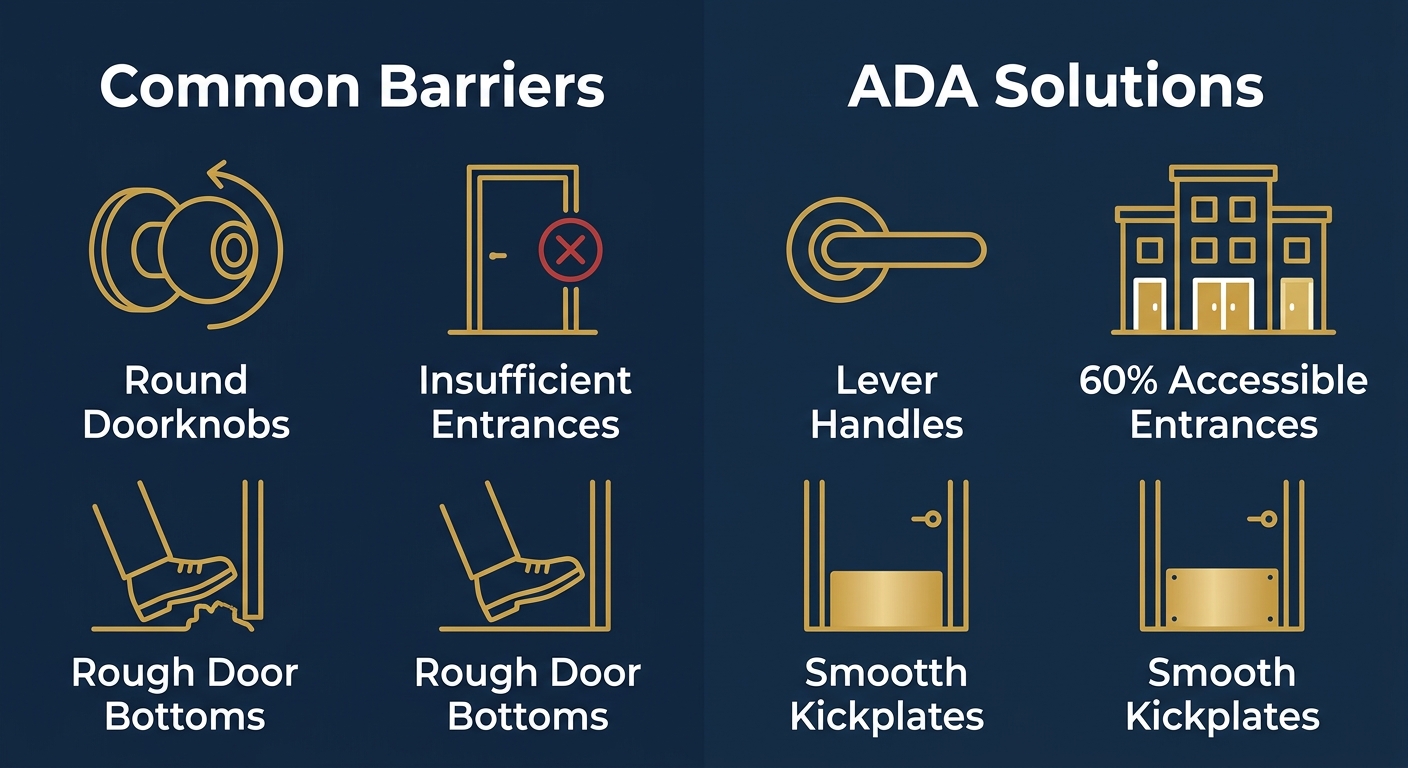
In new construction, at least 60% of public entrances must be accessible to wheelchair users. Door hardware must operate with one hand and without tight grasping, pinching, or twisting—round doorknobs violate this mandate. The push side of doors must have a smooth surface from the floor up to 10 inches, ensuring that wheelchair footrests do not catch. Which version of the ADA Standards applies, 1991 or 2010, depends on the original construction date and any subsequent alterations, as detailed by the Department of Justice.
Here’s how this works: Three kinds of barriers are listed here along with their solution as dictated in the standard set up by the ADA.
| Barrier Type | Description | Impact on Wheelchair Users | Potential Solution |
|---|---|---|---|
| Door Hardware | Round doorknobs require grasping and twisting, violating ADA. | Prevents independent entry for users with limited dexterity. | Lever handles, push plates, or automatic openers. |
| Entrance Accessibility | New construction must have 60% accessible entrances; older buildings often lack them. | Users face longer routes or rely on assistance. | Reconfigure to add accessible doors with proper clearances. |
| Door Bottom Surface | Push-side doors require smooth surfaces to 10 inches high. | Textured surfaces catch footrests, causing trips or damage. | Install smooth kickplates. |
If a store has a round knob on its door, then someone using a wheelchair would have a difficult time going in without help, if at all. If half of a building’s entrances are inaccessible, you may have to navigate busy parking lots or steep ramps to reach the nearest service.
These physical obstructions also significantly limit independence for wheelchair users in Spring Valley, NY. Custom motorized wheelchairs will help them get over these structural blockages, and give them greater independence. Removing physical obstacles is only half the battle though. There is still plenty of uneven terrain such as slopes, steps and potholes that may cause problems which are explored later on this page.
How Environmental and Terrain Challenges Affect Motorized Wheelchair Independence
Wheelchair users have trouble in narrow doorways, uneven sidewalks and other places that make it hard to get around independently on their own power. The ADA and accompanying standards define minimum accessibility requirements, yet real-world conditions often fall short.
The Impact of Narrow Doorways and Stairs on Wheelchair Accessibility
Older buildings as well as door hardware that does not comply with accessibility standards provide physical obstacles for motorized wheelchair users. Stairs pose a barrier that most power chairs are unable to navigate over. Thus, if a two-level entrance lacks an elevator, it can prevent people using motorised wheelchairs from entering the premises. In accordance with the ADA Standards established by the US Access Board, a clear opening must be a minimum of 32 inches wide and thresholds should not exceed half an inch high when new construction begins; however, many old entrances have been reduced down to only 28 inches in size or lower.
The U.S. Access Board requires that manual door hardware be usable with one hand and without tight grabbing, pinching or twisting of the wrist, criteria a round knob cannot meet. Also, the law says you need at least 60% of the entrances into new structures to have them being accessible for folks who need help getting in, though it is not uncommon that the old places don’t follow all these rules.
Navigating Outdoor Terrain: From Gravel to Steep Inclines
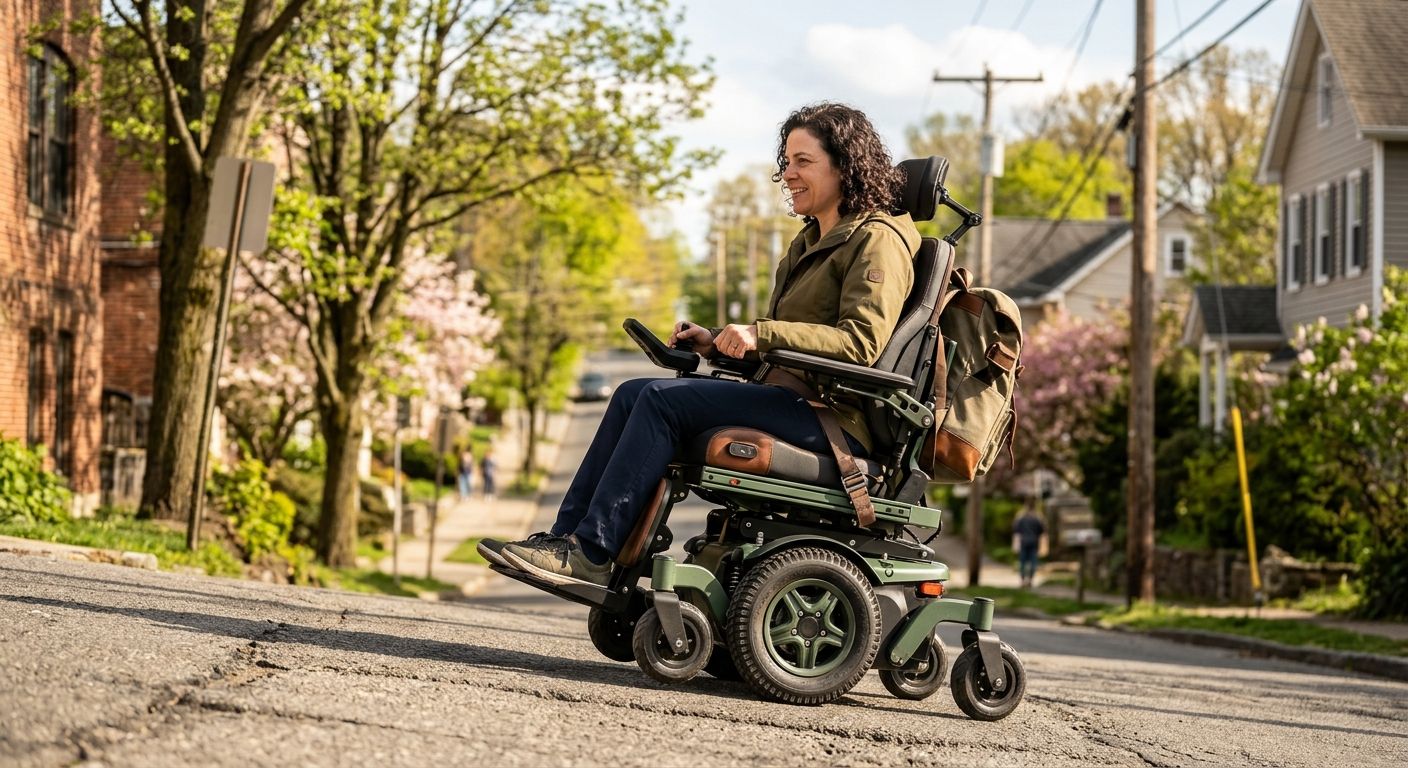
The slope rating for a power chair, which is the steepest grade it can climb while standing still, limits where someone using such equipment can travel. According to both the MedEquipped technical guide and RESNA research, if you attempt to drive up a steep hill or on an improperly-deployed ramp above the machine’s slope rating, the wheelchair may tip over. A RESNA study showed that out of all street level bus boarding instances in America, around 45% involved the deployment of ramps at angles greater than the ADA-recommended standard of 9.5 degrees.
Low centers of gravity, high-torque motors, and custom tire selection allow these latest-generation power chairs to traverse gravel, grass, and broken pavement more securely.
| Terrain Type | Common Challenges | Required Wheelchair Feature | Safety Rating |
|---|---|---|---|
| Steep Inclines | Traction loss; backward tipping when grade exceeds incline rating | High-torque motors; anti-tip wheels | Low |
| Gravel | Loose surface; vibration; instability during turns | Low center of gravity; all-terrain treaded tires | Medium |
| Grass | Uneven ground; wheel sinkage; hidden obstacles | Heavy-duty suspension; wide tire footprint | Medium |
| Uneven Pavement | Bumps; jarring; edge drops that can momentarily unload one drive wheel | Custom-tuned suspension; solid anti-tip casters | High |
Source: MedEquipped Power Wheelchair Incline Rating Guide.
Safety drops sharply on steep inclines unless your wheelchair’s incline rating is specifically matched to the slope. Our staff can set up the correct motor/suspension packages to help you maintain confidence on tricky terrain.
The Role of Public Transportation in Daily Mobility and Social Inclusion
There are some legal provisions for people who use wheelchairs on buses and trains, but physical access remains inconsistent. According to the Americans With Disabilities Act, public transportation companies had to let anyone who was using a wheelchair get into any area where everyone else could go. They may not ask about the nature of a person’s disability when they board. The RESNA study which uncovered instances where slopes were too steep also reported that power chairs made up around 70.6% of observed boardings.
If they deploy when the angle exceeds the wheelchair’s rated incline, riders may face unsafe choices that reduce access to employment, medical care, and social activities.
We’ll help you pick out your customized motorized chair at MedEquipped in Spring Valley, New York, matching each chair to your daily terrain and transit needs to help you move through your world with greater security and autonomy. Find your configuration based on the locations you visit regularly.
Navigating Spring Valley, New York with a Motorized Wheelchair: Practical Solutions
When someone is in Spring Valley, NY, with a motorized wheelchair, understanding accessible route requirements and entrance specifications is essential for evaluating local destinations.
This table compares typical building types in Spring Valley and their accessibility characteristics, drawing on the ADA Standards for Accessible Design.
| Building Type | Typical Barriers | ADA Compliance Level | Wheelchair Navigation Tips |
|---|---|---|---|
| Older residential buildings (pre-1991) | Narrow doorways (below 32 inches clear width), steps at entrances, steep access paths, high thresholds | Partially compliant; barrier removal may be required if readily achievable under Title III | Request barrier removal for entrances; look for accessible parking spaces; use ramps with handrails where rise exceeds 6 inches; confirm door maneuvering clearances |
| Modern commercial stores (post-1991) | May still have non-compliant hardware, heavy doors, or thresholds up to 3/4 inch in altered areas | Generally meets 1991 standards; renovations must meet 2010 standards | Use automatic door openers where available; check that door hardware operates with 5 lbs of force or less; verify that at least 60% of public entrances are accessible |
| Municipal offices (post-2010) | Rare major barriers; some older municipal buildings may have limited alterations | Required to meet 2010 ADA Standards for program access | Confirm accessible routes connect parking to building entrances; assess passing spaces every 200 feet along corridors; ensure handrails are present on ramps with a rise greater than 6 inches |
Evaluating Local Accessibility Hotspots in Spring Valley
An accessible route that connects between parking areas or other site arrival points (sidewalks, etc.) and all accessible building entries has to be provided, and walking surfaces should not exceed a running slope of 1:20 (5% grade). There has to be passing space(s), which is 60 in by 60 in. This passes over every 200 ft or less of longer routes and allows two wheelchairs to go past each other. The handrail needs to be available on both sides of the ramp if the rise is more than six inches. When deciding what part of the standards applies to a facility (such as when to make counters level rather than high and when to provide stalls in restrooms, and what requirements are placed on the door hardware), determine if it follows the 1991 or 2010 ADA Standards.
Overcoming Barriers in Older Buildings and Facilities
Older buildings in Spring Valley—converted homes and historic commercial structures—often have narrow entrance doors, high thresholds, and front steps. A door on an accessible route must provide a clear opening width of at least 32 inches when opened to 90 degrees; the bottom surface of push-side doors must be smooth to a height of 10 inches to avoid catching footrests. Title III requires private businesses to remove architectural barriers when removal is “readily achievable,” meaning the change can be made without much difficulty or expense relative to the business’s resources. Where thresholds exceed allowed heights for altered facilities, beveling or other adjustments can reduce obstruction.
Selecting a Motorized Wheelchair for Spring Valley’s Environment
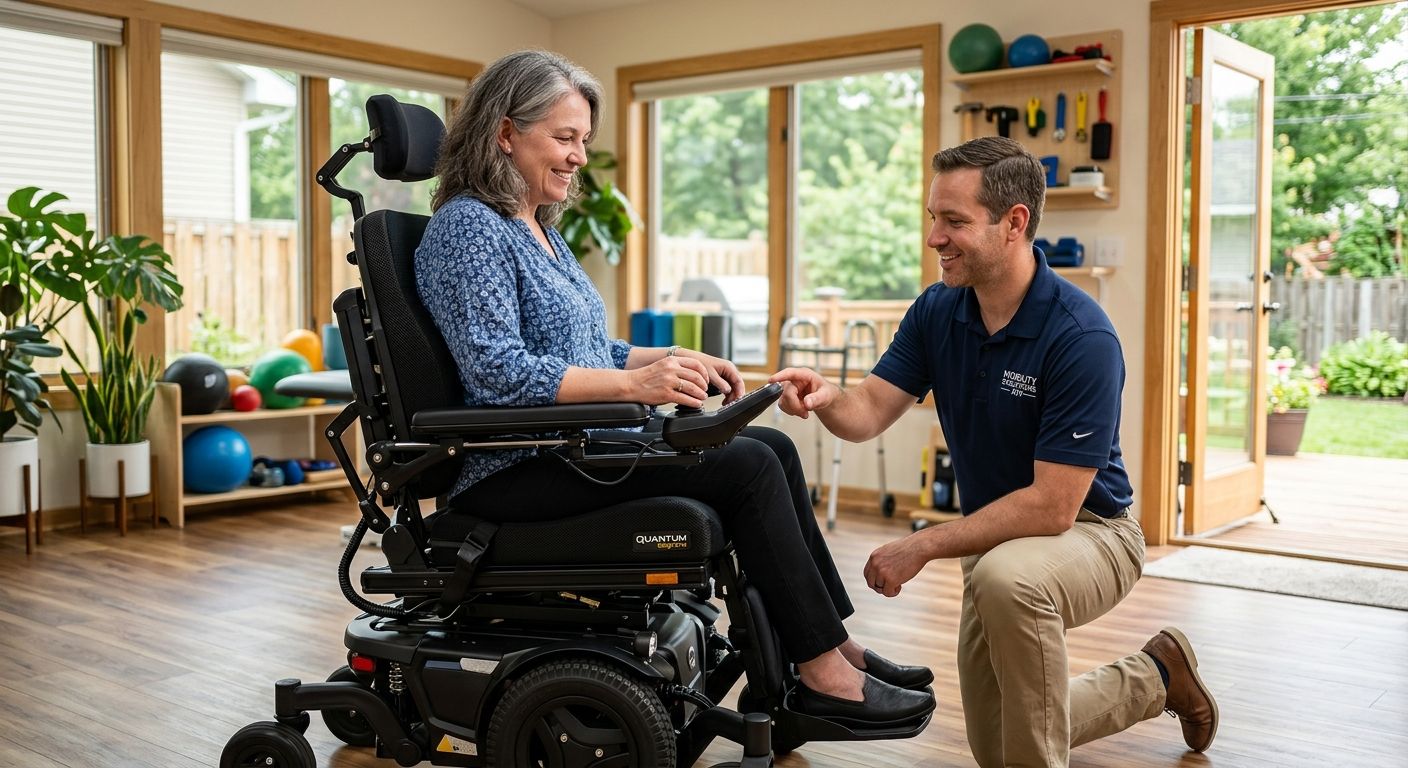
Selecting the proper powerchair will be determined according to Spring Valley’s physical landscape. When you come into the office at our clinic located at 747 Chestnut Ridge Road, staff will conduct your assessment of equipment requirements and assist in the selection of the proper powerchair, assist with funding sources and Medicare paperwork, perform personalized fit and adjustment, and verify benefits and handle related documentation. Once ordered, normal turn around time on custom made powerchairs is usually about 30-60 days. To make an evaluation appointment and set out what your mobility needs are, contact us at this phone number (845) 237-2381
Understanding which wheelchair features suit Spring Valley’s environment sets the stage for more advanced customizations that tackle specific barriers.
Advanced Custom Motorized Wheelchair Solutions for Complex Accessibility Needs
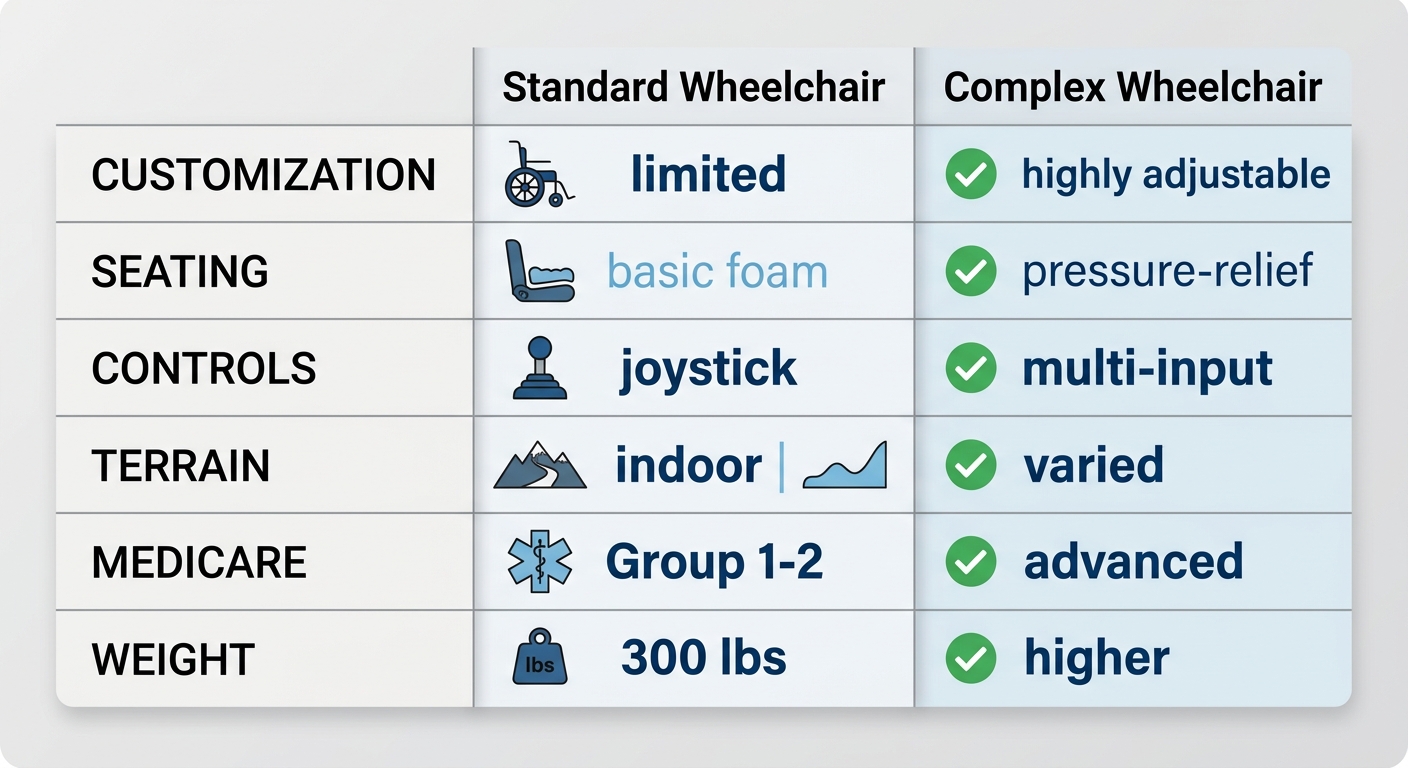
It’s more difficult to get around on the hilly and lumpy sidewalks in Spring Valley with your standard wheelchair. This means we’ll have to tailor a unique motorized configuration to meet your demands for navigating the harshness of this area of town.
Here are some examples of how the custom features solve common mobility challenges in environments like those in Spring Valley:
| Challenge | Custom Feature | Benefit | MedEquipped Approach |
|---|---|---|---|
| Steep inclines exceeding standard wheelchair capacity | High-torque motors and low center of gravity | Enables safe climbing of hills within the wheelchair’s rated incline, reducing tip risk | Assess home and community terrain, then specify motor and frame geometry for stability |
| Uneven terrain and obstacles (gravel, curbs, etc.) | Custom suspension and tire selection | Improved traction and shock absorption for a smoother, more comfortable ride | Select wheel type and suspension based on the patient’s typical usage environment |
| Access limitations due to lack of knowledge of rights | Wheelchair classification protections under the ADA | Peace of mind and confidence to use the wheelchair in all public areas | Educate clients on their ADA rights during the fitting and delivery process |
A power wheelchair’s incline rating defines the maximum grade it can safely climb from a standstill, but real-world conditions often exceed expected limits. Our internal research references a RESNA study showing that 45% of street-level bus ramp deployments surpass the ADA’s 9.5-degree slope guideline. Our Premium products include custom motorized wheelchairs with high-torque motors and a low center of gravity, which can improve stability and reduce tipping risk on non-flat surfaces. A thorough assessment of the user’s home and community landscape ensures the chair’s specifications align with real-world demands.
Under the ADA, public facilities must permit wheelchairs throughout all public areas, and staff cannot inquire about a person’s disability. Safety rules must pertain only to actual threats and not unfounded biases or generalizations.
There’s almost a seamless connection between this knowledge and curiosity towards the actual fitting process and how it can be funded.
Common Questions About Wheelchair Accessibility and Custom Solutions
ADA regulations require wheelchair and manually powered mobility aid access to all areas open to public. Business establishments as well as government agencies can’t ask about the nature or extent of a person’s disability. What are the ADA requirements for wheelchair accessibility in public places?
What does the ADA define as building access? In other words, what ADA design standards should be used in buildings. According to the 2010 ADA Standards for Accessible Design, accessible route specifications should be followed when building construction occurs. They apply to state and local government facilities under Title II and to businesses serving the public under Title III. How do ADA design standards apply to building accessibility?
Can businesses restrict my mobility device for safety reasons? The reason would have to be related to risk, not stereotype or speculation.
Is a custom powered chair right for you? We do in-depth evaluations, design chairs based on personal assessment, physical need and function, and assist with required funding documentation. How can a custom motorized wheelchair help with daily accessibility?
FAQ
How does the lack of accessible public transportation affect the daily mobility and social inclusion of wheelchair users?
Inconsistent accessible public transportation reduces wheelchair users’ daily mobility by creating unsafe boarding conditions. A study found 45% of bus ramp deployments exceeded the ADA slope guideline of 9.5 degrees. This unreliability limits access to employment, medical care, and social activities, directly impacting social inclusion.
What are the most common physical accessibility barriers that wheelchair users encounter in public spaces?
The most common physical accessibility barriers in public spaces are narrow doorways below the required 32-inch clear width, round doorknobs that require grasping and twisting, steep entry ramps, and insufficient accessible entrances. New construction mandates 60% of public entrances be accessible, but older buildings often lack compliant door hardware and smooth door bottom surfaces.
How do environmental challenges like narrow doorways and stairs impact the independence of motorized wheelchair users?
Narrow doorways below 32 inches clearance block entry for motorized wheelchair users, and stairs are impassable without an elevator. This forces users to find alternate routes or rely on assistance, significantly reducing their ability to enter buildings and move independently through public spaces.
What types of outdoor terrain are most difficult for motorized wheelchairs to navigate safely?
Steep inclines pose the greatest risk, causing traction loss and tipping when a slope exceeds the chair’s incline rating. Gravel surfaces cause instability and vibration, grass can hide obstacles and allow sinkage, and uneven pavement jars the chair, all making navigation without anti-tip wheels, high-torque motors, and a low center of gravity dangerous.
What are the most significant daily difficulties faced by powered wheelchair users when trying to access older buildings or facilities?
The most significant daily difficulties when accessing older buildings are narrow entrance doors, which can be as small as 28 inches, high thresholds that obstruct wheels, front steps that motorized chairs cannot climb, and round doorknobs that require grasping and twisting. These barriers often prevent entry without assistance.
Moving Forward with Confidence in Spring Valley, New York
For most of their patients, the problem isn’t moving on flat ground, but going up hill. And our Custom Power Wheelchair models have Low CG, and High-Torque Motors that make the uphill trips safer. ADA guarantees the right to use mobility devices in public spaces, and we handle evaluation, fitting, delivery, and Medicare paperwork assistance. In the Spring Valley office call us at (845)237-2381 email: intake@medequipped.com Consultation here. Results MAY vary. Begin a consultation in Spring Valley, New York by calling (845) 237-2381 or emailing intake@medequipped.com; results may vary; verify Medicare/insurance coverage (the supplier does not guarantee coverage) and consult your treating healthcare professional for medical necessity.
Schedule Your Custom Wheelchair Evaluation
Now that you understand the physical and environmental barriers that make navigation difficult for wheelchair users, it’s time to consider a custom solution. A motorized wheelchair with a low center of gravity and high-torque motors can safely handle steep inclines and uneven terrain like those in Spring Valley, New York. We specialize in personalizing power wheelchairs to your specific needs, from the initial evaluation through final delivery. We assist with funding sources and Medicare paperwork to simplify the process. To begin your journey toward greater independence, call (845) 237-2381 or visit our office at 747 Chestnut Ridge Road. Schedule your evaluation today.
Schedule Your Custom Wheelchair Evaluation