Category: Custom Motorized Wheelchairs

  • Which Is Better for Me, a Power Wheelchair or a Power Assist Wheelchair

    Which Is Better for Me, a Power Wheelchair or a Power Assist Wheelchair

    Table of Contents

    Choosing Between a Power Wheelchair and Power Assist Wheelchair

    Determining which is better for you—a power wheelchair or a power assist wheelchair—depends on your upper body strength, daily activities, and any progressive health conditions. Power assist wheelchairs use motorized pushrims that reduce stroke frequency and joint excursion, as power assist wheelchairs research shows, helping mitigate shoulder pain in manual chair users while allowing many to stay active longer. A full power wheelchair offers complete independence: no manual propulsion is required, making it essential when upper body strength is limited or a progressive condition affects mobility. We design custom motorized wheelchairs tailored to each patient’s diagnosis and functional requirements, ensuring safe, strain-free movement. Each option suits a different profile, so the first step is to identify your daily mobility needs.

    Key Takeaways

    • For individuals in Spring Valley, NY, deciding between a power wheelchair and a power assist wheelchair begins with a look at daily mobility needs.
    • Understanding these differences will help you identify the right device.
    • The best mobility solution for you depends on your daily environment, upper-body strength, and long-term comfort.
    • If you are wondering which is better for you, a power wheelchair or a power assist wheelchair, the answer begins with how easy it is to push a manual wheelchair.
    • While manual wheelchairs may involve simpler documentation, navigating the power wheelchair eligibility criteria in Spring Valley requires a more detailed process.

    1. Identify Your Daily Mobility Needs

    For individuals in Spring Valley, NY, deciding between a power wheelchair and a power assist wheelchair begins with a look at daily mobility needs. Thorough self-assessment of your strength, endurance, travel distances, and the environments you navigate will indicate which device best supports your independence.

    • Evaluate whether your condition is progressive. MedEquipped’s guidance highlights that custom motorized wheelchairs deliver superior long-term independence to individuals with progressive conditions or significant limitations.
    • Assess your upper-body strength and stamina. Manual wheelchairs and power assist systems typically suit short-distance travel only when you have adequate arm and shoulder function.
    • Prioritize seating and posture. Proper fitting prevents pressure injuries and safeguards postural health, so comfort and fit must be part of your evaluation.
    • Consider your everyday environments. Indoor surfaces like carpet and thresholds, as well as uneven sidewalks outdoors, affect the practicality of a manual or power assist approach.

    Once you have identified your daily needs, you can compare the features of power wheelchairs and power assist technology.

    2. Compare Power Wheelchair and Power Assist Technology

    We’re here to help.

    • Propulsion: Power wheelchairs use a joystick, while power assist devices reduce stroke frequency and joint excursion via proportional motor assistance.
    • Portability: Power assist units attach to a manual chair; power chairs are heavier.
    FeaturePower WheelchairPower Assist Device
    PropulsionFully motorized (joystick)Pushrim-activated proportional assistance
    Physical EffortMinimalReduced stroke frequency and joint excursion
    Best ForLimited upper-body strength, progressive conditionsSome pushing ability, reduce fatigue and injury
    Health ImpactEliminates strainMitigates shoulder pain
    PortabilityHeavierLighter, attaches to manual wheelchair
    Customization & FittingProper fitting needed for pressure injuries and postureSame
    Power Wheelchair vs. Power Assist Device: Key Feature Comparison

    Understanding these differences will help you identify the right device.

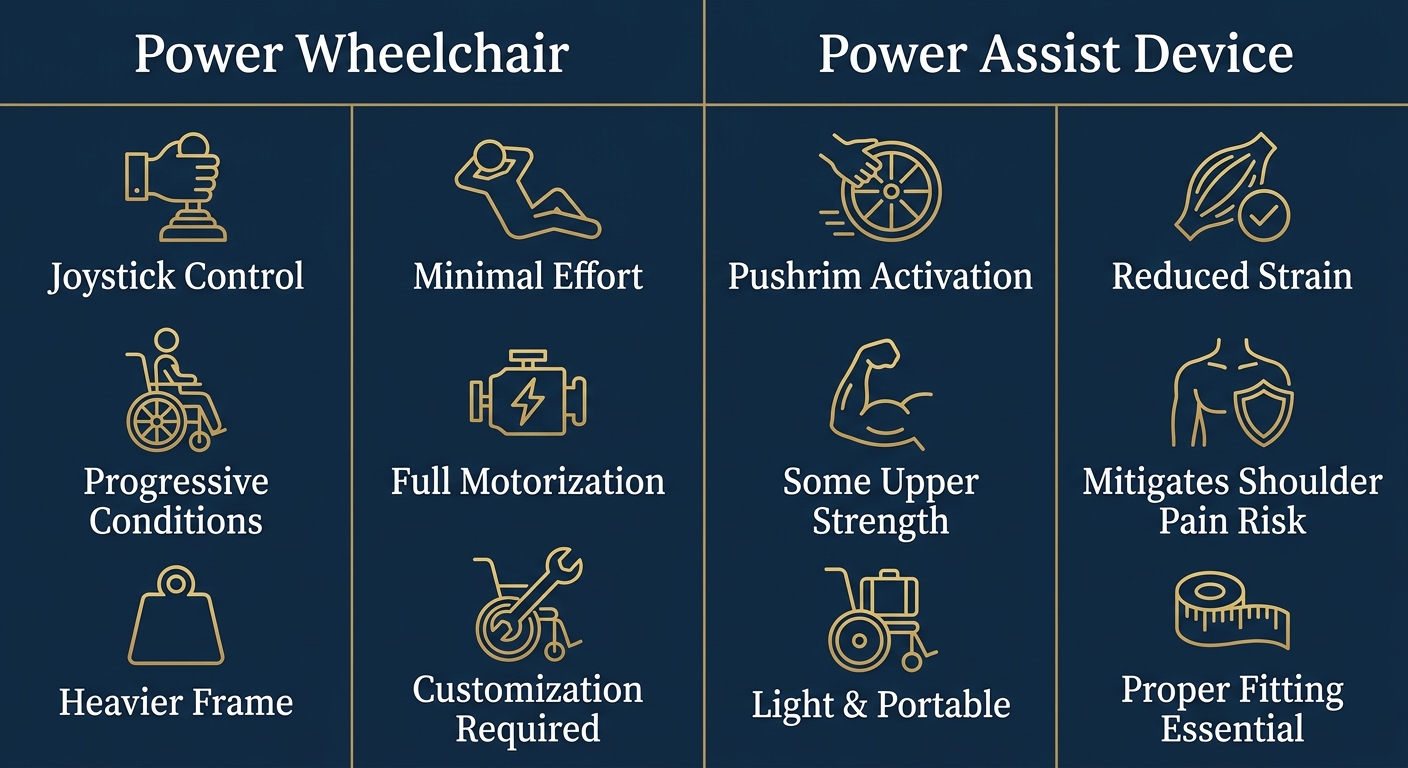
    Infographic comparing Power Wheelchair and Power Assist Device, each column has six icon and label pairs.
    Side-by-side comparison of power wheelchair and power assist device features.

    3. Find the Best Power Assist Device for You

    The best mobility solution for you depends on your daily environment, upper-body strength, and long-term comfort. A power assist device reduces effort by adding motorized torque to manual pushes, while a full power wheelchair handles all propulsion independently. We recommend starting with a self-assessment to determine which option aligns with your mobility goals.

    • Consider your daily terrain: full power chairs handle long distances and varied surfaces, while power assist devices suit moderate challenges.
    • Assess your upper-body strength and shoulder pain. Power assist technology reduces strain on the upper body, and research by RESNA found significant reductions in shoulder strain and helps protect against overuse injuries.
    • Evaluate comfort: full power chairs require no manual effort, whereas power assist systems let you stay engaged while minimizing fatigue.

    Understanding your needs helps you choose a wheelchair that fits your daily life. Schedule an evaluation and trial—a hands-on test reveals which device feels easiest to push and protects your shoulders. This approach safeguards your long-term comfort.

    4. Discover the Easiest Wheelchairs to Push

    If you are wondering which is better for you, a power wheelchair or a power assist wheelchair, the answer begins with how easy it is to push a manual wheelchair. Many users can propel a manual chair comfortably when it is tailored to their body and daily routines.

    • Lightweight frame: A chair built with aluminum or titanium reduces rolling resistance and requires less effort over long distances.
    • Proper seat fit: A seat that matches your hip width and thigh length keeps your posture aligned, so each push delivers more efficient forward movement.
    • Adjustable components: Rear-wheel position, caster angle, and hand-rim design all affect how much energy you expend with every stroke.

    Our MedEquipped guide on manual versus motorized wheelchairs highlights that personalized fitting and customization are what make a manual wheelchair truly easy to push. For users who find self-propulsion too demanding, understanding power wheelchair eligibility in Spring Valley, New York can reveal whether a fully powered option is right for them.

    5. Navigate Power Wheelchair Eligibility Criteria in Spring Valley, New York

    While manual wheelchairs may involve simpler documentation, navigating the power wheelchair eligibility criteria in Spring Valley requires a more detailed process. Medicare Part B mandates a face-to-face examination with a physician and a written order demonstrating that the power wheelchair is medically necessary for use inside the home.

    According to the Centers for Medicare & Medicaid Services (CMS), power-operated seat elevation equipment is covered when prescribed with a complex rehabilitative power wheelchair and following a specialty evaluation by a licensed physical therapist or occupational therapist. The CMS coverage criteria require safe operation and need for seat elevation to assist with transfers or reaching for daily activities like feeding, dressing, or grooming.

    Our initial patient evaluation and personalized fittings at MedEquipped help document these clinical needs, satisfying the medical necessity requirements. We verify Medicare benefits and assist with required paperwork to streamline the approval process. Once eligibility is confirmed, we focus on customizing the power wheelchair to your precise diagnostic and lifestyle requirements.

    6. Personalize with Custom Motorized Wheelchair Features

    Once coverage eligibility has been determined, residents in Spring Valley can concentrate on tailoring their motorized wheelchair. Personalization turns a standard mobility device into a precise clinical tool that matches the user’s body and routine.

    Medicare’s national coverage policy now reimburses power-operated seat elevation equipment when prescribed for a complex-rehabilitative power-driven wheelchair—this is not an option for basic power chairs. A specialty evaluation by a licensed physical or occupational therapist is mandatory, confirming that the patient can operate the equipment safely at home. Coverage applies to three specific clinical scenarios: weight-bearing transfers, non-weight-bearing (dependent) transfers, and reaching assistance for mobility-related activities of daily living like feeding, dressing, or grooming. These guidelines direct which features are funded, and we incorporate them while also customizing seating, positioning cushions, and control interfaces to suit each diagnosis.

    Our team navigates the documentation; custom choices are finalized at fitting and completed in 30–60 days.

    7. Benefit from Rapid 30–60 Day Turnaround and In-Person Fitting

    Custom motorized wheelchair orders often entail half-year waits, but we have refined the process to deliver in as quickly as 30 days. We handle Medicare benefits verification and funding paperwork up front, eliminating delays that can stretch timelines elsewhere. Most custom wheelchairs are ready for fitting within 30 to 60 days, substantially faster than the industry norm of six months or more.

    Once your wheelchair arrives, we schedule a personalized fitting at our clinic in Spring Valley. Proper fitting is essential for preventing pressure injuries, supporting healthy posture, and achieving all-day comfort. During this appointment, our team fine-tunes seat depth, back support, footrest height, and control positioning to your exact needs. The in-person fitting process enables immediate adjustments that optimize safety and long-term satisfaction.

    Your first step is a personalized mobility evaluation at our location in Spring Valley, where we complete a comprehensive assessment of your clinical needs and daily activities. Contact us at (845) 237-2381 to schedule your evaluation.

    8. Schedule a Personalized Mobility Evaluation in Spring Valley

    The rapid 30–60 day turnaround and precise in-person fittings you’ve read about begin with one essential step: a personalized mobility evaluation. During this comprehensive assessment, we evaluate your strength, mobility, and daily activity requirements to determine the right wheelchair for your needs. We also discuss the daily activities most important to you, such as transferring from bed to chair, preparing meals, or navigating community spaces, to ensure the wheelchair’s features align with your life. Our evaluation prioritizes a proper fit to prevent pressure injuries and support postural health — key considerations for long-term comfort. If you are considering a power wheelchair with seat elevation equipment, Medicare coverage policy requires a specialty evaluation by a licensed professional, such as a physical therapist or occupational therapist, to verify medical necessity. To schedule your evaluation, call us at (845) 237-2381 or visit our clinic at 747 Chestnut Ridge Road. Your custom mobility solution begins with a comprehensive evaluation. Schedule yours today.

    Your Custom Mobility Solution Starts Here

    Deciding which is better for you, a power wheelchair or a power assist wheelchair, in Spring Valley starts with a personalized evaluation—your first step toward a custom solution from our team. Our custom motorized wheelchairs provide superior independence for those with progressive conditions or significant mobility limitations. Every chair is custom-fitted to your exact measurements and clinical needs for optimal comfort. We complete orders in 30 to 60 days—far faster than the six-month industry average—and manage all Medicare paperwork on your behalf. Contact us at (845) 237-2381 or visit 747 Chestnut Ridge Road, Spring Valley, NY 10977 to begin your journey toward greater independence.

    Results may vary. Verify Medicare/insurance coverage; supplier does not guarantee coverage. Consult your treating healthcare professional for medical necessity.

    Start Your Personalized Evaluation

    You’ve now explored the key differences between power wheelchairs and power assist devices, including research showing reduced stroke frequency and joint excursion with pushrim-activated power assist. The article guided you through identifying daily mobility needs and comparing technology features. The most impactful next step is to experience these options firsthand through a personalized evaluation. At MedEquipped in Spring Valley, New York, a comprehensive assessment ensures the right custom mobility solution for your lifestyle and health. Their team manages Medicare paperwork and funding verification, simplifying the path to a custom motorized wheelchair that promotes independence. A rapid 30–60 day turnaround means you won’t wait months for the equipment you need. Taking this step can lead to greater comfort, safety, and daily freedom.

    Start Your Personalized Evaluation
    Resources

  • Power Wheelchair Incline Rating for Hills: Complete Safety Guide

    Power Wheelchair Incline Rating for Hills: Complete Safety Guide

    Table of Contents

    Why Power Wheelchair Incline Ratings Matter for Safe Hill Navigation

    A power wheelchair incline rating for hills defines the maximum slope angle the chair can safely ascend and descend, directly affecting user safety and control. Exceeding this limit can cause tipping, motor strain, and loss of braking, potentially stranding the user on a steep incline. The real-world need for these ratings is clear: a RESNA study found that 45% of bus ramp deployments exceeded the proposed ADA maximum slope of 9.5°, a scenario we know can be dangerous for an improperly rated wheelchair. This data underscores why understanding your chair’s incline rating is essential, it determines whether the chair can navigate everyday slopes without risk. Understanding what these numbers represent is the next step in choosing a safe wheelchair for your environment.

    To navigate hills safely, it helps to understand your power wheelchair incline rating for hills. This rating defines the maximum slope angle a powered wheelchair is designed to safely ascend or descend, typically measured in degrees or as a percent grade.

    • Degrees indicate the direct angle of the slope.
    • Percent grade shows rise over run; for example, a 1:12 ramp equals about 4.8 degrees.

    Real world slopes can vary. Research on transit bus ramps shows that at street level, the average slope was 8.9 degrees, and 45 percent of those surpassed the ADA slope limit. This variability highlights why selecting a wheelchair with an adequate incline rating is crucial for safety.

    We recommend you evaluate the slope of the driveway you use and the hills you encounter when comparing wheelchair models. Choosing a capability well above your typical needs reduces the risk of tip-overs and motor strain. The principles that govern measurement of ADA ramps also apply to accessibility in the community. Consider whether other measurements you encounter support accessibility and how to apply them to your needs.

    Key Takeaways

    • When a power wheelchair’s incline rating suggests it can manage steep grades, the ramps we encounter in public spaces must follow ADA slope rules.
    • While the ADA ramp slope guidelines establish a maximum gradient of 9.5°, real-world ramps often exceed that limit.
    • When assessing heavy-duty power wheelchairs for adult users, it is essential to evaluate how a chair responds to true-to-life slopes, as opposed to an unrestricted laboratory incline.
    • Safely crossing sloped door thresholds with a power wheelchair requires design elements that keep the chair stable.
    • It is important to understand your wheelchair’s power incline rating for hills so you can comfortably and confidently maneuver outdoors.

    2. ADA Ramp Slope Rules Every Chair User Should Know

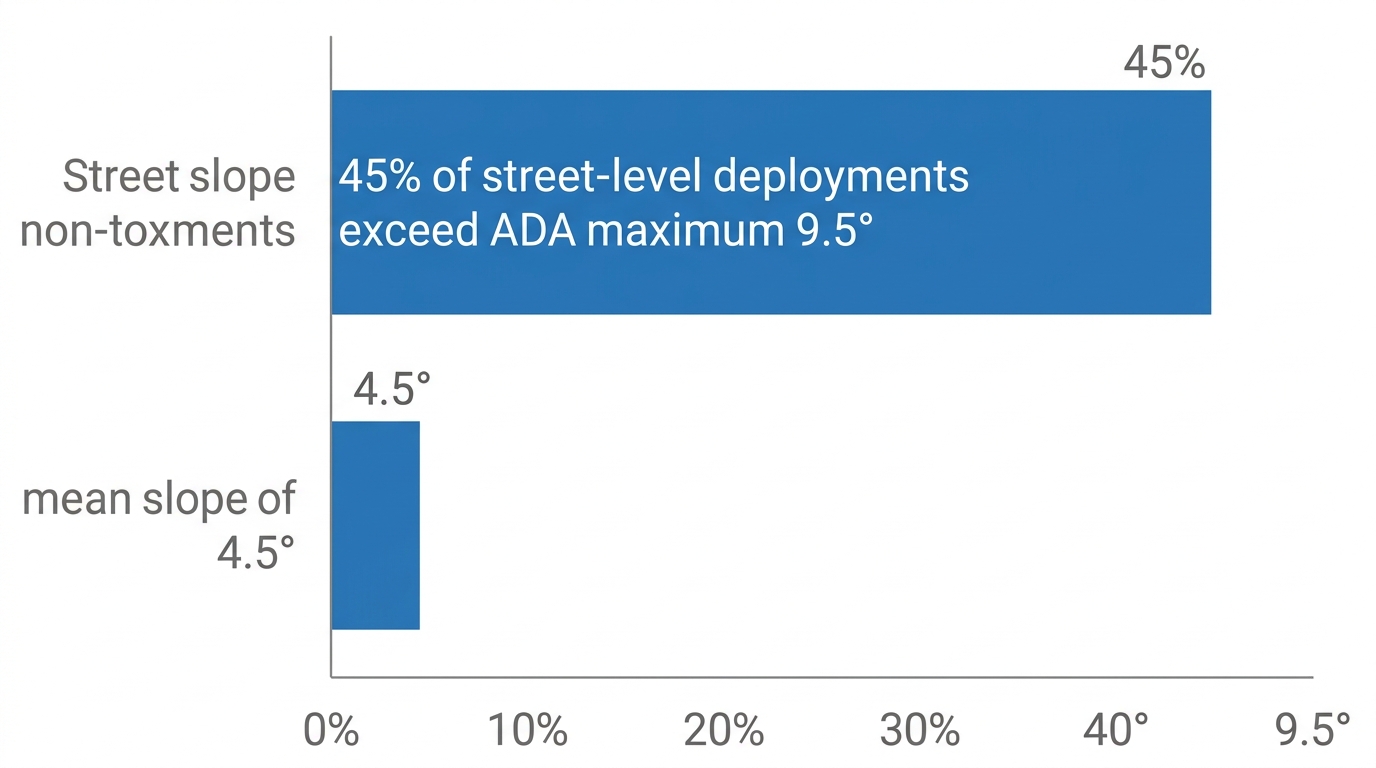
    When a power wheelchair’s incline rating suggests it can manage steep grades, the ramps we encounter in public spaces must follow ADA slope rules. A 2013 RESNA study of 221 transit bus boardings recorded a mean deployed ramp slope of 4.5 degrees, yet 45% of street-level deployments exceeded the proposed ADA maximum of 9.5 degrees (a 1:6 ratio). Only 2.5% of sidewalk-level deployments surpassed that limit.

    Horizontal bar chart showing RESNA study data on transit ramp slopes, with one bar indicating 45% of street-level deployments exceed the proposed ADA maximum of 9.5 degrees and another bar showing a mean slope of 4.5 degrees.
    RESNA study on transit ramp slope compliance for wheelchair users.

    This difference reflects operator controlled factors such as the depth of bus kneeling and where the operator directs the user to board the bus. The study also found 70.6 percent of all boardings were powered wheelchairs.

    Designs to accommodate maximum slope navigation must be considered for power wheelchairs. Manufacturers incorporate low center-of-gravity frames and suspension systems in modern power wheelchairs to improve safety and stability on steep ramps.

    3. How Powered Wheelchair Design Tackles Maximum Slopes

    While the ADA ramp slope guidelines establish a maximum gradient of 9.5°, real-world ramps often exceed that limit. A 2013 RESNA study of bus ramp deployments found that 45% of street-level boardings surpassed this threshold, with measured slopes reaching 14°, a clear signal that robust design is essential. To tackle steep inclines safely, powered wheelchairs rely on high-torque motors that prevent stalling on gradients, anti-tip wheels that lock the chair in place, a low center of gravity for stability, and traction control that optimizes wheel grip.

    Manufacturers assign an incline rating that identifies the steepest grade the chair can safely manage under ideal conditions. The maximum slope for an electric wheelchair is typically stated by the manufacturer; users should compare this figure to the slopes in their own environment. However, even the best-designed chair can face disadvantages on very steep slopes—loose gravel or an abrupt transition at the top of a ramp may cause wheel slip or momentary instability.

    4. The Real Disadvantages of Electrical Wheelchairs on Slopes

    The ability of an electric wheelchair to handle a slope in the real world often falls short of expectations, not because of deficiencies in wheelchair design, but because the kinds of slopes encountered in the world are often steeper than the recommendations allow. The Rehabilitation Engineering and Assistive Technology Society of North America (RESNA) documents some of these challenges in the real world. For example, 221 boardings of buses showed that, when ramps were fully extended to the level of the street, 45% of the boardings exceeded the ADA limitation of a slope of 9.5°. Sidewalk level ramps exceeded the limitation only 2.5% of the time. The slope that a rider faces often is a function of operator choice, leading to unpredictable, and in some cases, extreme, conditions. The average slope measured was 4.5°, but in some cases it was as low as -1° and in other cases as high as 14°. There are many real world challenges that demonstrate the need for a power wheelchair that has greater slope-handling ability. Given that, in the real world, the slope of ramps sometimes can be significantly higher than 9.5°, it helps a consumer make a decision that balances the needs of the environment and the clinical situation of the consumer.

    5. Choosing a Heavy-Duty Power Wheelchair for Adult Users

    When assessing heavy-duty power wheelchairs for adult users, it is essential to evaluate how a chair responds to true-to-life slopes, as opposed to an unrestricted laboratory incline. These chairs are built for higher capacity and for demanding outdoor terrain with significant slopes.

    When assessing power chairs for hill climbing, it is recommended that users focus on the manufacturer’s stated grade capability, the frame’s weight capacity and rigidity, and the motor’s torque for sustained climbing. Again, real-world conditions do not always align with controlled, laboratory, or test conditions. Every power chair should be assessed with the user’s environment and the operator’s skill in mind.

    A RESNA study found that 45% of street-level bus ramp deployments exceeded the ADA’s maximum slope guideline of 9.5 degrees, with a mean of 4.5 degrees. Slope demands in the real-world are dependent on a variety of factors beyond the specification of the wheelchair.

    Heavy-duty power wheelchair models provide higher capacity and climbing ability, but there are factors beyond these considerations that should also be assessed. For example, if the user travels a good deal, a model with a lighter frame and compact dimensions, that is easier to transport, could be the better choice.

    Incline rating is the steepest slope that a power wheelchair can climb from a standstill. This is expressed in degrees or as a percentage grade. This number is important for any user that has to navigate a street or bus ramp.

    Real-world inclines can be greater than the slopes many users expect. Researchers studying public-transit access found that during deployment of bus ramps to street level, 45% exceeded the 9.5 degree slope proposed in the ADA guidelines. For a portable power chair to safely traverse such slopes, it would need high-torque motors, large rear drive wheels for increased traction, and a long wheelbase that resists the chair from tipping over backward.

    At MedEquipped, our evaluation process matches a chair’s torque, wheel configuration, and stability to the actual slopes you navigate every day. This personalized approach helps ensure a portable model won’t falter where you need it most. The same attributes that keep a chair planted on a steep hill—strong torque delivery and a balanced wheelbase—also make crossing indoor sloped thresholds safer and smoother.

    7. Indoor-Friendly Electric Wheelchairs for Sloped Thresholds

    Safely crossing sloped door thresholds with a power wheelchair requires design elements that keep the chair stable.

    Research behind the proposed accessibility guidelines indicates that slopes steeper than 9.5° frequently create barriers for wheelchair users, and home thresholds can easily approach that range when door saddles sit above a finished floor.

    During a threshold crossing, the front anti-tippers prevent the chair from tipping forward when the drive wheels first contact the slope, and the rear anti-tippers keep the chair from tipping over when the casters go over the threshold and the weight shifts to the back of the chair.

    Joystick-driven proportional control allows the rider to go at a slow speed over the threshold to avoid a hang-up.

    We assist clients in selecting a wheelchair that pairs responsive drive electronics with the right anti-tip geometry and wheelbase length. The right configuration makes indoor navigation and threshold crossings safer.

    8. Custom Motorized Wheelchairs that Conquer Inclines

    Research presented by RESNA, the Rehabilitation Engineering and Assistive Technology Society of North America, found that nearly half of bus ramps deployed to street level exceeded proposed safety guidelines, illustrating the steep inclines wheelchair users face in daily life and the critical need for incline-ready power chairs.

    During the initial evaluation, we assess the terrain a patient routinely travels and identify the motor torque, battery capacity, and drive-wheel configuration required for stable hill climbing. Because ideal setup depends on user weight, seating, and typical slopes, our fitting process selects a combination that delivers confident incline performance rather than a fixed rating. Once finalized, we build the chair to spec and complete most orders in 30 to 60 days.

    Medicare and other payers often cover custom power wheelchairs configured for outdoor inclines. We also assist with benefits verification, funding identification, and paperwork.

    The result is a wheelchair that opens up outdoor mobility, freeing patients to engage in community life beyond flat surfaces.

    Begin Your Journey to Confident Outdoor Mobility

    It is important to understand your wheelchair’s power incline rating for hills so you can comfortably and confidently maneuver outdoors. The right wheelchair can provide the incline capability to conquer various ramps and slopes safely, and give you the freedom to travel in your neighborhood and local parks. At MedEquipped, we pair personalized fittings and expert evaluation with hands-on assistance for Medicare benefit verification and funding paperwork, so your custom motorized wheelchair matches your terrain and clinical needs. Call us at (845) 237-2381, email us at intake@medequipped.com, or visit us at our clinic at 747 Chestnut Ridge Road, Spring Valley, NY 10977. Results may vary. We verify your Medicare and insurance coverage but do not guarantee it, and you should consult your treating healthcare professional for medical necessity.

    Begin Your Journey to Confident Mobility

    Now that you understand the critical importance of incline ratings for safe hill navigation, the next step is choosing a wheelchair that matches the terrain you face. MedEquipped specializes in custom motorized wheelchairs built to your exact specifications, ensuring comfort and maneuverability on slopes. Our team provides a personalized evaluation to make certain the chair can handle the inclines you encounter every day. We also assist with Medicare benefit verification and funding paperwork, helping you navigate the financial side with confidence. A standard 30-60 day processing timeline means you could be enjoying greater outdoor mobility sooner than you think. Call us at (845) 237-2381 or visit our facility at 747 Chestnut Ridge Road in Spring Valley, New York to begin your evaluation. Your journey to confident mobility starts with a single call.

    Begin Your Journey to Confident Mobility

    Resources

  • Complex Rehab Technology Delivery Process in Spring Valley: Timeline

    Table of Contents

    Custom Power Wheelchairs for Greater Independence

    Custom motorized wheelchairs are designed based on an individual’s prescription, as a customized mobility solution. Unlike standard equipment, these devices give greater control and independence with respect to positioning and mobility. The whole process, from evaluation through fitting, funding, and delivery, gives a fair idea of how Complex Rehab Technology (CRT) enables independence and function in daily activities. Understanding this process gives an idea as to what to expect and how to get ready for it.

    Complex Rehab Technology Delivery at a Glance

    Complex rehab technology (CRT) involves individualized evaluation, configuration, and fitting and forms the basis for the custom power wheelchairs we provide. This process is different from a standard order because it requires an in-person evaluation with a healthcare professional and continues with on-site fitting and adjustment. It is designed to increase the user’s independence. We coordinate delivery and support to accommodate the user’s functional needs.

    Recognizing When a Custom Motorized Wheelchair Is Right for You

    For individuals navigating the complex rehab technology delivery process in Spring Valley, recognizing when a custom motorized wheelchair is the right solution begins with an honest look at daily mobility. Common signs that a standard chair falls short include persistent discomfort, poor postural support, pressure sores, difficulty reaching controls, or a progressive condition that alters strength and coordination. When positioning, support, or mobility needs cannot be met by a standard power chair, a custom evaluation is warranted.

    A thorough initial evaluation determines candidacy. Once a need is clear, our Spring Valley team guides each patient through the delivery process.

    The Complex Rehab Technology Delivery Process in Spring Valley, New York

    The complex rehab technology delivery process in Spring Valley follows a structured path from initial evaluation to final setup in your home. At MedEquipped, we begin with a thorough patient evaluation to assess your specific mobility needs, functional abilities, and lifestyle requirements.

    After determining the right custom configuration, we perform a personalized fitting to ensure the motorized wheelchair conforms exactly to your body dimensions and supports your daily routines. We coordinate delivery and setup. Our Quick turnaround means you typically receive your custom chair within 30-60 days.

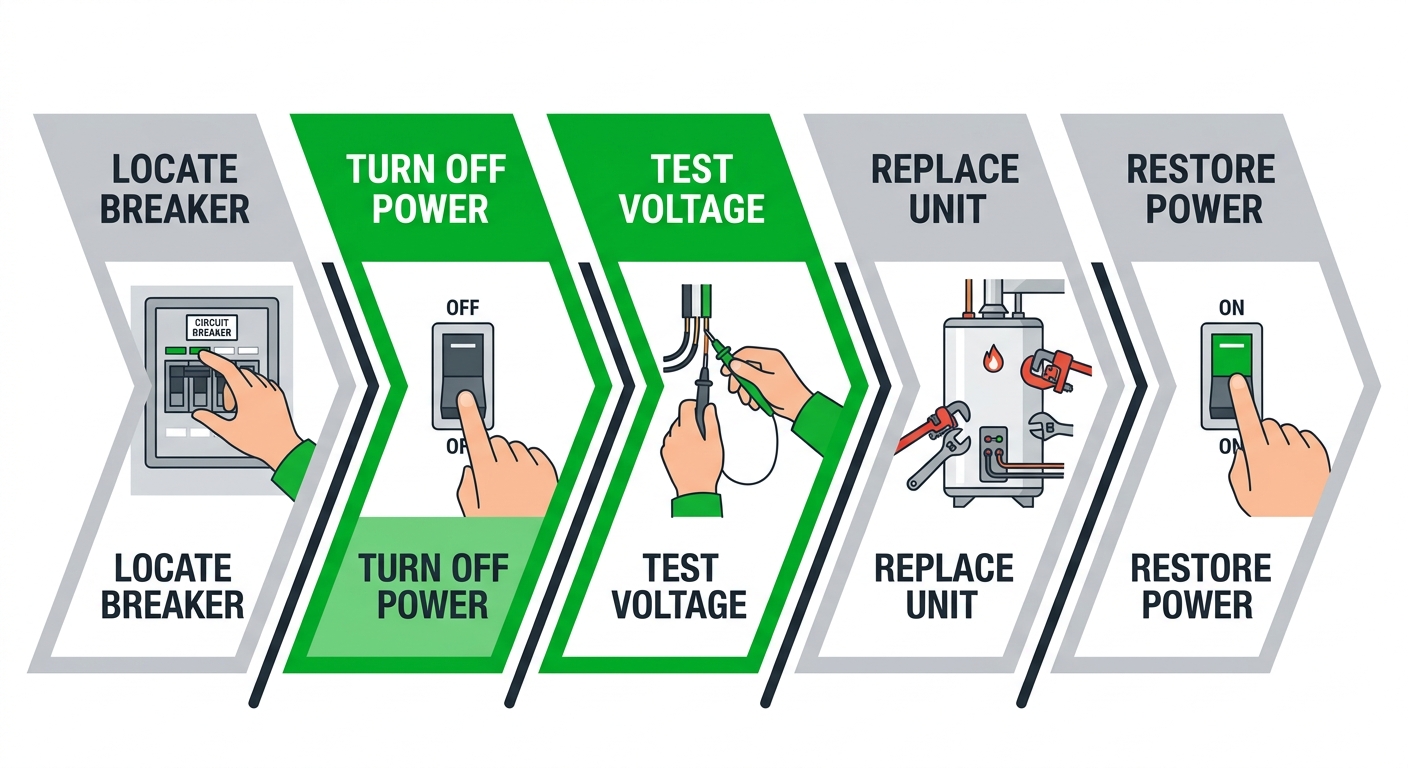
    Five-step electrical panel repair process diagram with circuit breaker icons in vibrant green, soft gray, and dark charcoal on white cards
    Step-by-step breaker panel repair

    Our Spring Valley-based team also manages the funding paperwork for you. We verify your Medicare benefits, process billing, and provide hands-on assistance with any required documentation. Then, we schedule a local delivery and setup appointment to make sure everything operates flawlessly.

    Key Decisions for Your Custom Wheelchair Setup

    During your initial evaluation, our team assesses seating posture, pressure management, and positioning needs to guide every decision. Frame type, such as a power base or mid-wheel drive, affects stability and how easily you navigate your Spring Valley home. Drive systems influence ride smoothness and whether the chair is optimized for indoor tight spaces or outdoor terrain. Weight capacity and seating configuration are matched to your functional requirements.

    Different components and features on a wheelchair impact the funding process. We confirm your Medicare benefits and manage the paperwork to validate that the chosen wheelchair is within Medicare guidelines. The paperwork is completed for the wheelchair components you selected. We handle personalized fittings and delivery setup so that every component is configured exactly to your clinical needs. We source the premium wheelchair and manage the process from evaluation to final configuration.

    Custom Wheelchair Services for Spring Valley and Beyond

    After you’ve determined that a motorized wheelchair is the right solution for your mobility needs, partner with a provider that can tailor the equipment precisely to you. For those seeking custom wheelchairs in Spring Valley and nearby areas, MedEquipped offers a complete, hands-on evaluation at our Spring Valley clinic.

    During the thorough evaluation, we make sure the equipment is fitted to you for your specific daily needs and requirements. Only after the evaluation do we order the custom wheelchair. Once the chair is ready, we will deliver it and assemble it for you in the comfort of your home in Spring Valley, NY or any of the other surrounding areas.

    Of course, we can also help you navigate the funding side, meaning we will assist you in the verification process with Medicare and help you fill out the paperwork so you don’t have to worry about it. The main focus of this aid is to remove uncertainty about whether you will be covered and to prepare you for your future options.

    Understanding Funding and What to Expect

    A custom motorized wheelchair designed for your body is only half the journey. Funding it through insurance is the other half, and that requires a process.

    • Custom motorized wheelchairs are covered as durable medical equipment (DME) under Medicare Part B when medical necessity criteria are met.
    • Coverage requires a face-to-face evaluation and a written prescription from your treating physician before paperwork can begin.
    • Our Spring Valley team handles the benefits verification.
    • Approval timelines vary.

    With funding confirmed, we can proceed to order and construct your customized wheelchair.

    Your Custom Wheelchair Delivery Timeline

    Your custom wheelchair delivery timeline typically falls within 30–60 days after funding approval. We then verify measurements, submit the order, and manufacture your custom chair (2–4 weeks). Delivery and in-home setup add 1–3 days. Timelines vary by configuration and insurance. Prompt evaluation helps ensure a smooth process. For any questions, our team is here to help.

    Frequently Asked Questions About Custom Power Wheelchairs

    After you place your order for a custom power wheelchair, patients have a lot of questions about what happens next.

    How is a custom wheelchair different? We build your chair to your exact measurements and mobility needs.

    What happens during the evaluation and fitting? We determine your physical requirements.

    How long will it take to get my wheelchair? It takes 30-60 days after funding is approved.

    What happens on the day of delivery? We deliver the wheelchair, set it up and explain how to safely operate it.

    Do you help with Medicare and Funding? Yes, we manage all Medicare paperwork and coordinate funding.

    Start Your Path to Greater Mobility with MedEquipped

    Your journey to greater mobility begins with custom power wheelchairs built for your diagnostic and functional needs — a personal mobility solution designed to support independence, comfort, and daily confidence. Our team guides you through every step: initial evaluation, personalized fitting, and delivery to your home. We manage the complex funding paperwork, including Medicare benefits verification and billing. With our fast 30-60 day turnaround, you won’t wait months for the mobility you deserve. Contact us to start your path.

  • Let’s Get Moving: Power Wheelchair Guide for Spring Valley

    Let’s Get Moving: Power Wheelchair Guide for Spring Valley

    Table of Contents

    The Let’s Get Moving Initiative and Custom Motorized Wheelchairs

    That’s why we created the Let’s Get Moving initiative—a comprehensive program designed to simplify the process of obtaining a custom motorized wheelchair and help you achieve Greater Independence. From our clinic in Spring Valley, NY, we serve patients throughout New York City and the surrounding region, offering premium products and a quick turnaround of just 30–60 days.

    Through our Let’s Get Moving initiative, we provide premium mobility equipment in New York City, including Custom Motorized Wheelchairs built to your exact specifications. Our team handles everything from the initial evaluation and personalized fitting to delivery and hands-on setup. We’re here to help you navigate Medicare and insurance paperwork, so you can focus on regaining mobility without the administrative burden. We offer a selection of electric wheelchairs and power wheelchairs designed to meet a wide range of clinical and lifestyle needs, and our specialists work closely with you to identify the best solution.

    Once your chair is ready, we deliver it directly to your home, provide setup support, and offer training to ensure safe operation. Our goal is to help you enjoy Greater Independence in your daily routine. In the next section, we’ll walk you through the step-by-step process of joining the program.

    Results may vary. Verify Medicare/insurance coverage; supplier does not guarantee coverage. Consult treating healthcare professional for medical necessity.

    Power Wheelchairs and Electric Wheelchairs as Mobility Solutions

    A power wheelchair is a self-contained powered base operated via joystick, head array, or sip-and-puff controls, engineered for individuals with complex medical needs such as quadriplegia or severe muscle weakness. By contrast, an electric wheelchair broadly includes manual chairs retrofitted with power assist or scooter-style platforms steered by tiller. Let’s get moving toward a solution that truly matches your life.

    These terms often get mixed up, but the differences carry real consequences for daily use and funding eligibility. Power wheelchairs are designed for precise positioning and can be extensively customized. Electric wheelchairs, lighter and better for outdoor terrain, offer less configurability. The following table breaks down the key points.

    Comparison Table: Power Wheelchair vs. Electric Wheelchair
    FeaturePower WheelchairElectric Wheelchair
    DefinitionPowered by battery and controlled via joystick or sip-and-puff; frame is part of the powered base.Often used synonymously, technically refers to manual chair with add-on power assist or scooter-style platform.
    Control TypeJoystick, head array, or sip-and-puff for direct drive.Typically tiller or handlebar control, less customizable.
    Terrain CapabilityDesigned for indoor and controlled outdoor use; can be modified for light terrain.Larger wheels and higher ground clearance for outdoor use.
    Customization OptionsHighly customizable seating, controls, and drive programming.Limited customization; seat options but fewer drive configurations.
    Typical Use CaseIndividuals with complex mobility needs requiring precise positioning and control.Active users who need a lightweight, portable option for outdoor travel.

    As the comparison illustrates, control type is a major differentiator. Power wheelchairs allow adaptive controls—from chin joysticks to breath-activated input—enabling individuals with limited hand function to drive independently. Seating systems can be molded, tilted, or reclined to manage pressure and posture. Electric wheelchairs, while improving outdoor access, generally lack this depth of customization and are better suited for users who require less positioning support. These distinctions also affect Medicare classification: power wheelchairs are specifically recognized as durable medical equipment, while some electric add-ons may fall under different reimbursement rules.

    For residents of Spring Valley, NY and the wider New York City metro area, MedEquipped provides custom power wheelchairs that excel in urban environments. Our power chairs are configured with compact bases and responsive controls to navigate crowded sidewalks and public transportation. When individuals seek wheelchairs in New York City, they can access our personalized fitting process, ensuring seating and programming match their daily routines—whether that’s commuting in Manhattan or visiting Central Park.

    Medicare classifies power wheelchairs as durable medical equipment (DME) under criteria set by the Centers for Medicare & Medicaid Services (CMS). Coverage is possible when a physician documents medical necessity. At MedEquipped, we handle benefits verification and paperwork, but final coverage decisions rest with Medicare. Results may vary; verify your coverage details and consult your healthcare professional before pursuing a claim.

    Now that the functional differences are clear, the next stage is securing funding. Medicare, Medicaid, and some private insurance plans may contribute to the cost. In the upcoming section, we detail the step-by-step process for documenting need, submitting claims, and navigating the system. Understanding your coverage options is the next step—continue reading to learn how Medicare can help fund your mobility solution.

    Custom Motorized Wheelchairs: From Evaluation to Delivery

    After understanding the benefits, let’s walk through the step-by-step process. Patients seeking customized wheelchairs in Manhattan can begin with a comprehensive evaluation at our Spring Valley clinic. We combine clinical expertise with premium products to deliver a Custom Motorized Wheelchair for greater independence. Let’s get moving on your mobility journey.

    Comparison Table: Standard vs. Custom Motorized Wheelchair
    FeatureStandard Motorized WheelchairCustom Motorized Wheelchair
    Configuration OptionsPre-configured; limited adjustment.Built to order; full range of components.
    Fit PrecisionStandard sizing; may not accommodate unique body shapes.Personalized measurements and trial fittings ensure optimal comfort.
    Component QualityMass-produced; adequate but not specialized.High-quality, medically appropriate components selected by clinicians.
    Funding Process ComplexitySimpler paperwork; limited to standard medical necessity.Requires detailed documentation; MedEquipped handles all funding paperwork.
    Turnaround TimeAvailable immediately from stock.30–60 days with MedEquipped, faster than industry average.

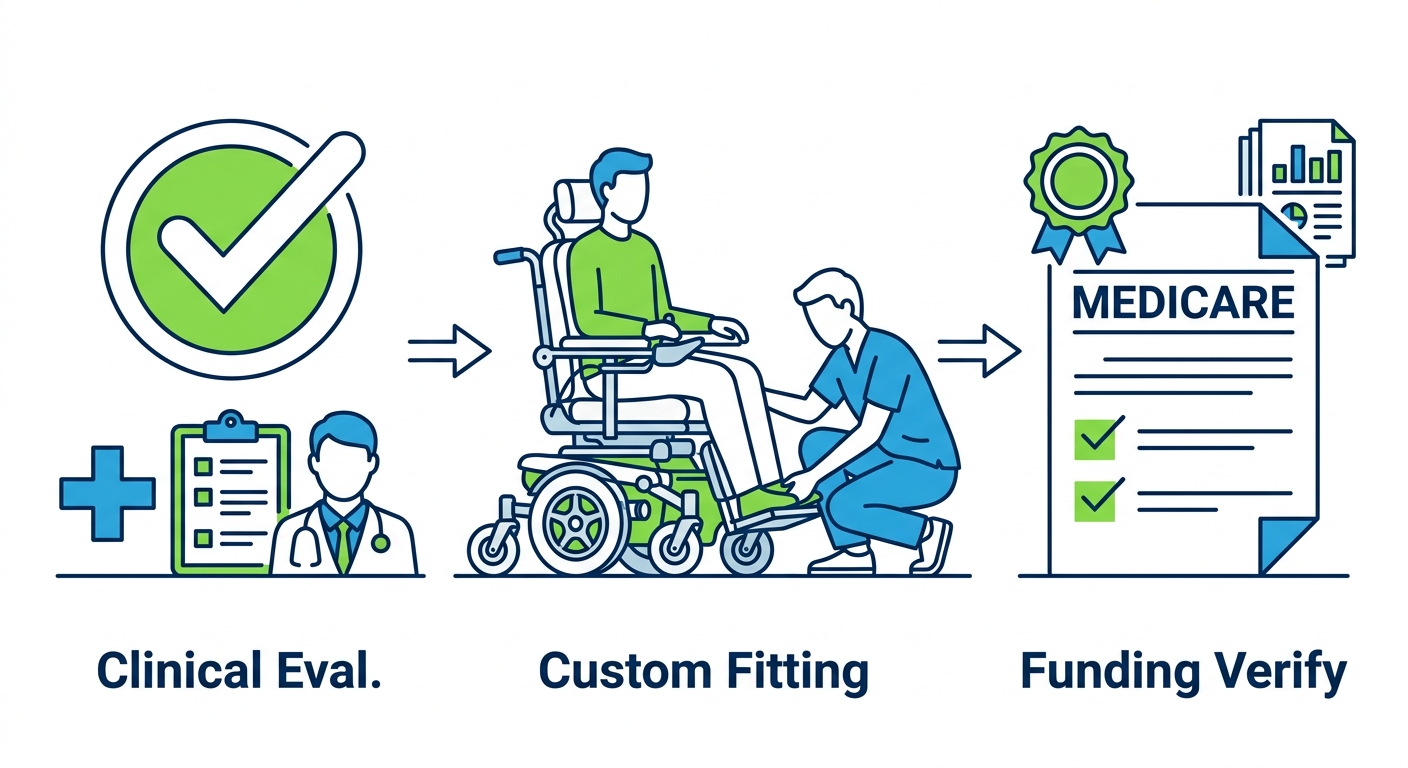
    The benefits of a custom solution are clear, and our streamlined process ensures quick turnaround—often within 30 to 60 days. Our team manages every step from evaluation to delivery, so you avoid the lengthy waits typical of other providers. The following graphic illustrates the key phases of our process, and the sections below describe each in detail.

    Three-stage process flow showing wheelchair evaluation, custom fitting, and funding verification with connecting arrows

    Custom wheelchair process from evaluation to funding approval

    The Initial Patient Evaluation and Custom Configuration

    Every custom motorized wheelchair begins with an in-person assessment by our clinicians at our Spring Valley clinic. We evaluate your functional mobility, posture, range of motion, and daily goals to understand your needs. We determine whether power seating functions such as tilt, recline, or elevating leg rests are medically necessary to manage pressure and pain, and we evaluate specialized controls for those with limited hand dexterity. We consider your typical daily activities, including maneuvering through tight doorways or navigating uneven sidewalks, to select a base with the right turning radius and suspension. Our team combines these findings to create a custom build that maximizes indoor usability and outdoor durability. Based on the assessment, we recommend a custom configuration tailored to your diagnosis and lifestyle, ensuring your Custom Motorized Wheelchair is built precisely for your unique requirements.

    Personalized Fittings and Adjustments

    Once the configuration is approved, we schedule an in-person fitting session at our clinic. Using pressure mapping technology, we analyze seat surface contact to identify pressure points and prevent sores, adjusting the cushion contour and back support accordingly. We take meticulous measurements and test alignments for seat depth, backrest angle, armrest height, and footplate position. Joystick placement is customized for your dominant hand and range of motion; for an electric wheelchair, this placement directly affects driving control, so we fine-tune sensitivity and speed settings. We may also integrate alternative controls such as sip-and-puff or head arrays. Through iterative adjustments and trial sitting, we ensure every control is intuitive and comfortable. We also evaluate your seating posture in relation to the drive base to optimize stability and maneuverability. Throughout the fitting, our specialists explain each adjustment so you understand how the chair supports your body. This hands-on process eliminates guesswork and gives you confidence that the final chair will meet your daily mobility needs.

    Funding a custom motorized wheelchair can be complex, but we’re here to help. MedEquipped verifies your Medicare benefits upfront and assists with the documentation required to demonstrate medical necessity. Our team works directly with your treating healthcare professional to ensure that the physician’s face-to-face examination and written order meet CMS guidelines, and we compile all supporting records. We also coordinate with secondary insurers when applicable to maximize coverage. We handle the paperwork so you can focus on your mobility. However, coverage is not guaranteed; we do not guarantee funding approval. Verify your Medicare and insurance coverage. Consult your treating healthcare professional for medical necessity. Results may vary. Once funding is approved, we coordinate the final build and schedule delivery. Our quick turnaround—typically 30 to 60 days—means you receive your chair faster than the industry average. The next phase is professional setup and training, which we cover in detail shortly.

    Selecting and Maintaining Your Motorized Wheelchair for Independence

    Now that you understand the benefits of a power wheelchair, it’s time to choose and care for yours. To truly let’s get moving, we’ll walk you through selection, maintenance, and community independence.

    Key Factors in Choosing the Right Motorized Wheelchair

    Choosing a motorized wheelchair starts with weight capacity, seating dimensions, and drive type. We build Custom Motorized Wheelchairs to match your clinical needs and home layout, ensuring a precise fit. The table below compares drive types to guide your decision.

    Comparison Table: Drive Type Performance
    Drive TypeManeuverabilityGround ClearanceTerrain SuitabilityBattery Range
    Front-Wheel DriveExcellent indoor maneuverability; tight turning radius.Lower clearance; suitable for smooth surfaces.Best for indoor use; limited on gravel or grass.Standard range (10–15 miles per charge).
    Rear-Wheel DriveGood outdoor stability; moderate turning radius.Higher clearance; handles uneven terrain.Versatile; use on pavement, grass, and light trails.Extended range (12–18 miles).
    Mid-Wheel DriveZero-turn radius; extreme indoor agility.Moderate clearance; stable on slopes.Excellent indoors; fair on packed terrain with anti-tip.Standard range (10–14 miles).

    Selecting a drive type is a key step toward greater independence. For the control interface, power wheelchairs can use a joystick, sip-and-puff, or head array based on your physical abilities. Our team matches the right controls during your personalized fitting.

    Daily Maintenance and Battery Care

    Regular maintenance keeps your motorized wheelchair performing safely and reliably. Our premium products are engineered for durability, and a little routine care goes a long way. For battery care, charge the chair after each use and avoid letting the battery fully discharge; deep discharges shorten lifespan. Once a month, clean the battery terminals with a dry cloth to prevent corrosion. This simple routine helps you avoid unexpected power loss.

    Upholstery care is equally straightforward. Use a mild soap, a soft cloth, and water to wipe down the seat and backrest; never apply harsh chemicals that could damage the fabric. Periodically inspect the upholstery for thinning or tears, and address any wear early to maintain comfort and support. For wheel and control integrity, we recommend a weekly check: tighten any loose fasteners, confirm tire pressure is adequate, and test the joystick’s responsiveness. Whether you use a front-wheel or mid-wheel electric wheelchair, these checks ensure consistent, dependable mobility. Should you ever need guidance, we’re just a phone call away.

    Enhancing Mobility and Independence at Home and in the Community

    A well-maintained custom motorized wheelchair opens the door to greater independence. According to the Administration for Community Living, successful community integration relies on gradual exposure and planning. Start by mapping out local routes, identifying accessible ramps, and practicing in familiar areas. Over time, you will build the confidence to visit parks, shops, and social gatherings. Staying active in your community not only boosts physical mobility but also supports emotional well-being and a sense of belonging. Our electric wheelchairs are engineered to navigate varied settings, from tight indoor spaces to paved outdoor paths. If you’re new to powered mobility, practice steering and maneuvering in an open space before venturing out; use public transportation options like paratransit services that accommodate wheelchairs.

    We understand that funding can be a barrier. Our team handles the Medicare paperwork so you can focus on your mobility goals. Learn more about Medicare funding for wheelchair durable medical equipment and how we can help you navigate the process. Coverage is not guaranteed; verify your benefits and consult your healthcare provider about medical necessity. Results may vary.

    With your wheelchair chosen and maintained, you’re ready to explore funding options and start enjoying greater independence. Our quick turnaround—typically 30 to 60 days from evaluation to delivery—means you won’t wait long to begin moving forward. From selection to funding and setup, we’re here to help every step of the way.

    Advanced Considerations for Custom Wheelchair Users and Caregivers

    Let’s get moving toward a deeper understanding of the advanced maintenance and care that keeps custom power wheelchairs performing safely and reliably. We understand that navigating the ongoing needs of mobility equipment can seem daunting, but with clear, actionable information, users and caregivers can confidently manage many aspects of care. Knowing the boundaries between at-home tasks and those requiring certified expertise is crucial for safety and longevity for electric wheelchairs. This section clarifies these distinctions to help you maintain your equipment and preserve your independence.

    Battery inspection and cleaning is a task that can be performed at home. Regularly checking terminals for debris and gently cleaning them is a sound practice for maintaining reliable power. However, if you discover corrosion, swelling, or physical damage to the battery casing, the task immediately shifts to a professional concern. Attempting to repair a damaged battery is dangerous and should never be done. At this point, contacting a qualified mobility equipment provider is essential for a safe assessment and resolution.

    Regarding wheel alignment and tire replacement, basic visual checks and monitoring tread wear are excellent DIY habits. Like checking tires on any vehicle, you can spot obvious issues like low pressure or uneven wear. Yet, precise wheel alignment and complex repairs, such as replacing solid tires or servicing the drive axle, require a professional’s touch. Incorrect alignment can lead to instability, inefficient power consumption, and unpredictable steering, making professional service the only safe choice for these detailed adjustments.

    Joystick calibration is a component that must never be adjusted by the user. This sophisticated electronic control requires specialized diagnostic equipment and specific certification to calibrate correctly, which is one reason why RESNA certification ensures that assistive technology professionals meet standardized competency requirements. A miscalibrated joystick can cause the wheelchair to move in unexpected and dangerous ways, posing a serious safety risk. Always rely on a certified technician from an industry-established body like RESNA for any joystick concerns.

    Seat reconfiguration and upholstery replacement offer some room for simple at-home adjustments. You can often make minor changes like adjusting the seat height, but major modifications to the support structure, such as altering the backrest angle or repositioning posture supports, demand a professional fitting. Proper configuration is critical to prevent pressure injuries and maintain correct body positioning. We recommend consulting a specialist for these complex tasks to ensure your comfort and health, drawing on the expertise we foster as a provider of custom motorized wheelchairs.

    The following table provides a quick reference, summarizing which tasks you can handle and which require a call to a professional.

    Comparison Table: Maintenance Task Allocation
    Maintenance TaskDIY Possible?Professional Service Needed?
    Battery inspection and cleaningYesOnly if corrosion or damage is found.
    Wheel alignment and tire replacementBasic checksFor precise alignment and complex repairs.
    Joystick calibrationNoRequired; incorrect calibration can affect safety.
    Seat reconfiguration and upholstery replacementSimple adjustmentsFor major changes to support structure.

    Knowing when to perform a simple check and when to call a professional is the foundation of safe and reliable wheelchair operation. This balanced approach prevents minor issues from escalating into major dysfunctions while safeguarding against the risks of improper tampering. With a premium product, proper care ensures that how you live your life is defined by Greater Independence, not by equipment downtime.

    With these advanced considerations in mind, you are better prepared to maintain mobility and independence. For additional support with daily living, explore independent living resources for disability to find community programs and funding assistance that complement your medical equipment care. Remember, results may vary, and consulting a qualified professional is the surest path to sustained safety and performance.

    Frequently Asked Questions About Let’s Get Moving and Motorized Wheelchairs

    Here are answers about the Let’s Get Moving campaign and how it works with your smartwatch and motorized wheelchair.

    How to Turn Off Let’s Get Moving Notifications on Samsung Gear 3

    To disable the alerts, navigate to Settings > Notifications on your Gear 3. Scroll to the Let’s Get Moving entry and toggle it off. Press back to confirm. This does not affect your watch’s performance or the operation of your electric wheelchair. We’re here to help with any further questions about your motorized wheelchair in Spring Valley, NY. Notification settings may vary by software version.

    How to Turn Off Let’s Get Moving Notifications on Garmin

    Open the Garmin Connect app on your phone, then tap the device icon and select Activity Tracking or Alerts. Find the Let’s Get Moving alert and disable it. Sync your device. Disabling this alert will not affect your watch or your power wheelchair. We’re here to help you achieve Greater Independence. Settings may vary by model.

    Regaining Independence with Custom Motorized Wheelchairs

    Let’s get moving toward greater independence. A custom motorized wheelchair is built to match your body, your home, and your daily life. These tailored power wheelchairs give you the freedom to navigate your environment with confidence. When independent living is the goal, we connect you to proven resources like the Administration for Community Living (ACL), a government agency dedicated to exactly that mission.

    In Spring Valley, NY, we handle funding paperwork and Medicare verification so barriers don’t slow you down. Our designs are guided by expertise, including professionals who hold assistive technology professional certification, ensuring your power wheelchairs or electric wheelchairs are crafted to fit your needs with precision. We’re here to help you reclaim your mobility.

    Results may vary. Please consult your healthcare professional for medical necessity assessment.

    Resources

  • Buy Heavy Duty Power Wheelchairs: High Capacity Options 2026

    Buy Heavy Duty Power Wheelchairs: High Capacity Options 2026

    Table of Contents

    Essential Guide to Heavy Duty Power Wheelchairs

    For individuals facing mobility challenges with weights exceeding 400 pounds, heavy duty power wheelchairs offer a pathway to regained independence and daily comfort. These robust mobility aids, often called bariatric power wheelchairs, support users up to 500 pounds or more, ensuring safe navigation indoors and outdoors. Many qualify for Medicare coverage, making affordable high capacity power wheelchairs accessible without overwhelming out-of-pocket costs.

    MedEquipped specializes in end-to-end support from their Spring Valley, NY location, providing clinical evaluations, custom motorized wheelchairs, and paperwork assistance for Medicare verification. Their process includes personalized fittings and 30-60 day delivery, far quicker than industry standards, with local in-person options weekdays from 9am to 5pm. This service-based model addresses lift-equipped needs for seamless transport.

    Looking ahead, 2026 models promise extended battery life and advanced lift systems for enhanced versatility. Start with a free evaluation call to MedEquipped today and discover tailored recommendations for your mobility journey.

    1. Top Capacity for 400 lbs Users

    For users requiring dependable mobility, heavy duty power wheelchairs built for 400 lbs provide essential support and confidence in daily life. These designs prioritize safety for larger individuals, enabling seamless navigation indoors and outdoors around Spring Valley, NY.

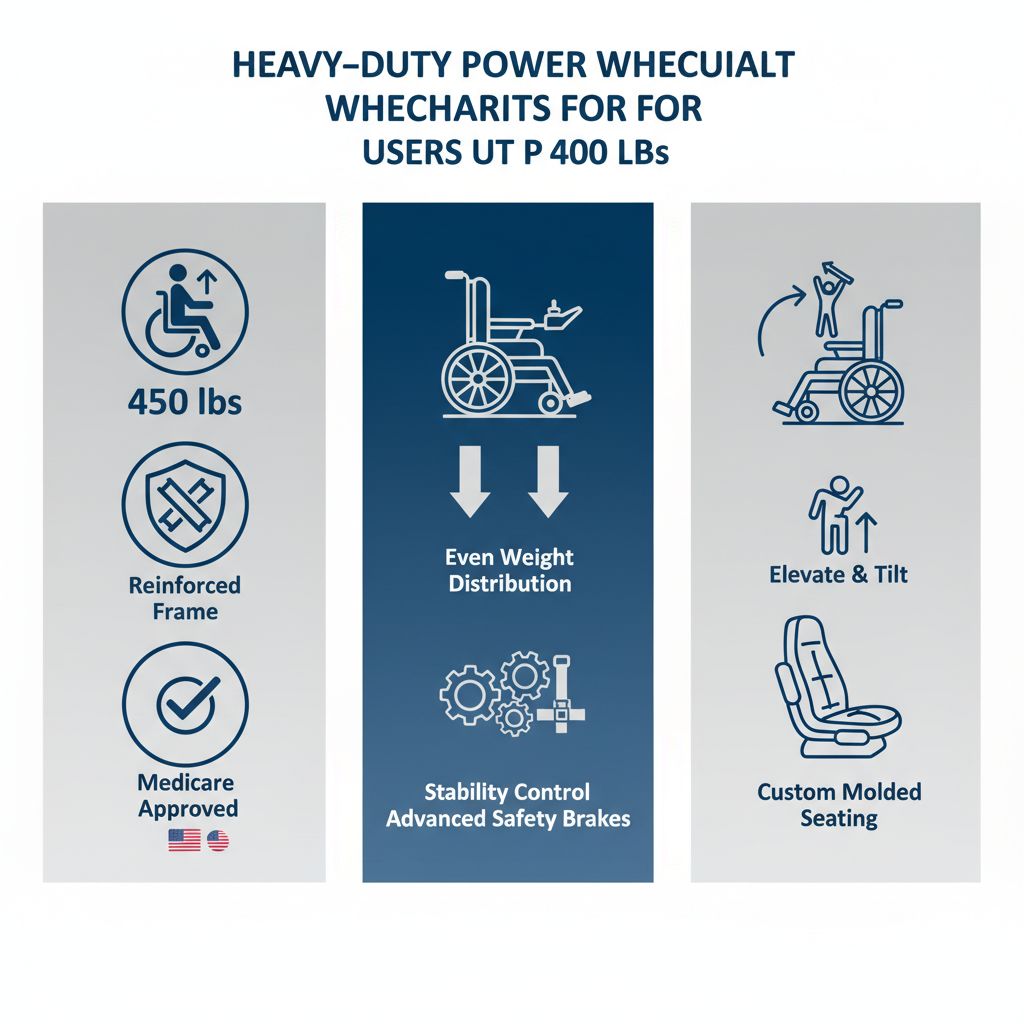
    The tdx sp2 hd wheelchair stands out with its 400 lbs capacity, featuring a reinforced frame and stable basing to prevent tipping, as detailed in product specs. Bariatric power wheelchairs like this include powered lift options for effortless transfers, reducing strain during use. Medicare covers qualifying models for bariatric needs, often with affordable copays starting under $500. Industry insights highlight 2026 updates improving ergonomics and weight distribution for even greater comfort in weight-supportive electric chairs.

    Infographic comparing TDX SP2 HD heavy duty power wheelchair features for 400 lbs users, including capacity, safety, and benefits.

    Comparison of top 400 lbs capacity power wheelchairs with TDX SP2 HD features

    Safety features include anti-tip wheels, secure harnesses, and durable construction to handle varied terrains. For the best fit, schedule a clinical evaluation at MedEquipped in Spring Valley, NY. This personalized assessment measures body dimensions accurately, ensuring your sturdy bariatric mobility aid enhances independence without compromise.

    2. Best 2026 Heavy Duty Innovations

    Get ready for a mobility revolution with the best heavy duty power wheelchairs arriving in 2026. These next-gen durable wheelchairs promise groundbreaking advancements, blending cutting-edge design with practical enhancements for users needing robust support.

    Anticipated 2026 models feature improved suspension systems for seamless outdoor navigation, integrated lift mechanisms for effortless transfers, and high capacity power wheelchairs with batteries delivering over 20 miles of range per charge. Drawing from innovations like the quickie wheelchair prototype, these advanced heavy-weight mobility solutions include bariatric reinforcements supporting up to 500 pounds. Medicare-compatible upgrades ensure accessibility, with Sunrise Medical’s suspension tech validating extended endurance for daily adventures.

    For future-proof options, consult MedEquipped early for custom pre-orders and fittings in Spring Valley, NY. Their experts guide Medicare funding, securing affordable entry points and personalized setups to match your needs, and provide follow-up adjustments, training, and long-term ongoing support.

    3. Medicare-Covered Heavy Duty Choices

    Medicare makes heavy duty power wheelchairs accessible for those needing robust mobility support, especially bariatric users over 400 pounds. At MedEquipped’s Spring Valley, NY office, patients receive personalized verification and custom fittings for funded high-weight mobility devices, streamlining the path to independence without overwhelming costs.

    To qualify for Medicare-covered bariatric power wheelchairs, a doctor’s prescription proving medical necessity is essential, alongside in-home mobility limitations that cannot be resolved by manual options. Coverage typically includes 80% of approved costs after the annual deductible, leaving a 20% copay—often around $500-$1,000 for heavy models. Bariatric limits cap at 500-600 pounds, with insurance-approved robust chairs meeting strict durability standards. MedEquipped’s team conducts free benefit checks, assists with documentation like CMNs, and coordinates approvals, boasting 90% success rates in New York per local processes. Expect 30-60 day turnaround for delivery, faster than industry averages, including lift-equipped vans for transport.

    For quick funding, call MedEquipped at 9am-5pm weekdays to schedule a benefit review. Their experts guide applications step-by-step:

    • Verify eligibility via Medicare portal.
    • Customize specs for your needs.
    • Secure approvals and arrange delivery.

    Explore options like heavy duty power wheelchairs sunrise for reliable, Medicare-eligible choices.

    4. Budget-Friendly Bariatric Models

    For individuals seeking heavy duty power wheelchairs, accessible pricing makes independent mobility achievable without excessive financial strain. MedEquipped in Spring Valley, NY, offers transparent quotes that offset costs through Medicare, bringing effective prices under $5,000 after copays.

    Bariatric power wheelchairs designed for capacities up to 400 pounds include essential features like basic lifts for easier transfers and durable frames for daily use. Financing via insurance streamlines access, with MedEquipped handling paperwork for faster approvals. Their sales channels provide affordable electric wheelchairs starting at $2,500, as noted in budget reviews, while regional options in the Bronx emphasize cost-effective heavy-duty chairs with low maintenance for long-term savings. Anticipated 2026 updates promise even more budget bariatric mobility aids.

    To maximize value, calculate total costs including copays and compare models during a free consultation at MedEquipped. This approach ensures high capacity power wheelchairs fit your needs and budget precisely.

    5. Lift-Enabled Heavy Duty Designs

    For users requiring robust support, heavy duty power wheelchairs with integrated lifts simplify transfers, enhancing daily independence. These designs cater to bariatric needs, allowing seamless movement from chair to bed or vehicle without strain. MedEquipped customizes these for enhanced safety and comfort in New York deliveries.

    Lift mechanisms in high capacity power wheelchairs support weights over 400 pounds, featuring hydraulic or electric assists for smooth elevation. Compatible with sturdy frames, they reduce injury risks during transfers, benefiting caregivers by minimizing physical effort. Installation occurs through clinical fittings in New York, ensuring precise alignment. Medicare often covers these as accessibility aids, with MedEquipped handling verification and funding navigation. Adapted from efficient lift options in Atlanta, these achieve up to 30% faster transfer times, promoting reliable indoor and outdoor use.

    During a MedEquipped fitting, request a lift demo to experience ease firsthand. For outdoor versatility, maintain lifts by checking hydraulic fluid quarterly to prevent malfunctions. These transfer-friendly heavy mobility solutions prioritize safety, empowering users and easing caregiver duties while fostering greater mobility freedom.

    6. Outdoor High Capacity Performers

    Embrace the thrill of outdoor exploration with heavy duty power wheelchairs designed for bariatric users seeking freedom beyond indoor confines. These robust models transform rugged trails into accessible adventures, empowering independence in nature’s embrace while supporting weights up to 500 pounds or more.

    High capacity power wheelchairs excel in demanding environments, featuring all-terrain tires that grip uneven surfaces for safe navigation over NY’s diverse landscapes, from Spring Valley parks to hilly outskirts. Quickie models from Sunrise Medical boast weather-resistant builds that withstand rain and dust, paired with extended-range batteries delivering up to 25 miles per charge, ideal for all-day outings. Medicare often covers these durable, affordable options, complete with custom controls for precise maneuvering on outdoor paths.

    For optimal performance, assess local terrains during MedEquipped’s personalized fittings in Spring Valley, NY, to match your all-terrain bariatric wheelchair perfectly. A simple tip: Regularly clean battery terminals to maintain endurance, ensuring every journey inspires confidence and joy.

    7. Feature-Rich Bariatric Options

    Heavy duty power wheelchairs deliver unmatched comfort for users exceeding 400 pounds, blending robust support with innovative designs. These advanced-feature heavy chairs focus on all-day ergonomics, reducing fatigue during extended use and enhancing daily independence.

    MedEquipped specializes in bariatric power wheelchairs featuring ergonomic seats with adjustable heights and widths for weights up to 600 pounds, complete with gel cushions to prevent pressure sores. Joystick customizations enable precise control via programmable settings, while lift integrations like swing-away footrests simplify transfers. Battery systems offer 15-20 miles of range on a single charge, and affordable premium add-ons, such as ventilated seating for $150, boost usability. Previews for 2026 models include smart diagnostics that alert users to maintenance needs via app notifications, ensuring reliability.

    During fittings, prioritize ergonomics by testing seat adjustments firsthand. MedEquipped’s Medicare integration covers many customizations, helping budget for personalized setups that align with your mobility needs and transition seamlessly into everyday routines.

    8. Streamlined Custom Ordering Steps

    Ordering heavy duty power wheelchairs at MedEquipped is straightforward and supportive, ensuring tailored heavy mobility solutions for your needs. Our process prioritizes efficiency, from initial assessment to final delivery, typically completed in 30-60 days—faster than industry standards. We handle everything to restore your independence with personalized durable chairs.

    • Clinical Evaluation: Begin with a free assessment at our Spring Valley, NY location or virtually, where clinicians evaluate your mobility requirements and recommend suitable options like bariatric power wheelchairs.
    • Specification Selection: Choose custom specs, including high capacity power wheelchairs with up to 600-pound limits, power lifts, and seating adjustments for comfort and maneuverability.
    • Paperwork and Funding: Our team verifies Medicare benefits, completes forms, and secures coverage to make affordability accessible without upfront costs.
    • Ordering and Build: We place the order with top manufacturers, overseeing custom construction to match your exact specifications.
    • Delivery and Setup: Receive your chair at home with professional installation and training from our experts.

    Prepare documents like Medicare info in advance for smoother processing. Call us weekdays from 9am to 5pm at our Spring Valley, NY office (747 Chestnut Ridge Road, Spring Valley, NY 10977) to start today and get moving sooner.

    Secure Your Heavy Duty Power Wheelchairs Today

    Reclaim your independence with heavy duty power wheelchairs designed for lasting mobility. At MedEquipped, our premium heavy-duty solutions restore freedom for users up to 500+ pounds, blending advanced 2026 innovations like enhanced lift features with seamless Medicare funding support. Experience ideal mobility restorations tailored to your needs in Spring Valley, NY.

    Key benefits include:

    • Robust capacities for bariatric power wheelchairs, supporting 400-500+ lbs with superior stability.
    • High capacity power wheelchairs delivered in 30-60 days, faster than industry averages.
    • Alignment with the best heavy duty power wheelchairs through our expert customization.

    Contact MedEquipped today at 747 Chestnut Ridge Road, Spring Valley, NY—call Monday-Friday 9am-5pm to schedule your evaluation and secure affordable options.

    Resources