Category: Medicare Guidelines

  • Medicare Power Wheelchair Eligibility 2026: Complete Guide

    Medicare Power Wheelchair Eligibility 2026: Complete Guide

    Table of Contents

    Understanding Medicare Power Wheelchair Coverage in 2026

    Medicare power wheelchair eligibility 2026 follows established Medicare Part B guidelines that classify power wheelchairs as durable medical equipment (DME). At MedEquipped, we help patients meet these requirements by providing custom motorized wheelchairs tailored to their specific mobility needs. To qualify for coverage, a patient must demonstrate medical necessity through a face-to-face examination with their treating physician, which must occur within six months of the claim submission. The physician then provides a written prescription and a 7-element order confirming the need for a power wheelchair. Eligibility hinges on the patient’s inability to perform mobility-related activities of daily living (MRADLs) — such as walking, transferring, or toileting — without the assistance of a power wheelchair, even when using a manual aid like a cane or walker. According to the Centers for Medicare & Medicaid Services, the core criteria remain consistent, but 2026 may bring updated documentation requirements. Our comprehensive coverage guide details these potential changes and helps patients understand what records Medicare expects. At MedEquipped, we specialize in assisting with Medicare benefits verification and the necessary paperwork to streamline the application process, reducing the risk of common claim denials. Our experienced team handles everything from the initial evaluation to the final delivery and setup, ensuring each custom motorized wheelchair is fitted precisely to the patient’s requirements. In the following section, we break down the 2026 eligibility rules at a glance.

    2026 Medicare Power Wheelchair Eligibility Rules at a Glance

    With that foundation in mind, here are the specific eligibility rules at a glance. For a complete breakdown of medicare power wheelchair coverage criteria 2026, see our detailed guide—but what follows is the essential checklist you need to begin.

    The Centers for Medicare & Medicaid Services establishes criteria that every power wheelchair claim must satisfy before approval; Medicare administrative contractor guidelines from organizations like CGS Medicare outline how those standards are applied in practice.
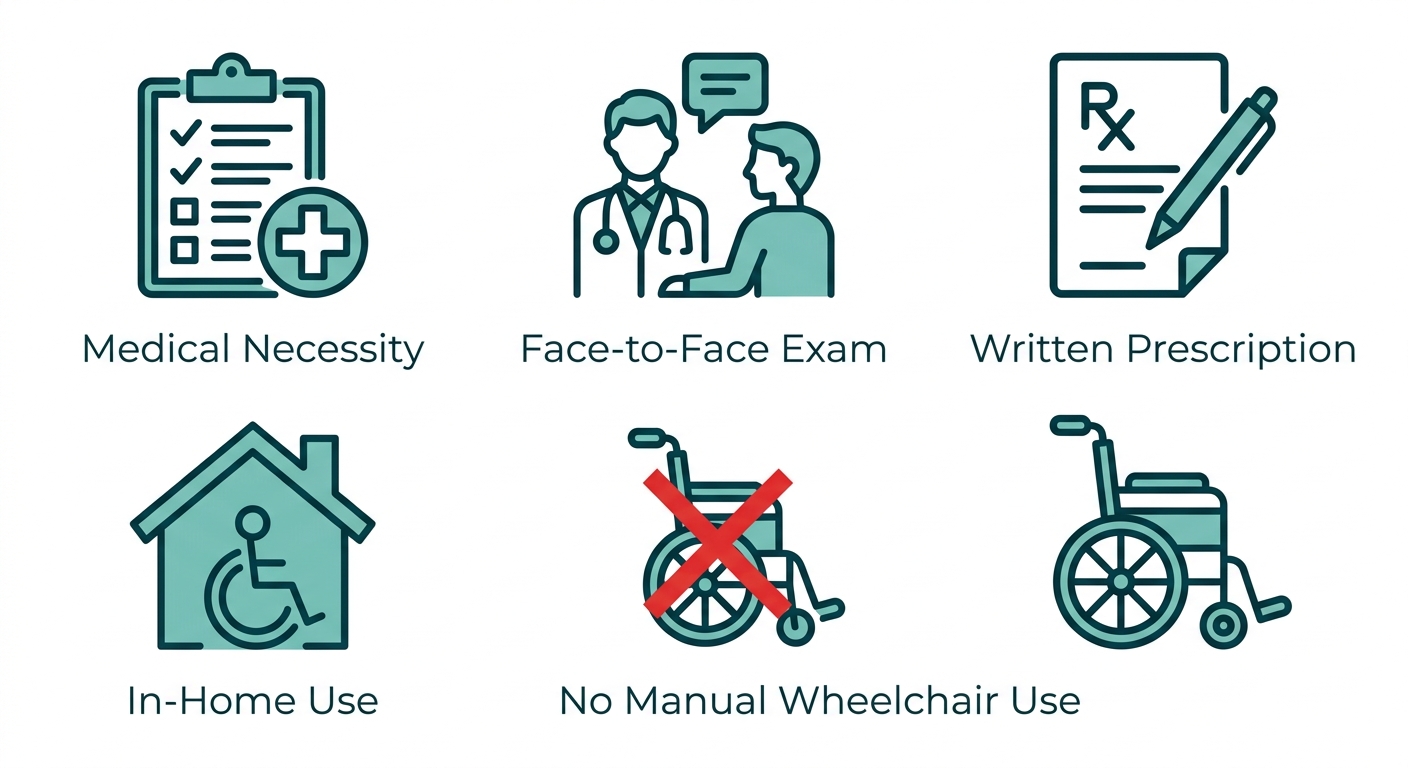
    Flat teal icon set showing the five Medicare power wheelchair coverage criteria: medical necessity, face-to-face exam, written prescription, in-home use, and no manual wheelchair use.
    Five key Medicare coverage criteria for power wheelchairs in 2026.

    Medical Necessity with a Qualifying Mobility Limitation

    The patient must have a documented mobility limitation that significantly impairs their ability to perform Mobility Related Activities of Daily Living (MRADLs), such as walking, transferring, or toileting, and be unable to complete these tasks safely at home even with a cane, walker, or other manual aid.

    Face-to-Face Examination by a Qualified Practitioner

    A face-to-face examination must be conducted by a treating physician (MD, DO, NP, or PA) within six months prior to claim submission to establish medical necessity and document the mobility limitation and the clinical reasoning for the power wheelchair. Claims without an exam within this window may be denied.

    Written Prescription from the Treating Physician

    The physician must provide a signed, dated 7-Element Order during the face-to-face visit containing specific diagnostic information, clinical justification, and confirmation that less-intensive mobility aids were considered. Without this order, the claim cannot proceed.

    In-Home Use Requirement

    Medicare Part B classifies power wheelchairs as Durable Medical Equipment and requires they be needed primarily for in-home use. Documentation must show the patient cannot navigate essential living areas—bedroom, bathroom, kitchen—without the powered device.

    Inability to Safely Operate a Manual Wheelchair

    The patient must be unable to safely and effectively propel a manual wheelchair due to factors such as poor upper-body strength, balance issues, or respiratory limitations. Clinical documentation should specify which deficits preclude manual use to justify a powered system.

    The necessary documentation for any claim includes the written 7-Element Order, comprehensive medical records that substantiate the mobility limitation, and a Certificate of Medical Necessity or similar formal documentation tying the clinical findings to the equipment requested.

    Once eligibility is confirmed, the next critical step is the face-to-face mobility examination, which we will walk through in the next section.

    The Face-to-Face Mobility Examination: Step-by-Step

    Now that you understand the rules for Medicare coverage of power wheelchairs in 2026, let’s walk through the face-to-face mobility examination step by step.

    Understanding the Face-to-Face Examination

    The Medicare face-to-face mobility exam requirements are established by the Centers for Medicare & Medicaid Services (CMS) to verify that a beneficiary truly needs a power wheelchair for use inside the home. In the Face-to-Face mobility examination, a qualified healthcare professional evaluates whether a patient’s mobility limitations are severe enough to justify coverage under Medicare Part B. This in-person (or, in limited cases, telehealth) assessment is mandatory for power wheelchairs; scooters and power-operated vehicles (POVs) are exempt. The exam focuses on documenting actual difficulties with mobility-related activities of daily living (MRADLs) — such as transferring, walking, and maintaining standing balance — rather than relying solely on a diagnosis.

    Authorized Examiners and Exam Settings

    The exam must be performed by a Medicare-approved practitioner. Authorized clinicians include:

    • Physician (MD or DO)
    • Nurse practitioner (NP)
    • Clinical nurse specialist (CNS)
    • Physician assistant (PA)

    The standard setting is an in-person visit at the practitioner’s office, clinic, or hospital. CMS permits a telehealth examination only under specific conditions. During a telehealth visit, the same mobility observations must be made via secure, real-time audio-visual communication and the provider must document the telecommunication method.

    Face-to-Face Exam Comparison: In-Person vs. Telehealth Options
    Requirement In-Person Exam Telehealth Exam (If Allowed) Notes
    Location of Exam Physician office, clinic, or hospital setting Remote via secure audio-visual platform Telehealth allowed only under CMS conditions
    Approved Practitioners Physician (MD/DO), NP, CNS, PA in person Same practitioners via telehealth Provider must hold a valid license and be able to assess mobility remotely
    Mobility Assessment Direct observation of walking, transferring, standing balance, and MRADL tasks Observation through telehealth; limited physical assistance If visualization is insufficient, an in-person exam may be required
    Documentation Requirements Written order with diagnosis, mobility deficits, date, signature, and NPI; order valid for 7 months Same documentation plus notation of telecommunication method All Medicare documentation standards apply

    Mobility Assessments During the Exam

    The examiner must directly observe the beneficiary’s ability to perform MRADLs. Key evaluations include transfers between surfaces, walking (with or without an assistive device), and standing balance. The practitioner must determine that a cane or walker is insufficient and that a manual wheelchair cannot safely meet in-home mobility needs. If the patient already uses a wheelchair, the evaluation may assess capacity to operate a powered device, including upper-extremity strength and coordination for joystick control.

    Documentation and Timeline After the Exam

    After the face-to-face evaluation, the clinician issues a detailed written order that includes the patient’s diagnosis, the observed mobility deficits, the recommended power wheelchair type, the date of the encounter, the examiner’s signature, and the examiner’s NPI. CMS requires that the exam occur no more than 45 days before wheelchair delivery if the order is based solely on that exam; longer intervals are allowed only with documentation of stability. CGS Medicare enforces a 7-month claim submission window from the exam date—if that window lapses, a new face-to-face exam and order are required.

    At MedEquipped, we’re here to help you manage deadlines and gather the necessary paperwork for a complete submission. With the examination completed and documented, the next step is documenting medical necessity to build a strong power wheelchair claim.

    Documenting Medical Necessity: How to Build a Strong Power Wheelchair Claim

    After completing the face-to-face mobility examination, the next critical step is to properly document medical necessity. Properly documenting medical necessity for power wheelchairs is the foundation of a successful Medicare claim. Medicare requires clear evidence that a power wheelchair is medically necessary. Below we outline the documentation requirements and best practices to build a strong claim.

    Documenting MRADL Deficits for Medical Necessity

    MRADL deficits form the clinical justification for a power wheelchair. Medicare medical necessity hinges on the patient’s inability to perform Mobility-Related Activities of Daily Living (MRADLs). During the face-to-face exam, at least two documented deficits are required, such as impaired ambulation, difficulty with transfers, or limited fine motor skills. The clinician must record specific examples, not generic statements. According to CMS guidelines, the documentation must demonstrate that the patient cannot safely accomplish these tasks without the device. CGS Medicare emphasizes that detailed functional descriptions—such as “patient cannot independently transfer from bed to wheelchair”—strengthen the claim. This level of detail establishes the medical necessity backbone.

    The 7-Element Order for Power Wheelchairs

    The 7-element order serves as the official prescription for a power wheelchair. It must include: the patient’s full name, primary diagnosis, the exact date of the face-to-face exam, the specific wheelchair type, all prescribed accessories, the physician’s signature, and the date the order is signed. According to CMS 2026 rules, the order must be signed and dated within 45 calendar days of the face-to-face exam. If the order is signed too early or late, Medicare will deny the claim. Each element must be individually listed on the prescription; a generic note is insufficient. We review orders for completeness and alignment with exam findings, ensuring no element is overlooked.

    Submitting a Complete Claim Package

    A complete claim package includes the signed 7-element order, the medical records from the face-to-face examination, and any therapy notes that support MRADL deficits. A certificate of medical necessity (CMN) may also be required, completed by the physician to formally attest to the need. For certain payers, a prior authorization letter is needed before delivery. Coordination among the physician, therapist, and DME supplier is essential to gather all documents. At MedEquipped, we use a detailed checklist to verify that each document meets Medicare’s latest requirements. A quick turnaround on assembly and submission helps prevent processing delays and ensures patients receive their custom power wheelchair promptly.

    Common Pitfalls to Avoid

    Common documentation errors cause unnecessary denials. The most critical mistake is omitting the face-to-face exam date on the 7-element order—Medicare treats this as an automatic denial. Other pitfalls include missing signatures, relying on medical records that are older than six months without updated functional assessments, and insufficient detail in MRADL descriptions. We recommend using a pre-submission checklist to confirm every document’s completeness. Ensuring the order is signed within 45 days of the exam and that all dates are consistent will significantly reduce denial risk. By addressing these issues upfront, providers build a stronger claim.

    Once a strong claim is built, providers should also understand special coverage scenarios such as outdoor use and telehealth exams, covered next.

    Special Coverage Scenarios: Outdoor Use, Telehealth Exams, and More

    Beyond standard documentation for medicare power wheelchair eligibility 2026, certain special coverage scenarios require additional consideration. Under CMS guidelines, Medicare primarily covers power wheelchairs for indoor use to navigate within the home, but coverage may extend to outdoor use when the home environment presents significant barriers. A long or unpaved driveway, a rural setting without nearby sidewalks, or the need to access essential outdoor areas like a garden or mailbox can establish medical necessity. Proper documentation from the treating physician and a mobility assessment that outlines these environmental challenges is essential.

    Telehealth assessments have become an accepted method for verifying medical necessity under Medicare. The Centers for Medicare & Medicaid Services has expanded telehealth options, allowing qualified clinicians to evaluate a patient’s functional limitations and mobility needs via secure video consultation. This approach eliminates the need for an in-person clinic visit, which can be especially beneficial for those with severe mobility restrictions. We work with patients and their clinicians to facilitate the telehealth evaluation and ensure all Medicare documentation requirements are met, including detailed notes about the beneficiary’s ability to perform mobility-related activities safely.

    Other special circumstances may also warrant coverage. Patients recovering from joint replacement surgery may need a power wheelchair temporarily to navigate their home during rehabilitation, while individuals with progressively degenerative conditions such as ALS or MS may require a custom chair earlier than the typical course to maintain independence as the disease advances. Each situation requires thorough clinical justification and careful documentation of medical necessity. Working with a custom power wheelchair provider can simplify the process for these unique cases, as they manage funding paperwork and coordinate with Medicare for accurate verification. Our team serves clients in Spring Valley, NY, guiding them through documentation for outdoor use, telehealth assessments, and other special scenarios. These scenarios often raise common questions, which we address in the next section.

    Frequently Asked Medicare Power Wheelchair Eligibility Questions

    What are the core eligibility and documentation requirements? Medicare Part B requires that you have a mobility limitation interfering with daily activities, cannot operate a manual wheelchair, and can safely use a power wheelchair. The primary need must be for in-home use, though outdoor coverage may follow once that need is established. Documentation must include a written order from your treating physician, a face-to-face in-person exam within six months, a Certificate of Medical Necessity (CMN), a detailed exam report, and a prescription. The evidence must demonstrate that you cannot perform mobility-related activities of daily living (MRADLs) without the power wheelchair.

    Does a telehealth exam satisfy the face-to-face requirement? No; Medicare mandates an in-person examination. Virtual visits cannot establish the required medical necessity.

    Take the Next Step Toward Your Custom Power Wheelchair

    Still have questions about Medicare power wheelchair eligibility 2026? Our experts can help you determine if you qualify and take the next step toward a custom power wheelchair. We provide personalized fittings, handle Medicare paperwork, and deliver custom wheelchairs in as little as 30 days. Call (845) 237-2381 or visit our clinic in Spring Valley, NY to start your evaluation. Coverage verification is required; results may vary. A healthcare professional must determine medical necessity.

    Start Your Custom Wheelchair Journey

    Now that you understand the 2026 Medicare eligibility requirements for power wheelchairs, including the face-to-face exam and documenting MRADL deficits, the next step is to get personalized guidance. MedEquipped specializes in custom motorized wheelchairs designed to meet your specific mobility needs. Our team can assist with Medicare verification and help you compile the necessary documentation. We serve clients in Spring Valley, New York and throughout the region. Call us at (845) 237-2381 or visit our office to start your consultation. A custom power wheelchair can restore your independence and improve your quality of life. Take the next step toward your new mobility solution today.

    Start Your Custom Wheelchair Journey

    Resources

  • Medicare Mobility Assistive Equipment Algorithm Explained

    Medicare Mobility Assistive Equipment Algorithm Explained

    Table of Contents

    The Medicare Mobility Assistive Equipment Algorithm Explained

    So how does Medicare actually decide whether a motorized wheelchair qualifies as covered mobility assistive equipment? The Medicare mobility assistive equipment algorithm is the coverage test that determines eligibility for a custom power wheelchair.

    The first decision point is the face-to-face mobility evaluation Medicare requires, where a treating practitioner documents mobility limitations and certifies that a power wheelchair would improve daily activities and support greater independence. This evaluation is just one part of the Medicare mobility assistive equipment algorithm; the Medicare motorized wheelchair coverage criteria also require a written order within 45 days detailing medical necessity. Ongoing changes to Medicare mobility equipment compliance rules from HHS and DOJ make expert guidance essential.

    At MedEquipped in Spring Valley, NY, we help patients prepare for the evaluation and handle the paperwork. We verify benefits for smooth coverage decisions. Our premium products and quick turnaround help you regain greater independence.

    Understanding the algorithm is the first step — here is how we handle the rest.

    Results may vary. Verify Medicare/insurance coverage; supplier does not guarantee coverage. Consult treating healthcare professional for medical necessity.

    Prerequisites for Medicare Motorized Wheelchair Coverage

    Before a motorized wheelchair can be approved, Medicare requires that several criteria be met. The medicare mobility assistive equipment algorithm determines coverage eligibility under Part B, evaluating medical necessity and functional limitations.

    The medicare motorized wheelchair coverage criteria center on a mobility limitation that significantly interferes with daily activities, cannot be fully addressed by a cane or walker, and makes a manual wheelchair unsafe or impossible to use. A face-to-face mobility evaluation medicare must be performed by your treating physician within the 12 months preceding the wheelchair order. This in-person exam must document that you (or a responsible caregiver present in the home) have the physical and cognitive ability to operate a power wheelchair safely.

    Your physician must supply a written prescription, the certificate of medical necessity, and medical records from the evaluation, confirming that the chair will be used primarily in the home—as outlined by Medicare’s mobility assistive equipment algorithm. At MedEquipped, we’re here to help verify your benefits and handle the paperwork, but coverage is never guaranteed. We encourage you to consult your treating healthcare professional about medical necessity and to confirm your benefits with us.

    If you meet these prerequisites, our team can guide you through a personalized mobility evaluation. We’ll help you select a custom motorized wheelchair designed for greater independence, and our quick turnaround gets you outfitted in weeks, not months.

    Assess Your Daily Mobility and Functional Limitations

    The Medicare mobility assistive equipment algorithm rests on one question — can you safely manage everyday tasks at home?

    Daily Mobility Check

    • Do you run out of breath after a short walk, like crossing a room?
    • Do you need support to stand from a chair or bed?
    • Have you fallen or nearly fallen this year?
    • Is moving on and off the toilet, bed, or car seat hard?
    • Do you shift positions often because sitting hurts?
    • Does self-propelling a manual wheelchair tire you out quickly?

    Jot down specifics: how many feet you can walk before resting, how often you sit down, and any pain or weakness. These notes support the face-to-face mobility evaluation Medicare requires.

    Results may vary. Verify Medicare/insurance coverage — the supplier does not guarantee coverage. Consult your treating healthcare professional for medical necessity.

    Bring your completed checklist to your clinician, then contact us for a personalized fitting. Meeting Medicare motorized wheelchair coverage criteria depends on documented limitations in your home, and our custom motorized wheelchairs are built for greater independence. We’re here to help — reach out in Spring Valley, NY.

    Document the Walker Trial and Its Failure

    Within the Medicare mobility assistive equipment algorithm, a walker trial that has been documented and proven insufficient elevates a patient’s case for a power mobility device. This step follows the initial face-to-face evaluation in our in Spring Valley clinic and records that a standard walker or cane could not meet the patient’s daily mobility needs safely.

    Treating clinicians must note specific trial details — the dates the walker was used, the device type, the functional limitations reported, and the prescriber’s conclusion that the walker failed. A thorough face-to-face mobility evaluation Medicare documentation package explicitly captures these observations, demonstrating that the patient’s condition warrants Custom Motorized Wheelchairs configured for Greater Independence.

    A documented walker trial failure supports but does not satisfy all Medicare motorized wheelchair coverage criteria by itself; coverage hinges on meeting every requirement in the algorithm during medical review. We’re here to help you move your prescription forward with a Quick turnaround, but Results may vary. Verify Medicare/insurance coverage and consult your treating healthcare professional before proceeding. The next step brings together your supporting documentation for the formal coverage review.

    Complete the Face-to-Face Mobility Evaluation

    Once your appointment is scheduled, our team will guide you through the next step: the face-to-face mobility evaluation. This required clinical assessment, conducted by a treating healthcare professional, is necessary for documentation that aligns with the medicare mobility assistive equipment algorithm.

    The clinician evaluates your functional mobility limitations, ability to perform daily activities, and home environment—including doorways, thresholds, and hallway dimensions. Positioning and postural support needs are also assessed to determine the most appropriate configuration.

    Bring relevant medical records, current prescriptions, and a list of daily mobility challenges to your appointment. This preparation helps ensure the documentation addresses medicare motorized wheelchair coverage criteria, allowing us to match you with the right custom motorized wheelchair from our premium product range.

    With your evaluation complete, our team helps ensure all required coverage criteria have been addressed. The face-to-face mobility evaluation medicare requires supports the documentation we need to move forward in helping you achieve greater independence. Coverage is not guaranteed—please consult your treating healthcare professional for medical necessity and verify coverage with Medicare.

    Prepare the Required Clinical Documentation

    Once we have a clear picture of your mobility needs, the next step is preparing the required clinical documentation. When you’re navigating the medicare mobility assistive equipment algorithm, the paperwork can feel overwhelming, but we’re here to simplify it.

    Medicare’s motorized wheelchair coverage criteria require an in-person face-to-face mobility evaluation with your treating healthcare professional. You’ll need a written prescription or detailed order for your custom motorized wheelchair, the results of that face-to-face mobility evaluation medicare requires (a mobility assessment documenting your functional limitations), and, if requested, a Certificate of Medical Necessity (CMN) supporting medical necessity. This paperwork must demonstrate how your daily mobility limitations—such as an inability to self-propel a manual chair or complete essential activities of daily living at home—support the need for a custom motorized wheelchair.

    Our team in Spring Valley, NY guides you through collecting and submitting these documents, helping you request what you need from your healthcare provider. From paperwork to final delivery, we make the process straightforward. Please note: Medicare coverage is not guaranteed; results may vary. Always verify your benefits and consult your treating professional about medical necessity.

    Submit the Prior Authorization Request

    Once the face-to-face mobility evaluation is complete, the next step is securing prior authorization—a process outlined by the Medicare mobility assistive equipment algorithm. This mandatory review confirms that medical necessity and coverage criteria are satisfied before a custom motorized wheelchair can be dispensed. Medicare requires this step and will not cover the device without it.

    We prepare and submit the standard CMS-10211 form on your behalf, compiling all necessary documentation. The package includes:

    • The results of the face-to-face mobility evaluation Medicare requires,
    • Supporting clinical notes, and
    • Relevant mobility assistive equipment algorithm documentation.

    Our team carefully verifies that every document aligns with Medicare motorized wheelchair coverage criteria, checking for completeness, required signatures, and timely filing. We work to reduce delays and handle the entire paperwork burden as part of our Assistance with funding sources and paperwork service. Throughout the process, you can count on clear communication and support.

    After approval, we move to the next step—delivery and setup. Please verify Medicare/insurance coverage; supplier does not guarantee coverage.

    Understand Your Coverage Determination and Usage Rules

    Before we walk you through the process, it helps to understand how coverage decisions are made. Medicare does not automatically cover power wheelchairs; coverage is determined by the Medicare mobility assistive equipment algorithm, and we help verify benefits and complete the paperwork.

    The medicare motorized wheelchair coverage criteria require that you have a mobility limitation that significantly interferes with daily activities, cannot effectively use a cane, walker, or manual wheelchair, and can operate a power wheelchair safely (or have a caregiver who can). The treating physician must perform a face-to-face mobility evaluation (Medicare’s foundational requirement) and write the order; the face-to-face mobility evaluation Medicare mandates generally must occur within 30 days before the order is written, and we assist with scheduling and documentation. The Medicare mobility assistive equipment algorithm also weighs whether the wheelchair is needed for use in the home — a device required primarily for outdoor errands or recreation generally will not meet the in-home usage standard.

    Once you understand these coverage rules, the next step is your personalized evaluation — and we’ll verify your benefits and handle the paperwork. We’re here to help you every step of the way. Results may vary. Verify Medicare/insurance coverage; supplier does not guarantee coverage. Consult your treating healthcare professional regarding medical necessity.

    Get Fitted for Your Custom Motorized Wheelchair

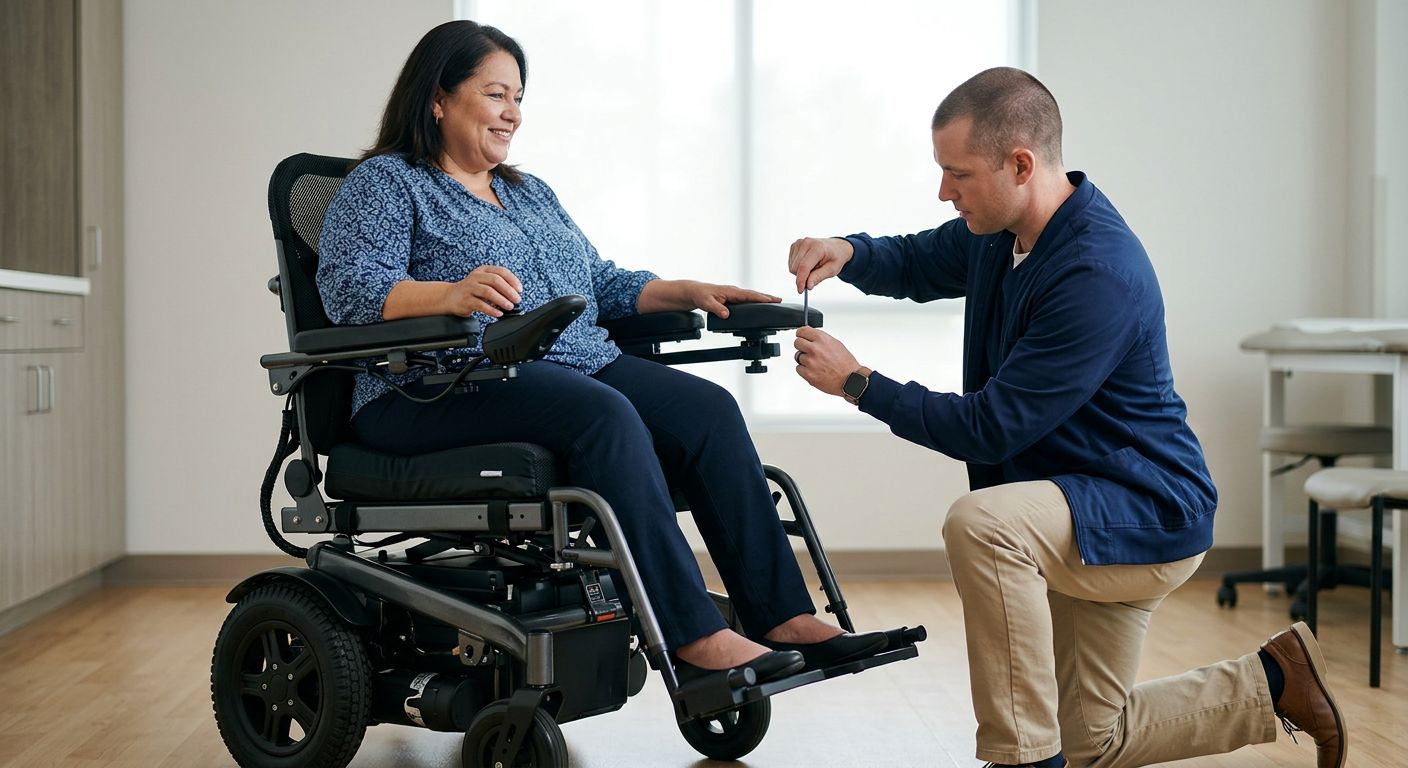
    A Custom Motorized Wheelchair is only as comfortable as its fit. At MedEquipped, we begin every order with a personalized in-clinic evaluation in Spring Valley, NY, guided by the medicare mobility assistive equipment algorithm to maximize your comfort and safety.

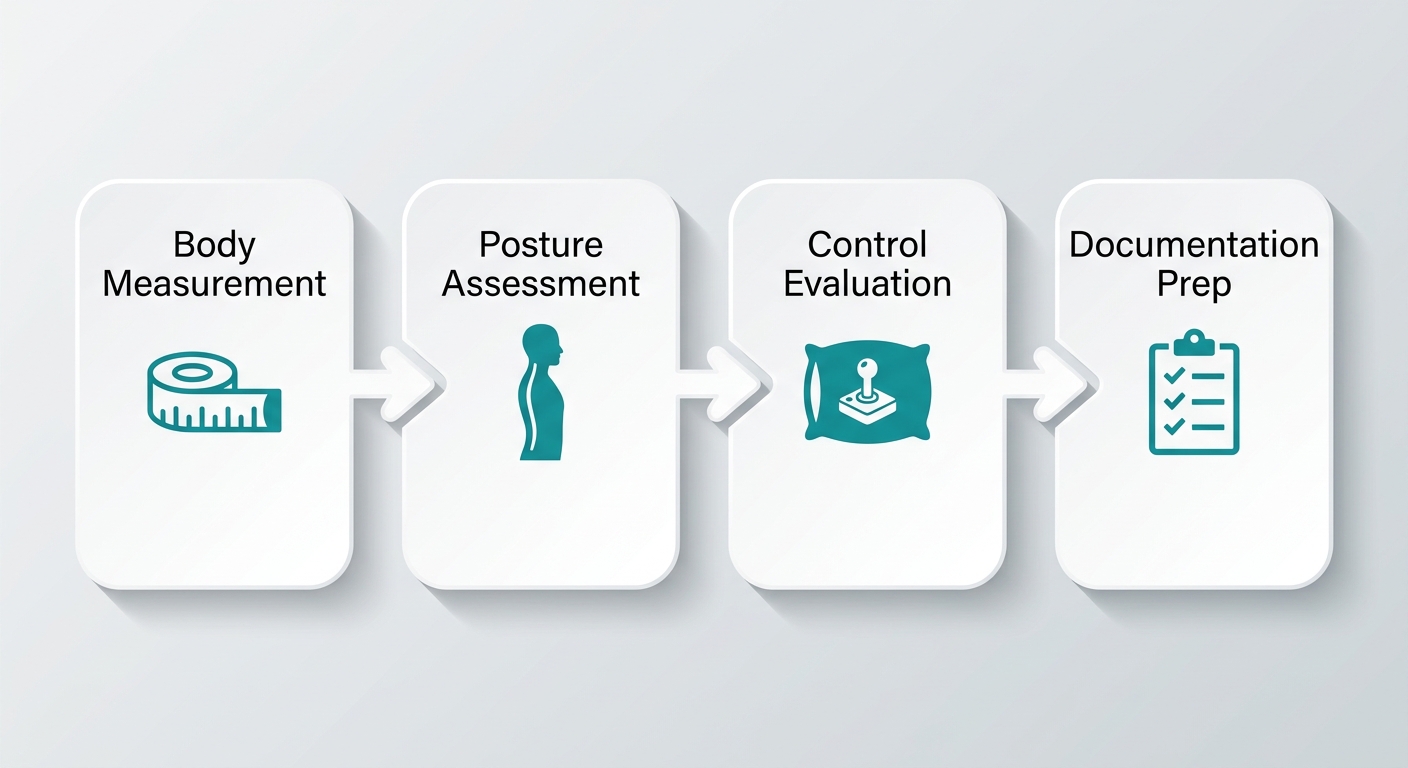
    Process flow diagram showing the four steps to fit a custom motorized wheelchair: body measurement, posture assessment, control evaluation, and documentation prep.
    Four-step custom motorized wheelchair fitting process, from measurement to documentation.

    Our experienced staff tailor the fitting to your body type, mobility needs, and lifestyle.

    • We take detailed body measurements and assess posture, pressure points, and seating ergonomics to configure the chair for all-day support.
    • You test drive controls—joystick, head array, or sip-and-puff—to ensure responsive, intuitive operation.
    • The fitting supports Medicare’s face-to-face mobility evaluation and medicare motorized wheelchair coverage criteria.
    • After the fitting, your custom chair is built and delivered in a Quick turnaround of 30–60 days—far faster than typical wait times.

    Results may vary and coverage is not guaranteed; consult your healthcare professional for medical necessity. We’re here to help—contact us to schedule your fitting and experience Greater Independence with Premium products built for you.

    Resolve Common Coverage Challenges and Denials

    Even with a solid understanding of Medicare eligibility, denials for motorized wheelchairs still happen. The key to overcoming those setbacks is understanding the medicare mobility assistive equipment algorithm, a structured process that determines coverage based on functional need. Most coverage challenges arise from paperwork gaps — not from a lack of medical necessity — so the right support can make a meaningful difference.

    Medicare’s medicare motorized wheelchair coverage criteria require clear evidence that a mobility limitation significantly interferes with mobility-related activities of daily living (MRADLs) such as toileting, bathing, and dressing, and that a cane, walker, or manual wheelchair cannot resolve the limitation. The rules also depend on a documented, in-person face-to-face mobility evaluation medicare requires — completed by the treating physician — before the order is written. Missing or incomplete documentation from that exam is the single most common trigger for an initial denial.

    Other common denial reasons include a failure to establish that the device will be used primarily in the home, clinical notes that do not adequately demonstrate the patient cannot self-propel a manual wheelchair, or insufficient proof that the patient can operate the equipment safely — or has a caregiver who can. These challenges are frustrating, but they are almost always addressable on appeal.

    The resolution pathway starts with a redetermination, the first-level appeal, which must be supported by the treating physician’s updated records. Because suppliers and patients typically face specific filing timeframes, prompt follow-up matters. We’re here to help at MedEquipped: our team verifies Medicare benefits, helps assemble the prior authorization and appeal paperwork, and works quickly alongside your doctor’s documentation. Verify Medicare/insurance coverage; supplier does not guarantee coverage. Results may vary. Consult your treating healthcare professional regarding medical necessity.

    For families in Spring Valley, NY, our experienced staff is ready to navigate coverage challenges for custom motorized wheelchairs with a quick turnaround on new orders. If you are facing a denial or just want to get the process right the first time, contact us to begin the initial patient evaluation.

    Securing Mobility Independence with the Right Support

    Achieving true mobility independence begins with a Custom Motorized Wheelchair built to your individual needs. Greater Independence becomes attainable when the right equipment is matched with a dedicated support team.

    Medicare’s coverage process uses a medicare mobility assistive equipment algorithm that structures eligibility decisions. Verifying specific medicare motorized wheelchair coverage criteria is part of this journey. A face-to-face mobility evaluation medicare requires helps confirm medical necessity, and for patients in Spring Valley, NY, we guide you through each requirement.

    We’re here to help with paperwork, funding coordination, and personalized fittings. Our Quick turnaround of 30–60 days delivers your custom mobility solution faster, so you can enjoy Greater Independence sooner. As a supplier of Premium products, we focus on patient-centered care from evaluation to delivery. Results may vary. Verify Medicare/insurance coverage; supplier does not guarantee coverage. Once your evaluation is scheduled, the next step is understanding coverage details and how we assist with the approval process.

    Resources

  • Medicare K0823 Requirements: Guide for Heavy Duty Power Wheelchairs

    Medicare K0823 Requirements: Guide for Heavy Duty Power Wheelchairs

    Table of Contents

    1. Understanding K0823 Weight Capacity Requirements

    Meeting Medicare K0823 requirements starts with understanding that this HCPCS code classifies a heavy duty power wheelchair built for users whose body weight does not exceed 300 pounds. Accurate weight classification is the foundation of a smooth approval process, so we begin every patient journey by confirming that your clinical profile aligns with this specific capacity. When your weight falls within that threshold, the K0823 designation becomes the most appropriate funding pathway under Medicare DMEPOS guidelines, and we at MedEquipped work diligently to build a complete documentation package that supports timely authorization.

    Individuals who require heavy duty power wheelchairs 450 lbs or greater capacity typically qualify for a higher-tier code such as K0824, which accommodates users up to 450 pounds. Your evaluating Assistive Technology Professional reviews your medical history, mobility limitations, and functional needs to determine which classification best matches your daily life. Getting this classification right is critical because a mismatch can delay funding or lead to a chair that simply cannot support you safely. Our team acts as your partner in mobility freedom by verifying your weight measurement against current clinical records and helping you understand why Medicare requires this precise categorization before approving equipment.

    To support a K0823 claim, Medicare expects several pieces of documentation, which we help you gather and submit:

    • A physician’s prescription that clearly states the medical necessity for a heavy duty power wheelchair.
    • A recent clinical evaluation completed by a certified ATP or qualified clinician, documenting mobility deficits and functional limitations.
    • A documented weight measurement, typically recorded during an in-person assessment within a reasonable timeframe of the order.
    • A functional mobility assessment that demonstrates your inability to perform daily activities without powered assistance.

    MedEquipped simplifies what can otherwise feel like a daunting paperwork process. When you contact our intake team in Nanuet, New York, we collect your existing records, coordinate with your referring physician, and schedule an evaluation with an ATP who understands exactly what Medicare reviewers need to see. Our familiarity with Medicare K0823 requirements helps us flag missing details early so your submission is as clean as possible, which supports our goal of delivering your custom motorized wheelchair within a typical 30- to 60-day processing window.

    Beyond the weight-based classification itself, we also consider bariatric power wheelchair seating and positioning factors that influence safety and long-term comfort. Even within the 300-pound capacity, your body dimensions, pressure distribution risks, and postural support needs shape the seating configuration we recommend. In the next section, we explore those critical seating and positioning considerations in greater depth.

    Disclaimer: Results may vary; individual outcomes are not guaranteed. The information provided here is for informational purposes only and is not medical advice. Consult a healthcare professional before making clinical decisions.

    2. Qualifying for a Medicare Heavy Duty Chair

    Understanding Medicare K0823 requirements is the first step toward obtaining a heavy duty power wheelchair, building on the overview of chair options from the previous section. Medicare classifies power wheelchairs as durable medical equipment, so you will need a prescription from your treating physician and a face-to-face examination that documents your mobility limitations within the home. To establish medical necessity, you must demonstrate that you cannot safely operate a manual wheelchair because of a condition such as severe arthritis or a neurological disorder.

    For those who need heavy duty power wheelchairs 450 lbs and above, the K0823 code applies and covers weight capacities from 450 to 600 pounds. If your weight falls below 450 pounds, other K-codes like K0822 may be appropriate. Proper bariatric power wheelchair seating and positioning also plays a critical role in comfort and safety for larger users. According to MedEquipped’s qualification guide, an Assistive Technology Professional evaluation can strengthen your case by detailing how the chair supports your independence. Our team helps you gather the right documentation so you can move through the process smoothly. Consult a healthcare professional before making clinical decisions. Once you meet the eligibility criteria, we shift to paperwork and insurance navigation — the topic of the next section, where we walk you through applying with MedEquipped’s end-to-end support.

    3. Medical Documentation You Need

    Getting your Medicare K0823 power wheelchair approved starts with having the right medical documentation. Meeting Medicare K0823 requirements doesn’t have to be complicated — it’s about gathering specific paperwork that shows why you need this particular type of heavy duty power wheelchair documentation for your daily life at home.

    Here are the core documents Medicare needs to review:

    • Written Order (Prescription). This is your doctor’s official prescription for the wheelchair, confirming it’s medically necessary. It’s the foundation of your K0823 paperwork.
    • Face-to-Face Examination Record. Medicare requires a record showing your doctor evaluated you in person within a specific timeframe before they write the prescription. This note links the exam findings directly to the mobility recommendation.
    • Medical Necessity Statement (Detailed Written Order). This detailed narrative must clearly describe your physical functional limitations, why the wheelchair is necessary for activities inside your home, and the clinical reasons for the specific chair configuration and seating components being ordered.

    Your doctor and MedEquipped’s certified ATP evaluator work together to make sure these documents connect — the prescription aligns with the exam observations, and the medical necessity statement reflects exactly what the evaluation uncovered about your strength, range of motion, and daily mobility challenges.

    We guide you and your physician through every piece of this documentation so nothing gets missed. We handle the paperwork, insurance navigation, and coordination, turning a process that often feels overwhelming into a clear, step-by-step partnership. When your documents are complete and well-organized from the start, the typical timeline from evaluation to delivery stays within 30–60 days — much faster than trying to manage it alone.

    Once your paperwork is ready, the next stage is submitting it through the right channels. We’ll walk you through exactly what happens after your doctor signs the order.

    4. Medicare Part B Coverage for K0823

    Now let’s look at how Medicare Part B covers this code. Medicare K0823 requirements specify that this code applies to a standard power-operated vehicle designed primarily for indoor use. Under Medicare Part B, you may qualify for coverage when your physician certifies medical necessity — for example, when you cannot safely ambulate indoors without assistance.

    For heavy duty wheelchair medicare questions beyond standard K0823 criteria, additional documentation may be necessary. We handle the paperwork, insurance navigation, and coordination so you can focus on what matters most. Generally, the typical timeline for custom-fitted power chairs runs 30 to 60 days from evaluation to delivery.

    Your supplier must be enrolled in Medicare and meet all accreditation requirements. While Medicare picks up the majority of approved costs, some cost-sharing through deductibles and coinsurance still applies. Contact MedEquipped for a custom estimate of your out-of-pocket responsibility. Results may vary; individual outcomes are not guaranteed. Once coverage is confirmed, MedEquipped guides you through the next steps.

    Privacy notice: we do not sell personal information (see Privacy Policy). SMS terms: message and data rates may apply; reply STOP to unsubscribe. Consult a healthcare professional before making clinical decisions.

    5. Group 2 vs Group 3 Heavy Duty Chairs

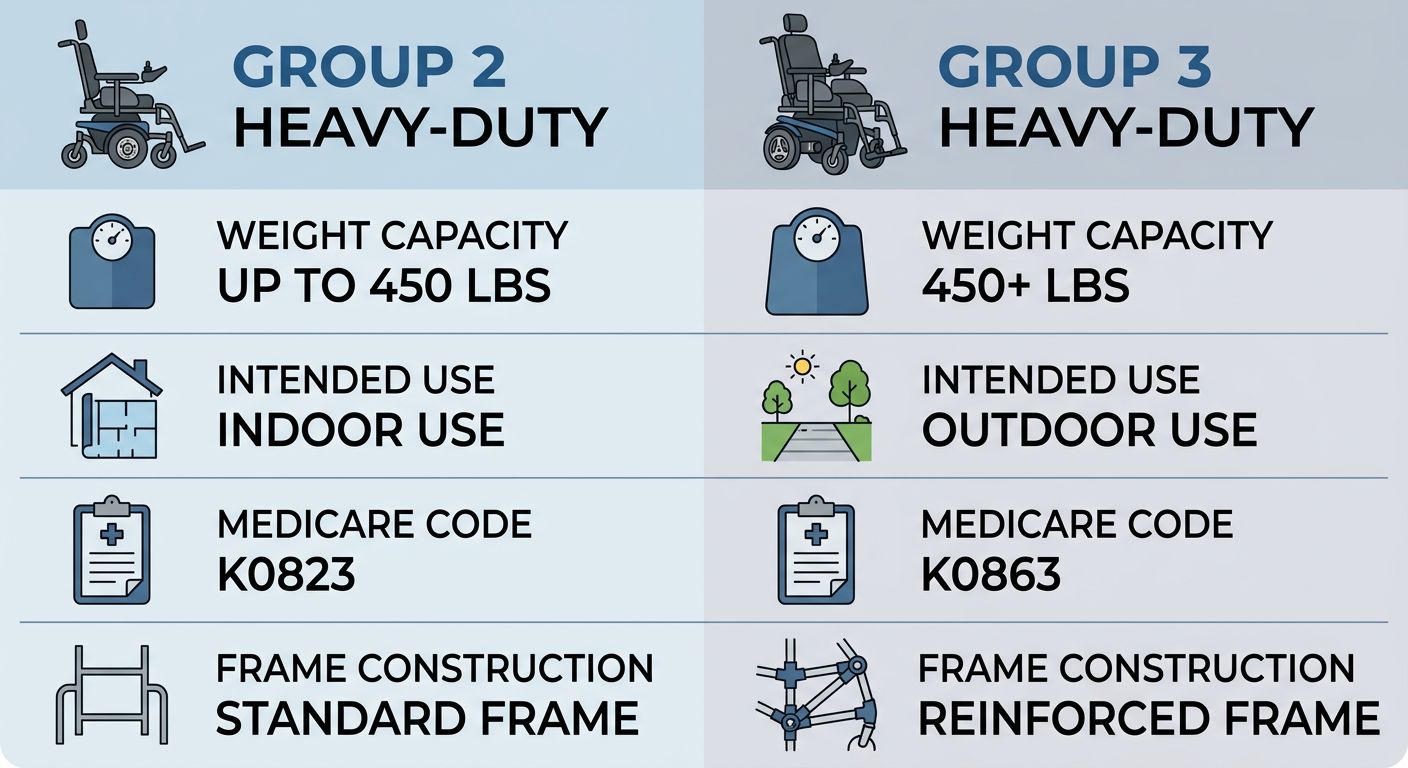
    Understanding the difference between Group 2 and Group 3 heavy duty power wheelchairs is essential for finding the right fit. These categories, defined by RESNA (Rehabilitation Engineering and Assistive Technology Society of North America), help match equipment to your weight and lifestyle needs.

    Feature Group 2 Heavy Duty Group 3 Heavy Duty
    Weight Capacity Up to 300 lbs (K0823) 300 – 600 lbs+
    Intended Use Primary indoor mobility Indoor/Outdoor & All-Terrain
    Medicare Code K0823 / K0822 K0848 – K0864

    While both groups offer exceptional support, Group 3 chairs are built for all-terrain mobility, while Group 2 models excel in everyday indoor environments.

    Two-column comparison infographic showing Group 2 and Group 3 power wheelchair specifications including weight capacity, intended use, and Medicare codes.

    Group 2 vs Group 3 heavy duty power wheelchair comparison.

    If you need a heavy duty power wheelchair rated for 450 lbs or more, or require specialized bariatric power wheelchair seating systems, we can help. Our certified ATP evaluators will assess your clinical needs and recommend the right group, ensuring your custom motorized wheelchair becomes a partner in mobility freedom. We handle the paperwork, insurance navigation, and coordination for you. Remember, Medicare K0823 requirements apply for Group 2, while Group 3 needs medical necessity documentation.

    Consult your healthcare provider to determine which group is right for you, or reach out to us for a personalized evaluation.

    6. Scheduling Your Face-to-Face Evaluation

    Once you and your physician have decided that a custom power wheelchair is the right path, the next step is a face-to-face clinical evaluation. This appointment is a standard part of meeting Medicare K0823 requirements and other insurer guidelines, ensuring your unique needs are properly documented before a chair is ordered. Think of it as your personal mobility consultation, where we become your partner in mobility freedom by getting to know you and your daily life.

    Scheduling is simple. Here’s how the process works:

    1. Contact us by phone or through our website. An intake coordinator will gather your initial information.
    2. You’ll need to provide a written prescription from your doctor, relevant medical records, and your insurance details.
    3. We then schedule your evaluation with a certified Assistive Technology Professional (ATP) at a time and place convenient for you.

    The ATP will assess your mobility, take precise measurements, and discuss your needs, including options for heavy duty power wheelchairs 450 lbs or specialized bariatric power wheelchair seating and positioning if they apply to you. We handle all the paperwork and insurance navigation, so your only job is to attend. The evaluation is typically scheduled within days, and we’ll have your chair ordered within 1–2 weeks. Results may vary; individual outcomes are not guaranteed. Bring your current mobility device and a list of questions. After the evaluation, our team takes the reins to process your custom order and guide you swiftly toward the delivery day we’ll cover next.

    Message and data rates may apply; reply STOP to unsubscribe.

    7. Configuring Bariatric Seating and Positioning

    After choosing from available bariatric power mobility bases, the next essential step is configuring the seating and positioning system. This process directly impacts comfort, pressure distribution, and overall safety during daily use. Proper configuration also helps meet key regulatory standards, including Medicare K0823 requirements, which define specifications for heavy-duty seating.

    We recommend starting with precise measurements. A minimum seat width of 22 inches is typical, but the depth and back height must match the patient’s body for optimal support. Weight capacity is equally critical; seating frames and cushions on heavy duty power wheelchairs 450 lbs and above need careful selection to ensure durability and safety.

    For a better fitting bariatric power wheelchair seating and positioning setup, consider these accessories:

    • Elevating leg rests to improve circulation and reduce swelling.
    • Tilt-in-space functionality to manage pressure and enhance comfort.
    • Adjustable armrests for easier transfers and upper body support.

    We believe that a clinical evaluation by a certified ATP, like MedEquipped’s team, is vital for achieving the best fit. Once this configuration is complete, the final steps involve testing all adjustments and preparing for delivery.

    Consult a healthcare professional before making clinical decisions related to wheelchair seating.

    8. Working with Certified ATP Professionals

    After understanding the complex world of insurance and wheelchair selection, working with a Certified ATP Professional simplifies everything. A Certified ATP Professional is a specialist trained to match mobility needs with appropriate powered devices, and their involvement is key to satisfying Medicare K0823 requirements for coverage.

    During evaluations, our ATPs assess critical areas like weight capacity for heavy duty power wheelchairs 450 lbs and seating support for bariatric power wheelchair seating and positioning, ensuring every adjustment aligns with your clinical picture and documented medical necessity.

    At MedEquipped, our ATPs coordinate with your clinicians and insurance providers, handling paperwork to streamline approvals. As your partner in mobility freedom, we specify chair configurations that match your needs, including custom adjustments for bariatric users. While we advocate for coverage, insurance outcomes depend on individual plans.

    Our certified team stays current with industry advances, offering informed guidance from evaluation through to ordering. With professional ATP support in place, the next step is delivery and long-term care.

    Partnering with MedEquipped for Your K0823 Journey

    Navigating Medicare K0823 requirements can feel overwhelming, but MedEquipped is here to simplify every step. We provide end-to-end support, from your initial clinical evaluation through insurance paperwork, custom ordering, delivery, and ongoing care. Our certified ATP evaluators across New York, Georgia, and Michigan work closely with you to configure chairs for complex needs, including mobility solutions like heavy duty power wheelchairs 450 lbs and specialized bariatric power wheelchair seating and positioning. We handle the paperwork, insurance navigation, and coordination so you don’t have to, typically completing the process in 30–60 days. As your partner in mobility freedom, we’re ready when you are—contact us to start your journey.

    Consult a healthcare professional before making clinical decisions.

    Resources