MedEquipped

Category: Medical Equipment

  • Best Sunrise Medical Quickie Power Wheelchair for 2026

    Best Sunrise Medical Quickie Power Wheelchair for 2026

    Table of Contents

    Sunrise Medical Quickie Power Wheelchairs: An In-Depth Look

    The sunrise medical quickie power wheelchair line is one of the most versatile custom motorized wheelchairs available today. Known for their lightweight frames, superior adjustability, and wide range of configurations, Quickie chairs are built to adapt to diverse clinical and lifestyle needs. Sunrise Medical has earned a reputation for precision engineering, and MedEquipped leverages that expertise to create mobility solutions tailored exactly to each individual.

    Comfort and support are just as important as power, which is why we offer jay seating systems as an integrated upgrade. Jay cushions and backs deliver advanced pressure redistribution and postural stability, helping to reduce fatigue and improve positioning throughout the day. For users who need nonstandard driving methods, wheelchair alternative access controls—such as specialty joysticks, head arrays, or sip-and-puff inputs—can be seamlessly incorporated into a Quickie base, giving every patient a way to operate their chair safely.

    At MedEquipped, we make the process simple: our certified ATP evaluators assess your daily environment and physical requirements, then configure a Quickie that feels like it was built just for you. From there, personalized mobility solutions come together as we handle the paperwork, insurance navigation, and coordination so you don’t have to. Most orders are completed within 30–60 days (faster processing), and our team remains by your side for follow-up adjustments and education long after delivery.

    The Quickie Power Wheelchair Lineup: Design and Clinical Strengths

    MedEquipped offers a range of powered mobility devices, and the Sunrise Medical Quickie power wheelchair lineup exemplifies the innovation and clinical focus we bring to every client. As your partner in mobility freedom, we want to walk you through the standout design and clinical strengths of these chairs.

    The Quickie 2 features a dependable folding frame, making it a practical choice for easy transport and storage. Its straightforward design supports reliable daily use without sacrificing comfort. For those who prioritize agility, the Quickie 6 offers a lightweight, compact platform that excels in tight indoor spaces, proving that a smaller footprint can still deliver robust power chair performance.

    Clinically, these models are designed to support diverse needs. The Quickie Q7, with its rigid ultra-lightweight frame, maximizes energy efficiency and precise maneuverability. This rigid design can enhance driving range and responsiveness. For superior postural support, each chair can be seamlessly integrated with Jay seating systems, which are clinically designed to improve comfort and stability. For users with limited hand function, alternative access controls can be configured to ensure safe and independent operation.
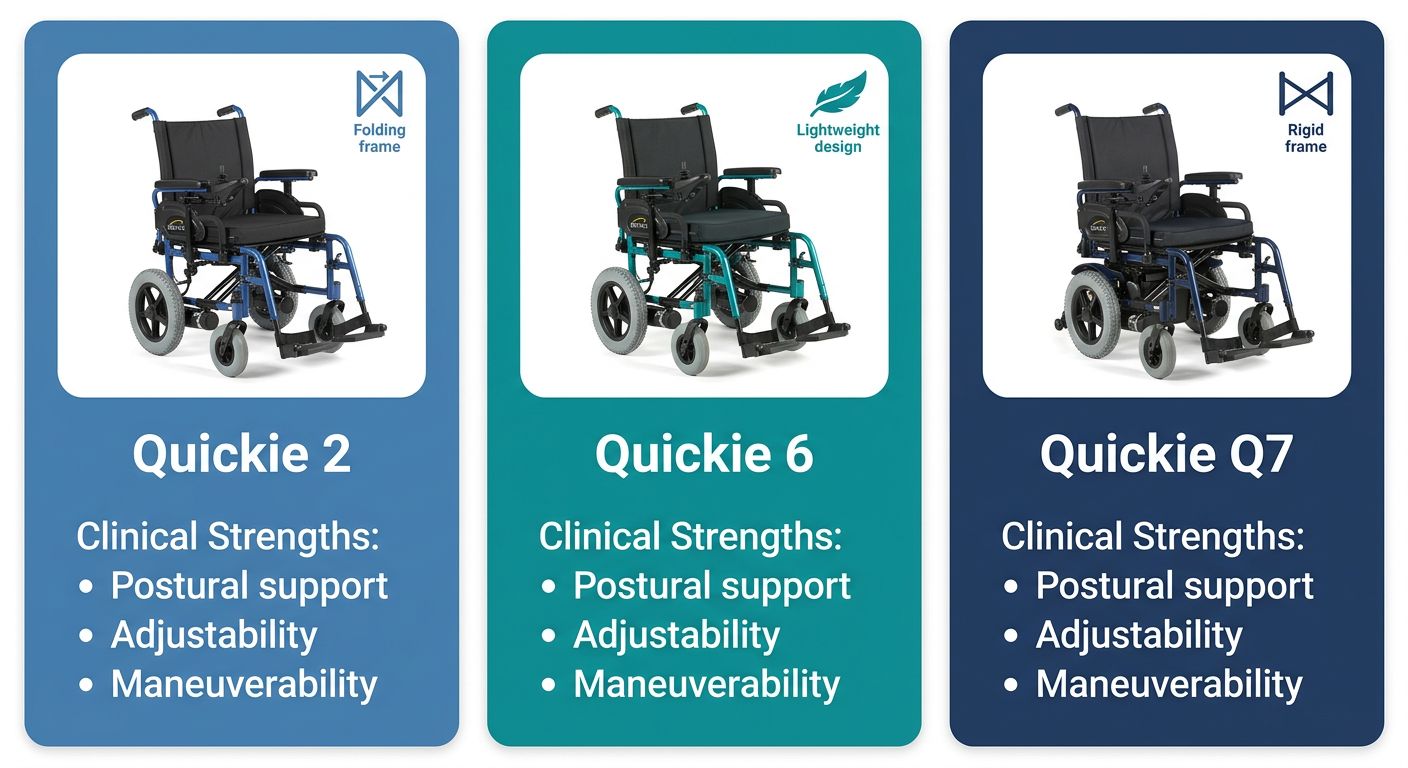
    Infographic comparing three Quickie power wheelchair models: Quickie 2, Quickie 6, and Quickie Q7 with feature icons and clinical strengths
    Quickie power wheelchair lineup comparison with clinical strengths

    Each of these Quickie power wheelchairs can be tailored to your specific requirements through our custom motorized wheelchairs service.

    Comparing Quickie Power Wheelchairs to Permobil and Other Clinical Models

    Now that we’ve explored the features of Quickie power wheelchairs, let’s compare them to other leading clinical models like Permobil to help you decide which is right for you. Both brands are trusted in the mobility industry, and choosing the right chair often comes down to your individual clinical needs, daily routines, and how you use a Sunrise Medical Quickie power wheelchair versus an alternative. At MedEquipped, we guide you through these decisions with a friendly, personalized approach.

    The following table compares key features and clinical considerations:

    Quickie vs Permobil Power Wheelchair Comparison
    FeatureQuickie Q-SeriesPermobil F-SeriesWhat to Consider
    Battery RangeUp to 18 milesUp to 22 milesDaily range needs
    Outdoor TerrainExcellent with mid-wheel driveSuperior with power seatsFrequent outdoor use may favor Permobil
    Seating OptionsCompatible with JAY seriesIntegrated Permobil seatingCustom seating vs integrated system

    The battery range difference may matter if you plan extended outings, but the Quickie Q-Series still delivers capable all-day performance for most users. For outdoor terrain, the Quickie’s mid-wheel drive offers excellent stability, while Permobil’s power seating provides added comfort on uneven ground. Seating is where a key distinction emerges: Quickie chairs are compatible with jay seating systems, giving you more flexibility for custom configurations. Both brands can be equipped with wheelchair alternative access controls, though Quickie offers specific options through expert clinical evaluation. Clinical professionals, like those certified by RESNA, use standardized assessment frameworks to ensure the selected wheelchair aligns with your long-term health and mobility goals.

    After reviewing the comparison, the best match depends on your unique lifestyle and support needs. We are your partner in mobility freedom and can help you navigate insurance, coordinate paperwork, and complete a custom order—typically in 30–60 days. For a professional evaluation and guidance on which model fits your needs, consider consulting with PT Solutions physical therapy or contacting our team directly.

    Results may vary; individual outcomes are not guaranteed. Consult a healthcare professional before making clinical decisions. This information is not medical advice and is for informational purposes only.

    Pricing and Insurance Coverage for Quickie Power Wheelchairs

    When considering a Sunrise Medical Quickie power wheelchair, understanding pricing and insurance coverage is key. Because each Quickie power wheelchair is built to your exact needs, pricing is personalized rather than a fixed list price. Your configuration choices—from advanced seating options like Jay seating systems to alternative access controls such as wheelchair alternative access controls—directly influence the final quote. We provide a custom quote based on your clinical evaluation and lifestyle requirements.

    Medicare may cover Quickie power wheelchairs under Durable Medical Equipment (DME) guidelines when they are medically necessary. According to Medicare (Centers for Medicare & Medicaid Services), coverage requires a face-to-face examination, a written prescription, and sometimes prior authorization for power wheelchairs. We help you navigate medicare wheelchair coverage to determine eligibility and maximize your benefits, coordinating every step of the documentation. Results may vary; individual outcomes are not guaranteed. Our team also manages private insurance claims and handles all funding paperwork.

    As your partner in mobility freedom, we handle the paperwork, insurance navigation, and coordination. Most custom motorized wheelchairs arrive in 30–60 days (faster processing). Contact us for a personalized quote and let our certified ATPs guide you through the process.

    Selecting the Right Quickie Power Wheelchair for Your Mobility Needs

    At MedEquipped, we understand that mobility needs are unique, and selecting the right Sunrise Medical Quickie power wheelchair is a personal journey. Our team is dedicated to helping you navigate the options and find a custom solution that fits your lifestyle, mobility goals, and clinical requirements. With the right Quickie chair, you can regain confidence and freedom of movement.

    The first step is a thorough evaluation with one of our certified Assistive Technology Professionals. Our ATPs hold assistive technology professional certification from RESNA, the leading authority in assistive technology standards. During the assessment, we examine your mobility, seating, positioning, and control requirements. This comprehensive review helps us determine the ideal Quickie model, configuration, and support accessories that match your daily life.

    Quickie power chairs offer advanced customization options. You can choose Jay seating systems that provide superior pressure relief and all-day comfort, and integrate wheelchair alternative access controls such as joysticks, head arrays, or sip-and-puff devices for users with limited hand function. These adaptable solutions ensure you maintain independence and comfort throughout the day.

    As your partner in mobility freedom, we’re with you from evaluation to delivery. We handle the paperwork, insurance navigation, and coordination from start to finish. Most orders are completed in just 30–60 days (faster processing). Contact us today for a custom quote and take the next step toward greater independence. Consult a healthcare professional before making clinical decisions.

    Partnering with MedEquipped for Your Quickie Power Wheelchair Journey

    Choosing your Quickie power wheelchair is just the first step—MedEquipped is your partner in mobility freedom, guiding you from evaluation to final delivery. Our certified ATP evaluators perform detailed fittings to tailor your chair precisely to your body and lifestyle.

    We handle the paperwork, insurance navigation, and coordination, so your Sunrise Medical Quickie power wheelchair arrives within 30–60 days. For added comfort and control, we can integrate Jay seating systems and alternative access controls. We serve patients in New York, Georgia, and Michigan through in-clinic or telehealth evaluations.

    After delivery, your Quickie power wheelchair is backed by dedicated technicians handling adjustments and support for a truly personalized fit. Next, we’ll guide you through customization and ordering. Please remember that results vary; consult a healthcare professional.

    Resources

  • Custom Mobility Equipment Suppliers NY: ATP Provider Hub

    Custom Mobility Equipment Suppliers NY: ATP Provider Hub

    Table of Contents

    Custom Mobility Equipment Suppliers in New York: Your Trusted Partner

    As your trusted partner in New York, MedEquipped stands out among custom mobility equipment suppliers in New York because we truly are your partner in mobility freedom. We guide you through every step, making the process of obtaining a custom power wheelchair straightforward and personal.

    We offer comprehensive custom motorized wheelchair services, including clinical evaluation and fitting, insurance and funding navigation, ordering, and direct delivery. We also serve as Complex rehab technology providers in NY, backed by certified ATP evaluators who ensure the perfect fit. With our established processes across New York, Georgia, and Michigan, we typically complete custom orders in 30 to 60 days.

    Our certified ATP wheelchair evaluation ensures your chair is configured for your exact needs, and our commitment continues with dedicated post-delivery support. We handle the paperwork and coordination so you can focus on your mobility, and we are ready to guide you through every step — from clinical evaluation to delivery.

    New York Service Areas for Custom Wheelchairs

    As a leading custom mobility equipment supplier in New York, MedEquipped proudly serves clients throughout Rockland County, in the Bronx, and across the Nanuet and Spring Valley area. We are your partner in mobility freedom, bringing personalized evaluations, expert insurance coordination, and custom motorized wheelchairs directly to you.

    The following table offers a quick visual comparison of our core services across these regions.

    Service Availability in Key New York Regions
    Service Feature Rockland County Bronx Nanuet / Spring Valley
    Clinical Evaluation (ATP Assessment) On-site or mobile ATP evaluation available by appointment ATP evaluation at our Nanuet office or via telehealth In-person evaluation at our Nanuet clinic
    Insurance & Funding Navigation Full assistance with paperwork, Medicare/Medicaid coordination Insurance coordination and documentation handled end-to-end Full coordination from initial paperwork to approval
    Custom Ordering & Delivery 30–60 day turnaround with expedited options 30–60 day turnaround with urgent case prioritization 30–60 day timeline; direct delivery to your location
    Post-Delivery Support Adjustments, repairs, and patient education included Ongoing clinical support and follow-up visits Dedicated support team for adjustments and repairs

    Whether you are at home in Rockland County, the Bronx, or right near our Nanuet clinic, we bring clinical expertise to you. Our evaluations are conducted by certified Complex rehab technology providers NY, ensuring each power chair is configured for your unique needs.

    A thorough ATP wheelchair evaluation is the critical first step in matching you with the right equipment. Our clinical evaluations are conducted by certified Assistive Technology Professionals (ATPs) listed in the RESNA Assistive Technology Professional directory. We handle the paperwork, insurance navigation, and coordination from start to finish, so you can focus on what matters.

    After delivery, our commitment continues. We provide ongoing adjustments, repairs, and patient education to ensure your mobility solution fits your life for the long term. To begin the process in any of these New York service areas, contact our team today.

    Results may vary; individual outcomes are not guaranteed. Information is not medical advice and is for informational purposes only.

    Power Wheelchair Delivery Timeline and Insurance Support

    As a trusted custom mobility equipment supplier in NY, we understand that waiting for your power wheelchair can feel overwhelming. Here at MedEquipped, we typically deliver custom power wheelchairs within 30 to 60 days after your insurance has been approved and your order has been placed. This timeline allows us to ensure your chair is built precisely to your clinical needs and lifestyle. Please note that results may vary; individual outcomes are not guaranteed.

    We manage the entire process end-to-end so you don’t have to navigate complex bureaucracy alone. After your ATP wheelchair evaluation is complete and your funding is authorized, our team immediately begins coordinating the custom build with the manufacturer. Working with experienced complex rehab technology providers in NY ensures that every chair is configured for optimal comfort, positioning, and functionality. At MedEquipped, we handle all the insurance paperwork, prior authorizations, and follow-ups, keeping you informed every step of the way.

    Timelines can naturally vary depending on your insurance provider’s response times, the complexity of your custom chair, and current supply chain factors. That’s why we never promise a universal delivery date and always communicate transparently about your specific situation. If you are facing more urgent mobility needs, please ask about our expedited power wheelchair service for faster processing. We also invite you to visit our Become a Patient page to take the first step on your journey to greater independence. Once your chair arrives, we continue to support you every step of the way.

    Results may vary; individual outcomes are not guaranteed.

    Local Factors for Choosing a Mobility Provider

    Beyond general considerations, local factors play a critical role in finding a trusted partner for your custom motorized wheelchair. When searching for custom mobility equipment suppliers NY, proximity is only the beginning. Your ideal provider must have the clinical expertise to translate a prescription into a chair that truly fits your body and daily life.

    We recommend looking for Complex rehab technology providers NY whose staff includes RESNA-certified Assistive Technology Professionals. These specialists perform a thorough ATP wheelchair evaluation, considering your posture, skin integrity, and functional goals—not just your diagnosis. Confirm they offer in-home or clinic-based assessments rather than simple showroom consultations. A quality provider will also handle insurance navigation, typically completing paperwork and approvals within a 30 to 60 day window, and will support you long after delivery with adjustments and repairs.

    To verify a provider’s credentials, use the ATIA assistive technology provider resources tool or the RESNA Member Directory. These industry-standard resources help you locate certified professionals in your area. Remember that FDA clearance of power wheelchairs ensures they meet federal safety standards.

    Your First Steps to Custom Mobility Equipment

    Looking for custom mobility equipment suppliers in NY? MedEquipped makes it easy to get your custom motorized wheelchair. Our custom power wheelchair patient services simplify the entire process, from your first call to delivery and beyond.

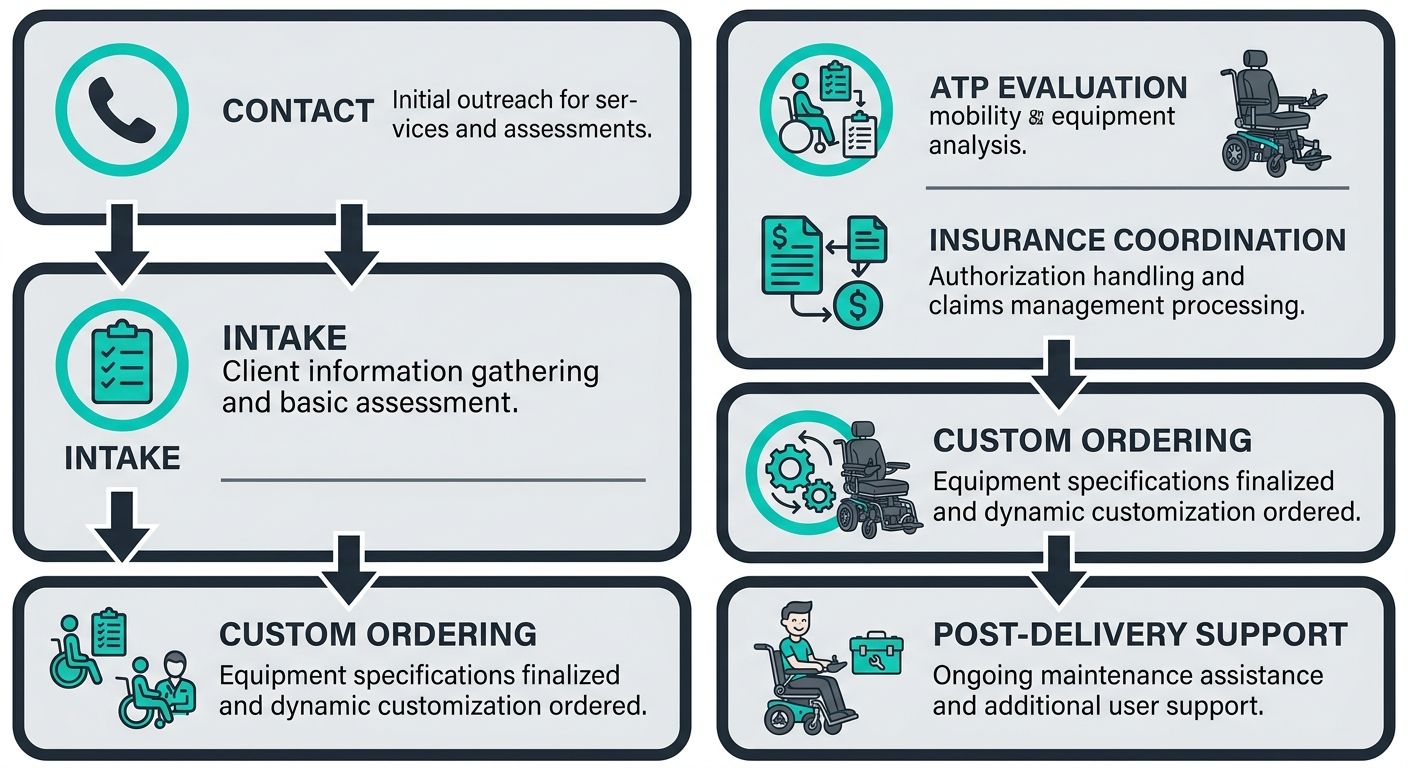
    Six-step vertical process flow for MedEquipped custom mobility equipment: Contact, Intake, ATP Evaluation, Insurance Coordination, Custom Ordering, and Post-Delivery Support.

    Your first steps to custom mobility equipment with MedEquipped.

    Ready to take the first step? Here’s how we make it easy as your partner in mobility freedom:

    • 1. Contact MedEquipped. Reach out by phone or online form. We’ll discuss your needs and verify your insurance. We handle the paperwork, insurance navigation, and coordination.
    • 2. Complete intake and insurance verification. Provide your details so we can confirm coverage and start your file.
    • 3. Schedule your ATP wheelchair evaluation. As experienced Complex Rehab Technology providers in NY, our certified ATP evaluators conduct a comprehensive assessment of your mobility needs.
    • 4. Insurance and funding coordination. We manage all clinical documentation, approvals, and funding logistics.
    • 5. Custom chair ordering and delivery. Order your chair with delivery typically in 30-60 days (faster processing).
    • 6. Post-delivery support and service. Dedicated support continues after you receive your custom motorized wheelchair.

    Once you complete these steps, your dedicated patient services team will guide you through every detail. Start your journey — visit our custom power wheelchair patient services page or call us directly.

    Results may vary; individual outcomes are not guaranteed.

    Custom Mobility Equipment Services Ready for You

    We make that happen with a full suite of services. As your partner in mobility freedom, we connect you with top custom mobility equipment suppliers in NY, Georgia, and Michigan. Our certified ATP wheelchair evaluation ensures a precise, clinical fit for your lifestyle, while our team handles all insurance navigation and paperwork. We manage ordering, build, and delivery on a 30-to-60-day timeline with ongoing support. Our custom motorized wheelchairs meet rigorous safety standards backed by FDA medical device registration data. Complex rehab technology providers NY trust our end-to-end process. But don’t just take our word for it—hear from our community of patients who’ve regained independence through our personalized care.

    Resources

  • How to Assess Mobility Related Activities of Daily Living (MRADLs)

    Table of Contents

    The Role of MRADLs in Power Wheelchair Eligibility

    Beyond the general rules for durable medical equipment, Medicare eligibility for a motorized chair centers on your ability to perform everyday tasks in your home. These are your Mobility Related Activities of Daily Living (MRADLs), and they are the foundation of the medical necessity determination. Unlike general daily activities, MRADLs specifically refer to the core movements required for self-care: bathing, toileting, transferring in and out of a chair or bed, dressing, and feeding yourself. We focus on these tasks because they are essential for a safe and dignified home life.

    Medicare stipulates that you must be unable to perform one or more of these MRADLs even while using a cane or walker. According to our understanding of power wheelchair Medicare guidelines, the assessment of your in-home mobility activities is the key factor in the approval process. A physical or occupational therapist will watch how you manage these daily mobility tasks during your evaluation. We see this step as part of a broader power wheelchair medical necessity checklist, creating a clear record that supports your case.

    Documenting this inability is the central purpose of the required face-to-face mobility evaluation requirements. Your physician must conduct this exam and provide a written prescription that reports your specific MRADL limitations. We help you navigate this process by coordinating the clinical evaluation and managing the paperwork, so you can focus on your well-being.

    Understanding MRADLs sets the stage for the face-to-face evaluation. As your partner in mobility freedom, we handle the coordination, allowing you to benefit from our expertise with insurers. This information is not medical advice and is for informational purposes only. Consult a healthcare professional before making clinical decisions.

    MRADLs Defined: The Foundation of Power Wheelchair Eligibility

    To understand how Medicare determines medical necessity for a power wheelchair, we first need to define the core criteria: Mobility Related Activities of Daily Living (MRADLs). These are the specific mobility tasks that a patient must be able to perform safely and efficiently within their own home. Unlike broader self-care assessments, MRADLs zoom in on the fundamental movements Medicare uses to evaluate whether a power mobility device is justified.

    The five key MRADL tasks, as defined by Medicare’s Local Coverage Determination, include bed mobility, transfers to and from a bed, chair, or toilet, walking, wheeling, and the ability to negotiate stairs. An impairment in one or more of these areas, when it prevents a person from completing essential daily routines in the home environment, forms the basis of the medical necessity argument for a power wheelchair. Importantly, a deficit must exist within the home setting—not just in the community—to meet coverage criteria.

    The table below distinguishes MRADLs from standard ADLs in key areas that directly affect power wheelchair eligibility.

    MRADLs vs. Standard ADLs
    CategoryStandard ADLsMRADLs
    MobilityBathing, dressing, toileting, feedingBed mobility, transfers (to/from bed/chair/toilet), walking, wheeling, stairs
    PurposeAssessing overall functional independenceEvaluating specific mobility deficits that require a wheelchair
    Documentation FocusLevel of assistance required (independent, standby, total)Specific deficits impacting mobility within the home environment, justifying need for a power mobility device

    As the table shows, MRADLs zero in on the specific mobility deficits Medicare requires for a power wheelchair. Standard ADLs help gauge a person’s overall functional status, but it is the inability to manage these mobility-related daily activities safely that triggers the need for powered support. This is where the power wheelchair medical necessity checklist begins: the MRADL assessment itself.

    Documenting these deficits requires more than a simple patient report. Medicare mandates a face-to-face mobility evaluation conducted by a qualified practitioner, such as a physician, physician assistant, nurse practitioner, or clinical nurse specialist. During this exam, the clinician must record objective findings of MRADL impairment, connecting them directly to the rationale for a power mobility device. By doing so, the practitioner fulfills the face-to-face mobility evaluation requirements that are essential for prior authorization. Our mobility solutions FAQ provides further details on how MRADL deficits are assessed during the clinical evaluation.

    Comparación clínica de MRADLs vs. ADLs estándar para elegibilidad de sillas de ruedas.

    With MRADLs clearly defined, the next step is understanding how to document these deficits in a formal medical evaluation. While MRADL impairment is the foundation, it alone does not guarantee approval—every piece of clinical evidence must work together to paint a complete picture of medical necessity.

    This information is not medical advice and is for informational purposes only. Consult a healthcare professional before making clinical decisions.

    Documenting MRADL Limitations for Medical Necessity

    Now that we understand the evaluation process, we must focus on documenting Mobility Related Activities of Daily Living (MRADLs) specifically for Medicare medical necessity. As your partner in mobility freedom, we at MedEquipped handle the paperwork, insurance navigation, and coordination to secure your custom motorized wheelchairs in a seamless 30-60 days (faster processing) window. Proper documentation is the cornerstone: Medicare’s primary coverage criteria require that you prove an inability to perform daily mobility tasks inside the home environment. The following table highlights the different documentation focus for in-home versus community mobility.

    In-Home vs. Community Mobility Documentation
    Documentation AspectIn-Home Mobility (Primary Criteria)Community Mobility (Secondary Criteria)
    Primary FocusBedroom, bathroom, kitchen, hallway transfers and mobilityCurb hopping, uneven terrain, public access, transportation
    Mobility Device ConsiderationPower wheelchair vs. manual wheelchair vs. walker vs. canePower wheelchair vs. power scooter vs. power add-on
    Documentation RequirementSpecific deficits in MRADLs, safety concerns, and caregiver assistance needs inside the homeFunctional deficits outside the home, work, or school environments
    Medicare ImpactPrimary basis for medical necessity determination and coverageSupports primary criteria but cannot solely justify a power wheelchair

    Understanding this distinction is vital. The in-home criteria form the foundation of your claim, while community mobility needs serve as supportive but not standalone evidence.

    The “Within the Home” Rule for MRADL Deficits

    Medicare’s “within the home” rule dictates that Mobility Related Activities of Daily Living (MRADLs) must be documented exclusively as deficits occurring inside the residence. We at MedEquipped frequently guide clinicians to evaluate functioning in the bedroom, bathroom, kitchen, and hallways. Community mobility challenges—such as navigating a parking lot or crossing uneven terrain—cannot satisfy the primary coverage criteria for a power wheelchair, per the U.S. Food and Drug Administration’s coverage guidelines. Instead, the medical record must capture specific, observable limitations: can the patient transfer from bed to chair without hands-on assistance? Is a manual wheelchair impossible to propel across the kitchen floor? Does the individual require caregiver support to access the bathroom? According to our internal clinical support resources, these in-home deficits are the benchmark for medical necessity. Without detailed notes confined to the living quarters, Medicare reviewers will likely deny the claim.

    The Role of a Walker or Cane in MRADL Assessment

    A question we often answer at MedEquipped is whether a patient who uses a walker or cane can still qualify for a power wheelchair. The answer is yes—but only if the documentation demonstrates why the assistive device is insufficient for safe functional mobility limitations inside the home. Our internal FAQ clarifies that partial independence does not equal total independence. If a patient can walk a few steps with a cane but requires hands-on assistance to stand for transfers or exhibits significant safety concerns, the device is not meeting their needs. The record must detail the reason: unsteady gait, fatigue mid-task, pain exacerbation, or caregiver intervention required. Merely noting that a walker is used does not disqualify the patient; failing to explain why it fails to enable daily mobility tasks does.

    Specific Medical Necessity Language for Medicare

    To meet Medicare power wheelchair coverage criteria, your documentation must include precise clinical language that demonstrates a need for a power drive system due to weakness, pain, or endurance limitations. In line with the power wheelchair medical necessity checklist, our team advises including the following examples for Group 2 and Group 3 qualifications:

    • “Unable to propel a manual wheelchair inside the home due to bilateral upper extremity weakness, rating 3/5 on the MMT. The patient requires a power drive system for basic bedroom and bathroom navigation.”
    • “Requires hands-on assistance for bed-to-chair transfers. The patient cannot perform this Mobility Related Activities of Daily Living (MRADLs) task with a walker or cane alone due to severe balance deficits and pain.”

    Group 3 documentation, which supports complex rehabilitation chairs, adds language around tilt, recline, or custom seating to address skin integrity or postural support. Our team ensures that face-to-face mobility evaluation requirements are met by detailing the specific medical condition, functional deficits, and the rationale for selecting a particular power base. With proper documentation in place, we move to selecting and ordering your custom power wheelchair.

    Consult a healthcare professional before making clinical decisions. Information is not medical advice and is for informational purposes only.

    A Practical Checklist for Your Power Wheelchair Evaluation

    Now that you understand the evaluation overview, here is a practical checklist to ensure you and your clinician are fully prepared. As your partner in mobility freedom, we handle the paperwork, insurance navigation, and coordination to streamline your process, typically completing custom orders within a 30-60 day timeframe across our service areas in New York, Georgia, and Michigan. This guide focuses on the power wheelchair medical necessity checklist requirements, particularly how your clinician documents Mobility Related Activities of Daily Living (MRADLs). Below, we differentiate a standard visit from a dedicated mobility evaluation.

    The following table compares a standard office visit with a face-to-face mobility evaluation, highlighting the specific documentation needed for a power wheelchair claim.

    Standard Office Visit vs. Face-to-Face Mobility Evaluation
    AspectStandard Office VisitFace-to-Face Mobility Evaluation
    Primary PurposeGeneral health check, medication management, acute illnessAssess mobility limitations and medical necessity for a power wheelchair
    Required ComponentsHistory, physical exam, assessment, planDetailed functional assessment of mobility, MRADL limitations, strength, tone, coordination, and safety awareness
    Documentation FocusDiagnosis and treatment of acute/chronic conditionsSpecific deficits in bed mobility, transfers, walking, wheeling, and justification for a power mobility device
    Clinician TypePhysician (MD/DO), NP, PAPhysician, NP, PA, or a physical therapist (with physician finalizing the order)
    Valid for Telehealth?Yes, under certain telehealth provisionsGenerally requires in-person presence for the functional assessment component

    This comparison underscores why the face-to-face mobility evaluation requirements are more rigorous. Our team coordinates this appointment timeline to ensure the face-to-face encounter occurs within the CMS-required 45 days prior to the written order.

    Preparing for the Face-to-Face Mobility Evaluation

    Bringing the right materials streamlines your evaluation. Gathering these documents in advance helps your clinician focus on assessing your MRADL deficits without administrative delays.

    • Referral and Prior Authorization: Bring a referral from your primary care provider and any prior authorization numbers from your insurance.
    • Identification and Insurance: Have your photo ID and insurance card ready.
    • Medical History: Compile a list of current medications and any records of previous mobility devices you have used.
    • Personal Notes: Jot down specific daily tasks that are challenging, such as moving from your bed to a chair, bathing, or preparing meals, to clearly articulate your activities of daily living limitations.

    During the evaluation itself, your clinician will conduct a hands-on physical exam. According to our internal resources, this must include documentation of your range of motion, muscle strength, and endurance—particularly in your upper extremities if self-propulsion is a goal. The exam also assesses coordination, balance, sitting tolerance, and your safety awareness to determine the right device configuration. We recommend you wear comfortable clothing and be ready to demonstrate your current mobility abilities.

    Key Documentation Your Clinician Must Include

    Beyond the physical exam, your clinician’s progress notes must create a compelling narrative of medical necessity. This is the core of meeting the power wheelchair medical necessity checklist and justifying the specific device selected.

    • Explicit MRADL Limitations: The notes must detail specific deficits in mobility-related ADLs. This means clearly stating your limitations in bed mobility, transferring (e.g., from bed to wheelchair), toilet use, bathing, and walking or wheeling.
    • Why a Power Wheelchair is Necessary: The documentation must explain why you cannot operate a manual wheelchair safely and effectively to complete your MRADLs. It should also justify why a scooter is insufficient, often citing postural support needs, strength deficits, or the need for powered seating functions like tilt and recline.
    • Rationale for Device Type: If a specific drive configuration (center-wheel drive vs. front-wheel drive) or seating system is recommended, the notes must connect those features directly to your physical findings and daily environment.

    Our certified ATP evaluators guide clinicians through these specifics during our in-person assessments, ensuring the rationale for the chosen power wheelchair is watertight for a smoother review process.

    Common Reasons for Power Wheelchair Insurance Denials

    Even with thorough preparation, claims can encounter hurdles. Understanding the most frequent denial triggers helps you and your clinician fortify your application from the start.

    • Insufficient MRADL Documentation: The most common setback is a failure to specifically document which MRADLs the patient cannot complete. Generic notes about “difficulty walking” are insufficient; the record must detail, for instance, an inability to independently transfer to the toilet or propel a manual chair across carpet.
    • Incomplete Physical Exam Findings: Claims are often denied when the physical exam lacks specific measurements of range of motion, muscle strength, or coordination needed to justify the chair’s features.
    • Lack of Specific Device Justification: Ordering a high-end power wheelchair without a clear narrative explaining why a less complex device is inadequate frequently leads to denial. The notes must connect your specific physical deficits to the required technology.

    We navigate these challenges daily. While this checklist focuses on power wheelchair evaluations, if your home requires additional accessibility modifications such as outdoor stair lifts, we can also help coordinate those solutions for complete home access. Our expertise in managing the paperwork helps preempt many of these common pitfalls.

    With this checklist in hand, you are ready for a smooth evaluation process. We handle the insurance navigation, so you can focus on regaining your mobility freedom. Remember, this information is for informational purposes only and does not constitute medical advice. Results may vary; individual outcomes are not guaranteed. Always consult a healthcare professional before making clinical decisions.

    Proving Medical Necessity for Group 3 Power Chairs

    Meeting clinical requirements is essential to justify a Group 3 power chair to Medicare. At its core, “medical necessity” means the patient cannot perform key Mobility Related Activities of Daily Living (MRADLs) — such as getting to the bed, bathroom, or kitchen — without a powered base in the home. We focus on documenting how specific indoor mobility deficits make a standard wheelchair insufficient.

    A mandatory face-to-face mobility evaluation by a licensed professional confirms exactly which MRADLs are affected and why the patient needs a Group 3 chair rather than a lower-tier device. The evaluation must show that specialized seating, positioning, or power tilt and recline are clinically required for daily function, not simply for comfort. Our certified staff hold an assistive technology professional certification from the Rehabilitation Engineering and Assistive Technology Society of North America (RESNA), ensuring your evaluation meets the highest industry standards.

    Medicare’s power wheelchair medical necessity checklist turns on whether the primary mobility limitation exists inside the home; outdoor use alone does not establish coverage. The face-to-face mobility evaluation requirements also confirm that the patient’s condition cannot be managed with a cane, walker, or manual chair. This in-home focus, combined with documentation of the clinical need for power positioning, satisfies the formal criteria insurers look for.

    We handle the paperwork, insurance navigation, and coordination so families are not left piecing together forms and clinical notes on their own. Our team manages the full clinical documentation, ensuring each element of the face-to-face evaluation and home-use justification aligns with Medicare’s standards while keeping the process manageable. To strengthen claims, we also follow up with clinicians and suppliers to streamline approvals, resolve documentation gaps, and confirm MRADLs are clearly documented for in-home use.

    Common Questions About MRADLs and Face-to-Face Evaluations

    Here are answers to common questions about the MRADLs and the evaluation process.

    What are MRADLs? Mobility Related Activities of Daily Living (MRADLs) are the essential tasks you perform every day inside your home, such as toileting, feeding, dressing, bathing, and functional mobility. A power wheelchair is designed to help you complete these MRADLs safely and independently.

    Why is a face-to-face evaluation required? Meeting with a qualified healthcare professional is a prerequisite for insurance funding. This examination validates your specific mobility limitations and confirms that a complex power wheelchair is necessary to complete your daily living tasks.

    What happens during the evaluation? Our clinicians use this standard visit to understand how you move through your home environment. The findings are then used to document medical necessity and build a strong support package for your insurance claim.

    How do MRADLs and the evaluation connect? The face-to-face evaluation requirements help your provider demonstrate how equipment overcomes specific barriers to performing daily tasks. We use these details to advocate for coverage, managing the paperwork so you can focus on preparing for your custom motorized wheelchair.

    We encourage you to reach out for a custom quote so we can learn more about your unique needs.

    Information is not medical advice and is for informational purposes only.

    Your Path to Power Wheelchair Eligibility with MedEquipped

    So, how do you get started? Your path to eligibility begins with demonstrating a medical need for a power wheelchair based on your ability to perform Mobility Related Activities of Daily Living (MRADLs) in your Spring Valley home. Our team at MedEquipped, your partner in mobility freedom, then steps in to handle the paperwork, insurance navigation, and coordination, aiming for approval and delivery within 30-60 days (faster processing). A mandatory face-to-face mobility evaluation with your physician is required, followed by our certified ATP clinical evaluation to define the right custom motorized wheelchairs. We then manage the power wheelchair medical necessity checklist and secure pre-authorization, all while you focus on what matters most.

    Resources