MedEquipped

Category: Custom Power Wheelchairs

  • ADA Accessible Medical Equipment Deadlines 2026: Key Guide

    ADA Accessible Medical Equipment Deadlines 2026: Key Guide

    Table of Contents

    A Turning Point for Healthcare Accessibility

    A transformative shift is underway in healthcare accessibility, thanks to renewed enforcement of the Americans with Disabilities Act and new guidance from the Department of Justice. With the ada accessible medical equipment deadlines 2026 on the horizon, individuals with mobility challenges and the facilities that serve them are facing a critical but welcome opportunity to create more inclusive care environments.

    The DOJ medical diagnostic equipment rule now mandates that accessible exam table requirements be met by a specific compliance date, meaning hospitals, clinics, and practices must upgrade their spaces and equipment. At the same time, organizations like the Rehabilitation Engineering and Assistive Technology Society of North America (RESNA) continue to set the standard for rehabilitation technology, ensuring that solutions not only meet legal requirements but also serve real clinical needs.

    At MedEquipped, we view these changes as a chance to empower our clients rather than overwhelm them. We specialize in custom motorized wheelchairs tailored to each person’s unique diagnosis and lifestyle, and we handle the entire funding and paperwork process from start to finish. Our certified ATP-led evaluations ensure that every wheelchair is configured for comfort, safety, and independence—helping individuals and facilities meet the new accessibility standards without the hassle.

    We invite you to explore how MedEquipped can be your partner in mobility freedom during this pivotal moment. As regulations continue to evolve, having a dedicated team on your side makes all the difference.

    Disclaimer: This information is not medical advice and is for informational purposes only. Individual outcomes may vary. Consult a healthcare professional before making clinical decisions.

    Understanding the 2026 MDE Deadlines

    The ada accessible medical equipment deadlines 2026 represent a significant milestone in healthcare accessibility. As we discussed in the broader context of ADA regulations, the Department of Justice has established firm compliance dates that you need to know. These deadlines focus on ensuring that individuals with disabilities have equitable access to medical diagnostic equipment (MDE) — a cornerstone of the DOJ medical diagnostic equipment rule.

    The July 8, 2026, Deadline for Accessible Exam Tables

    Mark your calendar: July 8, 2026, is the date when your facility’s examination tables must be compliant with federal accessibility standards. This cut-off date, established under the DOJ medical diagnostic equipment rule, specifically targets examination tables used in patient care. The regulation requires that a specified percentage of these tables in your practice be height-adjustable and capable of accommodating patients who use wheelchairs or have other mobility limitations. Meeting the accessible exam table requirements is not just about regulatory compliance — it is about ensuring every patient receives dignified, equitable care.

    Which Medical Equipment Must Be Compliant?

    Beyond exam tables, the rule applies to several other categories of medical diagnostic equipment. Your facility must ensure that a designated percentage of equipment in each category is accessible. This includes weight scales that accommodate wheelchairs, imaging equipment such as mammography machines with adjustable platforms, and other diagnostic devices used in routine care. The Rehabilitation Engineering and Assistive Technology Society of North America (RESNA) provides the technical specifications and standards that guide equipment accessibility. According to RESNA, these standards ensure that equipment is designed for safe and independent use by patients with a wide range of disabilities.

    Who Must Comply?

    The DOJ rule casts a wide net, applying to healthcare providers that offer medical diagnostic services. This includes private practices, hospitals, outpatient clinics, and specialty diagnostic centers. If your organization uses examination tables, weight scales, or imaging equipment to evaluate patient conditions, you are likely covered. The requirement is clear: you must have accessible equipment available in each category, and your staff should be trained to use it effectively.

    We know that navigating these regulations can feel overwhelming, but you do not have to do it alone. At MedEquipped, we see ourselves as your partner in mobility freedom, and we are here to help you understand and meet these compliance requirements. Understanding these deadlines is the first step, and in the next section, we will walk you through the practical steps you can take to prepare your practice for full compliance.

    Deep Dive: Standards for Exam Tables, Scales, and Exam Chairs

    As we covered in our overview of the broader MDE equipment landscape, the ADA accessible medical equipment deadlines 2026 are driving significant attention toward clinical furnishings. Among these, accessible exam table requirements occupy a central position in any practice’s compliance planning. Understanding what makes a surface truly accessible means going beyond general accessibility principles and examining the specific dimensions, capacities, and features that the DOJ medical diagnostic equipment rule mandates.

    Exam Tables

    When we evaluate accessible exam table standards, the transfer height—the distance between the floor and the top of the compressed seat surface—is the single most critical measurement. RESNA, the Rehabilitation Engineering and Assistive Technology Society of North America, defines that an accessible transfer surface must be positioned low enough to allow a patient to slide laterally from a wheelchair without lifting their body weight vertically. For the majority of manual and power wheelchair users, this means a transfer height range that reaches down to at least 17 to 19 inches at its lowest setting. Patients who use power wheelchairs for seniors benefit from tables with extra-low transfer heights and wide adjustment ranges that accommodate the higher seat-to-floor dimensions common on heavy-duty power bases.

    The DOJ medical diagnostic equipment rule also establishes weight capacity benchmarks that exceed what many older fixed-height tables were designed to support. We have compiled the following models to illustrate how current-generation exam tables meet these requirements through specific exam table compliance features.

    The following table compares four accessible exam table models across transfer height range, weight capacity, and the key compliance feature that distinguishes each design:

    Model / BrandTransfer Height RangeWeight CapacityKey Compliance Feature
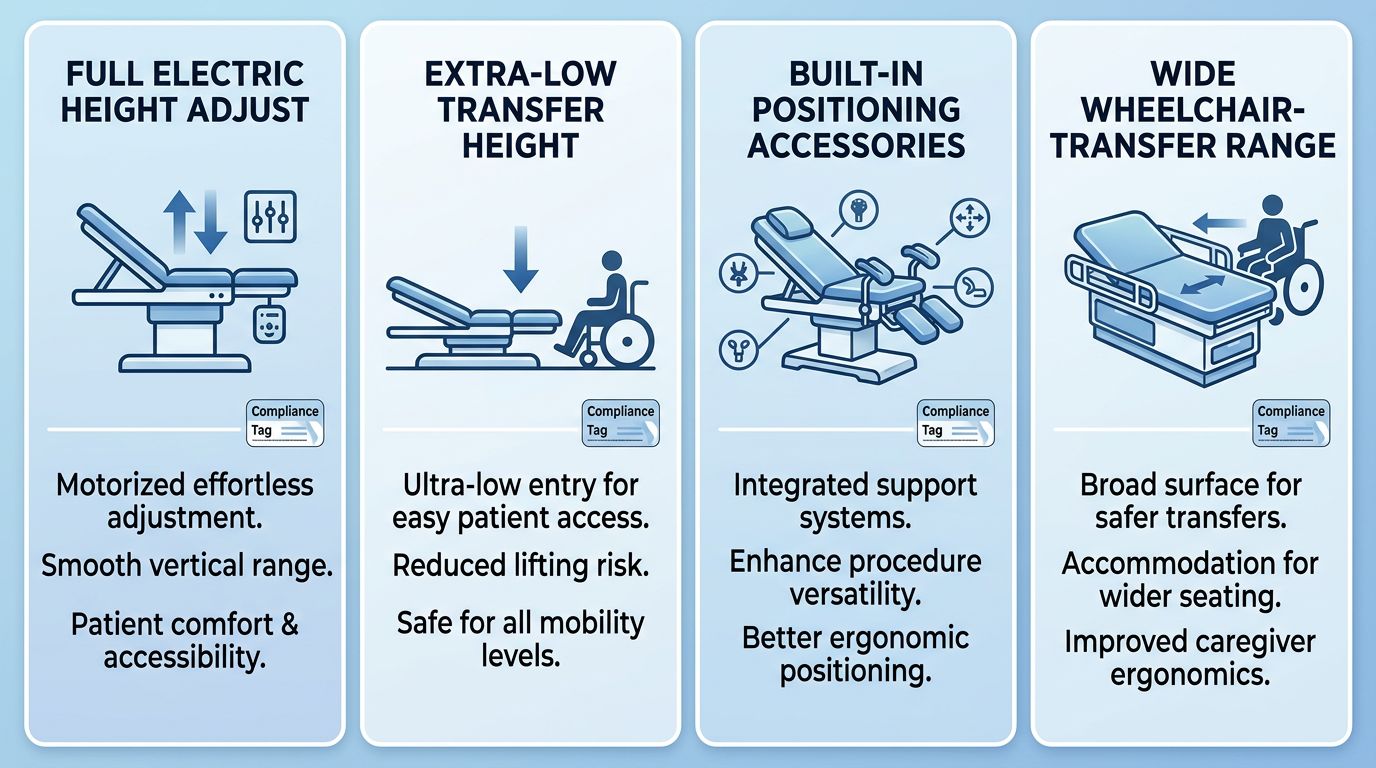
    Model A (Midmark 626)18–25 inches500 lbsFull electric height adjust
    Model B (Hausmann Power-Pro)17–36 inches600 lbsExtra-low transfer height
    Model C (Brewer ComfortView)19–30 inches450 lbsBuilt-in positioning accessories
    Model D (Oakworks MedPro)18–38 inches550 lbsWide range for wheelchair transfers

    Source: U.S. Access Board standards for MDE transfer surfaces and manufacturer specifications from MedEquipped.

    The Midmark 626 delivers full electric height adjustability across a solid 18-to-25-inch range, making it a dependable mainstream option for clinics upgrading from manual tables. The Hausmann Power-Pro stands out with an extra-low transfer height of just 17 inches and the highest weight capacity among these models at 600 lbs, a combination that particularly benefits bariatric patients and individuals with lower seat heights. For practices that need integrated positioning support, the Brewer ComfortView includes built-in accessories that help patients maintain stability during exams, while the Oakworks MedPro offers the widest adjustment range—spanning 20 vertical inches—to accommodate an exceptionally broad spectrum of wheelchair transfer scenarios.

    Four-panel infographic comparing exam table models: Full Electric Height Adjust, Extra-Low Transfer Height, Built-in Positioning Accessories, and Wide Wheelchair-Transfer Range, with icons and compliance tags.

    Comparison of four exam table models highlighting key compliance features.

    Selecting the right table involves balancing these dimensions against the specific patient population a practice serves. A clinic with a high volume of wheelchair users may prioritize an extra-low minimum transfer height, while a general practice might focus on overall adjustability and positioning flexibility.

    Scales

    Accessible scales address a barrier that many patients encounter before the exam even begins. Under the accessible exam table requirements framework, a compliant medical scale should feature a platform height no higher than 2 to 3 inches above the floor to allow a wheelchair to roll onto it directly, or it must accommodate a transfer board approach. Handrails on both sides provide stability during weighing, and the weight capacity should reach at least 600 lbs to safely serve bariatric patients along with their mobility devices. A wheelchair-accessible design that permits a patient to remain seated in their chair throughout the measurement eliminates the need for a potentially risky stand-and-transfer maneuver.

    Exam Chairs

    Exam chairs bridge the gap between standard waiting-room seating and full examination tables, and the DOJ medical diagnostic equipment rule applies the same transfer-surface logic to these devices. A compliant exam chair provides adjustable seat height that reaches down to a low transfer range, typically between 17 and 22 inches, allowing a patient to slide across from a wheelchair with minimal vertical displacement. Removable armrests further facilitate lateral transfers by clearing the path from the wheelchair to the chair seat. A supportive backrest and stable base round out the essential design characteristics, and we recommend confirming that any chair under consideration meets the same transfer-surface standards that govern exam tables.

    Meeting the ADA accessible medical equipment deadlines 2026 is about more than regulatory compliance. It is about ensuring that every patient who enters a medical examination room can receive care with dignity and safety. By selecting exam tables, scales, and chairs with documented exam table compliance features, practices build an environment where mobility challenges do not become barriers to quality care. In the next section, we will walk through the practical steps of purchasing and implementing this equipment so that your practice is ready well before the compliance deadline.

    This information is for informational purposes only and does not constitute medical advice. Consult a healthcare professional before making clinical equipment decisions. Results may vary; individual outcomes are not guaranteed.

    A Practical Path to Compliance for Your Facility

    Now that you understand the requirements of the DOJ medical diagnostic equipment rule, it is time to shift from awareness to action. Meeting the ADA accessible medical equipment deadlines 2026 does not have to be overwhelming—with a clear roadmap, your facility can move forward confidently. The following steps will guide you through auditing your current setup, planning upgrades and budgets, and partnering with the right specialists to ensure every exam table, stretcher, and imaging unit meets accessible exam table requirements before the July 2026 deadline.

    Conducting a Compliance Audit of Existing Equipment

    Start by inventorying all medical diagnostic equipment in your facility, including exam tables, stretchers, and imaging systems. For each piece, measure the transfer height—the distance from the floor to the top of the seat or platform—and compare it against the transfer-height standards established by the Access Board. Adjustable equipment should be able to reach a low range of 17 to 19 inches to accommodate patients who use wheelchairs. Document which units currently comply, which can be adjusted, and which need full replacement.

    To help you choose the right evaluation approach, consider the three frameworks outlined below. A self-audit, conducted by your in-house team, typically takes one to two weeks and involves minimal cost for basic measuring tools; it is ideal for an initial check and budget planning. A third-party audit brings in an external compliance consultant who completes the review in one to three days, providing a detailed gap analysis for a moderate fee. For the most comprehensive path, an ATP-led assessment involves a certified Assistive Technology Professional—such as a member of the MedEquipped team—who evaluates your entire environment over a customized timeline of one to four weeks and includes specific equipment recommendations.

    Comparison of Audit Frameworks
    Audit TypeTimelinePrimary BenefitRecommended For
    Self-Audit1–2 WeeksLow Cost / Initial PlanningFoundational assessment
    Third-Party Audit1–3 DaysExpert Gap AnalysisLiability documentation
    ATP-Led Assessment1–4 WeeksHolistic Patient-Centered SpecsFull clinical implementation

    A well-documented audit not only clarifies your compliance standing but also strengthens your position when seeking insurance reimbursement or defending against potential liability claims. Standards developed through RESNA certification and standards inform the evaluation criteria for adjustable-height exam tables and accessible stretchers, giving your documentation added credibility with regulators and funding sources.

    Planning Upgrades and Budgeting for the Deadline

    Once your audit is complete, prioritize replacements by focusing on areas with the highest patient volume, greatest safety risk, and simplest upgrade paths. Often, replacing an older fixed-height table with an adjustable exam table yields immediate benefits for both patient access and staff workflow.

    Funding these upgrades may feel daunting, but several options can help offset the expense:

    • Operational budget allocations spread costs across fiscal periods.
    • Insurance coverage may reimburse some equipment upgrades as part of facility modernization.
    • Grant programs from federal, state, or philanthropic organizations often support accessibility improvements.

    Building a multi-year budget that phases purchases leading up to 2026 ensures you can maintain financial stability while steadily improving your facility’s equipment.

    Partnering with Specialists for Seamless Implementation

    Selecting the right equipment and coordinating deliveries before the July 2026 cutoff requires hands-on expertise. We at MedEquipped recommend working with ATP-certified specialists who understand not only the technical specifications of compliant exam tables and stretchers but also the clinical workflow needs of your practice. Our team brings a structured, patient-centered process to every project—we handle the paperwork, insurance navigation, and coordination so your staff can stay focused on patient care.

    For example, when a facility partners with MedEquipped for an ATP-led assessment, we provide more than a checklist. We learn how your clinicians work, measure spaces, recommend equipment configurations that meet transfer-height standards, and then manage the entire order and delivery timeline. Our ability to complete custom orders in 30 to 60 days—significantly faster than the six months or longer that is common in the industry—gives you the scheduling confidence you need. We also remain available for post-delivery support, adjustments, and staff training to ensure the new equipment integrates smoothly.

    While our core experience lies in mobility solutions such as power wheelchairs for seniors, the same clinical rigor, documentation discipline, and coordination capabilities translate directly into MDE compliance planning. Whether you are upgrading a single exam room or rolling out a site-wide accessibility initiative, we can help you build a timeline that respects your operational realities. Results may vary; individual outcomes are not guaranteed.

    With a clear plan and the right partners, your facility can meet the 2026 deadline confidently and continue serving every patient with the dignity and respect they deserve.

    Advanced Integration: Aligning MDE Compliance with Clinical Mobility Planning

    Meeting the 2026 MDE compliance deadline means healthcare facilities must pair accessible exam tables and diagnostic equipment with a comprehensive mobility strategy. For many patients, especially those requiring a custom motorized wheelchair provider, smooth clinical care starts with the right seating and positioning long before they reach an appointment. We help our partners in New York, Georgia, and Michigan see this as one integrated workflow — not separate regulatory and clinical tasks.

    A facility that invests early in clinical mobility planning can avoid the high cost of retrofitting rooms later. RESNA, the Rehabilitation Engineering and Assistive Technology Society of North America, guides that certified Assistive Technology Professionals (ATP) evaluate the whole person — not just the wheelchair — which parallels the ADA’s emphasis on accessible diagnostic environments. Aligning these efforts may streamline both compliance documentation and patient throughput.

    That’s where we step in as your custom motorized wheelchair provider. Our team coordinates the clinical evaluation, insurance navigation, and custom chair delivery while keeping MDE accessibility in full view. Whether you’re updating an exam room with a height-adjustable table or ordering a power chair for a patient with complex positioning needs, our ATPs bring both clinical insight and regulatory awareness to the conversation. As a custom wheelchair provider and power wheelchair specialist, we handle the paperwork, funding, and coordination so you can focus on patient outcomes.

    Thinking about compliance early sets the foundation for everything that follows — from selecting the right equipment to planning a step-by-step procurement process. We work alongside facilities to map out a path that respects the 2026 deadlines without overcomplicating day-to-day operations. That integrated framework is what we explore next when we look at how to build a practical custom wheelchair acquisition plan.

    Frequently Asked Questions

    What is the process to get a custom power wheelchair from MedEquipped?

    Your journey starts with an evaluation by one of our certified Assistive Technology Professionals, following standards set by the Rehabilitation Engineering and Assistive Technology Society of North America (RESNA). We coordinate your prescription, required documentation, and conduct a fitting to match the chair to your clinical needs. Our team then handles the insurance paperwork and coordination from start to finish.

    How long does it take to receive my custom chair?

    Most orders are completed within 30–60 days (faster processing). The exact timeline can depend on insurance authorization speed and the specific customizations involved. We keep you updated at every stage so you always know the status.

    Do you help with insurance and paperwork?

    Absolutely. We handle the paperwork, insurance navigation, and coordination for you. From verifying your benefits to managing prior authorizations with your physician, our goal is to make the funding process seamless.

    Are there ADA accessible medical equipment deadlines in 2026 that affect power wheelchairs?

    Yes, recent updates to the Americans with Disabilities Act focus on improving access to accessible medical diagnostic equipment by 2026. These deadlines encourage healthcare facilities to have exam tables and diagnostic tools that accommodate wheelchair users, ensuring you receive equitable care during medical appointments.

    What is the DOJ medical diagnostic equipment rule?

    The Department of Justice rule requires certain healthcare providers to ensure their medical diagnostic equipment is accessible to people with disabilities. For our clients, this means more exam rooms will feature adjustable tables and clear floor space, making your medical visits safer and more dignified.

    Do I need a prescription for a custom motorized wheelchair?

    Yes, a face-to-face physician evaluation and a written order are required to justify medical necessity. We guide you through this step, helping your provider document your mobility limitations so the right equipment is approved.

    What kind of support comes after delivery?

    We’re your partner in mobility freedom for the long term. Our local service teams across New York, Georgia, and Michigan provide adjustments, maintenance, and troubleshooting. Most repairs are completed within 3 to 7 business days, with urgent needs getting same-day assessments.

    Consult a healthcare professional before making clinical decisions.

    Compliance in Motion

    As you plan for mobility, the ADA accessible medical equipment deadlines 2026 and the DOJ Medical Diagnostic Equipment Rule mandate that new exam tables and scales meet accessible exam table requirements. As a custom motorized wheelchair provider, we ensure your chair aligns. Key points:

    • The 2026 deadline covers new and altered equipment.
    • We handle the paperwork, insurance navigation, and coordination as your partner in mobility freedom.
    • Chairs fit accessible exam tables seamlessly.

    Proactively addressing ADA accessible medical equipment deadlines 2026 safeguards your mobility. Results may vary; individual outcomes are not guaranteed. Consult a healthcare professional before making clinical decisions.

    Resources

  • Best Custom Power Wheelchairs for 2026: Top Options

    Best Custom Power Wheelchairs for 2026: Top Options

    Table of Contents

    Custom Power Wheelchairs: Personalized Mobility Solutions

    While standard models suit many, custom power wheelchairs elevate personalization to transform your mobility. At MedEquipped, we design these tailored power wheelchairs as fully adjustable devices with bespoke seating, control interfaces, and chassis modifications based on your measurements and lifestyle. They address unique needs, from everyday activities for those with spinal cord injuries to active routines.

    Key customization options include:

    • Variable seat widths to fit diverse body types.
    • Programmable joystick sensitivity for precise control.
    • Tilt and recline functions calibrated to medical conditions.
    • Compatibility with heavy duty power wheelchairs for higher weight capacities.

    These features deliver superior pressure distribution for skin health, reduced fatigue through ergonomic positioning, and greater independence. Compliant with national seating and mobility standards and Medicare guidelines, they outperform off-the-shelf models with higher user satisfaction in studies. As your partner in mobility freedom, we handle fittings expertly. Our certified ATPs coordinate fittings and insurance support, simplify documentation, and expedite approvals for faster delivery.

    Ready to experience personalized heavy-duty wheelchairs? Contact us at medequipped.com for a fitting assessment. Explore specific configurations next for your ideal fit.

    Understanding Custom Power Wheelchairs

    At MedEquipped, we partner in mobility freedom by providing custom power wheelchairs tailored to your unique needs. These personalized power wheelchairs enhance independence for users with complex conditions. This section explores what they are, top manufacturers like those behind the QUICKIE series and ROVI X3, and our key ally, National Seating and Mobility.

    What Are Custom Power Wheelchairs?

    What exactly are custom power wheelchairs, and how do they stand out?

    Custom power wheelchairs are fully customizable mobility devices designed around individual body size, medical conditions, and lifestyle demands. Unlike standard models with fixed dimensions and limited adaptability, these bespoke mobility chairs offer true personalization for optimal comfort and function.

    Key features make them superior. They include:

    • Adjustable seating systems for pressure relief and posture support
    • Modular frames that adapt to various sizes and weights
    • Advanced controls like joystick or head arrays for precise navigation
    • Heavy duty power wheelchairs options with up to 600 lbs capacity
    • Terrain-capable bases for indoor-outdoor use

    Standard wheelchairs lack this flexibility, often leading to discomfort or poor fit. We focus on these tailored electric wheelchairs to empower users effectively. Building on these advantages, let’s examine leading makers we trust.

    Top Custom Power Wheelchair Manufacturers

    Which brands lead in custom power wheelchairs, and what models do we use at MedEquipped?

    Top manufacturers deliver innovative custom motorized wheelchairs. Sunrise Medical offers the QUICKIE series, known for lightweight frames and high maneuverability. Pride Mobility provides the ROVI X3, excelling in stability with robust suspension for uneven surfaces.

    These models support weight capacities up to 600 lbs in heavy-duty variants and feature programmable electronics for user-specific speeds. National Seating and Mobility collaborates with such brands for expert configurations. At MedEquipped, we select QUICKIE and ROVI X3 for custom fittings, ensuring seamless integration with your daily life. Other notables include Invacare and Permobil for specialized rehab tech.

    A key partner in accessing these is National Seating and Mobility, powering our service excellence.

    National Seating and Mobility Overview

    What role does National Seating and Mobility play in custom wheelchair solutions?

    National Seating and Mobility (NSM) stands as a leading U.S. provider of complex rehab technology. Founded in 1994, it now boasts over 100 locations nationwide after PatientCare Solutions acquired it in 2021.

    NSM excels in prescribing, funding, and servicing custom power wheelchairs through certified clinicians. They handle intricate evaluations and insurance navigation, much like our streamlined approach at MedEquipped. Partnerships enable us to deliver robust heavy-duty powerchairs with 30-60 days processing—faster than industry norms.

    With NSM’s backing, we manage paperwork, fittings, and ongoing support. Discover how our process starts with your consultation next.

    Benefits of Custom Power Wheelchairs

    Beyond standard models, custom power wheelchairs offer tailored benefits that boost satisfaction by 70%, transforming everyday mobility for users like you.

    Enhanced Comfort and Independence

    At MedEquipped, we see how custom power wheelchairs elevate daily life through precise personalization.

    • Adjustable seating with custom foam contours reduces pressure ulcers by 30-50%, allowing longer periods of comfort during outings.
    • Joystick customization enables one-handed operation, empowering self-feeding and other independent tasks without assistance.
    • Tailored controls match your grip strength and preferences, minimizing fatigue on extended trips.
    • Users share stories of enjoying full-day adventures, from park visits to family gatherings, free from discomfort.

    Our certified ATPs complete individualized fittings and follow-up adjustments to ensure each seating and control modification continues to match daily routines and medical needs. That hands-on process reduces trial-and-error time, letting you enjoy outings sooner.

    These features make custom power wheelchairs a true partner in mobility freedom, enhancing your independence significantly.

    Cost Considerations for Custom Models

    Investing in custom power wheelchairs makes financial sense when you consider their long-term value over standard options.

    • Pricing ranges from $5,000 to $15,000, influenced by motor power (300W-800W), battery life (12-24 hours), and add-ons like tilt and recline functions.
    • Heavy duty power wheelchairs boast superior durability, leading to 20% lower lifetime costs through fewer repairs.
    • Medicare Part B often covers up to 80%, and we handle the paperwork, insurance navigation, and coordination to simplify the process.

    We also offer routine maintenance plans, clear warranty options, and proactive repair coordination to keep downtime minimal. Our team assists with documentation so insurance approvals proceed smoothly, with timely follow-up and communication regularly.

    Building on comfort, these robust custom power chairs deliver exceptional value, making them a smart choice for sustained use.

    Ideal Options for Adult Users

    For adult users, custom power wheelchairs with heavy-duty features provide the reliability needed for active lifestyles.

    • 400+ lb weight capacity supports diverse body types, paired with 5-8 mph top speeds and 15+ mile ranges for versatile travel.
    • Reinforced aluminum frames ensure stability on varied terrains, from urban streets to home environments.
    • Integration with national seating and mobility standards optimizes ergonomics for prolonged comfort.

    Our selection includes reinforced bases, upgraded suspension systems, and modular components that adapt to transfers, active lifestyles, and varying home layouts—ensuring stability and confidence across environments for everyday use and long-term reliability too.

    We configure these heavy duty power wheelchairs to fit your needs perfectly in Spring Valley, NY. Explore top models next to find your ideal match.

    How Our Custom Power Wheelchair Process Works

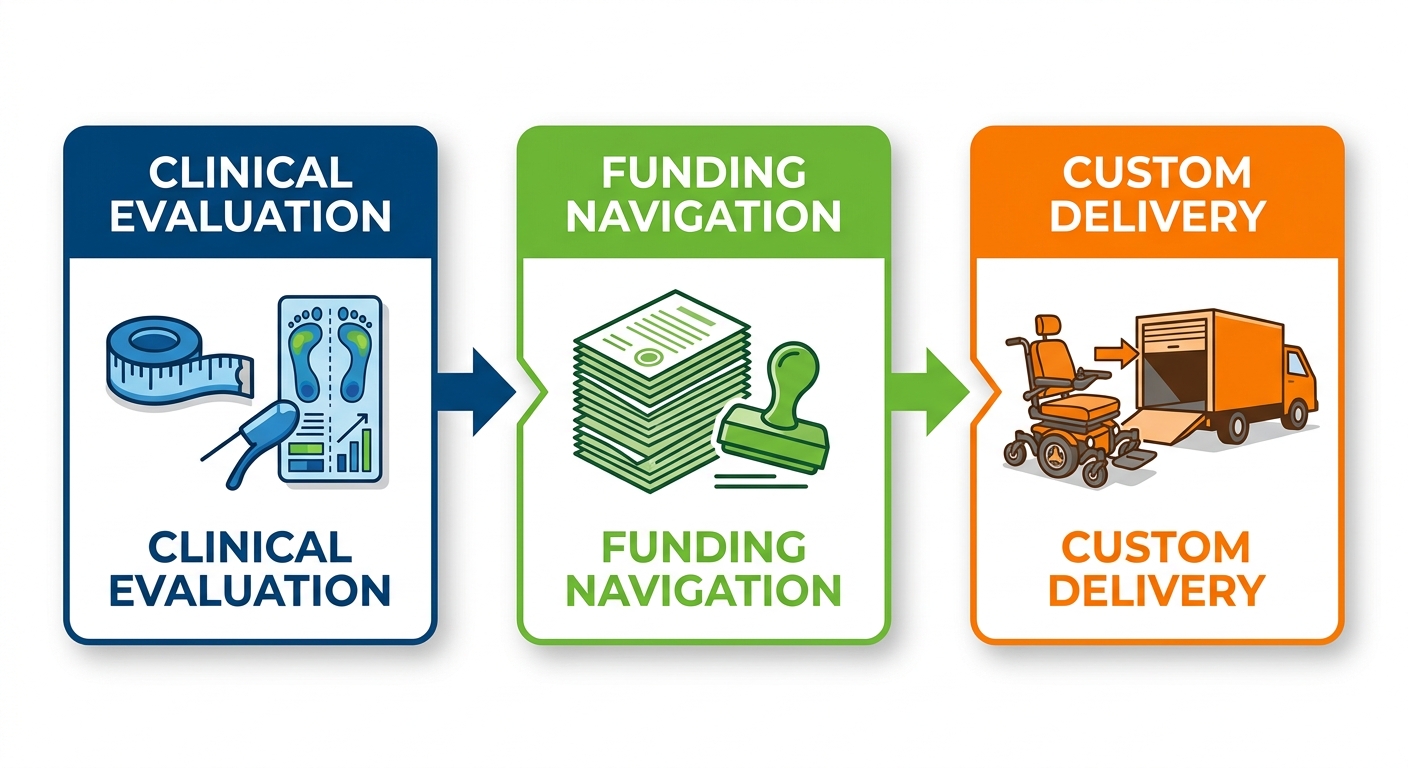
    Now, see how our process makes getting your custom power wheelchair effortless. At MedEquipped, we guide you through a seamless, ATP-led journey from evaluation to delivery. We handle the details, ensuring personalized fitting and hassle-free funding as your partner in mobility freedom.

    Horizontal process flow diagram of three stages for custom power wheelchair service: clinical evaluation, funding navigation, and delivery.

    Custom power wheelchair process: evaluation, funding, and delivery stages

    This visual outlines our three key stages, making it easy to follow your path to enhanced mobility.

    Clinical Evaluation and Fitting

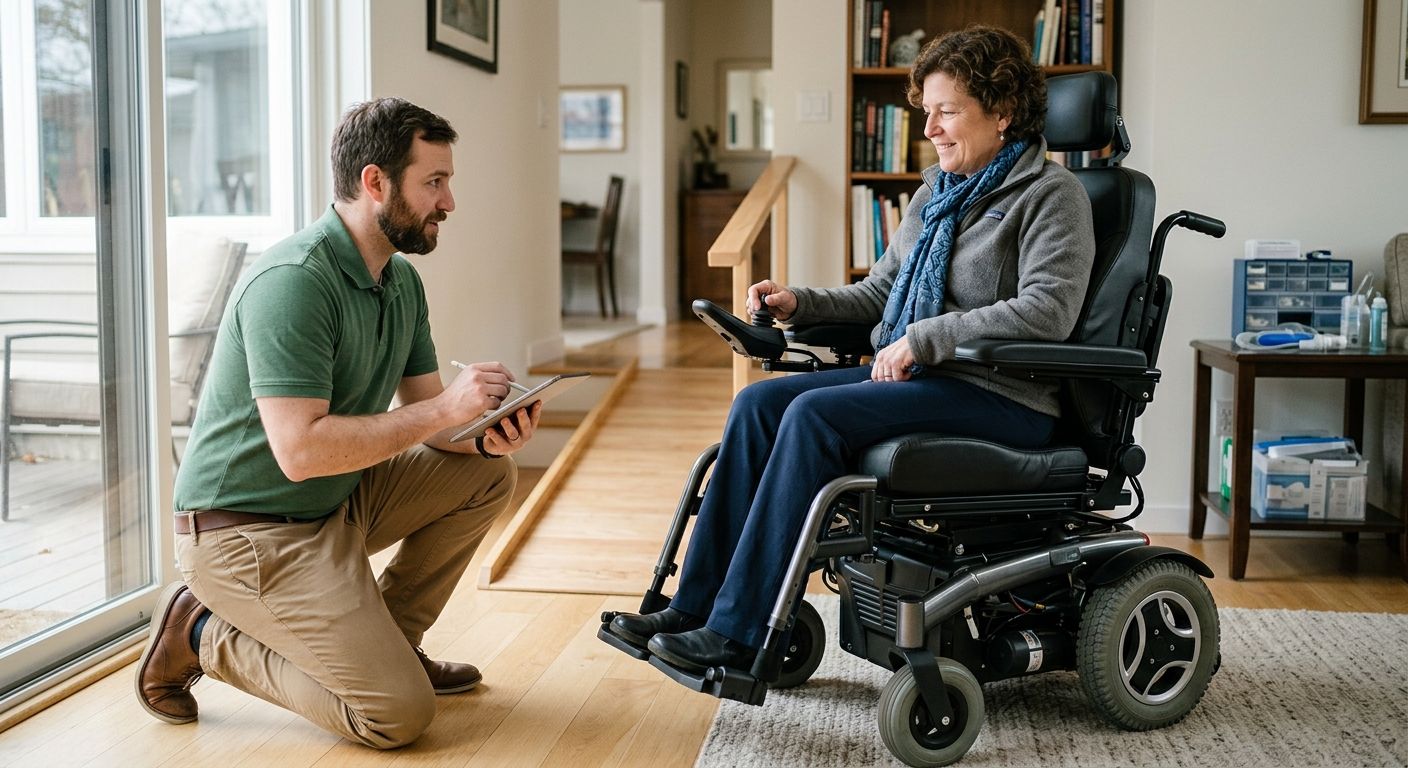
    Our certified Assistive Technology Professionals (ATPs), adhering to RESNA standards, start with a thorough assessment. We conduct in-home or clinic visits tailored to your needs across New York, Georgia, and Michigan.

    1. Gather client history and goals to understand lifestyle demands.
    2. Take precise measurements using goniometers and inclinometers for posture alignment.
    3. Perform pressure mapping to prevent skin issues and optimize seating.
    4. Conduct trial fittings with drive simulations on models like QUICKIE or ROVI X3.
    5. Document findings for medical necessity.

    This personalized approach ensures your power wheelchair matches your body and daily activities perfectly. Once fitted, we tackle funding seamlessly.

    Insurance and Funding Navigation

    We handle the paperwork, insurance navigation, and coordination so you don’t have to. Our dedicated team manages everything for Medicare Part B, which covers custom motorized wheelchairs for those with functional mobility loss from diagnoses like ALS or spinal cord injury.

    Required documents include:

    • Physician prescription outlining needs.
    • Letter of Medical Necessity (LMN) justifying customization.

    We submit for pre-authorization, typically taking 30-60 days with our faster processing. If needed, we handle appeals and explore VA benefits or private insurance alternatives. You focus on recovery while we secure approval efficiently. With our expertise akin to national seating and mobility leaders, funding becomes straightforward. Next, we order your chair.

    Ordering, Configuration, and Delivery

    Your input shapes the perfect setup. We configure seating, controls, and accessories—like heavy duty power wheelchair bases such as TDX SP2 HD—for durability and comfort.

    The process includes:

    1. Review evaluation data and preferences.
    2. Select components from trusted brands.
    3. Place custom order with 30-60 days faster processing.
    4. White-glove delivery to your door.
    5. On-site setup and training (2-4 hours) for safe use.
    6. Provide 1-year warranty and ongoing support contracts.

    Our team ensures everything fits your life, with adjustments as needed. We’re with you every step for lasting mobility.

    Ready to begin? Contact us at 845-237-2381 or intake@medequipped.com to schedule your evaluation today. Trust MedEquipped for reliable custom power wheelchairs.

    Best Practices for Custom Power Wheelchairs

    When it comes to custom power wheelchairs, the right fit makes all the difference for bariatric or high-need users. We at MedEquipped focus on heavy-duty options that ensure stability, comfort, and independence as your partner in mobility freedom.

    Selecting Heavy-Duty Models

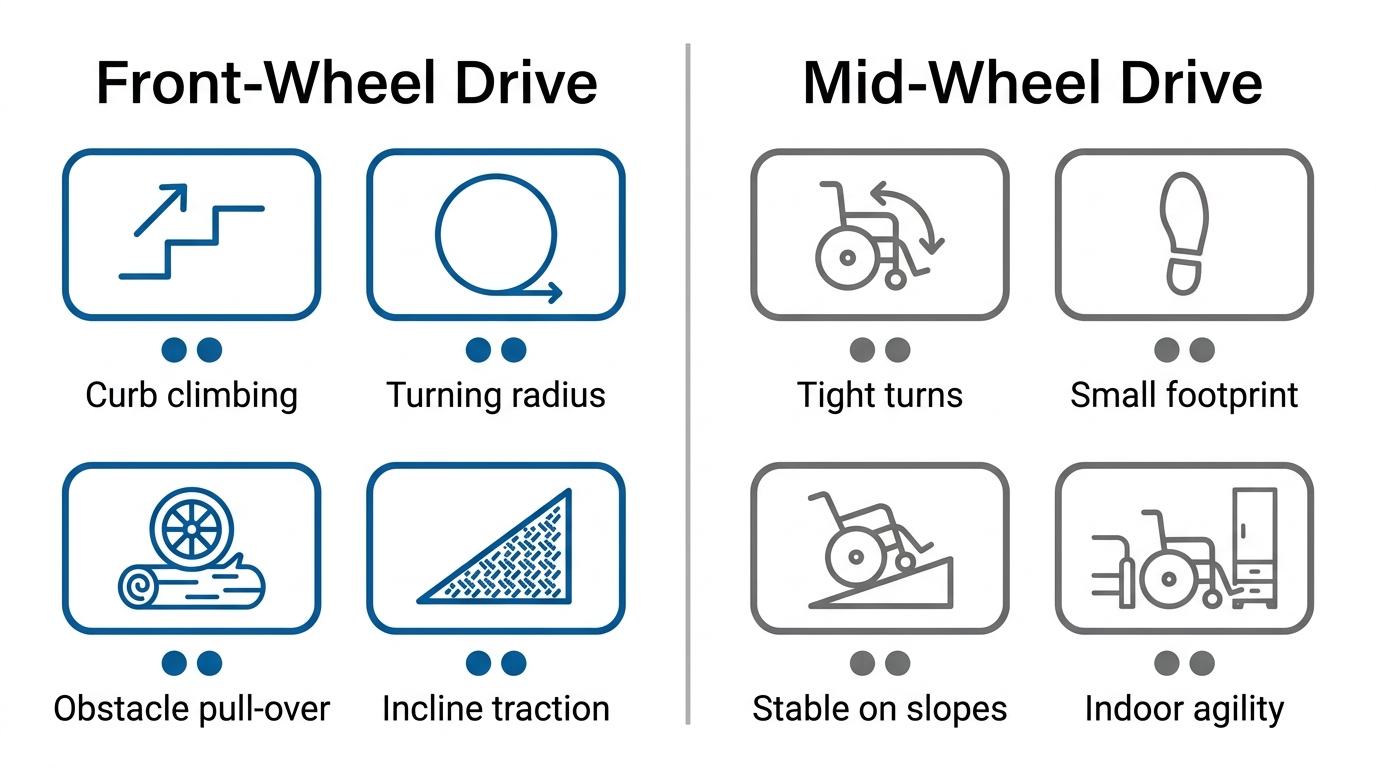
    Selecting heavy duty power wheelchairs starts with weight capacities over 300 lbs to support bariatric users safely. Look for robust base stability on varied terrain and Medicare Group 3 approval, which covers complex power seating like tilt and recline. We recommend models like the ROVI X3 for active adults or QUICKIE Heavy-Duty Base for complex needs. These offer mid-wheel drive agility or stable power bases, prioritizing durability and maneuverability in daily life. Prioritize certified evaluations to match your lifestyle.

    The following table compares key features of popular heavy-duty models we offer:

    Heavy-Duty Power Wheelchair Model Comparison
    FeatureROVI X3TDX SP2 HDQUICKIE Heavy-Duty Base
    Up to 300 lbs400 lbs350 lbs
    Mid-wheel driveHeavy-duty trackedStable power base
    YesYes (Group 3)Yes
    Active adultsBariatric usersComplex needs

    This comparison, drawn from our clinical expertise, highlights how each excels in specific scenarios. Contact us at 845-237-2381 for personalized guidance.

    Key Features of TDX SP2 HD

    The TDX SP2 HD stands out among heavy duty power wheelchairs with its heavy-duty tracked base, conquering rough terrain effortlessly. Boasting a 400 lb capacity, it supports bariatric users with exceptional stability. Adjustable seating ensures custom comfort, while power tilt and recline promote pressure relief and positioning for all-day use. Integrated controls and spacious seating enhance independence for high-need individuals. We configure these custom power wheelchairs with precise fittings during our clinical evaluations. Its robust construction handles demanding environments, from home to outdoors. As certified ATPs, we tailor the TDX SP2 HD to your needs, delivering in 30-60 days with ongoing support. Ready to explore? Email intake@medequipped.com.

    Local Availability and Considerations

    Finding custom power wheelchairs locally is straightforward through national seating and mobility networks. In NY, especially the NYC metro and our Spring Valley base, we offer in-home assessments for seamless fittings. In GA, our Atlanta-area services provide evaluations and delivery. In MI, Detroit and Grand Rapids clients benefit from our dedicated teams. We handle everything from clinical visits to custom configurations across these regions. Consider terrain, home access, and daily routines during assessments. Our faster processing gets you mobile sooner. We manage insurance navigation too, so you focus on freedom. Schedule your consultation today at 845-237-2381.

    Medicare and Purchase Options

    For Medicare, Group 3 custom power wheelchairs require a doctor’s prescription and mobility justification via A&A study. We guide rentals for trials or purchases for ownership, often with competitive pricing and financing. As your local A&A provider, we streamline approvals and paperwork. Explore cash-pay options for flexibility. Contact MedEquipped to start your process efficiently.

    Start Your Journey with MedEquipped Custom Power Wheelchairs

    Tired of mobility holding you back? Custom power wheelchairs from MedEquipped unlock your independence, tailored precisely to your unique needs and lifestyle. We are your partner in mobility freedom, transforming everyday challenges into seamless adventures.

    Our process starts with a personalized clinical evaluation in Spring Valley, NY. Our certified ATP team conducts thorough assessments to configure seating, controls, and accessories, ensuring each motorized chair meets your clinical needs and daily lifestyle demands and activity goals. We design custom motorized wheelchairs that fit your body type, usage scenarios, and preferences perfectly. Need robust support? Explore our heavy duty power wheelchairs for higher weight capacities, all integrated with national seating and mobility standards for safety and compliance.

    We prioritize quality, comfort, and innovation in every build. Our certified ATP team handles paperwork, insurance navigation, and coordination, delivering your chair in just 30-60 days. Key benefits include:

    • Perfect fit for enhanced comfort
    • Faster processing than industry averages
    • Ongoing support for lasting reliability

    Ready to discover how we build your ideal chair next? Schedule your free consultation today—call 845-237-2381 or email intake@medequipped.com!

    Resources

    This article was researched and written with the assistance of AI tools.