Power Wheelchair Incline Rating for Hills: Complete Safety Guide
Table of Contents Why Power Wheelchair Incline Ratings Matter for Safe Hill Navigation 1. Decoding Power Wheelchair Incline Ratings 2. ADA Ramp…
Read More
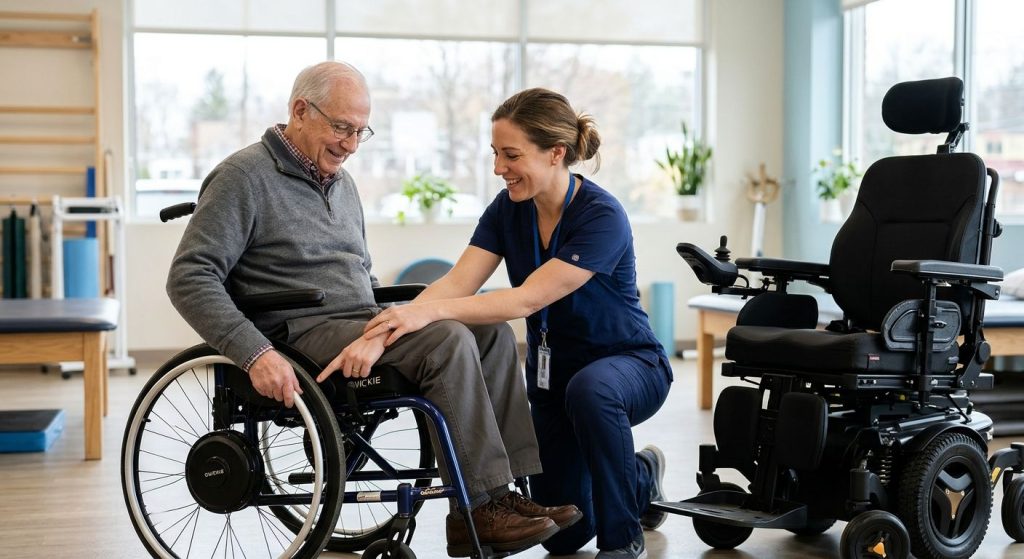
Determining which is better for you—a power wheelchair or a power assist wheelchair—depends on your upper body strength, daily activities, and any progressive health conditions. Power assist wheelchairs use motorized pushrims that reduce stroke frequency and joint excursion, as power assist wheelchairs research shows, helping mitigate shoulder pain in manual chair users while allowing many to stay active longer. A full power wheelchair offers complete independence: no manual propulsion is required, making it essential when upper body strength is limited or a progressive condition affects mobility. We design custom motorized wheelchairs tailored to each patient’s diagnosis and functional requirements, ensuring safe, strain-free movement. Each option suits a different profile, so the first step is to identify your daily mobility needs.
For individuals in Spring Valley, NY, deciding between a power wheelchair and a power assist wheelchair begins with a look at daily mobility needs. Thorough self-assessment of your strength, endurance, travel distances, and the environments you navigate will indicate which device best supports your independence.
Once you have identified your daily needs, you can compare the features of power wheelchairs and power assist technology.
We’re here to help.
| Feature | Power Wheelchair | Power Assist Device |
|---|---|---|
| Propulsion | Fully motorized (joystick) | Pushrim-activated proportional assistance |
| Physical Effort | Minimal | Reduced stroke frequency and joint excursion |
| Best For | Limited upper-body strength, progressive conditions | Some pushing ability, reduce fatigue and injury |
| Health Impact | Eliminates strain | Mitigates shoulder pain |
| Portability | Heavier | Lighter, attaches to manual wheelchair |
| Customization & Fitting | Proper fitting needed for pressure injuries and posture | Same |
Understanding these differences will help you identify the right device.
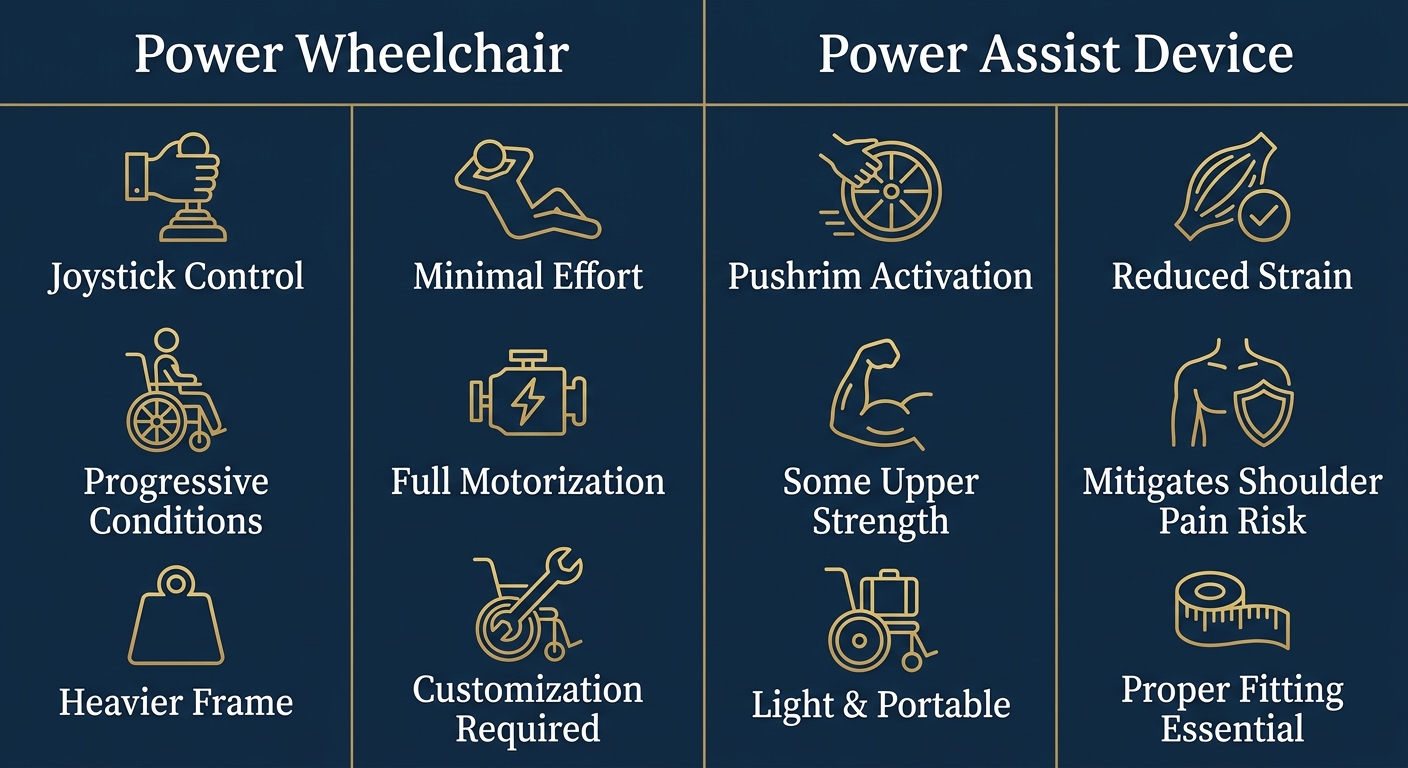
The best mobility solution for you depends on your daily environment, upper-body strength, and long-term comfort. A power assist device reduces effort by adding motorized torque to manual pushes, while a full power wheelchair handles all propulsion independently. We recommend starting with a self-assessment to determine which option aligns with your mobility goals.
Understanding your needs helps you choose a wheelchair that fits your daily life. Schedule an evaluation and trial—a hands-on test reveals which device feels easiest to push and protects your shoulders. This approach safeguards your long-term comfort.
If you are wondering which is better for you, a power wheelchair or a power assist wheelchair, the answer begins with how easy it is to push a manual wheelchair. Many users can propel a manual chair comfortably when it is tailored to their body and daily routines.
Our MedEquipped guide on manual versus motorized wheelchairs highlights that personalized fitting and customization are what make a manual wheelchair truly easy to push. For users who find self-propulsion too demanding, understanding power wheelchair eligibility in Spring Valley, New York can reveal whether a fully powered option is right for them.
While manual wheelchairs may involve simpler documentation, navigating the power wheelchair eligibility criteria in Spring Valley requires a more detailed process. Medicare Part B mandates a face-to-face examination with a physician and a written order demonstrating that the power wheelchair is medically necessary for use inside the home.
According to the Centers for Medicare & Medicaid Services (CMS), power-operated seat elevation equipment is covered when prescribed with a complex rehabilitative power wheelchair and following a specialty evaluation by a licensed physical therapist or occupational therapist. The CMS coverage criteria require safe operation and need for seat elevation to assist with transfers or reaching for daily activities like feeding, dressing, or grooming.
Our initial patient evaluation and personalized fittings at MedEquipped help document these clinical needs, satisfying the medical necessity requirements. We verify Medicare benefits and assist with required paperwork to streamline the approval process. Once eligibility is confirmed, we focus on customizing the power wheelchair to your precise diagnostic and lifestyle requirements.
Once coverage eligibility has been determined, residents in Spring Valley can concentrate on tailoring their motorized wheelchair. Personalization turns a standard mobility device into a precise clinical tool that matches the user’s body and routine.
Medicare’s national coverage policy now reimburses power-operated seat elevation equipment when prescribed for a complex-rehabilitative power-driven wheelchair—this is not an option for basic power chairs. A specialty evaluation by a licensed physical or occupational therapist is mandatory, confirming that the patient can operate the equipment safely at home. Coverage applies to three specific clinical scenarios: weight-bearing transfers, non-weight-bearing (dependent) transfers, and reaching assistance for mobility-related activities of daily living like feeding, dressing, or grooming. These guidelines direct which features are funded, and we incorporate them while also customizing seating, positioning cushions, and control interfaces to suit each diagnosis.
Our team navigates the documentation; custom choices are finalized at fitting and completed in 30–60 days.
Custom motorized wheelchair orders often entail half-year waits, but we have refined the process to deliver in as quickly as 30 days. We handle Medicare benefits verification and funding paperwork up front, eliminating delays that can stretch timelines elsewhere. Most custom wheelchairs are ready for fitting within 30 to 60 days, substantially faster than the industry norm of six months or more.
Once your wheelchair arrives, we schedule a personalized fitting at our clinic in Spring Valley. Proper fitting is essential for preventing pressure injuries, supporting healthy posture, and achieving all-day comfort. During this appointment, our team fine-tunes seat depth, back support, footrest height, and control positioning to your exact needs. The in-person fitting process enables immediate adjustments that optimize safety and long-term satisfaction.
Your first step is a personalized mobility evaluation at our location in Spring Valley, where we complete a comprehensive assessment of your clinical needs and daily activities. Contact us at (845) 237-2381 to schedule your evaluation.
The rapid 30–60 day turnaround and precise in-person fittings you’ve read about begin with one essential step: a personalized mobility evaluation. During this comprehensive assessment, we evaluate your strength, mobility, and daily activity requirements to determine the right wheelchair for your needs. We also discuss the daily activities most important to you, such as transferring from bed to chair, preparing meals, or navigating community spaces, to ensure the wheelchair’s features align with your life. Our evaluation prioritizes a proper fit to prevent pressure injuries and support postural health — key considerations for long-term comfort. If you are considering a power wheelchair with seat elevation equipment, Medicare coverage policy requires a specialty evaluation by a licensed professional, such as a physical therapist or occupational therapist, to verify medical necessity. To schedule your evaluation, call us at (845) 237-2381 or visit our clinic at 747 Chestnut Ridge Road. Your custom mobility solution begins with a comprehensive evaluation. Schedule yours today.
Deciding which is better for you, a power wheelchair or a power assist wheelchair, in Spring Valley starts with a personalized evaluation—your first step toward a custom solution from our team. Our custom motorized wheelchairs provide superior independence for those with progressive conditions or significant mobility limitations. Every chair is custom-fitted to your exact measurements and clinical needs for optimal comfort. We complete orders in 30 to 60 days—far faster than the six-month industry average—and manage all Medicare paperwork on your behalf. Contact us at (845) 237-2381 or visit 747 Chestnut Ridge Road, Spring Valley, NY 10977 to begin your journey toward greater independence.
Results may vary. Verify Medicare/insurance coverage; supplier does not guarantee coverage. Consult your treating healthcare professional for medical necessity.
You’ve now explored the key differences between power wheelchairs and power assist devices, including research showing reduced stroke frequency and joint excursion with pushrim-activated power assist. The article guided you through identifying daily mobility needs and comparing technology features. The most impactful next step is to experience these options firsthand through a personalized evaluation. At MedEquipped in Spring Valley, New York, a comprehensive assessment ensures the right custom mobility solution for your lifestyle and health. Their team manages Medicare paperwork and funding verification, simplifying the path to a custom motorized wheelchair that promotes independence. A rapid 30–60 day turnaround means you won’t wait months for the equipment you need. Taking this step can lead to greater comfort, safety, and daily freedom.
Start Your Personalized Evaluation
Table of Contents Why Power Wheelchair Incline Ratings Matter for Safe Hill Navigation 1. Decoding Power Wheelchair Incline Ratings 2. ADA Ramp…
Read More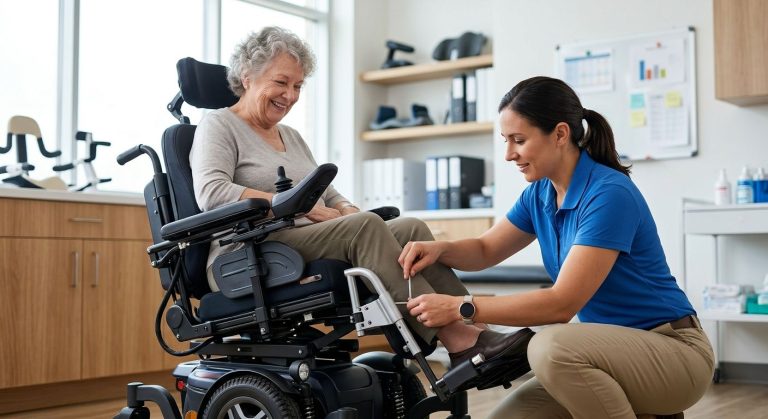
Table of Contents Your Source for Custom Motorized Wheelchairs in Spring Valley Quick Answers to Common Power Wheelchair Questions When to Consider…
Read MoreTable of Contents Custom Power Wheelchairs for Greater Independence Complex Rehab Technology Delivery at a Glance Recognizing When a Custom Motorized Wheelchair…
Read More