Medicare Approved Wheelchair Providers Spring Valley: Trusted Experts
Table of Contents Your Source for Custom Motorized Wheelchairs in Spring Valley Quick Answers to Common Power Wheelchair Questions When to Consider…
Read More
A power wheelchair incline rating for hills defines the maximum slope angle the chair can safely ascend and descend, directly affecting user safety and control. Exceeding this limit can cause tipping, motor strain, and loss of braking, potentially stranding the user on a steep incline. The real-world need for these ratings is clear: a RESNA study found that 45% of bus ramp deployments exceeded the proposed ADA maximum slope of 9.5°, a scenario we know can be dangerous for an improperly rated wheelchair. This data underscores why understanding your chair’s incline rating is essential, it determines whether the chair can navigate everyday slopes without risk. Understanding what these numbers represent is the next step in choosing a safe wheelchair for your environment.
To navigate hills safely, it helps to understand your power wheelchair incline rating for hills. This rating defines the maximum slope angle a powered wheelchair is designed to safely ascend or descend, typically measured in degrees or as a percent grade.
Real world slopes can vary. Research on transit bus ramps shows that at street level, the average slope was 8.9 degrees, and 45 percent of those surpassed the ADA slope limit. This variability highlights why selecting a wheelchair with an adequate incline rating is crucial for safety.
We recommend you evaluate the slope of the driveway you use and the hills you encounter when comparing wheelchair models. Choosing a capability well above your typical needs reduces the risk of tip-overs and motor strain. The principles that govern measurement of ADA ramps also apply to accessibility in the community. Consider whether other measurements you encounter support accessibility and how to apply them to your needs.
When a power wheelchair’s incline rating suggests it can manage steep grades, the ramps we encounter in public spaces must follow ADA slope rules. A 2013 RESNA study of 221 transit bus boardings recorded a mean deployed ramp slope of 4.5 degrees, yet 45% of street-level deployments exceeded the proposed ADA maximum of 9.5 degrees (a 1:6 ratio). Only 2.5% of sidewalk-level deployments surpassed that limit.
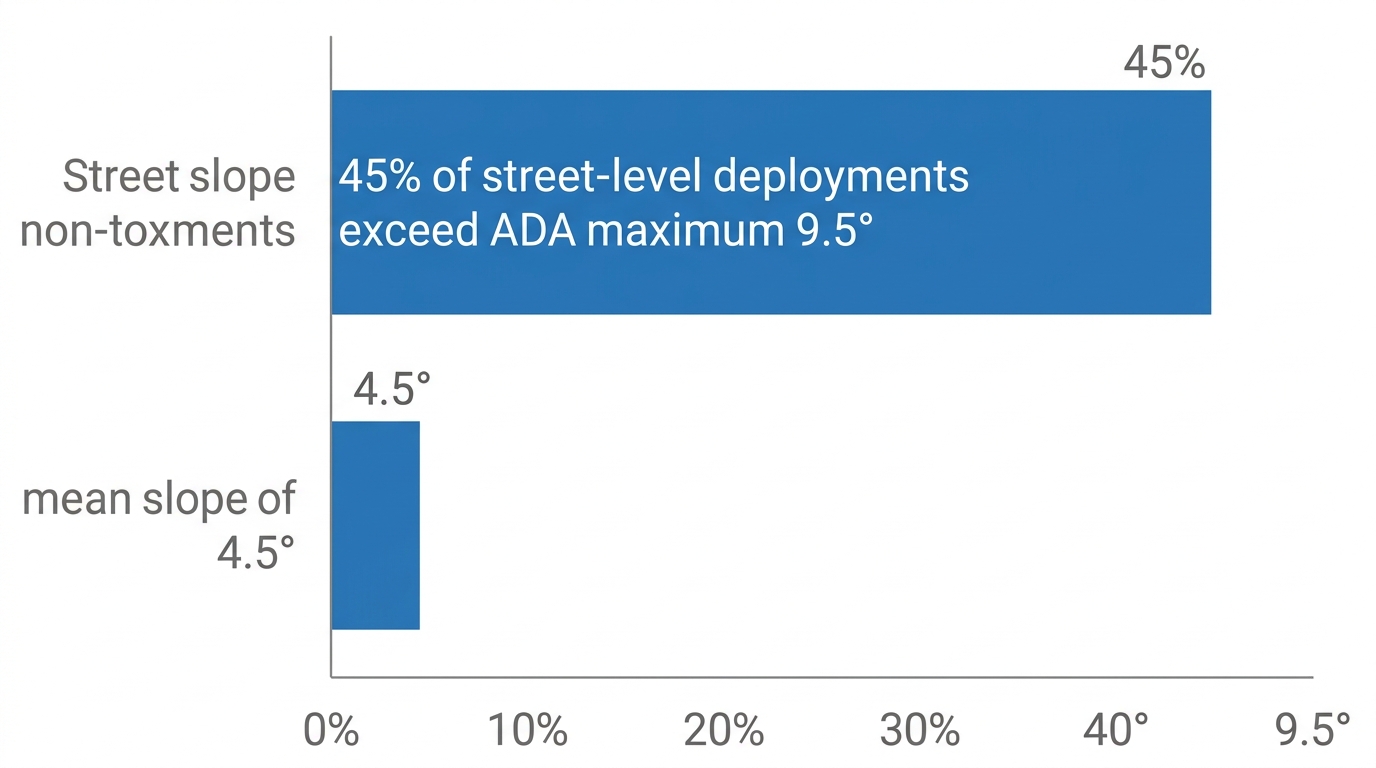
This difference reflects operator controlled factors such as the depth of bus kneeling and where the operator directs the user to board the bus. The study also found 70.6 percent of all boardings were powered wheelchairs.
Designs to accommodate maximum slope navigation must be considered for power wheelchairs. Manufacturers incorporate low center-of-gravity frames and suspension systems in modern power wheelchairs to improve safety and stability on steep ramps.
While the ADA ramp slope guidelines establish a maximum gradient of 9.5°, real-world ramps often exceed that limit. A 2013 RESNA study of bus ramp deployments found that 45% of street-level boardings surpassed this threshold, with measured slopes reaching 14°, a clear signal that robust design is essential. To tackle steep inclines safely, powered wheelchairs rely on high-torque motors that prevent stalling on gradients, anti-tip wheels that lock the chair in place, a low center of gravity for stability, and traction control that optimizes wheel grip.
Manufacturers assign an incline rating that identifies the steepest grade the chair can safely manage under ideal conditions. The maximum slope for an electric wheelchair is typically stated by the manufacturer; users should compare this figure to the slopes in their own environment. However, even the best-designed chair can face disadvantages on very steep slopes—loose gravel or an abrupt transition at the top of a ramp may cause wheel slip or momentary instability.
The ability of an electric wheelchair to handle a slope in the real world often falls short of expectations, not because of deficiencies in wheelchair design, but because the kinds of slopes encountered in the world are often steeper than the recommendations allow. The Rehabilitation Engineering and Assistive Technology Society of North America (RESNA) documents some of these challenges in the real world. For example, 221 boardings of buses showed that, when ramps were fully extended to the level of the street, 45% of the boardings exceeded the ADA limitation of a slope of 9.5°. Sidewalk level ramps exceeded the limitation only 2.5% of the time. The slope that a rider faces often is a function of operator choice, leading to unpredictable, and in some cases, extreme, conditions. The average slope measured was 4.5°, but in some cases it was as low as -1° and in other cases as high as 14°. There are many real world challenges that demonstrate the need for a power wheelchair that has greater slope-handling ability. Given that, in the real world, the slope of ramps sometimes can be significantly higher than 9.5°, it helps a consumer make a decision that balances the needs of the environment and the clinical situation of the consumer.
When assessing heavy-duty power wheelchairs for adult users, it is essential to evaluate how a chair responds to true-to-life slopes, as opposed to an unrestricted laboratory incline. These chairs are built for higher capacity and for demanding outdoor terrain with significant slopes.
When assessing power chairs for hill climbing, it is recommended that users focus on the manufacturer’s stated grade capability, the frame’s weight capacity and rigidity, and the motor’s torque for sustained climbing. Again, real-world conditions do not always align with controlled, laboratory, or test conditions. Every power chair should be assessed with the user’s environment and the operator’s skill in mind.
A RESNA study found that 45% of street-level bus ramp deployments exceeded the ADA’s maximum slope guideline of 9.5 degrees, with a mean of 4.5 degrees. Slope demands in the real-world are dependent on a variety of factors beyond the specification of the wheelchair.
Heavy-duty power wheelchair models provide higher capacity and climbing ability, but there are factors beyond these considerations that should also be assessed. For example, if the user travels a good deal, a model with a lighter frame and compact dimensions, that is easier to transport, could be the better choice.
Incline rating is the steepest slope that a power wheelchair can climb from a standstill. This is expressed in degrees or as a percentage grade. This number is important for any user that has to navigate a street or bus ramp.
Real-world inclines can be greater than the slopes many users expect. Researchers studying public-transit access found that during deployment of bus ramps to street level, 45% exceeded the 9.5 degree slope proposed in the ADA guidelines. For a portable power chair to safely traverse such slopes, it would need high-torque motors, large rear drive wheels for increased traction, and a long wheelbase that resists the chair from tipping over backward.
At MedEquipped, our evaluation process matches a chair’s torque, wheel configuration, and stability to the actual slopes you navigate every day. This personalized approach helps ensure a portable model won’t falter where you need it most. The same attributes that keep a chair planted on a steep hill—strong torque delivery and a balanced wheelbase—also make crossing indoor sloped thresholds safer and smoother.
Safely crossing sloped door thresholds with a power wheelchair requires design elements that keep the chair stable.
Research behind the proposed accessibility guidelines indicates that slopes steeper than 9.5° frequently create barriers for wheelchair users, and home thresholds can easily approach that range when door saddles sit above a finished floor.
During a threshold crossing, the front anti-tippers prevent the chair from tipping forward when the drive wheels first contact the slope, and the rear anti-tippers keep the chair from tipping over when the casters go over the threshold and the weight shifts to the back of the chair.
Joystick-driven proportional control allows the rider to go at a slow speed over the threshold to avoid a hang-up.
We assist clients in selecting a wheelchair that pairs responsive drive electronics with the right anti-tip geometry and wheelbase length. The right configuration makes indoor navigation and threshold crossings safer.
Research presented by RESNA, the Rehabilitation Engineering and Assistive Technology Society of North America, found that nearly half of bus ramps deployed to street level exceeded proposed safety guidelines, illustrating the steep inclines wheelchair users face in daily life and the critical need for incline-ready power chairs.
During the initial evaluation, we assess the terrain a patient routinely travels and identify the motor torque, battery capacity, and drive-wheel configuration required for stable hill climbing. Because ideal setup depends on user weight, seating, and typical slopes, our fitting process selects a combination that delivers confident incline performance rather than a fixed rating. Once finalized, we build the chair to spec and complete most orders in 30 to 60 days.
Medicare and other payers often cover custom power wheelchairs configured for outdoor inclines. We also assist with benefits verification, funding identification, and paperwork.
The result is a wheelchair that opens up outdoor mobility, freeing patients to engage in community life beyond flat surfaces.
It is important to understand your wheelchair’s power incline rating for hills so you can comfortably and confidently maneuver outdoors. The right wheelchair can provide the incline capability to conquer various ramps and slopes safely, and give you the freedom to travel in your neighborhood and local parks. At MedEquipped, we pair personalized fittings and expert evaluation with hands-on assistance for Medicare benefit verification and funding paperwork, so your custom motorized wheelchair matches your terrain and clinical needs. Call us at (845) 237-2381, email us at intake@medequipped.com, or visit us at our clinic at 747 Chestnut Ridge Road, Spring Valley, NY 10977. Results may vary. We verify your Medicare and insurance coverage but do not guarantee it, and you should consult your treating healthcare professional for medical necessity.
Now that you understand the critical importance of incline ratings for safe hill navigation, the next step is choosing a wheelchair that matches the terrain you face. MedEquipped specializes in custom motorized wheelchairs built to your exact specifications, ensuring comfort and maneuverability on slopes. Our team provides a personalized evaluation to make certain the chair can handle the inclines you encounter every day. We also assist with Medicare benefit verification and funding paperwork, helping you navigate the financial side with confidence. A standard 30-60 day processing timeline means you could be enjoying greater outdoor mobility sooner than you think. Call us at (845) 237-2381 or visit our facility at 747 Chestnut Ridge Road in Spring Valley, New York to begin your evaluation. Your journey to confident mobility starts with a single call.
Begin Your Journey to Confident Mobility
Table of Contents Your Source for Custom Motorized Wheelchairs in Spring Valley Quick Answers to Common Power Wheelchair Questions When to Consider…
Read MoreTable of Contents Custom Power Wheelchairs for Greater Independence Complex Rehab Technology Delivery at a Glance Recognizing When a Custom Motorized Wheelchair…
Read More
Table of Contents Understanding Medicare Power Wheelchair Coverage in 2026 2026 Medicare Power Wheelchair Eligibility Rules at a Glance The Face-to-Face Mobility…
Read More