Table of Contents
- Understanding Wheelchair Seating Systems
- Basics of Wheelchair Seating Systems
- Exploring Advanced Wheelchair Seating Configurations
- Applying Wheelchair Seating Systems in Daily Use
- Specialized Applications of Wheelchair Seating Systems
- Common Questions on Wheelchair Seating Systems
- Choosing the Right Wheelchair Seating Solution
Understanding Wheelchair Seating Systems
Imagine a patient with spinal cord injury struggling with daily mobility until the perfect wheelchair seating system brings relief and independence. At MedEquipped, we serve as your partner in mobility freedom, helping individuals in New York, Georgia, and Michigan find custom motorized wheelchairs that fit their unique needs. Wheelchair seating systems play a vital role here, offering tailored comfort and support to prevent pressure sores and enhance posture for those facing complex impairments like cerebral palsy.
These systems include customizable components such as cushions, backs, and positioning aids, designed to integrate seamlessly with power mobility bases like the TDX SP2 HD from the QUICKIE series or the ROVI X3. We conduct thorough power mobility evaluations to assess clinical requirements, ensuring selections address specific challenges and promote better mobility. Our certified ATPs lead the process, from initial national seating and mobility assessments to custom seating configurations that optimize daily function. We handle the paperwork, insurance navigation, and coordination, delivering fully fitted solutions in just 30-60 days for faster processing than typical waits.
- Pressure-relief cushions: Distribute weight to reduce skin breakdown risks.
- Adjustable back supports: Maintain upright posture for improved breathing and reach.
- Lateral positioning aids: Stabilize the body during movement for enhanced control.
This introduction lays the groundwork for exploring wheelchair seating fundamentals, types, and advanced customizations ahead. Whether seeking comfort-focused options or posture benefits, our end-to-end services guide you toward informed choices that improve quality of life. For more on our motorized wheelchair products, explore how we tailor solutions to your journey.
Basics of Wheelchair Seating Systems
At MedEquipped, we understand that wheelchair seating systems form the foundation of safe and comfortable mobility for individuals with complex needs. These systems are essential for users in bustling areas like New York or quieter communities in Georgia, where daily navigation demands reliable support. We start with the basics to help you grasp how proper seating enhances independence and prevents common issues like pressure sores.
Let’s break down the core components that make up effective wheelchair seating. Cushions are the first line of defense against discomfort and skin breakdown. We recommend options like foam-based cushions for basic absorption, but gel or air-filled varieties offer superior pressure redistribution by conforming to the body’s contours and reducing contact points. For instance, air-filled cushions can adjust dynamically during movement, which is ideal for urban navigation in New York where uneven sidewalks are common. Back supports provide crucial trunk stability, with fixed contour designs offering straightforward posture maintenance for everyday use. Adjustable lateral supports take this further, allowing customization for optimal alignment and reducing the risk of fatigue over long periods. Positioning devices, such as harnesses and chest straps, secure the user while permitting natural movement, integrating seamlessly with power bases like the ROVI X3 for enhanced control.
These elements work together in seating and positioning setups to support overall well-being. During a power mobility evaluation, our certified Assistive Technology Professionals (ATPs) assess individual needs to ensure the fundamentals align with clinical requirements. This process, informed by evidence-based practices, helps identify how basic components can evolve into tailored solutions that promote long-term mobility.
Understanding the basics of these components is vital because they directly impact daily mobility and quality of life. Simple choices in cushions and supports can mean the difference between discomfort and ease during routine activities, whether commuting in Michigan or attending appointments in Georgia. By focusing on foundational elements, users can build a seating system that adapts to their lifestyle while minimizing health risks.
| Component | Standard Option | Custom Option | Key Benefit |
|---|---|---|---|
| Cushions | Foam-based | Gel or air-filled | Prevents sores |
| Back Supports | Fixed contour | Adjustable lateral | Posture alignment |
As shown in the table, standard options provide reliable entry-level support, while custom ones deliver targeted benefits like better pressure management and stability. Research from sources like the NCBI indicates that proper cushioning can reduce pressure sore incidence by up to 60% in at-risk users. At MedEquipped, we customize these components through our ATP-led evaluations, ensuring they fit seamlessly with custom motorized wheelchairs. We handle the paperwork, insurance navigation, and coordination to deliver solutions in just 30-60 days, faster than many national seating and mobility providers. Our regional focus in New York, Georgia, and Michigan means personalized service tailored to local needs.
Building on these comparisons, the benefits of foundational wheelchair seating extend to enhanced comfort and efficiency in daily tasks. For example, effective back supports reduce upper body strain, allowing longer periods of independence without constant adjustments. We emphasize clinical mobility assessments to match these basics with user-specific goals, promoting better posture and energy conservation. Remember, consult a healthcare professional before making clinical decisions, as individual outcomes may vary. This approach not only prevents issues like sores but also supports active lifestyles, making mobility feel empowering rather than restrictive.
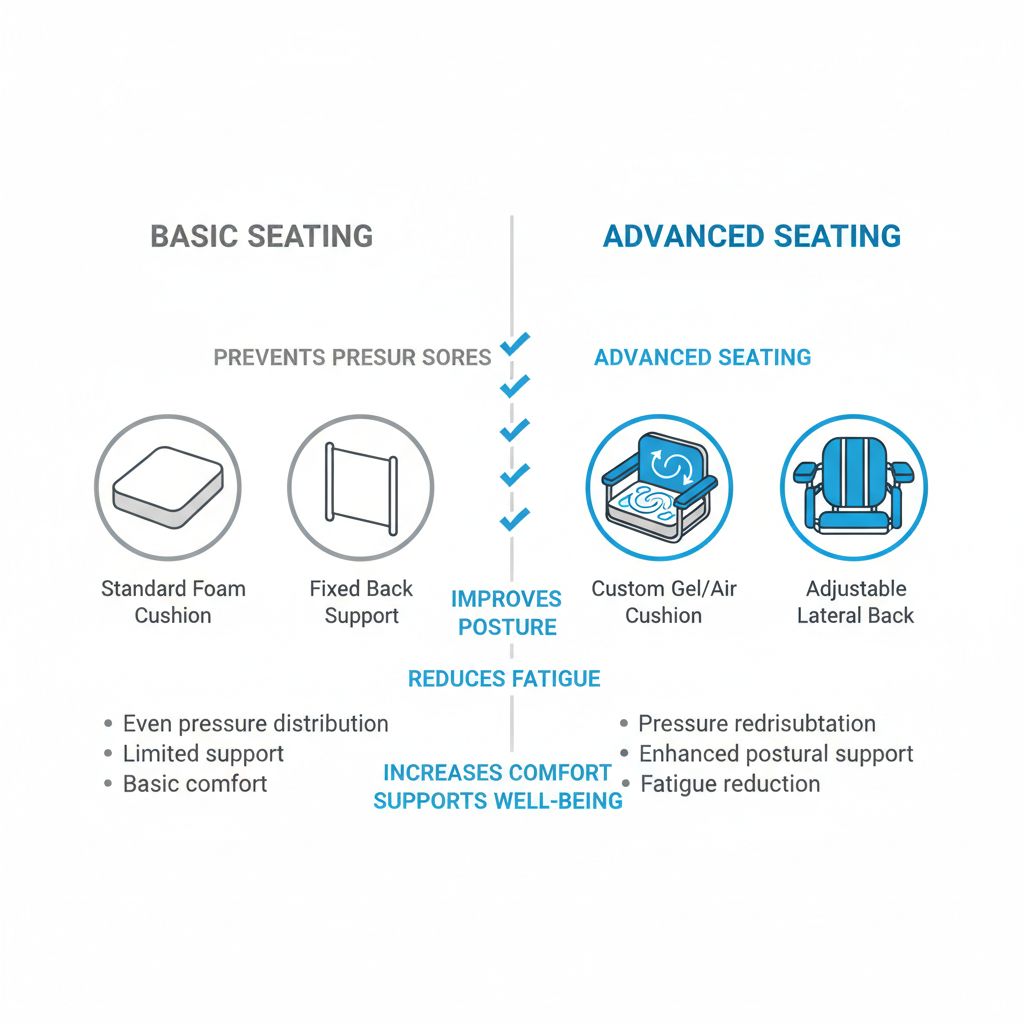
Comparison of basic vs advanced wheelchair seating components
In summary, mastering these seating fundamentals equips you to make informed choices, setting the stage for advanced customizations that truly transform mobility.
Exploring Advanced Wheelchair Seating Configurations
At MedEquipped, we specialize in wheelchair seating systems that transform daily mobility for individuals with complex needs across New York, Georgia, and Michigan. These systems go beyond basic support, offering advanced configurations tailored through comprehensive power mobility evaluations. As your partner in mobility freedom, we integrate cutting-edge options like dynamic cushions and modular backrests to enhance comfort and function.
Cushion and Backrest Innovations
Innovations in cushion and backrest designs address key challenges like pressure ulcers and postural instability, which are critical for long-term wheelchair users. We focus on materials that provide dynamic pressure relief and adjustable features for personalized support during our clinical evaluations. For instance, fluid-filled cushions adapt to body movements, reducing shear forces by up to 50% according to clinical studies on tilt and recline benefits.
Advanced positioning tech, such as adjustable lumbar supports and lateral trunk guides, ensures optimal alignment for users with scoliosis or limited trunk control. These elements pair seamlessly with power tilt and recline functions, promoting better circulation and preventing skin breakdown. In our detailed mobility fittings, certified Assistive Technology Professionals (ATPs) assess individual biomechanics to recommend systems that align with lifestyle demands.
The following table highlights key cushion and backrest innovations, drawing from established guidelines on coverage and clinical efficacy:
| Type | Material | Benefit | Coverage |
|---|---|---|---|
| ROHO Air Cushion | Interconnected air cells | Excellent adjustability for pressure redistribution | Often covered under Medicare for moderate-risk users |
| Jay Backrest | Molded foam with gel inserts | Lateral stability and contouring for trunk support | Eligible for custom prescriptions in complex cases |
| Fluid-Filled Cushion | Viscoelastic fluid | Shear reduction and immersion for high-risk skin protection | CMS-approved for documented medical necessity |
These innovations underscore the importance of clinical relevance in selecting components that mitigate risks while maximizing independence. Post-evaluation, we handle the paperwork, insurance navigation, and coordination to secure medequipped custom wheelchairs fitted precisely to these specifications. Our process ensures seamless integration, typically within 30-60 days, fostering confidence in everyday mobility.
Integration with Power Mobility Bases
Seating systems shine when paired with robust power mobility bases, amplifying functionality for users requiring heavy-duty support or precise control. At MedEquipped, we conduct thorough power mobility evaluations to match seating with bases like the QUICKIE series for lightweight agility, the ROVI X3 for versatile tilt, and the TDX SP2 HD for maximum stability in demanding environments. This integration supports national seating and mobility standards, ensuring compatibility that enhances maneuverability in homes or communities across our service areas.
For heavy-duty needs, the TDX SP2 HD base accommodates advanced seating with full recline and power shear reduction, ideal for users over 300 pounds. The QUICKIE series offers lightweight frames that pair well with adjustable cushions for urban navigation, while the ROVI X3 excels in tilt capabilities that work alongside modular backrests for better reach and transfer. Accessories like adjustable headrests and footplates further customize these setups, addressing specific impairments such as limited range of motion.
Clinical metrics from sources like CMS guidelines validate these pairings, showing improved outcomes in stability and fatigue reduction. We prioritize configurations that align with insurance-covered customizations, coordinating approvals to deliver systems that fit seamlessly into daily routines.
The table below compares popular seating options with leading power bases, based on product compatibilities and user requirements:
| Seating Type | QUICKIE Series | ROVI X3 | TDX SP2 HD |
|---|---|---|---|
| ROHO Air Cushion | Excellent adjustability | Good for lightweight | Heavy-duty support |
| Jay Backrest | Lateral stability | Trunk control | Max weight capacity |
This comparison illustrates how seating enhances base performance, from agility in the QUICKIE to durability in the TDX SP2 HD. Following such integrations, our team provides ongoing support, including adjustments and education, to maintain optimal function. Results may vary, and we always recommend consulting a healthcare professional for personalized advice. Through this approach, we empower greater independence without the hassle of fragmented processes.
Applying Wheelchair Seating Systems in Daily Use
Wheelchair seating systems play a key role in enhancing daily comfort and independence for individuals with mobility challenges. At MedEquipped, we focus on practical seating solutions that align with your unique lifestyle, whether you’re navigating busy city streets or managing home-based routines. We’ll guide you through selecting the right options and handling the processes in Georgia and Michigan to make mobility freedom accessible.
Selection Criteria for Personal Needs
Choosing the right wheelchair seating begins with a thorough assessment of your lifestyle and clinical factors. We consider elements like your activity level, body weight distribution, and type of impairment to ensure optimal support. For instance, an active urban user might need seating that promotes maneuverability during commutes, while a homebound individual requires features that minimize pressure points during extended sitting. Our certified Assistive Technology Professionals (ATP) conduct a power mobility evaluation to match these needs with appropriate systems, drawing from industry standards like those from national seating and mobility providers.
A key step involves reviewing your medical history and daily routines. We’ll discuss how often you transfer positions, the surfaces you encounter, and any skin sensitivity issues. This evaluation-based fitting helps prevent common discomforts and supports long-term health. For active users, adjustable components can improve posture during errands, whereas fixed setups suit those with limited transfers.
The following table compares custom versus standard seating for different lifestyles:
| Lifestyle Factor | Standard Seating | Custom Seating | MedEquipped Advantage |
|---|---|---|---|
| Active Urban User | Basic cushion | Adjustable tilt | Faster fitting in NY; Enhanced maneuverability; Personalized eval |
| Homebound Patient | Fixed back | Pressure mapping | Insurance navigation; Reduced sores; Ongoing support |
This comparison highlights how custom options outperform basics in targeted scenarios, with our services adding value through quick assessments and tailored advice. As your partner in mobility freedom, we prioritize what fits your life best.
After selection, practical tips include testing seating in real settings during your visit. Schedule a consultation by calling us at 845-237-2381 or emailing intake@medequipped.com. One patient shared in our testimonies how their custom setup transformed daily reading sessions at home, reducing fatigue significantly. Remember to consult a healthcare professional for personalized advice, as individual outcomes vary.
Insurance and Evaluation Processes
Navigating insurance for wheelchair seating systems can feel overwhelming, but at MedEquipped, we handle the paperwork, insurance navigation, and coordination to simplify it for you. Our process starts with a comprehensive power mobility evaluation, where we review your medical documentation and discuss funding options under Medicare or private plans, as outlined in CMS guidelines. This wheelchair fitting evaluation ensures the seating meets clinical criteria for coverage in regions like New York, Georgia, and Michigan.
Preparation involves gathering recent physician notes and outlining your mobility goals. We’ll guide you step-by-step: first, submit intake forms via our Become a Patient page; next, our team coordinates with insurers for pre-approval. Unlike standard routes that can drag on, our end-to-end approach typically wraps up in 30-60 days. Post-approval, we arrange fittings with adjustments for daily comfort, such as tilt functions for easier transfers.
To illustrate efficiency, here’s a comparison of insurance steps:
| Step | Standard Process | MedEquipped Process |
|---|---|---|
| Initial Consultation | Patient schedules independently | We coordinate ATP-led evaluation |
| Documentation | Gather and submit forms alone | We handle paperwork and insurance navigation |
| Approval Wait | 90+ days typical | 30-60 days faster processing |
| Final Fitting | Basic setup at delivery | Customized with ongoing support adjustments |
Our streamlined method reduces hassle, as seen in patient stories where quick approvals allowed seamless integration into routines. For example, a Georgia resident appreciated our navigation through complex coverage, avoiding delays in their custom motorized wheelchair delivery.
After delivery, we provide education on maintenance and follow-up visits for tweaks, ensuring lasting comfort in tasks like meal prep or virtual meetings. Cost considerations depend on your plan, but we maximize benefits without out-of-pocket surprises. Information is for informational purposes only; consult your provider for specifics. Reach out today to start your journey toward practical seating solutions.
Specialized Applications of Wheelchair Seating Systems
At MedEquipped, we understand that wheelchair seating systems go beyond basic mobility to address unique challenges faced by individuals with complex impairments. These specialized configurations are essential for conditions like ALS or post-stroke recovery, where standard setups fall short. Our team in New York crafts tailored solutions using advanced medicare wheelchair seating coverage guidelines to ensure accessibility and funding support. As a partner in mobility freedom, we specialize in powered adjustments and sensor technology that monitor posture and prevent pressure sores, enhancing daily comfort.
For those with spinal cord injuries or muscular dystrophy, wheelchair seating systems incorporate features like tilt-in-space mechanisms or custom contoured backs. These adaptations, often evaluated through power mobility evaluation processes, integrate seamlessly with accessories such as lateral supports and adjustable armrests. We work closely with certified Assistive Technology Professionals (ATPs) to conduct advanced evaluation protocols, ensuring the seating aligns with lifestyle needs and promotes long-term outcomes like reduced fatigue and greater independence. In Georgia and Michigan, our ongoing support includes modifications as conditions evolve, helping users maintain optimal positioning without frequent replacements.
Advanced needs demand precise customization to improve circulation and stability. The following table highlights specialized seating options for specific impairments, showcasing how targeted features lead to meaningful results.
| Impairment | Seating Feature | Model Example | Outcome |
|---|---|---|---|
| Spinal Cord Injury | Tilt-in-space | ROVI X3 | Improved positioning, better circulation, less fatigue |
| Muscular Dystrophy | Custom contoured back | TDX SP2 HD | Support stability, enhanced comfort, daily independence |
This comparison underscores the value of impairment-specific designs, drawing from evidence on how such specialized seating tech reduces secondary complications like skin breakdown. At MedEquipped, our ATP-led assessments go further by simulating real-world use during fittings, similar to what national seating and mobility providers offer but with our faster 30-60 day processing. We handle the paperwork, insurance navigation, and coordination, delivering QUICKIE series models fully configured for users in New York. Our expertise ensures these systems not only meet clinical standards but also foster sustained mobility, with post-delivery adjustments to adapt to changing needs. Results may vary; consult a healthcare professional for personalized advice.
Common Questions on Wheelchair Seating Systems
Wheelchair seating systems play a crucial role in enhancing comfort and mobility for individuals with complex needs. At MedEquipped, we serve as your partner in mobility freedom, addressing common concerns through our clinical expertise. Below, we answer key questions to help you navigate options in our service areas of New York, Georgia, and Michigan.
What is a power mobility evaluation?
We conduct a power mobility evaluation to assess your specific needs, ensuring the right wheelchair seating systems match your lifestyle. This involves measuring posture, skin integrity, and daily activities with our certified ATPs. It’s a personalized process that typically takes 1-2 hours.
How do I prepare for a wheelchair seating evaluation?
Arrive with comfortable clothing and any current mobility aids. Bring medical history or prescriptions for reference. Our team handles the rest, including insurance navigation, to make the experience smooth and informative.
What are the benefits of custom wheelchair seating systems?
Custom systems prevent pressure sores, improve positioning, and boost independence. Unlike standard options, they fit your unique body and activities, leading to better long-term comfort and reduced adjustments needed post-delivery.
How can I order wheelchair accessories in Michigan?
Contact us at intake@medequipped.com or 845-237-2381 to discuss accessories like cushions or controls. We manage ordering, funding coordination, and delivery within our 30-60 days timeline, ensuring everything integrates seamlessly with your power wheelchair.
Are services like national seating and mobility available through MedEquipped?
While we draw from industry standards similar to national seating and mobility providers, our focused regional approach offers faster processing and hands-on support in New York, Georgia, and Michigan. We tailor evaluations to your needs without the wait times of larger networks.
Choosing the Right Wheelchair Seating Solution
Selecting the ideal wheelchair seating systems involves prioritizing comfort, mobility, and personalization to enhance daily life. At MedEquipped, we stand as your partner in mobility freedom, offering custom motorized wheelchairs through thorough power mobility evaluations that outpace national seating and mobility standards.
Our certified ATP experts deliver optimal seating choices with faster processing in 30-60 days, handling insurance navigation and coordination across New York, in Georgia, and in Michigan. We invite you to contact us at 845-237-2381 or intake@medequipped.com for a consultation. Together, we commit to improving patient outcomes with tailored support.
Resources
- Discover High-Quality Motorized Wheelchairs with Expert Evaluations
- Streamline Custom Motorized Wheelchair Acquisition and Delivery
- Obtain Personalized Custom Wheelchairs with Funding Assistance
- Access Durable Custom Power Wheelchair Solutions and Support
- Read Inspiring Patient Testimonials on Mobility Improvements
- Become Patient for Tailored Wheelchair Services and Updates
- Learn Proper Wheelchair Fitting and Seating Evaluations
- Navigate Medicare Coverage for Wheelchair Seating Compliance